




 English (pdf)
 Article in xml format
 Article references
 Automatic translation
 Send this article by e-mail
 Cited by SciELO
  Similars in
SciELO
Similars in
SciELO 
 Permalink

All social systems tend to be organized based on hierarchies where at least one group has higher status and more power than the others (e.g., Pratto et al., 2013). Hierarchical social structures seem inevitable and strongly resistant to changes, promoting and maintaining social inequalities and injustice (e.g., Pratto et al., 2013). Indeed, as Jim Sidanius noted (in a personal note about his life path and meaningful events that inspired the development of social dominance theory), “every attempt to replace group-based hierarchy with truly egalitarian social interaction has failed, without exception” (Sidanius, & Pratto, 2012, p. 422). As he continues, although “many of these revolutionary efforts have succeeded in replacing one group of ruling elites with another, and sometimes even decreasing the overall level of oppression, none have ever succeeded in their original goals of replacing group-based hierarchy with genuine egalitarianism” (Sidanius, & Pratto, 2012, p. 422). Thus, hierarchies and social stratification have prevailed, been perpetuated, even in social systems based on equality, contributing to systemic inequality (e.g., systemic racism), discrimination, and social exclusion. Indeed, racism, ethnocentrism, sexism, and many other forms of intergroup conflict and oppression, are grounded on, or are a manifestation of, preferences for social hierarchies and inequality. Thus, understanding individuals’ support for group-based hierarchies and social inequality, and the reason why hierarchical and unequal social systems thrive and persist, has been an important issue for the social sciences and particularly, for social psychology. To address these questions, one of the most important theories developed was the Social Dominance Theory.
Social dominance theory
Social dominance theory (SDT) argues that these social hierarchical systems tend to be stable and there is a high consensus on which groups are dominants (e.g., European Americans in the United States; natives) and which groups are subordinates (e.g., African Americans and Latinos; immigrants) (e.g., Sidanius & Pratto, 1993). SDT posits that these social systems rely on, and are maintained through, legitimizing myths; that is, beliefs that justify and legitimize the attribution of positive or negative social value to the social groups within a social system. These beliefs either promote (hierarchy-enhancing legitimizing myths) or attenuate (hierarchy-attenuating legitimizing myths) intergroup hierarchies and inequality (Sidanius et al., 1994a). The extent to which these legitimizing myths or ideologies are accepted by individuals is represented by social dominance orientation (SDO).
Social dominance orientation
SDO reflects preference and support for the maintenance of hierarchically structured intergroup relations, dominant-subordinate relationships, and inequality between social groups (Sidanius et al., 1994a; Sidanius et al., 2017). Thus, high scores on SDO reflect support for group-based hierarchies and inequality, as well as beliefs that social groups differ and should differ in value. Low scores on SDO are associated with support for group-based equality and opposition to differentiations between groups’ status, power and resources (e.g., Pratto et al., 2000).
SDT predicts that members of high-status groups tend to more strongly support group-based hierarchy and inequality (i.e., higher SDO) than members of low-status groups (e.g., Levin, 2004; Sidanius et al., 1994a), because these attitudes justify and legitimate their dominant position (Levin & Sidanius, 1999). For high-status (dominant) groups, equality represents a decrease in ingroup status and power, being inconsistent with privileged ingroup interests and with the maintenance of a positive ingroup distinctiveness. On the contrary, for low-status (subordinate) groups, equality represents an increase in status and power, which allows to achieve a positive group identity, and thus, low SDO scores are expected among members of these groups (Schmitt et al., 2003).
Moreover, SDO is expected to be more strongly related to hierarchy-enhancing legitimizing myths (e.g., racism, sexism, meritocracy) among members of high-status groups, than among members of low-status groups - known as the ideological asymmetry hypothesis (Sidanius et al., 1994b). Related to this hypothesis, SDT also expects that the relation between SDO and ingroup attachment (e.g., ingroup identification, ingroup favoritism) should increase as a function of social status, that is, this relationship is expected to be stronger among members of high-status groups than low-status groups (Sidanius et al., 1994b). Nevertheless, more recent evidence has challenged this assumption, showing that, when status distinctions between groups are perceived to be unstable (i.e., susceptible to change - social competition settings), ingroup identification reinforces SDO among members of both high- and low-status groups. Thus, SDO endorsement, under such contexts, may repre sent an ideological strategy by members of low-status groups to favor the ingroup over the outgroup (i.e., ingroup status-enhancement strategy; Carvalho et al., 2021).
Furthermore, SDT predicts that men have significantly higher SDO than women, regardless of social status, ethnic group, age, or any other demographic characteristics - known as the invariance hypothesis (Sidanius et al., 1994b). This is expected to occur because men tend to hold a more powerful and privileged position in society. Moreover, it is also expected SDO to be positively related with right-wing political identification (e.g., Ho et al., 2012).
Importantly, SDO is related to “a long array of sociopolitical attitudes, ideologies, opinions, beliefs, values, causal attributions, and public policy initiatives that either express support for, or opposition to, the redistribution of social value among social groups (e.g., social class, ethnic groups, “races”, genders, nations)” (Sidanius et al., 1994b, p. 196), and predicts outgroup aggression and oppression. Therefore, SDO is considered one of the most important measures to study intergroup attitudes and behavior and represents a fundamental construct to understand intergroup relations and conflict, adherence to sociopolitical ideologies and how hierarchical and unequal social systems are maintained (e.g., Ho et al., 2012). For instance, SDO has been found to be related to discrimination and prejudice against, and persecution of, minorities and low-status groups (e.g., immigrants, gays, Jews, poor people); related to the endorsement of hierarchy-enhancing ideologies such as, conservatism, sexism, and nationalism; and related to the support of punitive social policies, opposition to humanitarian practices and social welfare (Ho et al., 2012; Sidanius et al., 1996). Moreover, SDO is also related to system justification (e.g., Ho et al., 2012; Kugler et al., 2010; Jost & Thompson, 2000), that reflects the motivation to defend and justify the status quo, that is, motivation “to justify and rationalize the way things are, so that existing social, economic, and political arrangements tend to be perceived as fair and legitimate” (Jost & Hunyady, 2005, p. 260); and right-wing authoritarianism (RWA; e.g., Roccato & Ricolfi, 2005), that reflects strong adherence to conventions, that is, strong support and inflexible adherence to established social norms and traditional values (i.e., conventionalism); punitive attitudes toward, and support for the use of violence against those who deviate those norms and values (authoritarian aggression); and high obedience and respect to established authority (authoritarian submission) (Altemeyer, 1996).
The Social Dominance Orientation Scale
The previous SDO scale (SDO6;Pratto et al., 1994), has been widely used and proved to be an effective and powerful measure in predicting a wide variety of individuals’ attitudes and behaviors regarding intergroup relations, having already been translated into several languages and validated in many different cultures, including for European Portuguese with a Portuguese sample (Giger et al., 2015), as well as in other European countries (e.g., European Spanish with a Spanish sample by Silván-Ferrero & Bustillos, 2007). Initially, the SDO scale was conceptualized and designed to be a unidimensional construct (Pratto et al., 1994), however, the proposed one-factor structure of the scale, although it works well as a single construct, it has been widely discussed in the literature, and growing evidence about its two-factor structure have emerged reflecting the need for this construct to be understood and conceptualized as having in fact two complementary but distinct subdimensions (Ho et al., 2012, 2015; Jost & Thompson, 2000; Kugler et al., 2010). A widely discussed aspect of the SDO6 scale was the fact that the items seemed to reflect two different orientations corresponding to two distinct concepts and the items of each orientation was worded in opposite directions: the items in a pro-trait direction (i.e., higher scores indicated higher SDO, e.g., “In getting what you want, it is sometimes necessary to use force against other groups.”) reflected a dominance orientation, while the items in a con-trait direction (i.e., higher scores indicated lower SDO, e.g., “It would be good if groups could be equal.”) reflected an egalitarian orientation (e.g., Ho et al., 2012, 2015; Jost & Thompson, 2000). As a result, it was suggested that the bidimensional structure frequently found could be “not because of the attitudinal contents of the items per se, but because the items on group-based dominance [were] worded positively and the anti-egalitarian items [were] worded negatively” (Jost & Thompson, 2000, p. 220). To address this issue, Jost and Thompson (2000) developed a “balanced” scale, by slightly rewording some items, so that the two subdimensions would have equal numbers of pro-trait and con-trait items. Evidence for the two-factor solution persisted with the “balanced” version of the scale, and the results of the confirmatory factor analysis revealed that the two-factor model fitted the data better than the one-factor model. More recently and considering the previous evidence, the SDO scale was significantly changed in the new and seventh version (Ho et al., 2012, 2015) taking into account these two orientations (support for dominance and antiegalitarianism), and so that each subdimension included equal number of items in a pro-trait and con-trait direction. Moreover, items were verified, and adapted when needed, to reflect the “current conceptualization of SDO as a general orientation towards group inequality irrespective of one’s ingroup position” (Ho et al., 2015, p. 1010) instead of reflecting “the extent to which one desires that one’s ingroup dominate and be superior to outgroups” (Pratto et al., 1994, p. 742) as initially proposed. For instance, the item “Sometimes other groups must be kept in their place”, was replaced by “Some groups of people must be kept in their place” (Ho et al., 2015).
The two dimensions of SDO
By acknowledging the multidimensional nature of SDO, the new SDO7 scale was designed so that one dimension measures support for group-based dominance hierarchies (SDO-D) and the other measures opposition to equality or antiegalitarianism in social systems (SDO-E). Although the two subdimensions should be strongly correlated, each one is linked to distinct underlying motivations and, thus, is expected to predict uniquely different intergroup phenomena. Specifically, since each component arises from different motivations, and reflect two distinct psychological orientations, it should allow to understand and predict, with more precision, intergroup attitudes, and behaviors, and explain different kinds of political views (Ho et al., 2012, 2015; Kugler et al., 2010).
Ho and colleagues (2012, p. 585) defined SDO-D “as support for group-based dominance hierarchies in which dominant groups actively oppress subordinate groups [and] will be related to phenomena such as support for aggressive intergroup behavior, support for overtly negative intergroup attitudes, support for negative allocations to outgroups, and the perception of group-based competition.”. SDO-D reflects beliefs that some groups are “superior” and “worthier” than others, that dominant groups should actively oppress subordinate groups, and preoccupation in maintaining the relative power difference between groups (Ho et al., 2012). It has also been proposed that this subdimension reflects social identity motives, such as preferences for members of own group and concerns for ingroup promotion, and thus, should be strongly related to outgroup derogation, hostile competition, and to active and forceful hierarchy promotion of the ingroup (Kugler et al., 2010).
On the other hand, “SDO-E is defined as opposition to group-based equality. This includes an aversion to the general principle of equality and to reducing the level of hierarchy between social groups. Opposition to equality translates psychologically into support for exclusivity. People who want groups to be unequal wish to exclude certain groups from access to resources that could elevate their social position” (Ho et al., 2012, p. 585). This subdimension is expected to reflect system justification motives, strongly associated with the desire to maintain the existing social system (i.e., resistance to change; Kugler et al., 2010), and opposition to group-based equality and to reduce the level of hierarchy between social groups (Ho et al., 2012). Indeed, SDO-E predicts legitimization and justification of stratified social systems and support for differential intergroup access to power and resources (Ho et al., 2012).
Moreover, since SDO-D and SDO-E represent distinct ideological constructs, each are expected to produce divergent social psychological outcomes for members of low-status groups and high-status groups (Ho et al., 2015; Jost & Thompson, 2000), and thus, “treating SDO as a unidimensional construct fails to capture the ideological experiences of low status group members” (Kugler et al., 2010, p. 119). For instance, Jost and Thompson (2000) found that SDO-E was negatively related to ingroup favouritism among African Americans (low-status group) and positively related among European Americans (high-status group), while SDO-D was found positively related to ingroup favouritism among both groups (Jost & Thompson, 2000). These results suggests that although the overall SDO score is a good predictor of intergroup attitudes among members of high-status groups, it is a weaker predictor among members of low-status groups (Jost & Thompson, 2000). Bergh and colleagues (2015) attempted to replicate the previous findings with another ethnic group - Pākehā (European) and Māori New Zealanders, with the former occupying a higher social status -, however, they observed a weak and negative relations between SDO-E and ethnic identity among Pākehā (the high-status group). The authors discussed and explained these unexpected results due to the existing bicultural/multicultural national identity in New Zealand, leading to a more egalitarian (vs. mono-cultural) identity (Bergh et al., 2015).
Similar to Jost and Thompson (2000), Ho and colleagues (2015) also observed that the relationship of SDO-D and SDO-E with criterion variables was found less consistent among Black participants then among White participants.
Contrasting to previous findings, more recently, Carvalho and colleagues (2021) found SDO-E, but not SDO-D, positively related to ingroup identification and system-challenging collective action among members of both low- and high-status groups but only when status positions between groups were perceived to be unstable (i.e., the social structure condition for social competition to emerge). The authors discuss the results by stating that, under social competition settings, the endorsement of status differences between groups and the desire to maintain hierarchically structured intergroup relations among low-status groups, which is associated with the desire of low-status group members to improve their disadvantaged position within the status hierarchy in the future (i.e., SDO as an ingroup status-enhancement strategy), is more in line with SDO-E than with SDO-D (Carvalho et al., 2021).
Moreover, the conceptualization of SDO-D as a reflection of social identity motives and SDO-E as a reflection of system justification motives (Jost & Thompson, 2000; Kugler et al., 2010), may not be as straightforward and may depend on the context, identities, and group interests. For instance, evidence shows a positive association between SDO-E (but not SDO-D) and group identity, among low-status groups, in a context of social competition, motivated to improve ingroup status (Carvalho et al. 2021); a positive association between both SDO-D and SDO-E and Catalan Nationalism among independence supporters (a group subordinate to the central power of Madrid, the dominant group) (Carvalho et al., 2022); a positive association between SDO-D and (general) system justification, among a disadvantaged group interested in achieving equality between groups (Carvalho et al., 2023), and between SDO-D and gender-specific) system justification among both low- and high-status group (Māori and Pākehā, respectively; Bergh et al., 2015).
Therefore, as emphasized by the authors (Ho et al., 2015, p. 1023), when “researchers do not have a specific focus on intergroup phenomena that relate more to one dimension of SDO versus the other, it would be desirable to use the whole SDO7 scale”. On the contrary, when studying intergroup phenomena, examining each dimension separately can offer clarity regarding the underlying motivations depending on the social context (e.g., features of the social structure), salient identities, and ingroup status, especially among low-status groups, and at the same time allows to predict more accurately intergroup attitudes and behaviours (Ho et al., 2015).
The present study
The aim of this study was to a) adapt and validate the new SDO7 scale into the European-Portuguese language, b) examine the factorial structure of the scale, considering one-factorial structure and the proposed two-factorial structure of the new scale, and c) analyze the relation between SDO and related constructs (construct validity). As proposed by Ho and colleagues (2015), we expect that the two-factor model will fit the data well. Moreover, RWA and nationalism are expected to correlate more strongly with SDO-D than with SDO-E, since conceptually SDO-D reflects support for dominance and oppression of subordinated groups, as well as beliefs that some groups are “superior” and “more worthy” than others; and system justification and meritocracy are expected to correlate more strongly with SDO-E than with SDO-D, because conceptually SDO-E is related to hierarchy-enhancing ideologies and beliefs that allow to legitimate and maintain inequality between groups (e.g., Ho et al., 2015; Jost & Thompson, 2000; Kugler et al., 2010).
Method
Participants
Participants were 313 Portuguese nationals (187 female, 126 male) aged between 18 and 79 years-old (M = 30.33, SD = 14.05). We discarded 13 participants who had outliers scores in items 10, 13, and 15 of the SDO7 scale. The final sample is composed by 300 participants (182 female, 118 male) aged between 18 and 79 years-old (M = 29.91, SD = 13.99), 51% completed secondary education, 42% higher education, and less than 1% basic education. The majority were student (58%) and employed (34%), and the remaining were unemployed (5%), retired (2%) and homemaker (1%). Regarding the left-right political spectrum, the average score on a 7-point Likert-scale (1 = Left, 7 = Right), was close to the scale midpoint of 4, though leaning left (M = 3.77, SD = 1.23). Participants were also asked about perceived socioeconomic status compared to other citizens of the country where they live on a 7-point Likert-scale (1 = Very low, 7 = Very high; around the scale midpoint, M = 4.16, SD = 1.01).
Procedure
Due to difficulties in recruiting participants, data collection was conducted both using an online survey platform (Qualtrics) and in-person (pencil-and-paper survey). In the first case, participants were contacted via online platforms (participation invitations with a link to the online questionnaire, were shared through Facebook Ads, Facebook groups, and University mailing list), and in the second, participants were recruited to participate in the study as a curricular activity (large group in a classroom). In both cases, participation was completely voluntary. After giving informed consent (including information on confidentiality, anonymity, risks and benefits, contact information, etc.), participants provided demographic information (e.g., age, sex, education). On completion, participants were thanked.
The research from which this data was extracted followed the American Psychological Association’s ethical principles and code of conduct (2017, 2020), and all methods were performed in accordance with the relevant guidelines and recommended regulations.
Measures
SDO7 scale. Prior to initiate any procedure, the first author of the original scale (SDO7, Ho et al., 2015) was contacted in order to obtain his approval for the Portuguese validation1. Similar to the previous version, the SDO7 scale is composed by 16 items, with the first eight items corresponding to the SDO-D subdimension (item 1-8) and the last eight (9-16) corresponding to the SDO-E subdimension, answered on a 7-point Likert-scale (1 = I strongly oppose, 7 = I strongly favor), where higher scores indicate higher agreement or preference for group-based dominance hierarchies and opposition to equality between groups, respectively. Items 1-4 represent pro-trait dominance and 5-8 con-trait dominance items; 9-12 represent pro-trait anti-egalitarianism and 13-16 con-trait anti-egalitarianism items. The con-trait items were reverse-scored before computing a composite subscale mean. Following previous recommendations for existing scales validation (e.g., Fenn et al., 2020; ITC, 2017), the scale was translated from the original English into European-Portuguese by one of the researchers (native Portuguese fluent in English) and by a professional translator. The two translations were compared, and some adjustments were made by a second experienced researcher (also native Portuguese fluent in English). Next, the Portuguese version was back-translated by another professional translator. The two versions (original and retranslated) were compared and discussed. The European-Portuguese version was again analyzed, revised, and adapted in accordance with the contributions discussed by the researchers and translators. The revised version was pilot tested on a small sample (N = 51, not included in the final sample) to assess its adequacy and comprehensibility. At the end of the questionnaire, the respondents were asked (using open-ended question) whether they understood all the items and to indicate any doubts or difficulty in comprehensibility. No participant reported difficulties or doubts in understanding the items. The final version can be seen in Table 1.
Table 1 Translation of the SDO7 into European-Portuguese.
| Original (English) version (Ho et al., 2015) | European-Portuguese version |
|---|---|
| Instructions: Please indicate how much you support or oppose each idea below, by selecting a number from 1 to 7 on the following scale. You may answer quickly; your first thought is usually best. | Instruções: Indique o quanto você apoia ou se opõe a cada ideia abaixo, selecionando um número de 1 a 7 na escala que se segue. Você pode responder rapidamente; o seu primeiro pensamento é geralmente melhor. |
| SDO 1. Some groups of people must be kept in their place. | SDO 1. Alguns grupos de pessoas devem ser mantidos no seu lugar. |
| SDO 2. It’s probably a good thing that certain groups are at the top and other groups are at the bottom. | SDO 2. É provavelmente uma coisa boa que certos grupos estejam numa posição superior e que outros grupos estejam numa posição inferior. |
| SDO 3. An ideal society requires some groups to be on top and others to be on the bottom. | SDO 3. Uma sociedade ideal requer que alguns grupos estejam numa posição superior e que outros grupos estejam numa posição inferior. |
| SDO 4. Some groups of people are simply inferior to other groups. | SDO 4. Alguns grupos de pessoas são simplesmente inferiores a outros grupos. |
| SDO 5*. Groups at the bottom are just as deserving as groups at the top. | SDO 5*. Grupos que estão numa posição inferior são tão meritórios como os grupos que estão numa posição superior. |
| SDO 6*. No one group should dominate in society. | SDO 6*. Nenhum grupo deveria dominar na sociedade. |
| SDO 7*. Groups at the bottom should not have to stay in their place. | SDO 7*. Os grupos que estão numa posição inferior não deveriam ter de ficar no seu lugar. |
| SDO 8*. Group dominance is a poor principle. | SDO 8*. O domínio de grupos é um mau princípio. |
| SDO 9. We should not push for group equality. | SDO 9. Não deveríamos insistir na igualdade entre os grupos. |
| SDO 10. We shouldn’t try to guarantee that every group has the same quality of life. | SDO 10. Não deveríamos tentar garantir que todos os grupos tenham a mesma qualidade de vida. |
| SDO 11. It is unjust to try to make groups equal. | SDO 11. É injusto tentar tornar os grupos iguais. |
| SDO 12. Group equality should not be our primary goal. | SDO 12. A igualdade entre os grupos não deveria ser o nosso principal objetivo. |
| SDO 13*. We should work to give all groups an equal chance to succeed. | SDO 13*. Deveríamos trabalhar para dar a todos os grupos uma oportunidade igual de ter sucesso. |
| SDO 14*. We should do what we can to equalize conditions for different groups. | SDO 14*. Deveríamos fazer o possível para igualar as condições dos diferentes grupos. |
| SDO 15*. No matter how much effort it takes, we ought to strive to ensure that all groups have the same chance in life. | SDO 15*. Independentemente do esforço necessário, deveríamos lutar para garantir que todos os grupos têm a mesma oportunidade na vida. |
| SDO 16*. Group equality should be our ideal. | SDO 16*. A igualdade entre os grupos deveria ser o nosso ideal. |
| * Con-trait items. Note. The proposed short version of the SDO7(s) scale is composed by items 3, 4, 5, 6, 11, 12, 13, 14 (Ho et al., 2015, Appendix B) |
Right-wing Authoritarianism (Short Scale)2. To measure participants’ endorsement of right-wing authoritarianism (RWA), we used ten of the 15-item short scale developed by Zakrisson (2005; e.g., “Our country needs a powerful leader, in order to destroy the radical and immoral currents prevailing in society today.”; 1 = I fully disagree; 7 = I fully agree). We excluded 5 items for being difficult to adapt to the European/Portuguese context. The scale is reliable (Cronbach’s α = .79; ω = .77; M = 3.10, SD = 0.95), and therefore we averaged these items into a RWA score, where higher scores indicated higher levels of authoritarian attitudes.
Nationalism. To measure participants’ nationalism (Portugal), we used Terhune’s 7-item scale (1964; e.g., “My country should strive for power in the world.”; 1 = I fully disagree; 7 = I fully agree). The scale is reliable (Cronbach’s α = .77; ω = 76; M = 4.49, SD = 1.03), and therefore we averaged these items into a nationalism score, where higher scores indicated higher levels of nationalist sentiments towards Portugal.
System Justification. Participants completed the 8-item general system justification scale (e.g., “In general, you find society to be fair.”; Kay, & Jost, 2003; 1 = I fully disagree; 7 = I fully agree), that measures perceived fairness, legitimacy, and justification of the existing social hierarchical system. The scale is reliable (Cronbach’s α = .74; ω = 72; M = 3.17, SD = 0.89), and therefore we averaged these items into a system justification score, where higher scores indicated higher levels of system justification tendencies.
Meritocracy. Finally, participants answered to a 6-item meritocracy scale (Castillo et al., 2019; e.g., “In [country] people are rewarded for their intelligence and skills.”; 1 = I fully disagree; 7 = I fully agree). The scale presented questionable reliability (Cronbach’s α = .66, ω = 56; M = 4.24, SD = 0.86; see Data Analytic Strategy section below), which would not improve with the exclusion of any item. Nevertheless, we present the results of correlations with this scale, emphasizing the need for cautious interpretation. Therefore, we averaged these items into a meritocracy score, where higher scores indicated higher levels of meritocracy beliefs.
Data analytic strategy
The factorial structure and psychometric properties including validity and reliability of the new scale were examined. We conducted a confirmatory factor analysis (CFA), using maximum likelihood estimation procedure, for both a one-factor (unidimensional structure with all the items loading on one common factor) and a two-factor solution (two-dimensional structure with items loading respectively on two independent correlated factors - SDO-D and SDO-E). The goodness-of-fit of each model (one-factor vs. two-factor solution) was evaluated through multiple criteria (e.g., West et al., 2012), such as chi-square and the ratio of the chi-square to its degree of freedom (CMIN/DF), comparative fit index (CFI), root mean square error of approximation (RMSEA), and the Akaike Information Criterion (AIC). According to previous recommendations, CMIN/DF should be ≤ 3 (Kline, 1998), indicating an excellent fit between the proposed model and the sample data. Typically, for the CFI, values ≥.90 indicate a good fit of the data to the model (Bentler, 1990). For the RMSEA, values of 0 (zero) indicate a perfect fit, values ≤ .05 indicate “close fit” or “good fit”, up to .08 indicate a reasonable fit, and values ≥ .10 suggest a poor fit (Brown, 2015; Browne & Cudeck, 1992; West et al., 2012; Whittaker, & Schumacker, 2022). Finally, the AIC is used to compare two or more models with smaller values indicating a better fit, and the model most likely to replicate (Hu & Bentler, 1995; Kline, 2016). In accordance with previous recommendations (e.g., Brown, 2015; Gerbing & Anderson, 1984; Kang, & Ahn, 2021; Whittaker, 2012), Modification Indices (MI > 10) were taken into consideration to perform post-hoc modifications. Only associations among errors from the same dimension were considered (i.e., correlating within-factor errors) and additional parameters between errors were added, considering the highest MI, one by one, in sequential order, to avoid overfitting. MI inspection was repeated until no additional parameters between errors were necessary.
The internal consistency reliability of the new SDO7 scale (of the full scale and each subdimension), and the correlated constructs, was examined with Cronbach’s Alpha and McDonald’s Omega, being internal reliability of > .70 considered acceptable (Cronbach & Meehl, 1955; McDonald, 1999).
Finally, we analyzed the construct validity of the new SDO7 scale, by examining the relationship of each subdimension with other theoretically related measures (see Boateng et al., 2018 for a review on construct validity procedures): right-wing authoritarianism (RWA), nationalism, system justification, and meritocracy. Pearson’s correlation coefficient was used to assess the strength of association between each SDO subdimension and the related constructs.
Results
Confirmatory Factor Analysis (CFA)
A CFA was performed to assess goodness-of-fit of both one-factor and two-factor solution models. In the one-factor solution model, MI suggested correlating error terms 1<->4, 2<->3, 6<->8, 10<->16, 11<->12, 13<->14, 13<->153. In the two-factor solution (see Figure 1), MI suggested correlating error terms 1<->4, 5<->7, 6<->8, 10<->16, 11<->12, 13<->14, 13<->15.
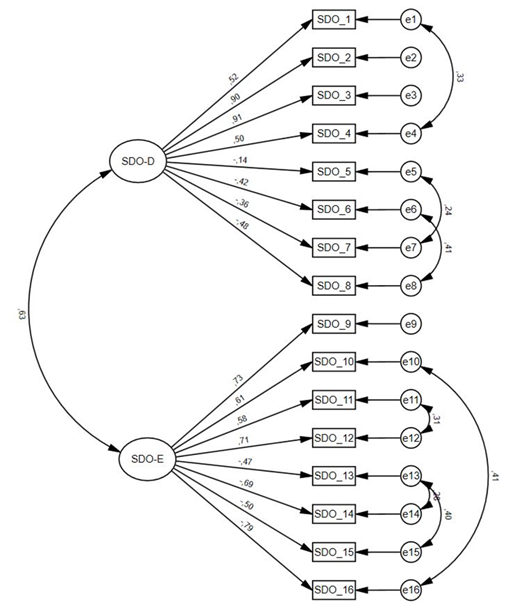
Both the one-factor solution model, χ2 (df) = 283.98 (97) p ≤ .001, CMIN/DF = 2.93, CFI = .901, RMSEA = .080 90% CI [0.07, 0.09] p ≤ .001, AIC = 361.98, and the two-factor solution model, χ2 (df) = 241.32 (96) p ≤ .001, CMIN/DF = 2.51, CFI = .923, RMSEA = .071 90% CI [0.06, 0.08] p ≤ .001, AIC = 321.32, fit the data in a good and similar way, although, the two-factor solution model tended to slightly revel a better fit pattern to the data (AIC = 321.32) than the one-factor solution model (AIC = 361.98). The factor loadings for each model are shown in Table 2.
Table 2 Means and standard deviations of all items, CFA factor loading on the SDO7 Scale.
| CFA loadings | ||||
|---|---|---|---|---|
| M | SD | One-factor model | Two-factor model | |
| Pro-trait dominance | ||||
| SDO 1 | 3.27 | 1.77 | .47*** | .52*** |
| SDO 2 | 3.07 | 1.70 | .59*** | .90*** |
| SDO 3 | 3.09 | 1.79 | .59*** | .91*** |
| SDO 4 | 2.33 | 1.73 | .46*** | .50*** |
| Con-trait dominance | ||||
| SDO 5 | 5.57 | 1.63 | -.28*** | -.14* |
| SDO 6 | 5.05 | 1.93 | -.35*** | -.42*** |
| SDO 7 | 5.12 | 1.49 | -.42*** | -.36*** |
| SDO 8 | 4.99 | 1.67 | -.45*** | -.48*** |
| Pro-trait anti-egalitarianism | ||||
| SDO 9 | 2.37 | 1.54 | .72*** | .73*** |
| SDO 10 | 1.90 | 1.35 | .60*** | .61*** |
| SDO 11 | 2.98 | 1.92 | .57*** | .58*** |
| SDO 12 | 3.00 | 1.71 | .69*** | .71*** |
| Con-trait anti-egalitarianism | ||||
| SDO 13 | 6.25 | 1.02 | -.49*** | -.47*** |
| SDO 14 | 5.70 | 1.36 | -.69*** | -.69*** |
| SDO 15 | 6.11 | 1.04 | -.51*** | -.50*** |
| SDO 16 | 5.24 | 1.51 | -.78*** | -.79*** |
| SDO-D | 2.88 | 1.08 | ||
| SDO-E | 2.37 | 1.01 | ||
| SDOtotal | 2.62 | 0.94 | ||
| Note. Standardized regression weights. p≤.05; ** p≤.01; *** p≤.001 | ||||
Reliability and descriptive statistics
All the con-trait items were reversed-coded before we averaged participant’s response to SDO-D and SDO-E scores. The average of all the items was also computed in a single score (SDOtotal). Cronbach’s alpha was .78 for SDO-D, .85 for SDO-E, and .88 for SDOtotal. McDonald’s Omega was .77 for SDO-D, .85 for SDO-E, and .87 for SDOtotal. These values are very similar to those found in another European sample, the Italian adaptation of the scale (Aiello, et al., 2019).
Although SDT expects men to display higher SDO scores than women, no differences were found regarding SDO-D (Mw = 2.85, SDw = 1.02; Mm = 2.92, SDm = 1.17), t(298) = .53, p = .595; SDO-E (Mw = 2.32, SDw = 0.97; Mm = 2.44, SDm = 1.08), t(298) = 1.02, p = .309; or SDOtotal (Mw = 2.59, SDw = 0.88; Mm = 2.68, SDm = 1.02), t(298) = 1.02, p = .309. Bivariate correlations showed that only SDO-E was positively correlated with age (i.e., as age increases, so do SDO-E scores), and, as expected, political orientation was positively correlated with both subdimensions (i.e., individuals’ SDO scores increase the more politically oriented to the right). Moreover, although SDT would expect SDO to increase the higher the participants’ status, none of the subdimensions nor the full scale were correlated to perceived status.
As expected, SDO-D strongly correlates with SDO-E (r = .61, p ≤ .001). Moreover, as we can see in Table 3, SDOtotal was positively correlated with all the related constructs. However, analyzing the correlations with each subdimension, we observe that Nationalism correlates more strongly with SDO-D than with SDO-E. As expected, System justification and Meritocracy correlates more strongly with SDO-E than with SDO-D. We also observe that RWA correlates with both SDO-D and SDO-E.
Table 3 Means, standard deviations and correlations between measures.
| M | SD | SDO-D | SDO-E | SDOtotal | |
|---|---|---|---|---|---|
| Sex | --- | --- | .03 | .06 | .05 |
| Age | 29.91 | 13.99 | -.03 | .14* | .06 |
| Political orientation | 3.77 | 1.23 | .31*** | .37*** | .38*** |
| Perceived status | 4.16 | 1.01 | .07 | .07 | .08 |
| RWA | 3.10 | 0.95 | .42*** | .46*** | .49*** |
| Nationalism | 4.49 | 1.03 | .15** | .07 | .12* |
| System justification | 3.17 | 0.89 | .11† | .20*** | .17** |
| Meritocracy | 4.24 | 0.86 | .10† | .13* | .13* |
| † p≤.10; * p≤.05; ** p≤.01; *** p≤.001.Note: Sex variable coding (1 = female, 2 = male) |
Discussion and conclusions
The present research aimed to assess the psychometric proprieties of the European-Portuguese version of the SDO7 scale. Firstly, we conducted the translation of the scale followed by back-translation method to detect any inaccuracy or ambiguity on the interpretation of the items, words, and expressions, or possible different meaning, due to cultural differences. This process involved two experienced researchers (fluent in both languages) and two professional translators. Then, the final version was pilot tested on a small sample prior to conducting the main study.
In order to analyze the factorial structure of the instrument, we performed a confirmatory factor analysis (CFA). Then, we examined the internal consistency reliability of the European-Portuguese version of the SDO7 scale (full scale and each subdimension) and the construct validity by examining the relationship of each subdimension (and full scale) with other theoretically related measures, such as, RWA, nationalism, system justification, and meritocracy.
Results of the CFA showed that both the one-factor solution model and the two-factor solution model have good indicators of model fit. Moreover, by examining the Cronbach’s alpha and McDonald’s Omega we observed that both the full scale (single score) and each subdimension (SDO-D and SDO-E) revealed good internal reliability. Thus, depending on the aim of the research, the European-Portuguese version of the SDO7 scale can be used as a unidimensional construct (with a single score) or considering its two subdimensions. These results are consistent with those found for the Italian version of the SDO7 scale (Aiello et al., 2019).
Results also showed that, as expected by more traditional conceptualizations, SDOtotal was positively correlated with all the related constructs (RWA, nationalism, system justification, and meritocracy). However, consistently with the new conceptualization and more recent evidence, we observed a positive correlation between Nationalism and SDO-D, and not with SDO-E; and both system justification and meritocracy were positively correlated with SDO-E but not with SDO-D. RWA was positively correlated with both SDO-D and SDO-E. Thus, although the SDO7 scale can be used as a single score construct, considering the two subdimensions (SDO-D and SDO-E) and examining the two separately, provides a more comprehensive understanding and predictive capability regarding intergroup attitudes and behaviors, enabling a better understanding and explanation of various political perspectives (Ho et al., 2012, 2015; Kugler et al., 2010). Indeed, each dimension is expected to predict different intergroup phenomena (e.g., Ho et al., 2012, 2015).
Limitations
In spite of the satisfactory psychometric proprieties of the European-Portuguese version of the SDO7 scale, the present study has some limitations that should be acknowledged.
Due to difficulties in data collection, it was not possible to obtain a larger sample (convenience sample), and the majority of the participants were students (58%). Thus, our results are not representative of the Portuguese population.
Another potential limitation, raised by one of the reviewers, is related to our data-driven approach, namely, the use of modification indices (MIs) for model refinement. While analyzing MIs is a common practice, serving as a valuable tool to identify sources of misfit in a model, there are inherent risks associated with exclusively relying on data-driven modifications. Specifically, we acknowledge the risks of overfitting and model inflation that may arise from indiscriminately accepting all modifications suggested by MIs. To address these concerns, we systematically added additional parameters between errors one by one in sequential order to prevent overfitting. Furthermore, we balanced between data-driven insights and theoretical grounding in our model refinement process. While we considered MIs as indicators of potential areas for improvement, we also critically evaluated each modification in light of established theoretical frameworks, as recommended (e.g., Brown, 2015; Kline, 2016; Whittaker, 2012). By adopting these procedures, we believe that we have mitigated the risks associated with MIs, thereby ensuring that our final model remains both statistically sound and theoretically meaningful. Nonetheless, adjustment indices without applying this approach are also provided.
Nevertheless, despite these limitations, the European-Portuguese version of the SDO7 scale proved to be reliable and can be applied in future research namely to assess individuals’ support for social inequality and their views and beliefs about intergroup relations.
Declaration of interest statement
The author(s) declared no potential conflicts of interest with respect to the research, authorship, and/or publication of this article.
Data Availability
The data described in this article will be made available upon request to the authors.
Footnotes
1. All the procedures for the validation of the European-Spanish of the scale were also initially conducted. However, due to great difficulty in obtaining participants, the validation was not concluded. Nevertheless, the European-Spanish version of the scale (along with a description of the procedures) is also openly available at the online supplementary materials (OSM) at https://osf.io/mxza5/
2. RWA, Nationalism, System Justification, and Meritocracy scales were translated into Portuguese, by one of the researchers and back-translated by another experimented researcher. The two translations were compared, and some adjustments were made by a third experienced researcher.
3. Before model modification, models’ fit was weak: one-factor solution model, 1, χ2 (df) = 711.59 (104), p ≤ .001, CMIN/DF = 6.84, CFI = .678, RMSEA = .140 90% CI [.13, .15] p ≤ .001, AIC = 775.59; two-factor solution model, χ2 (df) = 476.66 (103), p ≤ .001, CMIN/DF = 4.63, CFI = .802, RMSEA = .110 90% CI [.10, .12] p ≤ .001, AIC = 542.66.
Credit authorship contribution statement
Catarina L. Carvalho: Conceptualization; Data Curation; Formal analysis; Funding acquisition; Investigation; Methodology; Writing - Original Draft; Writing - Review & Editing. Isabel R. Pinto: Conceptualization; Investigation; Methodology; Writing - Review & Editing. Rui Costa-Lopes: Conceptualization; Investigation; Methodology; Writing - Review & Editing. Darío Páez: Conceptualization; Investigation; Methodology; Writing - Review & Editing.

