




 Inglês (pdf)
 Artigo em XML
 Referências do artigo

 Tradução automática
 Enviar este artigo por email
 Citado por SciELO
 Similares em
SciELO

 Permalink


Introduction
The last few decades have seen the rise - first in the United States, then in Europe and the rest of the world - of climate change litigation. Indeed, a growing number of civil society players are taking legal action against governments, local authorities and major corporations, in order to expose the inadequacy of the measures taken to mitigate climate change. The Sabin Center for Climate Change Law, based at Columbia University, keeps a record of these ever-increasing claims in its vast database1 and produces an annual report. Thus, in 2019, over 1,200 cases were recorded in over 30 countries. Among the most emblematic cases is undoubtedly the 2015 Urgenda case in the Netherlands. This trial resulted in the Dutch government being condemned for its lack of diligence with respect to climate change, in light of its legal obligations towards the Dutch people and the rest of the world.2 By finding that the Dutch government’s policy to reduce greenhouse gas emissions lacked ambition, the Dutch court convinced a growing number of activist organizations that legal action could be one of the most effective ways to force governments to step up their efforts.
This article is the result of a survey relating to a climate dispute that was clearly inspired by this Dutch precedent. The “Case of the century” (in French, “L’ Affaire du siècle”) was brought in France in December 2018, by four activist organizations: Greenpeace France, Oxfam France, Fondation (Nicolas Hulot) pour la Nature et l’Homme, Notre Affaire à Tous. Through the lens of the study of social movements, and more specifically of the mobilization of resources (McCarthy and Zald, 1977), we will look at how social movement organizations deploy resources in order to shine a light both on the importance of a public issue and on the relevance of the solutions they recommend. As we will see, in this instance, the goal was to express concern about the climate emergency, to denounce government procrastination, and in doing so, to demonstrate that legal action is the perfect response to the concerns of a large number of French citizens.
The “Case of the century” was clearly part of an effort to boost collective mobilization, which during that time also took the form of “climate marches”.3 However, launching the “Case of the century” also meant that activist organizations first had to adopt a tactical alternative that was far from obvious: the judicialization of their struggle (Pelisse, 2009). In other words, they also had to convince as many of their fellow citizens as possible that the courts would be the best place to solve the problem they were denouncing. The way in wich legal skills constitute resources that social movements can put to good use is now well documented (McCann, 1994; Israël, 2009; Agrikoliansky, 2010). From this perspective, reliance on legal expertise has generally been seen as a tactical skill diametrically opposed to affective behaviors.
The originality of this article will thus consist in showing how the analysis of the uses of the law as a means of protest benefits from the attention now paid to emotions in the study of social movements. Examining an instance of judicialization of the fight against climate change, such as the “Case of the century”, will give us the opportunity to analyze how protest organizations are able to closely combine two ways of coordinating collective action (Traïni, 2015): on the one hand, appealing to emotions (to make as many people as possible aware of the climate emergency) and on the other hand, the formalization of expertise (necessary to comply with the rules of legal procedure). Part of the theoretical challenge of this article will be to demonstrate that a proper understanding of the way emotions contribute to collective protests means rejecting the idea that emotions only play a significant role in cases of impulsive and disruptive actions or during periods of great unrest or upheaval. By showing how they can be closely associated with an extremely codified legal procedure, we will be in a better position to understand how emotions fit into repertoires of contention (Tilly, 2008).
Emotions, collective mobilizations and relationships with political institutions
Looking at emotions as part of the study of social movements has long been met with resistance. As Craig Calhoun (2001, p. 48) wrote, “it is hard to get emotions back into the field partly because they were not merely neutrally absent from it but expelled in an intellectual rebellion that helped to give the field its definition”. One must indeed keep in mind that the pioneers of this field, and founders of mob psychology, from Hyppolite Taine to Gustave Le Bon, often simply disqualified mass gatherings by reducing them to shameful emotional outbursts. However, in the second half of the twentieth century, academics had to examine mobilizations, such as the civil rights movement or opposition to the Vietnam War, in which they sometimes themselves took part. It was increasingly difficult for them to reduce collective mobilizations to the negative idea of protesting crowds overwhelmed by uncontrolled emotions. At the time, specialists in the study of mobilizations focused on paradigms such as “resource mobilization”, “framing analysis” or the “political opportunity theory”. These new theoretical models sought to explain what the dynamics of collective mobilizations owed to their promoters’ tactical assessments, organizational rationality and argumentative skills.
Bringing back the study of emotions first started in the us when authors realized that excessively utilitarian and strategic theoretical models were inadequate (Jasper, 1998 and 2011; Goodwin, Jasper and Polletta, 2001 and 2007). One of the challenges was to overcome the limits of the political opportunity theory, pioneered by researchers such as Herbert Kitschelt or Doug McAdam (1982). After the political variable had long been neglected, these authors had paved the way for a large body of research aimed at demonstrating that, on the contrary, the characteristics of collective mobilizations are largely determined by the political institutions they address. This focus on the explanatory power of interactions between “polity” and its “challengers” overlooked the fact that social dispositions and biographical experiences unrelated to politics can have a considerable influence on the future of mobilizations. To address this blind spot, James Jasper and Jane Poulsen (1995) developed the concept of moral shock in order to better identify the affective experiences that prepare people to commit to a cause, even in the absence of the favorable factors put forward by the political opportunity theory (accumulation of resources and expansion of political opportunities). This new focus on the affective states at the root of commitment to action was complemented by research into the way emotions are transformed even as mobilizations take place. For example, Deborah Gould analyzed how the founding of Act Up in the us led its queer activists to shift from feelings of shame to feelings of pride (2002). From then on, the dynamics of mobilizations could, thus, be linked to sometimes very deeply personal affective experiences. Interestingly, a large number of studies focused specifically on the affective reactions linked to the involvement of bodies exposed to risk or suffering. For example: hunger strikes (Siméant, 1998), high-risk activism (Romanos, 2014; Sommier, 2015), the jihadist martyrdom (Blom, 2021), or Act Up’s thundering zaps (Fillieule and Broqua, 2009).
This growing focus on emotions is an essential contribution to the study of collective protests. On closer examination, it can however present an unfortunate limit. By focusing on what participation in collective mobilizations owes to affective experiences unfolding in confidential and private spaces, it fails to take into account the relationships with political institutions that were once at the heart of the explanations offered by proponents of the political opportunity model. Thus, while affects can shed light on the motivations behind individual commitment and the trigger for collective mobilizations, this perspective struggles to explain how appealing to emotions can fit into public arenas and into the repertoires of contention (Tilly, 2008). What’s more, the interactions between social movements and political institutions are sometimes reduced to the most disruptive and disturbing forms that unfold on the margins of the most legitimate procedures. This reductive view stems from the fact that the study of the emotional dimensions of mobilizations generally relates to the observation of situations where they seem not only intense, reactive and negative, but also at odds with the ordinary institutional order. Left unchecked, there is a risk of bias in the long term, of believing that politically significant emotions (in terms of collective mobilizations) are limited to those forms of affliction, anger, or indignation that are unexpected and sudden, those that are the most vivid, immediate and spectacular. Against such bias, the work of sociologist Norbert Elias (Elias and Dunning, 1994) invites us, on the contrary, to be just as attentive to low intensity emotions that depend on processes whereby they are formalized and integrated into extremely codified social interactions. Indeed, when it comes to politics, emotions - far from being mere unbridled emotional outbursts - are part of institutionalized forms that dictate the way they are expressed and received. Thus, by way of example, the study of self-presentation constraints weighing on those in power (Le Bart, 2018) or that of the implementation of participatory policies (Blondiaux and Traïni, 2018; Tawa Lama-Rewal, 2019), call for an examination of why emotions cannot be detached from the frameworks and institutionalized procedures that regulate interactions and tactical calculations.
As we will see later in this article, the study of a collective mobilization around legal proceedings, far from an overly catastrophic view of emotions, constitutes a particularly appropriate vantage point in order to analyze the ways in which emotions can be combined with the most institutionalized tactical behaviors and procedures. With this in mind, we will turn to the notion of “sensitizing devices”, which refers to “the material support, the arrangement of objects, and the staging that activists deploy in order to inspire the affective reactions that predispose those who experience them to support the proposed cause” (Traïni, 2011, p. 233). This concept lies at the junction of the successive perspectives which, as we have just very briefly summarized, have shaped the study of the relationships between social movements and political institutions. Hence the duality that characterizes sensitizing devices.
On the one hand, analyzing the characteristics of sensitizing devices means asking how they fuel a process of “self-work” that consists in exploring and intensifying the personal affective states without which commitment to collective action could not be maintained. Indeed, activists are sometimes themselves their own target and the affective states they experience thanks to their own sensitizing devices are akin to a form of emotional work (Hochschild, 1979) aimed at conforming to the affective norms dictated by the cause they support. From a methodological point of view, interviews with a biographical component are necessary so that researchers can examine the extent to which the emotions generated by the sensitizing devices complement, intensify or alter sensitivities shaped during various stages of socialization.
On the other hand, sensitizing devices appear to be accessories to a proselytizing work aimed at convincing the widest possible audience of the existence of a public issue and of the need to remedy it collectively. Here the tactical value of arranging objects so as to elicit affective reactions lies in their expressive effectiveness and their ability to generate shared ideas and representations (Neveu, 1999; Cefaï and Terzi, 2012). It is clear that the development of sensitizing devices cannot be separated from the previously accumulated skills and know-how, nor from the strategic considerations specific to activist organizations. The survey actually quickly revealed that the most experienced activist organizations generally seek to supplement the use of sensitizing devices with expert devices that are often indispensable in order to gain influence in administrative and political arenas. The term “expert devices” refers to the material support, the arrangements of objects, and the staging that activists use in order to demonstrate their mastery of the specialized knowledge and skills that are not available to lay persons. Here, in contrast to the aforementioned biographical section, the survey thus focused on the behaviors adopted in order to highlight the existence of a public issue while at the same time seeking to put pressure on governments. It is with this in mind that we present this article, which is based on a survey centered around the promoters of a legal action (and not on a large sample of French citizens concerned about climate change, which would have required a whole other research protocol).
A legal action backed by remarkable popular support
The “Case of the century” is the second most important climate case brought before the French courts.4 From a procedural point of view, the operation began with the filing of a summary motion, on March 14, 2019, before the Paris administrative court, followed by an additional brief on May 20, 2019. However, from a public standpoint, the substance of this operation cannot be reduced to just these two 41- and 94-page documents. This legal action against the French government for climate inaction was combined with a mobilization campaign of remarkable success. Indeed, in December 2018, the four plaintiff organizations released an eponymous video in which celebrities and youtubers invited the public to sign a petition to show their support for the legal action brought by these organizations.
In terms of form, this 2-minute 49-second video features a speech which - sometimes accompanied by images to support the point being made - involves a succession of 31 narrators, including a number of well-known celebrities: youtubers like McFly & Carlito or Max Bird, as well as celebrities and artists such as Cyril Dion, Juliette Binoche, Marion Cotillard, Élie Semoun or Shaka Ponk. This video circulated well beyond the social networking sites specific to environmental sympathizers, and enjoyed remarkable visibility with, for example, over 15 million views on Facebook. The video’s objective was achieved well beyond the expectations of its creators, since it took less than five days for the petition supporting the “Case of the century” to surpass the record held until then by the petition against the 2016 El Khomri bill on the reform of labor law (1.36 million signatures). It also surpassed the petition for lower fuel prices, which, after being launched in May 2018, had led to the start of the Gilets jaunes (yellow vests) movement (1.15 million signatures). The petition supporting the “Case of the century” ultimately became, with over 2.3 million signatories, France’s biggest petition to date.
The fact that a case pertaining to administrative law - generally known as technical and esoteric - could be the reason for such a large and swift mobilization might seem surprising at first. Data had to be collected to explain how the promoters of the “Case of the century” went about convincing their potential supporters to back a legal action presented as an appropriate solution to the fight against climate change. The analysis presented in this article is based on a survey that began a few weeks after the launch of the “Case of the century”. The corpus of data included three complementary sections. First, an inventory of the tools used to publicize the operation: an eponymous video, the presentation of the case on the websites of the associations involved, adherence to the customs of social networking sites, press releases, coverage of the case by media professionals… Second, a collection of expert documents produced by lawyers at various stages of the proceedings: the summary motion, the additional brief and the reply filed with the Paris administrative court, as well as commentaries by legal experts… Last but not least, the survey involved a series of 26 interviews with the general managers, lawyers, and communications and digital campaign managers from the four plaintiff organizations.
Framing and emotional offer on social networking sites
So how do we explain the unusual success of this mobilization around the launch of a legal action? Part of the answer to this question lies in the know-how previously accumulated by some of the promoters of the “Case of the century”. Indeed, the video’s preparation was entrusted to players who had long worked on developing web-campaigning practices on social networking sites. Thus, the purpose of Youtube channel Partager-C’est-Sympa and collective #OnEstPrêt is to raise awareness among Internet users of the need to fight climate change, by mobilizing youtubers and other influencers on social networking sites. Their prior experience provided them with the know-how they needed to optimize visibility on social networking sites: creating a video script with rhythm, enlisting celebrities with a great number of followers, making use of helpful features - such as Facebook’s cross-post technique - to increase the chances of wider circulation.
However, beyond these initial answers, a careful examination of the video’s content was required. In order to do so, it seemed appropriate to use a tool that is now a classic in the study of social movements: frame analysis. Initially inspired by Goffman’s theory of frame analysis, this line of research began to develop in the us in the 1980s, with the intention of paying greater attention to the ways in which the promoters of a mobilization endeavor to rally partners and supporters behind common demands (Snow et al., 1986; Benford and Snow, 2012). More specifically, from the perspective of the precursors of frame analysis, the development of a mobilization, far from being born out of a supposedly objective injustice, results above all from the intense work deployed by the promoters of a social movement so that the actors who can potentially be mobilized come to agree on the problematic nature of the situation (diagnostic framing), on the alternatives needed to remedy such situation (prognostic framing), and lastly on the significant principles and values that may be consolidated (motivational framing). We will mainly focus on showing that this now classic type of analysis can be usefully supplemented by looking at the “Case of the century” video through the notion of “sensitizing devices” (see above).
In doing so, we will seek to understand why the enlistment of the 2.3 million signatories cannot be separated from an emotional offer, the composite nature of which deserves careful consideration. Table 1 below thus provides a preliminary overview of the way framing processes, theorized by Snow and Benford, actually structure how the video unfolds. Each line in the table indicates the intervention of one of the many successive speakers, thus restoring the rhythm of what is said collectively.
Unsurprisingly, a significant proportion of the video is geared towards “diagnostic framing”, i. e., the process that involves identifying the issue while at the same time triggering a feeling of concern and urgency justifying collective action. Here the video features a disturbing inventory of the consequences of global warming: droughts, fires, storms, loss of biodiversity… There is also the fact that scientists are frustrated not to be heard even though their knowledge has led them to alert public authorities since the 1960s. The figures put forward are alarming, while the list of threats to health, air quality, water, food, housing, etc., emphasizes the impression that we are dealing with an objectively indisputable and subjectively frightening issue: “everything might collapse”, “we are all in danger!”.
In line with the frame analysis perspective, here we must highlight the importance of the “attribution component of diagnostic framing [which] attends to this function by focusing blame or responsibility” (Benford and Snow, 2012, p. 14). Indeed, in this case, the point was not only to identify a problem, but even more to denounce the culprits: politicians accused of inaction, of procrastination, of grandiloquent but ineffective declarations. When it comes to global warming, this way of specifically blaming politicians is all the more necessary given that the damage is diffuse and could just as easily be attributed to the energy-hungry lifestyle of each and every citizen. “We’re trying to do our bit [the narrators of the video object], to sort our waste, to eat less meat, to ride our bikes, but if we have two years to change everything… We have to face it! These small steps are not enough!” In this instance, the responsibility attributed to politicians is particularly effective in mobilizing people, as it supports the affirmation of an “injustice frame” (Gamson, 1992), that is, a definition of the situation that fuels not only moral indignation in the face of what is described as unbearable, but also the delineation of a virtuous “us” pitted against an opposing “them”. Table 1 shows just how central this opposition is, between, on the one hand, successive governments, and, on the other hand, the collective of those invited to protest their inaction: an “all of us”, which excludes politicians, and which first consists of the 31 speakers featured in the video, who are then joined by all the Internet users answering their call to sign the petition and to share the video.
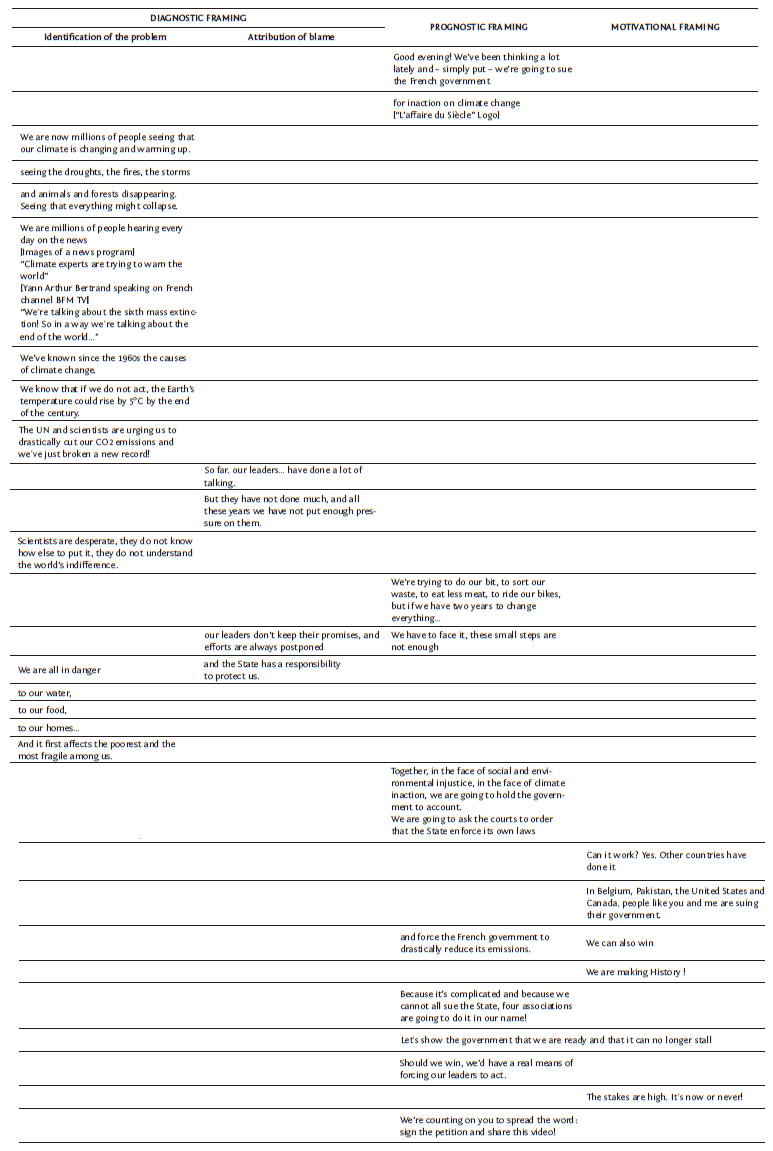
We must emphasize here just how much affirming this divide - citizens threatened by global warming versus politicians guilty of inaction - also constitutes a valuable basis for the “prognosis framing”, which “involves the articulation of a proposed solution to the problem, or at least a plan of attack, and the strategies for carrying out the plan” (Benford and Snow, 2012, p. 16). In this case, the idea is to present the legal action before the Paris administrative court as the best way to remedy the issue in question: “simply put - we’re going to sue the French government”, “and force the French government to drastically cut its emissions”, “demand from the courts that the government really protect us”.5 Of course, there is no question here (as we will do later in the article) of evoking the complex intricacies and lengthy procedures of administrative law. The idea is rather to present the collective action - which everyone is invited to join by signing the petition - as a response that is all the more appropriate because it counterbalances the feelings of despondency and prostration that the scale of the problem might have triggered.
In fact, we note that this discursive process quickly moves on to “motivational framing”, i. e., the invocation of higher principles and motives that make participation in the collective action seem pleasant and worthwhile. Here as well, the affective tone fostered is very different from the anxiety-provoking aspects - concern and indignation - of the diagnostic framing, since this time it is rather an exhilarating impetus that is suggested through the combination of several interdependent elements. First of all, the idea of joining a global movement, a very promising “climate justice” that has been successfully introduced elsewhere on the planet and that we simply need to replicate it in order to take part in a decisive turning point in history: “we can also win”; “we are making History”. Second, the satisfaction of finally being able to force those in power to do the right thing, and to do so by the power of numbers: “Let’s show the government that we are ready and that it can no longer stall.” What is prescribed here is the communicative excitement that characterizes enthusiasm, which, as Jean-Philippe Heurtin (2009) has shown with regard to the French Téléthon,6 is fueled by the joy of contributing to a collective action with a strong spectacular and specular dimension (in the sense that group members enjoy observing themselves acting). Here however, the enthusiasm generated also owes a great deal to the communication tools used and to the potential for immediate participation by as many people as possible, which are generally highly appreciated on social networking sites. The rapid succession of the 31 speakers in the video thus introduces the image of a collective “we all together” that every Internet user is invited to join and amplify by signing the petition and sharing it within their networks: “so let’s sign our names, millions of names”, “we’re counting on you to spread the word: sign the petition and share this video!”.
Thus, we can see here how the promoters of the “Case of the Century” set out to mobilize supporters by presenting them with a framing combining several elements to elicit both distinct and complementary affective reactions: global warming is a most alarming and urgent problem; a very large number of citizens are increasingly concerned about it; the culpable inaction of politicians is no longer tolerable; legal action will soon force politicians to take more appropriate action; everyone can contribute to this historic turning point by supporting this operation, which will be undertaken by associations that are qualified to do so. Here, it is the composite and dynamic nature of the emotional offer presented to Internet users that must be highlighted. Indeed, the goal was first to activate fears, which in isolation could lead to prostration, only to quickly turn them into anger and indignation against politicians, and then into enthusiasm at the idea of joining a major collective action. The positive response of 2.3 million signatories was all the quicker because the logic inherent to hashtag movements (which are now increasingly common) makes it possible to set off a “keyboard mobilization” based on what R. Badouard (2013) refers to as “aggregation through clicking”.
Admittedly, some will say that support given by signing an online petition is simply slacktivism (Morozov, 2009). Nonetheless, the huge number of signatures collected in the subsequent phases went on to constitute a valuable legitimizing resource for the four applicant organizations. Thus, on the morning of January 14, 2021, the day when the rapporteure publique7 was to present her conclusions, a giant 30 x 3 meter poster displaying the statement “We are 2.3 million”, was placed on the voie Georges Pompidou, a stone’s throw from the administrative court. Greenpeace France’s press release that day stated: “The Case of the century in court: today the State is challenged by 2.3 million people.”8
Legal profiling and activist diglossia
Of course, there is more to the “Case of the Century” than the video seeking signatures for the petition. Understanding the ins and outs of this operation requires an equally careful examination, not only of the case documents (summary motion, additional brief, reply, court decisions), but also of the numerous commentaries they elicited from legal experts. In addition, the survey conducted among the promoters of the “Case of the Century” provided an insight into the complexity of the collective work that enabled a pool of lawyers affiliated to the plaintiff organizations in various capacities to draft the motion filed with the court. What can be seen here is the way the technical nature of the legal debates was set apart from the appeal to emotions aimed at rallying the greatest possible number of supporters. Preparing the case documents required specific and expert legal work and involved formulating the claim in the terms best suited to the resources and constraints of legal proceedings. It was no longer a question of evoking common-sense fears and indignation, but rather of mobilizing expert knowledge to reveal a problem of a specific legal nature. The facts presented thus referred to quantified indicators showing, for example, that the means implemented by the French government had not made it possible to achieve the greenhouse gas reduction trajectories to which the government had committed according to Decree no 2015-1491 of November 18, 2015, on the national carbon budgets and the National Low-Carbon Strategy. The goal at this stage was to expose violations of legal norms which offenders would have to be reminded of. The know-how mobilized involved “producing that ‘legal qualification of the facts’ that allows [lawyers] to finally make sense […]; a task achieved by mobilizing the very technique of learned legal exposition with its layers of references or its search for precedents” (François, 1993, p. 207).9
In this case, the strategy adopted sought to apply to the as yet uncharted field of climate obligations the concept of a “carence fautive de l’État”, i. e. the State’s failure to act, which emerged from previous rulings regarding the prevention of green algae in Brittany or the safety of the Seveso-classified AZF chemical plant in Toulouse. The work of legal characterization has thus led to the denounced issue being translated into terms acceptable to the administrative court, even though the attribution of responsibility in the climate crisis has regularly proved to be complex and subject to debate (Jamieson, 2015).
A more complete and detailed analysis of the legal technicalities involved in the “Case of the century” can be found in other publications (Cournil, Le Dylio and Mougeolle, 2020). Our focus here is rather the dual nature of the mobilization organized around the launch of this legal action. Indeed, one is struck not only by the contrasts, but also by the close interconnection between two very distinct ways of denouncing an issue warranting mobilization. On the one hand, there is a framing intended for a wide audience and appealing to common emotions - a proselytizing work aimed at rallying as many people as possible to the cause. On the other hand, there is the framing of legal arguments based on specialized knowledge meant to be tested in court and to advance the law. It is important to highlight that this duality reflects more than a way of dividing labor between the lawyers and other promoters of the “Case of the Century”. Here there is also a kind of activist diglossia that enables the collective action undertaken to be understood by switching from one form of language to the other. To prove this, it is enough to observe that the legal experts representing the association Notre Affaire à Tous - who are obviously the ones most at ease with this form of diglossia- demonstrate both the skills needed to formalize legal expertise and an appetite for emotionally resonant discourse. Indeed, appealing to emotions has not been left exclusively to the video aimed at the general public. Numerous other sensitizing devices circulating within activist social networks also contributed to strengthening everyone’s commitment to the collective action. For example, the 31-page booklet entitled “How we are going to save the planet. A manifesto for climate justice”,10 which moves back and forth between worrying figures, an inventory of climate disputes around the world and inspiring lyricism: “We are everywhere, [the authors of the manifesto conclude] under various names, in various languages, we are international disrupters, we are rebelling and we are spreading. We will become their nightmare since they won’t give us time to dream. We will base our happiness on this fight” (p. 29). This observation confirms just how much appealing to emotions constitutes not only an accessory to proselytizing work, but also a form of self-work and reward for activism, the motivations of which cannot simply be reduced to the utilitarian model inspired by Mancour Olson (Traïni, 2009).
Emotions and legal expertise: two complementary pieces of the repertoire of contention
We have highlighted the eminently dual nature of the mobilization around the “Case of the century”. However, one cannot simply conclude that appealing to emotions and formalizing expertise constitute two complementary pieces of a repertoire of contention from which activists can draw at will. To understand why challengers benefit from combining them when the goal is to try and force those in power to take their demands into account, one must look at the tactical advantages and disadvantages of each of these two ways of coordinating collective action. As a matter of fact, these two methods complement one another in a way that is all the more inevitable given that the fight against climate change requires multi-sectoral mobilization, forcing its promoters to try and exert influence on multiple arenas that are both segmented and interdependent.
Generally speaking, because of the level of knowledge and rigor involved, formalizing expertise significantly increases the chances that challengers will be seen as credible and legitimate interlocutors by the authorities. This is especially true when it comes to legal expertise, given that “resorting to the law is a privileged means of accessing the State, mainly because the law remains the language in which the State and its agents express and think about themselves” (Michel, 2003, p. 10).11 Going to court puts even more pressure on the authorities, since a trial carries the risk of a final verdict that may force the government to meet the claimants’ demands. The possibility of being found at fault by a court according to the protesters’ complaint always poses a risk to the reputation for sound administration that governments like to pride themselves on.
However, resorting to legal expertise also presents tactical downsides that stem first and foremost from the uncertain outcomes of legal proceedings, and even more so from their slow and lengthy timelines. Thus, the first ruling of the Paris administrative court took place on February 3, 2021, more than two years after the launch of the “Case of the Century” (which is somewhat ironic when dealing with the climate emergency), and the proceedings were then extended pending new elements. Eight months later, on October 14, 2021, the court ordered that the greenhouse gas emissions exceeding the cap set by the first carbon budget (2015-2018) had to be offset by December 31, 2022, at the latest. The French government was thus given 14 months to make up for the delay accumulated over three years in reducing greenhouse gas emissions. While this decision was celebrated by members of the four plaintiff organizations, one must admit that the fact that it was so late, technical and temporizing hardly fueled enthusiasm beyond the circles of environmental law specialists.
It is therefore easier to understand how useful sensitizing devices can be, in tactical terms, when used in conjunction with the launch of legal proceedings. While coordinating around expert devices tends to significantly limit the range of actors authorized to play an important role in mobilizations, appealing to emotions, on the other hand, involves a very common ability to be moved, which points to much broader and more open groups of supporters. In other words, appealing to emotions is a much more immediate way to achieve activists’ objectives of criticizing power and mobilizing crowds. On the one hand, as we have seen, the framing presented to the public enables a large number of supporters to be rallied very quickly. In addition, the emphasis on the urgency of climate change, the outrage over government inaction, and the prospect of a trial that could both constrain and admonish politicians all serve to underpin a tactical move that is best suited to exploit a suddenly favorable change in the political context (McAdam, 1982). Indeed, generally speaking, “the law, and more specifically the use of legal action, can act as catalysts and indicators (for the media or public opinion) of a new form of mobilization” (Israël, 2009, p. 35).12
Thus, launching a legal action referred to as the “Case of the Century” effectively gave new impetus to a previously dormant criticism of power and mobilization of citizens. Indeed, up until the Fall of 2018, the French government and president Emmanuel Macron could still claim to be champions in the fight against climate change. They still enjoyed the effect of Emmanuel Macron’s stunt following the us withdrawal from the Paris Agreement, when he invited American scientists to come and work in France, proclaiming a grandiloquent “make our planet great again”. Given than activist organizations are keen to denounce the inadequacies of climate policies, it was important to swiftly exploit the series of events that had created a much more favorable context: the heatwave in July 2018, the successful “Rise for Climate” protests that took place on September, 8, 2018, or, on August, 28, 2018, the dramatic resignation of Nicolas Hulot as the French Minister of Ecological Transition… The indignation sparked by the “Case of the Century” video may also have been fueled by the growing unpopularity of a French president accused of abusing pontificating postures and illusory announcements.
However, this equivocal emotional offer, which triggered many swift reactions, is also characterized by an unavoidable obsolescence. Indeed, on social networking sites, the public’s attention can be quickly distracted by other information, causes for indignation, calls for demonstrations or petitions. Luckily, regardless of the lability of emotions and of visibility on social networking sites, the legal process continues and activist organizations, through their mastery of the formal language of administrative law, can avoid the uncertainty and the short-term nature of media coverage. We can therefore better understand just how emotions and formalizing expertise actually benefit from being combined when it comes to putting pressure on the authorities by rallying a large number of supporters while resorting to the law.

