



 Inglês (pdf)
 Artigo em XML
 Referências do artigo
 Tradução automática
 Enviar este artigo por email
 Citado por SciELO
  Similares em
SciELO
Similares em
SciELO 
 Permalink

Introduction
The constant evolution of communication technologies has contributed to an increase of different violent phenomena, particularly among youth, affecting their mental and physical health (UNICEF, 2017). Cyberbullying, defined as the repeated use of technological means to harm others, is a specific form of peer violence that has increased over the years (Patchin and Hinduja, 2015). This type of aggression is known to affect adolescents’ mental health, leading to psychological problems, such as suicide ideation, depression, anxiety, cutting, negative emotions, and psychosomatic symptoms (Fridh, Lindström and Rosvall, 2015; Nixon, 2014).
There are different participants in cyberbullying, similarly to other bullying situations, including the victim, one or more aggressors, and bystanders, which can play different roles. Bystanders can be defined as the individuals who witness or know about an emergency or violent situation (online or not) and have other choices concerning what to do (Dillon and Bushman, 2015). Specifically, they can intervene directly (e. g., by providing immediate assistance to the victim), intervene indirectly (e. g., by reporting the situation), join the cyberbully (e. g., by attacking the victim), or be inactive (e. g., by walking away from the event). Recently, greater relevance has been attributed to the bystanders of cyberbullying since they can exert major influence in the progression and outcome of a cyberbullying event (Macháková, 2020).
In cyberbullying, bystanders play an important role, as they can contribute to stopping the situation or decreasing its negative impact on mental health and well-being by providing support to the victim (Allison and Bussey, 2017; Macháková et al., 2012). However, regardless of their potential to change the course of events, bystanders frequently remain passive and choose not to intervene (Dillon and Bushman, 2015; Schultz, Heilman and Hart, 2014). Due to the specificities of virtual and online environments, namely the higher number of bystanders compared to face-to-face events, bystanders tend to attribute their responsibility for intervening to others (Macháková et al., 2012). Therefore, following a socio-cognitive approach, it is important to understand what specific personal, behavioral, and environmental factors lead bystanders to experience apathy towards cyberbullying. Bystander apathy (or the bystander effect) refers to a psychological phenomenon where those who observe an emergency do not provide help, either due to social influence or the diffusion of responsibility (Darley and Latané, 1968), among other factors which can also influence this specific behavior considerably. Within a socio-cognitive perspective of moral agency (Bandura, 2006, 2008), it seems significant to investigate how individuals who observe inhumane conduct, such as cyberbullying, may react in different ways, even in ways which are not according to their individual moral standards (such as apathy), and therefore lead them to morally disengage from what they have observed. Accordingly, a recent systematic review (Lo Cricchio et al., 2020) highlighted a positive association between moral disengagement and bystanders’ passive behavior in cyberbullying, even after the roles of moderating variables were accounted for.
Following a socio-cognitive approach, personal, behavioral, and environmental factors reciprocally influence individuals’ behavior while interconnecting with their surrounding context (Bandura, 2006). According to this perspective, moral agency refers to individuals’ ability to make moral judgements based on what they consider to be right or wrong and it is a key element of self-directedness that determines the intentional influence on one’s own functioning and life situations. Inherently, moral reasoning is converted into action through self-regulatory processes, namely through the moral judgment of behavior, which is based on individual standards and environmental occurrences. Hence, moral actions are a result of the reciprocal interplay of cognitive, affective, and social influences, and individuals can be perceived as moral agents within a surrounding social reality that influences them (Bandura, 2016).
Moreover, moral agency can be inhibitive, where individuals may refrain from behaving in inhumane manners, and proactive, where they abstain from engaging in inhumane behavior and engage in prosocial behavior. In fact, individuals with similar moral values may behave differently in a situation because they can differ in how they morally disengage from what they observe and do (Bandura, 2016; Simão et al., 2018). As such, this theoretical perspective may help explain why individuals behave in less acceptable ways while interacting with others through social media, especially in aggressive situations. Particularly, bystanders’ passive behavior in cyberbullying can be explained by how bystanders morally disengage, as previous research suggests (Lo Cricchio et al., 2020). Indeed, social media may even contribute to escalating moral disengagement, considering that face-to-face interaction is absent and also that anonymity and pseudonymity are means to hide one’s identity, which, thus, facilitates the lack of personal and social sanctions for socially disapproved behavior (Simão et al., 2018). Accordingly, individuals can more easily disconnect from a moral judgement and, therefore, withdraw from a witnessed situation without feeling personal responsibility, which can help explain bystanders’ apathy in cyberbullying.
In the digital era, observing inhumane conduct through technology devices has created a physical distance between those who are victimized, those who bully, and those who observe. Thus, understanding how bystanders function as moral agents is fundamental since moral judgments of aggressive behavior, based on individual moral beliefs, have been known to affect bystanders’ intentions to intervene (Barchia and Bussey, 2011). Furthermore, since moral agency depends on social influences (Bandura, 2008), the social context also seems to determine bystanders’ behavior depending on their normative moral beliefs (Bastiaensens et al., 2016; Pabian and Vandebosch, 2014). Hence, in the present study, a socio-cognitive perspective of moral agency was adopted to explain bystanders’ behavior in cyberbullying with the intention to complement previous research focusing on moral disengagement and bystanders’ intervention in cyberbullying (e. g., Dillon and Bushman, 2015; Macháková, 2020). Considering the influence that moral beliefs and moral disengagement may exert on bystanders’ behavior, this study aimed to understand adolescents’ moral engagement as bystanders of hypothetical cyberbullying incidents (i.e., cyberbullying visual scenarios). Specifically, this investigation focused on exploring adolescents’ moral engagement with cyberbullying by examining how their individual and normative moral beliefs and moral disengagement mechanisms lead them towards bystander apathy. Previous research has already used visual methods referring to cyberbullying scenarios, however, the data was collected by individual surveys with open-ended questions (Price et al., 2014). This study presents an innovative approach by including the use of visual cyberbullying scenarios with adolescents within a semi-structured interview, which, apart from the possibility of providing an online social context for adolescents to engage with, also allows a more in-depth analysis.
Moral beliefs and bystander apathy in cyberbullying
Moral judgment of behavior originates from personal and environmental factors and exerts an influence on behavior (Bandura, 2006). Therefore, to better understand bystanders’ actions in cyberbullying, it is relevant to explore how different personal and social factors related to moral agency can influence behavior. This study focused on moral standards functioning at the individual and social level (Bandura, 2008) to explore bystander apathy, given that violence-related phenomena, such as cyberbullying, can be explained by applying a socio-cognitive approach to moral agency (Allison and Bussey, 2017; Ferreira et al., 2021).
At the individual level, individual moral beliefs can influence bystanders’ responses to cyberbullying. Those with stronger beliefs of disapproval may feel more compelled to intervene, as responding passively could lead to feelings of guilt and shame (Allison and Bussey, 2017). Moreover, adolescents may not intervene if they believe an aggressor’s actions are morally justifiable (Simão et al., 2018). Thus, this study aims to understand adolescents’ individual moral beliefs concerning cyberbullying situations to help clarify bystander behavior since moral beliefs have been less contemplated in previous research, particularly concerning bystander apathy in cyberbullying.
Additionally, individuals behave morally not only according to personal factors but also as a consequence of social influences (Bandura, 2008). Therefore, the way individuals socially interact with each other influences their moral standards, contributing to their behavior (Bandura, 2006). Accordingly, in cyberbullying, normative social influence and social pressure from peers seem to influence bystanders’ behavior to support the aggressor ( Bastiaensens et al., 2016; Pabian and Vandebosch, 2014). Previous research has also highlighted that adolescents who believed that their parents and teachers disapproved of their engagement in cyberbullying were less involved in these incidents (Hinduja and Patchin, 2013). However, the role that the expectations of others can exert, specifically in bystander apathy in cyberbullying, remains unclear. Therefore, in addition to individual moral beliefs, this study also considered normative moral beliefs, which were defined as adolescents’ perceptions of what others expected them to do as bystanders of cyberbullying (Simão et al., 2018). To understand adolescents’ moral beliefs at an individual and social level and their relationship with bystander apathy in cyberbullying, a first research question was proposed:
q1 Can individual and normative moral beliefs lead adolescents to experience apathy in witnessed cyberbullying situations?
Moral disengagement and bystander apathy in cyberbullying
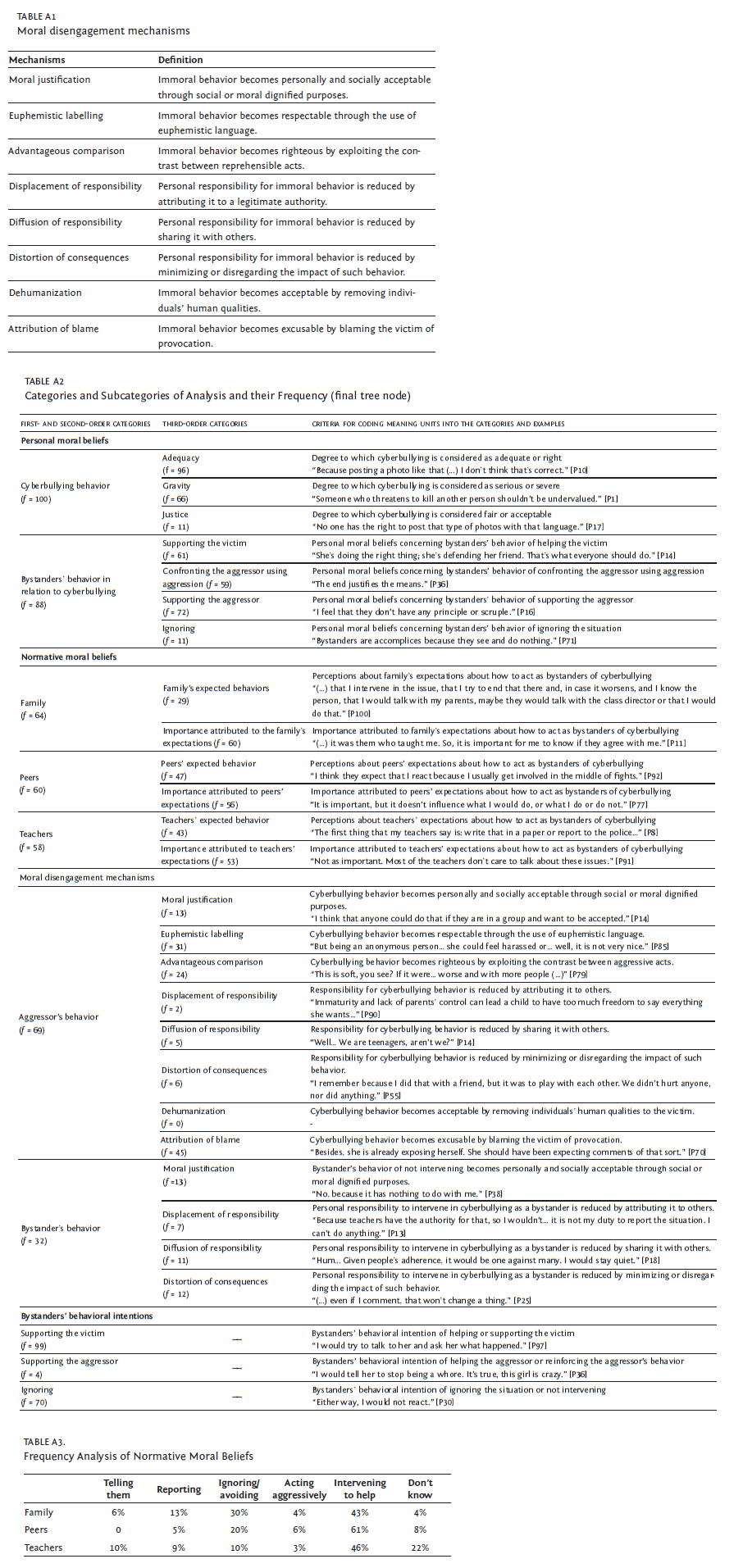
By adopting an interactionist perspective of moral agency, moral actions are considered the result of reciprocal and interdependent personal and social influences (Bandura, 2006). In the development of a moral self, individuals adopt standards of right and wrong, which guide and create limits for their actions and tend to avoid immoral behavior that goes against their moral standards (Bandura, 2008). However, different types of psychosocial mechanisms can be used to disengage moral self-sanctions from unacceptable behavior. Accordingly, since moral standards are not fixed internal regulators of conduct, when moral disengagement mechanisms are activated, an interruption occurs in self-regulation (Bandura, 2016). Therefore, selective activation and disengagement of self-sanctions can be made through moral disengagement mechanisms, which explain how individuals with the same moral standards behave differently in the same situation (Bandura, 2004; cf.Appendix, Table a1 for a description of moral disengagement mechanisms).
Selective disengagement of moral self-sanctions allows individuals to justify immoral behavior, not only in face-to-face interactions but also in virtual contexts. This seems to foster a moral disconnect regarding harmful behavior, considering the physical distance between victims, aggressors, and bystanders, as well as other features of online environments (e. g., anonymity), which can diminish personal and social sanctions (Bandura, 2006). In line with this, previous research has shown that a determinant of bystanders’ defending the victim refers to low moral disengagement (DeSmet et al., 2012), while bystanders’ passive behavior has been found to be related with four mechanisms of moral disengagement (i. e., diffusion of responsibility, displacement of responsibility, distortion of consequences and attribution of blame; Van Cleemput, Vandebosch and Pabian, 2014). More recently, a systematic review concluded that moral disengagement was found to be positively associated with both cyberbullying perpetration and passive bystander behavior (Lo Cricchio et al., 2020). However, previous research has focused mainly on quantitative approaches or qualitative studies using surveys with open-ended questions instead of interviews or other more in-depth instruments to collect qualitative data (e. g., Price et al., 2014; Van Cleemput, Vandebosch and Pabian, 2014).
In the present study, the relation between moral disengagement and bystander apathy in cyberbullying will be explored in a novel way through the integration of participative approaches (i.e., visual method) in more traditional methodologies (i. e., semi-structured interview), which allow to better grasp adolescents’ opinions, their decision-making process and potential needs (Larkins, Kiili and Palsanen, 2014). Thus, since moral disengagement can affect how adolescents intervene (or not) in cyberbullying as bystanders, the following research question was established:
q2 Can moral (dis)engagement explain adolescents’ apathy in cyberbullying incidents they observe?
Method
Participants
Participants included a convenience sample of 100 adolescents aged 13 to 20 (m age = 15.74, sd = 1.52, 52% boys) from 9th to 11th grades (34% 9th graders, 35% 10th graders, and 31% 11th graders) of three Portuguese public schools from urban areas in the South-Central interior and coastal regions of Portugal (i. e., Lisbon, Alentejo and Algarve). Participants were all fluent in Portuguese.
Instruments
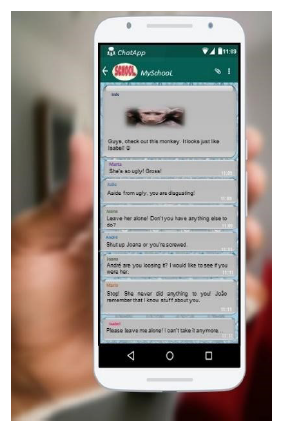
Semi-structured interviews were conducted according to a previous script with open-ended questions (e. g., “If you witnessed a situation like this one, would you try to understand if it was a joke or something serious? Why?”). The interviews focused on adolescents’ perceptions concerning three cyberbullying scenarios involving different fictional social media outlets and adolescents playing different roles (i.e., victims, aggressors, and bystanders). The purpose was to understand participants’ beliefs regarding the cyberbullying scenarios and cyberbullying behavior in general, as well as their perceptions on what they would do as bystanders. The scenarios were developed in a previous study (Simão et al., 2018), which focused on aggressive language used by adolescents in cyberbullying. The first scenario (cf.Figure 1) referred to a fictional chat group where a picture was shared by the aggressor to make fun of the victim. While some bystanders defended the victim, others supported the aggressor. The victim reacted, asking the aggressor to stop. The second scenario referred to a fictional internet channel where an adolescent shared a video of herself dancing, followed by anonymous comments including sexual harassment and threats, to which the victim did not react. The last scenario occurred in a fictional social network where a private photo of the victim was shared by the aggressor without consent. Some bystanders defended the victim, others supported the aggressor, and the victim reacted by threatening the aggressor. Cyberbullying scenarios were submitted to prior content and facial validation with three adolescents.
Procedures
Authorization to conduct this study was granted by the Ministry of Education of Portugal, the Portuguese National Commission of Data Protection, the Deontology Committee of the academic institution of the research team, the schools’ boards of directors, teachers, parents, and students. After obtaining authorization, members of the research team visited the classrooms of the participating schools and made initial contact with 9th and 10th grade students to request their participation in the interviews. Students who volunteered and consented to participate received informed written consent forms addressed to their parents. Student and parental consent determined who participated in the present study. The interviews were conducted in the schools by researchers. All participants were informed that they could request psychological support and that they could quit at any time. All interviews were recorded according to previous consent and transcribed verbatim subsequently. The participants’ names were changed into codes and deleted, ensuring data confidentiality. All records were deleted after transcribing the interviews.
Data analysis
A thematic analysis was performed using software nvivo 12, focusing on four main theoretical constructs that derive from the socio-cognitive framework applied to moral agency (Bandura, 2005, 2006, 2008): individual moral beliefs, normative moral beliefs, moral disengagement, and bystanders’ behavioral intentions. A thematic analysis of the data was conducted to identify, analyze, and report themes and, subsequently, organize and describe them (Braun and Clarke, 2006). The main categories of analysis matched the previously mentioned theoretical constructs, and the first subcategories were established according to what derived from the data. Data was divided into statements or natural meaning units of the interviews’ transcriptions, followed by their coding (Bazeley, 2013). Subsequently, the analysis progressed to a focused coding by reviewing and refining codes and the initial coding structure, according to most frequently occurring data and could relate with a moral perspective on cyberbullying and bystanders’ behavior in response to it. Accordingly, codes with similar meanings were merged into a single code and renamed whenever necessary. Then, codes containing less prevalent natural meaning units were removed, which resulted in the final categories and subcategories of analysis (cf. Appendix, Table A2). A description of the themes identified in the data was used to build a comprehensive, contextualized, and integrated understanding of the research questions (Bazeley, 2013; Braun and Clarke, 2006).
A frequency analysis supported the coding of data. The reported f values (cf. Appendix, Table A2) indicate the frequency of cases in which at least one natural meaning unit was coded, referring to each one of the categories and subcategories of analysis. Coding of the full transcriptions of the total interviews (n = 100) was performed by two independent researchers, and interrater reliability was tested concerning 25% of the interviews, revealing substantial agreement with a kappa value of .66 (McHugh, 2012). Agreement between coders was established through regular meetings to debrief and verify coding and interpretations during the entire coding process.
Results
Overall, results derived from the preliminary theoretical constructs that guided the analysis, i.e., individual moral beliefs, normative moral beliefs, moral disengagement, and bystanders’ behavioral intentions, were used to provide a better understanding of bystander apathy in cyberbullying. Results were organized according to the following four main themes found in the data.
Theme 1: disapproving cyberbullying versus devaluing its gravity
Results regarding individual moral beliefs about cyberbullying revealed that the phenomenon was strongly disapproved by the participants. Cyberbullying behavior was perceived mostly as morally wrong (96%), serious (57%), and unfair (11%), as illustrated in the next quote.
“Talking bad things about someone and not showing their faces is really bad.” [p35]
However, a tendency for the participants to devalue cyberbullying, unless the situation reached a high level of seriousness, was also found in the participants’ discourse. Therefore, although cyberbullying seemed to be strongly disapproved by the participants, the gravity of the hypothetical cyberbullying scenarios was underrated, as can be observed in the following statement.
“Some comments were a little excessive, but I didn’t find them very serious.” [p31]
Theme 2: intervening versus ignoring
Results reflecting individual moral beliefs about bystanders’ behavior indicated that supporting the victim was approved by more than half of the participants (61%). In contrast, ignoring the situation was the most frequently disapproved behavior (73%). The following examples illustrate these results. However, a moral conflict was found concerning bystanders’ behavior of ignoring. Specifically, bystanders’ apathy was considered as an acceptable behavior and was simultaneously perceived as morally wrong by the adolescents, as can be noted in the following example.
“They should have reacted, but, at the same time, so they don’t get into trouble, they are allowed not to react.” [p14]
This moral conflict also seems to extend to the expected behaviors of others, considering how the participants would act as bystanders of cyberbullying (i. e., normative moral beliefs). Although intervening to help was the most expected behavior reported by the adolescents concerning family, peers, and teachers, ignoring the situation was the second one by both family and peers. Results also revealed that the family’s expectations were considered as the most important ones (valued by 94% of the sample), followed by peers (48%). Teachers’ expectations (40%) were the least valued (cf. Appendix, Table A2 and Table A3).
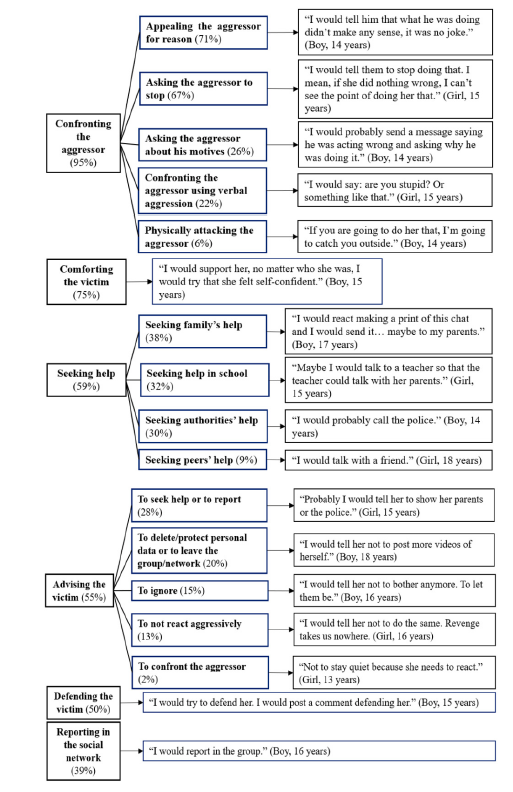
Concerning bystanders’ behavioral intentions, supporting the victim was reported at least once by almost every participant (99%). Figure 2 presents the different intended behaviors of supporting the victim, revealing that confronting the aggressor was the most frequently reported strategy by the participants.
However, and in line with the previous results, the intention of ignoring or avoiding the situation as a bystander was stated by 70% of the sample, as illustrated in the following statements.
“Most of the time, I let it go because these are things which sort themselves out over time.” [p32]
The intention to stay out of the situation if the victim was a classmate, a schoolmate, or a stranger was a shared pattern among the participants. Conversely, the intention to intervene was found to be higher if the victim was a friend. Moreover, fear of retaliation was another shared pattern among cases as a motive to ignore or avoid a witnessed cyberbullying incident. In accordance, participants would prefer to prevent themselves from becoming a target, as presented next.
“Since it’s a person who is not my friend, for example, in Twitter this happens every day, I probably wouldn’t get involved because I don’t want to get in trouble in that situation.” [p89]
Theme 3: moral acceptance of the aggressor’s behavior
Different moral disengagement mechanisms were found in the participants’ discourse, which were used to devalue the aggressor’s behavior of harming or humiliating the victim. Blaming the victim was the most frequent mechanism (45%) to justify cyberbullying behavior, making it more acceptable. The following quote exemplifies it.
“Maybe she is exposing her body too much in Youtube.” [p100]
Also, the use of euphemistic language to make cyberbullying behavior more respectable (i. e., euphemistic labelling) was found in the participants’ discourse (31%), as exemplified in the next statement.
“She also knows that he is trying to scare her. It’s not a big deal.” [p14]
Lastly, contrasting aggressive acts to make cyberbullying behavior more righteous (i. e., advantageous comparison) was found in 24% of the participants’ responses, as presented in the following example.
“On the other hand, there are much worse things.” [p17]
Theme 4: removing individual responsibility as a bystander
Other moral disengagement mechanisms were used by the participants to remove their individual responsibility of intervening in witnessed cyberbullying situations. Moral justification, distortion of consequences, and diffusion of responsibility were the most frequent mechanisms used to justify bystander apathy (13%, 12%, and 11%, respectively). Concerning moral justification, the participants used morally dignified purposes to justify not intervening, mainly focusing on individual characteristics or social conduct, as illustrated in the following excerpt.
“I’m not a violent person or something like that.” [p18]
Another shared pattern among cases was the distortion of the consequences of cyberbullying behavior, which was supported by the belief that their intervention would not change the outcomes of a witnessed cyberbullying event, as can be read in the following example.
“There are people who defend the victim […] they don’t solve anything because the rest of the people will ignore it.” [p51]
Concerning the diffusion of responsibility, participants considered depending on others’ actions to intervene as a bystander, thus, sharing the responsibility to act with other bystanders, as presented next.
“I think I’d wait to see what others would say, if someone commented something. If no one said anything about it, then I think, perhaps, I would say something.” [p20]
Discussion
The present study focused on moral agency and its relationship with bystanders’ behavior in cyberbullying, according to a socio-cognitive perspective ( Bandura, 2006). Specifically, the aim was to explore adolescents’ moral engagement with cyberbullying by examining how their individual and normative moral beliefs and moral disengagement mechanisms lead them towards bystander apathy. Findings were organized in four themes, which were found to reflect patterns but also contradictions among cases with the intention to answer our research questions.
Themes 1 and 2 helped to answer the first research question (i.e., How can individual and normative moral beliefs lead adolescents to experience bystander apathy in cyberbullying?). The first theme highlighted a conflict between participants’ individual moral beliefs concerning cyberbullying and their perceived gravity of this type of behavior. Our findings are consistent with the idea that individuals look forward to avoiding behavior opposing moral standards (Osofsky, Bandura and Zimbardo, 2005), since the participants perceived cyberbullying according to what is socially acceptable and desirable by morally disapproving of it. However, the identified tendency of the participants to devalue the severity of cyberbullying indicates that adolescents only seem to consider cyberbullying as serious when confronted with an extreme situation (e. g., life threat), which suggests that their perception of risk threshold is high. Thus, this may lead them not to intervene, according to previous research (Van Cleemput, Vandebosch and Pabian, 2014), which, in part, clarifies why bystanders experience apathy in cyberbullying (Lo Cricchio et al., 2020).
However, some results were less conforming to moral standards. According to our second theme, a struggle between the intention of ignoring the situation and intervening to help as a bystander was found among cases. Although ignoring was strongly disapproved, the acceptance of this behavior was also a shared belief, and the vast majority of the participants considered they would either support the victim or ignore the situation. Thus, our findings suggest the existence of a conflict between adolescents’ individual moral beliefs and their behavioral intentions concerning a witnessed cyberbullying situation. Specifically, it was found that almost every participant (i.e., 99% of the sample) indicated that they would support the victim, and they seemed to be well informed about adequate strategies to intervene (e. g., confronting the aggressor by appealing to reason or asking him to stop; comforting the victim; seeking help). However, 70% of the participants also indicated that they would ignore a cyberbullying situation. Results concerning normative moral beliefs also reflected this moral conflict, since helping the victim was the most frequently expected behavior (simultaneously referring to family, peers, and teachers), however, the second one was that they would ignore or avoid the situation (family and peers’ expectations). Thus, these findings suggest a high perceived acceptability of bystander apathy. Accordingly, previous research has identified a lack of parental support for helping the victim and a high prevalence of peer acceptance of bystander apathy (DeSmet et al., 2012). As a consequence, this may lead bystanders to experience apathy more easily. Since behavior depends on the interplay of both individual and social factors from a socio-cognitive perspective (Bandura, 2005), even if they perceive cyberbullying behavior as morally inadequate, or if they disapprove of bystander apathy, social influence can exert a determining role in how they choose to act, particularly if others’ expectations are relevant to them (Bastiaensens et al., 2016).
The third and fourth themes allowed to answer our second research question (i. e., Can moral disengagement explain adolescents’ apathy in cyberbullying incidents they observe?), since a high prevalence of moral disengagement mechanisms were used by the participants to justify the aggressor’s behavior, making it more acceptable, and also to justify bystander apathy, by removing the personal responsibility to intervene. Thus, these findings support previous research that positively associated moral disengagement with bystanders’ passive behavior in cyberbullying (Lo Cricchio et al., 2020). Our findings add to previous research by highlighting that moral justification focused on individual characteristics and social conduct can be used to remove bystanders’ individual responsibility to intervene, as well as distorting the effects of intervening or attributing to other bystanders the responsibility to take action. Virtual contexts may even foster the diffusion of responsibility caused by the bystander effect (bystander apathy), which, as a consequence, inhibits supportive behavior due to the physical distance between bystanders, the aggressor, and the victim (Macháková et al., 2012). In this sense, and according to our findings, adolescents seem to use moral disengagement to justify aggressive behavior, as well as their apathy as bystanders, making both morally acceptable behaviors. According to a socio-cognitive approach, different mechanisms can be used to interrupt the self-regulation process and, consequently, disengage moral self-sanctions from unacceptable behavior, which, in turn, allows us to understand how individuals with the same moral standards behave differently in the same situation (Bandura, 2001, 2004). Accordingly, experiencing moral disengagement may be one of the reasons that lead to bystander apathy, as already pointed out, since according to a socio-cognitive perspective (Bandura, 2001, 2004), bystanders can find relief from self-condemnation that arises from not assuming personal responsibility when they morally disengage. Therefore, a divergence between adolescents’ beliefs that intervening as bystanders is righteous and their frequent behavior of not intervening seems to persist. Altogether, these results may reflect a struggle in the process of self-regulation through the selective activation and disengagement of self-sanctions (Bandura, 2001, 2004). According to previous research, adolescents frequently justify their lack of intervention as bystanders through moral disengagement, while they perceive that intervening is morally right (Barchia and Bussey, 2011). Hence, this view of moral agency may help explain why the results revealed that, although perceiving cyberbullying as unacceptable, most of the participants morally disengaged.
Our findings also supported previous research concerning the possible motives for the relation between bystander apathy and moral disengagement. For instance, being a classmate, a schoolmate, or a stranger seems to foster bystander apathy (as opposed to being friends with the victim), which is also following previous research, highlighting the type of relationships with the victim as a determinant of bystanders’ intervention (Patterson, Allan and Cross, 2015). Specifically, supporting the victim seems to be more probable when they are close friends, while ignoring seems to be less likely (Patterson, Allan and Cross, 2017). Additionally, fear of retaliation was also mentioned as a probable motive for bystander apathy. Thus, to avoid the risk of becoming victims themselves, bystanders may decide to adopt passive behavior, as already indicated by previous research (Macháková et al., 2012; Van Cleemput, Vandebosch and Pabian, 2014). Results also indicated that the family’s expectations were especially valued and that they were more valued than those of peers, which is quite surprising considering that the opposite result was found in other studies (Pabian and Vandebosch, 2014). This result suggests that what adolescents believe their family expects of them as bystanders may affect how they choose to act; thus, families may play a determining role in preventing cyberbullying behavior.
Limitations, future research, and implications
Some limitations of this study need to be considered. Firstly, this investigation has an exploratory nature with no aims of generalization. Thus, results need to be cautiously read since the main aim was to provide clues for future research. Another important limitation was the use of cyberbullying fictional scenarios; although they were developed according to aggressive language reported by real adolescents, they are not as complex as actual cyberbullying scenarios. Moreover, since participants were directly asked to share their perceptions, participants’ responses were most likely influenced to some degree by social desirability. It would be relevant for future research to conduct cross-sectional studies concerning the variables under study. For example, it would be interesting to study mediating effects concerning the influence of individual and normative moral beliefs on bystanders’ behavioral intentions, using moral disengagement as a moderator variable. Moreover, a data-driven bottom-up approach could be useful in other studies by using, for example, a grounded theory methodology.
Despite the aforementioned limitations, the findings provide important contributions concerning bystanders’ behavior in cyberbullying. Results suggest that by not activating self-regulation processes that enable inhibitive and proactive moral agency, adolescents morally disengage from the incident and experience bystander apathy (Bandura, 2008). This process may occur even though they condemn cyberbullying or disapprove of the behavior of ignoring or avoiding a witnessed incident. Specifically, individual moral beliefs may not be enough for adolescents to act pro-socially as bystanders if they morally disengage from the situations (e. g., by attributing blame to the victim or by sharing the responsibility of intervening with others). Therefore, it would be important for cyberbullying interventions to focus on self-regulation strategies that could encourage or motivate adolescents to adopt pro-social behavior, leading them to positively intervene as bystanders instead of experiencing apathy. Hence, bystanders could contribute to decreasing the negative impact of cyberbullying on victims’ mental health and well-being (Fridh, Lindström and Rosvall, 2015; Nixon, 2014), considering their determining role in the course of cyberbullying events (Allison and Bussey, 2017; Macháková et al., 2012).
Additionally, this study contributes to knowledge regarding normative moral beliefs. Results provided an important insight regarding the highly perceived acceptability by both family and peers of bystander apathy in cyberbullying. Results also highlighted the importance attributed by adolescents to how their family believes they should act as bystanders. According to a socio-cognitive approach, since behavior depends on the interaction of individual and social factors (Bandura, 2005), the findings concerning normative moral beliefs complement the previous ones, by highlighting how peers and especially the family’s expectations may influence adolescents’ actual behavior as bystanders (Bastiaensens et al., 2016; Pabian and Vandebosch, 2014). Specifically, according to the results, parents may have led them to adopt passive behavior more easily, as opposed to intervening, even if adolescents considered this behavior morally incorrect. Thus, including parents by fostering their knowledge and working on their beliefs about cyberbullying should be valued while planning interventions in this domain. Moreover, results revealed adolescents’ uncertainty about what their teachers expected them to do as bystanders, which emphasizes the need for teachers to obtain knowledge regarding cyberbullying in order to provide students with adequate tools to deal with this phenomenon. Therefore, it would be important to design interventions which could promote better communication between students, family and teachers concerning technologies and the use of strategies to deal with cyberbullying (Simão et al., 2017), with the aim of promoting pro-social behavior which may lead to healthier relationships, not only in online environments, but also in other interpersonal interactions.