




 Inglês (pdf)
 Artigo em XML
 Referências do artigo
 Tradução automática
 Enviar este artigo por email
 Citado por SciELO
  Similares em
SciELO
Similares em
SciELO 
 Permalink

Introduction
The pandemic signified a health emergency which required governing. This governance became dominated by an interpretation of the virus as an invisible enemy which states were at war with. This positioning led to the implementation of lockdown policies, presented as the best strategy to combat the spread of the sars-cov-2 virus. This context enabled unprecedented measures which resulted in the suspension of political rights and the imposition of advanced surveillance mechanisms regulating nearly every facet of people’s lives. Restrictions on movement and traveling, stay-at-home directives, the adaptation of social interactions to social distancing rules and digital means of interaction, prohibitions on public gatherings, and encouragement of - where not obliging - teleworking represent only some of these measures (Honey-Rosés et al., 2020; Martínez & Short, 2021).
A large body of academic work has dealt with the short-term and eventual long-term impacts of these pandemic measures on various domains, including the public space. For example, researchers have approached whether and how street politics and grassroots movements were affected during the lockdown period (Pleyers, 2020; Ferrero & Natalucci, 2020). They mainly focus on the practices and repertoires of action adopted due to the lockdown measures and their usage of public space (Gerbaudo, 2020; Accornero et al., 2020; Mendes, 2020; Stavrides, 2020; Springer, 2020; Kowalewski, 2020; Aramayona & Nofre, 2021; Apostolopoulou & Liodaki, 2021; Arampatzi, Kouki & Pettas, 2022).
Nevertheless, little research attention has hitherto been paid to the scope for the pandemic - in terms of its governance - to have served as a tool for achieving wider governmental purposes. One such exception has already argued for the state’s potential target being suppressing social unrest and emerging due to the possible impacts on deaths and socio-spatial inequalities due to the pandemic’s governance (Chapman & Miller, 2020; Playere, 2020; Filippides, 2020). Such a claim seems well justified when considering how the implementation of austerity policies in many European (and other) states in the last decade has contributed, on the one hand, to disintegrating the welfare state and health care provisions and, on the other hand to the emergence of social movements fighting against these policies (Hadjimichalis, 2018).
Bearing these developments in mind and seeking to contribute to this field, this article focuses on public space in the city of Athens, Greece. This sets out to study whether, how, and at what point did the lockdown policies serve as an opportunity for the dominant socio-spatial order to reinforce its pre-pandemic efforts to control the public space and its political role. Of course, this in no way claims that lockdown policies were not primarily implemented in order to combat the spread of the virus.
This article breaks down into five sections. The first presents the theoretical framework around which the research question is approached. This sketches the relationship between the articulation of the “war metaphor” and the political role of the public space in which the “war” was said to have spread to. The second section brings the pre-pandemic socio-spatial context of Athens into focus: a prerequisite for stepping into the during-the-pandemic context as this portrays the pre-existing tensions over controlling the public space. The third and fourth parts analyze the key research findings, presenting the enforced processes of policing public space while also addressing the emerging processes of politicization. The final section consists of the concluding remarks.
Theorizing the pandemic governance and its relationship with the public space
On 17th March 2020, the Greek Prime Minister stated that “[W]e are at war. With an enemy who is invisible, but not invincible”. He deployed a metaphor that interpreted the virus as an enemy, invisible in its nature, which the state was at war with. Generally, metaphors “are a call to reality, an attempt to frame the virus in terms that we are able to grasp at the social, philosophical and cultural level” (Santos, 2020, p. 22). However, their deployment demands special attention as “[F]ar from being arbitrary, metaphors are intentional. They point to different types of action and conjure up different post-pandemic societies” (ibid., p. 22). In the case of the “war metaphor” raised by the Greek Prime Minister, this appeals to “the patriotic need for unity”, signaling the state as the exclusive actor and activating the “simplistic political narrative, of the ‘you’re either with us or against us’ type” (ibid., pp. 22-23). This conveys how activating this narrative produces the potential for extending the “war” to other metaphorical enemies of the state. Such a claim stems from the employment of war metaphors in the past, in other socio-spatial and time contexts, having served “those who declare them in achieving ends that have nothing to do with the ends they declared” (ibid., p. 23) by advancing their respective political agenda (Chapman & Miller, 2020). Simultaneously, the pandemic - by being interpreted as a “war” - became the main subject - an emergency - for governing, downgrading other issues or effects and oversimplifying “personal risks as a shared sacrifice” (ibid., p. 1117). This “type of action” (Santos, 2020, p. 22), in keeping with framing the pandemic as a war, took effect through the implementation of lockdown policies. An exceptional socio-spatial context that became socially legitimized courtesy of employing this war metaphor.
This mode of governing the pandemic may be portrayed through the lens of policing. According to Rancière’s conceptualisation, policing is not identified as the “petty police” but rather as a process that “defines the allocation of ways of doing, ways of being, and ways of saying” and distributes specific “roles and places” which preserve and legitimize socio-spatial inequality (Rancière, 1999, p. 29; see also Dikeç, 2005). From this point of view, the interpretation of the state as the exclusive decision-making actor and of the pandemic as the main subject monopolizing the social and political reality account for only two of its aspects. Rancière (2021) described the pandemic as “the accelerator” of a policing process which “was already under way” (Rancière, 2021), thus considering policing as a process. This reflects how the socio-spatial order, which is presented as naturalized, always remains in progress as its “full realization” is disrupted and challenged by its antagonistic process and politicization (Uitermark & Nicholls, 2014, pp. 973-974). Hence, politicization then becomes “whatever breaks with the tangible configuration… whatever shifts a body from the place assigned to it or changes a place’s destination. It makes visible what had no business being seen, and makes heard a discourse where once there was only place for noise” (Rancière, 1999, pp. 29-30). Its “guiding principle” is equality (Dikeç, 2005, p. 174).
This raises an interesting question as regards just what might be considered as a disruption. The answer varies in accordance with its defining factors, such as its form, “nature” and “result”. For example, some scholars claim that disruptions should be characterized by the change produced in the dominant socio-spatial order, visible and understandable as such to anyone (Swerts, 2021), for such reason advocating a type of evaluation. Other authors focus on its “nature”, proposing that even should it become widely visible through a spontaneous moment or event, such as a speech or a riot, more often it results from a constant process (Uitermark & Nicholls, 2014, p. 973; Dikeç, 2017b). Generally, we may consider disruption as the process or the moment when inequality is challenged and equality is performed, when a transformative potential becomes visible. Such evolutions may contribute to the constitution of political beings and spaces, interrupting the “normalized structures and repetitive practices of everyday life that may be sources of injustices or wrongs” (Dikeç, 2017a, p. 52).
Hence, the public space is a terrain in, but also an actor for, where policing and politicization unfold. This constitutes the space where strangers can meet and interact, where claims and rights can be made, letting political disputes and dissensus rise. This accounts for the space where marginalized and oppressed groups can obtain representation by articulating their discourse and praxis. For this reason, the public space is perceived as a “space for representation” (Mitchell, 2003). However, it can also become an actor as socialization can give rise to emancipatory actions (Butler, 2011, p. 2) in keeping with how “non-mediated modes of social conduct can play out” (Kallianos, 2013). These embody the two types by which disruption may be reflected in relation to the public space. In contrast, policing attempts to control the public space by suppressing political interaction and disruption. For this reason, other functions of the public space are promoted, including entertainment, consumption and spectacle (Mitchell, 2003). The dominant discourse interprets the public space as a “space of circulation… a space of ‘moving-along’” (Davidson & Iveson, 2014, p. 553), where “there is nothing to see, nothing happening, nothing to be done but to keep moving” (Ross, 2002, p. 22), presenting parliament as the proper place for politics (Dikeç, 2005, p. 74).
In summary, this article approaches the governance of the public space by the state during the pandemic as this created the policing potential for its visibility, which interrelates with the political and social roles of public space, to be suppressed. Its discursive and performative levels, characterized by the employment of the “war metaphor” and the according implementation of lockdown measures, establish the framework for such a reading.
The next sections focus on the conflicting characteristics of policing and politicization that unfolded in the public space over recent years in Athens, and especially during the pandemic period. This strives to ascertain whether, how and at what point the governance of the pandemic served - apart from combating the virus - to reinforce the state by advancing its pre-pandemic political agenda for controlling the public space.
Methodology
This article applies a combination of primary and secondary sources. More specifically, the pre-pandemic context of public space governance in Athens is based on a literature review. This includes some of the most indicative temporal processes of policing and politicization that unfolded in and for the public space in the city center from 2008 until the outbreak of the pandemic. This analysis details the background through which the public space governance was approached during the pandemic in order to investigate the acceleration or otherwise of past tensions over controlling the public space. On the other hand, the pandemic period, which provides the main focus of the article, derives from primary sources. The field research focused on the different struggles that occurred in and for the public space in Athens, Greece, during the second lockdown (November 2020-April 2021) without attempting to portray any comprehensive account. At this point, some further methodological choices should be referenced, especially regarding the type of struggles (see Gerbaudo, 2020) studied and the corresponding criteria. The field research concentrated on political processes emerging among parts of the so-called “social antagonistic movement” (ranging from anarchists to non-parliamentary leftist parties), and not anti-vaccination or anti-lockdown protests. This choice is multi-dimensional. Firstly, the social antagonistic movement has historically maintained a tactical/regular presence on the streets, considering the public space both as basic terrain for doing politics and an actor reinforcing their actions. On the contrary, anti-vaccination or anti-lockdown protests, composed of anti-authoritarians but primarily of far right-wing groups, focused exclusively on the pandemic period. Secondly, there were limited anti-lockdown and anti-vaccination protests in Greece. Thirdly, the tactic of anti-lockdown and anti-vaccination protesters of refusing to wear masks and respect social distancing, in contrast with the majority of other struggles in which participants at some point respected the health regulations, might serve as the pretext for suppressing protest. This might guide the research to false conclusions as the purpose here involves demonstrating whether the suppression of politics in public space was reinforced during the pandemic.
We collected and triangulated data according to three methods. First, the author, as an active participant (Bryman, 2012, pp. 431-454), engaged in assemblies and external political actions that occurred in and for the public space, such as demonstrations. Second, informal conversations and interviews (three in total) with activists overlapped with this participation. These were collected after the end of the second lockdown (between June and October 2021). The names of these research participants have been changed at their request. Third, we also studied the mainstream and alternative communication media.
The pre-pandemic context in / for the athenian public space
Since the mid-1990s, the city of Athens has changed significantly. The “modernization” discourse and the accompanying processes of neoliberalisation have played key roles (Kouki & Liakos, 2015). The 2004 Olympic Games, hosted in Athens, may be considered as a catalyst for these processes. Τhe event served as a tool for changing the landscape and the developmental path of the city. Inevitably, the center and the public space have been affected. They were designed to illustrate the entrepreneurial turn of Athens, on the one hand, accompanied by the enforcement of processes of commodification and surveillance practices and, on the other hand, by the emergence of social movements protesting against them (Petropoulou, 2008; Arampatzi & Nicholls, 2012).
These processes were disrupted due to the 2008 unrest (Kalyvas, 2010). On 6 December, the 15-year-old student Alexis Grigoropoulos was shot dead by a police officer in the historically radical district of Exarcheia. Riots spread throughout the city from there (Makrygianni & Tsavdaroglou, 2011), breaching the “spatial contract” according to which the Exarcheia district was the epicenter and exclusive district in which protests and riots took place (Vradis, 2020). During those days, the commodified version of public space was contested. This not only performed its role as a space for visibility and representation but its political role was also expanded, undergoing transformation into the space for “radical politics”. Streets became the space “where most of the battles were fought” (Kallianos, 2013, p. 549). As Kallianos & Fumanti (2021) point out, the public space was transformed into “an everyday site of mobilization” (ibidem, p. 1107), affecting the way citizens consider public spaces. These events contributed towards shaping, on the one hand, the first tensions leading to the supression of the political role of public space by the State and, the actions of grassroots organizations and neighborhood assemblies (Arampatzi & Nicholls, 2012).
The 2009 outbreak of the debt crisis and the implementation of austerity policies also affected the police ordering of the city center (Souliotis, 2013). On the one hand, the public space became the space where the state implemented “cleaning” operations, criminalizing and stigmatizing migrants and vulnerable people, further reinforcing the increasing presence and attacks by the “Golden Dawn” neo-Nazi group in public spaces (Vradis & Dalakoglou, 2011; Dalakoglou, 2013). On the other hand, mass anti-austerity protests were organized, followed by the “squares movement” and solidarity initiatives afterwards (Markantonatou, 2015), once again reflecting the role of public space in the emergence of politicization and socialization processes (Karaliotas, 2017; Arampatzi, 2017) in conjunction with the state’s need to control them.
The following years experienced an intensification of the efforts to interpret politicization processes as a threat to the neoliberalisation and “touristification” of Athens. One indicative example arises from the “Resilient Athens Program”, which demanded strict regulation of public spaces in order to avoid the “negative impacts” of social demonstrations and street politics on the urban economy. Additionally, beyond the criminalisation of mass protests, this program sought to control grassroots solidarity initiatives by incorporating them into the City of Athens’ platforms (Chalastanis, 2022). More generally, such assimilation strategies served as less “violent” processes - but with the same goal - during the “post-crisis” years, mostly under the syriza government (Karaliotas, 2021).
The demand to control public space and suppress politicization processes grew even stronger with the conservative right-wing New Democracy party taking office in 2019, promoting the “law and order” doctrine as a key slogan to its political agenda (To Vima, 2019). In conjunction with the newly elected right-wing Mayor of Athens, Kostas Bakoyannis (the prime minister’s nephew), the consequences soon became evident with a marked increase in police brutality and rights violations (Smith, 2019). For example, the publicly announced “cleaning up” of the central and historically politicized district of Exarcheia included both direct interventions, such as displacement of political or refugee squats, and also indirect methods such as the introduction of the “Adopt Athens” program by the City of Athens, which focused on - among other goals - removing “illegal” posters and stencils “with the support of the private sector”.1 Thus, this acted to suppress a widespread political act in the public spaces of Athens (Tsilimpounidi & Walsh, 2010).
The brief outline above portrays the public space governance of the last twenty years through to the emergence of the pandemic. This characterizes the conflicting dynamics between policing and politicization, designating the public space as an important terrain for their performance. However, the most recent pre-pandemic tensions also clearly convey the advance of the state objective to control public space and suppress the unfolding politicization. The next section investigates whether governance during the pandemic might have signified an enforcement of these tensions by highlighting different forms of their performance.
The exceptional context of public space policing during the pandemic
A variety of measures and types of intervention were implemented during the pandemic, forming an exceptional context for public space policing. The first lockdown period was enacted between March 2020 and May 2020, and with the second running between November 2020 and May 2021. Despite this switching between lockdown and non-lockdown periods, it seems these processes were interrelated and worked in mutual combination as, in some cases, the implementation of the former acted in support of the performance of the latter. Their characters also differentiated as some were temporary in application while others gained a more permanent nature. The next sub-sections present some of these measures based on both lockdown periods and the non-lockdown period in between.
“Essential services”: marking the exclusion of politicization from public spaces
The introduction of restrictions on using public space as a lockdown measure to combat the spread of the virus was accompanied by the application of “essential services”. These referred to services which were excluded from the curfew, hence allowing usage of the public space to fulfill such services (Honey-Rosés et al., 2020). These essential services considered such activities as going out for supplies or personal exercise, visiting a pharmacy, a doctor or a person in need of healthcare, walking your pet, and commuting to and from your workplace. People were only able leave their homes either after sending a text message to a number (13033) announced by the state authorities or after making a written declaration on paper before leaving the house as long as both contained all of the required information.2 This requirement was enforced by the fines levied in case of non-compliance. In the first lockdown period, the fine was 150 euros but then increased to 300 euros in the second lockdown. Furthermore, in the second lockdown, the curfew was extended and, in some instances, lasting from 6pm to 5am.
As a result, the categorization of services attributed a differential status to formal rather than informal activities. For example, work was considered as an essential service only when working in the formal sector. Only in this case were workers authorised to move in the public space and/or be eligible to claim financial support from the state. Thus, informal sector employees were ignored, deemed invisible and non-existent despite the significance of this specific sector in Greece (see Stratigaki & Vaiou, 2008). In a similar sense, “formal” politics was supposed to take place only in the parliament by professional politicians and hence the reason “informal” politics did not get classed as an essential service. The state was interpreted as the exclusive decision-making actor for dealing with the pandemic while grassroots movements were not allowed into the public space meaning that politicization could not be legally performed there.
Blanket bans: temporal mechanisms for suppressing politicization
The peak of this framing came with the imposition of blanket bans. There were three times when they were imposed on all public outdoor assemblies and demonstrations. The first, on 17 November 2020, aimed at avoiding any occurrence of demonstrations to commemorate the student uprising against the military junta, while the second was imposed on the anniversary of the murder of student Alexis Grigoropoulos by a police officer on 6 December 2020. In these two cases, the blanket ban covered all public outdoor assemblies of four or more individuals. In these two cases, commemorative demonstrations are typically organized by leftwing and anarchist groups, paying tribute and keeping the political memory alive. Finally, a third blanket ban on public outdoor assemblies of more than 100 people was imposed in late January 2021 at a time when students were protesting against the Law 4777/2021 (as detailed in the next section).
These decisions were taken on the pretext of protecting public health by preventing the virus from spreading. Nevertheless, it was subsequently revealed that the bans did not receive the health committee’s backing. On the contrary, they were decisions taken exclusively by the government (Amnesty International, 2021, pp. 12-13).
legislating stricter control in/for the public space
Two laws were enacted during the pandemic period which directly related with the public space. Law 4703/2020 “Public, outdoors gathering and other provisions” was legislated in the wake of the first lockdown, on 10 July 2020. The law set advanced restrictions, formulating a strict normative context under which exercising the right of peaceful protest might be deemed legal. In other cases, police forces “have the competence to disperse protesters” (Kasapi, 2021, p. 3). In keeping with the pre-pandemic context set out above, the regulation and control of outdoor public gatherings, especially street protests and social demonstrations, represented an important goal for local and central state authorities. According to the latter, streets and squares serve as spaces for circulation and entertainment for usage by workers, tourists and consumers. From this point of view, there is no space left for politicization, such as staging demonstrations and protests, which require regulation and approval by the police forces. This legislation did not directly relate to the pandemic but did so indirectly as we shall see in the following sections as it was applied to suppress assemblies and demonstrations that emerged during the lockdown period.
The second came with Law 4777/2021 “Introduction to higher education, protection of academic freedom, upgrading of the academic environment and other provisions”, which was passed on February 17 2021. This law stipulated for the deployment of a new police unit, the “university campus protection unit”, correspondingly inside university campuses. Its aim was defined as “the protection and security of both the persons and infrastructures inside” (Law 4777/2021). Its legislation was a pre-election target of the current government, perceived as an attempt to intensify the suppression of politicization. The “nature” of university spaces, specifically whether or not they are public spaces, has been contested for decades. Furthermore, they have played significant roles in the politicization of subjects as both social and physical spaces in recent decades, especially due to their location in city centers (see also Makrygianni & Tsavdaroglou, 2011; Kallianos & Fumanti, 2021), contributing to their identification as public spaces. On the other hand, this role accounts for the main reason they have become key target for the state, with the latter having tried to control and regulate them at different points in time. Once again, the attribution of their proper role as strictly spaces for education is advocated, thereby aiming to suppress the continuation of interpreting universities as potential spaces for politicization.
Expanding the metaphorical war: interpreting public spaces and protests as enemies
Based on the implications of employing the war metaphor described above, it was but a matter of time before the “enemies” of the state began multiplying. The war expanded beyond the formal enemy, the virus, to now attack visible “enemies”. The governmental invocation of “personal responsibility” and the stigmatization of young people and other ethnic and social groups as mainly responsible for spreading the virus were some of the implications (see Tsiganou, Chalkia & Lempesi, 2021). The Prime Minister, among others, claimed that “[T]he main source for the spread was the entertainment of young people” (Ekathimerini, 2020). Face to face socialization and practices ignoring the restrictions were criminalized, having been summoned as the scapegoat for growing death rates rather than the state’s inability to provide, or denial of, proper healthcare provision. Similarly, subjects and forms of struggle activating the political role of public spaces were also incriminated. The most prominent example here is the claims made by the former Minister of Public Order and Citizen Protection, Michalis Chrisochoidis. He stated that “streets and protests carry the virus and give birth to disease” (Chrisochoidis, 2021), targeting protesters and interpreting their right to express themselves as a threat, spreading the virus. However, the process of incriminating demonstrators and protesters did not first emerge during the pandemic. On the contrary, this reflects the continuation of a typical process also identifiable in the past. For example, in the “Athens Resilience Strategy for 2030”, protesters were interpreted as holding responsibility for exacerbating the “urban crisis” (Chalastanis, 2022).
Such interpretations articulated by the dominant discourse may have acted as social legitimization for these government measures and the legislation passed during the pandemic period stipulating control over the public space. However, they also dispersed policing mechanisms among citizens (Aramayona & Nofre, 2021), a practice that later became normalized as workers were obliged to check rapid tests or vaccination certificates before allowing consumers inside retail stores or cafes/bars.3
Emerging politicization IN / FOR the public space and their pandemic suppression
Despite the exceptional socio-spatial context and the deepening of public space policing during the pandemic, politicization and socialization still emerged. Furthermore, the forms they acquired varied mostly in accordance with the actors and their means of struggle. This research focuses primarily on public assemblies, peaceful demonstrations, and the street politics emerging on a neighborhood scale without overlooking the importance of other forms of socialization and politicization.
Public assemblies
Two types of public assemblies emerged. The first type experimented with virtual platforms and received widespread rejection for failing to guarantee safety, privacy, and broad participation. The second type, which did prevail, involved face-to-face meetings. However, this incurred more requirements than just an Internet connection and a personal computer. Giannis has been active in neighborhood assemblies and urban movements in Athens since 2008. According to his perspective, the lockdown measures might be seen as an “exercise in how to control public space”, undermining processes of socialization and politicization. He continued by saying that “you began using public spaces as migrants without papers do, meaning you don’t take the shortest or best way but instead the way with the least police checks”, arguing that “such practices had been implemented firstly on migrants without papers”. He explained “individual and not organized resistance” was very important as they challenged state power. Giannis was then gathering with other comrades in a squat, trying to socialize and hold a conversation about the pandemic and its effects on their lives. This need widely shared and explains why lockdown measures and policing were ignored by a wide range of citizens. Characteristically, he remembers a spontaneous birthday gathering which “happened in a street market, as the latter was still allowed at that time” (personal interview 12/5/2022). Nevertheless, the holding of public assemblies became even more difficult. Kostas has been a neighborhood assembly member since 2015. He recalled how, during the lockdown, they could not legally hold a public assembly as it required finding an accessible indoor public space, justifying the movement as an “essential service” and, finally, “avoiding police checks due to the night time curfew as, in many cases, assemblies finished after 9 pm”.
Furthermore, the “where” and “when” of assemblies was not publicly announced in most cases as this activity risked penalization due to being “informal”. Kostas remembered many cases in which police forces stepped up their patrols or surrounded squats and university spaces where they knew assemblies and conversations were taking place. In one case, “police forces surrounded the squat in which we were distributing basic goods to vulnerable people, threatening to impose fines to those who were exiting the squat with goods in their hands” (personal interview 9/4/2022).
Demonstrations
Peaceful demonstrations took place not only during the periods when public outdoor assemblies and demonstrations were not banned but also on days when blanket bans had been imposed. In both cases they were treated by the police forces with brutality, especially those occurring in the city center. Despite the fact that in most cases protesters were peaceful, keeping their distance and wearing masks, the police forces dispersed them by recourse to - whether together or separately - three different means: arrests, fines for breaching public health rules and excessive force (Amnesty International, 2021).
One indicative example stems from the demonstrations organized in solidarity with the hunger strike by a political prisoner, Dimitris Koufondinas. This was a struggle in and not for the public space as the protesters attempted to raise the public profile of the prisoner’s unjust treatment and demand justice for his case. A series of street protests and gatherings occurred in the city’s central public spaces (for example Syntagma square and Propylaia) by dozens of people wearing masks and maintaining safe distances amongst themselves. At the outset, there were 120-150 militants. However, over time, this movement gained ground and attracted solidarity from other leftwing social and political groups. As a result, there was a period in which demonstrations were held daily for five days in a row and concentrating over 5,000 protesters each day.
Despite the absence of any blanket ban, many of these actions received a combination of the means of dispersion set out above. There were cases in which unnecessary force was used not only inside metro stations but also in public spaces even before the gatherings occurred. Giwrgos has participated in grassroots actions in Athens since 2015. He also participated in most of the aforementioned protests in solidarity with the prisoner and stated that “a political action could be characterized as successful if the banner was able to stand in the public space for 30 seconds” (personal interview 23/7/2022). Giannis explains how the suppression of political actions was attributed such importance that “when the protest broke out by the police forces, we randomly concentrated in little groups” to shout slogans against suppression. The police forces simultaneously placed citizen health at risk, in addition to suppressing their right to self-expression, by deploying water cannons and chemical irritants, and detaining arrested protestors in poor and overcrowded conditions, contradicting their stated concern over protecting public health. Giwrgos described characteristically that during his arrest and transfer to the police station, “there were 40 protesters packed together on the bus, with some standing due to the lack of available seats”. Sometimes, the police force acts of suppression were so brutal that, on becoming publicly known through videos and photos, they contributed to stirring even deeper rage among citizens about pandemic governance. Kostas argued that “these dozens of weirdos kept the public space alive… After 45 days, the left and other activists also took to the streets. It was not about Koufontinas. It was about the rights of the people, the rights of prisoners, the rights of everyday people. It was generally about the governance of the pandemic”. An argument which highlights that a struggle in the public space, enacts a struggle for the public space reflecting how, regardless of a struggle’s specific demands, it is first and foremost the enactment of the political role of public space.
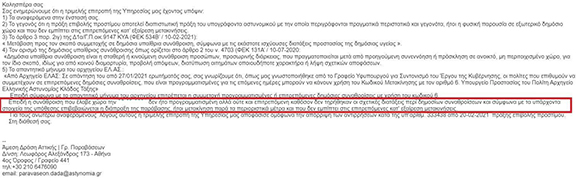
These struggles, apart from contributing to the growing participation in street politics, also directly revealed the relationship between processes of policing public spaces and the pandemic. An email sent by police officers in answer to the objections made by some of the protesters (seen in the photo 4 below) regarding their accusations, is indicative. The demonstration was suppressed according to Law 4703/2020 as the protesters had failed to request the police department for the permission required. Nevertheless, the actual charges did not relate to this law. On the contrary, they stemmed from pandemic measures as also did the fines imposed on those arrested. They were accused of breaching public health rules according to the article 285 of Law 4619/2019 and had to pay 300 euro fines.
The importance of such actions in public space further increased as citizens attempted to “do politics” through virtual space - mainly from home - for hygienic or other reasons, encountered the same policing practices. The social media were perceived as an eventual means of challenging enforced policing. Nevertheless, policing mechanisms were also employed on social media ( Iordanides, 2021), with the case of communicating Koufondinas’ hunger strike accounting for an important example (Papaevangelou & Smyrnaios, 2021).
The neighborhood scale
Politicization also got dispersed to the peripheral districts and the neighborhood scale. This partially stems from the restrictions imposed on movement but also from the aggression of police forces in the city’s central public spaces. Kostas recalls how “we took to the streets of the neighborhood leaving leaflets under the gates of houses. On another day, we used a car with the loudest sound to shout slogans. On another day, we distributed leaflets in a street market” in order to challenge the state’s pandemic governance. Another case was breaking the curfew and the blanket bans imposed on 17 November and 6 December. Demonstrations by left-wing and anarchist/anti-authoritarian groups took place in many of the city’s neighborhoods. Additionally, various initiatives were undertaken on the basis of solidarity and horizontality, distributing basic goods and providing services to the most vulnerable citizens as Kostas described above, despite the policing practices in effect. These initiatives emerged especially in low-income neighborhoods with high proportions of immigrants and working-class people, in many cases depending on the specific characteristics and social bonds that had been developed (Stavrides, 2020; Aramayona & Nofre, 2021; Apostolopoulou & Liodaki, 2021).
However, a demonstration of 5,000 people in a middle-class suburb, Nea Smyrni, represents the peak of the policing advance into the neighborhood scale public space. On 7 March 2021, “police officers threw a citizen to the ground and attacked him with batons (which had been banned due to their metallic structure)” (Fili, 2021). This police brutality was widely covered and hit the media headlines, triggering the major demonstration two days later that was followed by riots resulting in a police officer getting injured. The social anger and rage accumulating due to the pandemic’s governance and enforced policing were thereby expressed. After the Nea Smyrni riots, police brutality decreased and the Minister of Public Order and Citizen Protection was later removed from office.
Concluding remarks
The key research question articulated through this article was whether, how, and to what extent the pandemic - in terms of its governance - served as an opportunity for the state to reinforce its control in/for the public space and suppress the latter’s political role. The theoretical framework sought to justify this research question while simultaneously establishing the background for its study. More specifically, the discursive framework which framed the pandemic as a “war against an invisible enemy” created the potential for such a metaphorical war to be covertly extended beyond the formally declared enemy - the virus - to other “informal” and more visible “enemies” of the state. Furthermore, the implementation of the lockdown measures provided the performative stage for framing the pandemic as a war, introducing an exceptional socio-spatial context which controlled and distributed the right to use public spaces for formal and informal activities. The combination of these two interrelated stages of pandemic governance, the discursive and the performative, was put forward from policing perspective, rendering politicization as the informal “enemy” of the state and requiring suppression.
The field research focused on the public space in Athens, Greece and highlighted how socialization and politicization were incriminated by the state. Thus, the metaphorical war was indeed extended beyond the formal “invisible enemy” towards informal visible “enemies”, such as political and social practices unfolding in/for the public space. However, their interpretation as “enemies” of the state was no innovation arising during the pandemic. On the contrary, this represented the continuation of the state’s discourse and practices of the last fifteen years in Athens. Throughout all these years, the state’s aim was to restore the dominance of the interpretation of parliament as the only appropriate place for “politics”. Hence the reason the pandemic may be considered as having been used as an opportunity to accelerate the implementation of this political agenda.
Meanwhile, politicization emerged in/for the public space and disputing the enforced socio-spatial ordering of the pandemic and the corresponding imagination of “post-pandemic” Athens. Even if greater research needs doing for a more detailed account of their impacts, the insights obtained remain of great importance. Temporal measures, such as the lockdown restrictions, were challenged while permanent mechanisms, such as the legislation passed, have either not yet been implemented, for example Law 4777/2021, or have been challenged ever since their passing, such as Law 4703/2020. Police brutality and the unnecessary and excessive force deploy during the pandemic were also exposed and with consequences for the state’s policies. Thus, should politicization aim to make an injustice visible and shareable in the public space, there are several insights demonstrating how the pandemic was deployed to turn this visibility into an enemy, and thereby make it invisible. However, the objective of expelling and/or silencing political actions from the visibility of public spaces was not fully achieved.

