




 Inglês (pdf)
 Artigo em XML
 Referências do artigo
 Tradução automática
 Enviar este artigo por email
 Citado por SciELO
  Similares em
SciELO
Similares em
SciELO 
 Permalink

Highlights
Analyzes how SDG-13 travels from global frameworks to local policy implementation.
Identifies challenges in integrating equity, social inclusion, and environmental justice.
Emphasizes the need for local adaptation and capacity-building in implementing global agendas.
Demonstrates, through process tracing, how global ideas shape planning in Sorocaba’s region.
Highlights tensions around climate agendas as both cooperation tools and sources of conflict.
I. Introduction
In an increasingly interconnected world, urban studies and their cognate disciplines have emerged in recent years as a vibrant arena for in-depth exploration and understanding of the transfer and circulation of ideas, practices, theories, and agendas among nations and cities (Jajamovich & Silvestre, 2023). This scenario, amplified by globalization, highlights a reality where political and geographical boundaries become permeable to the flow of influences that transcend contexts (Santos, 2000; Stone, 2001). A key mechanism shaping the circulation of policies is the role of informational infrastructures, which do not merely facilitate diffusion but actively frame and structure how urban policies are generated, translated, and reinterpreted at multiple scales. These infrastructures encompass individuals, institutions, organizations, and technologies that interpret, frame, package, and represent information about best policy practices, successful cities, and cutting-edge ideas (McCann, 2011; Ward, 2024).
They act as platforms for generating, diffusing, and legitimizing development strategies, thereby facilitating the global circulation of ideas and practices that shape governance at multiple levels (McCann, 2011). However, policies do not simply move across territories; they are also reconfigured and ‘made up’ locally (McCann & Ward, 2010). In parallel, non-elite actors like transnational advocacy networks and social movements leverage informational infrastructures to coordinate actions, share knowledge, and shape international policy debates (Baker et al., 2020). These networks utilize digital technologies to mobilize global campaigns, influence decision-making, and challenge dominant governance paradigms, demonstrating how informational infrastructures enable non-state actors to exert significant influence over policy-making (Stone et al., 2020).
Initiatives aimed at environmental sustainability are a good example of a global exchange of policies. With growing recognition of the impacts of climate change, international pressure for responsive strategies has increased. Cities play a central role in global governance, especially in the context of environmental issues (Beck, 2014; Bulkeley & Castán Broto, 2013, Foster & Swiney, 2022). Crises, such as climate change and migration, often manifest themselves in urban areas, where coping strategies are implemented (Sassen, 2018). A notable example of this global exchange is the C40 Cities Climate Leadership Group. Through C40, cities have shared best practices in urban sustainability, including low-carbon transportation policies, green infrastructure projects, and climate resilience strategies (Haupt et al., 2020). These platforms exemplify how urban areas are not merely passive recipients of global policies but active participants in shaping climate governance through policy circulation, mutual learning, and localized adaptations.
Transnational city networks have played a fundamental role in promoting the climate agenda in Brazil, but uncertainty persists about the specific ways they have contributed to their territorialization in policies at local and national levels (Barbi & Macedo, 2019). While these networks facilitate knowledge exchange and policy learning, their actual influence on the long-term transformation of governance structures and institutional frameworks remains a topic of debate. Understanding how these international agendas materialize in metropolitan governance is therefore crucial for assessing their real impact beyond political discourse.
In this way, climate challenges frequently transcend geographical and institutional boundaries, reinforcing the imperative for multilevel cooperation in mitigation, adaptation, and the advancement of climate justice (Frey et al., 2021). Within this framework, the United Nations Sustainable Development Goals (SDGs) provide a universal blueprint for sustainable urban development, with SDG-13 (Climate Action) emphasizing the urgency of integrating climate measures into policies, strategies, and planning at all levels (United Nations Brazil, n.d.). As a founding member of the United Nations ([UN], 2015) since 1945, Brazil has long-standing formal commitments to global agendas, which makes the national and subnational translation of these goals particularly relevant. This is especially evident in urban and metropolitan planning, where the challenge of aligning international environmental commitments with local and regional governance remains pressing (Torres et al., 2021).
Among the main challenges facing Latin American metropolitan regions are adapting to climate change and integrating the digital transformation into metropolitan governance (Costa, 2024). In addition to the difficulties of coordination between different scales, these regions often operate in fragmented institutional contexts, marked by overlapping competences between the state and federal levels. In the case of Brazil, this fragmentation, aggravated by political polarization, generates instability and deepens urban inequalities, resulting in disjointed governance instruments and actions that make it difficult to implement cohesive public policies (Zimmermann et al., 2023). These challenges arise not only from the institutional complexity that characterizes metropolitan governance but also from the interpretative dilemmas surrounding the definitions, delimitations, and geographic and administrative scales of metropolises (Lencioni, 2017).
In this sense, we present the case of the Metropolitan Region of Sorocaba (MRS) - the third most populous in the State of São Paulo and an economically significant hub for agribusiness, industry, and technology - as an example of how policy mobility unfolds in mid-sized cities projected for accelerated urban growth. The MRS stands out not only for the common challenges faced by Brazilian metropolises but also for its strategic position between distinct agendas and interests (local, state and federal). At times, the region operates under directives and priorities set by the state, while at others, it emerges as a space where local actors seek to advance their own demands and strategies, leading to constant tension and drift (Santana-Chaves et al., 2025).
A concrete example of this lack of coordination in our case study is the development of its Integrated Urban Master Plan (PDUI), which was finalized in 2022 after a complex process of coordination among various actors and institutions and, as we shall see, the incorporation of global agendas. However, to date, the plan has not yet been submitted for consideration and voting in the São Paulo State Legislative Assembly (ALESP), which prevents its effective institutionalisation (Santana-Chaves et al., 2025). Its approval is essential for defining guidelines and coordinated policies aimed at strategic planning and integrated regional development. Thus, the MRS becomes an insightful case for understanding how global dynamics, such as urban policy circulation, take root in contingent and asymmetrical ways in metropolitan contexts of the Global South (Zimmerman & Momm, 2022).
In this paper, we investigate in which ways and through which configurations of actors, policies related to climate action have been taken up in the metropolitan agenda of our case study. We argue that the importance of the metropolitan scale has largely been overlooked; this scale is where the practical challenges of aligning global goals with local realities become evident, as the actual implementation of the policies and the power dynamics play out, revealing how political commitments translate into actionable strategies and tangible outcomes.
To support our argument, we draw on Robinson’s (2015) topological perspective, which helps illuminate the role of informational infrastructures in shaping global agendas and influencing local decision-making. In this view, proximity is not merely geographical, but also institutional and political, as policies are often shaped by actors who hold power and legitimacy across distances, exerting influence over local governance structures remotely. This is particularly relevant in the context of policy mobilities and climate governance, where transnational networks and international organizations establish normative frameworks that cities and metropolitan regions are expected to follow. To investigate these transformations, we employ process tracing as our methodological approach, systematically identifying the causal processes and mechanisms underlying the integration of climate adaptation into metropolitan governance. By analyzing how municipalities within the MRS engage with global climate frameworks - not as passive recipients, but through dynamic entanglements with a variety of actors, institutions, and governance networks - this study offers a relational perspective on how policies circulate and are reconfigured across scales, shaping metropolitan governance.
We begin the article with a discussion grounded in the literature on policy mobilities, with particular emphasis on its dialogue with urban theories, planning, political science, and global agendas. Next, we present our metropole region and case study - MRS, and our relational methodological approach, which structures our analysis by identifying causal processes and highlighting the events and dynamics involved in the incorporation of the climate agenda at both local and metropolitan scales. In the following section, dedicated to discussion, we articulate the mechanisms identified through the interweaving of the previous sections, shedding light on the dialogue between local and global actors - mediated by informational infrastructures and other arenas of policy circulation.
Finally, this article returns to its central argument by emphasizing the metropolitan scale as a crucial arena where global commitments intersect with local governance challenges in climate action. The case of the MRS illustrates how climate policy circulation unfolds amid institutional disputes and power asymmetries, resulting in uneven adaptations of international agendas. Rather than a linear incorporation of global directives, metropolitan governance emerges from multi-scalar interactions and negotiations involving local, national, and transnational actors, mediated by informational infrastructures that frame, translate, and legitimize policies across contexts. This relational perspective contributes to urban planning and public policy debates by underscoring the need for approaches that address the complexity of institutional arrangements and the reinterpretation of global agendas within Global South metropolisation.
II. From how the emergence of climate change mobilized subnational climate policies
The study of policy mobilities has emerged as a central concern in urban studies, aiming to understand how ideas, practices, theories and agendas travel across different geographical contexts (Dolowitz & Marsh, 1996, 2000; McCann & Ward, 2012; Peck & Theodore, 2010). Policy mobilities literature emphasizes that policies are not simply transferred but actively reshaped through institutional and social processes. While early studies focused on state-to-state mobility of policies, more recent analyses highlight the role of international organizations, consultancies, and intercity networks in shaping global policy agendas (McCann, 2011). These are part of a wider set of informational infrastructures that stimulate the circulation of a broad range of public policies, including urban mobility (Carr & Hesse, 2020), education reform (McKenzie et al., 2015), and environmental governance (Dolowitz & Medearis, 2009). Many of these policies are circulated through transnational and informational networks, influenced by international organizations (IOs), private actors, and intermunicipal collaborations (Stone, 2008). Recent publications have also pointed to the emergence of new patterns of influence, including South-North, South-South, and East-West exchanges, reflecting an increasingly decentralized and dynamic policy instruments and methodologies (Porto de Oliveira et al., 2020).
Recent studies in policy mobilities highlight that policies do not circulate in a linear way (Robinson, 2015). Rather, they are actively mobilized, reshaped, and contested by a wide array of actors operating across different scales (McCann, 2011; Baker et al., 2020). On one hand, elite actors - such as consultancies, policy advisors, and international and supranational organizations like the European Union (EU), the Organisation for Economic Co-operation and Development (OECD), and the United Nations (UN) - play a key role in legitimizing and promoting policy models globally. These actors are central to the production and operation of informational infrastructures that structure how policies are framed and disseminated (Stone, 2008; McCann, 2011; Andersson & Cook, 2019). On the other hand, recent studies have also emphasized the role of non-elite actors, including civil society organizations and community activists, who reinterpret and adapt policies, often proposing alternative modes of governance (Baker et al., 2020). Together, these dynamics reveal how policymaking is embedded in complex power relations and knowledge hierarchies, where certain models are legitimized over others through mechanisms such as benchmarking, best practices, global rankings, and soft governance strategies (Weiss et al., 2017). Informational infrastructures, in this sense, mediate policymaking processes by embedding specific knowledge regimes and shaping intergovernmental dependencies beyond formal regulatory structures.
Within these wider debates, the scalar politics of policymaking becomes apparent. Thus far, policy mobility studies have positioned cities as key sites for policymaking and governance. However, there has been a growing consensus that cities do not operate in isolation, as their policy choices are conditioned by state regulations, financial dependencies, and international agreements (Jonas & Ward, 2007; Sassen, 2018). Furthermore, while some global cities exert significant influence - such as the metropolis of São Paulo - many medium-sized cities (such as Sorocaba) and small cities (a large part of the MRS) remain highly dependent on national and state institutions. This scenario reflects not only the uneven geographies of urban policymaking but also disparities in institutional capacity and how governmental responsibilities are distributed across different administrative levels (McCann & Ward, 2010). Thus, rather than merely a matter of urban hierarchy, these inequalities are tied to the structure of government systems and the availability of resources at each level of public administration.
In this sense, rather than attributing policy autonomy solely to a city’s position within the inter-urban political economy, we emphasize the role of local and state governance structures and legal frameworks in shaping policy implementation across different urban scales. In Brazilian case, the metropolitan scale has gained particular importance in recent years, especially with the legal reinforcement provided by the Statute of the Metropolis (Federal Law N. 13.089/2015). However, in practice, this scale has been mobilized less as a tool for effective regional policy coordination and more as a discursive justification for specific political agendas. As a result, rather than fostering cooperation and equity in policy formulation among municipalities, the metropolitan scale often becomes a battleground for competition over resources and influence, further exacerbating asymmetries among cities that should be working in an integrated manner.
Urban studies have increasingly engaged with climate change as one of the most pressing global challenges, recognizing its disproportionate impacts across territories. For instance, climate change induced threats as the increasing frequency and intensity of heat waves - leading to higher rates of heat-related illnesses and deaths, along with economic impacts from reduced productivity and increased healthcare costs - and sea-level rise - threatening coastal areas and islands with population displacement and loss of habitable land (Elneel et al., 2023; Scott et al., 2020).
In response, the acceleration of climate change has demanded comprehensive policy action at both global and local levels, aimed at mitigation and adaptation (Artaxo, 2019; Marques, 2023; Sassen, 2018). This climate emergency has been increasingly addressed through global urban governance frameworks, particularly those promoted by UN-Habitat. The New Urban Agenda (United Nations Human Settlements Programme [UN-HABITAT], 2016), built upon SDG 11, emphasizes the need for inclusive, resilient, and low-carbon cities, and highlights metropolitan governance as a key mechanism for advancing climate adaptation and mitigation strategies. Building on these global frameworks, Brazil, as a founding member of the UN, has played an active role in international governance negotiations, including the OWG that formulated the SDGs. Although these commitments are formally non-binding, they exert normative and institutional influence on Brazilian public policies at national, state, and local levels (Frey et al., 2021).
Subnational governments and metropolitan regions have become key actors in aligning local policies with global sustainability goals. In parallel, the growing urgency of climate challenges has fostered the emergence of intercity and transnational networks involving NGOs, local and subnational governments, activists, and private sector actors (Nelles et al., 2018). Organizations such as the UN Framework Convention on Climate Change (UNFCCC) and ICLEI - Local Governments for Sustainability1 - provide platforms for negotiation, knowledge exchange, and advocacy, playing a critical role in linking global agendas with local implementation. Cities and their metropolitan surroundings have increasingly functioned as laboratories of experimentation and innovation in both policy tools and governance models. Implementing global agendas at the urban level is crucial for the effectiveness of climate governance, as cities act not only as mediators of international directives but also as active contributors to global strategies - taking on the role of autonomous agents of economic, political, and environmental transformation (Jonas & Ward, 2007; Frey et al., 2021; Torres et al., 2021). These interactions, however, are shaped by transnational power asymmetries, as international policy transfer processes often reflect uneven capacities and influence among actors (Dolowitz & Marsh, 1996, 2000).
Unlike the MDGs, which were primarily designed within international financial institutions and later incorporated into the United Nations framework, the SDGs emerged from a broader and more participatory process, with contributions from UN member states, civil society organizations, and research institutions. Institutional mechanisms such as the OWG, established after Rio+20 in 2012, and the UN General Assembly (UNGA) played key roles in shaping and legitimizing this process (Veiga, 2021) and are part of the informational infrastructures informing policy choices. Additionally, the role of the OECD (OECD, 2018), the World Bank (World Bank, 2019), and the United Nations Development Program ([UNDP], 2023a, 2023b) in shaping global governance mechanisms and tracking SDG progress has been crucial in operationalizing these goals at multiple levels. While the MDGs largely focused on poverty alleviation and basic human development, the SDGs incorporate broader systemic challenges, such as climate change (SDG 13), sustainable cities (SDG-11), and governance structures (SDG 16) reflecting a growing recognition that sustainable development is inherently multidimensional and requires coordinated action across national and subnational levels (Weiss et al., 2017).
As Barnett and Finnemore (2004) and Faria (2018) argue that IOs are both products and producers of globalization, playing a pivotal role in the internationalization of public policies. These organizations are central to the construction, legitimization, and operation of transnational networks and epistemic communities, which shape the diffusion of policies and contribute to the development of what is often called “global public policies”. The influence of IOs and these networks on local policies blurs the distinction between domestic and international governance, while simultaneously positioning them as key platforms for promoting and implementing policies. This reflects the growing importance of cross-border cooperation in knowledge exchange and policy implementation (Faria, 2018).
However, several organisational and structural reasons make it difficult for metropolitan regions to move and translate public policy. In terms of regional inequality and fragmentation, for example, local governments' centrifugal forces may oppose metropolitan integration, impeding the execution of coherent and successful public policies (Savitch & Adhikari, 2017) and placing an unfair emphasis on urban areas at the expense of remote and interior municipalities (Harrison & Heley, 2015). Additionally, many metropolitan areas, particularly smaller RMs in the Global South, lack the legal and financial resources as well as formal institutional structures that support integrated governance (Hamilton et al., 2004). This hinders grassroots initiatives, and the multi-level governance required for successful metropolitan policies (Smętkowski et al., 2019).
III. Methodology and study case
1. A Relational Methodological Approach
As suggested by Robinson (2015), in this article, we propose going beyond focusing solely on what is moving (trajectories of a policy document, an idea, a policy consultant) and instead examining, in a relational manner, how policymakers shape their ideas and practices on climate change at metropolitan and local scales amid a myriad of external influences. Accordingly, we explore how municipalities within the MRS engage with global climate action frameworks - not as passive recipients, but through dynamic interactions with various actors, institutions, and governance networks. In doing so, we identify the causal mechanisms that influence decision-making processes, as well as how global commitments are reinterpreted within local governance structures. The literature on the circulation of policies and planning instruments highlights the complex trajectory of ideas shaped by transnational influences, global networks, and local contexts. As Porto de Oliveira et al. (2020) argue, understanding the adaptability of these “moving objects”- ideas, practices, theories and agendas - is crucial for analyzing how policy models are not only transferred but also reshaped in different governance settings. This approach aligns with our objective of examining how global climate policies are assimilated, contested, and reformulated at the metropolitan scale, emphasizing the dynamic interplay between international agendas and localized political and institutional realities.
To systematize our findings, this study adopts the methodological approach of process tracing. According to Collier (2011), this methodological approach examines the interaction between independent variables (cause) and dependent variables (outcome) within a causal process, allowing for a detailed exploration of the intervening variables (causal mechanisms) linking them. Another justification for its use follows Beach and Pedersen (2013), who highlight the potential of process tracing for theory testing, theory building, and explaining outcomes. Although our approach is centered on a case study (empirical analyses), it also contributes to theory building, as it examines the context of metropolitan regions in Brazil, bringing new insights to studies on policy mobility in other contexts.
The identification of these patterns does not aim for broad generalizations but rather seeks to reveal how specific causal mechanisms operate within our case study. In this regard, Robinson’s (2015, 2018) discussions on proximity and (non)direct influences are relevant, as is the relationship between the nation-state, international organizations, and the formulation of metropolitan and urban policies within the specificities of the Global South and its colonial disparity legacies. Thus, by examining entities, events, and actions within causal processes, our analyses provide a framework (fig. 1) for systematizing the formulation of more precise inferences about the mechanisms shaping political and institutional dynamics (Bennett & Checkel, 2014; Collier, 2011).
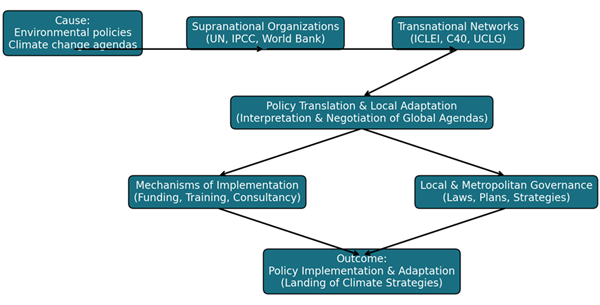
Based on document analysis, we selected municipal and metropolitan-related policies - on the one hand referring to municipalities within the MRS, and on the other to the State of São Paulo - directly linked to climate-related issues. The selection focused on published official documents but was hindered by data fragmentation, as each municipality structured its platforms differently and without systematization criteria, making their actions and legislation available in a disjointed manner. To organize the search, we prioritized content from the past three decades that guides local and regional strategies to address climate impacts, including instruments and strategic guidelines. The consultation encompassed plans, laws, and legal documents available on official municipal platforms (city hall and legislative chamber portals), as well as materials from councils, agencies, regional/metropolitan consortia, and other relevant entities.
This process was not exhaustive but followed a standardized, systematic search, using common terms on each platform such as “climate change” and “environment.” As the research progressed, additional terms were included, such as “funds,” “councils,” “sanitation,” “solid waste,” “GHG emissions,” and “risk.” Due to the length of the resulting table, only officially regulated events were included. The data collected were synthesized into a spreadsheet (see Appendix 1) that systematizes the identified climate policies and other related actions. Although the spreadsheet is based on the study by Barbi & Ferreira (2013), our approach goes further by also considering transnational articulations and the positioning of these policies within the Sustainable Development Index for Cities (IDSC-BR), enabling a deeper analysis of their alignment with the Sustainable Development Goals (SDGs).
Following this causal-mechanical model, we analyzed the collected data to understand the agents and institutions involved in transnational networks, with special attention to the adoption and adaptation of global agendas such as the SDGs. Additionally, we investigated the circulation of ideas and external influences in the formulation of metropolitan policies. With qualitative research techniques, along with detailed contextual analysis, it provides a broader and more in-depth understanding of the phenomena studied.
2. The Metropolitan Region of Sorocaba
In Brazil, a metropolitan region (MR) is a territorial unit composed of adjacent municipalities, created to integrate the organization, planning, and execution of public functions of common interest. At the federal level, the Statute of the Metropolis (Law N. 13.089/2015), which amends the City Statute (Law No. 10.257/2001), establishes criteria and guidelines for their creation. However, MRs are formally established by complementary state law. Some key characteristics of MRs include functional, economic, and social integration, shared challenges and solutions, the need for coordinated planning, and the provision of metropolitan-scale public services. They must have an interfederative governance structure, encompassing administrative organization, resource allocation, accountability, and mechanisms for social control. Public functions of common interest in an MR may include transportation, the regional road system, basic sanitation, land use, and environmental management (Brazil, 2015).
MRs are therefore intended to integrate and optimize efforts and have the potential to increase local institutional and individual capacities. Such local institutional and individual capacities are fundamental within policy transfer processes, to foster translation and learning (Stone et al., 2020), which potentially puts MR at an advantage over non-metropolitanized cities (Fricke, 2020). When it comes to public policies, MRs have the advantage of making it possible to create and carry out policies that tackle problems that cut over local jurisdictional lines and take advantage of effective strategies from other areas (Zimmermann, 2019). Metropolitan governance can help integrate policies and services, fostering more effective and cooperative management at various governmental levels and regional collaboration to address complex issues that call for coordination.
In other ways, as the main players in climate policymaking, cities have certain restrictions that the MRs can help to alleviate. Cities are frequently cited as important locations for climate governance, although they are limited by their resources and jurisdictional constraints. However, MRs offer a framework for integrated planning that goes beyond municipal boundaries, encouraging cooperation and building institutional strength (Cavaco et al., 2024). This regional size makes it easier for several municipalities to coordinate, bringing local initiatives into line with larger national and international climate objectives. Additionally, by using their governance structures, MRs can advocate for policy coherence across governmental levels, access national and international funding mechanisms, and carry out large-scale infrastructure projects that may be difficult for individual cities to fund or coordinate on their own (Jacobi et al., 2024)
Overcoming legal obstacles that impede climate action at the municipal level is another benefit of MRs. Before putting tangible steps into place, many towns must create specific climate action plans. This can be a difficult process for smaller communities, which sometimes lack the financial resources, technological infrastructure, and people ability to complete the process, especially smaller ones in the Global South (Cid et al., 2024). On the other hand, MRs can create a single metropolitan climate strategy or a framework that all local governments in the area can use as guides. In addition to reducing bureaucratic fragmentation, this coordinated strategy increases smaller towns' ability to participate in effective climate governance by giving them access to pooled resources, technical assistance, and structured policies.
This article uses the case of MRS to illustrate scalar politics. The collaboration between sub-national and international actors in the country has been vital in promoting the development of strategies to deal with climate change. Transnational networks play an essential role in building the capacity of local authorities and integrating cities into global discussions. In addition to municipalities, metropolitan regions are becoming increasingly important. These function both as points of contact in global sub-national networks, as recipients of policies that travel transnationally, and as the very regional networks of co-production and cooperation in planning policies and strategies (Zimmerman, 2019; Zimmerman & Momm, 2022). We argue that this adds new questions to the policy transfer and mobility process. Encouraging transnational networks can provoke metropolitan regions to engage with issues beyond their original scope, fostering innovative policy solutions, although potentially making MRs more outwardly oriented (e.g, in intercity competition) than locally focused (Fricke, 2020).
Institutionalized in 2014, the MRS encompasses 27 municipalities and holds a strategic position between São Paulo’s capital, Paraná’s capital (Curitiba), and the Port of Santos, the largest port in South America in terms of import and export volume (fig. 2). This metropolis houses over two million inhabitants, representing 4.6% of the state’s population. It covers an area of 9,821.32 km², which corresponds to 3.69% of São Paulo’s territory. The regional economy accounts for 5.1% of São Paulo State’s GDP, making it one of the most significant economic hubs in the interior of the state. Strongly reliant on industry and the tertiary sector, it ranks as the third most industrialized metropolitan region in the state, behind São Paulo and Campinas. Yet, agriculture still plays a relevant role in the economy of smaller municipalities, particularly in the production of corn, sugarcane, soybeans, and other commodities (Santana-Chaves et al., 2025).
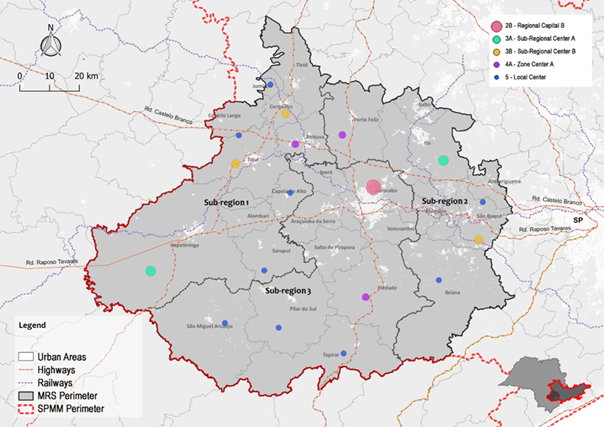
Sorocaba plays a central role in the regional urban hierarchy, acting as the main decision-making center and exerting significant influence over the metropolitan region’s economic and administrative dynamics. It is also one of the few municipalities in the region that presents a notable urban area, conurbation (with Votorantim) and a consolidated urbanization process relative to its total area. However, despite this centrality, Sorocaba does not meet the criteria for a metropolis as defined by the Brazilian Institute of Geography and Statistics (IBGE), being officially classified as a medium-sized city and a regional capital. The other municipalities within the MRS, almost small, are largely characterized by rural areas or conservation zones. This configuration reveals not only an atypical metropolitan profile but also a singular metropolization process, in which the absence of a metropolis may be the least of its challenges, given a regional governance that must balance urban and rural dynamics while facing issues such as territorial fragmentation and difficulties in implementing integrated metropolitan policies.
In this regard, in 2023, the city received national recognition by ranking first in the state of São Paulo and second in Brazil in the United Nations Sustainable Cities Program (PCS). In addition to Sorocaba, four other municipalities in the MRS are signatories of the program, reinforcing the commitment of some municipalities to the SDGs and the implementation of public policies focused on sustainability. At the São Paulo State level, in 2023, Sorocaba also ranked first in the Green and Blue Cities Program (PMVA). Although the participation of some municipalities in the PCS indicates efforts towards governance aligned with global guidelines, the implementation of integrated metropolitan policies still faces significant challenges. Institutional fragmentation and asymmetries between municipalities result in unequal responses to sustainability demands and climate adaptation, highlighting the difficulty of consolidating collective action strategies at the regional level. In this context, understanding how the climate agenda materializes in the MRS requires an analysis of the mechanisms that condition the adoption and implementation of the wider environmental policies they are integrated with within the territory. The following section investigates the causal process linking metropolitan governance to environmental policies, analyzing the challenges faced by MRS municipalities in incorporating the climate agenda and building effective responses for climate change mitigation and adaptation.
Causal process: MRS and the un climate agenda
1. Regional Disparities in Local Climate Policy
Searches conducted on the official platforms of the municipalities in the MRS revealed limited information specifically related to climate change. Most documented actions focused on environmental awareness events, such as Environment Week, Water Day, and the Green June Campaign. However, a review of the platforms of municipal legislative chambers showed that all municipalities have some form of environmental protection council. Furthermore, most municipalities implement specific actions related to solid waste management, reforestation, energy transition, and, notably, the introduction of environmental education policies. Despite these efforts, the initiatives remain purely local in scope and are often carried out in isolation without integration at the metropolitan scale.
In another way, an example of this local scope is Bill No. 124/2007 (Itapetininga, 2007), which proposed the creation of the Municipal Climate Change Policy (PMMC) in Itapetininga. Although initially approved by the municipal chamber, it was later vetoed in 2009 on the grounds of unconstitutionality when a new administration took office. Rather than being discontinued mid-process, this case illustrates a failure to mobilize climate policy altogether. In contexts where political commitment is weak and transnational engagement absent, policies may remain in a latent or static state, what Temenos & Lauermann (2020) describe as “immobile policies”. Even in municipalities such as Tietê, São Roque, and Piedade, where climate policies were still legally approved, there is little to no evidence of subsequent concrete plans or institutionalization. This reinforces the notion that, in the absence of broader networks and implementation mechanisms, climate policies remain fragile, fragmented, often symbolic and not materialized in practice at the local level.
This scenario reveals a disconnect between the guidelines of the National Policy on Climate Change (Law No. 12.187/2009) and its implementation at the municipal level, where climate policies often face discontinuity due to the lack of integration with national and international plans. Adding to this picture is the existence of the State Policy on Climate Change (PEMC), established by State Law No. 13.798/2009 and regulated by Decree No. 55.947/2010, which sets the State of São Paulo’s commitment to addressing the challenges of global climate change. However, coordination between this state-level policy and the municipalities of the MRS remains limited. In this sense, the fragmentation and uneven adoption of climate policies among the municipalities that make up the MRS indicate that the main driving force behind environmental actions still relies on state and federal incentives.
The lack of integration among municipalities complicates the formulation and maintenance of mitigation and adaptation strategies for climate change. In this context, the implementation of the climate agenda in these municipalities also reflects the role of the Brazilian state as a mediator of these policies and how they ended up being translated locally. Although the PMMC establishes guidelines for states and municipalities, the implementation of these policies in Brazil occurs within a decentralized framework, where municipalities often receive little technical and financial assistance to effectively operationalize national directives (Viola & Franchini, 2018).
Another critical challenge is the weak adherence of municipalities to the SDGs. Although the MRS Climate Change Charter exists, few municipalities - such as Tietê, Araçariguama, and Itu - demonstrate explicit alignment with the SDG agenda. This misalignment suggests that local climate policies have not yet been fully incorporated into sustainable development strategies, making it more difficult to access international funding and institutional support. Additionally, municipal climate change conferences remain an underdeveloped practice. Only Boituva, Itapetininga, Salto, São Roque, Araçoiaba da Serra, Pilar do Sul, Salto de Pirapora, Sorocaba, and Votorantim hold such events, limiting the debate and policy formulation in other cities. These conferences are essential mechanisms for engaging stakeholders, strengthening intermunicipal cooperation, and expanding public participation in the climate agenda.
2. Sorocaba: Constructing and Translating The UN Climate Agenda
Sorocaba represents the most structured case of translation of the UN Climate Agenda within the MRS. As a member state of the UN, Brazil has committed to integrating the SDGs into national and subnational policy frameworks. In this context, Sorocaba's engagement with transnational networks - particularly ICLEI and the Urban-LEDS initiative - has enabled the city to reinterpret and institutionalize SDG 13 through concrete governance structures, such as the Municipal Climate Action Plan (Sorocaba, 2023) and dedicated climate policy instruments. These were not simply imported, but co-produced through a relational process involving international cooperation, technical assistance, and local political agency.
The relationship between the global climate agenda and local policies does not occur automatically but rather through institutional mechanisms that facilitate this translation. In the case of MRS, the role of networks such as ICLEI and the adherence to Urban LEDS were crucial in aligning local initiatives with UN guidelines for fundings. The incorporation of SDG 13 into municipal and metropolitan plans took place through the influence of these programs, promoting capacity-building, access to funding, and knowledge exchange. The UN operates as a catalyst, encouraging the adoption of international standards through transnational networks, without necessarily imposing a single governance model. Additionally, UN initiatives, such as the Global Covenant of Mayors for Climate & Energy and the Sustainable Cities Program, have contributed to the dissemination and construction of SDG 13 in Latin American municipalities, including those in the MRS, through capacity building, data sharing, stakeholder engagement as well as access to resources.
Due to prior engagement and established connections, in 2012, eight Brazilian cities - including Sorocaba - were selected to participate in the Urban LEDS project, along with 21 cities from South Africa, India, and Indonesia. Additionally, eight "Experienced European Cities" were included in the program to share their best practices, knowledge and experiences that informed policies in Sorocaba as relevant references (Urban LEDs, 2016). The IntegraBike case study (Local Governments for Sustainability [ICLEI], 2015, 2016), which involved Sorocaba’s Bicycle Plan and its public bike-sharing system - designed to integrate with the bus network and the planned BRT corridor - presents Sorocaba as an international success story, alongside cities such as Copenhagen, Amsterdam, and New York. These cases, highlighted in ICLEI’s publications as best practices, play an important role in demonstrating how integrated urban transport systems and cycling infrastructure can contribute to emissions reduction and improved quality of life. In this context, such references help guide the long-term planning of cities within the network, aiming to strengthen the transition toward low-emission urban development in emerging economy countries.
Through participation in Urban LEDS and exposure to European planning practices, Sorocaba adopted international climate governance tools - such as GHG inventories, mobility diagnostics, and low-emission development strategies - which were then translated into its own local institutions and instruments, such as the Climate Action Plan and the Municipal Urban Mobility Plan. These experiences illustrate not only the exchange of technical knowledge but also the relational and iterative nature of policy learning, where external models are adapted to local constraints and opportunities.
Between 2015 and 2016, Sorocaba institutionalized key components of its local climate strategy. Mayor Antonio Carlos Pannunzio submitted Bill No. 39/2015, formally establishing the project of Municipal Climate Change Policy (PMMC; Municipal Chamber of Sorocaba, 2015)2, which was approved based on alignment with the UNFCCC. In parallel, the city published its first GHG Inventory, created climate governance bodies, and later, through Urban LEDS II, developed a Climate Risk Analysis and second GHG Inventory (2014-2017) (ICLEI, 2014). These processes were supported by WayCarbon and local academic institutions. The legal establishment of the PMMC through Law No. 11.477/2016 (Sorocaba, 2016)3 further embedded climate governance into municipal structures. The law emphasizes articulation with the State of São Paulo, metropolitan municipalities, and the São Paulo Macrometropolis. It provides for regional conferences and the use of international funding mechanisms, such as the Green Climate Fund. Among these mechanisms, highlighting the global interconnectedness around information and financial mechanisms that stimulate a standardized way of implementation and facilitate the adoption of shared reference frames (see Table 1). Although Sorocaba has played a significant role in adopting climate policies aligned with SDG 13, the other municipalities of the MRS have not necessarily followed the same path. Instead of a direct replication, there is evidence of a path dependency process, in which each city shapes its approach based on its institutional capacity, political priorities, and available support networks (Pierson, 2000).
Table I Sorocaba’s Climate Agenda.
| Year | Instrument / Action | Influence / Support | Scale | Outcome |
|---|---|---|---|---|
| 2012 | Entry into Urban LEDS | ICLEI, UN/EU | Local | Initial engagement with SDG 13 frameworks |
| 2015 | Bill No. 39/2015 / PMMC Law Project (Sorocaba, 2015) 1st GHG Inventory | UNFCCC, WayCarbon/UN | Local | Formal proposal of PMMC, climate data established |
| 2016 | Law No. 11.477 enacted (PMMC) | Local executive, ICLEI/UN | Local | Institutionalization of local climate policy |
| 2017 | 2nd GHG Inventory and Climate Risk Analysis | Urban LEDS II/UN | Local | Technical foundation for action plan |
| 2019 | First Regional Climate Change Forum | AGEM-MRS, ICLEI/UN/EU | Metropolitan | Reinforcement of metropolitan leadership, circuit of policy mobilities |
| 2019 | Open Letter of the Sorocaba Metropolitan Region | Local entities/Local municipalities | Metropolitan | Circuit of policy mobilities |
| 2020 | 2nd Regional Climate Change Forum & IDSC Ranking Recognition | AGEM-MRS, ICLEI/UN/EU | Metropolitan | Reinforcement of metropolitan leadership, Circuit of policy mobilities |
| 2023 | Thematic Chambers in Climate Changes | AGEM-MRS/Local entities/Local municipalities | Metropolitan | Circuit of policy mobilities |
Sorocaba’s experience highlights how integration into international networks and coordination across multiple scales - municipal, metropolitan, national, and international - facilitates the implementation and continuity of climate policies. However, even with legal frameworks requiring a regional/metropolitan approach, the lack of an effective governance structure to coordinate collective efforts keeps climate initiatives fragmented and unequal, making them highly dependent on the political will of each municipality.
3. Metropolitan Scale: Fragmentation and Emerging Coordination
Metropolitan coordination around the climate agenda has progressed through strategic initiatives. A significant milestone occurred in November 2019, when the Sorocaba City Hall organized the 1st Regional Climate Change Forum, bringing together the Department of Environment, Parks, and Gardens (SEMA), the Department of Institutional and Metropolitan Relations (SERIM), and the University of Sorocaba (UNISO). The event marked an important step in building a collective approach to the climate crisis, resulting in the drafting and release of a Metropolitan Charter, which was later made available for public consultation (Jornal Z Norte, 2019).
The "Open Letter of the Sorocaba Metropolitan Region for Combating Climate Change" (Municipal Government of Sorocaba, 2019) represents a significant collective commitment, signed by a wide range of actors, including local governments, the productive sector, civil society organizations, and research and education institutions. The document emphasizes the urgency of addressing climate change as a global challenge that requires coordinated actions at all levels of society. It establishes ambitious commitments for decarbonization and strengthening regional resilience, in addition to enhancing transparency through the creation of a Monitoring, Reporting, and Verification System. The cooperation between different levels of government and the need for policies aligned with global agreements and the 2030 Agenda are also highlighted, demonstrating the MRS’s commitment to environmental issues and climate change mitigation (Secretaria de Meio Ambiente de Sorocaba [SEMA], 2019).
Since its creation in 2015, the Metropolitan Agency of Sorocaba (AGEM-Sorocaba) has played a relevant role in the regional climate agenda. An analysis of its platform revealed initiatives focused on the dissemination and implementation of policies in the municipalities of the Sorocaba Metropolitan Region (MRS). Among the main projects, two stand out: "Our MRS: Plans, Dreams, and Possibilities"4, with the project Metropolitan Cities 2030 (MC-2030)5; and the "Training in Urban Planning Instruments: Municipal Master Plans and Integrated Urban Development Plans - MRS (TUPI-MRS)". The first project aims to facilitate the exchange of best practices (linked within environmental certifications, hydric resources and urban gardens) across municipalities of the metropolitan region, fostering dialogue between local administrations. This exchange is grounded in the understanding that policy learning can occur through the direct appropriation of initiatives developed in other regions - what one of the program’s coordinators described as a kind of “copy and paste” strategy (City Council of Sorocaba, 2023). The second promotes technical training for territorial planning, reinforcing the incorporation of the SDGs from the 2030 Agenda into regional public policies.
The Episode #6 of MC-2030, recorded in 2022, focused on SDG 13 (Climate Action) and included contributions from the Director of AGEM-Sorocaba and invited experts - a forestry engineer, an architect and environmental consultant. The discussions emphasized environmental education, public awareness, and the promotion of sustainable practices at the local level. One of the guests, an environmental engineer from São Paulo State University (UNESP), highlighted the growing importance of environmental certification focused on reforestation, increasingly demanded by both international and domestic markets. Another speaker addressed the critical issue of water pollution. Among the concrete examples mentioned during the episode, the only implemented local initiative was the “Adopt a Square” program, a public-private partnership policy created in 1996 and reactivated in Sorocaba in 2019. It allows private entities to support the maintenance and preservation of public green spaces. Although modest, the initiative reflects an attempt to localize SDG 13 through governance mechanisms that encourage civic participation and environmental responsibility.
The TUPI-MRS6, aimed to strengthen the technical capacity of municipal managers and serve as a platform for disseminating the 2030 Agenda in the Sorocaba metropolis. Held in June 2023, it was structured into three groups, corresponding to the sub-regions of the MRS, with two representatives per municipality. Its main objective was to support the implementation of the Integrated Urban Development Plan (PDUI) by training technical teams responsible for local urban planning. The curriculum covered topics such as the development and management of municipal master plans and their alignment with regional guidelines. A significant portion of the training was dedicated to finalizing the PDUI, completed in 2022 but still awaiting formal approval.
The Special Thematic Chamber on Climate Change7 was officially established on May of2023, following discussions that had been ongoing since 2020 (AGEM-Sorocaba, 2023; AGEM-Sorocaba, 2020). However, despite its formal establishment, no evidence or records of meetings or concrete actions conducted by the Thematic Chamber have been found to date. This scenario reflects a recurring challenge in policy transfer, where the creation of institutional structures does not necessarily ensure their effectiveness. As Dolowitz and Marsh (2000) point out, policies can be adopted without necessarily being implemented, particularly when gaps exist in technical capacity, funding, or monitoring. Without active support networks and well-established institutional mechanisms, instruments like the Thematic Chamber risk remaining purely normative without translating into concrete actions (Benson & Jordan, 2011).
The initiatives promoted by AGEM-Sorocaba so far demonstrate progress in municipal technical capacity-building and community engagement with the climate agenda. However, the lack of progress within the Thematic Chamber underscores the need to strengthen metropolitan governance and overcome institutional fragmentation, ensuring that local efforts translate into integrated and continuous strategies. Studies on urban governance indicate that learning processes and intermunicipal collaboration are essential for the successful implementation of climate policies (Bulkeley, 2010; Kern, 2019). For the MRS to overcome this challenge, it is crucial to establish mechanisms that ensure coordination among municipalities and the exchange of best practices, fostering a more dynamic process of learning and climate policy implementation (Tait & Jensen, 2007). Despite these initiatives, the translation of the UN Climate Agenda into a coordinated metropolitan strategy remains incipient. Most actions rely on discursive convergence rather than binding mechanisms, and Sorocaba continues to operate as a central node without fully fostering horizontal governance across the MRS. The metropolitan scale has thus functioned more as a discursive space than an institutionalized arena for climate policy. As a result, the construction and translation of metropolitan approaches aligned with Agenda 2030 remain uneven and contingent on the leadership of specific actors, rather than on a shared governance framework. This reinforces the importance of examining not only what institutions exist, but how - and by whom - they are activated in practice.
V. Causal mechanism: transnational networks and the metropolis in the transfer of ideas
As outlined in the previous section, transnational networks, such as ICLEI, play a significant role as intermediaries in the movement of ideas, practices, theories and agendas as well as resources, particularly within local and metropolitan structures. ICLEI, which describes its actions as "peer exchange and capacity building," facilitates the advancement of global agendas, such as climate change adaptation. This occurs through institutional induction, which is perceived as non-coercive, where local governments choose to adopt certain policies based on the exchange of models and best practices within the network, whether with peers or consultants, supposedly without hierarchical imposition (Faria, 2018).
However, these agendas are driven by international funders. In the case of Urban-LEDS, the European Union was the primary funder in both phases of the project, as has been the case in various initiatives operated by ICLEI in Latin America. This funding allows local governments to access resources, obtain technical support, and expand their integration into global networks, which, in turn, enhances the visibility and competitiveness of these cities. As Jakobi (2009) points out, the adoption of global agendas at the local level is influenced by a quest for legitimacy, reflecting global cultural expectations regarding how a state or region should behave and develop.
The city of Sorocaba stands out in this context. This status as a "best practice" was not self-ascribed but gradually constructed through Sorocaba's early and visible participation in international programs such as Urban LEDS, its formal adoption of climate legislation aligned with the UNFCCC, and its active engagement in knowledge-sharing initiatives coordinated by ICLEI. Notably, the city’s inclusion in ICLEI publications alongside global reference cases such as Copenhagen and Amsterdam (ICLEI, 2016) positioned Sorocaba as an emerging model of climate governance among medium-sized cities in the Global South. This international recognition has been reinforced by domestic achievements. Sorocaba is one of the pioneer municipalities in Brazil’s PCS, and in 2023, it ranked first in the state of São Paulo in the PMVA, confirming its leadership at the subnational level in environmental and climate policies. This dual validation - external and internal - combined with the city’s strategic efforts to institutionalize climate action through GHG inventories, risk analyses, and action plans, has contributed to its recognition as a national leader in the implementation of SDG 13. As a local and national, its experience illustrates how municipalities can leverage global urban agendas to drive local transformations. The city’s commitment to SDG 13 highlights the crucial role of cities in implementing the 2030 Agenda.
However, the relational methodology used in this study revealed that policy transfer is not a mere exercise in replication but a complex process of adaptation and implementation. Sorocaba’s leadership demonstrates that, beyond adopting global targets, the city also seeks to engage the community in these discussions, positioning itself as a reference, positioning its policies as best practices in the Brazilian context. In other MRS municipalities, however, this dynamism occurs only partially and in a heterogeneous manner. The capacity for adaptation varies according to the existing institutional structure of each municipality, often limited by a shortage of human and technical resources, especially in smaller municipalities.
The alignment of widely disseminated global practices faces challenges due to the predominance of municipal-scale governance and planning instruments. However, some initiatives, such as the Regional Climate Change Forums, the MRS Charter for Climate Change Response, and the Special Thematic Chamber on Climate Change, indicate recent progress in metropolitan governance. The COVID-19 pandemic and the increasing frequency of extreme climate events have reconfigured political priorities, encouraging subnational actors to intensify paradiplomatic collaborations, particularly through virtual events and transnational networks.
Sorocaba’s efforts, along with the "Our MRS" project and the training course on urban planning tools, highlight the importance of interinstitutional partnerships in subnational governance. The collaboration between municipal government, AGEM-MRS, educational institutions, and the local community strengthens the implementation of public policies and expands social participation in the climate agenda. In this regard, the emphasis on technical capacity-building, as evidenced by the training course offered by AGEM-MRS, underscores the need to foster well-informed and technically skilled human capital for sustainable urban planning (Barbi et al., 2024). Education is a pillar of sustainable development, providing the skills needed to interpret and implement policies effectively, while the interaction between experts and municipal managers demonstrates a commitment to continuous education, even though it remains mostly limited to technical enhancement.
By focusing on knowledge production, co-creation, and its dissemination, it is essential to recognize that the complexity of reality and global challenges demand rethinking, redefining, and relearning. This can drive new ideas based on the concept of social learning, fostering changes in how the environment is approached (Jacobi et al., 2016). The learning process is essential for transforming how we perceive reality. One of the biggest challenges is enhancing resilience through the role played by the learner, the subject being taught, and the potential physical, biological, social, cultural, and economic changes involved in the process (Jacobi, 2005). On the other hand, critical education plays a crucial role in the SDG objectives and the actions of global actors. This is a key point, as education not only empowers but also aligns discourses and techniques. The ability to critically question, analyze, and understand global issues is fundamental for fostering innovation and ensuring the appropriate landing of ideas.
Furthermore, competition among cities is another factor influencing the adoption of projects and the language associated with the SDGs. As central municipalities in metropolitan regions have more resources and greater institutional capacity to participate in international projects and attract funding for locally adapted initiatives, they often hold a strategic advantage over smaller municipalities. In many cases, access to funding for climate adaptation is highly competitive, particularly in the Global South, where resources are limited and often allocated based on institutional capacity, pre-existing networks, and political influence (Burch et al., 2013; Betsill & Bulkeley, 2006; Granberg & Elander, 2007). This dynamic results in what some scholars refer to as the "climate finance divide", where well-connected municipalities secure most investments due to their networks, which also help them attract international funding, while smaller cities struggle to access similar opportunities (Anguelovski & Carmin, 2011; Kern, 2019).
Although intermunicipal cooperation is a fundamental aspect of climate governance, the reality of financial constraints makes regional competition for scarce resources a recurring phenomenon. In the literature on the subject, studies show that local governments frequently compete for international funding opportunities, visibility in global networks, and recognition as climate leaders, which can lead to prioritizing individual gains over collaborative solutions (Toly, 2008). This competitive logic can reinforce disparities within metropolitan regions, where central cities consolidate their leadership in climate actions, while peripheral municipalities struggle to implement adaptation policies due to limited technical capacity and institutional fragmentation (Bulkeley & Kern, 2006).
Sorocaba's position within the MRS (Santana-Chaves, 2025) and its prominence in the urban hierarchy are strongly reinforced through international agendas. With the consolidation of its institutional networks and support from other actors and organizations involved in the implementation of the SDG agenda, Sorocaba mobilizes and develops plans and resources more effectively than its smaller neighboring municipalities. In our specific case, it is difficult to determine whether competition is truly present, as the perceived reality suggests that only a few competitors are actually engaged in this race.
The metropolitan climate governance of the MRS faces the challenge of balancing cooperation and competition. While AGEM-MRS plays an essential role in regional coordination, barriers still exist for smaller municipalities to fully participate in decision-making and access the necessary resources for climate adaptation. Sorocaba’s leadership in the PCS and in the implementation of SDG 13 exemplifies how global agendas can drive local actions, but they also reinforce urban hierarchies. Ensuring that metropolitan climate governance is both inclusive and effective requires not only the incorporation of global frameworks but also the strengthening of regional cooperation to mitigate inequalities in access to climate resources.
The creation of the Special Thematic Chamber on Climate Change raises expectations for a deeper debate on these issues but also calls for a critical reflection on how governance structures can be redesigned to promote greater regional equity, rather than reinforcing existing asymmetries.
VI. Final remarks
The current study adds to the literature by elucidating the role of international entities in the form of global agendas, particularly those centred on environmental issues and climate action, which are transferred, modified, and implemented in particular metropolitan contexts. By highlighting the case of Sorocaba and its metropolitan region and including the ODS-13 agenda, this article enhances the current literature by providing an analysis of the dynamics involved in the dissemination and localisation of global sustainability policies in Brazil. Our study adds to the literature by elucidating the role of international entities in the form of global agendas, particularly those centred on environmental issues and climate action, which are transferred, modified, and implemented metropolitan contexts. The translation of global policies into local contexts, as focused by many studies, demonstrates the interaction between local and global contexts and shapes contemporary urban planning and governance practices. Cities are strategic actors in global climate governance and do not exist in isolation. Depending on their position in the division of labor, they can play very different roles in global networks where power dynamics between levels influence the transfer of ideas, practices and agendas and the ultimate establishment of policies. The emergence of international networks as independent and influential actors, as well as the pivotal role of transnational networks, consultancies, and NGOs, illustrates the shift in how these entities are perceived. These networks play a crucial role in spreading innovative practices and public policies, encouraging the adoption of adaptation actions and the application of ideas in various urban contexts.
The study also highlights the role of international organisations in building and strengthening these epistemic networks and communities (Faria, 2018; Haas, 1992), which help shape global public policies. These organisations not only set goals and policies, but also set up financial, training, and monitoring mechanisms that influence the conditions under which metropolitan areas and municipality’s function and align with international objectives. Metropolitan regions and their plans and policies can provide spaces for knowledge sharing and governance, which will advance the inclusion of certain (generally more politically and economically powerful) municipalities in transnational networks to benefit the entire region and promote internal trade. In Brazil, where metropolitan governance is often limited by legal and institutional ambiguities, the role of international organizations in supporting technical capacity-building and funding opportunities becomes even more critical. This study demonstrates that Brazilian metropolitan regions can benefit from structured international cooperation, reinforcing their ability to implement climate policies despite existing governance challenges.
In the field of urban studies, this article highlights the feasibility of ambitious sustainable development goals while providing practical insights into the alignment between the theory of sustainable global development and municipal practice. The analysis of MRS data shows that cities can be leaders in sustainability, even challenging national and international references in urban planning and management. However, the implementation of ODS-13 in the MRS does not happen uniformly. The integration of the metropolitan climate agenda is complicated by institutional inequality and differences in technical capacity among municipalities. This scenario emphasises the need for more inclusive strategies and adequate funding to overcome these obstacles, for which some municipalities turned to international sources. This study highlights that while leading cities like Sorocaba can access transnational networks and funding mechanisms, smaller municipalities within metropolitan regions often struggle to do so. The findings suggest that fostering metropolitan-scale coordination, with mechanisms to support smaller municipalities, could help reduce these disparities and create a more cohesive regional climate strategy.
The observed local initiatives show a greater focus on environmental education and capacity-building events for territorial planning, highlighting the significance of a technically skilled human capital and an informed community. This confirms that education and training are the cornerstones of such initiatives, with a focus on providing individuals and organisations with fundamental knowledge. However, there is still uncertainty over the effectiveness of these measures to ensure full capacity to understand and implement effective policies, especially in smaller municipalities. Given the complicated global challenges, it is imperative that we reconsider and improve learning processes, encourage social learning, and adopt a transformative approach to environmental issues, particularly those related to emerging climate change. .
The next steps for the research could involve ad hoc case studies in other metropolitan regions to compare approaches and outcomes, giving a more comprehensive view of metropolitan practices. As well as other themes, such as mobility and housing. In addition, it would be beneficial to look into local leaders' perceptions and engagement with regard to already-implemented sustainable policies, as well as their motivations and interests in the climate agenda. A potential focus could be public administration and its (continuities) as well as local educational and research institutions.
Finally, we recommend that future research take into account the development of analytical frameworks that could help predict and measure the long-term effects of policies developed from global agendas, both at the local and metropolitan levels. Strengthening municipal governance and integration on international networks is not only desirable, but also necessary to consolidate effective and equitable climate adaptation and mitigation strategies. For Brazilian metropolises, this means prioritizing collaborative governance structures that integrate different scales of decision-making, ensuring that global commitments translate into concrete local actions. Without effective coordination at the metropolitan level, climate initiatives risk being unevenly distributed, reinforcing existing inequalities rather than mitigating them.
Author`s contribution
Igor Matheus Santana Chaves: Conceptualization, Methodology, Software, Validation, Formal analysis, Investigation, Resources, Data curation, Writing - original draft preparation, Writing - review and editing, Visualization, Supervision, Project administration, Funding acquisition. Leticia Costa de Oliveira Santos: Conceptualization, Formal analysis, Investigation, Resources, Writing - original draft preparation, Writing - review and editing. Pedro Roberto Jacobi: Writing - original draft preparation, Writing - review and editing, Supervision, Project administration, Funding acquisition. Niklas Werner Weins: Conceptualization, Validation, Formal analysis, Investigation, Resources, Data curation, Writing - original draft preparation, Writing - review and editing.
Legal documents
Itapetininga. (2007). Projeto de Lei n. 124 de 13 de Dezembro de 2007. Institui a Política Municipal sobre Mudanças Climáticas - PMMC, e dá outras providências [Bill No. 124 of December 13, 2007. Establishes the Municipal Climate Change Policy - PMMC, and provides other provisions]. https://camaraitapetininga.sp.gov.br/Consulta/Documentos/Documento/36882
Sorocaba. (2015). Projeto de Lei 39 de 29 de Fevereiro de 2015. Institui a Política Municipal sobre Mudanças Climáticas - PMMC, e dá outras providências [Bill No. 39 of February 29, 2015. Establishes the Municipal Climate Change Policy - PMMC, and provides other provisions.]. http://syslegis.camarasorocaba.sp.gov.br:8383/syslegis/materiaLegislativa/imprimirTextoIntegralFinal?idMateria=20004
Sorocaba. (2016). Lei Ordinária 11.477 de 20 de Dezembro de 2016. Institui a Política Municipal sobre Mudanças Climáticas - PMMC, e dá outras providências [Ordinance No. 11.477 of December 20, 2016. Establishes the Municipal Climate Change Policy - PMMC, and provides other provisions.]. https://www.camarasorocaba.sp.gov.br/propositura.html?id=5e3f0e0b05d7040f28b455a8
Sorocaba. (2023) Plano de Ação Climática [Climate Action Plan.]. https://meioambiente.sorocaba.sp.gov.br/gestao-ambiental/plano-de-acao/

