




 Inglês (pdf)
 Artigo em XML
 Referências do artigo
 Tradução automática
 Enviar este artigo por email
 Citado por SciELO
  Similares em
SciELO
Similares em
SciELO 
 Permalink

Highlights
The three most studied threats in multi-hazard scenarios are urban floods, landslides and earthquakes.
Collaboration between institutions and authors remains limited, indicating the need to strengthen research efforts.
The most cited authors identified three research areas: i) multi-hazard; ii) risk management and vulnerabilities; and iii) processes and methodologies related to hazard assessment.
Studies addressing urban vulnerability and complex relationships in urban environments in relation to hazard assessment and its consequences were considered hot topics.
Introduction
The use of the term multi-hazard and its variations is not new, having appeared in Agenda 21 for sustainable development with a call to include multi-hazard research into human settlement planning (United Nations [UN], 1992). As the international agenda evolves, the use of the term ‘multi-hazard’ has also changed. In 2002, it appeared in the Johannesburg Plan as an approach to address hazards in all forms. The document called for actions to strengthen institutional capacities and promote international research on an integrated multi-hazard approach (UN, 2002).
Over the years, awareness of the importance of addressing multiple hazards in urban environments continued to grow, driven by, among other aspects, increasing migration to urban centers and the rising number of people living at risk, both physically and socially. When hazards manifest in urban contexts, they typically result in significantly greater losses than in rural areas, due to the higher densities of population and infrastructure (S. Wang et al., 2022).
Despite the existing connection between disaster risk reduction (DRR) strategies and the mitigation of vulnerability, there is a lack of integration of DRR measures into the urban planning process in areas experiencing rapid urbanization, particularly in terms of actions effectively oriented towards addressing multi-hazard scenarios (Kalaycıoğlu et al., 2023).
Given the close relationship between DRR and multiple hazard scenarios, the Sendai Framework for Disaster Risk Reduction (SFDRR) (UN, 2015) emphasizes the importance of a multi-hazard and multisectoral approach to effectively reduce disaster risk. It also underscores the need to understand risk through, among other means, multi-hazard and solution-driven research.
Embedding multi-hazard analysis into urban planning includes not only DRR but also the comprehension about how to integrate the existing hazards. Since urbanization modifies living patterns, hazard damage potential can be amplified by human activity. According to the Global Assessment Report of 2022, the outcome of a hazard event depends on how the elements of the affected systems interact with each other (United Nations Office for Disaster Risk Reduction [UNDRR], 2022).
In this context, this study conducted a systematic review of urban multi-hazard research that has been published in the last years using bibliometric analysis. Our goal is to provide an overview of the main characteristics of urban multi-hazard research, focusing on the understanding of how multiple hazards are being integrated into a single product and the processes involved in that integration, in order to provide insights to further researchers. It is important to highlight that while there is an extensive number of documents publicized about individual hazards, the number of publications about multi-hazard is limited, especially those related specifically to urban areas. In this context, it is worth mentioning that the focus of the present research is not on identifying individual methodologies for assessing single hazards but rather on understanding how multiple hazards have been integrated into a single product and the processes involved in that integration.
Method
The bibliometric search was preceded by the application of two guiding protocols: the Preferred Reporting Items for Systematic Reviews and Meta-Analyses (PRISMA) (Page et al., 2021) and a guide for cleaning bibliometric data (Lim et al., 2024). PRISMA protocol basically defines four steps for systematic reviews that consist in identification, selection, appraisal and inclusion. The workflow adopted in this review is schematized in figure 1.
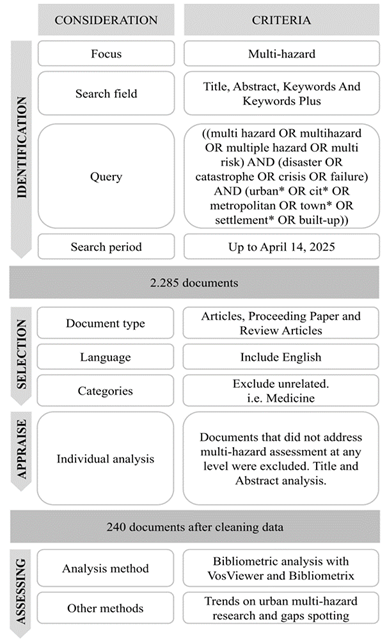
Fig. 1 Flowchart of the documentation extraction process and data analysis. Source: Authors’ elaboration
2.1 Description of data retrieved
This article conducted a bibliometric analysis to explore the current landscape of multi hazard research worldwide. For this, up-to-date data from Web of Science (WoS) database was retrieved. The platform is one of the most complete international catalogues for bibliometric analyses and literature reviews, allowing comparison of publications and identifying trends (Leydesdorff, 2012).
The primary characteristic of the search is the query used. That said, the search was conducted in April 2025, on the Web of Science database. The field tag used was TS=Topic, which extends the search in the fields Title, Abstract, Keywords and Keywords Plus. The search query was: TS=((multi hazard OR multihazard OR multiple hazard OR multi risk) AND (disaster OR catastrophe OR crisis OR failure) AND (urban* OR cit* OR metropolitan OR town* OR settlement* OR built-up)).
The initial search resulted in 2285 documents. The cleaning phase involved excluding irrelevant documents and enhancing the overall quality of the final dataset. The inclusion and exclusion criteria for document selection were conducted in two stages. The first involved a semi-automatic process comprising: (a) the exclusion of WOS Categories (and their associated articles) listed in the search panel that have low adherence to the theme. For instance, a study may reference multi-hazard topics but focus primarily on Medicine (Dermatology category) or another unrelated subject. In such cases, the category and its documents should be excluded due to their limited relevance to the actual research objective; (b) the inclusion of documents classified as Articles, Proceedings Papers, and Review Articles; (c) the exclusion of documents published in other languages than English. The second stage consisted of an individual analysis including: (d) the exclusion of documents whose titles and/or abstract clearly indicated a focus on single hazard analysis or did not address urban multi hazard contexts.
Based on the above-mentioned screening criteria, 2045 documents were excluded. The remaining documents (240) were exported in plain text format, preserving full records and referenced citations.
2.2 Bibliometric analysis and the main parameters analysed
The second part of the analysis was conducted using VosViewer (van Eck & Waltman, 2010) and Bibliometrix (Aria & Cuccurullo, 2017), both open-source software tools for bibliometric analysis to identify clusters and interconnections within the dataset. VOSviewer and Bibliometrix offer a range of analytical techniques, making it essential to carefully select those most aligned with the research objectives. To identify patterns in urban multi-hazard research, the following variables were selected:
Author Keywords: as the name implies, are the keywords used to identify and provide a broader context for the document. Combined, they can give an idea of the most relevant research areas.
Co-authorship network: refers to documents published by two or more researchers, either with joint responsibility for a single document or multiple documents. This is a key metric to understand the existence of collaborative efforts and may indicate sustained partnerships between authors when a significant volume of co-authored publications is observed (Ponomariov & Boardman, 2016).
Country collaboration: to understand international research partnerships, the analysis examined the most frequent country collaborations, the presence of single- and multiple-country contributions in each document, and the most cited countries. These insights help identify which countries play a significant role in the research field.
Authors co-citation: the analysis is conducted using the reference list and measures how frequently an author is cited across multiple documents. A high co-citation frequency indicates the author's significance as a key reference in both past and future research.
The final part of the analysis focused on a detailed review of selected multi-hazard studies. To better understand how authors integrate multiple hazards into a single product, papers with more than 30 citations were selected for an in-depth analysis. The goal was to identify key aspects that illustrate how the multi-hazard approach is being applied in current research.
The review sought to determine which hazards are commonly studied together. To achieve this, hazards were normalized based on definitions and classifications outlined in the SFDRR (UNDRR, 2020). Other parameters to be evaluated were whether cascading effects are considered, whether historical events were incorporated, the approaches used to assess the hazards, and the methods used to integrate multiple hazards.
3. Results and discussion
3.1 Increasing trend of multi-hazard publications
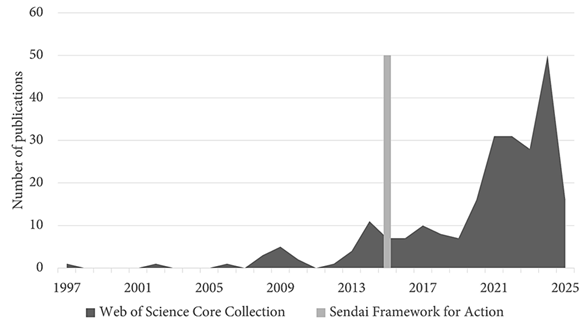
The initial search retrieved 2285 documents, including books, with the earliest publication mentioning multi-hazard found in the WOS core collection dating back to 1991. Despite this, filtered documents started to address multiple hazards in 1997. The annual scientific production, in terms of number of documents per year (fig. 2), experienced minimal activity between 2007 and 2013, with the number of published documents falling between zero and five. However, it was only in 2014 that multi-hazard research began to gain noticeable traction in academic publications. Between 2014 and 2019, the production ranged between seven and 11, but the most meaningful increase occurred in the last five years, between 2020 and 2025, with more than 15 documents per year. Although the concept of “comprehensive multi-hazard research” was introduced as part of the Agenda 21 recommendations for disaster risk reduction (UN, 1992), significant growth in this research area began after the Sendai Framework's publication in 2015. The framework emphasized the importance of a multi-hazard approach as one of its guiding principles (UNDRR, 2025), which may have contributed to increased interest in this thematic area among researchers, as also suggested by Owolabi and Sajjad (2023).
3.2 Clustering analysis
3.2.1 Authors Keywords
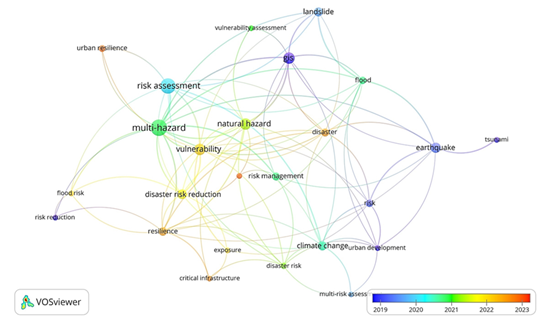
Initially, 1210 keywords were retrieved. Since authors often use varying keywords to describe the same topic - such as disaster risk and disaster risk assessment, or even risk assessment and risk assessment model - the keywords list was exported to Excel for manual review semantic similarities and plural forms. This process was used to generate a thesaurus file to be used on keywords mapping. After the cleaning process, 839 keywords remained. Among them, 26 keywords appeared at least four times and were ranked by their average number of publications per year (fig. 3).
Although the most used author keywords were risk assessment, multi-hazard, GIS, vulnerability, and earthquake, it is important to consider the temporal analysis highlighted in figure 3. It indicates a shift from the processes related to hazard assessment or impact analysis (which include terms such as landslide, earthquake, tsunamis, and GIS) to a people-centred perspective, with terms like vulnerability, resilience, critical infrastructure and urban resilience being appearing most recently. Some researchers suggests that COVID-19 pandemic has made changes on multi-hazard research field, posing vulnerability as a key component in the risk analysis, since it has an important role to individuals, communities, and societies (Albulescu & Armas, 2024; Rogers et al., 2020). On the other hand, Rezvani et al. (2023) suggests that disasters caused by climate change, such as rainfall and sea-level rise, poses significant threat to urban area. Therefore, the intersection of resilience, disaster risk assessment, and climate change has become a major focus of scholarly discussion.
3.2.2 Authorship and collaborative network
Co-authorship network analysis created clusters among 1087 authors, considering a minimum of two occurrences, returning 58 authors and 21 clusters (fig. 4). Among the leading contributors, considering the number of published documents, are Enrico Quagliarini, Guofang Zhai, Gabriele Bernardini and Elena Cantatore. Enrico Quagliarini and Guofang Zhai published the greatest number of documents, totalling five each. The authorship clusters indicate a strong relation within different clusters, the only exception being two clusters, both formed by Italian researchers (highlighted circle).
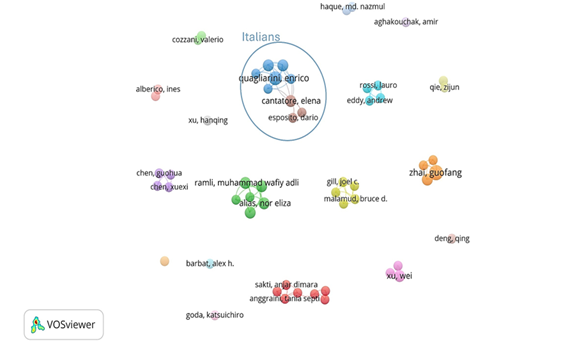
The strongest author connections were found in the Enrico Quagliarini cluster, a group extensively engaged in research on multi-hazard issues in urban areas. This research group sometimes publishes as a cohesive unit (Cremen et al., 2023; Jenkins et al., 2023), and at other times in smaller sub-groups (Gentile et al., 2022). These collaboration patterns align with the insights derived from the bibliometric data.
The collaboration analysis showed that there are few multi-hazard research groups strongly established, with low collaborative practice among different research groups, indicating a need to strengthen multi-hazard research efforts. Owolabi and Sajjad (2023) also found limited collaboration among authors in the broader field of multi-hazard risk assessment, suggesting that research co-production would benefit not only different research groups, but the whole multi-hazard research field.
It is evident that many research groups still publish independently or with limited collaboration, highlighting the need for stronger collaborative research efforts. The Countries Collaboration World Map (fig. 5A) reinforces that limited cooperation, with few/no collaboration in South America, the Caribbean, and Africa, although African countries are the most affected by disasters in number of people (Centre for Research on the Epidemiology of Disasters, 2023). The countries that most frequently collaborate with others on urban multi-hazard research are Italy, United States, and United Kingdom. The strongest bilateral collaborations are observed between Germany and Netherlands, which has resulted in four joint publications. China-Netherlands/United Kingdom/United States, and Italy-Portugal/United Kingdom/United States granted three publications each.
To understand the degree of collaboration between countries, each document was associated to a single country, based on the affiliation of the corresponding author, with the 20 most productive countries being represented on figure 5B. The figure also indicates the number of single-country publications (SCP) and multiple-country publications (MCP). The analysis indicates that, from the most productive country, only Bangladesh is publishing lonely, but from the entire list, there is several others, such as Turkey, Romania, Singapore and Belgium. Although China and Italy produce the largest volume of publications, the United Kingdom demonstrates the highest level of collaboration, with eight out of its ten publications involving co-authorship. This result emphasizes the value of establishing partnerships between countries and institutions. According to Hemingway and Gunawan (2018), such efforts helped reduce hazard risk in the United Kingdom. Countries like Brazil, Colombia, Denmark, Malta, Nepal, and Switzerland, while each producing only one publication, did so in partnership with researchers from other countries.
The most cited countries (fig. 5C) were the United States, China, and Italy, which is consistent with their high volume of publications. In contrast, Australia and Sweden had the lowest citation counts. Among the most cited countries, Greece stands out - ranking fourth overall and holding the highest average citations per publication. This is primarily due to the highly cited paper by Skilodimou et al. (2019), which alone accounts for 215 citations.
Despite the limited collaborative efforts observed, only 16 out of 8714 authors cited in the reference list received 20 or more citations (fig. 6). This suggests that while researchers may not be collaborating extensively across groups, they are consistently referencing and building upon the work of a common set of influential authors. The clusters generated highlight three major research areas. The central cluster (green), which includes authors such as Joel C. Gill, Michael S. Kappes, and Valentina Gallina, is distinguished by its focus on multi-hazard research. These authors are recognized for developing innovative concepts and methodologies that advance the understanding and integration of multiple hazards.
The right-hand cluster (red) consists of Omar-Dario Cardona, Joern Birkmann, Maxx Dilley, Susan L. Cutter, and the UNDRR (formerly UNISDR - United Nations International Strategy for Disaster Reduction, before 2019). This cluster is primarily associated with research on vulnerability mapping, climate change, and risk management. In addition to UNDRR's institutional presence, these authors are frequently affiliated with or collaborate with United Nations initiatives - an organization recognized for its extensive focus on vulnerable populations.
Notably, Susan L. Cutter's contributions have been foundational to the development of the social vulnerability to environmental hazards concept (Cutter et al., 2003). The left-hand cluster comprises Mohammad Ali Pourghasemi, Hariklia Skilodimou, George Bathrellos, and Thomas Saaty. This group is primarily associated with methodological approaches for assessing natural hazards, including the use of the Analytical Hierarchy Process (AHP).
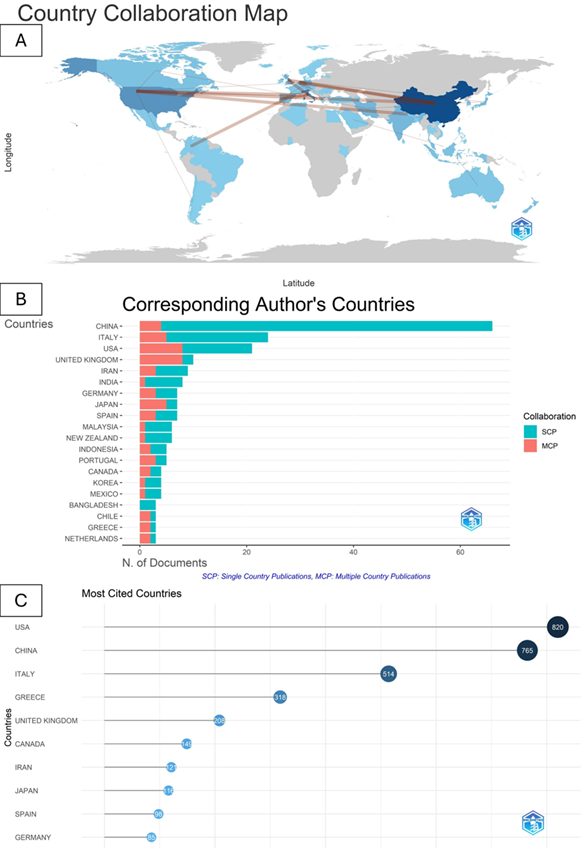
Fig. 5 Collaboration world map. (A) Country collaboration map. (B) Document associated to a single country, based on the affiliation of the corresponding author. (C) Most cited countries. Colour figure available online. Source: Authors’ elaboration
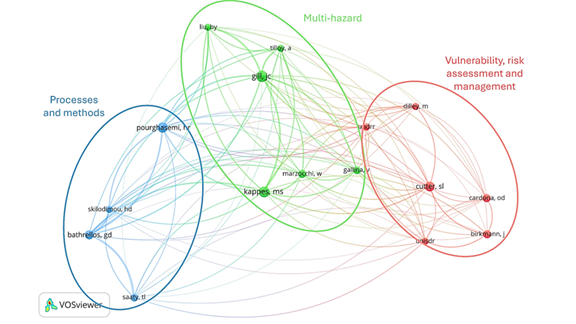
Fig. 6 Co-citation of authors from reference list. Colour figure available online. Source: Authors’ elaboration
3.2.3 Source Distribution of Publications
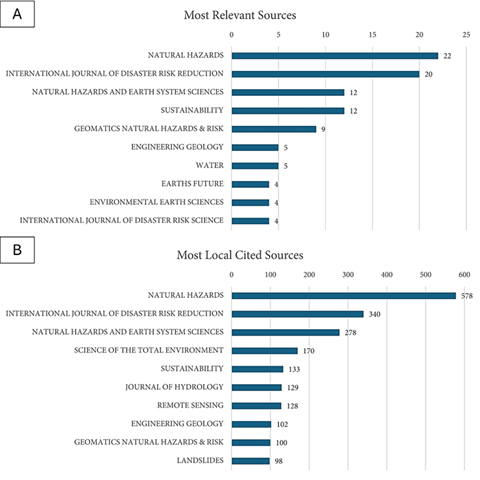
Analysing the main publication sources is essential for identifying the core journals in the field of multi-hazard research. This information is particularly valuable for researchers aiming to contribute to or publish within this area. Natural Hazards is the journal with the highest number of publications, followed by International Journal of Disaster Risk Reduction (fig. 7A). These two journals also occupy the top two positions among the most cited sources (fig. 7B), highlighting their importance as references among urban multi-hazard research thematic field.
2.3.4 Trending topics on urban multi-hazard research
The bibliometric analysis also provided insights into the temporal evolution of urban multi-hazard research and the emergence of key trends. The analysis was conducted by evaluating document abstracts, using a minimum frequency threshold of three occurrences in total and at least three per year. Similar terms were consolidated through a thesaurus file (fig. 8). The term “risk assessment” was the most frequently used, appearing 124 times between 2018 and 2023, followed by “disaster risk”, which appeared 120 times between 2019 and 2023, although, both are generic terms. The topic of “social vulnerability” was the most enduring, spanning a 10-year period, reinforcing its relevance. The tendency of the vulnerability research observed during the previous analysis is also confirmed here, with the most recent terms being related to urban resilience and complex systems. The integrated development of vulnerability assessment in urban environments, considering multi-risk interrelationships and cascading effects have been considered current hot topics by this research.
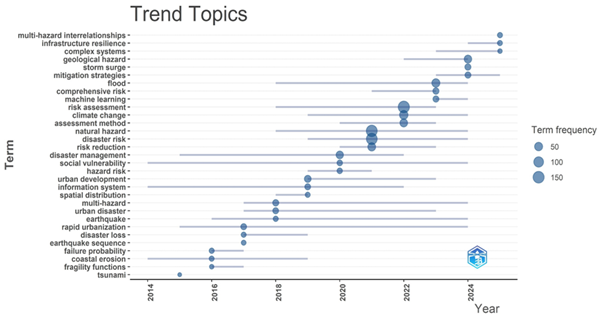
Fig. 8 Trend topics in urban multi-hazard research: Abstracts. Colour figure available online. Source: Authors’ elaboration
The thematic evolution of research titles was analysed by dividing the dataset into two time slices, using the years of 2015 and 2020 as dividing points. The primary objective was to identify emerging trends and shifts in urban multi-hazard research over the past ten years, considering the periods 2015-2019 (fig. 9A) and 2020-2025 (fig. 9B). The analysis divides topics into four quadrants, grouping them by relevance and development degree. The upper-right quadrant represents the most relevant and recent themes, while the bottom left quadrant is about emerging or declining themes.
During the former time slice, base themes were assessment method and multi-hazard, with climate change and geospatial analysis being rising themes (fig. 9A). In the period corresponding to the latter time slice, climate change shifted to the lower-right quadrant (fig. 9B), a region typically occupied by well-developed and central themes, thereby reinforcing its significance within the research field. Base themes also changed, with the appearance of themes like built environment and vulnerability assessment in more recent years (fig. 9B). On the left quadrant, the emerging theme is machine learning. This topic is emerging as an important tool to model complex relationships in urban multi-hazard, with the growing need assessing real-time scenarios of multiple hazards. Following the previous analysis, resilience also appears as a central theme, while vulnerability is considered a basic theme.
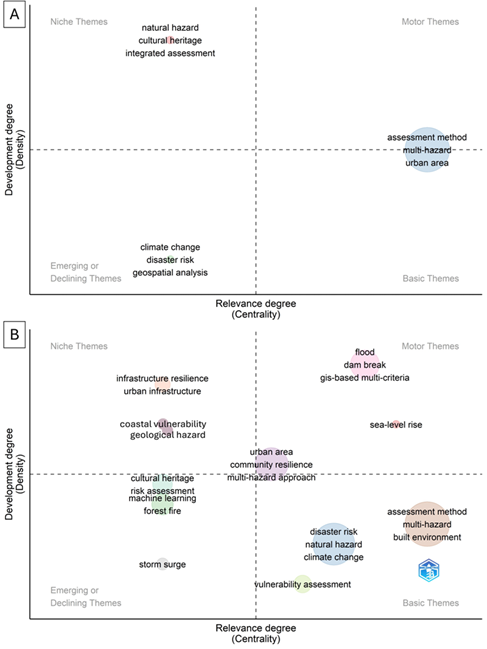
Fig. 9 Thematic evolution through title analysis between 2015-2019 (A) and 2020-2025 (B). Colour figure available online. Source: Authors’ elaboration
To explore research trends, an in-depth analysis was conducted to identify the most frequently studied hazard types. This analysis was carried out manually rather than using automated software tools. A sample of 37 documents were selected based on citation rate, each with 30 or more citations. These documents are summarized in Table I and further discussed in the subsequent paragraphs.
Table I Main characteristics of most cited documents.
| TYPE OF HAZARD INTEGRATION | HAZARD MAPPING | CASCADING HAZARDS | HISTORICAL DATA | NUMBER OF HAZARDS MAPPED | LOCATION | REFERENCE |
| Hazard overlaying (Simple) | Individual hazard analysis | Yes | Yes | 2, 3 | Dakar/Sudan, Gulf of Corinth/Greece, Hindu Kush Himalaya | (Fall et al., 2006; Papatheodorou & Ferentinos, 1997; Rusk et al., 2022) |
| No | Yes | 3 | Dharan/Nepal | (Aksha et al., 2020) | ||
| Hazard used to model cascading consequences. | Individual hazard analysis | Yes | Yes | 2, 3, 4 | Baseu River/Romania, Greater London/United Kingdom, Hipothetical, Jinsha river/Tibet/China, South America, Thessaloniki/Greece, Wuhan City/China, Xiaojinchuan River/Sichuan/China | (Antonioni et al., 2009; Fan et al., 2020; Ming et al., 2022; Pitilakis et al., 2016; Urzică et al., 2021; Vörösmarty et al., 2013; X. Wang et al., 2022; Zhu et al., 2021) |
| Joint hazard analysis. Indirect methodology. | Joint hazard analysis | Yes | Yes | 2, 4, 5 | Fujian Delta/China, Panzhou/China, Several | (Chang et al., 2022; Lin et al., 2021; Moftakhari et al., 2017; Peng et al., 2020) |
| Sum of all hazards (Proper equation). | Individual hazard analysis | Yes | Yes | 2, 3, 5 | Afghanistan, Hipothetical, Iloilo/Philippines, Manizales/Colombia, Piedmont region/Italy, Rome/Italy | (Anelli et al., 2022; Bernal et al., 2017; Carpignano et al., 2009; Ruiter et al., 2021; Lam & Lassa, 2017; Sevieri et al., 2020) |
| No | Yes | 2, 3, 4, 5, 6 | Austin/United States, Bangladesh, Donostia-San Sebastian/Spain, Mediterranean, Peneus River Basin/Greece, Rethymno/Greece, Yangtze River Delta/China | (Barua et al., 2016; Bixler et al., 2021; Gandini et al., 2021; Liu et al., 2013; Ravankhah et al., 2019; Satta et al., 2017; Skilodimou et al., 2019) | ||
| Theoretical consequences of joint hazards or cascading effects | Individual hazard analysis | Yes | Yes | 2, 3, 6, 7 | Beichuan/China, Genoa/Italy, Gorkha/Nepal, Mengdong/China, Sendai/Japan, Several | (Aubrecht et al., 2013; Faccini et al., 2015; Koshimura & Shuto, 2015; McNamara et al., 2017; Scheip & Wegmann, 2021; Yang et al., 2020; Zhang et al., 2014) |
| No | Yes | 2 | New York/United States | (Depietri & McPhearson, 2018) |
Source: Authors’ elaboration
The analysis of hazard types revealed that urban floods, earthquakes, and landslides were the three most frequently studied, often examined either together or in conjunction with other hazards (eight cases in total). When focusing specifically on hazard pairings (at least), the most common combinations were urban flood and earthquake, and landslide and earthquake, each appearing together in 11 papers. It is noteworthy that, despite the methodological differences and distinct characteristics involved in assessing urban flood hazards, landslides, and earthquakes - and the inherent complexity of modelling multi-hazard scenarios that include these events - they frequently appear together in multi-hazard studies (Aksha et al., 2020; Carpignano et al., 2009; Liu et al., 2013; Ravankhah et al., 2019; Skilodimou et al., 2019; Zhang et al., 2014). Wang and Weng (2020) suggests that hazards may interact by directly triggering one another or through more indirect relationships. In either case, the overall severity of a multi-hazard event can be influenced by the number of hazards involved, thereby increasing the complexity and difficulty of accurate prediction.
Results show that most of the documents focused on analysis that considered three (15 documents - 41%) or two (10 documents - 27%) hazard types, with only one document researching the relation between seven hazards (Zhang et al., 2014).
Extensive work has been undertaken to understand hazards relationships and consequences to the areas studied, and the types of hazards integrations were summarized as follows: a) hazard overlaying (simple); b) hazard used to model cascading consequences; c) joint hazard analysis. As indirect methodology: d) sum of all hazards (proper equation); and e) theoretical consequences of joint hazards or cascading effects. The most used methodology was the application of a proper equation to combine different hazards, followed by hazard assessment approaches used to model cascading hazards. Some authors have sought to understand multi-hazard associations through indirect methodologies that consider all relevant hazards from the beginning of the assessment process. These approaches often incorporate shared influencing factors - such as rainfall - or apply statistical techniques that can be linked to multiple hazards, such as Information Value and Weight of Evidence (Chang et al., 2022; Lin et al., 2021; Moftakhari et al., 2017; Peng et al., 2020). Although multi-hazard assessment is inherently complex, in many cases, the mere superimposition of individual hazards can be overly simplistic and fail to capture the true nature of their interactions (Kappes et al., 2012). These varying points of view may result from different definitions of multi-hazard, since one considers independent hazards occurring in a multiple hazard environment, while the other considers that hazards occurring at the same place can interact with each other (Angeli et al., 2022).
Despite employing different methodologies, all reviewed studies used historical or field data to conduct multi-hazard analyses. This underscores the essential role of hazard records in understanding not only the behaviour and impacts of individual hazards but also their interconnections with other events. In this context, recognizing whether one hazard can trigger another or lead to cascading consequences is particularly important. Among the 37 documents analysed, 75% (28 studies) addressed cascading hazards - such as natural events causing structural collapse or heavy rainfall triggering landslides - integrating both the initial hazard and its cascading effects into the multi-hazard scenario.
4. Conclusions
Studies about multi-hazards in urban areas have been increasing significantly in recent years. Our analyses provided information on how the topic has been evolving and highlighted the actual trends:
the author’s most used keywords were Risk assessment, Multi-hazard, GIS, Vulnerability, and Earthquake;
key journals publishing state-of-the-art research on urban multi-hazard are Natural Hazards and International Journal of Disaster Risk Reduction;
authors from different institutions show limited collaboration, as indicated by sparse co-authorship links. This highlights the need to strengthen multi-hazard research efforts through greater inter-institutional cooperation. Nevertheless, authors tend to cite similar references, which cluster around three main thematic areas: (i) multi-hazard monographies; (ii) risk management and vulnerabilities; and (iii) processes and methodologies related to hazard assessment;
trends indicate a growing interest in research related to vulnerability and resilience in urban environments, particularly in connection with urban planning and exposure assessment. These emerging areas suggest the development of a potential research hotspot.
The most frequently studied hazards were urban floods, landslides, and earthquakes. In most cases, authors conducted individual hazard analyses before to composing a multi-hazard assessment. Although the sequential analysis of single hazards followed by their integration - often through a specific equation - was the most common method, there remains a notable lack of comparative studies evaluating the different methodologies used in multi-hazard integration.
Finally, some limitations of this work should be mentioned. Firstly, the search was conducted solely on the WoS platform. Although it is an extensive and reputable database, it does not encompass all relevant publications, potentially omitting important contributions from other sources and works published in languages other than English. Furthermore, the results obtained are conditioned by the structure and scope of the search query, which may have excluded relevant studies due to keyword selection or indexing inconsistencies.
Acknowledgments
We are grateful to the Federal Institute of Education, Science and Technology of Espírito Santo (Ifes), Vitória campus, for the financial support in developing the research. This study was financed in part by the Coordenação de Aperfeiçoamento de Pessoal de Nível Superior - Brasil (CAPES) - Finance Code 001.
Author`s contribution
Sara Guerra Fardin: Conceptualization, Methodology, Software, Validation, Formal analysis, Investigation, Resources, Data curation, Writing - original draft preparation, Writing - review and editing, Visualization, Supervision, Project administration, Funding acquisition. Tatiana Sussel Gonçalves Mendes: Writing - review and editing, Supervision. Silvio Jorge Coelho Simões: Writing - review and editing, Supervision. José Luis Zêzere: Conceptualization, Methodology, Software, Investigation, Writing - review and editing, Visualization, Supervision.

