




 Inglês (pdf)
 Artigo em XML
 Referências do artigo
 Tradução automática
 Enviar este artigo por email
 Citado por SciELO
  Similares em
SciELO
Similares em
SciELO 
 Permalink

1. Introduction
The pivotal role of entrepreneurship in fostering economic growth is widely recognized. Regional development depends on dynamic territories and stakeholders that contribute to better living conditions, an improved business environment, job creation, and enhanced regional competitiveness. In this context, the entrepreneurial ecosystem has emerged as a potential driver of entrepreneurship and development at the regional level (Isenberg, 2010; Valente et al., 2019).
An entrepreneurial ecosystem is a recent construct that has been widely employed to synthesize initiatives aimed at fostering entrepreneurship and regional development (Ferreira & Prestes, 2023). They are described as complex networks comprising key actors such as investors, academia, and institutional policies that facilitate value creation and innovation (Felizola et al., 2024); they emphasize the role of "place" and provide a lens for understanding regional transformation through entrepreneurial action (Audretsch, 2015). The fundamental ideas behind the entrepreneurial ecosystem incorporate the roles of social, cultural, and economic forces into the development process (Spigel & Harrison, 2018; Stam & Van de Ven, 2019).
Recent studies (Cao & Shi, 2021; Wurth et al., 2022) have advanced our understanding of entrepreneurial ecosystems and how they operate, highlighting locality as a locus for promoting economic, social, and environmental development. Cho et al. (2022) point to the need for a better understanding of network dynamics, the role of entrepreneurial education, and the temporal evolution of ecosystems. Roundy & Bayer (2019) also consider it relevant to understand how local and global networks shape entrepreneurial behavior and facilitate innovation.
The perception that innovation is a key factor for development is shared by several scholars in the field, who emphasize that it is a crucial element for the competitiveness of regions. It is a decisive element in ensuring economic dynamism, greater competitiveness and, consequently, the prosperity of regional economies (Garcia et al., 2022). In this context, regions play a vital role, as innovations often emerge at this level through networks of innovators, local clusters, and inter-institutional cooperation (Asheim & Gertler, 2005). Therefore, regions are the places where innovative capacity is shaped. Innovative regions tend to strengthen their competitive potential, promote sustainable economic growth and, consequently, be more resilient to future economic shocks (Bristow & Healy, 2018; Garcia et al., 2022; Organisation for Economic Co-operation and Development [OECD], 2013).
In the Brazilian scenario, the country still has a lot to do to improve its innovative capacity. According to the 2024 Global Innovation Index (GII), prepared by Cornell University, the European Institute of Business Administration and the World Intellectual Property Organization, and considered the main indicator of the world's innovation ecosystem, Brazil is in 50th place out of a total of 133 countries participating in the ranking. Switzerland, Sweden and the United States are in the top spots. Among the five BRICS countries, Brazil is in third place, ahead of Russia (51st place) and South Africa (59th). China is in 12th place and India is in 40th place. However, Brazil is still the leader among the economies of Latin America and the Caribbean.
In terms of innovation in more localized contexts, the Brazil Innovation and Development Index (IBID), prepared by the National Institute of Industrial Property, indicates the innovation scenario in the five regions and 27 federative units of the country. The IBID results highlight national inequalities and diversities, indicating that the South and Southeast regions are the locus of innovation in Brazil. Of the top eight positions in the general ranking, seven are occupied by states from these two regions. States from the North and Northeast regions occupy the last 15 positions. Of these, the last six are occupied by states that belong to the so-called Legal Amazon, which indicates the challenges and the need for strategic actions for the development of this region that is so important for Brazil and the world, especially from the perspective of the bioeconomy. Brazil’s continental size and profound territorial diversity shape its innovation landscape. Ventura (2024) assesses that the IBID is a territorial portrait of innovation in Brazil, a country of continental dimensions. In this sense, the biggest bottleneck highlighted by the study is precisely this spatial concentration of innovative activities. According to the IBID, the key national strategic challenge is strengthening local science, technology, and innovation (ST&I) ecosystems to extend the regional reach of innovation and promote territorially integrated economic development.
Therefore, the objective of this article is to analyze the impact of the entrepreneurial ecosystem on innovation in Brazilian municipalities. To this end, the paper is organized into five sections. After this introduction, we present general considerations of the entrepreneurial ecosystem and its relationship with innovation. Next, we present the methodological process used in the research, followed by a presentation and discussion of the data. Finally, we present the final considerations.
2. Entrepreneurial ecosystem and innovation
The entrepreneurial ecosystem is a concept that has been receiving attention both in academia and in the government sphere. The Organisation for Economic Co-operation and Development (OECD, 2013) suggests that the concept of an entrepreneurial ecosystem is holistic and interactive in nature. It seeks to demonstrate why some regions can continuously promote the success of their new businesses, along with high levels of high-growth entrepreneurial activity (Stam & Spigel, 2017).
Wurth et al.'s (2022) study shows that current thinking about entrepreneurial ecosystems can be viewed from various contexts, including entrepreneurship, high-growth entrepreneurship, clusters, among others.
The term "entrepreneurial ecosystem" was initially coined by Prahalad (2005) and Cohen (2006) to describe conditions where individuals, companies, governments, civil society, and other partners come together, regionally, to support business activities aimed at generating economic wealth and prosperity. In an article commissioned by the OECD, Mason and Brown (2014, p. 5) define an entrepreneurial ecosystem as a set of interconnected entrepreneurial actors, entrepreneurial organizations, institutions, and business processes that "merge to connect, mediate, and govern performance within the local business environment". Similarly, Stam and Spigel (2017, p. 1) consider it to be "a set of interdependent actors and factors coordinated in a way that allows productive entrepreneurship within a given territory". Isenberg (2010) adds that it is a network of relationships that enables interactions between a wide range of institutional and individual actors to promote entrepreneurship, innovation, and regional economic growth.
Despite diverse approaches, every ecosystem involves several interconnected key elements that interact and reinforce each other, encompassing components that must cooperate to facilitate innovation and growth. As Valente et al. (2019) teach, entrepreneurship develops in ecosystems where stakeholders have essential synergistic roles, which demand the collaboration of multiple actors and the exchange of information, with the aim of carrying out joint activities and allowing the coordination of activities among various stakeholders. Thus, in the entrepreneurial ecosystem, the presence and action of non-governmental organizations, associations, economic entities, educational institutions, and research institutions with an interest in entrepreneurship and the existence of local, regional, and international relationship networks among entrepreneurs are observed (Isenberg, 2011).
There are various models of entrepreneurial ecosystems that differ in terms of their constituent elements. However, they have in common the interdependence between actors, geographical proximity, being characteristic of the place to which they belong, and an evolutionary dynamic that considers the ecosystem as a living organism, thus resulting in constant exchanges and flows of resources (Isenberg, 2010; Valente et al., 2019).
One of the main models of entrepreneurial ecosystems is that of Isenberg (2011), which is composed of six categories: public policies, financial capital, culture, support institutions, human resources, and markets. Spigel (2017) considers these ecosystems as evidence of three main regional resources that contribute to the increase and growth of entrepreneurship: (a) shared cultural understandings and institutional environments, which facilitate cooperation between companies and develop practices such as knowledge sharing and mobility between companies; (b) social networks within regions, which link entrepreneurs to financiers; and (c) government policies and universities, which can support the formation of an entrepreneurial culture and networks, removing institutional barriers, training skilled workers and entrepreneurs, and financing specific support programs. Thus, according to Spigel (2017, p. 49), entrepreneurial ecosystems comprise "the union of localized cultural perspectives, social networks, investment capital, universities, and active economic policies that create environments conducive to innovation-based ventures.
The literature emphasizes that innovation is a central element in the entrepreneurial process. Schumpeter (1988) highlighted the role of the entrepreneur as an agent of "creative destruction", introducing innovations that transform markets; existing products or production methods are destroyed and replaced by new ones.
Innovation plays a significant role in economic activities, not only in countries with developed economies but also in developing countries; it is one of the main drivers of economic growth. Although several factors influence the capacity for innovation and the results of a country's economic growth, the entrepreneur plays a significant role (Miguez & Lezana, 2018).
Innovation and entrepreneurship are complementary because entrepreneurship thrives in environments that enable creation, reinvention, and innovation. In the entrepreneurial ecosystem, innovation and entrepreneurship are seen as dynamic processes in which knowledge is accumulated through learning and interaction between stakeholders. This approach emphasizes the importance of transferring and diffusing ideas, experiences, and information (Miguez & Lezana, 2018).
The essence of the relationship between entrepreneurship and innovation lies in the perception and exploitation of new business opportunities and the creation of new ways of using resources (Rosenbusch et al., 2011). In addition, entrepreneurship and innovation have been associated with the concept of entrepreneurial orientation (Turró et al., 2014). An entrepreneurial company engages in product-market innovation, takes risks, presents proactive innovations, and gains a competitive advantage over its competitors (Haar & White, 2013). The interaction between entrepreneurship and innovation in entrepreneurial ecosystems suggests that public policies and private initiatives should focus on creating environments that stimulate the exchange of knowledge, access to resources, and reduction of barriers to the development of new businesses (Felizola et al., 2024).
In this context, entrepreneurial education involves a set of practices, methods, and skills that aim to develop the entrepreneurial capacity of individuals to create and manage new businesses, innovate, and lead within organizations or in their own lives. It seeks to stimulate creativity, strategic vision, and the ability to identify business opportunities, in addition to developing skills related to management, marketing, finance, sales, and leadership. Entrepreneurial education can be applied in various contexts, from basic education to higher education and professional training programs. In addition to training entrepreneurs, it can also contribute to developing skills and competencies valued in the job market, such as creativity, resilience, critical thinking, and interpersonal skills, as well as encouraging the practice and development of entrepreneurial projects with the aim of preparing individuals to face market challenges and contribute to economic and social development (SEBRAE, 2023).
In turn, access to financial resources is essential to foster innovation. Investments in innovation involve risk and uncertainty, and their results are difficult to predict. Several authors point out that government actions are necessary to build financing instruments for investments in innovation, and thus, government support appears to be relevant, especially in the initial phases, when uncertainty is high, and is generally associated with non-reimbursable resources. In Brazil, public financing for innovation is an important tool to boost the country's scientific and technological development, encouraging companies and researchers to develop innovative projects. This financing has been carried out mainly through tax incentives from the Ministry of Science, Technology and Innovation and financing operations by the Financiadora de Estudos e Projetos and the Banco Nacional de Desenvolvimento Econômico e Social. This is a recurring item in Brazilian Industrial and Innovation Policy, having resulted in the creation of instruments and the review of the legal framework, such as the creation of the Innovation and Goods laws (Santana et al., 2019). Thus, fiscal management becomes essential to guarantee public investment in innovation.
Finally, to stimulate business development, there must be incentives and the removal of bureaucratic barriers, and from this perspective, the government has a fundamental role, creating conditions for entrepreneurship to progress. These conditions are mainly linked to reforms in the legal, bureaucratic and regulatory frameworks; however, the role of the government is limited in terms of its efforts, with the remaining contributions to its development being made by the leaders of the entrepreneurial ecosystem (Isenberg, 2010).
3. Methodology
The data used in this study are from 2021 and were extracted from the Brazilian Service for Supporting Micro and Small Enterprises (SEBRAE) and the Brazilian Institute of Geography and Statistics (IBGE). The study covered all 5570 Brazilian municipalities. Innovation (INNOV), an indicator that considers patent deposits, industrial design deposits, and professional education establishments in the municipality, is used as the dependent variable. INNOV was extracted from SEBRAE and consists of a sub-dimension of the SEBRAE Local Economic Development Index (ISDEL).
Regarding the independent variables that affect municipal innovation, variables fundamental to an entrepreneurial ecosystem were selected. The variables of Entrepreneurship Education (ENT_EDU), this enables both managers and employees to innovate within the organizations they work for, an indicator that represents SEBRAE programs, Sebraetec, and Future Entrepreneur; Consumption Potential and Credit (CONS_CRED), by offering the local market a demand for the goods and services produced and encouraging companies to invest in product innovation, this indicator is composed of information related to the wage mass of formal employment, consumption potential, credit, and banking services; Fiscal Management (FIS_MAN), which offers financial conditions, supported by the public sector, to foster innovation, this indicator is composed of variables related to public funding and fiscal autonomy; Gross Domestic Product Per Capita (PIB_PC), which measures the economic condition of Brazilian municipalities, which consists of the municipality's GDP per capita; and Business Conditions (BUS_COND), this refers to the number of companies present in the municipality, measured by the companies per capita indicator. Additionally, Gross Domestic Product Per Capita squared (PIB_PC_S) and Business Conditions squared (BUS_COND_S) were considered to test for a non-linear relationship with municipal innovation in Brazil.
To construct the model, all independent variables were evaluated to avoid endogeneity. The innovation variable from ISDEL represents the conditions and generation of innovative products for the municipality, while the independent variables correspond to indicators of the entrepreneurial ecosystem, which considers internal economic agents, consumers, companies, and government (Vasconcellos & Garcia, 2014).
When evaluating how an entrepreneurial ecosystem can influence innovation in municipalities, the influence of the region, that is, of neighboring municipalities, must also be considered. In this sense, the effect of the INNOV of the municipalities in the region was also considered. To achieve the objective proposed in this study, Exploratory Analysis of Spatial Data (EASD), the Ordinary Least Squares (OLS) method, and the main spatial regression models were used.
A EASD is a technique for describing and visualizing spatial distributions, identifying outliers, discovering spatial association patterns (spatial clusters), and suggesting different spatial regimes and other forms of instability. However, to adequately test spatial effects, it is necessary to consider the degree of connection between regions through the spatial weight matrix.
In this article, the queen, rook, and k nearest neighbors matrices were tested, using as a selection criterion the one that presents the highest value of spatial autocorrelation based on Moran's I. According to the author, Moran's I statistical method is a spatial autocorrelation coefficient that uses the measure of autocovariance in the form of a cross-product. The investigation at the local level was carried out using spatial association indicators (LISA).
Spatial econometric models are an extension of classical econometrics, which use location in the territory as one of the explanatory factors in the models. In the present study, the Spatial Lag Model (SAR), Spatial Error Model (SEM), Spatial Durbin Model (SDM), Spatial Durbin Error Model (SDEM), and Spatial Cross-Regressive Model (SLX) were tested (Almeida, 2012).
4. Results and discussion
In this section, an Exploratory Analysis of Spatial Data (EASD) is conducted to assess the presence of a spatial pattern in the innovation index. Table I shows that Moran's I value was above the expected value and was significant for all conventions of spatial weight matrices, inferring that there is a positive spatial autocorrelation of the innovation index. For the analysis, the spatial weight matrix of the Rook Convention was selected, which presented the highest Moran's I value, according to the selection criterion.
The positive spatial autocorrelation, evidenced by the sign of Moran's I statistic, indicates that municipalities with a high innovation index are surrounded by municipalities with a high innovation index, whereas localities with a low innovation index are surrounded by municipalities with a low innovation index.
Table I Moran's I of innovation in brazilian municipalities, 2021.
| Convention | Moran's I | Expected Moran's I | P-value |
|---|---|---|---|
| Queen | 0,158 | -0,0002 | 0,000 |
| Tower | 0,160 | -0,0002 | 0,000 |
| K 5 neighbors | 0,124 | -0,0002 | 0,000 |
| K 7 neighbors | 0,110 | -0,0002 | 0,000 |
| K 10 neighbors | 0,104 | -0,0002 | 0,000 |
Source: Authos`elaboration
Therefore, it is possible to indicate that innovation in Brazilian municipalities functions as a network articulation, with spatial clusters of municipalities with high innovation indicators and agglomerations of municipalities with low innovation indicators.
This spatial dependence of innovation corroborates the results found by Montenegro and Betarelli Junior (2008), who verified the existence of a positive spatial autocorrelation of innovation among the municipalities of the state of São Paulo, and by Araújo (2014), who identified a positive spatial dependence of innovation among Brazilian microregions. The cluster map presented in figure 1 allowed us to verify where statistically significant spatial clusters were formed at the 5% level.
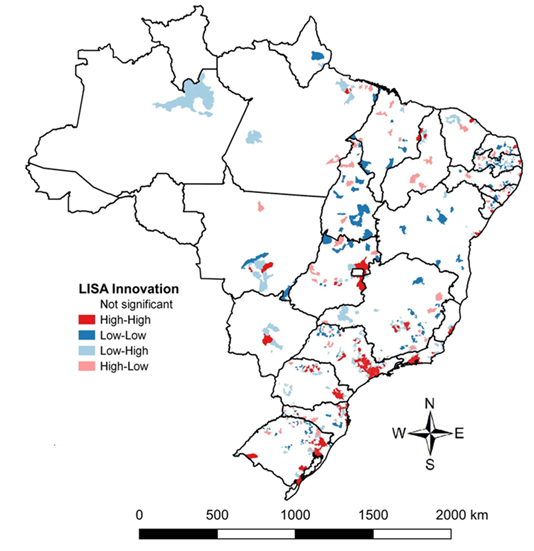
Fig. 1 Cluster map of Brazilian municipalities' innovation index. Colour figure available online. Source: Authos`elaboration
In the local analysis, the innovation index presented in 13.4% of municipalities (745) as statistically significant at the 5% level. Among these municipalities, the formation of HH-type clusters was concentrated in the southeast region. It is possible to verify in this grouping that the southeast region concentrated more than half (117) of the municipalities. At the state level, the highlight for the Southeast region was the state of São Paulo, which presented more than a third of the municipalities in the HH cluster, concentrated mainly in the metropolitan region of the city of São Paulo, favored by urban infrastructure, which contributes to technological development (Montenegro & Betarelli Junior, 2008).
In contrast, the northeast region presented the highest concentration of BB-type spatial clusters. It can be observed that the region is concentrated over 44% (93) of the municipalities. At the state level, the highlight for the Northeast region was the states of Rio Grande do Norte and Paraíba, which presented more than 8% in the LL cluster. Araújo (2014) verified clusters of microregions with low innovation, considering the number of patents in the Northeast and North regions, as they are localities with low national participation in economic and industrial activities, with the exception of some state capitals (Natal, Recife, and Fortaleza), corroborating the results of this research.
Regarding the effect of the entrepreneurial ecosystem on innovation, estimation was performed using the Ordinary Least Squares (OLS) method and spatial regression estimations, the results of which are presented in table II. In the regression performed by the OLS method, it can be verified by Moran's I test that the errors presented spatial autocorrelation. The Jarque-Bera test indicates that the model does not present a normal distribution. Therefore, the estimation should be performed using the Generalized Method of Moments (GMM). From the estimation of the Spatial Auto-Regressive (SAR), Spatial Error Model (SEM), Spatial Durbin Model (SDM), Spatial Durbin Error Model (SDEM), and Spatial Lag of X (SLX), SAR was adopted, the only one that eliminated the heterogeneity of the model.
Table II Estimates of the impact of the entrepreneurial ecosystem on innovation in brazilian municipalities, 2021.
| Variables | OLS | SAR | SEM | SDM | SDEM | SLX |
| Intercept | -0,0520** | -0,0510** | -0,0517** | -0,0509** | -0,0582** | -0,0600** |
| ENT_EDU | 0,4271** | 0,4286** | 0,4213** | 0,4023** | 0,3982** | 0,3963** |
| CONS_CRED | 0,5147** | 0,5094** | 0,5434** | 0,5799** | 0,5722** | 0,5732** |
| FIS_MAN | 0,1070** | 0,0994** | 0,0713** | 0,0299** | 0,0529** | 0,0530** |
| GDP_PC | -2,4733e-07** | -0,0003** | -0,0002** | -0,0002** | -0,0002** | -0,0002** |
| GDP_PC² | 3,4212e-13** | 4,12e-07** | 3,26e-07** | 2,66e-07** | 2,84e-07** | 2,77e-07** |
| BUS_COND | -0,3373** | -0,3340** | -0,3431** | -0,3325** | -0,3045** | -0,2998** |
| BUS_COND² | 0,3825** | 0,3795** | 0,3913** | 0,3863** | 0,3452** | 0,3380** |
| W_INNOV | - | 0,0533* | - | 0,3286** | - | - |
| W_ERROR | - | - | 0,3314** | - | 0,2535** | - |
| W_ENT_EDU | - | - | - | -0,1277** | 0,0403 | 0,0361 |
| W_CONS_CRED | - | - | - | -0,3634** | -0,2232** | -0,2245** |
| W_FIS_MAN | - | - | - | 0,2608** | 0,2542** | 0,2715** |
| W_ GDP_PC | - | - | - | -0,0002** | -0,0003** | -0,0004** |
| W_ GDP_PC² | - | - | - | 6,23e-07** | 8,23e-07** | 9,95e-07** |
| W_BUS_COND | - | - | - | -0,2737** | -0,0260 | 0,0372 |
| W_BUS_COND² | - | - | - | 0,3286** | 0,2535 | 0,0334 |
| Sample | 5570 | 5570 | 5570 | 5570 | 5570 | 5570 |
| Breusch-Pagan test | 76702,4770** | - | - | - | - | - |
| Jarque-Bera test | 1466432,6886** | - | - | - | - | - |
| R² | 0,6249 | - | - | - | - | - |
| Pseudo R² | - | 0,6237 | 0,6236 | 0,6453 | 0,6438 | 0,6440 |
| Moran’s I (error) | 16,1601** | - | - | - | - | - |
| Wald test (error) | - | 5,73* | 416,60** | 370,30** | 509,03** | 298,28** |
Note: **p<0,01; *p<0,05. Source: Authos`elaboration
The SAR model indicates that entrepreneurial education positively influences innovation. This result presents one of the greatest impacts on innovation and is aligned with the study of Bhatta et al. (2024), which showed that not only entrepreneurial education but also an entrepreneurial mindset contributes to executing effective strategies to generate innovation. Entrepreneurial education promotes the restructuring of the economic and business model, improves the dynamics of development, and drives development through innovation (Rongpipi & Sharma, 2024).
Regarding consumption potential and credit, it was found that a high level of consumption potential and credit leads to an increase in innovation, and municipal fiscal management has a positive impact on innovation. Knowledge of a population's consumption profile is fundamental for the development of new products, assisting managers and the public sector (Camelo et al., 2020). Together with knowledge of demand, access to credit increases companies’ investment in innovation (Pacheco, 2019).
On the other hand, Gross Domestic Product per capita (GDPpc) had a negative impact on innovation. However, GDPpc squared has a positive impact on the innovation index, indicating a non-linear relationship between GDPpc and the innovation index in a U-shape. The coefficients suggest that the GDPpc values of the municipality from R$40 048.54 have a positive impact on innovation. Pylypenko et al. (2023) show a strong positive correlation between an innovative social capital indicator and the GDPpc of countries at all levels of development. As the authors highlight, this strong dependence evidences inequality in innovation among countries. Poorer countries have room to increase their innovation potential, which, in the case of Brazil, the results showed that reaching a GDPpc level of just over R$40 000 has a positive impact on the innovation index.
Business conditions, which consider the number of companies, had a negative impact and the business conditions index squared had a positive impact, also indicating a non-linear relationship with innovation in a U-shape. The results indicate that the values of the business conditions index of the municipality from 0.44 have a positive impact on innovation. Companies alone are not enough to generate innovation in the new knowledge-based economy; a fundamental element for producing innovative products and processes is knowledge (Amaral et al., 2007), which forms the human capital of the organization (Stewart, 1998). In this sense, startups are fundamental to innovation processes because of their ability to deal with specific and new knowledge (Freire et al., 2017). Thus, Brazilian municipalities must travel a long way to reach the level of companies, especially startups, to generate positive impacts on the innovation process.
The results also allow us to verify that innovation in neighboring municipalities, given by the spatial lag of innovation, positively influences innovation. The dynamics of innovation are strongly influenced by geographical proximity, which considers innovation clusters formed by innovative companies that interact with each other, generating mutual benefits.
5. Conclusions
This study aimed to analyze the spatial distribution of the innovation index through Spatial Exploratory Analysis of Spatial Data (EASD) and evaluate the influence of the entrepreneurial ecosystem on innovation in Brazilian municipalities through spatial regressions. The results show spatial dependence for innovation. Municipalities with high innovation index rates were concentrated in the Southeast region, and agglomerations of municipalities with low innovation index rates were located in the Northeast region.
The estimation of the chosen spatial regression model (SAR) showed that entrepreneurial education, consumption potential and credit, and fiscal management had a positive impact on innovation. The variables of Gross Domestic Product per capita (GDPpc) and business conditions presented a non-linear relationship in a U-shape with innovation. The study showed that innovation is heterogeneously influenced in Brazilian municipalities by elements of the entrepreneurial ecosystem. There are factors that had a positive linear impact, and other factors that presented a non-linear relationship in a U-shape.
As a theoretical contribution, the study indicates that among the factors with a linear relationship, consumption potential, credit, and entrepreneurial education had the most significant impact on raising the innovation index. As for the factors with a non-linear relationship in a U-shape, GDPpc positively influences innovation from R$ 40 048.54, and business conditions tend to contribute positively to innovation from an index of 0.44.
As a practical contribution, based on the results found, it is suggested that policies be adopted to stimulate economic activity, the development of entrepreneurial knowledge, and the encouragement of business openings, especially startups, to foster innovation in municipalities, especially in the northeast region.
To advance the literature in the area, further research can delve deeper into the identification of factors that have regional impacts, both factors of the entrepreneurial ecosystem and factors that characterize the local units of the region, with a specificity in the role of companies that are classified as startups and human capital. In addition to research that evaluates the efficiency of innovation from a global and regional perspective.
Acknowledgments
Instituto Cesumar de Ciência, Tecnologia e Inovação (ICETI) researcher. ICETI research productivity fellow.
Authors’ contribution
Marcos Aurélio Brambilla: Conceptualization, Methodology, Software, Validation, Formal analysis, Investigation, Data curation, Writing - original draft preparation, Writing - review and editing, Visualization, Project administration, Funding acquisition. Rejane Sartori: Conceptualization, Investigation, Writing - original draft preparation, Writing - review and editing.

