




 Inglês (pdf)
 Artigo em XML
 Referências do artigo
 Tradução automática
 Enviar este artigo por email
 Citado por SciELO
  Similares em
SciELO
Similares em
SciELO 
 Permalink

1. Introduction
In recent decades, scholars from different backgrounds have drawn attention to the impact of the typewriter on 20th-century writing practices. 1 Relying on case studies from Germany, France, Belgium, Finland, the USA, the UK, and Australia, those critics concluded that “responses to the typewriter were never uniform” and “we must now extend the geographical sphere” of research (Lyons, 2021, pp. 89, 15) to promote a greater understanding of the machine’s influence on literary creativity throughout the 20th-century. Accordingly, this article focuses on a Portuguese author, Pedro Homem de Mello (1904-1984), whose prolific and multifaceted writing activity presents an interesting case study for textual and genetic criticism. 2
Besides being an award-winning poet of the so-called Second Portuguese Modernism - “a broad literary and artistic movement” 3 (Silvestre, 2003, p. 17) associated with the journal Presença (1927-1940), which involved different generations and aesthetic orientations lying “on the margins or alongside the avant-garde” 4 (Sena, 1977, p. 31) - Homem de Mello practised law and worked as a school principal and teacher, as well as a folklorist and audiovisual personality with several programs aired from the late 1950s until mid-70s. To comprehensively assess his writing habits, we shall, therefore, examine the author’s work within several spheres of activity: his personal and professional correspondence, his essays and newspaper collaborations as a folklorist, his work as an author and presenter of TV and radio programs, and his vast poetic oeuvre.
Based on extensive research into the author’s documentary estate5, this article will try to associate different uses of the machine with specific text genres before concentrating on material aspects of his literary typescripts to briefly interrogate how that multimodal mechanical writing may have “structured or influenced […] creativity” (Lyons, 2021, p. 4), enforcing potential stylistic changes in his poetry over the years.
2. Pedro Homem de Mello’s uses of the typewriter
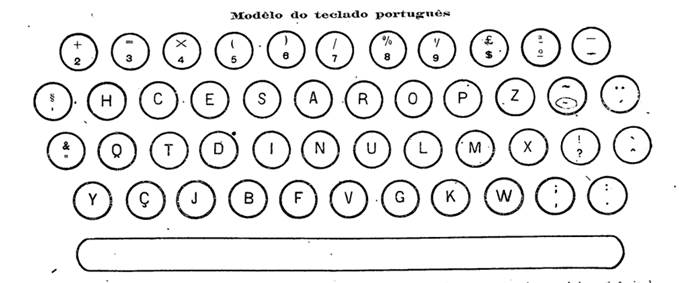
Although Pedro Homem de Mello’s estate provides abundant material evidence of his typewriting, there is no precise information about the kind of machine(s) the author owned in his lifetime, whether he used only mechanical devices or tried the electromechanical models that became popular after the 1960s. In the absence of forensic examinations to identify typewriter brands or models, 6 we may only assume he must have used some machines from Portuguese manufacturer Messa, with an HCESAR keyboard and dual-function keys. 7
In July 1937, a protectionist measure of Salazar’s dictatorial regime against foreign competition determined that any typewriter imported or produced in Portugal should adopt a specific keyboard (Figure 1), which differed from the international standards at the time. 8 Until the early 1970s (when the French AZERTY and the English QWERTY designs were accepted again), many people managed to deceive the authorities, masking the keyboard configuration of imported typewriters for customs clearance (Pinheiro, 2021b), but that seems unlikely to be the case for our author, considering that he was close to the regime and worked in several official institutions during the dictatorship period (1932-1974).
Besides inquiring about the device(s) employed by our author, we should also ask “how, when, and where” Pedro Homem de Mello used the machine (Lyons, 2021, p. 4).
While it is uncertain whether he always typed his texts or occasionally passed the task to a secretary, as did many contemporary writers, 9 the author must have learned basic typing skills throughout his education, becoming self-sufficient and independent from a young age. Indeed, the machine already coexisted with pens and pencils in his earliest writings for publication during the 1930s. 10 Initially, it was employed only for fair copying and revision since typing up a manuscript often “modified the writer’s ‘point of view’”, introducing “a distance between the author and the text” that “allowed a more critical reading” (Viollet, 1996, p. 204). 11 However, the author also gradually started using the typewriter for primary composition, as his cursive became hasty and indecipherable.
When we compare manuscripts produced over the years, 12 the handwriting deterioration is apparent and frequently mentioned in correspondence with friends and family. In 1938, for example, he admitted to fellow poet José Régio that his handwriting was “atrocious”, 13 while his mother, Maria do Pilar, repeatedly complained of illegible letters one could hardly make out:
Precisas de ver como escreves agora, pois é desconsolador precisar de ler as tuas cartas 2 e 3 vezes para as poder decifrar e nem sempre consigo fazel-o. É pelo sentido muitas vezes que descubro o que queres dizer, tu que tão boa letra tinhas.
[You must watch out how you are writing because it is heartbreaking to read your letters two and three times and not always be able to decipher them. I often guess the meaning from the context. You, who used to have such good handwriting. ] 14
Therefore, for the sake of legibility, he started using the machine to correspond with many of his acquaintances, typing letters straight onto the keyboard.
Researchers have already noted the “distancing effect of the typewriter and its disturbing ability to depersonalise texts” (Lyons, 2021, p. 22) by concealing “the hand, […], character and identity of the writer” (Pulkkinen, 2023, p. 36), which explains why it suited business letters over private correspondence as an individual form of expression and communication. For that reason, many 20th-century writers “felt a residual guilt about typing personal letters” (Lyons, 2021, p. 90), as seems to be the case with Pedro Homem de Mello. Typically, our author would write private missives to friends and family by hand and resort to the typewriter only for professional correspondence15 and formal purposes, such as dealing with debts16, family apologies, 17 invitations to dinner parties, 18 or addressing transcriptions of poems to literary peers. 19 However, after many complaints about deplorable calligraphy and letters returned as non-deliverable due to illegible addresses, he also started typing trivial letters to family members20 and friends (including the respective envelopes21). In such cases, though, the poet was careful to add a handwritten signature22 - occasionally with a salutation line23 or even a short personal message by hand - to preserve some mark of individuality and intimacy.
Many letters in the archives of his contemporaries demonstrate that Homem de Mello started writing correspondence on the typewriter even before midcentury, progressively embracing the new technology as a compositional tool in different spheres of activity over the 1950s, 60s, and 70s. Some draft articles for newspapers and tourism magazines at the time, for instance, had lists of words typed on the back of sheets24, suggesting that the author was already organising and planning part of his writing directly on the machine.
Like other 20th-century writers who worked as journalists, he must have become “accustomed to fast typing to meet short deadlines, with little time for revision” (Lyons, 2021, p. 63), especially in connection to some experiences as an author and presenter of radio and television programs aired since the late 1950s, which made him work around the clock. 25 Clearly, “the typewriter did not eliminate handwriting” (Lyons, 2021, p. 200), and our author’s preference for writing in cafés26 would keep him drafting verse as much as prose27 and TV/radio scripts28 in longhand before committing texts to the machine. 29 However, the two writing modes frequently coincided, as during “the 1950s and 1960s, drafting by hand and then typing up was artisanal, slow, deliberate, and often retrospective; working straight on to the machine was fluid, spontaneous, future-oriented, and not necessarily selective” (Sullivan, 2013, p. 255).
In our author’s practice, correspondence, newspaper articles, and audiovisual scripts more likely tended to motivate generative typing, while poetry remained associated with longhand. Still, the experiences on radio and television were responsible for introducing a typing habit that would positively influence his poetic enterprise.
To facilitate teamwork and comply with protocols of the National Information Secretariat, 30 which required prior approval of TV and radio scripts, Homem de Mello started typing on sheets of carbon paper31 to produce multiple copies simultaneously. In the next section, we will see that this procedure, imposed on his professional activity for pragmatic reasons, was assimilated into the poet’s composition method as a favoured revision technique, indicating the tight imbrication of all his writing. Rather than compartmentalised uses of the machine attached to specific text genres, one should thus regard Pedro Homem de Mello’s multimodal typing as a network ecology of writing “in which anything that affects one strand of the web vibrates throughout the whole” (Cooper, 1986, p. 370).
We will now briefly examine his literary typescripts to question how that multifaceted mechanical writing may have led to stylistic changes in his poetry over the years.
3. The materiality of literary typescripts
It has been noted how the technical and mechanical complexities of the typewriter posed numerous challenges, never fully overcome “until the word processor enabled immediate correction as well as the wholesale manipulation of texts” (Lyons, 2021, p. 39). The machine was most unsuitable for complex corrections or “vertical revisions” (Tanselle, 1990, p. 53), such as displacements of text, but even small deletions could be problematic as they implied interrupting the writing course to reverse the text. 32
Many 20th-century authors developed specific techniques to address correctability either by performing “a sort of ‘blind revision’” (Pulkkinen, 2020a, p. 206) 33 or using Tipp-Ex strips (developed in West Germany around the 1970s) and attaching new typed sections over the pages with the help of “scissors and glue (or pins, staples)” (Viollet, 1996, p. 203). 34 Pedro Homem de Mello, however, preferred a different approach: he would type “xx” over small mistakes for immediate corrections while resorting to carbon paper to duplicate his typescripts and experiment with retrospective layers of revision35 in several copies. The method, apparently developed while working on radio and television, was soon incorporated into his poetry, providing the ideal multiple canvases for revision since “the very existence of this visually intermediate stage” was “a better spur to rewriting than […] a homogeneous manuscript” (Sullivan, 2013, p. 8).
Pedro Homem de Mello’s documentary estate, housed at the Portuguese National Library and in the hands of his family, affords abundant material evidence of this practice throughout the 1960s and 70s. He would provide up to five mechanical copies for many such typed poems and experiment with handwritten revisions, introducing local corrections but also structural adjustments, such as additions and transpositions of entire stanzas connected through metamarks (usually arrows and numbers). 36
The author’s revision occurred within a network of different media, going back and forth between the typewriter and pens or pencils in consecutive editing campaigns. 37 However, not all handwritten corrections consisted of “substantive” revisions (i.e. “readings of the text […] that affect the author’s meaning or the essence of his expression” - Greg, 1951, p. 22); sometimes, they would only correct “errors by execution” 38; i.e. accidents caused by technical challenges of the machine - what Walter Greg (1951, p. 22) calls “the accidentals”. In fact, the typewriter was particularly prone to typos due to the proximity of keys and the disconnection of one’s eyes, fingers, and inscription, “located in a place entirely apart from where the hand works” (Beyerlin as cited in Kittler, 1990, p. 195).
A previous article (Pereira, 2018) already identified Homem de Mello’s most frequent typewriting errors by execution, involving the addition, repetition, suppression, or exchange of words and characters. Among these, special mention goes to punctuation marks, capital letters, and diacritics, which the author often avoided by adding them only by hand due to the mechanical complexity of such characters in the Portuguese dual-function keyboard. Also recurrent was a series of spacing errors, such as line-break and stanza-break cancellations, motivated by page management strategies to save paper39 and avoid introducing new sheets in the typewriter’s receptor - as that would interrupt the workflow.
For the same reason, instead of adding a new folio, the poet sometimes folded his typed sheet in half and fed the machine with a revised version of the poem under composition, applying different page orientations for better differentiation. 40
When ink faded out in the middle of the text, Homem de Mello would also switch to the red ink option of the machine instead of replacing the bicoloured ribbon in use. 41 Even though only headings were intentionally red highlighted in his modus scribendi, 42 he would take on the coloured option to complete the task without pausing the work session and keep using the red side of the ribbon in the following typescripts43, both for economy and practicality.
To all these material considerations, briefly drawn from text genetics and palaeographic analysis of authorial documentation, typewriter forensics could add yet another layer of information on such things as misaligned characters (Pulkkinen, 2023, p. 38) or the force employed in pressing keys onto the keyboard (Pulkkinen, 2023, p. 37), which allegedly reveal much about the mental state of the operator of a typewriter, 44 contributing to further insight into one’s writing. We shall now conclude by questioning whether the author’s increased use of typewriters might have impacted creativity, enforcing potential stylistic changes in his poetry.
4. Impact on literary creativity
Genetic critics often underestimate the interaction between the typewriter and literary creativity (Viollet, 1996, p. 206). Throughout the 20th-century, the machine initiated “a fundamental mutation in the mode of existence of language” (Wellbery, 1990, p. xiv) and “changed compositional practices”, offering writers “new opportunities, for speed” as well as “critical distance” (Lyons, 2021, p. 5). Recent studies additionally demonstrate that many modernist writers used the new technology to challenge poetic conventions (Lyons, 2021, p. 200) and develop a style free of traditional constraints of rhyme, metre, line, and stanza (Lyons, 2021, p. 67).
As a poet whose outlook is closer to post-romantic traditions than to neo-modernist verse style, 45 Pedro Homem de Mello never really sought freedom from verse and rhyme patterns from the oral tradition - which he diligently studied as a folklorist. His composition drafts also remained primarily attached to longhand, as many notebooks with manuscript poems in his estate demonstrate. 46 For him and many other poets, 47 pens seemed like a more natural form of lyrical expression - just like some writers who had reflected their memories on paper saw it “more natural to try and recover the past with a pen in your hand than with your fingers poised over a keyboard”, since it materially worked “like a tool, a cutting or digging tool, slicing down through the roots, probing the rock bed of memory” (Lodge, 2011, p. 260).
Still, one could wonder whether the typewriter contributed to enforcing freer modes of expression in the traditional poetic forms of his choice. Comparing some poems from the 1920s with other compositions written in the 1950s, 60s, and 70s, 48 we realise that the author’s style has become more diverse. Discursive poems adhering to strict formal constraints never disappeared from his work but were gradually combined with a loosened style of composition, with short, concatenated rhythms that bear a resemblance to the sound of a keyboard and could evoke T.S. Eliot’s letter to Conrad Aiken in 1916, referring to the impact of the typewriter on the length of his sentences:
Composing on the typewriter, I find that I am sloughing off all my long sentences which I used to dote upon. Short, staccato, like modern French prose. The typewriter makes for lucidity, but I am not sure that it encourages subtlety (Eliot, 2009, p. 158).
The correlation between writing technologies and literary creativity is difficult to assess. While Nietzsche noticed the link as early as the late 19th-century, 49 we cannot say if this more diverse style of composition that emerged in Pedro Homem de Mello’s oeuvre around the 1950s was materially structured by the daily use of typewriters or otherwise reflected environmental literary and cultural changes. The only safe assumption is that the author’s multimodal typewriting has significantly impacted his work of revision, favouring continual improvement of texts and presumably changing his perception of the “textual ecology - the shape of the poem on the page, the spatial and sonic relationship that its parts bear to one another” (Weston, 2016), as the machine “supposes (or implies) page management strategies, visual effects, rewriting systems, a specific connection between semantics and semiotics” (Viollet, 1996, p. 208). 50
So far, “interdisciplinary fields […] particularly interested in managing the discourse” of time and materiality (Layne, 2014, p. 63) have rarely explored 20th-century literary typescripts, 51 and further research into the archives of our authors is necessary for a systematic comparative outlook, since “the way […] authors use a typewriter can differ significantly, and its role in the genesis of a work by a single author may change from one project to another as well” (Pulkkinen, 2023, p. 33). Meanwhile, the material evidence collected from Pedro Homem de Mello’s textual and documentary heritage will be instrumental in helping us evaluate how literary creativity was “supported, inspired, and restricted by writing technologies” (Pulkkinen, 2023, p. 33) in 20th-century Portugal.

