




 Inglês (pdf)
 Artigo em XML
 Referências do artigo
 Tradução automática
 Enviar este artigo por email
 Citado por SciELO
  Similares em
SciELO
Similares em
SciELO 
 Permalink

Sport news provides numerous instances where athletes report relying on their feelings to direct their actions. Take, for instance, the words of Tom Brady, the American quarterback, who expressed, “I don’t know how I know where to pass. There are no firm rules. You just feel like you’re going to the right place... And that’s where I throw it” (as cited in Lehrer, 2009, p. 08).
Despite the existence of such examples, no study, to our knowledge, has explored athletes’ inherent beliefs about how feelings and thoughts influence their actions during a game. Therefore, this paper primarily aims to investigate whether athletes share a common perspective on the importance of feelings in shaping their performance. Additionally, it seeks to identify the specific scenarios in which this reliance on feelings is expected to be most pronounced. The relevance of this question to sports psychology lies in its potential to enhance our understanding of athletes’ performance.
Previous theoretical perspectives, such as the embodiment approach and ecological dynamics approach, have shown that athletes’ performance takes into account both their physical capabilities (e.g., Warren, 1984) and the dynamic properties of their actions - such as agility, force, and stamina (e.g., Fajen, 2005, 2007) - along with their specific beliefs about how these elements interact. However, no research has addressed whether athletes hold specific beliefs about the roles of feelings and thoughts in guiding their performance and decision-making. These beliefs may play a crucial role in the metacognitive processes that significantly influence athletes’ decisions and actions (e.g., Turner et al., 2018).
Do feelings inform action?
One reason athletes may perceive themselves as being informed by feelings is that past and current studies in social cognition have suggested that feelings (a subjective valenced physiological experience; Clore, 1992) can serve as a direct and rapid guide to action. Feelings, being simply physical experiences or sensations, tend to be differently interpreted within a social context, helping shape decision-making, judgments, and behaviors (Schwarz & Clore, 1983; Slovic et al., 2007). This happens particularly when quick decisions are needed or when cognitive resources are limited, suggesting that feelings can also serve as heuristics, or mental shortcuts, that help individuals navigate complex social and environmental contexts (as initial suggested by Simon, 1955; and further addressed by authors such Kahneman, 2011; Raab & Gigerenzer, 2015; Rieskamp & Hoffrage, 1999). The sport context is typically a situation where athletes have to make decisions with a higher time pressure, high uncertainty, and with limited available information (Moran, 2012). Recognizing this, Raab approached the study of the set of fast-and-frugal heuristics that can be used in such contexts (Raab, 2012; Raab & Gigerenzer, 2015). Within the heuristics identified by the authors, the use of the “first choice” became salient. It was identified by asking handball players (Johnson & Raab, 2003; Raab & Johnson, 2007) and basketball players (Hepler & Feltz, 2012) to watch video action sequences in their respective sports and list potential actions to be performed at specific moments when the video was paused, and to subsequently rated their perceived quality. Approximately 60% of handball players and 70% of basketball players indicated that their first option was the best solution. The authors concluded that athletes tend to act based on their initial instinctive choices rather than relying on options generated through a more deliberate, thoughtful process.
Several approaches within social cognition have embraced the assumption that “feelings” can serve as heuristics to support our decisions and behaviors (e.g., Loewenstein et al., 2001; Pham, 1998; Schwarz & Clore, 1983; Slovic et al., 2007; see Pham, 2007, for a review). Those approaches vary in addressing feelings as more cognitive or emotional, but recognizing that they have in common being subjectively experienced by individuals as affectively toned body sensations (Clore, 1992; Clore & Parrott, 1991; Schwarz & Clore, 2007). The general idea is that feelings are a ‘body’s grammar’ in the sense that they reflect the body’s state of homeostasis, stability, or lack of it. As such, feelings are apprehended by the individual as undefined bodily sensations, intuition, instinct, moods, or interpreted within the social context as, for instance, an emotion. Importantly, we never lack a feeling. They are continually experienced and changing, likely as a consequence of changes in our internal and external environment. Consequently, they are believed to inform about that environment, playing an important role in behavior and decision-making (e.g., Busemeyer et al., 2007; Damásio, 1994; Schwarz & Clore, 1988, 2007; Seo & Barrett, 2007), and being likely to informe our actions and capabilities.
The assumption that feelings provide a fast track (heuristic pathway) to help decisions and define behaviors has strong empirical support (for a critical review, see Shaw & Oppenheimer, 2008). This research posits that people rely on their bodily experiences as a direct source of evaluative information, especially when facing demanding situations. The general process resembles our mind asking at the moment of decision, ‘How do I feel about it?’ to facilitate a demanding decision-making process (Schwarz & Clore, 1988). The experiential and sensorial information - rather than conceptual information or belief - is assumed to embody the valence (i.e., positive and negative) and activation of a specific decision (Storbeck & Clore, 2008).
Feelings were already shown to play an inherent role in the sports context (e.g., Martinent et al., 2012). The competitive nature of sports has been shown to trigger various bodily processes that seem to be taken into account for performance (e.g., Veldhuijzen van Zanten et al., 2002). Because feelings pervade all phases of the decision-making process, occurring before, during, and after an outcome, they continuously influence or bias athletes’ goal-directed behavior (Zeelenberg et al., 2008; Zeelenberg & Pieters, 2006). Hanson (2005, cited by Kaya, 2014) posited that some athletes’ decision-making styles directly rely on their feelings. This unconscious influence may support athletes’ metacognition regarding their decision-making processes, anchoring more in feelings and less in careful, thoughtful processes. This idea is supported by Kaya’s (2014) literature review on decision-making in sports, which highlights that athletes base their decisions on experience, practice, feedback, and intuition, the latter of which is related to a reliance on affect (e.g., Morewedge & Kahneman, 2010).
However, sports decision-making literature suggests an alternative pathway for decision making: how athletes apprehend the situation. According to the eco-dynamic model (e.g., Araújo et al., 2006), athletes’ actions are guided by situational constraints arising from the interaction between athletes’ bodies and the current scenario. These constraints narrow down the number of possible actions to only a few that align with the actors’ systems, and this alignment may be felt. An illustration of this concept comes from Travassos and colleagues’ (2012) study, which focused on the interceptive action of ball passing in futsal. The findings demonstrated that successful trials emerged from dynamically regulating the ball trajectory in relation to the defender’s distance and speed relative to the ball. In this way, the ecological dynamic approach highlights how athletes’ decisions are shaped by the situational context and their bodily interactions, making feelings an integral part of the decision-making process in sports.
In summary, there is substantial evidence suggesting that athletes support their decision processes in different pathways than thoughtful processes. Feelings, as body sensations with affective tone, play a crucial role in the dynamic context of sports. Athletes rely on bodily experiences, which may have either a positive or negative tone, to support their actions and decisions.
Despite these indications, the studies within Sports Psychology, addressing how athletes perceive their decision-making process (Ashford et al., 2021a, 2021b; Gleeson & Kelly, 2020; Johnston & Morrison, 2016) offer no direct information regarding athletes’ belief in incorporating feelings in their decisions. Specifically, we do not know yet if they assess feelings as supporting their judgments and decisions when in a game situation. Indicating that this may be the case, we find in Ashford and colleagues’ study (2021b), where using a thinking-aloud paradigm, athletes reported using feelings when the decision was stated to be constrained by time. This state-of-the- art highlights the importance of further investigation into what athletes believe to be the role of feelings in their decision-making processes.
Relevance of athletes’ beliefs about feelings
The relevance of investigating athletes’ naïve theories (system of beliefs) about their decision processes comes from the fact that our beliefs (cognition) modulate our attitudes and behaviors (e.g., Fishbein & Ajzen, 1975). In the field of attitude and judgments, it has been previously shown that if individuals believe that their feelings are relevant, they use them to inform their behaviors (Schwarz & Clore, 2007, for a review). Conversely, if they believe that feelings are irrelevant, they exclude them from consideration (Albarracin & Kumkale, 2003).
In the sports field, we also find that athletes’ beliefs regarding how emotions impact their performance modulate how they regulate their feelings (Hanin, 2003, 2010; Robazza et al., 2004). For example, athletes who believe that anxiety enhances performance may regulate that emotion accordingly (e.g., Hanin, 2010; Lane et al., 2011; Wagstaff et al., 2012). Regardless of the adaptive degree of the outcome regarding the use of feelings to make decisions, the acknowledgment by experts that feelings support their decisions and behaviors suggests that individuals consciously rely on their intuitions (“feelings which guide our common actions” Bastick, 1982, p. 2). How they report using their own “gut feelings” (e.g., Agor, 1989; Hayashi, 2001; Shapiro & Spence, 1997) is likely to inform us about how they regulate the use of their feelings. Specifically, in what contexts do they feel they need to rely on intuition to perform efficiently, and when can other sources of positive or negative subjective experience inadvertently bias their actions?
We approach the question of whether athletes perceive their actions as being driven by feelings by contrasting it with whether they believe that their actions are driven by deliberative thinking or a “simple visual perception/looking/apprehension” of the situation (see Ashford et al., 2021b). Our goal is to understand whether athletes see themselves actively engaging in the auscultation of their feelings/sensations or not and to explore the conditions under which they are most likely to do so1.
Study 1
This study first examines athletes from various sports disciplines to understand the situations in which they typically “change an action” and to explore whether they believe these changes occur through a decision-making process based on thoughtful deliberation, feelings, or a simple apprehension of the situation. To do so, we conducted interviews with athletes. During the interview, we presented examples and discussed with them what constitutes an action, a change of action, different sources of information to inform our decisions and what these mean, to guarantee a clear and consistent understanding of our questions. We also assessed the situations under which they might change the course of an action in sport and the sources of information they believed informed their decision to do so.
Method
Participants
The participants were 18 Portuguese athletes (M = 20.17 age, SD = 3.34; 3 females; time of practice: M = 8.89 years, SD = 3.96; training load: M = 17.83 hours/week, SD = 7.47) who came from 7 different sports modalities: 110m hurdles, judo, basketball, triathlon, skating, cycling, and modern pentathlon. Sensitivity analysis for 5% error and 80% power suggests that this sample size allows the identification of a repeated measure effect with f = .31.
Procedure
The participants were contacted at their local training center and asked to participate in an interview about their sports activities. The first phase of the interview regarded changes of action that occur in sport: After obtaining participants’ consent, we started the interview by familiarizing participants with several examples of actions performed in the sports context, aimed at defining what we considered an “action” (e.g., running in one direction) and a “change of action” (e.g., stop running, slowing down, changing direction). The examples were designed to help participants clearly understand what we meant by an action and a change of action. To better address the point at which a decision is made, we focused on the moment of change. Once participants understood these concepts, they were asked to write at least five statements indicating changes of actions that they typically perform in their sports activities.
The second phase of the interview regarded the sources of information that inform the decision to change an action. To familiarize participants with different possible sources of information, we started by asking participants to consider an example, to think about the actions of “crossing a street with cars” and “going through a closing door” and were asked to indicate the ways by which they knew they could act properly on those situations. We explained that we would refer to those “ways” as the “source” or “sources of information” (as they could choose more than one) that they rely on to perform the previously mentioned sports action changes. Afterwards, we presented participants with three possible ways to gather information relevant to the decision of whether and how to change an action, i.e., three possible “sources of information” and what each of them meant: Thinking, described as elaboration, calculation, and reflection; Feeling, described as attending to a body sensation or subjective experience that is active at the moment; and looking/apprehending a situation, described as being complementary to the other two and referring to when they changed the course of an action due to a simple perception and apprehension of the situation (without conscious attention to thoughts or feelings). Participants were then asked to indicate if they used any of the three described sources of information (thinking, feelings, and simply looking at the situation) to inform the changes of actions they had listed previously. To achieve this, participants were presented with the list of changes in actions that they had written before and, for each change written, they were asked to indicate (a) whether they used thinking, feelings, and simply looking at the situation as a source of information (yes/no responses), and (b) how much they relied on it (on a 5-point scale, where 1 represents “no use/no reliance” and 5 represents “very strong use/strong reliance”.
Before finishing the interview, athletes were asked to rate how difficult it had been for them to understand the tasks, and to provide information about their birth year, gender, time of practice, and hours of training per week.
Results and discussion
Participants provided a total of 81 changes in action (e.g., “start running” in athletics; “perform a skill” in judo; and “jump to the rebound” in basketball).
We analysed the sources of information used (yes/no responses) and the degree to which participants relied on them (rating scale responses).
We started by computing the proportion of “yes responses” provided by each participant for the three different types of sources for each change of action. We conducted a repeated measures ANOVA comparing the proportion of “yes responses” across the three possible sources of information (thinking vs. feelings vs. looking). The results of this analysis showed no tendency of participants to report using one source more than the others, F(2,34) = 1.29, p = .289, η p 2 = .07. All sources were reported to equally inform participants’ changes in action (Thinking: M = .51, SE = 0.06; Feelings: M = .59, SE = 0.08; Looking: M = .43, SE = 0.07).
To analyse how much participants reported relying on each type of source of information to make their decisions, we conducted a repeated measures ANOVA comparing the responses given by participants on the 5-point rating scale across the three possible sources of information (thinking vs. feelings vs. looking). Data shows that athletes perceived to rely differently on each of the three sources, F(2,34) = 3.66, p = .037, η p 2 = .18, suggesting that athletes rely more on feelings (M = 2.61, SE = 0.31) than on thinking (M = 1.97, SE = 0.28) and on processes that do not use neither (looking, M = 1.55, SE = 0.30). Correlational analysis between the response ratings revealed that when participants reported using feelings as a source, they were less likely to report using thinking as a source (r = -.25, n = 81, p = .022). No other correlations were found (thinking and looking, r = -.16, p = .148; and looking and feelings, r = -.19, p = .086).
At the end of the interview, all participants rated the task as having been easy to understand.
These results inform our hypothesis by suggesting that athletes acknowledge the experience of feelings as a source of information to guide their changes of action and report using it more when not relying upon their thoughts. From Study 1 we also learned that athletes perceived using all three sources of information provided (which implies that they are not mutually exclusive) and they only differentiate them on how much they believe they rely on each of them.
Study 2
Study 2 aimed to explore whether the sources of information athletes perceive to use and rely on vary with the ambiguity, dynamism, and complexity of the situations in which the decision to change an action takes place.
To do so, Study 2 approached futsal athletes and, as such, limited the course of motor actions performed to futsal game situations. We chose this specific sports modality because it was feasible to operationalize different game scenarios representing “action changes” through the use of simple photographs. Thus, our investigation centered on whether futsal players believe they rely on feelings to support their action changes in a variety of specific contexts.
We strive for variability in the complexity of the selected contexts, as discussed above, because the use of feelings provides a fast track (heuristic pathway; Shaw & Oppenheimer, 2008), especially when participants encounter demanding, complex, or ambiguous situations (Aïte et al., 2013; Schwarz & Clore, 1988). For this reason, we asked participants to evaluate each photographic context in terms of ambiguity, dynamism, and complexity. These ratings allow us to characterize how scenarios are perceived and to understand the contexts in which athletes are most inclined to rely on their feelings. For example, a highly dynamic game context (e.g., 1 vs. 1) compared to a less dynamic context (e.g., a penalty kick) is likely to differ in the time participants have to make a decision. We anticipate that reliance on feelings will be more pronounced in the first scenario than in the second.
By exploring these aspects, we aim to gain a deeper understanding of how athletes perceive and utilize their feelings to guide their actions and decisions within different contexts.
Method
Participants
Data were collected from 6 futsal teams in the urban area of Lisbon currently playing at the elite national level (for a recent categorization of expert samples in sports, see Swann et al., 2015). The study was performed by a total of 63 futsal players (M = 26.70 years, SD = 6.05; 26 female), with an average of 12.78 ± 5.14 years of practice and 4.75 ± 0.74 hours/week of training load apart from official matches. Sensitivity analysis suggests that this sample size allows the identification of a moderate relationship between variables (r = .33), with 5% error and 80% power. All the participants participated in the study voluntarily and were informed that their identity would remain confidential. We provided a debrief about the study after the athletes completed the questionnaire.
Materials and apparatus
To select the game situations for this experiment, we gathered photos of futsal game situations from the Internet and conducted two pre-tests. The first pre-test consisted of a focus group with six experts jurors to evaluate the materials and ensure that they were consensually perceived as clearly representing a specific context. Based on the evaluations from the pre-test focus group, we identified 21 photographs that illustrated seven game situations (i.e., a subset of three pictures per situation: 1 vs. 1, 1 vs. 2, kicking-flying-ball, kicking-ground-ball, dribbling, feinting, and dead-ball; see Figure 1). Out of these seven game situations, six corresponded to dynamic situations in which the person holding the ball had to make a decision mid-action (change of action; actions performed ‘on the fly’), while one game situation corresponded to a static situation (dead-ball) in which the person had to make a decision to start an action, to serve as control.
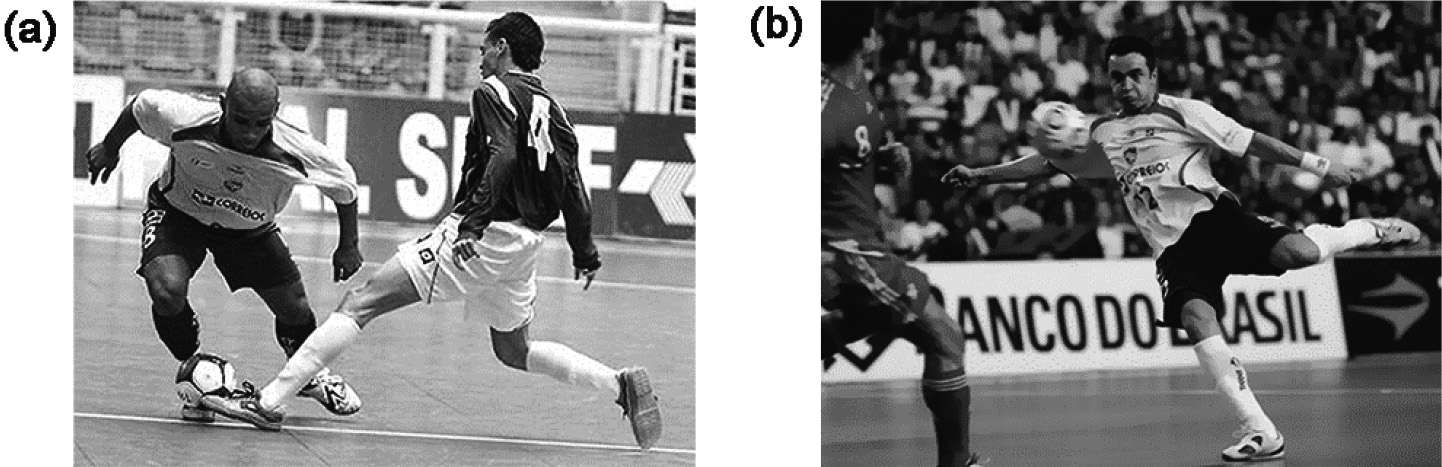
Figure 1 Examples of ilustration used for in-situ game actions. (a) On the left side a 1x1 situation; (b) on the right a high-kick situation
In the second pre-test, we asked a sample of futsal coaches and players to further evaluate the materials (N = 17, M = 26.53 years, SD = 9.23 years; M = 11.12 years of practice; SD = 7.58 years of practice). Using a Qualtrics survey, participants were randomly presented with each of the selected 21 photographs and a label below each one describing the game situation (e.g., 1x1; 1x2; High-Kick). Using a 5-point scale of agreement ranging from 1 - strongly disagree to 5 - strongly agree, participants were asked to evaluate each photograph on wether: (a) it was easy to identify the ball carrier in that action; (b) the action is frequent during a game; (c) the photograph represents the game situation indicated in the label. The registered scores were analyzed in order to allow the selection of the photos that, for each game situation, were easier to identify, were more frequent to occur, and were better represented by the photo. Two photos (dimensions of 400x300 pixels) representing each game situation were selected for the study (for examples, see Figure 1 and https://osf.io/74s9y/).
Procedure
The study procedure utilized the Qualtrics software (Qualtrics, Provo, UT) and data were collected using Apple iPad Mini tablets with a 7.9-inch retina color display. After obtaining authorization from the board of directors, we approached the athletes before their training sessions and provided them with a tablet to complete the survey, which took approximately 20 minutes. All instructions were displayed on the tablet screen. Instructions informed the participants that they would be presented with a set of in-situ photos. They should attend to each photo and report how they would perform that specific action during a game, by selecting one of three alternatives (each alternative was detailed on the basis of the discussion with participants in Study 1):
Thinking (represented by words such as elaboration, calculation, and reflection) was defined as “After capturing the information visually, I use my knowledge of my action capabilities to assess whether I can act”.
Looking (represented by words such as pure vision, not thinking anything, and not feeling anything) was defined as “After capturing the information visually, I directly access my action capabilities instantly, without thinking or feeling”.
Feeling (represented by words such as undefined body sensations, intuition, and instinct) was defined as: “After capturing the information visually, I feel and act on my capabilities”.
Participants were randomly presented with the seven scenarios, one per screen. Above each of them, the participants received the instruction: “Imagine yourself playing the action of the ball carrier”. Below them, they were asked to indicate which source of information they believed their next action would be triggered by: thinking, looking, or feeling. Next to each source of information, a 5-point rating scale was presented for participants to indicate how much they believe they would rely on that source of information, ranging from 1 (very weakly) to 5 (very strongly).
In the second part of the survey, participants assessed different features of the game situations represented on each of the seven scenarios previously evaluated. As such, each previously seen photo was presented again, now associated with different semantic differentials, being of interest: ambiguous-certain; dynamic-static; and simple-complex, defined on a 7-points scale (point 4 was “neutral”).
In the last part of the survey, participants were invited to provide personal data regarding their age (by typing the appropriate number in a blank space), gender (selecting from male, female, other, or prefer not to say), time spent practicing the game (in months), and training load per week (in hours).
Results and discussion
Reliance ratings for sources of information
We assessed differences in the reliance on each source of information (feelings, thinking, and looking) for each game situation with a General Linear Mixed Models approach (using The Jamovi Project, 2025, and the GAMLj package2, Gallucci, 2019), having the two factors as fixed effects and participants as a random factor3. We kept this intercept as a random factor since the result of the Wald Z test = 4.60, p < .001, 95% CI [.084, .196], attested to its significance for the model4.
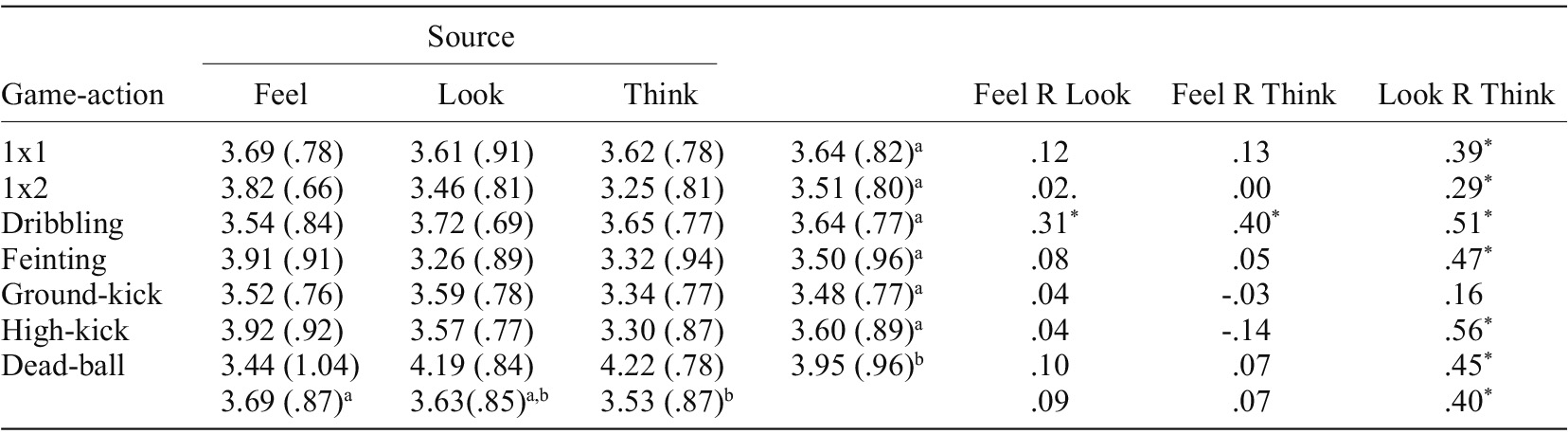
The main effect of the game situation was significant, F(6,1240)=8.90, p < .001, η p 2 = .13 The pattern of these differences (see Table 1) suggests that participants report relying more on the sources of information presented for all six actions performed ‘on the fly’ (i.e., embedded in a dynamic course of action that required a change of action) compared to the static action, the dead- ball game situation that required no change (all p < .001; maintaining the differences after a Bonferroni adjustment for the multiple comparisons). No other contrast was significant, suggesting that participants reported needing the same level of information across all the six dynamic game situations (all p > .20).
Table 1 Means (and standard deviations) of reliance on each source and correlations between sources across on game action
Note. Letters shared within each factor indicate no significant difference. The mean difference is significant at the .05 level; *= p < .05.
As expected the main effect of the type of source was also significant, F(2,1240) = 5.37, p = .005, η p 2 = .08, revealing the athletes reported relying more on feelings than on thinking, t(1240) = 3.24, p = .004, but not more than looking, t(1240) = 1.24, p = .649.
Of most relevance for our paper is the finding that these main effects were qualified by a significant interaction between game situations and sources of information, F(12,1240) = 8.99, p < .001, η p 2 = .16, sustaining the hypothesis that the use of feelings or thinking as a source of information is perceived to occur when performing game actions under specific conditions. Figure 2 illustrates the pattern of data associated with this interaction. The means pattern obtained suggests that participants rely on different sources of information for the dynamic game situations (six situations that require a change of action) compared to the static game situation action (dead-ball): When performing a dynamic movement, athletes report relying more on their feelings (e.g., 1x1 condition), instead of (e.g., 1x2) thinking; while with regard to the static situation, athletes report relying only on the looking and thinking, but not on their feelings to inform their actions.
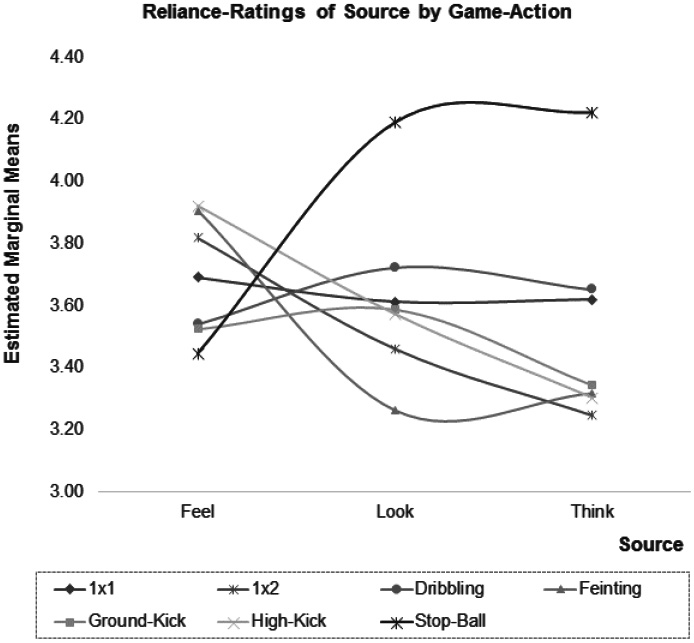
Figure 2 Reliance ratings indicated for each type of source of information across the seven different game situations. Futsal players’ awareness of thinking as source is intensified for the static action (i.e., stop-ball), whereas feeling as source is intensified for the remaining game situations that require a decision to be made mid-action
The means pattern also suggests that the variations found for feelings and thinking as sources of information are more associated with some scenarios than others. For instance, athletes report relying more on feelings as a source of information when performing higher dynamic game actions (e.g., High-kick) than a lower dynamic action (e.g., Feinting).
To further clarify the results, we conducted additional analyses: for each of the seven game situations, we analyzed the correlation between the reliance ratings of the different sources of information (see Table 1). Overall, across situations, results suggest that relying on feelings is not associated with relying on thinking or looking. But relying on thinking seems to be negatively associated with relying on a simple look/apprehension of the situation (correlation mean after Fisher-Z transformation, and re-transformation = .40, p < .05).
Reliance on feelings versus thinking across situation features: Ambiguity, dynamism, and complexity
At the second part of the survey, participants rated each game situation in terms of its ambiguity, dynamism, and complexity using semantic differentials. To explore how these perceived features of the situations affected athletes’ reliance on sources of information, we conducted three separate mixed models, with each one of the perceived features tested as moderators. We first reversed all the semantic differential scales so that higher values represent greater ambiguity, dynamism, and complexity. Because we are particularly interested in the differences between relying on feelings (intuitive source) and thinking (a more deliberate one), we restricted the sources of information to feelings and thinking. Therefore, each mixed model included “source” as a fixed factor and one of the perceived features (ambiguity, dynamism, or complexity) as a continuous fixed moderator. Participants were considered random factors in this analysis5. Results6 show that the interaction with all dimensions is significant, showing that ambiguous, dynamic, or complex situations were more likely to foster decisions based on feelings than based on thinking:
The interaction with perceived ambiguity of the game situation, F(1,816) = 106.47, p < .001, occurred because a higher perceived ambiguity is positively related to an increased reliance on feelings as a source of information, b = .17, t(869) = 8.40, p < .001, and negatively related with the reliance on thinking, b = -.11, t(869) = 5.35, p < .001.
The interaction with perceived dynamics of the game situation, F(1,816) = 41.28. p < .001, emerged because a higher perceived dynamism is positively related to the use of feelings, b = -.10, t(860) = 4.24, p < .001, and negatively related with the use of thinking, b = .11, t(860) = 4.48, p < .001.
The interaction with the perceived complexity of the game situation, F(1,816) = 70.82, p < .001, emerged because a perceived higher complexity of the game situation is positively related to the use of feelings as a source of information, b = -15, t(852) = 4.89, p < .001, and negatively related with the use of thinking, b = -.20, t(852) = 6.60, p < .001.
Overall, these results suggested that players rely more on feelings as a source of information to guide changes in action when they perceive the situational context to be more ambiguous, dynamic, and complex. These players also reported relying more on thinking when they perceived the situational context to be certain or static.
General discussion
Both Studies 1 and 2 were conducted to investigate whether athletes perceive relying on feelings as a source of information to support action changes. The data suggest that athletes believe to rely on three different sources of information in their decision-making processes: apprehension/observation of a situation, bodily feelings, and deliberative thinking. This is more clearly shown in Study 2 than in Study 1, as reliance on each source of information was reported to be lower in Study 1 than in Study 2, likely due to the vividness of the images compared to the reading of the statements. Taken together, both sets of data clearly indicate that, while not exclusive, athletes view feelings as a significant source of information for their actions. Data also indicates that athletes’ naïve theories incorporate the conditions where they use their feelings as a source of information, especially during dynamic and fast-paced actions, as opposed to stationary situations where thinking seems to be more salient. Participants explicitly report that as the perceived complexity of situations increases, they rely more on feelings to make their decision to change an action. This finding is in line with previous evidence suggesting that individuals should rely more on simple heuristic thinking in complex rather than simple contexts (see also Dijksterhuis et al., 2006; Dijksterhuis & Nordgren, 2006; Reber, 1989). The fact that athletes believe to rely more on feelings in ambiguous, dynamic, and complex game situations suggests that they consider using feelings as a heuristic to rapidly evaluate current conditions, such as their speed or fatigue level, in order to direct their actions accordingly. This possibility aligns with the reviewed feelings-as-information hypothesis (Schwarz, 2012; Schwarz & Clore, 1983, 2007). Thus, athletes’ acknowledgment that they rely on feelings for acting may indicate that feelings inform the directions to be taken within the course of an action.
Although we have specifically contrasted reliance on feelings versus thinking, it is important to acknowledge that our results show athletes report reacting through a direct connection between perception and action (looking), not necessarily accompanied by a subjective body experience. This may better translate what is assumed by the eco-dynamic model (e.g., Araújo et al., 2006), which posits that athletes’ actions are guided by situational constraints arising from the interaction between athletes’ bodies and the current scenario. Interestingly, we already find evidence that athletes may explicitly refer to this source of information when looking at the content analysis Ashford and colleagues (2021b) conducted of participants’ verbalizations about their lived decision-making experiences. The authors detected references to the perception of information and actions emerging together with references to slow and declarative game knowledge and fast-and-frugal game knowledge. The relationship between these types of knowledge and the frequency of no-thought decisions, fast-thought decisions, and slow-thought decisions shows some convergence with our data. References to no-thought decisions provide evidence of decisions made through feelings or reactions. More specifically, when athletes described having no time to decide, they verbalized reacting through a direct connection between perception and action, which we refer to as looking, and accessing fast-and-frugal knowledge.
It is crucial to emphasize that our results solely pertain to the beliefs that athletes hold about their use of feelings as information. We do not examine how athletes’ actual decisions in sports are actually influenced by their feelings. These beliefs are susceptible to various biases and misattributions, which may create a gap between what athletes believe and how they actually behave. For example, athletes’ beliefs might merely reflect the socially shared view of the role of feelings, and their perceptions are guided by this preexisting understanding. Consequently, there is a possibility of a disconnection between the actual influence of feelings on decision-making in sports and athletes’ perceptions or beliefs about such influence. Although this possibility should be addressed in future studies, it is also essential to stress that research has shown that beliefs are powerful predictors of behavior (Ajzen & Fishbein, 1972). Therefore, the fact that athletes acknowledge using feelings as information to support their sports actions may also exert a significant influence on their behavior.
Evidence suggesting that athletes’ beliefs may influence their actions has already been provided by some research (e.g., Zeelenberg et al., 2008; Zeelenberg & Pieters, 2006). Zeelenberg and Pieters (2006) propose that “feelings-are-for-doing”, based on the idea that specific emotions felt in a situation serve as indicators of a particular problem, prioritizing behavior to deal with it. Following this approach, most research linking feelings and motor action in the sports context has focused on the role of discrete emotions (e.g., anxiety) on performance (e.g., Hanin, 2007) and on choking under pressure (e.g., Beilock & Carr, 2001). These authors do not define the use of feelings as information as relying on a heuristic process (as in the feelings as a heuristic hypothesis, e.g., Schwarz, 2012), but rather as a process where each emotion has a specific informative value for the action. However, not all experiential feelings are emotional. There is a wide range of non-emotional feelings functioning as the body’s grammar, signaling the suspension of invariance (i.e., changes; Massumi, 2002) and arising and disappearing quickly. Some of these feelings have been associated with mental operations, such as feelings of familiarity (e.g., Garcia-Marques et al., 2004, 2016) and fluency of processing (e.g., Alter & Oppenheimer, 2009; Winkielman et al., 2003), which have been linked to subjective experiences of pleasure, positivity, and easiness. Others have been proposed as the core of our body awareness and affective experience, signaling homeostasis and changes in our bodily systems (e.g., triggered by muscle contractions or an increase in heart rate; e.g., Bechara & Naqvi, 2004; Cameron, 2001; Craig, 2002, 2009) - these are referred to as interoceptive feelings. Therefore, rather than being discrete emotions (Ekman, 1999; Plutchik, 2001), “non-emotional feelings” have dimensions that underlie specific emotions (i.e., pleasure-displeasure and activation-deactivation). They are supported by an online streaming “grounded in the somatovisceral, kinesthetic, proprioceptive, and neurochemical fluctuations that occur within the core of the body” (Barrett & Bliss-Moreau, 2009, p. 04). Although non-emotional feelings function as bodily information without the need to constantly cross the threshold of our consciousness (and engage in the constructive process assembled by emotions, Lindquist et al., 2012), during a flow of events, the homeostatic state of these feelings can quickly change in dynamic ways (see Damásio, 1999; Duncan & Barrett, 2007; Russell, 2009) and become informative. If so, actors would likely experience action based on those feelings, suggesting that athletes’ naïve theories about the use of feelings (not necessarily emotions) impact their behavior. Supporting this notion is the pioneering work on perceived climbability, conducted by Warren (1984). His studies indicated that action could be guided by “optimal points”, described as preferred regions of minimum energy expenditure that may be translated into feelings.
In our studies, athletes reported believing in using feelings, defined as any subjective experience activated during a course of action. However, we did not specifically address the nature of these feelings. Therefore, future research should aim to clarify the specific nature of the feelings that athletes report relying on. It is important to distinguish whether athletes are referring to any subjective experience with physiological activation, such as fluency in processing, moods, or arousal. Conducting future studies to investigate these aspects could allow for a comparison between the “feelings as a heuristic approach” and the “emotions as specific information approach”. This would help better understand whether athletes believe in using one or the other, and to what extent they rely on such beliefs in their decision-making and performance.
In sum, by focusing solely on the naïve theories of athletes, the data from our studies do not provide definitive answers to questions concerning the underlying mechanism of how feelings can inform action capabilities and integrated action decisions. This aspect will be the target of future empirical research, aimed at clarifying the precise role of the subjective experience of bodily feelings as a route of information for actions. However, it is crucial to emphasize that an alternative interpretation of these results should also be considered. It is possible that what athletes report in our studies may constitute a simple illusory naïve theory, which could potentially bias their actions instead of supporting them. This highlights the need for further investigation to fully comprehend the impact of athletes’ beliefs on their decision-making and performance.
Conclusion
In two studies, we have demonstrated that athletes naively believe in using feelings as a significant, immediate, and direct source of information to support their sports actions, particularly during fast-paced actions in ambiguous, dynamic, and complex environments. This paper contributes to integrating sports decisions into the affect/feeling as information model (see Schwarz & Clore, 2007), which allows us to further explore the other assumptions of this theory.
Previous research has shown that the successful utilization of feelings to support intuition in decision-making (e.g., Einhorn & Hogarth 1981; Simon, 1973) is associated with extensive experience in problem-solving, analysis, and solution implementation. Athletes appear to believe that their gut feelings offer this appropriateness for decision-making in their sports performance.

