




 Inglês (pdf)
 Artigo em XML
 Referências do artigo
 Tradução automática
 Enviar este artigo por email
 Citado por SciELO
  Similares em
SciELO
Similares em
SciELO 
 Permalink

Introduction
According to the Public Health Agency of Canada (2017), gestational loss represents a set of situations of abrupt and unexpected loss during pregnancy or after childbirth, which include spontaneous abortion, fetal death, neonatal death, and medical termination of pregnancy, often because of congenital anomalies in the fetus, as well as voluntary termination of pregnancy. Globally every year, one in four pregnancies do not progress beyond 12 weeks of gestation, with around two million babies dying after 28 weeks of gestation, and between 14% and 20% of all pregnancies ending in loss (World Health Organization [WHO], 2023).
Perinatal loss is a devastating experience, with changes in the emotional, physical, social, financial, and spiritual domains of the women and men who experience it (Alvarez-Calle & Chaves, 2023). This loss could involve the breakdown of a binding relationship with the imagined child that had been built up during pregnancy, leading to the start of a process of mourning and enormous suffering. Because it is sudden and unforeseen, often without any complications or irregularities, there is no possibility of emotional preparation or mobilization of the necessary resources to manage the pain, something that increases the shock felt and makes it difficult for the parents to accept this event (Callister, 2006).
When parents are faced with a pregnancy loss, there are secondary losses that they have to deal with, such as the loss of a beloved baby and a child who was expected to be healthy, the loss of status or social identity (mother/father figure), the opportunity to exercise parenthood, self-esteem, feelings of security and control over life, as well as expectations and dreams about the pregnancy and the future (Gabriel et al., 2021; Nazaré et al., 2010). Despite this, society tends to silence and devalue the suffering of these parents, accentuating feelings of incomprehension. Grief resulting from pregnancy loss is also considered to be a disenfranchised grief, denied and minimized by family members, friends, or colleagues of the bereaved, thus increasing their social isolation (Demontigny et al., 2020).
Due to the universal nature of death, the grieving process promotes changes in individual and relational identity for those who experience it. This study aims to carry out a systematic review of qualitative studies on the bereavement experiences of parents who have experienced pregnancy loss to understand the relationship between pregnancy loss and the bereavement experiences of these parents.
Methodology and analysis
Grief is universal and tends to be considered a normative response to loss, which differs from individual to individual. Although the loss of a child is regarded as one of the most traumatic experiences a human being can go through, there is still a lack of understanding of this loss, as well as of the processes of re-signifying parental bereavement. It was decided to carry out an in-depth and careful analysis of publications that show a relationship between parental experiences of bereavement and pregnancy loss, thus enabling an in-depth look at these issues. To this end, the main objective of this study was to systematically review the existing literature on parental bereavement following the experience of one or more gestational losses by identifying, selecting, and analysing scientific articles that refer to the constructs in question.
In this study, the principles of the Preferred Reporting Items for Systematic Reviews and Meta-Analyses (PRISMA) were used, and this article was registered in the International Prospective Register of Systematic Reviews (PROSPERO) database. The systematic review was carried out following the updated PRISMA 2020 guidelines (Page et al., 2021).
The articles were recognized and selected using eligibility criteria established according to the Population, Intervention/Exposure, Comparisons, Outcome, and Study type (PICOS) structure: (1) Population: women and men over the age of 18 who have experienced at least one gestational loss (miscarriage, stillbirth, perinatal death, and neonatal death), with no limit as to the number of weeks of gestation in which the loss occurred or the number of losses; (2) Interventions/Exposure: women and men should not be receiving any psychological care or treatment; (3) Comparisons: women’s and men’s experiences of the bereavement process will be compared according to the type of gestational loss that occurred, the time of pregnancy at which the loss occurred and the time after the loss; (4) Outcomes: to understand parents’ experiences of bereavement after gestational loss; (5) Study type/design: qualitative studies. The guiding research question: “What are the grief experiences of women and men who have suffered a miscarriage, stillbirth or neonatal death?”.
The period used to search for information for this review was from January 2013 to May 2024 using two bibliographic databases: Web of Science and Scopus. The search for articles in the databases mentioned above was complemented by a manual search of reference lists of other relevant publications related to the experiences of bereavement resulting from pregnancy loss to include additional studies not previously identified, thus ensuring data saturation.
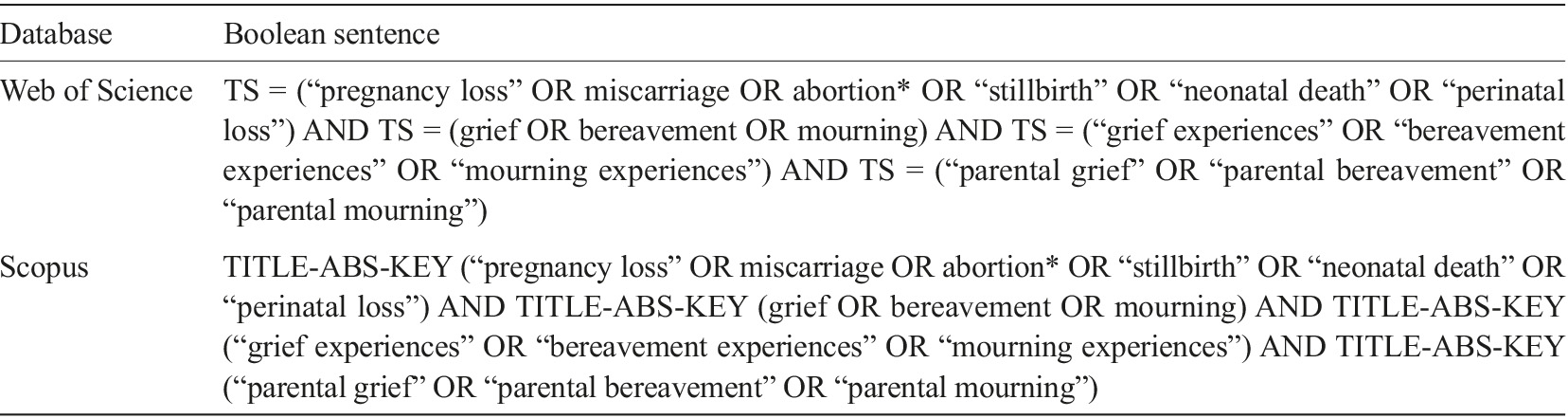
The search strategy included identifying the main terms based on the PICOS structure. The authors also identified keywords and/or synonyms associated with the main topics as described in Table 1. These descriptors were linked in Boolean logic, using the operators “AND” and “OR”, as well as truncation symbols (*) and quotation marks (“”) to restrict the search based on the eligibility criteria. Two independent reviewers assessed the eligibility of each study to reduce the number of articles lost and the risk of bias, thus allowing the divergences found to be discussed later.
Results
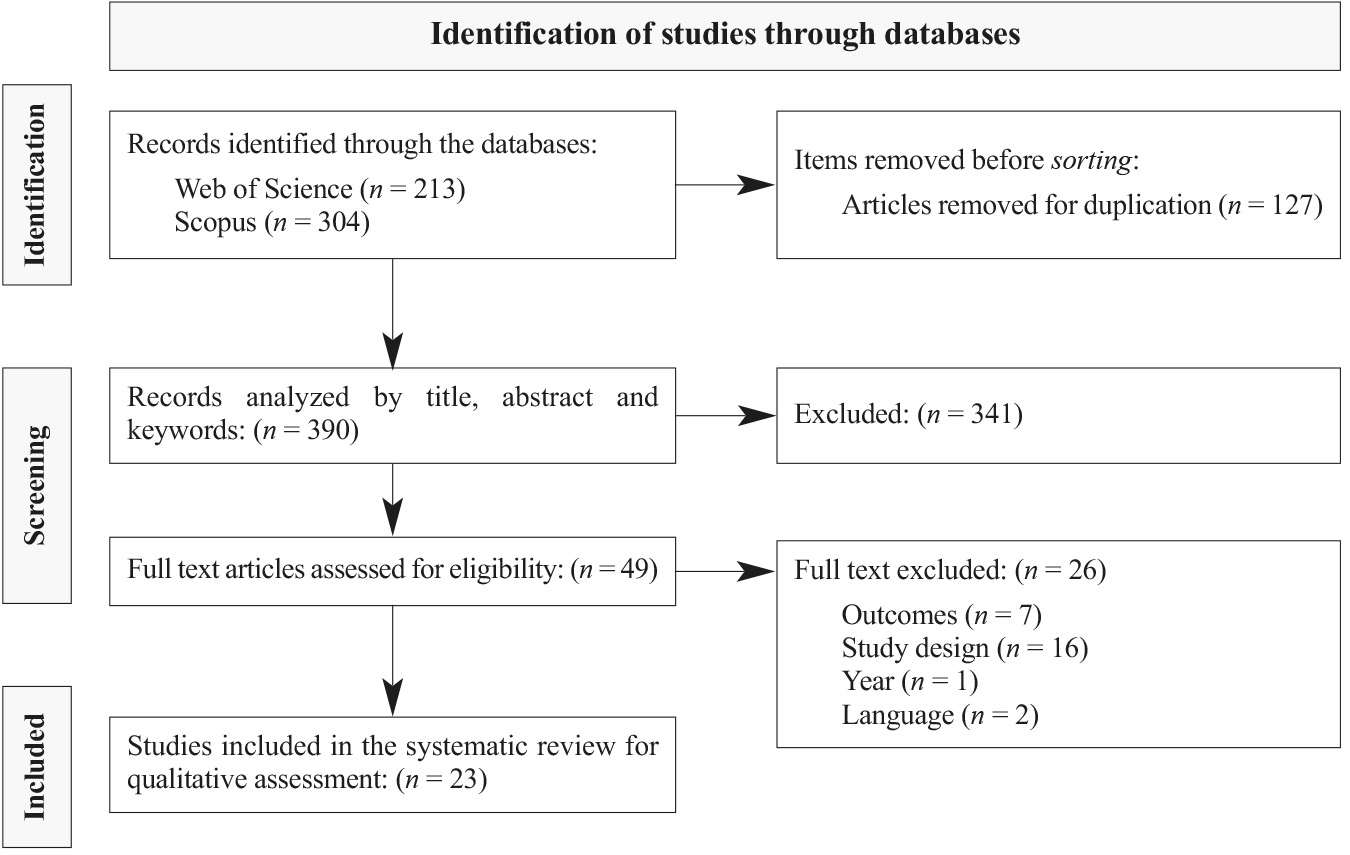
An exhaustive literature search was carried out, and the search results were recorded using the PRISMA diagram (Figure 1). The studies resulting from this search were extracted from an online platform called ENDNOTE.
The data extraction process considered the objectives and inclusion criteria of this systematic literature review. In this sense, and based on the instruments proposed by the Joanna Briggs Institute Reviewers’ Manual (Joanna Briggs Institute, 2014), a standardised data documentation table was adapted, ensuring the reproducibility of this review and presenting the most relevant aspects of each of the studies analysed - the respective authors and the year of publication; the title; the study design; the target population/participants; the measurement instruments used and the main results (Table 2).
Table 2.Discussion
Since each person is unique in terms of their personality characteristics, life history, and previous losses, a different grieving process will also be triggered (Gabriel et al., 2021).
The loss of a child during pregnancy or shortly after is considered a potentially traumatic and unnatural experience for those who experience it, violating what human beings consider to be expected and normative (Bratt et al., 2018). Specifically, during pregnancy, parents invest in building representations of their baby through the physical idealization of their child and the relationship that will be established with them (Lemos & Cunha, 2015). However, the sudden, violent, and often unpredictable loss breaks the bond with the imagined child that had been built during pregnancy (Sanches & Freitas, 2017), thus initiating a process of mourning and enormous suffering.
In this review, the pain and suffering of experiencing the loss of a child was a common point in all the studies. After a pregnancy loss, parents initially experience feelings of shock and denial at the news of the loss or the diagnosis of a fetal malformation (Arach et al., 2022; Azeez et al., 2022; Camarneiro et al., 2015; Popoola et al., 2024). These reactions protect against emotional overload, leading to the reality of the loss being denied (Cassady, 2018). In addition, and even though bereaved parents experience their feelings in an idiosyncratic way, moments of sadness, anguish, emptiness, confusion, and helplessness were present, but also feelings of frustration and anger (Chavez et al., 2019; Consonni & Petean, 2013; Cullen et al., 2018; Evans et al., 2022; Figueredo-Borda et al., 2022). Several studies states that when the shock begins to fade, it is often replaced by feelings of loneliness, guilt, anger, and irritability (Popoola et al., 2024; Tanacioglu-Aydin & Erdur-Baker 2022; Testoni et al., 2020). Other feelings experienced by bereaved parents were envy, jealousy, and shame when confronted with other pregnant women and the parenting of other couples and families (Jones et al., 2022). These results are corroborated by Nazaré et al. (2010), who state that there is a set of emotional, cognitive, behavioural, and physiological reactions that parents experience following a pregnancy loss.
Figueredo-Borda et al. (2022) found that the grieving process is a search to integrate and accept the reality of the loss of the baby in a way that is meaningful to the mother and her partner. It is about adapting to a world without the lost child, which is an experience of fragmentation of parental identity (Evans et al., 2022; Jones et al., 2022; Kecir et al., 2021). In addition, the existing literature states that the fact that there is no possibility of reliving memories created with the baby through insufficient memories increases suffering (Farren et al., 2018), especially if the loss occurred early. In this review, it was found that couples who experienced the loss of a child had periods of intense suffering that lasted for several months or even years (Razeq & Al-Gamal, 2018).
The studies analysed identified gender differences in the experience of bereavement. Meaney et al. (2017), Kecir et al. (2021) and Obst and Due (2019) showed that men experienced a duality in wanting to physically and emotionally protect their partner while experiencing their grief. In addition, there was a need for men to remain “strong” in front of their partners, which led to the internalisation of their emotions and the minimisation of their pain (Kecir et al., 2021). This gender difference can be explained by the fact that women experience the loss more emotionally, experience more intense grief with more manifestations, physically experience the loss, and have established a stronger bond with their child (Lemos & Cunha, 2015; Nazaré et al., 2010; Silva et al., 2019). Additionally, men seem to report less crying and, consequently, tend to seek less social support as a coping strategy, neglecting their feelings of loss (Avelin et al., 2013; Obst & Due, 2019). The literature highlights that, from the observer’s point of view, men’s grief appears to be less intense than that of their partners, even though their stories and demonstrations suggest otherwise (Willick, 2006, in Mourão, 2016). The task of being a father has traditionally been seen specifically in terms of supporting their partner, making them feel inferior and ignored due to the pressure induced by society to be strong and a source of support (O’Leary & Thorwick, 2005). Thus, men feel socially isolated by not receiving social support and shattered by the painful emotions that arise after the pregnancy loss (Cacciatore, 2013), putting added pressure on the marital relationship (Callister, 2006; Huffman et al., 2015).
In most of the studies consulted, mothers and fathers also express feelings of guilt towards themselves and others, such as health professionals (Coyle & Rue, 2015; Jones et al., 2022; Maguire et al., 2015). These feelings of guilt and responsibility for the loss of their child lead them to seek out maladaptive behaviours (alcohol consumption, smoking, or overworking) that could have somehow influenced the baby’s death or the diagnosis of malformation (Kecir et al., 2021), increasing their feelings of inability to prevent their child’s death. Although guilt is a common manifestation of bereavement, this feeling often does not allow for the integration and elaboration of grief and can paralyze the bereaved person (Gabriel et al., 2021).
One issue addressed in the studies in this review is the fact that bereaved mothers were admitted to the maternity ward with other non-bereaved mothers. As it was a place with several mothers with healthy babies, this situation intensified the feelings of failure about the ability to have a child and increased the parents’ suffering (Meaney et al., 2017). In addition, several couples revealed great dissatisfaction with the care provided by health professionals. Several mothers shared that they felt abandoned after the news of the loss, and fathers reported the insensitivity with which it was communicated (Asplin et al., 2014; Kecir et al., 2021). A lack of empathy on the part of health professionals was evidenced when they used insensitive terminology, judged women as the origin of the loss, and showed doubts about their suffering (Cullen et al., 2017; Figueredo-Borda et al., 2022; Wagner et al., 2018). In contrast, several mothers and fathers reported feeling welcomed and comforted by health professionals, having experienced empathetic and compassionate care, which led to a significant sense of confidence and security in adapting to the crisis (Asplin et al., 2014; Cullen et al., 2017; Hendriks & Abraham, 2022; Kecir et al., 2021). Lemos and Cunha (2015) state that it is up to health professionals to take a humanized approach to women and men diagnosed with pregnancy loss, showing empathy and sensitivity to the needs of these couples. According to Cassady (2018), comforting words have a positive and lasting impact on these parents; however, insensitivity and indifference (often unintentional) can worsen an already difficult and painful experience for bereaved parents.
A crucial point to help the family restructure after the death and lessen the pain was the explanation given to the parents about the death of their child. According to the bereaved parents in this review, the medical team should clearly and honestly explain the reason for the loss or the diagnosis of fetal malformation, allowing parents to express their concerns and sadness (Cullen et al., 2018). Health professionals need to be present, willing to accept these parents’ fears, advise them, and give them the support they need, always showing openness so that they can clarify their doubts (Arach et al., 2022; Asplin et al., 2014). The importance of the presence of these professionals after a pregnancy loss is corroborated by Cassady (2018), who states that these parents want their feelings to be validated and accepted and, if possible, clear information shared about what happened and the possible reasons so that they can express their grief meaningfully. Finding a meaning for the death of their baby has brought benefits to the parents’ lives, facilitating their grieving process, although this path is painful and often unbearable (Figueredo-Borda et al., 2022).
Although most women become pregnant after a pregnancy loss, this does not mean that the pain and suffering have been overcome (Camarneiro et al., 2015; Maguire et al., 2015). In the studies in this review, parents maintained their hope of experiencing a healthy pregnancy, even though it was characterized by moments of anxiety, fear, and distress and influenced by the implicit belief that specific behaviour could determine its failure (Maguire et al., 2015; Meaney et al., 2017; Razeq & Al-Gamal, 2018). The literature shows that, in pregnancies following a pregnancy loss, and despite there being no clinical condition to justify the couple’s fears, the truth is that there is a greater likelihood of premature expulsions or low birth weight of the baby, something that increases the parents’ anguish (Gordo, 2022).
Bereaved fathers and mothers reported experiencing this process alone, describing the difficulty in expressing their feelings to family and friends (Azeez et al., 2022; Chavez et al., 2019; Jones et al., 2022; Kecir et al., 2021). This result is due to people not recognizing the fetus as someone who was part of the family, but also due to the difficulty and inability to support the couple after the loss (Rosa, 2020). In this review, it was found that the lack of social support increased feelings of injustice and behaviours of isolation and avoidance of social contact since only these parents were able to understand the pain they were experiencing (Maguire et al., 2015). The existing literature reveals the importance of family members allowing the couple, and especially the woman, to experience bereavement, encouraging the sharing of feelings, experiences, and needs, and supporting the organization of the funeral or similar ceremony, thus allowing them to say goodbye to their child (Faria-Schutzer, 2014).
The possibility for mothers and fathers to talk openly about the child they have lost, to put the experience into words, to share it and integrate it, either with family and friends or through digital platforms and online forums, helps them to preserve their integrity and acknowledge the existence of their baby, something that facilitates their grieving process (Azeez et al., 2022; Figueredo-Borda et al., 2022; Jones et al., 2022; Testoni et al., 2020). In addition, several parents used farewell rituals, such as preparing and organizing a funeral or a similar ceremony, writing a diary or a letter, as well as writing a poem or a song for their child (Meaney et al., 2017). Rituals are defined by Kobler et al. (2007) as an intentional action carried out by a bereaved individual to acknowledge the loss and include symbolic expressions of the emotions, thoughts, and beliefs of the bereaved. Rituals are important psychological factors in the grieving process. They provide awareness that the death has occurred, and that the person is no longer present, guiding them to organize and rethink their life (Mitima-Verloop et al., 2021). Specifically, after a pregnancy loss, research by Castle and Phillips (2003) revealed that, in a sample of men and women, performing rituals facilitated the grieving process, resulting in acceptance of the loss and a reassessment of their life priorities.
The studies in this review also revealed that fathers and mothers resorted to a cognitive escape strategy, such as returning to work, playing sports, or seeking activities with family and friends to cope with the loss of their child (Consonni & Petean, 2013; Kecir et al., 2021; Razeq & Al-Gamal, 2018). Most of the mothers resorted to religious help, going to church and saying prayers to relieve their anguish and seek answers to the event before God (Figueredo-Borda et al., 2022; Razeq & Al-Gama, 2018). According to the study by Oliveira et al. (2022), it was found that spirituality and the use of religious activities are associated with lower levels of grief after a pregnancy loss. Fathers and mothers who have experienced pregnancy loss have said that the death of their child has brought about change and growth (Chavez et al., 2019). Several women reported that the process of writing and talking about their experience helped them not to feel so alone and to find a purpose: to transform their pain and help other bereaved mothers (Jones et al., 2022).
Final considerations
The loss of a child at any time during pregnancy or after childbirth is a potentially traumatic experience for human beings, with implications for the physical, psychological, and social well-being of the couple and their environment (Delgado et al., 2023). This review shows that it is usually an unpredictable and negative event for the whole family, especially the woman. However, despite their experience being undervalued, men also have intense emotional reactions to pregnancy loss. The analysis of the studies has provided an in-depth understanding of the emotions and feelings experienced when the grieving process begins after a pregnancy loss and has revealed gender differences in grief reactions and the way it is experienced. Faced with the death of a child, in many cases, there was a lack of understanding and recognition of the grief of the couple experiencing it on the part of family members, friends, and health professionals, which increased suffering and made it difficult to integrate and accept the loss. The experience of pregnancy loss, particularly in Portugal, is still an under-researched topic, and there are few studies published in this area. During this review, it was found that most of the research seeks to understand the psychopathological consequences of this painful experience. At the same time, there is little evidence about the emotions experienced, the difficulties felt - such as lack of validation, social recognition of the loss and support from the couple - or the rituals used to cope with it. In this way, this systematic review of qualitative studies reveals an innovative nature in this field, and this research is necessary for understanding the grieving process after pregnancy loss. The relevance of this article is justified by the need to understand the bereavement experiences and the psychological and emotional dimensions of those who experience gestational loss based on the existing literature from the last decade. Knowledge of this reality will allow us to improve professional practices in health and psychology, thus improving the intervention carried out with this population. In addition, it is hoped that this article will contribute to further research on the subject.
Implications for future research
This review has highlighted the need for further research into the potential influence of factors such as gestational age and causes of pregnancy loss on the characteristics of the bereavement process. There is also a need to investigate whether there are differences in the grieving process according to the age of the women and the number of pregnancy losses they have experienced. Future research should use a combination of qualitative and quantitative methods and include the perspectives of partners and other significant figures to assess the impact of pregnancy loss on their lives and the influence of social support. To improve support and care for those experiencing pregnancy loss, future research should seek to understand the perspectives of health professionals. This should include an examination of the main difficulties encountered and the needs felt by the multidisciplinary team.

