




 Inglês (pdf)
 Artigo em XML
 Referências do artigo
 Tradução automática
 Enviar este artigo por email
 Citado por SciELO
  Similares em
SciELO
Similares em
SciELO 
 Permalink

Affective touch constitutes a primary mode of embodied communication between caregivers and young children, supporting the co-construction of safety, emotional regulation, and social bonding from the earliest stages of development (Beebe et al., 2010; Jean & Stack, 2009). Far beyond a channel of nonverbal communication, touch plays a privileged role in affective co-regulation and the shaping of attachment patterns, serving as a critical input for the development of neural networks involved in social cognition (Crucianelli et al., 2019). Sensitive tactile interactions help organize the child’s internal states and establish relational expectations that influence long-term socioemotional trajectories (Feldman, 2012a). Consistent affective touch within caregiving relationships further supports stress regulation and socioemotional adjustment, particularly in contexts of early adversity and deprivation (Nikolaeva et al., 2024).
Caregiver touch has been shown to modulate behavioral, emotional, and physiological outcomes in children, both immediately and across developmental time (Carnevali et al., 2024; Nikolaeva et al., 2024; Pawling et al., 2024). Affectionate and responsive touch supports the maturation of the autonomic nervous system, reduces stress reactivity, and fosters the acquisition of social and emotional competencies (Feldman, 2012a; Stack & Muir, 1992). At the autonomic level, individual sensitivity to affective touch is associated with vagally mediated heart rate variability, linking tactile responsivity to self-regulatory capacity and socioemotional functioning (Pawling et al., 2024). Neuroimaging evidence demonstrates that pleasant, low-pressure tactile stimulation - typically delivered at slow velocities and mediated by C-tactile afferents - activates brain regions implicated in emotional processing and interpersonal attunement, including the posterior insular cortex and orbitofrontal areas (Gordon et al., 2013; McGlone et al., 2014; Morrison et al., 2010). These neural pathways are not only involved in the immediate hedonic experience of touch but also support the integration of social meaning, empathy, and emotional self-regulation (Tuulari et al., 2019).
Recent work further highlights that affective touch is defined not merely by contact occurrence but by the dynamic physical parameters that render it an information-rich and biologically grounded signal. Beyond its subjective pleasantness, affective touch is characterized by specific spatiotemporal and force-related parameters, including dynamic modulation of pressure, velocity, and shear forces, which distinguish socially meaningful tactile gestures from other forms of contact (McLaren et al., 2024). Converging evidence from comparative neuroscience indicates that the neural mechanisms supporting the processing of such tactile signals are evolutionarily conserved across primate species. Functional neuroimaging studies in lightly anesthetized rhesus monkeys demonstrate that slow, affective touch selectively engages the insula, anterior cingulate cortex, amygdala, and secondary somatosensory cortex - networks homologous to those observed in humans - suggesting that affective touch recruits interoceptive-socioaffective circuits even in the absence of conscious perception (Charbonneau et al., 2024).
During infancy and early childhood, when the autonomic nervous system is still developing, caregiver touch serves as an external regulator of physiological and affective functions, helping modulate heart rate, hypothalamic-pituitary-adrenal (HPA) axis activity, and behavioral expression (Feldman, 2007; Hertenstein, 2002). This regulatory function is especially critical in stressful contexts, where tactile soothing promotes emotional homeostasis and scaffolds the development of self-regulatory strategies (Montirosso & McGlone, 2020). Importantly, the quality of touch - not just its presence - matters. While affectionate, attuned touch fosters secure attachment and socioemotional growth, intrusive, inconsistent, or affectively neutral touch may signal emotional unavailability and contribute to maladaptive patterns of regulation (Beebe et al., 2011; Ferber et al., 2008). Experimental and developmental studies further indicate that affective touch selectively enhances infants’ attentional engagement with complex social stimuli and supports multisensory integration processes underlying early social cognition (Carnevali et al., 2024). Empirical findings suggest that early deprivation of affective tactile input, even in families without overt adversity, is linked to heightened emotional reactivity, social withdrawal, and attention regulation difficulties (Jean & Stack, 2009; Loman & Gunnar, 2010).
Despite a growing literature on the neurobiological and developmental importance of affective touch, few observational measures have been developed to systematically assess the quality and function of touch in naturalistic caregiver-child interactions. Most studies rely on self-report instruments or global ratings that fail to capture the nuanced, context-dependent, and dynamic nature of tactile behaviors (Feldman et al., 2010; Jean & Stack, 2009). Widely used observational scales - such as the Emotional Availability Scales (Biringen, 2008) and the Maternal Behavior Q-Sort (Pederson et al., 1990) - typically treat touch as a subcomponent of broader constructs like sensitivity or positive affect, without explicitly addressing its distinct functions, forms, or affective valence. On the other hand, research that isolates touch often uses binary measures (e.g., presence vs. absence), overlooking the relational meaning, intentionality, and emotional tone that characterize different types of tactile exchanges (Stack & Muir, 1992).
To address these gaps, we developed the Caregiver-Child Affective Touch Assessment (CCATA), a theoretically grounded observational measure designed to classify caregiver touch behaviors according to their affective, functional, and interactional qualities. The CCATA moves beyond frequency-based or dichotomous approaches by offering a multidimensional taxonomy that captures qualitative distinctions in how touch is expressed and experienced within the caregiver-child dyad. It enables researchers to classify both explicitly affective gestures and more pragmatic or regulatory forms of touch, reflecting an ecological understanding of everyday caregiving routines. Importantly, the classification includes both intentional and incidental touch behaviors, offering a comprehensive framework for analyzing tactile communication across a variety of caregiving contexts.
The CCATA distinguishes seven categories of caregiver touch based on three key dimensions: affective valence (positive, neutral, negative), functional purpose (e.g., soothing, directive, instrumental), and interactional context (e.g., spontaneous vs. goal-directed). This classification is anchored in developmental theory and supported by empirical findings linking specific types of touch to child outcomes such as emotional availability, self-regulation, and neural responsiveness (Feldman, 2007; Field, 2010; Jean & Stack, 2009; McGlone et al., 2014). By explicitly attending to the qualitative, regulatory, and relational properties of touch emphasized in recent neurobiological and developmental research (McGlone et al., 2024; Pawling et al., 2024), the CCATA enables the detection of touch patterns that may support or undermine children’s socioemotional development - making it a promising observational measure for both research and applied settings, including clinical assessment and early intervention programs.
This framework also responds to developmental transitions in early childhood, particularly between ages 2 and 5, when increased child autonomy and behavioral regulation challenges lead to changes in the nature and function of caregiver touch (Scott et al., 2022). In this period, caregivers often shift from predominantly affectionate gestures to more functional or directive forms of contact, which may carry both supportive and controlling elements. The CCATA is sensitive to this variability, allowing for the exploration of how different types of touch operate in response to child behavior and task demands.
The present study aims to introduce the development and initial psychometric evaluation of the CCATA. Specifically, we examine the instrument’s content validity, interrater reliability, and convergent validity in a sample of caregiver-child dyads observed during structured interaction tasks. In addition, we conducted a Principal Component Analysis (PCA) to explore whether the categories of touch identified by the CCATA cluster into broader dimensions that reflect underlying caregiving strategies or relational intentions. Based on theoretical and empirical foundations, we hypothesize the following:
1.H1 (Content validity): The CCATA items will demonstrate high content validity, reflecting the theoretical dimensions of affective touch in caregiver-child interactions.
2.H2 (Convergent validity): Touch behaviors coded as affective and responsive (e.g., affectionate, playful, and spontaneous touch) are expected to be positively associated with caregiver and child emotional availability (e.g., Sensitivity, Structuring, Non-intrusiveness, Non-hostility, Responsiveness, Involvement). Touch behaviors classified as intrusive or controlling (e.g., aggressive or directive forms of touch) are expected to be positively associated with harsh discipline and psychological control, and negatively associated with emotional availability dimensions.
Altogether, this study seeks to validate a novel observational measure capable of capturing the complexity and relational meaning of caregiver touch in early childhood. By offering a fine-grained and theoretically informed classification system, the CCATA has the potential to advance research on embodied caregiving processes and to inform interventions aimed at enhancing parent-child relationships and developmental outcomes.
Method
Participants
The study included 30 mother-child dyads, with children’s age ranging from 24 to 48 months (M = 34.97 months; SD = 7.54), the majority of whom were girls (53.3%). Mothers were between 18 and 39 years old (M = 29.27; SD = 5.69) and were from psychosocial risk backgrounds. The sample was identified by professionals working in child health and social support services in Northern Portugal. Overall, families were characterized by socioeconomic disadvantage: 70.3% (n = 21) of mothers had not completed the 12 years of mandatory schooling in Portugal, and 63.3% (n = 19) were unemployed.
Recruitment and data collection occurred within the context of an attachment-based parenting intervention designed to promote positive and sensitive caregiving in socioeconomically disadvantaged families (Negrão et al., 2014). The present study draws on observational data collected as part of the broader evaluation of this program. The intervention program was grounded in attachment theory and included standardized interaction tasks (Free Play, Structured Problem-Solving, Tidy-Up, and Don’t-Touch) developed to assess caregiving behavior across low- and moderate-stress contexts.
Inclusion criteria were: (a) availability to participate in two home-based observational sessions; absence of severe clinical diagnoses in either mother or child (e.g., maternal psychosis, child fetal alcohol syndrome), assessed via caregiver self-report during an initial screening interview; proficiency in Portuguese; and (d) the presence of at least one psychosocial risk indicator, as determined by the Portuguese short version of the Family Risks and Strengths Profile (PRF, Pereira et al., 2009; Rodríguez et al., 2006), completed by professionals from health and social services at referral, based on 23 risk items related to family relations and parenting quality (e.g., emotional neglect, lack of limit setting, coercive discipline, marital violence).
Two home visits were conducted to increase the reliability and representativeness of observed interactions across contexts and to enhance ecological validity. Assessments were carried out by trained researchers following standardized protocols. Written informed consent was obtained prior to participation, and all procedures were approved by the relevant institutional ethics committee.
Instruments
Mother-child interactions were assessed through a set of four interactive tasks designed to elicit different relational dynamics under varying emotional and regulatory demands, as it follows: (1) in the Free Play Task (10 minutes), mothers were instructed to interact naturally with their children using age-appropriate toys provided by the researchers; (2) in the Structured Problem-Solving Task (5 minutes), mothers guided their children in engaging with a challenging toy designed to create mild frustration, requiring maternal support and scaffolding strategies; (3) in the Tidy-Up Task (2.5 minutes), mothers encouraged their children to place scattered toys into a box, using both verbal and physical strategies to promote cooperative behavior in a low emotional demand context; (4) in the Don’t-Touch Task (2.5 minutes), mothers were asked to prevent their children from touching attractive toys placed nearby, a situation designed to elicit parental containment strategies and child emotional regulation under higher frustration (Negrão, 2014).
Caregiver-Child Affective Touch Assessment (CCATA): The CCATA is an observational measure developed to assess the quality of caregiver touch in interactions with children aged 2 to 5 years. It captures a continuum of tactile behaviors, from low-level physical actions (e.g., pushing, cuddling) to complex relational gestures (e.g., affectionate, instrumental, or intrusive touch). The system includes seven mutually exclusive categories based on affective valence and relational function: Affectionate, Instrumental, and Playful (positive valence); Intrusive and Rude (negative valence); and Static and Accidental (neutral valence). Mother touch was coded during the Tidy-Up and Don’t Touch tasks. Four trained raters with expertise in child development and CCATA procedures independently coded the data. Interrater reliability, calculated using intraclass correlation coefficients (ICC) on 33% of the videos, indicated very good agreement across the seven categories (ICC range = .86 - .94).
Emotional Availability Scales (EAS; Biringen, 2008): The EAS is a widely validated observational instrument developed to assess the emotional quality of caregiver-child interactions. It comprises six scales: Sensitivity (caregiver’s ability to perceive and respond appropriately to the child), Structuring (ability to guide the interaction constructively), Non-intrusiveness (allowing autonomy without overcontrol), and Non-hostility (absence of negative or rejecting behavior). For the child, Responsiveness (reflects receptivity to the caregiver, and Involvement (captures the degree of active engagement with the caregiver). Emotional availability was coded during the Free Play, Structured Problem-Solving, and Don’t Touch tasks for caregiver scales, and during the Free Play and Structured Problem-Solving tasks for child scales. Trained, independent raters blind to other study variables performed the coding. Interrater reliability was high across scales (average ICC = .87).
Maternal Interactive Behavior in Discipline Task (adapted from Verschueren et al., 2006; Erickson et al., 1985): This coding system evaluates maternal behavior during the Don’t Touch task. Three parenting dimensions were assessed: Harsh Discipline (e.g., unnecessary physical control and verbal irritation), Psychological Control (e.g., guilt induction or emotional withdrawal), and Supportive Presence (e.g., scaffolding, encouragement, appropriate guidance). Coding was carried out by trained raters blind to other measures. Interrater reliability, calculated across all coded segments, was high (ICC = .80).
Coding strategy and data analysis
The quality of maternal touch during interactions with the child was coded using the CCATA system, which employed an event-based strategy and classified behaviors into seven mutually exclusive categories according to affective valence: positive (Affectionate, Playful, Instrumental), negative (Intrusive, Rude), and neutral (Static, Accidental). Firstly, based on video recordings of mother-child interactions, each touch was identified and coded using a real-time annotation and timing system.
Affectionate touch includes gentle, caressing, or soothing gestures that communicate warmth, comfort, and emotional closeness. These touches are strongly linked to the activation of C-tactile afferents and have been associated with enhanced oxytocin release and positive socioemotional outcomes in children (Crucianelli et al., 2019; McGlone et al., 2014).
Playful touch refers to light, dynamic, and reciprocal tactile exchanges that promote dyadic synchrony, mutual enjoyment, and affective attunement. This type of touch is known to stimulate positive arousal and has been observed to facilitate affect regulation and social engagement in infants (Jean & Stack, 2009; Reece et al., 2016; Stack & Muir, 1992).
Instrumental touch, while primarily goal-directed (e.g., adjusting clothing or repositioning), is classified as positive when performed in a coordinated, respectful, and affiliative manner. Studies indicate that such pragmatic touches, when non-intrusive and affectively neutral, support caregiving goals and child cooperation (Crucianelli et al., 2019; Paradis & Koester, 2015).
Intrusive touch includes controlling, abrupt, or overly forceful gestures that constrain the child’s autonomy, often reflecting dysregulated caregiver behavior. Research has linked such touch to the development of resistant attachment styles and approach-avoidance behaviors in the child, indicating a disruption in affective coordination and regulation (Beebe et al., 2010).
Rude touch (sometimes termed “rough” or “abrupt”) refers to brusque, emotionally incongruent or negatively valence contacts that may communicate frustration, rejection, or hostility. This type of touch can compromise the child’s sense of safety and has been associated with lowered responsiveness and distress (Beebe et al., 2010; Paradis & Koester, 2015).
Static touch captures prolonged physical contact without dynamic movement or clear emotional expression (e.g., resting a hand). It is considered neutral, but may function as a regulatory baseline depending on context and co-occurring signals. Static contact has been described as a background channel of nonverbal communication and proximity maintenance (Hertenstein, 2002; Jean & Stack, 2009).
Accidental touch refers to incidental or unintentional contact (e.g., brushing past the child while reaching for an object). While these touches are affectively neutral, they must be distinguished from purposeful touch to preserve coding validity and ensure behavioral specificity (Crucianelli et al., 2019).
Together, these categories were developed to capture the diverse communicative and regulatory functions of caregiver touch, grounded in empirical evidence from developmental psychology, affective neuroscience, and attachment theory (Feldman, 2007; Jean & Stack, 2009). By distinguishing between valence (positive or negative) and neutral forms of tactile behavior, the CCATA system allows for a nuanced analysis of how caregivers convey affective signals, modulate arousal, and scaffold early social-emotional development through physical contact. For instance, positive touches such as affectionate and playful contact foster mutual engagement and biobehavioral synchrony, contributing to the child’s sense of safety, affect regulation, and social orientation (Crucianelli et al., 2019; Jean & Stack, 2009; Reece et al., 2016). Conversely, negative touches as intrusive or rude contact have been associated with disrupted dyadic regulation, increased infant distress, and the development of maladaptive relational expectations, particularly in high-risk or stressed caregiving contexts (Beebe et al., 2010; Paradis & Koester, 2015).
Importantly, the inclusion of neutral categories such as static and accidental touch addresses the communicative ambiguity often found in observational contexts, where not all physical contact carries a clear affective intent but may still contribute to the interactional climate. This tripartite classification (positive, negative, neutral) enhances ecological validity by accommodating the complexity of real-life caregiving behaviors and their contingencies.
Moreover, the CCATA categories are informed by converging lines of evidence suggesting that the quality - not merely the quantity - of touch plays a critical role in shaping early attachment patterns, social cognition, and the maturation of neural circuits related to empathy, emotional understanding, and self-regulation (Crucianelli et al., 2019; Feldman, 2012b; McGlone et al., 2014). By systematically coding these distinct tactile expressions, the CCATA provides a robust observational framework for examining how caregiving behaviors - particularly those involving touch - mediate the transmission of emotional availability, mentalization, and relational security from parent to child.
In terms of data analysis, absolute frequencies of each touch category were calculated per dyad. Proportions were then computed by dividing the frequency of each category by the total number of touches per dyad, thereby standardizing the data regardless of interaction length or intensity. Given the small sample size and the exploratory nature of the study, a Principal Component Analysis (PCA) was conducted, instead of an exploratory factor analysis, allowing the identification of patterns of covariance among variables and dimensionality reduction without requiring the stricter assumptions of factor analysis regarding common variance and sample size. Convergent validity was examined using Spearman correlations between the proportions of touch categories derived from PCA and theoretically related constructs, namely the dimensions of the Emotional Availability Scales (EAS) (Sensitivity, Structuring, Non-intrusiveness, and Non-hostility, Responsiveness, Involvement), which were computed as composite scores derived from the different observational tasks and the Maternal Interactive Behavior in Discipline Task (Harsh Discipline, Psychological Control, Supportive Presence).
Results
Frequency and distribution of touch
A total of 1,066 maternal touch were coded from observations of 30 mother-child dyads. One dyad exhibited no touch behaviors during either of the two tasks, and two additional dyads had no touch occurrences during the Tidy-Up task. The mean number of touches per dyad was 35.17 (SD = 17.38, range 0-98), with significant variation depending on the task performed. The Don’t-Touch task elicited substantially more touches (n = 803) compared to the Tidy-Up task (n = 263), t(29) = -3.62, p = 0.001, reflecting the greater physical involvement in situations involving child motor regulation.
The most frequently observed categories were Intrusive (46.9%) and Instrumental (21.7%), followed by Rude (15.7%), Playful (5.0%), Static (4.8%), Accidental (4.4%), and Affectionate (2.4%). Touches classified as negative in affective valence (Intrusive and Rude) accounted for the majority of interactions (62.6%). Positive-valence touches (Affectionate, Instrumental, and Playful) represented 29.1% of all occurrences, while neutral-valence touches (Static and Accidental) totaled 9.2%.
Principal Component Analysis (PCA)
A Principal Component Analysis (PCA) with Varimax rotation was conducted on the seven items of the Caregiver-Child Affective Touch Assessment (CCATA) to explore its underlying dimensional structure. Given the exploratory aim of the present study and the modest sample size, PCA was used as an initial data-reduction approach to identify provisional dimensions of caregiver touch for subsequent validation.
The Kaiser-Meyer-Olkin (KMO) measure verified sampling adequacy, with a value of 0.62, which is considered marginally acceptable for dimensionality reduction methods such as PCA (Kaiser, 1974). Bartlett’s test of sphericity was significant [χ²(21) = 50.75, p < .001], indicating that the inter-item correlations were sufficiently large to justify dimensionality reduction.
The analysis yielded three components with eigenvalues greater than 1, explaining 73.97% of the total variance. These components should be interpreted as preliminary dimensional groupings rather than definitive latent factors. Specifically, Component 1 accounted for 36.7% of the variance, Component 2 explained 20.0%, and Component 3 contributed 17.2%. The Scree plot also supported the retention of three components.
After Varimax rotation, distinct loading patterns emerged (Table 1). Component 1 was characterized by items reflecting regulatory and controlling tactile behaviors, including Intrusive (0.77), Rude (0.72), and Static (0.87). Component 2 encompassed interactive or pragmatic touches, such as Playful (0.85) and Instrumental (0.63), although the latter also showed moderate loadings on Component 1 (0.61). Component 3 included affective or spontaneous touches, notably Accidental (0.86) and Affectionate (0.65), with Affectionate also moderately loading on Component 2 (0.54). These cross-loadings suggest potential overlap between pragmatic and affective dimensions.
Table 1 Component Matrix of the CCATA (Varimax Rotation)
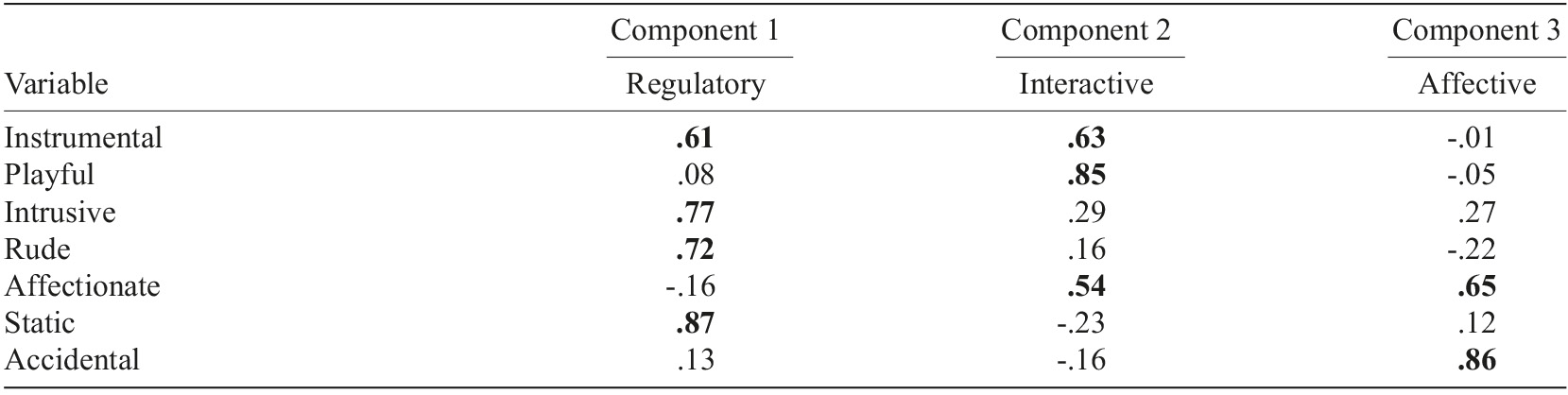
Note. Components loadings ≥ .40 are shown in bold. Varimax rotation with Kaiser normalization; rotation converged in 6 iterations.
Although the component structure was theoretically coherent, cross-loadings observed for some items warrant cautious interpretation. Overall, these findings suggest that the CCATA captures distinguishable dimensions of caregiver touch, which require confirmation through CFA in larger samples.
Convergent validity
To examine the convergent validity of the CCATA factors, Spearman’s rho correlations were computed between the three CCATA components (regulatory/controlling, interactive/pragmatic, affective/spontaneous), caregiver and child dimensions from the Emotional Availability Scales (Sensitivity, Structuring, Non-intrusiveness, Non-hostility, Responsiveness, Involvement), and parenting behaviors assessed through the Maternal Interactive Behavior in Discipline Task (Harsh Discipline, Psychological Control, Supportive Presence).
The regulatory/controlling component was positively correlated with Harsh Discipline (ρ = .41, p = .025) and Psychological Control (ρ = .58, p < .001), indicating that higher regulatory touch was associated with more directive and intrusive maternal behavior during the discipline task. Conversely, the regulatory/controlling component showed no significant association with caregiver sensitivity or support during play and tasks (ps > .05).
The interactive/pragmatic component was moderately correlated with the regulatory/controlling component (ρ = .50, p = .005) but showed no significant associations with any external parenting or child behavior measures. Compared to the other CCATA components, the interactive/pragmatic component demonstrated the lowest level of association with both emotional availability and discipline-related constructs. This absence of correlations suggests that this component may capture a distinct aspect of caregiver touch not represented in the existing observational measures.
The affective/spontaneous component was positively associated with Non-hostility (ρ = .39, p = .038), indicating that higher proportions of warm, spontaneous touch occurred in the context of emotionally regulated caregiving. Among the three CCATA components, the affective/spontaneous dimension showed the most consistent pattern of association with caregiver emotional availability variables, particularly Non-hostility (Table 2).
Table 2 Spearman’s correlations between CCATA components and observational parenting measures (n = 30)
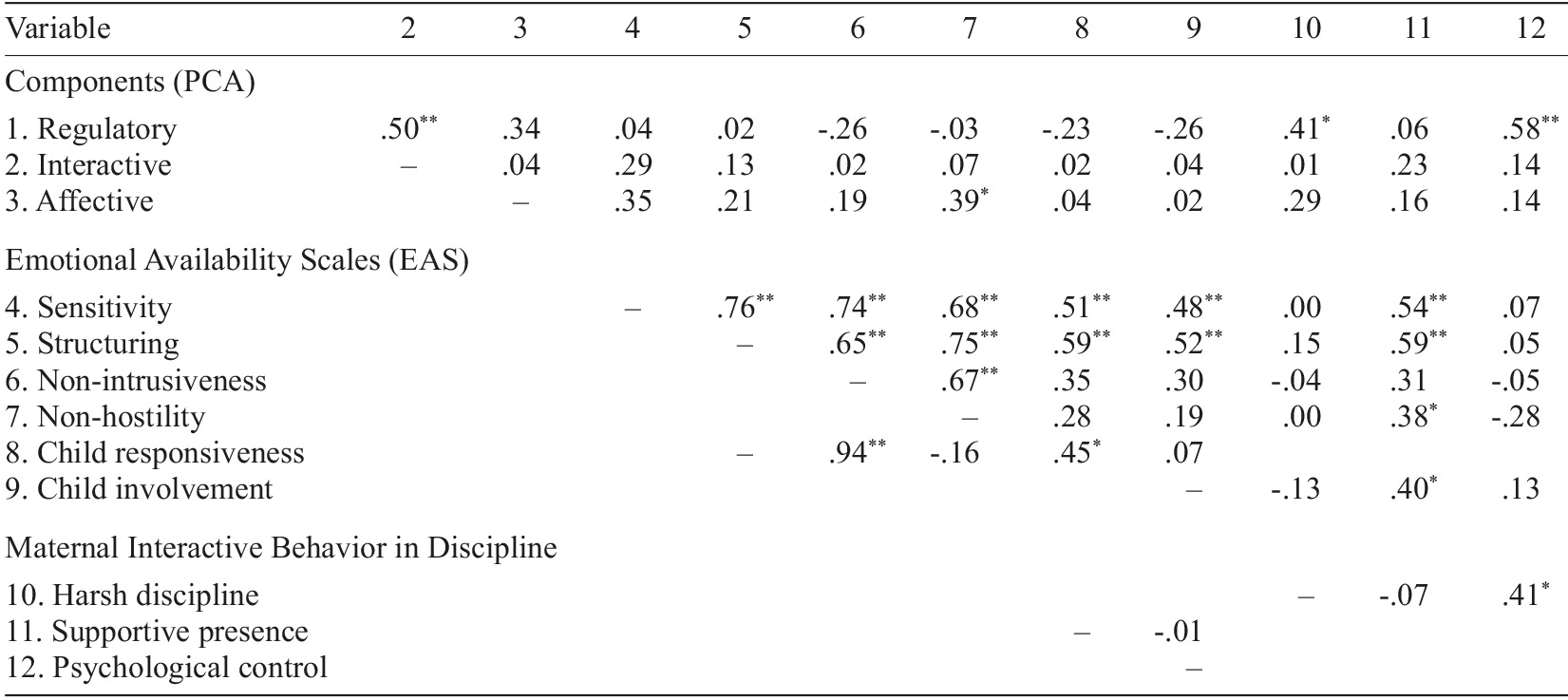
Among the EAS scales, caregiver Sensitivity and Structuring were strongly intercorrelated (ρs > .75, p < .001), and both were positively associated with Supportive Presence during the discipline task (ρ = .54 and ρ = .59, respectively, ps < .01). These associations confirm the expected coherence among the external validation measures used to assess the convergent validity of the CCATA.
Discussion
The present study introduced the development and initial validation of the Caregiver-Child Affective Touch Assessment (CCATA), an observational coding system designed to characterize the quality of caregiver touch in interactions with children aged 2 to 5 years. Given the modest sample size and exploratory analytic approach, the findings should be interpreted as preliminary. Nonetheless, by coding over a thousand touch events, the CCATA provided an initial framework to operationalize a caregiving dimension that has been largely overlooked in observational research.
High interrater reliability offers preliminary support for the clarity and replicability of the coding system, even in structured and demanding contexts such as the Tidy-Up and Don’t-Touch tasks. This is notable given that touch is often treated as a secondary component of broader constructs such as maternal sensitivity, rather than as a distinct behavioral domain (Biringen, 2008; Stack & Muir, 1992). However, reliability alone does not establish validity, and further psychometric evaluation is required.
Descriptively, intrusive and instrumental touches predominated in this sample, a pattern that warrants cautious interpretation. During the preschool years, caregivers increasingly rely on touch to manage autonomy and behavioral regulation, particularly in structured, goal-directed tasks. The Don’t-Touch task, which explicitly required behavioral containment, likely inflated regulatory touch. While such strategies may be adaptive for safety and limit-setting, they may also reduce opportunities for affiliative touch, especially in psychosocially at-risk families, where stress and adversity have been linked to lower emotional availability (Capistrano et al., 2022; Scott et al., 2022).
The low frequency of affectionate touch may similarly reflect developmental and contextual factors. As children gain independence, caregivers may perceive less need for explicitly warm tactile behaviors (Jean & Stack, 2009), particularly in tasks prioritizing behavioral management (Beebe et al., 2010; Biringen, 2008). In high-risk contexts, however, this pattern may also signal diminished attunement, underscoring the importance of supporting caregivers in integrating sensitive touch into everyday interactions (Stack & Muir, 1992).
PCA suggested a provisional three-component structure - regulatory/controlling, interactive/pragmatic, and affective/spontaneous - which is broadly consistent with theoretical accounts of touch as a multifaceted communicative channel serving both regulatory and affiliative functions (Cascio et al., 2019; Field, 2010). The regulatory/controlling component aligns with prior work linking physical guidance to behavioral containment, but excessive reliance on such strategies has been associated with less optimal socioemotional outcomes (Beebe et al., 2010, 2011; Jean & Stack, 2009). The interactive/pragmatic component grouped instrumental and playful touch, which may support task engagement and dyadic coordination (Field, 2010; Stack & Muir, 1992), though in this context these behaviors likely served functional rather than affiliative purposes. The affective/spontaneous component conceptually aligns with models emphasizing gentle, affiliative touch in co-regulation and bonding (Cascio et al., 2019; McGlone et al., 2014), a correspondence that should be interpreted as theoretical consistency rather than confirmatory evidence.
Convergent validity analyses provided partial support for construct validity. Regulatory/controlling touch was associated with psychologically controlling and harsh discipline, consistent with models of coercive caregiving (Beebe et al., 2010, 2011; Jean & Stack, 2009), whereas affective/spontaneous touch showed positive associations with caregiver sensitivity and non-hostility (Cascio et al., 2019; McGlone et al., 2014; Stack & Muir, 1992). Although modest and not uniformly significant, the directionality of these associations is theoretically meaningful. The interactive/pragmatic component showed weak associations with external measures, possibly reflecting the context-dependent and functional nature of these behaviors in structured tasks (Field, 2010; Stack & Muir, 1992).
Overall, the pattern of findings is broadly coherent with theoretical expectations but constrained by limited statistical power. Null results should therefore be interpreted cautiously. The absence of associations with child variables may reflect developmental variability, measurement sensitivity, or the analytic focus of this study. Overall, the findings suggest that the CCATA may be sensitive to qualitative differences in caregiver interaction style, while underscoring the need for larger, more diverse samples and confirmatory analyses.
Several limitations must be acknowledged. The small sample size limits generalizability; structured tasks may underrepresent spontaneous affiliative touch; mutually exclusive coding categories may oversimplify the multifunctional nature of touch; and the exclusive focus on mothers restricts applicability to other caregivers. Future research should examine longitudinal stability, cross-context consistency, and associations with neurophysiological markers such as prefrontal activation measured via fNIRS. By offering a fine-grained observational framework, the CCATA addresses an important methodological gap, but its developmental and clinical utility must be established through further empirical work.

