




 Inglês (pdf)
 Artigo em XML
 Referências do artigo
 Tradução automática
 Enviar este artigo por email
 Citado por SciELO
  Similares em
SciELO
Similares em
SciELO 
 Permalink
INTRODUCTION
Schizolobium parahyba var. amazonicum (Huber ex Ducke), commonly known as Paricá, is a tree species of the family Fabaceae, it has high performance in timber production under silvicultural systems (Silva & Sales, 2018). When cultivated in pure plantations or in consortiums under different soil and climate conditions and under high solar incidence, S. parahyba presents fast growth and low mortality (Dias et al., 2015). According to the Brazilian Tree Industry (IBÁ, 2021), native species of Brazilian biomes occupy 53,386 hectares in plantations, including S. parahyba, which increased in 3% on the planted area between 2019 and 2020.
Commercial plantings of S. parahyba are justified by its good acceptance in the wood market for the production of veneer and plywood, linings, sticks, furniture, as well as finishing pieces and frames (Silveira et al., 2017). Currently, most of the S. parahyba wood is addressed to the veneer production (unrolled) for the manufacture of plywood. Veneers are used both on the inside (core) and on the outside (cover) of the plywood, and its use depends on the veneer quality, where about 30% of the veneers produced are used as cover and the rest as core (Souza et al., 2003).
The most efficient production of S. parahyba seedlings is by sexual means through seed germination with dormancy breaking (Candido et al., 2023). Dormancy is a very common phenomenon in the Fabaceae family and occurs due to the tegument impermeability to water, which makes germination difficult (Carlos et al., 2017). When propagation is done through seeds, it increases the variability of resulting progenies, which is important for genetic improvement but undesirable in the cultivation of most tropical fruits (Santos et al., 2024).
In seeds of S. parahyba, the most used scarification treatments are: mechanical with small scratches in the integument that covers the embryo; thermal with hot water at high temperatures up to 100 °C, and chemical by means of chemical substances that induce the superficial layer rupture of the integument (Carvalho et al., 2019). To suppress dormancy is necessary for uniform and short-term germination. This reduces seed exposure to fungi and other pathogens and helps to increase seedlings quality in the forestry sector (Bardiviesso et al., 2020).
In this sense, the objective of this work was to test the efficiency of different methods of breaking dormancy in S. parahyba seeds, to help the production of high quality seedlings in shorter time and with high survival rates.
MATERIALS AND METHODS
Study area
This study was carried out in two stages. The dormancy break was conducted at the Forestry Engineering Laboratory of the State University of Pará (UEPA), Campus VIII Marabá and the germination in the nursery of tree seedlings of the Municipal Secretary of Agriculture - SEAGRI, both in the municipality of Marabá, Pará state, Brazil.
Schizolubium parahyba seedlings were purchased from the AMAZONFLORA company, located in BR-316 highway, km 15, municipality of Marituba, Pará. The company follows sales and marketing parameters for seedlings and seeds. For the experiment, 2 kg of seeds were used, with nearly 1000 seeds kg-1.
Seeds were collected in different seed trees and they went through a sorting process, where the seed quality was evaluated and a homogeneous size was selected, in which seeds withered, pierced, or with deformities that could hinder the dormancy break process were discarded.
Sampling design
A fully randomized design was used. The methods to suppress dormancy in S. parahyba seeds correspond to the physical, thermal, and chemical methods, being divided into five treatments, with five replications of 54 seeds each, totaling 270 seeds per treatment (Table 1).
Table 1 Tested treatments on dormancy suppression of Schizolobium parahyba var. amazonicum seeds
| Treatments | Description | Imersion in water | Repetitions | Seeds/ repetition |
| Sandpaper | Grain 400 mechanical sandpaper | 48 hours | 5 | 54 |
| Water-1m | Water at 100 °C per 1 minute | 48 hours | 5 | 54 |
| Water-2m | Water at 100 °C per 2 minutes | 48 hours | 5 | 54 |
| NaOH-12h | NaOH at 70% per 12 hours | 48 hours | 5 | 54 |
| NaOH-24h | NaOH at 70% per 24 hours | 48 hours | 5 | 54 |
Mechanical scarification was used in the sandpaper treatment, which proved to be very efficient (Carvalho et al., 2019). In this treatment, an electric sander with 400 grain size was used to break up the integument. The seeds were sanded on the opposite side of the hilum region, where the primary root emerges, in order to break only the integument and avoid damage to the embryo (Figure 1 A and B). Subsequently, the S. parahyba seeds were immersed in water at room temperature between 20 °C and 25 °C for a period of 48 hours inside a container (beaker) to occur water absorption by the endosperm.
In the treatments Water-1m and Water-2m, thermal treatment with hot water at 100 °C was used, in which the seeds were immersed for 1 minute in Water-1m, and 2 minutes in Water-2m, in order to maintain the water heated until the end of the estimated time. Afterwards, the heat source was turned off and the seeds were transferred to a beaker (Figure 1 C and D).
In the NaOH-12h and NaOH-24h treatments, the chemical dormancy suppression method was applied using commercial sodium hydroxide (NaOH) at 99.99% concentration, BRADOC prepared in a 70% NaOH solution, as a base. To prepare the solution, 50 g of NaOH were weighed in a 250 ml beaker, 100 ml of distilled water was added and stirred up to complete solubilization. The mixture was transferred to a 100 ml volumetric flask where the volume was completed with distilled water. In each treatment, 200 ml of 70% solution was used per repetition, totaling 700 g of NaOH and 1000 ml of distilled water. After the end of time, seeds were washed in running water for 20 minutes to neutralize the action of NaOH, and then transferred to a beaker (Figure 1 E and F).
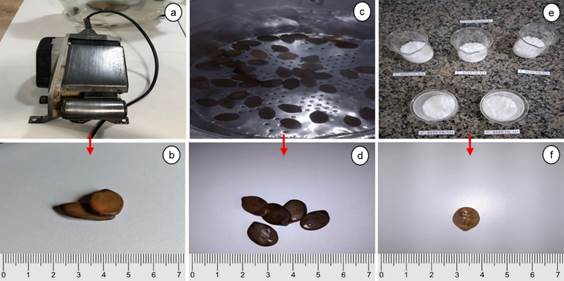
Figure 1 Material used to break seed dormancy of Schizolobium parahyba var. amazonicum. (a) Electric sandpaper used for mechanical scarification of seeds; (b) Seeds sanded on the opposite side to the hilum region; (c) Seeds submerged in water at 100 °C in an aluminum pan and aluminum pasta colander; (d) Seeds after immersion in water at 100 °C; (e) 70% sodium hydroxide NaOH and (f) Seeds after immersion in 70% sodium hydroxide solution.
Experiment installation and conduction
After the treatments application, seeds remained at rest for 48 hours with water at room temperature at 25 °C and then sowing was carried out at a depth of 2 cm, with the hilum facing down. This depth is the most recommended for the production of S. parahyba seedlings in nurseries (Souza et al., 2003). The nursery was covered with a 50% shade mash and irrigation was programmed to happen twice a day (08:00 am and 16:00 pm). The seeds were sown in small tubes of 280 cm³. The substrate used for seed germination is formed by sawdust, earth, and bovine manure in the proportion of 1:3:1, added by osmocote formulation 15.9.12 + micronutrients with application of 15 g of osmocote per small tube having in its formulation the following macro and micronutrients: Nitrogen 15%, phosphorus 9%, potassium 12%, magnesium 1.3%, sulfur 6%, copper 0.05%, iron 0.46%, manganese 0.06%, and molybdenum 0.02 %.
Data analysis
To determine the emerged seedlings percentage, the number of emerged seedlings was counted in relation to the total number of seeds in each treatment until process stabilization. The seed that presented exposed cotyledons was considered as a seedling emergence.
The mean emergence time (MET) was determined from the daily count of the number of emerged seedlings, which represents the weighted average of the time required for emergence, using equation 1.

Where: MET = mean time, in days, needed to reach the maximum emergence; E = number of emerged seedlings; T = time.
The speed emergence index (SEI) was determined from the daily count of the number of emerged seedlings, according to equation 2.

Where SEI = speed emergence index; E = number of emerged seedlings; D = number of days from sowing up to the last count.
To assess survival, the number of surviving individuals was counted, and the survival percentage was defined by the ratio between the number of surviving plants and the total number of initial seedlings. The verification of the number of surviving seedlings was done 40 days after sowing.
To evaluate the initial growth in height, 20 plants per repetition were randomly selected, totaling 100 plants per treatment. The variable shoot height (H) was measured 60 days after sowing, determined from the base to the apical bud, using a ruler graduated in centimeters.
For the statistical analyses, assumptions of the analysis of variance (ANOVA) were verified, namely: a) normality with the Shapiro-Wilk test (p > 0.05) and visualization with the Q-Q plot, and b) homoscedasticity by Bartlett's test (p > 0.05). In post-hoc case of significant difference between treatments, Tukey's test was used to compare means. Germination indices were calculated with the GerminaR package (Lozano-Isla et al., 2019). Graphs were generated with the "ggplot2" package, and statistical analyses and results rely on the "agricolae" package. All statistical analyses were performed in the R program version 4.2.1 (R Development Core Team, 2022), at the p < 0.05 significance level.
RESULTS AND DISCUSSION
Emergence and survivorship
The emergence of Schizolobium parahyba var. amazonicum seedlings started four days after sowing (DAS), with the maximum emergence point in 10 DAS and stabilization in 36 DAS (Figure 2). In seeds scarified with an electric sander (Sandpaper), seedling emergence started at four days and stabilized at 10 DAS. The treatments Water-1m and Water-2m varied from four to 25 days and four to 14 days, respectively. The treatments NaOH-12h and NaOH-24h started germination in four days, however, emergence lasted until 37 and 33 DAS, respectively (Figure 2).
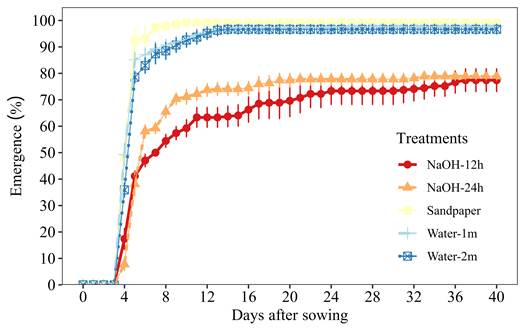
Figure 2 Accumulated germination of Schizolobium parahyba var. amazonicum seeds in different dormancy breaking treatments: Grain 400 mechanical sandpaper (Sandpaper); Water at 100 °C for 1 minute (Water-1m); Water at 100 °C for 2 minutes (Water-2m); NaOH at 70% for 12 hours (NaOH-12h), and NaOH at 70% for 24 hours (NaOH-24h).
Considering that seed dormancy is a natural protection mechanism present in many tree species, and that affects germination under certain conditions, the application of some methods to break dormancy is often not effective. In the present study, a high variation in emergence time was observed, which can be explained by the methods used to break the dormancy of S. parahyba seeds. Seed germination started from the fourth day of sowing, as described by Dionisio et al. (2022), considering seedlings which cotyledons were above the substrate as emerged. The application and efficiency of these treatments depend on the dormancy intensity, which is quite variable among species, provenances, and time after collection, and it is important to also consider the effective cost and practicality of execution (Oliveira & Aloufa, 2019). Furthermore, more vigorous seeds tend reach rates of higher germination (Shimizu et al., 2011).
The highest means of emergence were observed in treatments Sandpaper (99%), Water-1m (98%), and Water-2m (97%), which differed significantly from the treatments NaOH-12h (80%) and NaOH-24h (79%) (F4,20 =38.25, p = 0.001). The highest survival means were observed in the treatments Sandpaper (98%), Water-1m (96%), and Water-2m (92%), differing significantly from the treatments NaOH-12h (77%) and NaOH-24h (78%) (F4,20 =45.59, p = 0.001) (Figure 3A). When evaluating the mean emergence time (MET) and the speed emergence index (SEI), it was observed that seeds scarified with sandpaper presented higher SEI (5.4) and, consequently, lower MET (2.1 days), significantly differing from the other treatments. The treatments Water-1m and Water-2m, formed the second group with the highest SEI (3.1 and 2.8, respectively) and the lowest MET (5.1 and 5.3 days, respectively), with no statistical difference between them. The NaOH-12h and NaOH-24h treatments presented the lowest SEI (1.1 and 1.1) and the highest MET (7 and 9 days) respectively (Figure 3B).
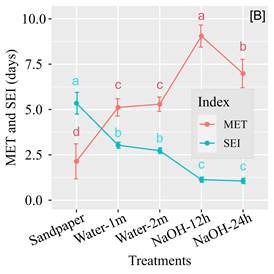
Figure 3 Emergence and survivorship (A) and speed emergence index (SEI), and mean emergence time (MET) (B) of Schizolobium parahyba var. amazonicum, 40 days after sowing under five different treatments of dormancy suppression: Grain 400 mechanical sandpaper (Sandpaper); Water at 100 °C for 1 minute (Water-1m); Water at 100 °C for 2 minutes (Water-2m); NaOH at 70% for 12 hours (NaOH-12h), and NaOH at 70% for 24 hours (NaOH-24h).
The higher the SEI and the lower the MET, more efficient the treatment will be, being a variable for analyses in germination methods. In the treatments NaOH-12h and NaOH-24h, in some seeds there was no depletion of the integumentary pellicle, which delayed the germination time. This situation may have occurred due to the lot had seeds from different matrices, being unviable, or the treatment was not enough to break the tegument (Zwirtes et al., 2013). Bardiviesso et al. (2020) in an evaluation of the physiological potential of S. parahyba seeds after pre-germination treatments, concluded that seed pre-soaking with gibberellin after mechanical scarification of 50% as a pre-germination treatment is recommended to obtain seeds with greater vigor and initial seedling growth. Evaluating different scarification methods in S. parahyba seeds, Neves et al. (2010) observed a germination rate of 99%, with lateral scarification of the tegument using manual sandpaper number 80.
Dapont et al. (2014) evaluated different methods to accelerate and standardize emergence of S. parahyba seedlings. The authors concluded that the treatments of integument perforation with puncture, immersion in water at 100 ºC, and scarification with electric emery eliminate integumentary dormancy, accelerate and standardize seed germination and emergence. Scarification treatments with water at 100 ºC and emery, showed 91% and 95% of emerged seedlings, respectively. Cruz et al. (2007) reported a germination rate of 83% in water at 100°C for 2 minutes and rest for 24 hours. Seeds scarified in water at 100°C for two minutes showed an efficiency of 62.0% and SEI = 1.60 (Shimizu et al., 2011).
Neto et al. (2007) found that immersion in water at 60 °C and 90 °C resulted in 70% and 79% germination of S. parahyba seeds, respectively. In our study, immersion in water at 100 ºC for one and two minutes resulted in 98% and 97% of seedling emergence. These results show the efficiency of thermal treatment that can replace mechanical scarification treatment with sandpaper. The use of thermal scarification, besides helping to reduce seed preparation time, also allows greater numbers of scarified seeds at once. In mechanical scarification with sandpaper, it is only possible to scarify one seed at a time, requiring more people for this activity and, consequently, higher cost. Scarification with immersion in hot water, on the other hand, can be done with a large number of seeds, with the size of the container being the only determining factor for the amount of seeds scarified at a time.
In NaOH-12h and NaOH-24h, scarification with NaOH (sodium hydroxide) presented 80% and 79%, respectively, being less efficient as a way to suppress dormancy. In a work carried out by Souza et al. (2014) with Enterolobium contortisiliquum seeds, also from Fabaceae family, they observed that treatments with immersion in 20% caustic soda for 30 and 60 minutes resulted in 76% of emerged seedlings.
Initial growth
Sandpaper, Water-1m and Water-2m presented the highest growth means in height, with 61.4±2.9; 61.1±2.5 and 61.6±3.0 cm in height, respectively (F4,495 =179, p = 0.001), but they did not differ significantly between them (Figure 4). The lowest means were observed in treatments NaOH-12h (55.5±2.9 cm) and NaOH-24h (53.6±2.8 cm), differing significantly between them and from the other treatments (Figure 4).
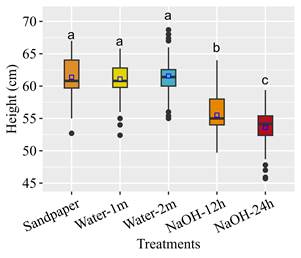
Figure 4 Mean height of Schizolobium parahyba var. amazonicum seedlings 60 days after sowing under five different treatments of dormancy breaking: Grain 400 mechanical sandpaper (Sandpaper); Water at 100 °C for 1 minute (Water-1m); Water at 100 °C for 2 minutes (Water-2m); NaOH at 70% for 12 hours (NaOH-12h), and NaOH at 70% for 24 hours (NaOH-24h).
Several factors can influence height growth of seedlings in the nursery. Solar incidence and nutrients in the substrate composition are some of these factors reported by Araújo et al. (2017) and Cordeiro et al. (2020). We emphasize that in the present study, the factor with greatest influence on the height of S. parahyba seedlings was the dormancy break treatment. The treatments in which seeds germinated first, consequently, presented lower MET and higher SEI (Figure 3B), where seedlings had more time to develop (Figure 4). That is, the greater or lesser growth of seedlings in this study is related to the seedling emergence time.
Another factor that influences seedling development is the genetic variability, adaptability, and seed origin. Ohashi et al. (2010) proved that different provenances present different levels of dormancy and adaptability. The authors indicate that the use of more adapted genetic materials will provide gains by conferring less loss in planting and, consequently, less time and labor spent. In a study with Erythrina speciosa (Fabaceae), seeds from different matrices showed wide variability in biometric characteristics, including external dimensions and fresh mass (Monteiro et al., 2016).
It is common S. parahyba producers to carry out pre-germination treatment of seeds with mechanical scarification using manual sandpaper to break seed dormancy. Many authors have also tested this method, demonstrating high germination rates. However, in terms of practicality and the accident risks (cuts) for workers, especially in the hands of those who carry out scarification, the method is not the most appropriate. In the present study, we recommend thermal treatments (usage of hot water) as an alternative to these problems. With thermal treatment, the emergence and survival rates of plants were high, >96% and >95%, respectively. When compared with mechanical scarification via manual sandpaper or electric sandpaper, thermal treatment has the main advantage of being able to scarify many seeds at once by a single person.
CONCLUSIONS
The treatment with electric sandpaper reached high rates of germination, proving to be an alternative to scarification with manual sandpaper.
Thermal treatment in hot water at 100°C for 1 minute and 2 minutes proved to be efficient as an alternative to the conventional break of S. parahyba seed dormancy due to its greater practicality and shorter initial seed preparation time, and to have high rate of germination and survival.
Chemical treatments based on 70% NaOH (sodium hydroxide) also indicated viability, however, future studies must find an adequate concentration of NaOH, as well as the time for its best efficiency.
Treatments with electric sandpaper, hot water at 100°C for 1 minute and for 2 minutes showed the highest rates of survival and initial growth. However, treatments with water have a shorter procedure time and are less likely to have work accidents.

