




 Português (pdf)
 Artigo em XML
 Referências do artigo
 Tradução automática
 Enviar este artigo por email
 Citado por SciELO
  Similares em
SciELO
Similares em
SciELO 
 Permalink

COMENTÁRIO
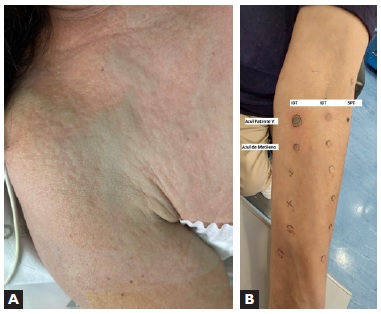
Uma doente de 62 anos foi referenciada por suspeita de reação de hipersensibilidade perioperatória manifestada por um exantema maculopapular azul (Figura 1A).
Um mês antes, a doente havia sido submetida a biópsia de gânglio sentinela axilar sob anestesia geral, com injeção subcutânea de azul patente V. Trinta minutos depois, na admissão ao recobro pós-anestésico, foi notado um exantema maculopapular pruriginoso azulado que pareceu progredir centrifugamente a partir do tórax, em minutos para os membros e dorso. Não se objetivaram outros sintomas. Foi iniciado tratamento com clemastina 2 mg por via endovenosa, com resolução completa nas horas seguintes.
Para investigação etiológica, realizaram-se testes cutâneos por picada (SPT) e intradérmicos (IDT), até às concentrações máximas não irritativas, com azul patente V (25 mg/ml e 0,25 mg/ml, respetivamente), lidocaína (10 mg/ml e 1 mg/ml), ropivacaína (10 mg/ml e 1 mg/ml), propofol (10 mg/ml e 1 mg/ml), fentanil (0,05 mg/ml e 0,005 mg/ml), rocurónio (10 mg/ml e 0,05 mg/ml), dexametasona (4 mg/ml e 0,4 mg/ml), ondansetron (2 mg/ml e 0,02 mg/ml), sugamadex (100 mg/ml e 10 mg/ml) e azul de metileno (10 mg/ml e 0,1 mg/ml) 1,2. Apenas o teste intradérmico com azul patente V (0,25 mg/ml) foi positiv(Figura 1B).
Desconhece-se se um exantema azul após a administração de corantes médicos azuis é patognomónico de uma reação de hipersensibilidade ao corante, ou se resulta simplesmente da presença do corante em circulação durante reações cutâneas. Neste caso, confirmou-se a hipersensibilidade ao azul patente V, que tem sido frequentemente implicado em reações de hipersensibilidade perioperatórias (3). O azul de metileno pode constituir uma alternativa nestes doentes 2.
COMMENT
A 62-year-old woman was referred for evaluation of a suspected perioperative hypersensitivity reaction, presenting as a blue maculopapular exanthema (Figure 1A).
A month before, she had undergone axillary sentinel lymph node biopsy under general anesthesia, with subcutaneous injection of patent blue V. During admission to post-anesthesia recovery thirty minutes later, a blueish pruritic maculopapular exanthema was noted, which seemed to progress centrifugally from the chest to the back and limbs in a few minutes. There were no other symptoms. Intravenous clemastine 2 mg was administered and the exanthema resolved completely in the following hours.
Prick (SPT) and intradermal skin tests (IDT) were performed, until the maximum non-irritative concentrations, with patent blue V (25 mg/ml and 0,25 mg/ml, respectively), lidocaine (10 mg/ml and 1 mg/ml), ropivacaine (10 mg/ml and 1 mg/ml), propofol (10 mg/ml and 1 mg/ml), fentanyl (0,05 mg/ml and 0,005 mg/ml), rocuronium (10 mg/ml and 0,05 mg/ml), dexamethasone (4 mg/ml and 0,4 mg/ml), ondansetron (2 mg/ml and 0,02 mg/ml), sugamadex (100 mg/ml and 10 mg/ml), and methylene blue (10 mg/ml and 0,1 mg/ml) 1,2. Only the intradermal test for patent blue V (0,25 mg/ml) was positive (Figure 1B).
It is unclear if a blue exanthema after the administration of blue medical dyes is pathognomonic of a hypersensitivity reaction to the dye, or simply a consequence of the presence of the dye in circulation during cutaneous reactions. In this case, we confirmed the hypersensitivity to patent blue V, na agent frequently identified as a cause of perioperative hypersensitivity reactions 3. Methylene blue is a potential alternative dye for these patients (2).

