




 Inglês (pdf)
 Artigo em XML
 Referências do artigo
 Tradução automática
 Enviar este artigo por email
 Citado por SciELO
  Similares em
SciELO
Similares em
SciELO 
 Permalink

Introduction
Sensory processing disorder (SPD) is recognized as a diagnostic entity in the Manual of Diagnostic Classification of Mental Health and Developmental Disorders of Infancy and Early Childhood (DC: 0-5). It is typically diagnosed between the ages of six months and five years. SPD is defined by patterns of behavior that reflect abnormalities in response to sensory stimuli, such as deficits in the detection, modulation, or interpretation of stimuli, that impair the infant/young child’s functioning in daily activities.1), (2 Children diagnosed with SPD are characterized by a distinct set of observable responses and behaviors involving one or more sensory domains that are consistently manifested over time and across various contexts.1),(3
SPD has been associated with a wide range of challenges, including difficulties in learning and academic performance, fine and gross motor coordination, behavioral problems, language development delays, and increased distractibility, impulsivity, hyperactivity, or hypoactivity. In addition, irritability, anxiety, and physiological challenges related to sleep and feeding are often reported.1 SPD represents a significant diagnostic challenge because it can involve simultaneous impairments in one or more sensory systems, including visual, auditory, tactile, olfactory, gustatory, vestibular, proprioceptive, and interoceptive.4
Originally introduced in 1994, this diagnostic category was classified as "regulation disorders" in the DC: 0-3. In the 2005 revised edition (DC: 0-3R), it was further specified as "regulation disorders of sensory processing" (RDSPs),5), (6 a terminology that will be adopted throughout this article. In 2016, the manual was further revised and the condition was renamed "sensory processing disorder" (SPD) in the DC: 0-5.1 This updated nomenclature has been used in clinical practice since 2018.
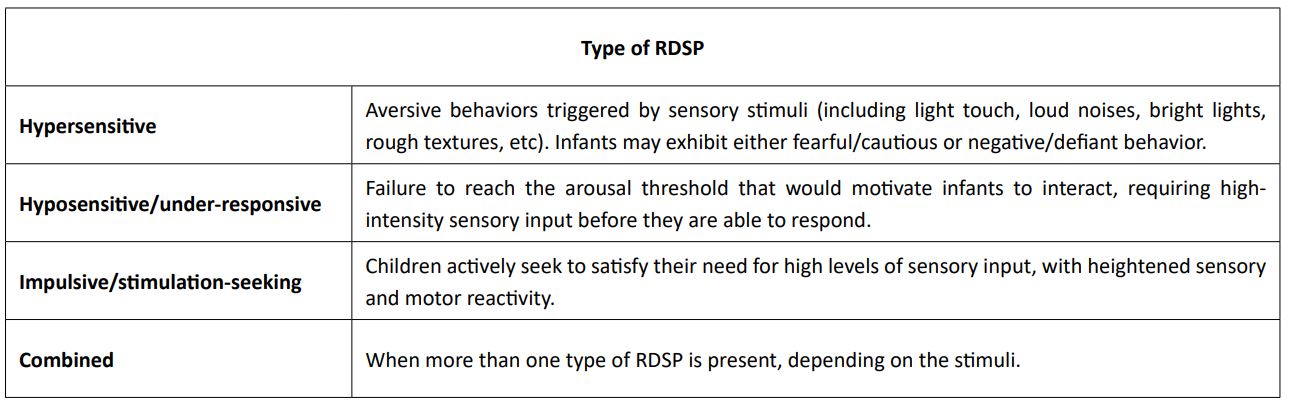
RDSP, as outlined in the DC: 0-3R, has been subdivided into four types (Table 1). In the hypersensitive type, children have difficulty modulating their responses and are easily overwhelmed and experience considerable stress as they try to manage their intense response to stimuli. In the hyposensitive/ under-responsive type, infants are typically quiet and alert and seem unresponsive and uninterested in their surroundings. When considering this diagnosis, the clinician must be aware of whether this impairment in social engagement is more likely to underscore an autism spectrum disorder (ASD), social anxiety disorder, or developmental delay.4-11 The sensory impulsive/stimulation seeking type, characterized by active seeking of sensory experiences in a more intense or frequent manner compared to typical individuals, has been suggested to be associated with attention-deficit/ hyperactivity disorder (ADHD). There was also a combined type in which more than one type was present, meaning that the child responded differently depending on the stimuli.6
In contrast to the RDSP defined in DC: 0-3R, SPD focuses exclusively on over- and under-responsiveness (with diagnostic criteria comparable to DC:0-3R), with an “Other” category for less typical presentations characterized by extended sensory exploration of typically unnoticed stimuli (e.g., licking walls).1 The stimulation-seeking/impulsive subtype has been removed from the current classification, allowing ADHD to be diagnosed from 36 months of age. Before that, overactive disorder of toddlerhood (OCD) should be considered. SPD may co-occur with other mental health disorders, except ASD, as atypical sensory responsiveness is now a diagnostic criterion.1),(7
Epidemiologic studies have shown a significant prevalence of SPD in preschool-aged children (5-15%), with more than half having another psychiatric disorder as comorbidity.4), (9), (12), (13 However, there is still a lack of awareness of this condition among health care professionals, making it one of the most intriguing and debated diagnoses in the pediatric literature.3 In fact, the American Academy of Pediatrics has discouraged the general diagnosis of SPD due to the lack of a widely accepted framework for diagnosing the condition and the likelihood that sensory processing deficits are associated with other developmental and behavioral disorders.14 Furthermore, due to the relatively recent recognition of the diagnosis, longitudinal studies evaluating the progression of children with SPD to other diagnostic entities are limited. As a result, the long-term course of SPD remains uncertain.1 One possible reason for this gap is the lack of precise diagnostic criteria and tools specifically designed to identify the sensory and behavioral patterns characteristic of SPD.15 A critical clinical concern for mental health professionals working with young children is to determine whether the diagnosis of SPD in infancy and early childhood is a precursor of future difficulties. This includes understanding whether these children are at increased risk of evolving into other diagnostic categories as they grow. Notably, neither the International Statistical Classification of Diseases (ICD-11) nor the DSM-5 explicitly describe or anticipate the diagnosis of SPD. According to the DC: 0-5, SPD is classified under “Other Neurodevelopmental Disorders” in the DSM-5, providing limited guidance on how the condition evolves as children develop.7 A study conducted at the Children’s Psychiatry Clinic of British Columbia Pediatric Hospital over a four-year period found that most children initially diagnosed with RDSP during their preschool years were later diagnosed with ADHD or ASD.(¹⁰) In addition, data examining four-year outcomes in infants with RDSP confirmed that these children, particularly if untreated, are at high risk for later developmental, sensorimotor, emotional, and behavioral deficits, including challenges with organizational and planning skills.8 The long-term consequences of SPD are particularly detrimental for school-aged children, who are at increased risk for emotional difficulties such as anxiety, low self-esteem, and depression, as well as externalizing behavioral problems, including aggressive behavior. These issues can significantly impair development during childhood and adolescence and have a lasting impact on personal and professional life in adulthood.16
Occupational therapy with sensory integration has been developed specifically for children with SPD. It aims to provide controlled sensory experiences to foster adaptive behaviors and responses while supporting the nervous system’s ability to efficiently modulate, organize, and integrate sensory information.17
The aim of this study was to longitudinally characterize the evolution of children previously diagnosed with RDSP in early childhood, focusing on their progression to other psychopathological conditions. It should be noted that the current classification system (DC: 0-5) was only implemented in 2018 in the unit where this study was conducted. Consequently, the inclusion of a cohort of children evaluated several years earlier, during the period when the DC: 0-3R classification system was in use, was required to provide a significant follow-up period. This extended follow-up was crucial for generating meaningful insights into the developmental pathways of psychopathological diagnoses.
Methods
This study was conducted at the Childhood and Adolescence Mental Health and Psychiatry Service of a tertiary hospital in Portugal. It included all children aged 1 to 5 years who were seen at the service between 2008 and 2014 and received an initial diagnosis of RDSP according to the DC: 0-3 classification system used at the time of diagnosis. Data were collected by reviewing the clinical records of selected patients, which included both paper and electronic files. Children who were lost to follow-up before the age of six years were excluded from the sample, as their progress beyond this age could not be determined. The following variables were collected: sociodemographic data, including age at diagnosis and gender; characterization of RDSP, including subtype and presence of other psychiatric comorbidities according to DC: 0-3R; occupational therapy support, if provided; longitudinal description of diagnostic categories according to DSM-5 for each patient over the years (due to the retrospective nature of the study and limitations of the clinical records, no distinction was made between primary and comorbid diagnoses); age at follow-up; and pharmacological interventions, both before and after the age of six years.
All protocols were reviewed and approved by the hospital Ethics Committee to ensure compliance with ethical standards.
Statistical analysis
The following variables were coded as categorical variables for analysis: RDSP subtype; gender; other diagnoses on axis I (according to DC 0-3R); presence or absence of global developmental delay; diagnoses during follow-up (according to DSM-5); age at medication initiation (<6 years vs. >6 years); type of medication; and presence or absence of occupational therapy support.
Statistical analysis was performed with Python 3.8. Categorical variables were described by absolute and relative frequencies. Correlation coefficients were calculated, and the SciPy library was used to perform Student’s t-tests and calculate p-values. A standard threshold of p <0.05 was used to determine statistical significance.
Results
Sociodemographic and clinical characteristics
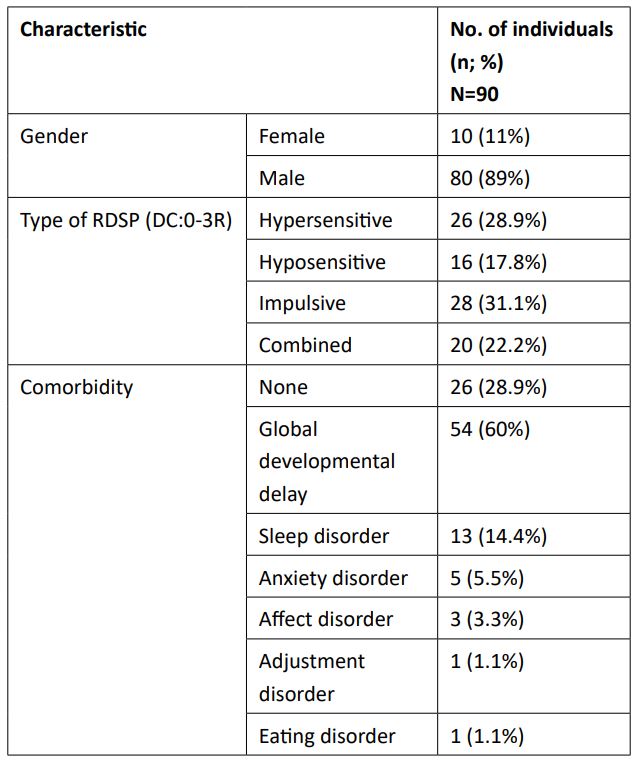
A total of 90 patients with a mean age at diagnosis of RDSP of 3.1 years were included in the study. The gender distribution was markedly unequal, with 89% (n=80) of the study population being male and only 11% (n=10) female. Different RDSP subtypes were identified in the study cohort: hypersensitive type in 28.9% of patients (n=26); hyposensitive type in 17.8% of patients (n=16); impulsive type in 31.1% of patients (n=28); and combined type in 22.2% of patients (n=20). Sixty percent (n=54) of children had global developmental delay, characterized by a score of 88 or less on the Ruth Griffiths Developmental Scale. Most children in the cohort with global developmental delay had the impulsive subtype (31.5%), while the remaining children had similar distributions of the other subtypes (24.1% had hypersensitive subtype, 22.2% had hyposensitive subtype, and 22.2% had combined subtypes, respectively). Comorbid sleep disorders were diagnosed in 14.4% of participants (n=13), while 5.6% (n=5) had a comorbid anxiety disorder. Mood disorders were found in 3.3% of patients (n=3), and one patient (1.1%) was diagnosed with a comorbid adjustment disorder. One patient (1.1%) had a comorbid eating disorder. Approximately one third (28.9%) of patients had no additional comorbidities. Table 2 summarizes the characteristics of the study population.
Evolution of psychopathological diagnosis
One of the main aims of this study was to understand the evolution of psychopathological diagnoses (according to DSM-5) in these children during the follow-up period. At follow-up, children’s age ranged from 9 to 20 years, with a mean age of 13 years. Because the information was collected by reviewing clinical records, certain diagnoses, such as neurodevelopmental disorders, had detailed descriptions that differed from the other nosological groups; therefore, with the exception of neurodevelopmental disorders, the results presented are categorized by nosological group. The most common diagnosis at the time of follow-up was ADHD, which accounted for 64.4% (n=58) of cases, followed by intellectual developmental disorder (IDD) in 17.8% (n=16) of cases. Noteworthy, 20% (n=18) of the children studied did not have a specific diagnosis at follow-up. ASD was diagnosed in 13.3% (n=12) of cases, while anxiety disorders were diagnosed in 10% (n=9), mostly of the hypersensitive type (n=5). In addition, 8.9% (n=8) of children had a diagnosis classified as “other”, which represents a heterogeneous group of diagnoses that were grouped together in this category due to their lower frequency. Elimination and communication disorders each affected 6.7% (n=6), while sleep-wake disorders were present in 5.6% of patients (n=5). Specific learning disorder and disruptive, impulse control, and conduct disorders were each diagnosed in 4.4% (n=4) of patients. Motor and depressive disorders were present in only one patient each (1.1%).
Analysis of clinical entities according to RDSP subtypes revealed that the hypersensitive subtype (n=26) evolved into ADHD in 50% (n=13) of cases, anxiety disorders in 19.2% (n=5) of cases, and IDD in 15.3% (n=4) of cases. Elimination disorders were found in 11.5% (n=3), while ASD and the category “other” were found in 2 patients each (7.7%). Seven patients (26.9%) had no other specific diagnosis. Children with the hyposensitive subtype (n=16) were also diagnosed with ADHD in 50% (n=8) of cases and with ASD, IDD, or no other diagnosis in 25% (n=4) of cases. Among children with the impulsive subtype (n=28), the majority (82.1%, n=23) were diagnosed with ADHD and 17.9% fell into the “other” category. In addition, 14.3% of these cases (n=4) presented with sleep-wake disorder. Overall, ASD, IDD, and no other diagnosis over time were observed in 10.7% (n=3) of cases. Children with the combined RDSP subtype (n=20) were also diagnosed with ADHD in 70% (n=14) of cases, IDD in 25% (n=5) of cases, ASD in 15% (n=3) of cases, and anxiety disorder or communication disorder in 10% (n=2) of cases. Twenty percent (n=4) of children with this subtype had no other diagnoses at follow-up. Table 3 and Figure 1 summarize the results of diagnoses at follow-up by RDSP subtype.
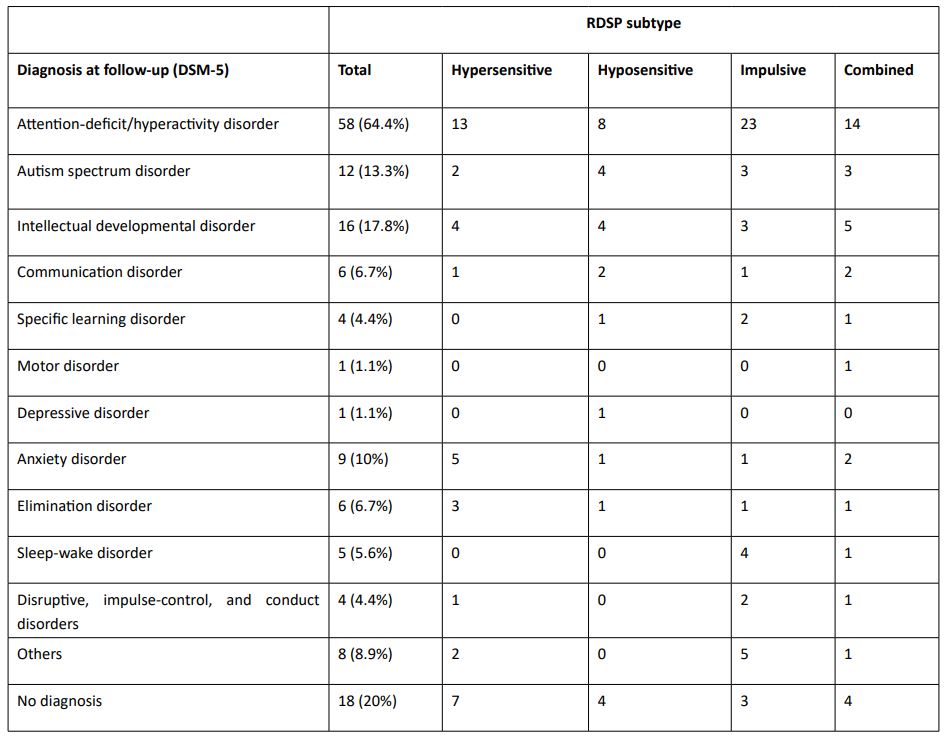
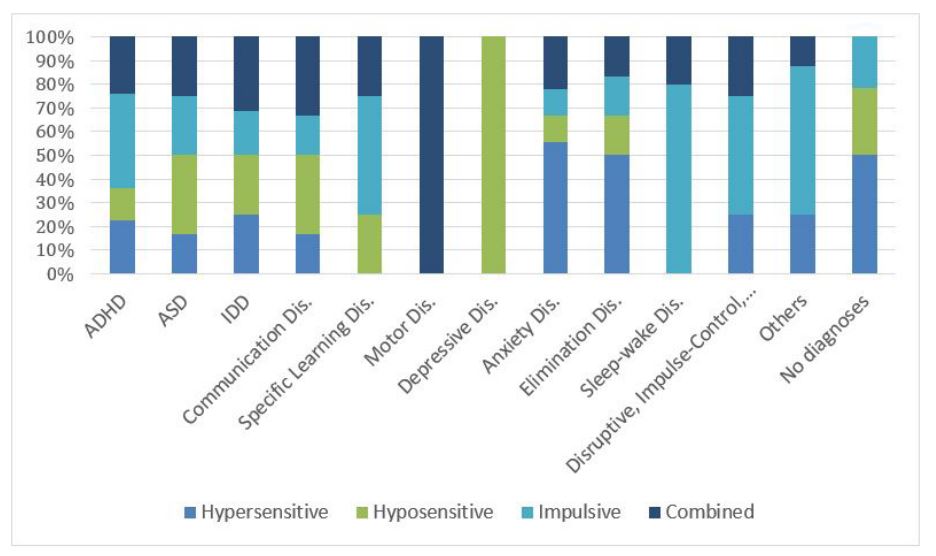
Figure 1 Diagnoses at follow-up according to DSM-5 criteria, by RDSP subtype. ADHD, attention deficit/hyperactivity disorder; ASD, autism spectrum disorder; DSM-5, Diagnostic and Statistical Manual of Mental Disorders, Fifth Edition; IDD, intellectual developmental disorder; RDSP, regulation disorder of sensory processing
The conditions described above were grouped into four categories for hypothesis testing: no diagnosis, neurodevelopmental disorders, anxiety disorders, and other disorders. The purpose of this categorization was to explore whether RDSP subtypes were potentially causal or related to these psychopathological categories. Overall, t-test analysis did not yield statistically significant results (p-value> 0.05) for associations between RDSP subtypes and neurodevelopmental disorders, anxiety disorders, or other disorders. However, some results approached statistical significance for causality, such as the hypersensitive type and neurodevelopmental disorders (p=0.06) and the impulsive type and neurodevelopmental disorders (p=0.08). In a comprehensive analysis of all diagnoses in the study population, the impulsive subtype of RDSP was found to be significantly associated with ADHD (p= 0.01). No other statistically significant associations were found between RDSP subtypes and other diagnoses.
The substantial prevalence of global developmental delay in this population (60%; n=54) suggests that there is a significant association between the manifestation of global developmental delay in infancy and early childhood and the subsequent development of IDD (p=0.0437).
This study also examined the percentage of patients who received medication before and after the age of six years. A total of 26 patients (28.9%) received medication over the years, with 9 patients (10%) treated exclusively before the age of six. A significant proportion (53.3%; n=48) started treatment after the age of six, while 7 patients (7.8%) received medication at both time periods, reflecting a subgroup with a continuous need for treatment across developmental stages. Early medication use (before the age of six) showed a weak positive correlation (correlation index ≈ 0.05) with an increasing number of diagnoses over time.
Regarding the management of sensory difficulties, most children (83.3%; n=75) received support through occupational therapy sessions. However, the available data do not provide sufficient evidence to conclude that occupational therapy had a discernible impact on later initiation of medication, particularly in the subgroup aged over six years, or that it significantly influenced the progression towards a diagnosis of ADHD.
There was a significant gender imbalance in the study population, with 80 (89%) participants being male and only 10 (11%) female. Within the female subgroup, the impulsive subtype was the most prevalent, accounting for 50% of cases (n=5). Additionally, 60% of females (n=6) later progressed to ADHD.
Discussion
This study is innovative in that few investigations have explored RDSP and the psychopathological conditions into which they evolve. These findings provide valuable insights for clinicians working in the neurodevelopmental field with young children and emphasize the need for vigilance regarding the progression of this entity.
The study results highlight that sensory abnormalities may have a negative cascading effect on various developmental and physiological aspects.18), (19 Sleep disturbances and anxiety disorders were found to be the most common comorbidities at the time of RDSP diagnosis, supporting the notion that the presence of sensory difficulties predisposes to other problems affecting the lives of young children.1), (2 However, it is important to note that the DC: 0-3R classification system included fewer diagnostic categories compared to the current DC: 0-5, which may explain the lower prevalence of comorbidities observed in this study compared to previous studies in preschool populations.1), (4), (6), (9 This lower prevalence may also be justified by the retrospective nature of this study, which relied on clinical records from several years ago and was therefore limited to what was documented in those files.
Notably, a significant proportion of children (60%) had global developmental delay. A study that estimated the prevalence of global developmental delay in children (without distinguishing the clinical population) reported rates of 25% worldwide and 10% in Europe.20 The results of the current study, significantly higher, refer to an exclusively clinical population of children, which may justify the differences. In addition, the sample of children in this study had clinically significant sensory changes. This is consistent with the notion that sensory regulation difficulties can affect behavioral, emotional, motor, and cognitive domains and may contribute to the learning and developmental problems observed in certain children.21), (22 While a significant progression from global developmental delay to IDD has been reported, there were significantly fewer children diagnosed with IDD at follow-up.
In addition to characterizing the population of interest, the retrospective longitudinal assessment of this study provides valuable insights into the range of psychopathological diagnoses and their distribution among children over the follow-up period. Its findings indicate that most children diagnosed with RDSP during preschool years eventually developed neurodevelopmental disorders. This suggests that SPD could serve as a non-specific marker of developmental dysfunction in children.23 Conversely, it is theoretically plausible that symptoms associated with SPD in younger children may be transient in the general population, as observed in 20% of this cohort.24 Most children (64.4%) had a diagnosis of ADHD during follow-up, which is consistent with the study conducted at the Children’s Psychiatry Clinic of the British Columbia Pediatric Hospital and the study by Ahn et al., which used a parent-report screening tool.10), (25 In fact, children with ADHD have been found to have sensory processing difficulties at a higher frequency than their counterparts without ADHD, with a substantial overlap between ADHD symptoms and sensory processing problems (inattention, impulsivity, and hyperactivity).3), (23), (26), (27 A plausible explanation for this phenomenon is that children who undergo sensory processing evaluations tend to be significantly younger than those diagnosed with ADHD. As a result, sensory processing abnormalities may manifest at an earlier developmental stage and serve as subtle indicators of deficits within the broadly defined domain of executive control in the developing brain, which may explain why many of these children are later diagnosed with more conventionally diagnosable disorders such as ADHD.28 In addition, sensory functioning has a strong correlation with academic achievement and cognitive processing in ADHD, so early identification and treatment of sensory processing problems may play an important role in improving the performance of children with ADHD.29
Although no direct causal relationship could be established between an RDSP subtype and neurodevelopmental disorders, anxiety disorders, or “other” disorders, some associations approached causality and should be discussed, such as that between the hypersensitive and impulsive subtypes and neurodevelopmental disorders. A study that compared sensory profiles in children with and without developmental disabilities also failed to find a significant association between sensory profiles and specific neurodevelopmental disorders.23 In this study, a more detailed analysis showed that the impulsive subtype was significantly associated with ADHD. In fact, unlike the hypersensitive and hyposensitive subtypes, the impulsive subtype has been removed from the current DC: 0-5 classification. In this classification, ADHD can be diagnosed from 36 months of age, which was not the case in the previous classification.1), (6 It is therefore speculated that the impulsive subtype corresponds to current cases of ADHD diagnosed at an earlier age, and clinicians working with this population should carefully consider this diagnosis.
Despite the lack of a statistically significant association between any RDSP subtype and anxiety disorders, these were observed in 10% of the study population during follow-up. A recent study of adolescents with anxiety disorders reported significantly more sensory difficulties in that population than in non-clinical adolescents, and the presence of neurodevelopmental disorders in this population did not account for the increased sensory processing difficulties, suggesting that these difficulties were largely related to internalizing mental health problems.30 In this study, more than half of children with anxiety disorders had been previously classified as having the hypersensitive subtype. This is consistent with previous studies showing that the highest levels of internalizing symptoms, including anxiety, are seen in the sensory hypersensitive group.31), (32 A possible mechanism for this association may be related to the way in which individuals with sensory impairments respond to aversive sensory stimuli with intense and negative emotional responses, which may predispose to anxiety disorders over time. Difficulties with emotion regulation may account for the relationship between childhood SPD symptoms and clinically significant levels of anxiety in adulthood.32 In addition, the relationship between sensory hypersensitive and social adaptive competence is essential. The ability to respond in a regulated manner to both external and internal stimuli, and the ability to focus, maintain, and shift attention to relevant stimuli without over-allocating attention to monitoring potential threats from sensations are the foundation for the development of social, academic, and self-care competence. In addition, appropriate sensory responsiveness enables individuals to recognize social cues and respond positively to the stimuli involved in social interactions.16
In this study, individuals exhibiting hyposensitivity were found to have the highest likelihood of later receiving a diagnosis of ASD, consistent with previous evidence suggesting reactivity to stimuli and baseline arousal in children with ASD.33 In young infants, it may be difficult to distinguish between the hyposensitive subtype, characterized by unresponsiveness and lack of interest in the environment and deficits in social engagement, and ASD. The former may not exhibit all of the core symptoms of ASD at an early age and may not manifest the full clinical picture until later, when environmental and social demands increase. Although symptoms of sensory processing difficulties are observed in up to 90% of children with ASD and are significant predictors of autism severity, they have only recently been included in the diagnostic criteria for ASD in DSM-5. As a result, clinicians are now more aware of these features even in very young children.2), (7), (34), (35
According to the DC: 0-5 classification, there is no documented evidence of gender differences in any type of SPD.1 However, in this study cohort, there was a notable disparity between the number of male and female children. The authors were unable to find a definitive explanation for this observation. Nevertheless, this gender difference mirrors that observed in the overall clinical population referred to the Child Psychiatry consultation, where 71.5% of children seen in 2020 and 2021 were male. In addition, this finding is consistent with a study conducted in the United States in a cohort of 796 boys and girls, which found that boys were more likely to have SPD than girls.9
Despite being the recommended treatment for SPD, this study did not provide conclusive evidence of the impact of occupational therapy on psychopathological progression or delayed medication initiation. However, this does not mean that occupational therapy is ineffective. In fact, clinical experience indicates that children show improvement in preexisting deficits with this therapy. Further research using rigorous methods is essential to validate sensory integration therapies.36), (37
This review is limited by its retrospective nature. The evaluation of cases was based solely on the data available in the clinical records and the retrospective application of relevant diagnostic criteria. In addition, some children in this cohort had been discharged from hospital, either because they had improved and no longer required care, or because they were being followed up in alternative health care settings. This presents a challenge in terms of access to comprehensive clinical information on these patients. On the other hand, a notable limitation of this study relates to changes in the diagnostic classification system over time. The children studied were originally classified according to the DC: 0-3R, which was the prevailing diagnostic framework at the time. This change in classification system may introduce potential discrepancies or challenges in directly comparing data with current standards, which could affect the accuracy and generalizability of the study findings. Future research should include longitudinal assessments to examine the evolution of diagnostic profiles in pediatric individuals diagnosed with SPD as categorized by the prevailing DC:0-5 classification system.
Conclusion
This study highlights the increased prevalence of psychiatric disorders in children with a history of sensory dysregulation and underscores that inadequate sensory regulation is a significant risk factor for later psychopathology. Longitudinal assessment of young children with sensory changes is therefore critical.
Although the study could not establish a direct causal relationship between specific types of sensory regulation difficulties and psychopathological outcomes - except for the impulsive type, which was associated with ADHD -, it highlights the need for larger and more diverse studies to draw robust conclusions. However, designing such studies is challenging due to the diverse and often mixed characteristics of children with SPD, as commonly observed in clinical practice.
Management of sensory regulation difficulties extends beyond occupational therapy interventions, which typically focus on addressing the child’s immediate challenges at the time of diagnosis. Effective management requires vigilant, interdisciplinary follow-up to monitor the child’s developing skills and response to increasing expectations of competence and self-regulation over time.
Authorship
Maria do Rosário Monteiro - Conceptualization, Data Curation, Investigation, Formal Analysis, Writing-original draft
Francisca Bastos Maia - Data Curation, Investigation, Formal Analysis, Writing-original draft
Ângela Azevedo - Data Curation, Investigation, Formal Analysis
Patrícia Magalhães - Conceptualization, Data Curation, Supervision, Writing- review & editing
Vânia Martins - Conceptualization, Supervision, Writing- review & editing

