




 Inglês (pdf)
 Artigo em XML
 Referências do artigo
 Tradução automática
 Enviar este artigo por email
 Citado por SciELO
  Similares em
SciELO
Similares em
SciELO 
 Permalink

A 12-year-old adolescent presented to the Pediatric Emergency Department with brown skin lesions on both hands with some hours of evolution (Figures 1 and 2). He reported no other symptoms such as itching or pain.
The boy denied prior trauma, unusual food intake, allergies, or similar previous episodes.
His personal history included asthma without the need for daily medication. He also reported adequate hygiene habits.
On physical examination, brownish pigmented patches were observed on both hands. The lesions had ill-defined borders and did not disappear with pressure.
What is your diagnosis?
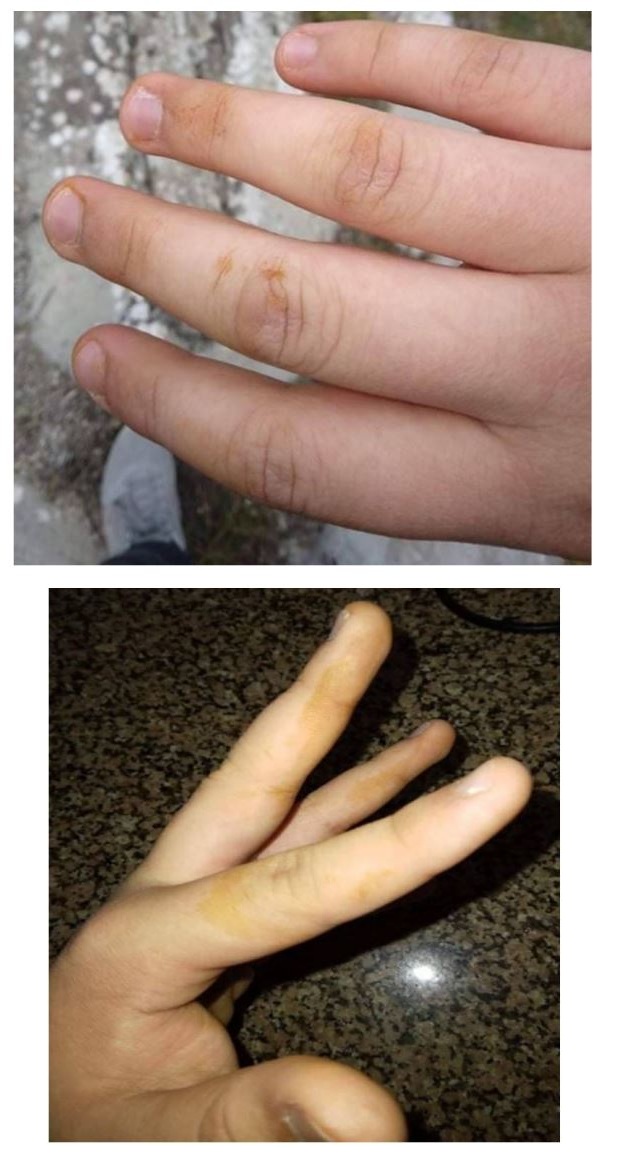
Diagnosis
Terra firma-forme dermatosis in an unusual location.
Hands were washed with soap and water, but none of the patches disappeared. However, application of 70% isopropyl alcohol successfully removed the lesions.
The patient was evaluated in Dermatology six months later with no recurrence of hyperpigmented lesions.
Discussion
Terra firma-forme dermatosis is derived from Latin and means “solid earth”. It was first described by Duncan in 1987 and is also known as “Duncan’s dirty disease”.1-4) It is a benign, idiopathic cutaneous disorder3) characterized by hyperpigmented, brownish areas that resemble dirt. These areas may be localized, generalized, unilateral, or bilateral, appearing as papules, plaques, or patches.2) They are typically not associated with symptoms such as itching or pain.1) The condition occurs in individuals with adequate hygiene habits and does not resolve with washing with soap and water, often causing significant esthetic discomfort.5),(6
Although the exact cause is unknown, terra firma-forme dermatosis is thought to be related to a keratinization abnormality. It results from delayed maturation of keratinocytes with incomplete keratin development, leading to the retention of keratinocytes and melanin in the epidermis.7) Genetic predisposition and sun exposure have been described in some cases, although a clear association has not been established due to the limited number of studies.6) The condition is predominantly observed in children, but due to its underdiagnosed nature, its incidence and prevalence remain unknown.3),(6) Although any cutaneous surface can be affected, the most commonly affected areas include the face, neck, upper body, and ankles.2),(8) According to current data, the condition equally affects both genders and different age groups.9
The present case reports terra firma-forme dermatosis in an unusual location and with symmetrical lesions on both hands.10) The differential diagnosis includes conditions such as nevus, post-inflammatory hyperpigmentation, vitiligo, psoriasis, and contact dermatitis, among others. Confirmation is easily achieved by applying a cotton swab or compress soaked in 70% isopropyl alcohol to the affected area, resulting in complete regression of the hyperpigmentation. This application has both diagnostic and therapeutic value.1),(4),(7),(8
At first glance, this case might suggest a neglected dermatosis. However, the boy had adequate hygiene habits and hyperpigmented lesions with less than 24 hours of evolution, and their persistence after washing with soap and water ruled out this diagnosis.
Definitive diagnosis can only be made by skin biopsy, which is rarely performed nowadays. The high specificity of the clinical presentation combined with the use of isopropyl alcohol usually obviates the need for additional laboratory testing or biopsies.
Treatment of terra firma-forme dermatosis consists of gentle rubbing of the affected areas with cotton or gauze soaked in 70% isopropyl alcohol, which effectively removes the hyperpigmentation. In some cases, spontaneous resolution of the lesions may also occur. The “dirty” appearance of the skin disappears as normal skin color is restored.1),(4),(6),(10
Recurrence after treatment is rare. However, persistent or recurrent cases may require weekly prophylactic application of isopropyl alcohol.1,4
This case highlights the importance of establishing an adequate differential diagnosis between benign cutaneous conditions and diseases with cutaneous involvement that may require systemic management. Recognition of terra firma-forme dermatosis, even in unusual locations, is critical to avoid unnecessary invasive procedures. Early identification allows for prompt treatment, thereby reducing the impact on the child’s social interactions and quality of life.

