




 Inglês (pdf)
 Artigo em XML
 Referências do artigo

 Tradução automática
 Enviar este artigo por email
 Citado por SciELO
 Similares em
SciELO

 Permalink


Introduction
In the modern world, people appear to have easy access to food; however, paradoxically, nutritional and vitamin deficiencies are on the rise, particularly among children, who are often more selective and prone to adopting restrictive or monotonous diets. This trend may contribute to the resurgence of certain once-forgotten diseases, such as scurvy.
Monotonous diets are not uncommon during childhood, especially in children with neurodevelopmental disorders, such as autism spectrum disorder or intellectual disability. However, otherwise healthy children may also present with severe restrictive eating habits, often driven by eating phobias or reinforced by permissive parenting styles.
Regardless of the underlying cause, an unbalanced diet can lead to various health complications, highlighting the urgent need for early recognition and intervention. 1-8
Case report
A five-year-old girl presented with a one-month history of anorexia, swelling of the right knee, inability to walk, and bleeding gums. Physical examination revealed a weight of 13.2 kg (percentile <3; -3< z-score <-2), a height of 102 cm (percentile 3-15; -2< z-score <0), and a body mass index of 12.7 kg/m² (percentile <3; -3< z-score <-2), consistent with emaciation. Cutaneous findings included perifollicular hyperkeratosis and petechiae on the lower limbs (Figure 1). Additionally, she exhibited swelling of the right knee with tenderness on palpation and gingivitis (Figure 2), without other abnormalities.
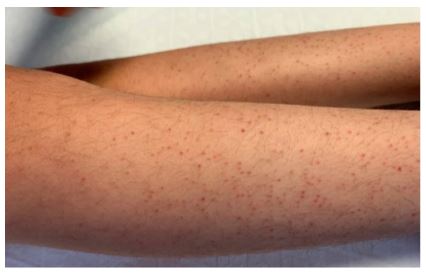
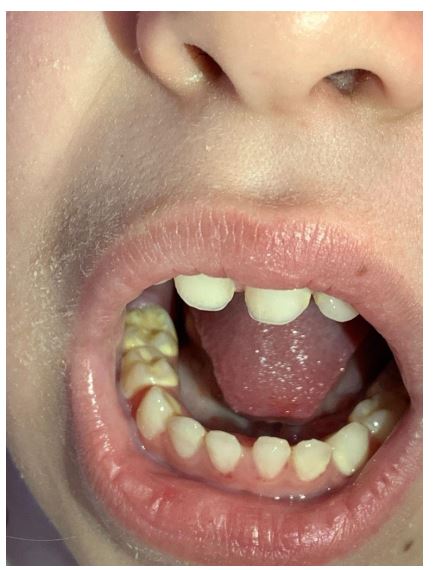
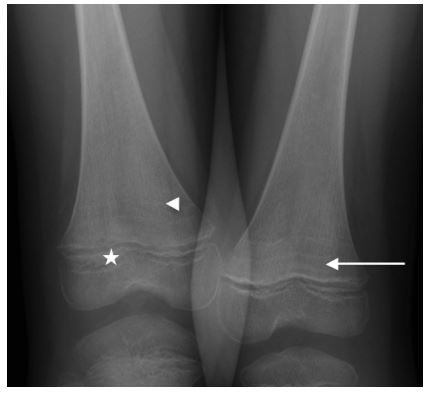
Figure 3 Lower limbs X-ray showing Trummerfeld zone (arrow), Frankel’s lines (arrow head) and enlarged metaphyseal margin (star)
She appeared to be a very introverted child with poor communication skills and demonstrated a highly dependent relationship with her parents. She attended preschool only a few times a week, as her parents reported she did not want to go. Neurodevelopmental assessment using Mary Sheridan’s Early Years Child Development Tool revealed speech impairment and global developmental delay.
Dietary history indicated a highly selective diet consisting almost exclusively of chocolate milk over the past two years. This dietary pattern began following an episode of viral tonsillitis, during which the patient started refusing nearly all types of solid foods. Her eating habits went unnoticed, as she frequently missed medical appointments and rarely attended school. When she did attend, she would eat at home. She was an only child with very permissive parents, who lacked certain educational and parenting skills.
Blood work revealed: Hb 12.5 g/dL, iron 49 μg/dL (normal range: 50-170 μg/dL), ferritin 8 ng/mL (normal range: 7-142 ng/mL), total iron-binding capacity 397 μg/dL (normal range: 250-450 μg/dL), vitamin D 19.1 ng/mL (normal range: 30-40 ng/mL), folic acid 6.3 ng/mL (normal range: 5-21 ng/mL), vitamin B12 746 pg/mL (normal range: 165-950 pg/mL), and ascorbic acid <0.1 mg/dL (normal range: 0.4-2 mg/dL). No other relevant alterations were found, including inflammatory or coagulation markers.
A right knee X-ray revealed clear metaphyseal bands (Trümmerfeld zones), thickened zones of calcification (Frankel lines), and enlarged metaphyseal margins (Figure 3). Based on clinical history, physical examination, and complementary tests, a diagnosis of scurvy was established.
The patient was admitted to the pediatric ward and received multidisciplinary treatment, including oral multivitamin supplementation (vitamin C 273 mg/day and vitamin D 666 IU/day) and iron supplementation (40 mg/day). Nutritional counseling, psychiatric and psychological support, and consultations with other specialties-namely orthopedics and physical therapy-were also provided.
To improve her eating behavior, several strategies were implemented, such as positive reinforcement for meal completion, shared meals with other children, and repeated exposure to previously rejected foods. Due to concerns about potential child endangerment, social services were involved.
Gradually, her symptoms resolved, and her behavior showed remarkable improvement.
She became more extroverted, with improved communication skills, greater autonomy, and reduced dependence on her parents. Her eating habits changed significantly; by the time of discharge, her dietary intake included a wide variety of foods.
At the six-month follow-up consultation, she maintained a varied diet, and her nutritional deficiencies (vitamin C, vitamin D, and low iron levels) had fully resolved. Her weight improved (-2 < z-score < -1), and she began attending school daily, displaying excellent social behavior.
Currently, she undergoes regular follow-up, is not on any medication, and continues to maintain a balanced and diversified diet.
Discussion
Scurvy is a condition caused by vitamin C (ascorbic acid) deficiency. As humans are unable to synthesize vitamin C, its levels depend entirely on dietary intake. Foods rich in vitamin C include citrus fruits, bell peppers, tomatoes, cruciferous vegetables, among others. 1-8
The first descriptions of scurvy date back to ancient Egypt, but the disease became more widely recognized during the Age of Sail, when long sea voyages resulted in limited access to fresh food. It is estimated that more than 50% of sailors on major expeditions died from scurvy. 1-2,4,8 James Lind, a Scottish naval surgeon, is often credited with demonstrating that citrus fruits could effectively prevent scurvy. However, this preventive measure was only implemented several years later. 1-2,4,6-8
Overall, scurvy is a rare condition, primarily observed in developing countries where malnutrition is more prevalent. 1-5 In developed countries, scurvy is nearly anecdotal, occurring more frequently in individuals with certain conditions such as autism spectrum disorder, Avoidant/Restrictive Food Intake Disorder (ARFID), neurological disorders, or in those following restrictive, monotonous, or selective diets. 1-7
In this case, the nutritional deficiency resulted from restrictive/selective eating habits, highlighting the possible association between scurvy and ARFID - a relatively recently recognized disorder.
According to the Diagnostic and Statistical Manual of Mental Disorders (DSM-5), ARFID is an eating disorder characterized by a persistent failure to meet nutritional or energy needs due to various factors, including lack of interest in eating, avoidance of certain foods based on sensory characteristics, or fear of adverse consequences of eating. The diagnosis requires the presence of at least one of the following features: significant weight loss, nutritional deficiency, dependence on enteral feeding or oral supplements, or marked interference with psychosocial functioning. The disorder is not attributable to food scarcity, cultural fasting practices, another medical condition, or other mental disorders such as anorexia nervosa or bulimia nervosa. 9,11 In this case specific, ARFID could be considered as the cause of the observed nutritional deficits, given the child's extremely selective eating habits, which led to severe nutritional deficiencies, poor growth in height and weight, and impaired neurodevelopment. Furthermore, this food restriction/selectivity could not be explained by cultural practices, mental disorders (such as autism spectrum disorder or intellectual disability), or food unavailability. However, several aspects argue against this diagnosis. The child's food selectivity was not associated with any neurodevelopmental disorder (such as autism or intellectual disability) or cultural practices, and there was no prior history of selective eating.
Instead, the eating disturbance appeared to stem from parental permissiveness. Following a viral tonsillitis episode, during which the child likely developed odynophagia, her refusal of solid foods was accepted and allowed to persist. Rather than turning meals into moments of sharing, socialization, and experiencing new flavors and textures, the parents permitted the child to dictate her own meals, which likely perpetuated the restrictive eating habits. This scenario makes the diagnosis of ARFID less likely and instead suggests that inadequate parental supervision played a key role in the development of the restrictive diet.
Clinical manifestations of scurvy are numerous and varied, including fatigue, malaise, swollen and bleeding gums, loosened teeth, petechiae, perifollicular hyperkeratosis, easy bruising, joint swelling and pain, limping, failure to gain weight, behavioral changes, and neurodevelopmental delay. 1-2,4-6,8
Due to its rarity, the diagnosis of scurvy is often delayed and typically based on anamnesis, physical examination, laboratory findings, and radiological features. In this case, a detailed review of the patient’s dietary history raised suspicion of a nutritional deficiency. However, the diagnosis was further delayed because the child frequently missed routine childhood health appointments, allowing her restrictive eating habits to go unnoticed for nearly two years.
Measurement of serum vitamin C levels is the gold standard for diagnosing scurvy. However, this method may not always be reliable, as recent vitamin C supplementation - even in small quantities - can yield falsely normal results. Therefore, dietary anamnesis is highly indicative when it reveals a complete absence of vitamin C-rich foods in the daily diet. 1-3,8
Blood work may also demonstrate anemia (Hb <9.5 g/dL), low iron levels (<50 μg/dL), low vitamin D levels (<30 ng/mL), and other nutritional deficits. 1-2,6-8 In this case, the child did not present with anemia but exhibited low iron and ferritin levels, as well as low vitamin D and undetectable vitamin C levels, all of which were attributable to her restrictive/selective eating habits.
Complementary imaging exams, such as X-rays and magnetic resonance imaging (MRI), may reveal osteopenia, metaphyseal rarefaction, metaphyseal spurs secondary to healing fractures, and metaphyseal dense lines of cartilage calcification. 1-8
The treatment of a child with severe food selectivity involves nutritional supplementation with an oral nutritional formula to provide a high-calorie diet, while carefully monitoring to prevent the development of refeeding syndrome. In more severe cases, enteral feeding through a nasogastric tube may be required, alongside behavioral interventions to promote healthier eating habits. 1-3,6-7,9-11
In this case, the child received vitamin C, vitamin D, and iron supplementation. In addition to pharmacological treatment, a multidisciplinary approach was implemented, including psychological and psychiatric support, along with consultations in other medical specialties. Treatment must also involve social intervention to assess family dynamics and identify necessary changes to ensure a safe and healthy environment for the child’s growth and development. In this case, the family-comprising the parents, child, and maternal grandmother-belonged to a low socioeconomic background. The mother was a stay-at-home parent with a history of anxiety and depression, which prevented her from working, while the father had a low educational level, working full-time in a tire factory and part-time at another factory.
Social services were actively involved, conducting home visits and regular meetings to closely monitor the family’s situation and provide ongoing support.
Once vitamin C deficiency is corrected, most patients experience complete resolution of symptoms, resulting in an overall excellent prognosis. 2,6,8 However, regarding the prognosis of ARFID, children with this disorder appear to have a higher risk of developing other eating behavior disorders in the future, such as anorexia nervosa or bulimia nervosa. 9-11 For this reason, long-term follow-up of the child and their eating habits is essential, as was done in the described case.
This case highlights the importance of recognizing that dietary restriction in children - even in those who appear otherwise healthy - may increase the risk of scurvy and other nutritional deficiencies. An accurate dietary history plays a critical role in the diagnostic approach, helping to identify potential nutritional deficits and avoid unnecessary invasive diagnostic procedures.
Authorship
Aida Correia de Azevedo - Methodology; Investigation; Writing - original draft
Ana Sofia Rodrigues - Investigation; Writing- original draft
Ana Feio - Investigation; Writing- original draf
João Faria - Investigation; Writing- original draft
Beatriz Andrade - Investigation; Writing- original draft
Sara Rolim - Supervision; Writing - review & editing
Alexandra Sequeira - Supervision; Validation; Writing - review & editing

