




 Inglês (pdf)
 Artigo em XML
 Referências do artigo
 Tradução automática
 Enviar este artigo por email
 Citado por SciELO
  Similares em
SciELO
Similares em
SciELO 
 Permalink
Introduction
The word “lignum” is derived from the Latin word lignum, which means wood. Ln plays a crucial role in the development of cell walls, especially wood bark, to which it gives stiffness and resistance to rot 1. A group of intricate organic polymers known as Ln serve as a crucial structural component of the tissues that support vascular plants and some algae. Ln is the second-largest polymer on earth after cellulose, and is commonly present in plants. The economics of producing biodiesel could be greatly enhanced by the conversion of Ln into value-added goods 2. Ln has a variety of economic uses, and its extraction might lead to development of several novel applications. Therefore, it is of the most significant to develop efficient and long lasting solutions for Ln extraction from Bm. For this reason, one of the goals of this study was to examine several ways of Ln extraction from Bm of RH and WH 3.
Bm to biofuel conversion has received more attention, being regarded as a novel strategy. In order to produce biofuel, a variety of raw materials has been used as feedstock, depending on Bm cost-effectiveness, availability and location. Among the various raw resources, lignocellulose Bm has drawn the interest of numerous researchers from all over the world. The potential use of lignocellulose Bm for biofuel was reported in the current review. Bm hydrolysis rate and accessibility have been significantly increased by the application of various pretreatment techniques 4.
This analysis focused on current developments in pretreatment techniques for increased biofuel output. Bm processing pathway mechanism, optimization and modelling have all been described in detail 4.
Pakistan’s primary agricultural product is wheat. The backbone of Pakistan’s economy is agriculture, which boosts GDP, creates jobs and generates foreign exchange, all of which contribute to the country’s economic and social well-being. Wheat and rice are the most significant food grain crops in the agricultural industry. According to the Government of Pakistan (2004), wheat and rice account for 13.8 and 5.4% of the value added to agriculture, and represent 3.4 and 1.3% of GDP, respectively 5. A significant portion of the rural people and whole economy benefit from agriculture. Nowadays, there is a desire for agricultural development in practically every region of the world. It is a really bleak challenge to balance food supply with the growing population 6. For most Pakistanis, wheat is their main source of sustenance. The wheat crop has suffered greatly over the past few years, due severe drought and water deficit conditions. Forecasting wheat output primarily depends on the farmed area. Therefore, a model must be created in order to estimate wheat production based on planted areas over the long term 7.
In the fiscal year 2016-2017, the agriculture sector, which is the backbone of Pakistan’s economy, was responsible for 42.5% of employment and 19.5% of GDP. Being the second-largest crop overall, wheat contributed with 1.9% to GDP and 3.4% to employment, in the same year. Wheat exports are anticipated to be considerably impacted in the upcoming years, due to the constantly rising domestic demand, which will be a big setback for the nation’s economy 8. However, if there are not equally cost-effective and environmentally sound alternatives, the entire value-adding process will be useless.
This study highlighted the most current developments in both conventional and state-of-the-art Ln extraction methods 9. Over the past few decades, Ln has been added to a variety of polymers to produce blends and composites 10.
The current project’s main goal was to extract Ln from sources of natural Bm. Lignocellulose-based fuels are seen as carbon-neutral alternatives to traditional petroleum sources in the transportation and energy sectors 11. Several biofuels that can be created are both gaseous and liquid, including syngas, biogas, bio methane and biofuel 12. Some examples of liquid biofuels include jet fuel, bio oil, bioethanol, bio butanol and biodiesel. These fuels can be produced using thermochemical and biochemical conversion processes 13. Pyrolysis, liquefaction, rapid pyrolysis, gasification, Fischer-Tropsch synthesis and transesterification are a few examples of thermochemical conversion processes, whereas the bulk of biological processes use hydrolysis reaction, ferment and digesters 14.
Material and methods
Materials
Bm from RH and WH were studied as feedstock and collected from Nawab Shah Sindh and Jamshoro Haidarabad areas. RW and WH were oven dried. The Bm samples were crushed and sieved. Then different particle sizes, like 0.45 and 0.55 mm, were weighted and sieved. The fine powder was oven dried at 110 ºC, and was used for further treatment.
Extraction of Ln from agricultural Bm
50 g Bm were taken and added to a beaker with about 1000 mL distilled water, using NaOH. After pretreatment, the sample was kept in an oven at 110 ºC. The pretreated solution was filtered by a filter paper in a beaker. Delignified solid was washed with distilled water. A magnetic hot plate stirrer was used for the solid/liquid ratio, being kept in the beaker for agitation. The obtained solid/liquid ratio was 1:20. The sample was kept in an oven, for 3 h, at 110 ºC, and then, for 4 h, at 120 ºC. The pretreated Ln from Bm was recovered by filter paper. A pipette was used for H2SO4 dropwise to reach pH 1 to precipitate Ln. Ln residues were separated, and distilled water was used until required pH 7 was obtained.
Analysis
SEM analysis of Ln
SEM is an imaging technique used to study the surface morphology of a wide range of materials, including Ln, which is a complex organic polymer available in Bm cell walls. SEM analyses of WH and RH were made, as shown in Figs. 3 and 4, respectively.
TGA analysis of Ln
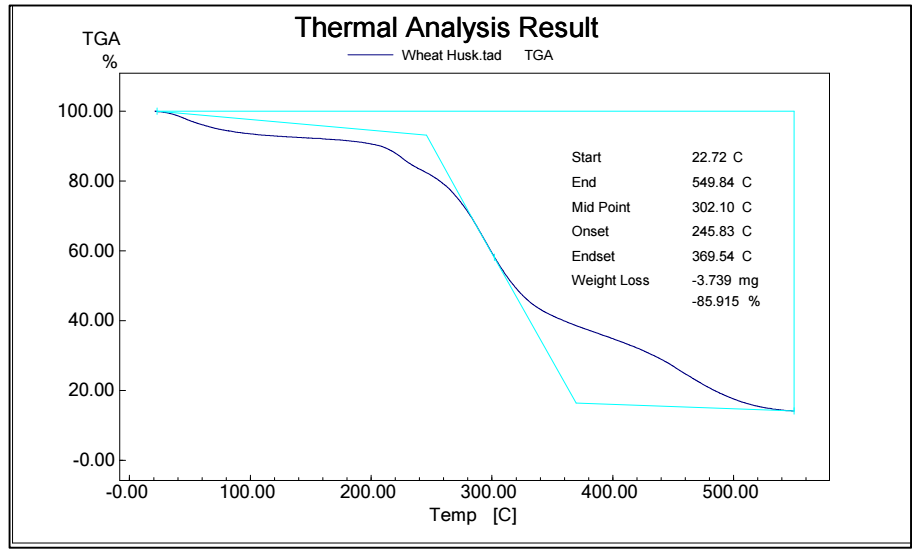
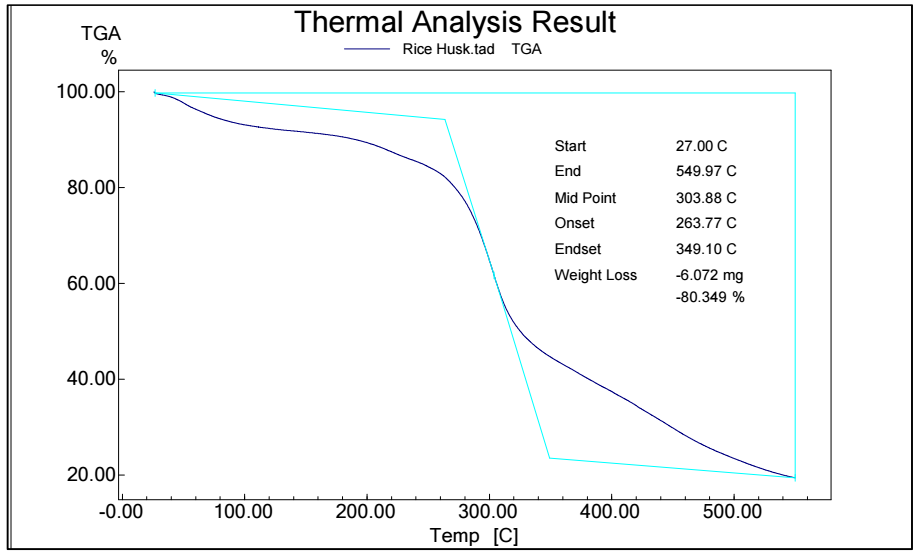
Ln thermal degradation was performed and evaluated using a TGA analyzer. A small quantity was heated in an Al pan, at various T. When exposed to rising T, many organic and inorganic substances may suffer thermal breakdown or deterioration. Complex molecules degrade into simpler compounds, such as gases, vapors or volatiles. The disappearance of these breakdown products causes the sample’s mass to decrease with time, resulting in a declining trend in TGA curve. To acquire a thorough picture of the sample thermal behavior, TGA data must be interpreted in combination with other methods.
Results and discussion
PA
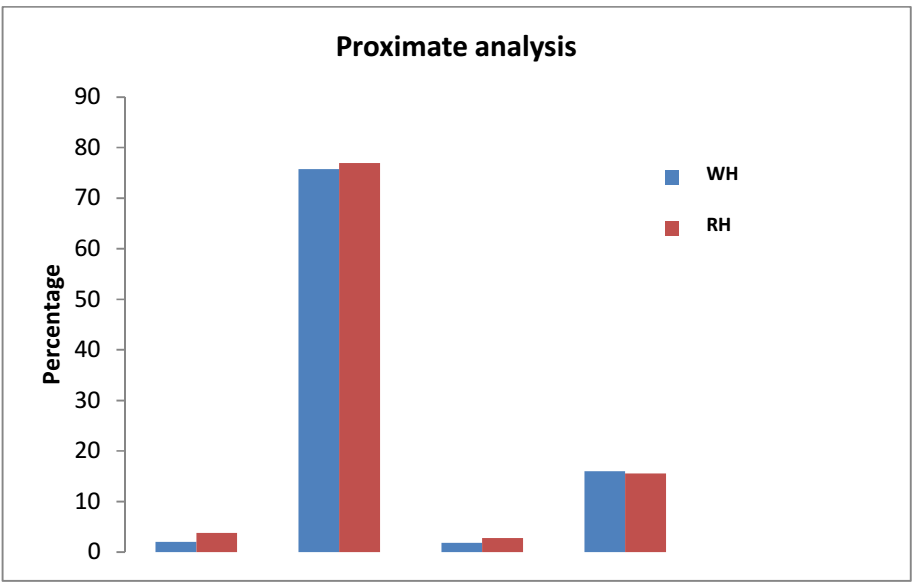
MC, VM, AC and FC of Bm from Ln were determined using PA. Table 1 and Fig. 1 summarize the obtained data, such as MC of RH, which was determined to be 3.82%.
Table 1: PA of Ln samples.
| Bm | MC(%) | VM(%) | AC(%) | FC(%) |
|---|---|---|---|---|
| WH | 2.08 | 75.79 | 1.84 | 16 |
| RH | 3.82 | 76.97 | 2.78 | 15.60 |
UA
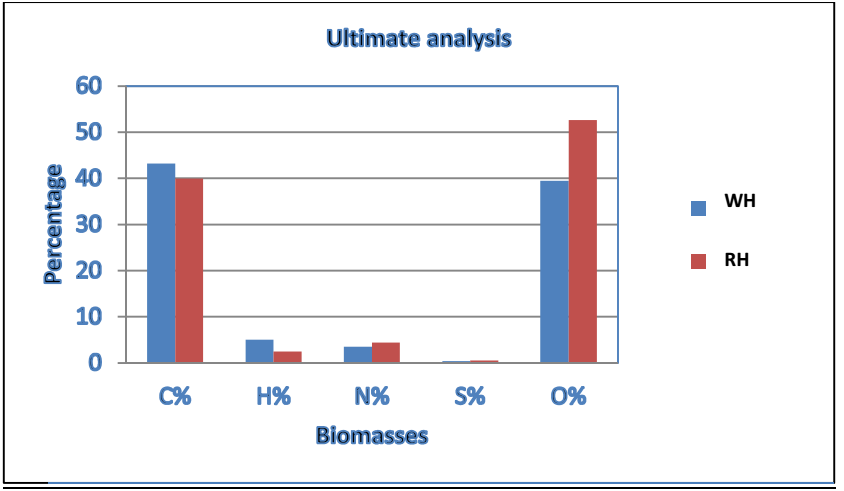
Ln ultimate examination is determining its elemental makeup, which commonly includes C, H, N, S and O(%). Elemental study of C and O content in RH revealed values from 39.98 to 52.61%. The findings of the final analysis are shown in Table 2 and Fig. 2.
Table 2: UA of Ln sample.
| Bm | C(%) | H(%) | N(%) | S(%) | O(%) |
|---|---|---|---|---|---|
| WH | 43.2 | 5.0 | 3.48 | 0.36 | 39.4 |
| RH | 39.98 | 2.45 | 4.43 | 0.53 | 52.61 |
The present study and experiments allowed to conclude that Ln extracted from WH is more efficient than that extracted from RH, in terms of its yields (Table 3).
Table 3: Ln yield from NTB and BTT.
| Bm sample | T (ºC) | Time (h) | Liquid solvent Ct | Raw material:liquor rate | Stirrer speed | Ln yield (wt%) |
|---|---|---|---|---|---|---|
| RH | 120 | 5 | 2% | 1:20 | constant | 12 |
| 4 | 13 | |||||
| 3 | 10 | |||||
| WH | 5 | 16 | ||||
| 4 | 13 | |||||
| 3 | 12 |
Different surface morphologies of Ln from WH and RH detected by SEM analyses are shown in Figs. 3 and 4, respectively.
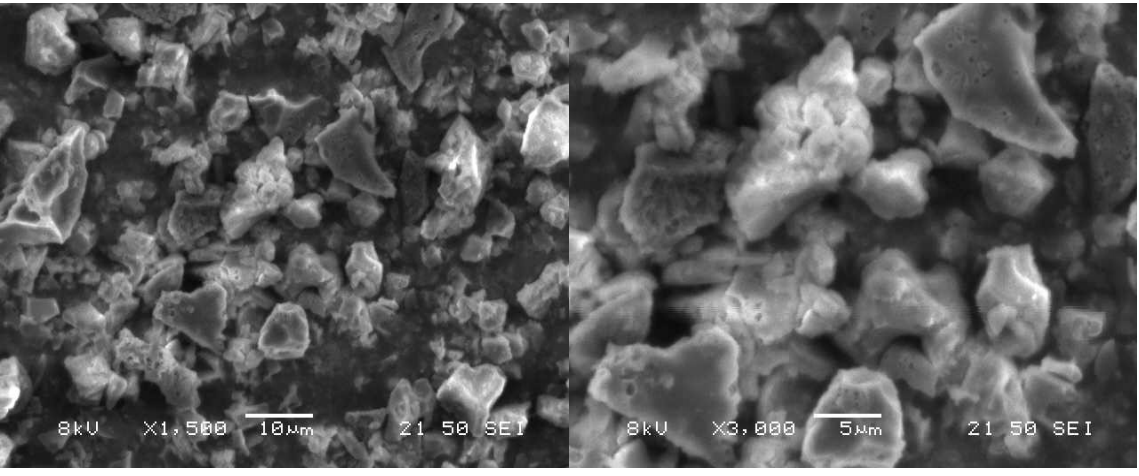
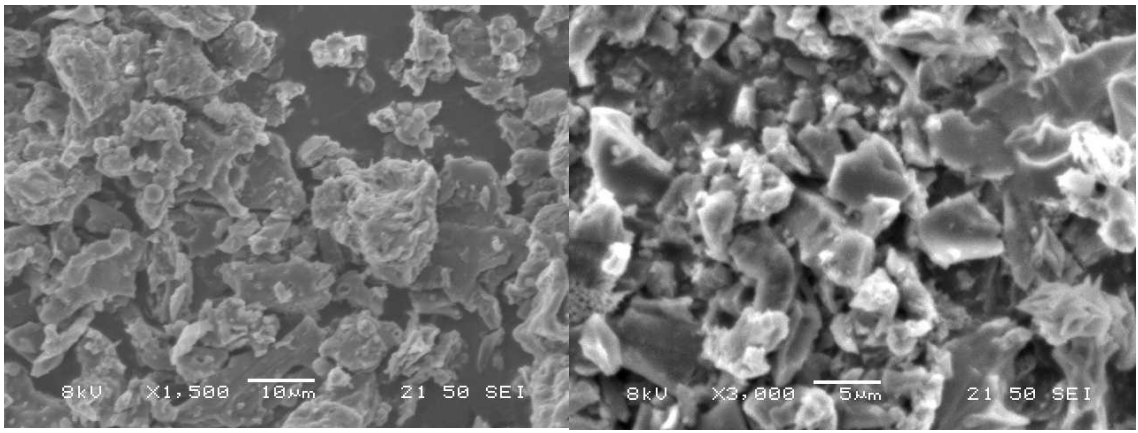
These figures indicate that Bm surface morphology has Ln stable particles, with some amorphous porous C structure and deposits, due to oxidation during S carbonization.
TGA
Perkin-Elmer pyris v-381 TGA wad used to measure Ln sample thermal decomposition. The Ln sample was placed in an Al pan. It was subjected to heat in a T range from 40 to 550 ºC, under a N blanket. T accuracy assessed the thermal stability of Bm from Ln. TGA analyses of WH and RH are shown in Figs. 5 and 6, respectively. Some compounds may include VM (low boiling point) that are poorly attached to the sample. This VM can desorb or evaporate from the sample, as the T rises, resulting in mass loss. The % change in mass on the TGA curve shows a declining trend.
Conclusion
This research performed Ln extraction from Bm. It was herein concluded that Ln from RH is more efficient than the one extracted from WH, for bio-fuel production. High Ln output by varying duration, T and solid quantity was obtained. NaOH was used as extraction medium. WH extraction yielded 16% Ln after 5 h. RH, on the other hand, yielded 13% after 4 h. Therefore, mass loss of Ln from RH was lower than that from WH, as concluded from TGA. Ln from RH is less porous than that from WH, as concluded from SEM. VM composition in Ln from RH is higher than that from WH, i.e., 76.97%, as concluded from PA. However, UA revealed that N, O and S content in Ln from RH was higher than that from WH, i.e, 4.43, 0.53 and 52.61%, respectively.
Acknowledgements
The writers of this paper would like to thank the Chemical Engineering Department of Mehran University of Engineering and Technology Jamshoro for their assistance.
Authors’ contributions
M. Siddique: worked on the paper. A. Wakeel: performed analysis work. A. A. Bhutto: removed mistakes. H. Ahmad: provided support in lab work. M. Asif: helped in results. S. Hussain: removed plagiarism. M. Husnain: improved the study with corrections. A. Abass: made extraction work. N. Jaffar: helped with the graphs.
Abbreviations
AC: ash content
Bm: biomass
BTT: Babul tree bark
Ct: concentration
FC: fixed carbon
GDP: gross domestic product
H2SO4: sulfuric acid
Ln: lignin
MC: moisture content
NaOH: sodium hydroxide
NTB: Neem tree bark
PA: proximate analysis
RH: rice husk
SEM: scanning electron microscopy
T: temperature
TGA: thermogravimetric analysis
UA: ultimate analysis
VM: volatile matter
WH: wheat husk

