




 Inglês (pdf)
 Artigo em XML
 Referências do artigo
 Tradução automática
 Enviar este artigo por email
 Citado por SciELO
  Similares em
SciELO
Similares em
SciELO 
 Permalink
Introduction
Cubic YSZ is a wide-gap ceramic with diverse uses in many technologically important applications 1. In the field of electrochemistry, YSZ is commonly employed as electrolyte material in solid-oxide fuel cells 2. It is an ionic conductor with electrical conductivity mediated by the diffusion of oxygen ions. Proton incorporation in bulk YSZ has been studied in the pioneering work of Wagner, where the solubility of protons in YSZ solutions was found to be low 3,4.
However, recent studies have reported high levels of electrical power originating from proton conduction in monocrystalline Nc-YSZ samples, at T below 150 ºC 5-7. An explanation for these findings is linked to a numbers of issues: a) How easy it is for protons to dissolve in bulk YSZ lattice?; b) What are the mechanisms of proton diffusion and associated migration-energy barriers?; and c) Does proton diffusion in Nc-YSZ take place through the bulk or through fast-diffusion pathways such as grain boundaries or internal surfaces?
The present work reviews and discusses some of its authors’ recent combined theoretical and experimental works on hydrogen defects in cubic YSZ 8-12. The calculations were based on DFT theory 13,14, under generalized-gradient approximation for exchange and correlation effects. They were carried out to determine the formation energy and migration behavior of protons in YSZ lattice. Experimentally, results of MSS experiments, where the implantation and evolution of muons, a much lighter hydrogen particle 15, were monitored and analyzed, are also herein presented.
Theoretical preliminaries
First-principles calculations based on DFT theory were performed with the aid of Vienna Ab initio Simulation Package computational code 16-18. A plane-wave basis limited by a cut-off energy of 420 eV was taken for the expansion of crystalline valence-electron wave functions. Pseudopotentials based on projector-augmented wave method 19 were used to represent valence-core interaction. Exchange and correlation effects between electrons were described within generalized-gradient approximation and PBE semi-local functional 20. Minimum-energy paths and migration barriers of proton diffusion were determined by NEB method 21, through the creation of intermediate system replicas connecting initial and final proton configurations in YSZ structure.
Structurally, YSZ lattice was represented by quasi-random bulk cubic-zirconia supercells where yttria formula units were added to achieve a stoichiometry of a10.3 mol% YSZ solution, which is within the stability limits of cubic phase 8. Yttrium atoms were introduced in the cation sublattice of zirconia, according to the following reaction, expressed in Kröger-Vink notation:
 (1)
(1)
Negatively-charged YZr defects are charge compensated by the creation of doubly positively charged oxygen vacancies, ʋ0, in order to achieve overall charge neutrality. O 𝑂 × denotes oxygen atoms at their normal lattice sites.
Defect-formation energies
Hydrogen atoms were inserted interstitially inside YSZ supercell, at various locations. Minimum-energy equilibrium sites were determined for each charge state of hydrogen by energy minimization. Final formation energies were determined as a function of Fermi energy, EF, within YSZ band gap, according to the following expression:
 (2)
(2)
where 𝐸 𝑑𝑒𝑓 𝑡𝑜𝑡 and 𝐸 𝑏𝑢𝑙𝑘 𝑡𝑜𝑡 represent the defect’s total energies (within embedded hydrogen atom) and pristine bulk-lattice supercells, respectively; µH denotes the magnitude of hydrogen chemical potential; ∆n accounts for deviations from stoichiometry; q is defect charge state; and EV stands for the value of valence-band edge, which served as reference energy for Fermi level. Band gap of 3.91 eV was obtained from DFT-PBE, a value that underestimated YSZ experimental gap 8.
Final formation energies for different charge states of hydrogen are shown in Fig. 1, as a function of Fermi level in the gap. It can be seen that neutral state is never thermodynamically stable for any position of Fermi level. Instead, monatomic hydrogen is an amphoteric defect in YSZ, with pinning level (+/-) at 1.47 eV below conduction band edge, EC. In band gap largest part, hydrogen is positively charged; thus, it is thermodynamically stable as a proton defect: H+. In Fig. 1, Fermi-level energies ranged from zero (valence-band edge, EV) to EC.
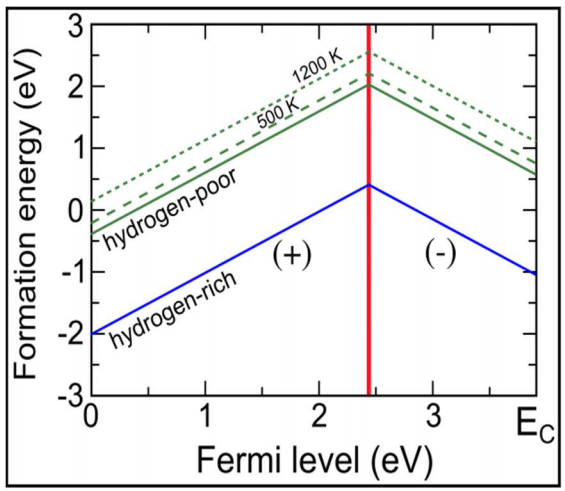
Figure 1: Formation energy of interstitial hydrogen in YSZ for hydrogen-rich and hydrogen-poor conditions as a function of Fermi-level position inside band gap. The red vertical line denotes (+/-) pinning level.
The dependence of formation energies on specific value of hydrogen chemical potential is depicted in Fig. 1. For hydrogen-rich conditions (equilibrium with hydrogen gas, H2(g)) corresponding formation energy is lower. Nonetheless, hydrogen-poorest conditions are the most realistic conditions in practical applications where YSZ samples are in equilibrium with a surrounding water vapor, H2O(g). In this case, formation energies were higher, and hydrogen chemical potential is given as:
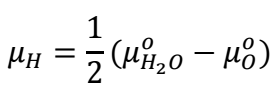 (3)
(3)
where 𝜇 𝐻 2 𝑂 𝑜 are 𝜇 𝑂 𝑜 are chemical potentials of water and oxygen, respectively, in their respective gas states, at standard T and partial-pressure conditions.
Furthermore, assuming an ideal-gas behavior for gas phases, effects of T and partial pressure can also be included to chemical potentials, as follows:
 (4)
(4)
where µº denotes chemical potential of hydrogen at standard conditions of T = 298.15 K and pº = 1 atm. ∆µ(T, pº) is T-dependent part of chemical potential. These quantities were obtained from thermochemical tables 22.
Structurally, it was observed that H+ bound to oxygen ions, forming hydroxyl-type O-H bonds, with bond lengths within a very narrow range, from 0.98 to 1.00 Å. Due to the disordered structure of YSZ lattice, H+ binding to various O ions led to not iso-energetic configurations 12. In fact, lower formation energies were recorded for O-H configurations very near oxygen vacancies (see Fig. 2a).
These results suggest that intrinsic oxygen vacancies of YSZ lattice defined trapping regions within YSZ, where protons preferably bind with oxygen ions which were the nearest neighbors of these vacancies. The structural relaxation pattern shows that O-H hydroxyl bond was accommodated by a breaking of one (or two) Zr-O host bonds, rendering participating O ion under-coordinated (see Fig. 2b).
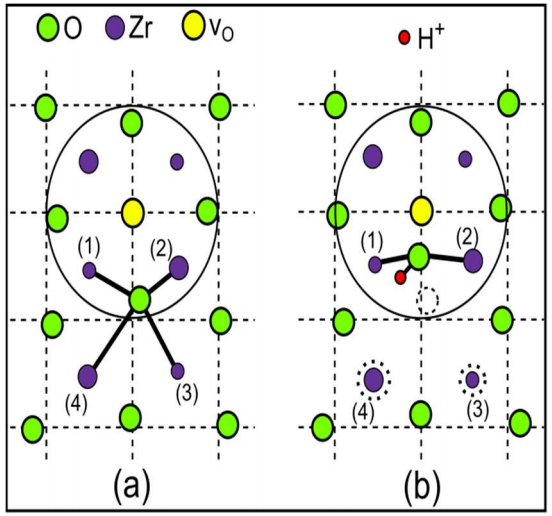
Figure 2: (a) YSZ lattice near an oxygen vacancy. (b) Proton configuration in YSZ lattice- formation of dative O-H bond and breaking of two Zr-O host bonds.
After establishing equilibrium sites and formation energies of protons in YSZ lattice, the next step was to determine energy balance of hydration reaction. Accordingly, protons incorporated into bulk YSZ lattice through dissociative dissolution of water molecules from surrounding atmosphere. Hydration reaction can be expressed as:
 (5)
(5)
A water molecule transferred from gas phase was the source of two protons that entered the oxide lattice, and oxygen atom filled an oxygen vacancy. Hydration enthalpy (T = 0 K) of this reaction can be obtained as follows:
 (6)
(6)
Considering formation energy of proton defect (see Fig. 1) and of the doubly positively charged oxygen vacancy 12, net balance of hydration reaction was negative (13 eV). Thus, hydration was an exothermic process and YSZ lattice favorably accommodated proton defects from surrounding water atmosphere, at low T.
Migration pathways and barriers
A number of migration pathways representing plausible possibilities for proton motion in entire YSZ lattice were considered. DFT calculations with NEB method identified two distinct groups of paths with substantially different migration barriers. Pathways spatially confined within the immediate neighborhood of individual oxygen vacancies were found to be short ranged (see Fig. 3), and to have low to moderate barriers ranging from 0.13 to 1.02 eV (Fig. 4).
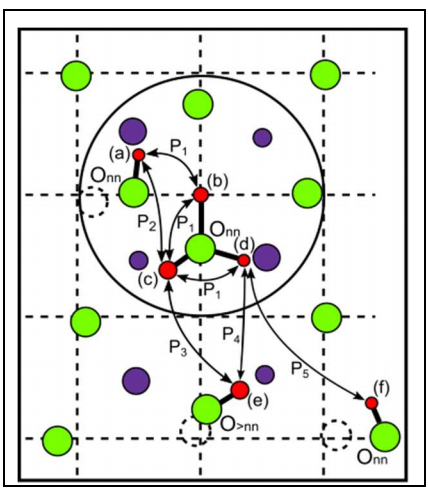
Figure 3: Migration paths of proton in YSZ lattice, denoted by arrows connecting initial and final proton sites. Oxygen vacancy site is represented by “b”.
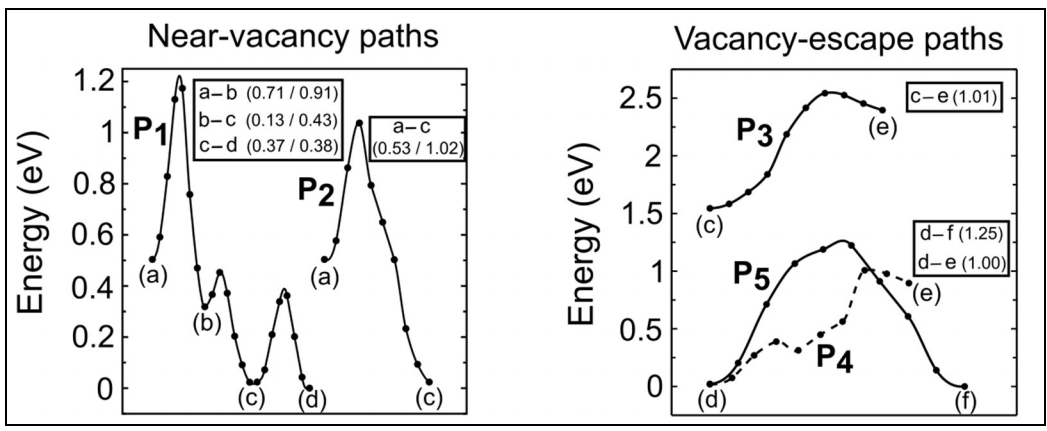
Figure 4: Energy profiles of proton migration paths depicted in Fig. 3. Energy barriers (in eV) for forward/backward motion are shown inside parentheses for specific migration segments.
These paths comprise both proton-transport and bond reorientation modes of migration. In contrast, vacancy escape paths are exclusively proton-transport type and have a longer range (Fig. 3). These paths should normally be linked to long-range macroscopic diffusion, and are associated with larger barriers, in excess of 1 eV (see Fig. 4). These findings strongly suggested that proton mobility in bulk YSZ should be rather low.
Additional NEB calculations were also performed for proton paths at the core of a high-angle grain boundary 12. Such extended defects constitute an integral part of Nc-YSZ samples internal structure. Calculations showed that Zr-Zr cation stacking at the core of these interfaces acted as strong obstacle to proton motion, creating very high barriers to overcome. Therefore, it is quite doubtful that grain boundaries can be fast diffusion pathways for proton transport. The only alternative for the reported high protonic conductivity in Nc-YSZ appears to be that protonic defects diffuse unhindered along internal surfaces of Nc-YSZ samples 7. This could be accomplished either by executing hopping jumps between oxygen ions as protons, or through a vehicle mechanism where H+ ions are part of larger groups (for instance H3O+ ions) that are present from water dissolution to the surface from a wet atmosphere.
MSS
MSS has become a standard technique for studying monatomic hydrogen configurations through modelling with muonium, a light pseudo isotope where the hydrogenic atom possesses a positive muon as nucleus: μ+-e− (23,24. Although the muon is only one-ninth the proton mass, muonium reduced mass 99.6% that of hydrogen, so that the respective electronic properties should be nearly identical 25,26. MSS has also the additional advantage of being restricted to high-dilution limit for muonium impurity, which can thus generally be regarded as isolated, only indirectly affected by other defects or impurities through overall Fermi energy.
MSS experiments took place at EMU instrument of ISIS Facility, Rutherford Appleton Laboratory, UK. A Nc YSZ (Zr0.92Y0.08O2) sample (grain size 13 nm) provided by Innovnano was investigated. In the experiments, 4 MeV positive muons were implanted into the sample. In the first one, a magnetic field (B = 10 mT) was applied perpendicularly to initial MSS polarization, at T of 8.5 K. Fig. 5 shows a Fourier transform of obtained MSS high statistics (using Lomb method 27): the level of probability of false alarm below 0.0001 is shown as a pointed line in Fig. 5.
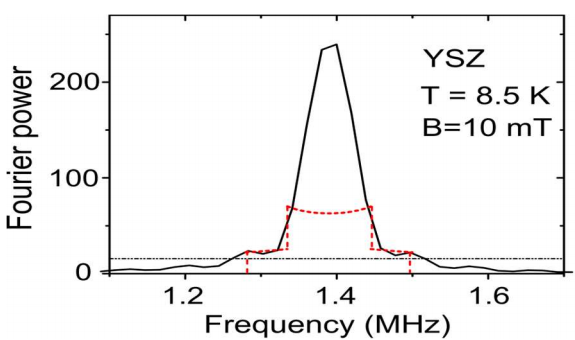
Figure 5: µSRS Fourier spectrum of YSZ at T = 8.5 K in an external magnetic field of B = 10 mT. The red dashed line is a simulation of a powder spectrum with Aiso = 0 MHz and D = 0.2 MHz.
The results clearly indicate, as identified previously 11, that MSS signal basically corresponds to positively-charged muons precessing at Larmor frequency. However, the frequency line width clearly exceeds the one expected from nuclear dipolar broadening, which indicates the presence of a small electronic spin density at the muon. Similar results have been obtained in other oxide systems 28, revealing that hyperfine interaction was mainly dipolar. One may immediately estimate its approximate value from the full width at line half maximum, which yields a dipolar term: D ≈ λ/π = 0.11 MHz. A closer inspection of Fig. 5 reveals the existence of a small spectral power above the threshold for false alarm, at frequencies of f1 ≈ 1.3 MHz and f2 ≈ 1.5 MHz. These are likely to correspond to expected steps of a powder-pattern hyperfine spectrum 29. Powder pattern represented as a red dashed line in Fig. 5 is a simulation with the model of 29, using a value of isotropic hyperfine interaction Aiso = 0 and D corresponds approxim. to D ≈ f2 − f1 = 0.2 MHz. Both approaches indicate that hyperfine interaction was of almost pure dipolar origin (Aiso ≈ 0 and with D ≈ 0.1 MHz- at most, 0.2 MHz).
A notable feature is that a significant part of MSS polarization was not seen at low T (missing fraction) 11. The missing fraction is related to muons depolarizing rapidly during thermalization stage, due to the formation of deeply bound muonium. Thus, one assigns the missing fraction to muons thermalizing in interstitial configurations 8 (either pure interstitial or oxygen-vacancy site). Nevertheless, hyperfine interaction associated to these configurations can be characterized by means of longitudinal-field repolarization technique. Fig. 6 shows repolarization curve for YSZ, at T = 300 K. This curve is two-stepped, which is a usual sign of anisotropy 30. Therefore, the data were fitted (Fig. 6) with phenomenological repolarization functions proposed in 30. Obtained values were Aiso = 2.1(2) GHz and D = 0.13(2) GHz. The corresponding fit is shown as a red line in Fig. 6.
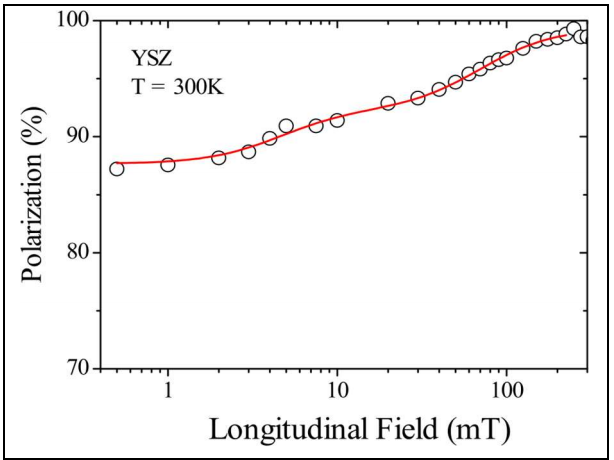
Figure 6: Repolarization curve for YSZ at T = 300 K. The red line is a fit assuming an axially symmetric anisotropic hyperfine interaction, as discussed in the text.
However, calculated hyperfine interaction for interstitial hydrogen in cubic bulk YSZ has been calculated in 10 as being essentially isotropic, with Aiso ≈ 3 GHz. This value is much higher than Aiso = 2.1(1) GHz, which is the present study’s experimental value. However, one must take into account that the sample used in these experiments is Nc, with an average grain size of 13 nm, implying an important role of the grain surface. MSS experiments in Nc II-VI semiconductors present strong evidence of surface states formation 31. Segregation of impurities on the nanograins surface is also a well-known effect 32, which may be enhanced with decreasing grain size 33. Moreover, the first-principles calculations of 10 showed that hydrogen at the grain boundary core was characterized by different Aiso values from those of hydrogen in bulk regions. In certain cases, the corresponding value was found to be lower by as much as 20%. This finding was attributed to the distinct interface structure of the grain boundary. This could allow (in certain cases) a much larger spilling of valence electron density to neighboring ions, thus leading to a reduction of spin density at hydrogen nucleus and, consequently, to a smaller Aiso value for hydrogen, at the grain boundary core. The corresponding reduced values for muonium, after scaling took into account the 3.183 factor of magnetic moment ratio of the muon and the proton, were around Aiso ≈ 2.3 GHz, which compared well with the experimental value. Therefore, it is probable that anisotropic component seen in Fig.6 corresponds to muonium influenced by the grains surface.
Conclusion
The proton defect in YSZ was studied by a combination of first-principles calculations and MSS measurements. By means of DFT calculations, the formation and hydration energies of protons in YSZ lattice were obtained, providing essential information on their local environment, thermodynamic stability and ease of incorporation from the water vapor. Representative migration pathways for protons were also identified linking the magnitude of diffusion barriers with YSZ internal microstructure. MSS allowed the characterization of hydrogen configurations in YSZ: an oxygen-bound configuration with a reduced electron spin density (with a mostly dipolar character) and an interstitial configuration with a high spin density. However, the latter was found to be much reduced with respect to theoretical estimates, indicating possible surface effects due to the nanometric size of crystalline grains.
Acknowledgements
This work was supported by FCT - Fundação para a Ciência e Tecnologia, I. P. (Portugal), projects UIDP/04564/2020 and UIDB/04564/2020. FCT is also acknowledged by R.B.L.V. for Researcher Positions (CEECIND/02127/2017). We acknowledge the use of the computing facilities of CFisUC of the University of Coimbra. We also acknowledge the ISIS Facility at the Rutherford Appleton Laboratory, UK, for beam time allocation and the technical help of the muon team.
Authors’ contributions
A. G. Marinopoulos: draft preparation, project administration, investigation. R. C. Vilão: draft preparation, formal analysis, investigation. H. V. Alberto: review and editing. J. M. Gil: review and editing. R. B. L. Vieira: data curation, review and editing. J. S. Lord: data curation, review and editing.
Abbreviations
DFT: density-functional theory
MSS: Muon spin spectroscopy
Nc: Nanocrystalline
NEB: nudged elastic-band method
PBE: Perdew-Burke-Ernzerhof functional
T: temperature
YSZ: yttria-stabilized zirconia

