




 texto em
  Inglês (pdf)
 Artigo em XML
 Referências do artigo
 Tradução automática
 Enviar este artigo por email
 Citado por SciELO
  Similares em
SciELO
Similares em
SciELO 
 Permalink

Introduction
The fields of structural and earthquake engineering are critical in ensuring the safety and resilience of our built environment, particularly as global challenges such as urbanization, climate change, and disaster preparedness become increasingly urgent (Ferreira & Santos, 2024). In recent years, the integration of engineering with artificial intelligence (AI), machine learning (ML), and deep learning (DL) has begun to reshape traditional paradigms. These technologies offer new opportunities to automate processes, enhance predictive accuracy, and optimize designs, paving the way for more efficient, adaptive, and sustainable engineering practices.
Despite its transformative potential, the adoption of AI in structural and earthquake engineering remains relatively underutilized compared to other fields (Tapeh & Naser, 2023; Xie et al., 2020). Traditional mechanics-based methodologies continue to dominate the field, and it remains to be seen how AI-driven approaches will coexist with these established practices, particularly in the professional and educational contexts. Some skepticism surrounding AI’s perceived opacity-often viewed as a "black box" compared to the transparency of experimental, numerical, and analytical methods-further complicates its integration. However, AI’s unparalleled ability to process extensive datasets, execute computationally intensive tasks, and adapt to real-time conditions presents significant opportunities for innovation.
In this editorial, I aim to provide a concise yet comprehensive reflection on AI's current state and transformative potential in structural and earthquake engineering. By looking at its impacts across research, education, and practical implementation, I hope to highlight some opportunities and challenges for AI integration. Furthermore, I will emphasize pressing concerns, such as the importance of fostering interdisciplinary collaboration and addressing the significant environmental footprint of AI technologies-an aspect that, in my view, has not received the attention it deserves.
1. The transformative impacts of ai in structural and earthquake engineering
1.1 AI as a Catalyst for Innovation in Research-Trends and Emerging Focus Areas
The rapid advancement of AI has become a cornerstone in driving multidisciplinary research across various fields, heralding a new era of "AI for science" (Lu & Burton, 2023). Within this context, AI and data-driven approaches are increasingly being explored for their potential uses in advanced structural and earthquake engineering applications, positioning the field as a growing frontier of innovation. This trend is illustrated in Figure 1, which plots the number of publications indexed in Scopus containing the terms "AI," "Artificial Intelligence," "Machine Learning," or "Deep Learning" applied in the context of structural or earthquake engineering . The analysis spans a total of 523 research outputs published between 1978 and 2024.
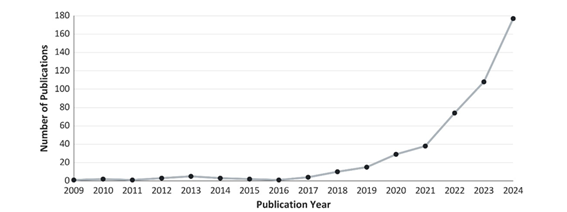
Figure 1 Number of Scopus-indexed publications per year (2009-2024) containing the terms "AI," "Artificial Intelligence," "Machine Learning," or "Deep Learning" in the context of structural or earthquake engineering.
Complementary to Figure 1, Figure 2 provides a visual representation of the interconnectedness and prominence of key research themes in the research output plotted in Figure 1. Machine learning emerges as the most influential term at the centre of the network, emphasising its pivotal role as the foundation for AI-driven advancements in these fields. Closely connected are artificial neural networks (ANNs) and deep learning (DL), which have been instrumental in overcoming computational challenges and driving breakthroughs in areas such as structural inspection and health monitoring (Spencer et al., 2019), structural design (Sun et al., 2021), and damage and fragility assessment (Kiani et al., 2019; Kostinakis et al., 2023). Moreover, these AI-driven methods are proving very effective for post-earthquake damage assessment, where rapid and accurate evaluations of structural integrity are critical to ensuring safe occupancy and effective disaster response (Estêvão, 2024).
The thematic map presented in Figure 2 also highlights the breadth of AI applications, showcasing prominent nodes like structural design, optimization, and reinforced concrete, which illustrate the penetration of AI into traditional structural engineering domains. Emerging technologies such as the Internet of Things (IoT) and Generative Adversarial Networks (GANs), situated on the periphery, point to the exploration of new research directions that blend real-time data acquisition with advanced modeling techniques. Plus, the timeline gradient within the figure demonstrates the evolution of research priorities, with topics such as IoT, deep learning, and GANs appearing in yellow, signifying their emergence as recent focus points.
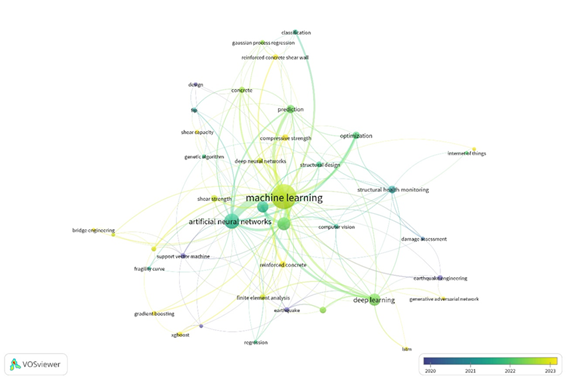
Figure 2 Thematic map of AI applications in structural and earthquake engineering: connections, trends, and emerging focus areas.
From the analysis of Figure 2, it is apparent that AI is increasingly permeating nearly every aspect of structural and earthquake engineering research. The dense network of connections between terms underscores the multidisciplinary nature of AI-driven research. At the same time, the prominence of specific themes, such as the already-mentioned structural inspection and health monitoring, structural design, and fragility and damage assessment, illustrates the dual focus on addressing long-standing challenges and exploring innovative approaches.
1.2 The Present and the Future of Engineering Education with AI
Although AI was first introduced in the 1950s and is well-established within the research panorama, its application in engineering education has only recently begun to attract meaningful attention (Haenlein & Kaplan, 2019). AI-powered platforms, including adaptive learning systems and virtual environments, enable personalized learning tailored to individual student's strengths and weaknesses. These tools provide students with opportunities to engage in hands-on simulations that replicate real-world engineering challenges, promoting the development of critical thinking and problem-solving skills in a controlled and interactive setting. Furthermore, they can address individual learners' specific needs and provide real-time, personalized feedback to enhance the learning experience (Shah, 2023; Talha Junaid et al., 2024).
Despite its promise, the adoption of AI in engineering education still has a long way to go, with surveys indicating that many educators and students remain unfamiliar with its potential or unaware of its possibilities (Vidalis & Subramanian, 2023). It is essential to acknowledge that the integration of AI in education faces several challenges, stemming not only from scepticism about AI models-often perceived as opaque compared to traditional methods-but also from the limitations of the models themselves. These models still face various technical challenges (some of which are addressed in Section 2.2) and struggle to customize solutions to specific engineering contexts. Nevertheless, students who have utilized AI tools, such as chatbots and automated systems, report improved understanding of topics, faster problem-solving, and enhanced engagement in coursework. The ability of AI to offer alternative problem-solving methods and instant feedback further bridges the gap between traditional educational approaches and the demands of a technology-driven workplace.
It seems apparent that the future of AI in engineering education, both in general and specifically in structural and earthquake engineering education, lies in addressing its current limitations while capitalising on its strengths. Providing students and educators with targeted training on AI tools, integrating these technologies into curricula, and fostering ethical awareness about their use will become increasingly critical as AI-based approaches transition from research to education. Not less important, equipping engineering students with the skills to leverage AI in their studies will enable the education system to prepare them for the growing demands of the profession, ensuring they are ready to innovate and adapt to the challenges of an increasingly data-driven world.
1.3 AI-Driven Innovations and Practical Applications in the Industry
In a rapidly urbanising world, innovation in the construction industry is critical for addressing sustainability and resilience challenges and meeting the demands of modern urban development. However, the construction sector has historically been one of the least innovative industries, characterised by limited productivity growth over the past two decades. With average productivity growth consistently below 1% over the last two decades (Javed et al., 2018), the construction industry has lagged significantly behind more digitalised sectors such as manufacturing or medicine, to name just two examples (Zhou et al., 2020). This stagnation has raised concerns about efficiency and underscored the need for transformative change. In response, the construction industry is increasingly exploring AI technologies to optimise practices, streamline workflows, and enhance productivity. Innovative AI-based tools promise several tangible benefits, including preventing cost overruns, improving site safety, optimising project management, and automating processes. For instance, AI-powered predictive tools can identify potential risks early in the project lifecycle, enabling proactive interventions to minimise delays and cost escalations. Similarly, AI applications in site management, such as autonomous equipment and computer vision systems, enhance efficiency and improve safety by monitoring on-site activities (Mohy et al., 2024).
In structural and earthquake engineering, AI technologies can be particularly transformative. During the design phase, machine learning algorithms can optimise structural layouts to find the most efficient balance between material efficiency, structural performance, and sustainability. In the construction phase, AI tools can, for example, monitor the quality of materials, while AI-powered robotics can streamline on-site tasks, reduce labour-intensive activities, and improve construction speed and precision, all while lowering costs and enhancing safety. Furthermore, structural health can be monitored in real-time throughout the building’s lifecycle using AI-powered monitoring systems, which can identify and flag structural issues that may compromise the building's seismic performance.
2. Challenges in ai implementation
Despite the transformative potential of the AI-based models and tools discussed above, their implementation in structural and earthquake engineering faces significant challenges that require careful consideration. These barriers can be broadly categorised into data-related issues, technical limitations, human factors, and environmental impacts, which I will aim to address in the following points in an explanatory but necessarily concise and non-exhaustive manner.
2.1 Data Challenges in AI Integration
AI models rely on the availability of high-quality, extensively labelled datasets for training. Generating such data is extremely costly and time-intensive, particularly for projects requiring domain-specific information. Furthermore, the lack of standardised data formats makes it highly challenging to share and utilise data collected and systematised by different stakeholders. Privacy and security concerns, especially in projects involving sensitive infrastructure, further limit data accessibility. Additionally, errors and noise in training data contribute to factual inaccuracies, a phenomenon often referred to as the "hallucination problem" (Borji, 2023). These inaccuracies can undermine trust in AI systems, particularly in safety-critical applications where precision is paramount. Although emerging technologies and domain-specific plugins can help mitigate some of these issues, their effectiveness in specialised tasks, such as those involved in structural and earthquake engineering, remains to be fully demonstrated.
2.2 Technical Barriers to AI Adoption
AI technologies also face technical constraints that hinder their widespread adoption. Many AI models, such as deep learning algorithms, are computationally intensive and require significant hardware resources, making them inaccessible to smaller firms or resource-constrained projects. Additionally, the "black box" nature of many AI models raises concerns about interpretability and trustworthiness, as these opaque models often fail to provide clear insights into how predictions or decisions are made, complicating regulatory approval and broader adoption. Furthermore, AI systems like ChatGPT lack robust mechanisms for explicit knowledge modeling. While these models excel at predicting the next word in a sequence-which is the basis of their operation-they often struggle with complex mathematical operations (Frieder et al., 2023) and the retrieval of domain-specific explicit knowledge.
2.3 Human Factors in the Path to AI Integration
Human factors represent another critical challenge in implementing AI. As mentioned above, there remains some scepticism about the reliability of AI models as viable alternatives to traditional approaches, which are valued for their transparency and proven track record. A lack of familiarity and training also drives resistance to adopting AI technologies, as the technical community has yet to fully integrate these tools into their workflows-a reality not markedly different from their peers in academia. Additionally, the introduction of AI raises concerns about workforce displacement and the need for upskilling. The practical implementation of AI will require targeted training programmes to enhance AI literacy among the technical and academic communities and strategies to foster collaboration between AI developers and domain experts.
2.4 Environmental Impacts
The widespread implementation of AI raises significant concerns about its environmental footprint, an aspect that has yet to receive the attention it deserves. Training and deploying advanced AI models, particularly those based on deep learning, require substantial computational resources, resulting in high energy consumption. For instance, large-scale models often utilise thousands of GPUs running continuously over weeks or months, consuming vast amounts of electricity and significantly contributing to carbon emissions (Dhar, 2020; Strubell et al., 2020). This is particularly troubling in regions where energy grids rely heavily on non-renewable energy sources. Beyond energy consumption, the operation of AI systems demands considerable water resources, primarily for cooling data centres. As the demand for AI grows, so does its contribution to water stress, especially in areas already experiencing shortages (Gupta, 2024). Furthermore, the mining of rare earth elements for the hardware components used in AI infrastructure exacerbates the environmental burden, raising concerns about resource sustainability and ethical sourcing.
3. Key takeaways and future directions
The transformative potential of AI in structural and earthquake engineering lies not only in advancing research, education, and practical applications but also in navigating the complex challenges that accompany its implementation. These challenges underscore the need for a multidimensional approach that balances innovation with ethical, environmental, and social considerations.
A key takeaway from this brief reflection is the necessity of addressing data-related challenges. The lack of standardised formats and the high cost of generating domain-specific datasets continue to hinder AI's practical application. Ensuring data accessibility through open access and open science initiatives, fostering collaboration, and integrating privacy-conscious practices are critical steps forward. At the same time, technical limitations, such as the opacity of "black box" models and their computational intensity, highlight the importance of developing explainable and efficient AI systems that can be trusted in safety-critical applications.
Equally pressing are the human factors influencing AI adoption. A relatively conservative technical and academic community calls for targeted training programmes to build AI literacy. Encouraging interdisciplinary collaboration between domain experts and AI developers will foster the trust and shared understanding necessary for widespread acceptance.
Finally, the environmental footprint of AI technologies is an aspect that deserves a more prominent role in discussions about the integration of AI into our workflows. The computational resources required to store data, train, and deploy large-scale models lead to substantial energy consumption, carbon emissions, and water use. The mining of rare earth elements for hardware exacerbates these impacts, raising questions about ethical sourcing and resource sustainability. Future efforts should prioritise the development of energy-efficient models, such as those aligned with "green AI" principles, and transition towards renewable energy sources for data centre operations.

