




 Inglês (pdf)
 Artigo em XML
 Referências do artigo
 Tradução automática
 Enviar este artigo por email
 Citado por SciELO
  Similares em
SciELO
Similares em
SciELO 
 Permalink

Introduction
In today's society, educational professionals are not only expected to possess subject knowledge but also to be innovative, open to learning and implementing new ideas, and engaged in self-discovery and self-evaluation. A proficient physical education teacher not only motivates and engages students in enjoyable physical activities but also creates a safe and inclusive environment for all students. Recognizing the importance of adapting to changing needs, physical education teachers should actively pursue continuous professional development by staying informed about the latest research and best practices in the field.
We strongly believe that teachers who analyze their actions, commit to self-improvement, and invest in personal and professional development can drive innovation, find creative solutions, and foster students' self-realization for success. Critical reflection, with its primary goal of identifying new approaches and improvements, is crucial for positive change in the educational community (Saric & Steh, 2017). There is a current demand for teachers who engage in continuous reflection, demonstrating thoughtfulness and systematic analysis of their experiences in professional activities.
The teacher's reflective attitude towards themselves as a subject of professional pedagogical activity is the basis for the development of pedagogical reflection as a necessary condition for professionalism. The process of reflective practice is called the reflective cycle which is described in Gibbs' model of reflection (Gibbs, 1988). Graham Gibbs (1988) created the Reflective Cycle as a way to provide a systematic approach to learning from experiences. This model offers a structure for analyzing experiences and is especially useful for cases that occur repeatedly. By utilizing this cyclic model, educators can reflect on successful and unsuccessful experiences, enabling them to learn from them and plan for future situations. Gibbs’ reflective cycle offers a more in-depth and comprehensive approach to reflection, which is helpful when individuals need to provide a more detailed analysis of their experience. However, not only wish to improve motivates teachers to reflect and develop. Collaboration, connection, and reflection are essential for teachers as they develop relationships and provide emotional support. We intended to combine reflection and collaborative practices to foster professional continuous development (CPD) for teachers of physical education at universities. Therefore, the purpose of this study is to examine the effectiveness of the Gibbs Model and Glatthorn’s (Glatthorn, 1990) collegial growth paradigm combination for physical education teachers’ self-reflection enhancement and motivation for CPD. Glatthorn's Collegiate Growth Paradigm complements Gibbs' model with its focus on long-term professional development and collaborative learning within collegiate settings. This paradigm emphasizes peer interaction, mentoring, and a supportive community toward continuous professional growth. Glatthorn's model stimulates a culture of shared learning and mutual support that will create the best setting for sustained professional development and innovation. Combining Gibbs' Reflection Model and Glatthorn's Collegiate Growth Paradigm creates a strong system for professional growth both at the individual and group levels. While Gibbs' model assures one of systematic and comprehensive reflection, Glatthorn's paradigm creates the best circumstances for a collaborative growth environment. Together, they provide a holistic approach toward the development of personal and professional capabilities; hence, they will constitute good additions to the introduction.
In the transfer of these theoretical models to empirical research we applied their phases and integrated them into practical methodologies. Gibbs' model was used for the creation of reflective journals and interview protocols, while Glatthorn's paradigm was important for the design of collaborative professional development activities. Such applications helped us observe how reflective and collaborative practices function in educational settings.
1. Theoretical framework
Various aspects of professional development are scrutinized in scientific literature, highlighting its relevance and significance for effective professional activities. This issue extends beyond research works to normative documents and recommendations from international and national organizations, emphasizing the peculiarities of professional training in education (Villegas-Reimers, 2003). Professional development is viewed as the teacher's personality development in a professional dimension, involving systematic preparation and encompassing initial training, entry into the profession, and continuous development (Scheeres et al., 2010). Kennedy (2014) underscores it as a deliberate, lifelong effort where educators strive to enhance personal and professional attributes, broadening prospects, and positively impacting students. Researchers address diverse topics for professional competence enhancement, including health education, sports and recreation, pedagogical issues, and research skills (Braga et al., 2016; Kann et al., 2001; Lynch & Curtner-Smith, 2019).
Within the constructivist framework, effective professional development requires participants to embody the roles of "teacher" and "learner," acquiring knowledge while relating it to previous experiences and anticipating practical applications (Rout & Behera, 2014). The professional development of physical education teachers in multidisciplinary institutions should involve specific pedagogical tasks, evaluation methodologies, observation, and joint performance of research within the professional community (Rout & Behera, 2014). The continuous nature of professional development, utilizing modeling potential, coaching, and collaborative learning, necessitates a comprehensive system for academic staff (Ma and Ren, 2011).
Reflective teaching is integral to professional development, leading to personal transformation in psychological, behavioral, and values dimensions (Thompson et al., 2020). Professional development involves acquiring knowledge, developing practical skills, and shaping human and professional values. The behavioral dimension emphasizes measuring program effectiveness by its impact on teachers' behavior and activities, affecting students' educational outcomes. Reflection is associated with continuous professional development as there is a strong relationship between professional reflectiveness and the motivation of a teacher's work activity (Agustin, 2019). Motivation in teachers' work provides an improvement in the quality of their work and a potential increase in the effectiveness and quality of pedagogical activity. Through professional reflection, a teacher gains a necessary understanding of how well they conform to professional standards, identify their limits and potential, become aware of their strengths and weaknesses, recognize areas of possible failure and success, and discover ways to improve themselves (Gutierez, 2016). The process of professional-pedagogical reflection results in the teacher's self-improvement as a subject of pedagogical activity by comparing their potential, competence, and personal experience with the demands of professional activity. Teacher evaluates their professional readiness based on certain conditions. Self-reflection is a critical skill for professional development in any field, including physical education. In order to enhance their teaching skills and improve the learning outcomes of their students, physical education teachers need to engage in reflection activities regularly.
The teacher's reflective attitude forms the basis for pedagogical reflection and professionalism, requiring research, analysis, and problem-solving for professional growth (Sekarwinahyu et al., 2019). Reflective practices, exemplified by the Gibbs reflective cycle, guide educators through stages of description, feelings, evaluation, analysis, conclusions, and action planning, enabling continuous improvement. Glatthorn (1990) recommends enhancing reflective practices through collaboration, peer supervision, coaching, and professional dialogue. The collegial growth paradigm involves educators creating their professional development plans and engaging in collaborative activities, such as peer supervision, coaching, support, and curriculum development. This cooperative model aligns with the collaborative aspect of reflective practice, fostering a proactive approach to professional development for physical education teachers.
Among effective continuous professional development researchers outline Boud's (2013) framework. Boud's model places much emphasis on experience, reflection, and learning. It contains three major stages: return to experience, attending to feelings, and re-evaluation of experience. The Boud model is most applicable while trying to develop a deeper understanding and learning from experience by focusing on the affective and cognitive functions of reflection. The model by Rolfe et al. (2001) builds on three simple yet powerful questions: what is the problem, what does it teach, and now what do I need to do? This model also focuses on experience and its implications for personal learning. Both Boud's and Rolfe et al.'s models bring out the importance of structured reflection in personal and professional growth. Boud's model is highly detailed, incorporating even the emotional aspects and provoking a complete re-evaluation of experience. On the other hand, Rolfe et al.'s model is straightforward and highly accessible; thus, it would be more applicable to quick reflections and implementations.
Having analyzed the sources, we can state that a comprehensive professional development system, incorporating key principles from various models, is crucial for improving the educational process and student outcomes. The integration of reflective practices and collaborative models ensures a proactive and evolving approach to professionalism in teaching, ultimately benefiting both educators and students.
2. Methods
A mixed-methods research approach (Huyler & McGill, 2019) was used to evaluate the effectiveness of the professional development program that combined Gibb’s reflective cycle and collegial growth paradigm. Our choice is justified by multiple aspects and a variety of data obtained during the study that led to a more thorough understanding of the research topic and the development of future implications. Moreover, mixed research methods enhance the triangulation of data by using multiple datasets, to address a research question. Our study addresses methodological triangulation that contributes to the validity and credibility of findings and mitigates the presence of any research biases. In our case, the methodological triangulation involves using data from focus group discussions, peer observations, and questionnaires.
In the present study, the analysis of the collected data was performed using various statistical techniques. Since the chi-square test for independence is non-parametric and doesn't require normally distributed data, it is frequently employed for Likert scale data. When two categorical variables are compared, the chi-square for independence test determines whether there is a meaningful correlation. The paired t-test was employed to compare the pre-and post-questionnaire findings and investigate whether there was a significant increase in the level of reflection. These measures provided valuable insights into the central tendency and variability of the data. In addition, content analysis was applied to the focus group discussions to identify and examine the recurring patterns and attitudes of the participants. The use of these rigorous analytical methods ensured the validity and reliability of the study findings and allowed for the interpretation of the results.
2.1 Sample
A total of 38 physical education teachers from two multidisciplinary higher education institutions, namely Lviv Polytechnic National University and Igor Sikorsky Kyiv Polytechnic Institute in Ukraine, participated in our study. These participants were purposively chosen from a pool of teachers who took a Continuous Professional Development course. The sample size of 38 was adopted because of the specific CPD course that the teachers had enrolled in during the time of the study. A particular type of non-probability sampling was applied for this study because it ensured that a group of educators who were actively participating in professional development activities could be identified and invited to participate in the study, thus making them appropriate subjects of the study on reflective practice and collaborative growth.
The participants were selected using a probability sampling method. Among the participants, there were 12 female and 16 male teachers, with varying ages ranging from 32 to 56 years old. The range of teaching experience was also diverse, with eight teachers having 5-7 years of experience, 15 teachers having 10-15 years of experience, and nine teachers having 15 years or more of experience. By Ukrainian education legislation, teachers are required to undergo professional continuous development at least once every five years. Therefore, all our participants had undergone professional development courses at least once during their teaching careers. The participants were informed about the purpose and procedures of the study and were asked to fill in a consent form. The confidentiality of the participants' information was maintained throughout the study. The study procedure was approved by the institutional Scientific Research Review Board of the researcher’s affiliated institution.
The intervention process included several steps. A pre-intervention self-assessment questionnaire was first given to them to learn more about the participants' prior exposure to professional reflection practices. This made it possible to fully comprehend the participants' present level of reflective practice and helped to identify areas that needed improvement. After that, the educators learned about the conceptual frameworks for the intervention, Glatthorn’s collegial growth paradigm, and the Gibbs Reflective Cycle. For each stage of the Gibbs model, the teachers were then given guided reflection exercises. Peer observation exercises and most of these activities were carried out in small groups by professors from two universities. The intervention took two months. Following the intervention, the participants were requested to complete a post-intervention questionnaire to assess the effectiveness of the intervention. Moreover, focus group discussions were held to reflect on the results of the questionnaire and peer observations, providing an opportunity for participants to share their experiences, perceptions, and feedback on the intervention.
2.2 Data collection instruments
The research involved a pre-and post-test design to measure changes in teachers' reflective practices. A questionnaire (Likert scale) on reflection skills was developed and distributed to a sample of physical education teachers at universities. It was a 5-point scale with a range from Strongly Disagree -Strongly Agree. The questionnaire included questions on the teachers' current level of reflection skills, their use of reflective practices in teaching, and the perceived impact of reflection on their professional development. The questionnaire included prompts related to the stages of the Gibbs reflective cycle and was analyzed quantitatively to determine if there was an increase in the level of reflection. The data collected from the questionnaire was analyzed using descriptive statistics. The questionnaire included the following statements:
1. I am comfortable with sharing my thoughts and concepts with colleagues when reflecting on my instructing strategies.
2. I effectively tune in to my colleagues' reflections and take them into thought when reflecting on my educating strategies.
3. I can offer useful input to my colleagues when reflecting on their instructing strategies.
4. I am open to getting input from my colleagues when reflecting on my educating strategies.
5. I effectively look for openings to collaborate with colleagues when reflecting on instructing strategies.
6. I can effectively communicate my thoughts and ideas to my colleagues when collaborating on reflective outcomes.
7. I can distinguish zones for enhancement in my instructing strategies through collaborative reflection with colleagues.
8. I can distinguish zones for advancement in my colleagues' educating strategies through collaborative reflection.
9. I am committed to developing my collaborative reflection aptitudes as an instructor.
10. I accept that collaborative reflection can emphatically affect instructing strategies and understudy results.
The questionnaire results were compared with a paired t-test to determine the difference between the means of pre- and post-study. The content and construct validity of the questionnaire were verified by reviewing the questionnaire by members of the Scientific Research Review Board to ensure that it covers all relevant topics and measures what it is intended to measure. Before the main intervention, a survey was sent to educators from another university to test its validity. The CRS analysis was done using exploratory factor analysis, in which only the 10 items were used. The analysis was done using SPSS 27. The results provided two factors, which were explained by about 68. 3% of the total variance: Factor 1, which tells about the openness to collaborate and reflect, included 42. 1% of the variance, while factor 2, which highlighted the perceived efficacy of the collaborative reflection, included 26,2% of the variance. The two factors demonstrated a strong positive correlation (r = .76, p < .001). The results of the reliability calculation yielded high internal consistency with the value of Cronbach’s alpha being α= .78.
Among qualitative data collection tools, we applied focus group discussions to gain insights into teachers' experiences with the reflection, the program, and the extent to which it helped them improve their reflection skills. We chose focus group discussion as we consider it a peer-supportive activity that promotes collegial reflection. As a result, the conversation became deeper and more varied as participants built on one another's ideas and observations. Moreover, focus group discussion enabled us of several viewpoints and perspectives on a specific subject or problem. To perform an efficient focus group discussion, we asked participants questions distributed into groups related to the Gibbs Reflection Cycle:
1 Description
Describe a later class or intervention you had.
What happened during the intervention?
What were the goals of the lesson?
What were the challenges you confronted in the lesson?
2 Feelings
How did you feel during the class?
What feelings did you encounter?
What were the reasons for these feelings?
How did your feelings influence your instruction?
3 Evaluation
What went well during the instructing involvement?
What might have been progressed?
How did the involvement match your objectives?
What did you learn from the experience?
4 Analysis
What were the options that contributed to the success or disappointment?
How did your expectations and presumptions impact the educational strategies?
What concepts can you apply to the involvement?
5 Conclusion
What did you learn from the experience?
What might you have done differently?
How can you apply what you learned in future education planning?
6 Action plan
What activities will you take to progress your educating practices?
How will you execute these activities?
What support or assets do you need to actualize these activities?
How will you measure the success of these activities?
In addition, we used a peer observation rubric that included criteria for evaluation such as effective classroom management, content knowledge, communication strategies, appropriateness and variety of teaching methods, students’ engagements, and use of technology. This rubric is not new for our teachers as we use it for regular peer observation practice.
2.3 Statistical analysis
In the present study, the analysis of the collected data was performed using various statistical techniques The chi-square test for independence is widely used with Likert scale data because it is non-parametric and does not demand data that is normally distributed. The pre-and post-questionnaire results were compared using the paired t-test to see if there had been a noticeable increase in the degree of reflection. In addition, content analysis was applied to the focus group discussions to identify and examine the recurring patterns and attitudes of the participants. The use of these rigorous analytical methods ensured the validity and reliability of the study findings and allowed for the interpretation of the results.
The three focus group discussions were held, and each lasted for about 90 minutes. To include the participants of the collaborative reflection program, the participants were recruited from the teaching team according to experience level and subject expertise. The discussions were led by a moderator who has experience in educational research and were recorded on audio, with all transcripts taken word for word. The answers from a group discussion were analyzed by the content analysis. The data were transcribed and analyzed using NVivo 12 software. During the first stage of the analysis, codes were developed inductively so that themes could be driven from the data. After the interviews were recorded and transcribed, we reviewed the text and assigned codes to the transcripts. The level of analysis for this study included phrases and themes. The codes were then compared and discussed to establish inter-coder reliability. Data were analyzed using an inductive coding system where themes were coded, categorized, and compared in terms of similarities. Lastly, the results of the qualitative research were compared with the survey results to get a holistic view of the collaborative reflection process.
We identified six themes related to collaborative reflection for teachers through the analysis of the focus group discussion. Themes were selected based on the word patterns that emerged from the data:
collaborative practices: team teaching, peer observation, collaborative planning, co-teaching, professional learning communities;
reflection strategies: group discussions, reflective writing, critical reflection, self-assessment, group reflection;
professional development: teacher growth, continuous education, teacher learning, teacher training, lifelong learning;
challenges and barriers: time constraints, workload, lack of support, lack of trust, resistance from colleagues;
teacher agency: the ability to choose reflection strategies, collaborate with specific colleagues, teacher autonomy, teacher empowerment, teacher voice, teacher choice, teacher collaboration;
leadership and support: providing time or resources for collaboration, administrative support, teacher leadership, mentorship, coaching, and professional development funding.
3. Results
The results of the study indicate that physical education teachers had varying levels of reflection skills, with some teachers indicating that they have never been engaged in reflective practices at all. However, those who engaged in reflection activities had a greater perception of the impact of reflection on their professional development. A chi-square test for independence was performed to assess the association between the variables. There was a significant relationship between the two scales, X2(df, 30) = 53,773, p = 0,04. The results of the Likert scales are demonstrated in Figure 1 and Figure 2.
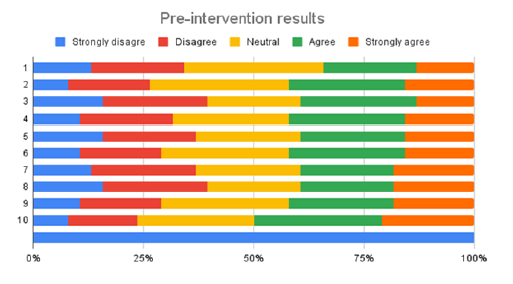
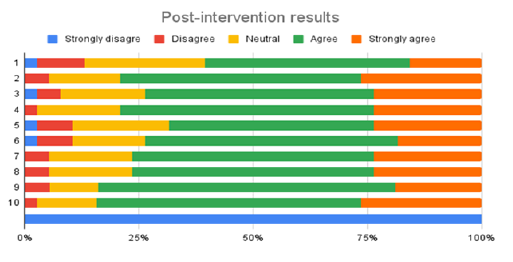
The relationship between pre-and post-intervention concerning the level of reflection skills in teachers of physical education was verified by applying paired t-tests. The null hypnosis stated that there would not be any difference between the pre- and post-study. The paired t-test results demonstrated a statistically significant difference between the pre-study (M = 2.54, SD = 0.21) and post-study (M = 3.94, SD = 0.37) measurements, t(9) = 16.47, p < 0.00001. These results indicate that there is a statistically significant difference between the pre-study and post-study measurements, with very strong evidence against the null hypothesis of no difference. Pre-intervention data on teachers' openness and desire to participate in collaborative reflection activities was collected using a Likert scale questionnaire. Overall, the results showed that teachers had a generally neutral attitude toward practices of collaborative reflection, with a mean score of 8.1 out of 25. Given that the standard deviation was 2.7, there was a sizable variation in the answers. The results specifically showed that most teachers (mean score of 3.6) do not regularly listen to their colleagues' comments and ideas when reflecting on their teaching techniques. The data also indicates that teachers were not able to collaborate effectively with colleagues when reflecting on their teaching practices (mean score of 3.6). The data implied that there was an opportunity for improvement in a few areas identification of areas for improvement, collaborative reflection, and discussions. The responses from the post-intervention indicate that participants' opinions toward collaborative reflective activities were positive. Particularly, the mean scores for questions 3, 4, 6, 7, and 8 were above 3.0, suggesting agreement or strong agreement with these claims. It is important to note that there is some variety in the answers, with the standard deviations for certain questions being higher than those for others. For instance, question 2's standard deviation is relatively high at 1.9, indicating that this question's replies varied more than the others. In terms of areas for improvement, it may be worthwhile investigating why there was more variation in replies to question 2 as well as why some participants showed lower levels of comfort or commitment to collaborative reflection (questions 1, 9, and 10).
The results of this study indicate that group reflection is a useful tool for teacher professional development as was noted by the majority of participants (n=35). However, the results of the discussion demonstrate that teachers (n=32) encounter several difficulties while participating in collaborative reflection, including time restraints, workload, a lack of support, a lack of trust, and opposition from coworkers. Some educators (n=18) mentioned the importance of teacher agency promotion while reflective collaborative practices. Moreover, it was noted by participants (n=27) that collaborative reflection also contributed to collegial support and leadership and teachers shared their insights on mentoring and coaching value for those who just entered the process of professional reflection. The key outcome of the discussion underscored the significance of providing sufficient resources, support, and chances for professional growth to enable efficient collaborative reflection processes at universities.
4. Discussion
The study highlights the importance of collaborative reflection skills for professional development in physical education and the effectiveness of the Gibbs Model for self-reflection. It suggests that programs on continuous development should emphasize the advancement of reflection skills. There are some special challenges directly affecting the professional practice of university-level physical education teachers. Situational aspects include the dynamic nature of research in sports science, the incorporation of technologies in teaching, and students’ variations in learning interests and abilities (Casey & MacPhail, 2018). In addition, there should be a balance between maintaining the academic standards and skills improvement of learners and the question of large group classes and frequently - limited resources. Thus, for those challenges to be overcome, the element of continuous professional development has to be put into focus. Continuous professional development for physical education teachers, in addition to the sophisticated and current aspects of the subject, includes updating their pedagogy, becoming interdisciplinary, and promoting students’ interest (Armour et al., 2017). Nonetheless, the current and conventional CPD methodologies do not adequately address these pluralistic requirements. This is in line with the present study, which aimed at integrating Gibb's (1988) model of reflection with Glatthorn’s (1990) collegial growth frameworks for professional growth. Incorporating such forms of metacognition allows physical education teachers to better address the professional issues they face; at the same time, it fosters the ongoing enhancement of their practice (Goodyear & Casey, 2015).
Additionally, professional development programs should provide opportunities for teachers to engage in reflection activities and use models like the Gibbs Model to guide their reflection. Gibbs model is a widely used framework for self-reflection and critical thinking in various professional fields, including physical education teaching (Brown et al., 2021). The model provides a structured approach for teachers to reflect on their practice, identify areas for improvement, and plan strategies for development (Markkanen et al., 2020). By integrating Gibb's model into their practice, physical training teachers can develop a more reflective and critical approach to their teaching. They can use the model to analyze and evaluate their practice, identify areas for improvement, and develop strategies for professional development. Over time, this reflective practice can help teachers improve their teaching skills, enhance student learning outcomes, and contribute to their ongoing professional development.
The results presented through the Likert scale demonstrate the improvement of reflection skills. The majority of teachers agreed with the statements “ I can give constructive feedback to my colleagues when reflecting on their teaching practices,” “ I can identify areas for improvement in my teaching practices through collaborative reflection with colleagues,” and “I believe that collaborative reflection can positively impact teaching practices and student outcomes.” Our conclusions are in line with those of researchers Sekarwinahyu et al. (2019), who highlight the efficiency of the Gibbs reflection cycle. We consider that such results were possible due to the integration of the Gibbs model into reflective practice. This reflective tool is clear and well-structured, focuses on changes and actions, and suggests a multi-perspective approach because teachers have to consider multiple perspectives, including their own colleagues and students. This approach leads to a deeper understanding of teaching practice and creates a more inclusive and collaborative learning environment. Moreover, Gibbs model encourages ongoing reflection that contributes to lifelong professional development. As confirmed by the findings of the focus group discussion, collaboration can be highly beneficial when using Gibbs' reflective cycle because it provides multiple perspectives on the same situation. The connection between Glatthorn's collaborative reflective practice and Gibb's model for physical education teachers is that both approaches emphasize the importance of reflection and collaboration to improve teaching practice. By working together and using a structured approach to reflection, physical education teachers can develop a deeper understanding of their practice, identify areas for improvement, and implement changes to enhance the learning experiences of their students (Mohamed et al., 2022). When educators collaborate on reflection, they share their experiences and interpretations of a particular event or situation, which can help to enhance the reflective process.
Through collaboration, teachers also learn from each other's experiences and gain new insights into their own experiences. For example, when working in a collaborative focus group discussion, participants took turns sharing their experiences related to a particular situation and discussed each person's perspective using the Gibbs model as a guide. Through this process, participants can gain a deeper understanding of their own experiences and those of others, and they can use this understanding to inform their practice (Marshall et al., 2022). In addition, collaboration can also provide support and accountability, which are both important components of professional development. However, we have to admit that not all stages of the Gibbs cycle require collaborative interventions. Such stages as description, feelings, and conclusions require personal consideration and perception of own mistakes, challenges, and emotions. Therefore, in our opinion evaluation, analysis, and action plan can be enhanced with collaborative practices. The following outline delineates how collaboration can be integrated into the professional development of physical education educators:
Description: The educator gives detailed information regarding a particular physical regimen or workout session, encompassing crucial aspects such as the ambiance, goals, and extent of student involvement.
Feelings: The present study involves an analysis of the educator's affective factors towards the activity at hand, encompassing their level of involvement, the degree of learner involvement, and any potential obstacles or challenges encountered during the instructional session.
Evaluation: In order to extend understudy learning and engagement, the educators evaluate the activity's adequacy, taking into consideration both what went well and what might have been done unexpectedly. To back their assessment, they may depend on data from understudy comments or execution information.
Peer observation (collaborative activities): Instructors can work together by watching each other's classes and giving each other input on their direction techniques. This could help teachers assess their instruction and pinpoint ranges for advancement.
Analysis: Collaborative reflection sessions provide a forum for teachers to engage in a collective process of introspection, where they can share their reflections and engage in meaningful discourse surrounding their respective teaching experiences. Educators can potentially experience advantages by exchanging information and acquiring novel perspectives concerning their instructional methods.
Collaborative reflection sessions: Upon conducting an examination and critical scrutiny, the instructor formulates well-informed opinions regarding the acquired knowledge and the measures that ought to be implemented to augment their professional performance. Furthermore, it is imperative to contemplate any moral or ethical inquiries that may arise as a result of engaging.
Conclusions: The educator conducts a comprehensive scrutiny of the task, considering the fundamental factors contributing to any challenges or achievements. Teachers may need to take into account their preconceptions or biases as well as possible external factors that could impact their decision-making.
Action plan: An action plan is developed by the teacher after reflecting upon their instructional practices, intended to facilitate desired changes. Teachers can devise strategies regarding the surveillance and evaluation of their advancement, determine the necessary assistance and resources, and establish objectives. Educators in question may also identify prospects for sustained professional development, including participation in workshops or collaboration with other educators specializing in physical education.
Collaborative activities:
Joint lesson planning: Teachers can work together by discussing teaching methods and organizing lessons together. This can aid teachers in reviewing their techniques of instruction and learning fresh ones from their peers.
Professional learning communities: Teachers can create these groups to work together and share resources, concepts, and best practices.
Co-planning and co-teaching: Lesson planning and delivery can be done collaboratively by teachers.
Mentoring: Experienced educators can help inexperienced educators by offering advice and support for their professional growth. In turn, the university develops a culture of cooperation and support.
Online collaboration: Teachers can communicate ideas, share materials, and give each other feedback using online collaboration technologies. This promotes cross-locational and time-zone collaboration among teachers and can present opportunities.
In the realm of pedagogy, the act of engaging in professional reflection stands as an integral component in the trajectory of continued and sustained professional advancement for educators. Educators are capable of critically introspectively evaluating their instructional methodology, identifying specific domains that require improvement, and augmenting their competencies by engaging in reflective practices. This undertaking will enable them to enhance their effectiveness in catering to the learning requirements of their students (Markkanen et al., 2020). However, the participants in the focus group discussion mentioned that the process of reflection posed significant challenges, particularly for educators. A major impediment to engaging in professional reflection pertains to temporal limitations. Owing to their demanding schedules, educators often face a dearth of opportunities for introspection and assessment. Moreover, educators may encounter a heavy workload that could potentially exhaust them, limiting their ability to engage in professional contemplation. To overcome the challenge, institutions of higher education can allocate a dedicated period within routine faculty assemblies, professional enrichment sessions, or deliberate contemplative periods. Educators can enhance their engagement in the process of reflective practice and cultivate ingrained habits thereof by giving due precedence to dedicated reflection time. Insufficient encouragement from colleagues or managerial personnel presents an impediment to the process of professional introspection. Educational institutions can foster a culture of collaborative and supportive practices by affording educators opportunities for mutually beneficial involvement in collaborative initiatives, such as idea exchange and constructive feedback mechanisms. The establishment of a nurturing peer community can result in a heightened sense of comfort among educators in the dissemination of their reflections, leading to increased receptiveness towards modifications in pedagogical practices. The process of professional reflection may experience substantial hindrances due to opposition posed by colleagues. Certain educational professionals may exhibit resistance toward change and demonstrate reluctance to engage in the process of reflection. Institutional support and training, with an emphasis on elucidating the benefits of engaging in professional reflection, as well as proffering appropriate resources and methodologies for undertaking this practice, should be made readily available to university students. In essence, academic institutions can help teachers surmount the challenges hindering effective professional reflection through the provision of adequate time, support, trust, and training. Ultimately, by prioritizing reflection, universities will create a culture of continuous learning and growth, benefiting both teachers and students.
Collaborative reflection strategies may offer educators the chance to gain a sense of efficacy by engaging in conversation about their experiences, ideas, and issues with others, which is why they are associated with teacher self-efficacy (Saienko et al., 2020). Teachers who conduct collaborative reflection can have a better grasp of their abilities and opportunities for growth as well as gain insight from the opinions and experiences of their colleagues. It leads to greater confidence in abilities to effectively teach students and positively impact learning outcomes.
The development of reflective abilities and continuous professional development for physical education instructors is improved by collaborative reflection as it gives physical education teachers more freedom to pursue their professional development, which is one of its main advantages. Teachers can identify their own needs and take control of their learning by working with colleagues to identify their areas of strength and weakness. Additionally, group reflection gives teachers more control over their professional development. Teachers can choose the tactics and strategies that are most pertinent to their requirements by collaborating with peers who have similar interests or objectives. This individualized method of professional development can result in improved learning outcomes as well as engagement and motivation. Collaboration among teachers is fostered by collaborative reflection, and this can improve the quality of teaching and learning. Teachers can cooperate on lesson planning and evaluation, share resources and ideas, and offer support and feedback to one another by working together. As a result, the teaching team may become stronger and more efficient, and the teachers may experience support and value.
Conclusion
For physical education teachers to advance professionally, reflection skills are essential, and using the Gibbs Model for self-reflection contributes to this process. The study suggests that professional development and teacher education programs should emphasize reflection activities and employ powerful self-reflection models. The Gibbs model of reflective practice, in combination with Glatthorn's collegial growth theory, benefits physical education teachers' Continuous Professional Development in several ways: improved self-reflection, better planning and preparation, enhanced students’ academic outcomes, and cultivating the culture of ongoing professional development. The small sample size and possible bias in the self-reported data are two major limitations of this study. The study can also be constrained by how generalizable the findings are to other situations. Examining the long-term effects of collaborative reflection on teacher practice and student results is a promising area for future research. Studies could examine how collaborative reflection affects the transfer of reflective skills and CPD to classroom practice and how this affects student learning and engagement.
Author contributions
Conceptualization, N.M. and Y.L.; data curation, N.M.; formal analysis, F.Z.; investigation, Y.L.; methodology, Y.L. and N.M.; project administration, F.Z.; resources, F.Z.; software, Y.L.; supervision, N.M.; validation, N.M.; visualization, Y.L.; writing-original draft, N.M. and Y.L.; writing-review and editing, Y.L.

