




 Inglês (pdf)
 Artigo em XML
 Referências do artigo
 Tradução automática
 Enviar este artigo por email
 Citado por SciELO
  Similares em
SciELO
Similares em
SciELO 
 Permalink

Introduction
Photobiomodulation (PBM) uses precise wavelength LED lights or low-level laser radiation to stimulate cellular and tissue responses (DiPalma et al., 2023). PBM is a well-tolerated, non-invasive technique with minimal adverse effects. This, paired with the quick post-operative recovery period, has aided the diffusion of PBM across multiple disciplines and patient populations, notably patients with special needs and pediatric patients (da Silva et al., 2010). Scientists' interest in PBM is most likely driven by an increasing interest in laser technology for medicinal uses, particularly in improving analgesics, healing processes, and other treatments (John et al., 2020).
PBM primarily interacts with porphyrins on the cell membrane and cytochrome c-oxidase in the mitochondrial electron transport chain (Tafur & Mills, 2008). These receptors absorb light photons, which activate the electron transport chain, trigger reactive oxygen species to convert ADP to ATP, and temporarily release nitric oxide from its binding site on cytochrome C oxidase, boosting cell respiration (de Freitas & Hamblin, 2016). In addition to direct tissue irradiation, PBM has numerous secondary and tertiary effects, such as improved lymphatic flow, activation of fibroblasts, osteoblasts, odontoblasts, and endorphins, reduced nerve fiber depolarization, and control of inflammatory mediators (Asan et al., 2021).
PBM offers a non-invasive therapy option for dental practitioners (Dompe et al., 2020). It can be used in conjunction with current therapies or as a standalone treatment (Nammour et al., 2021). PBM is widely used in dentistry to treat dental analgesia, dentine hypersensitivity, soft tissue healing, post-surgical pain and swelling reduction, implant bone integration, and orthodontic tooth movement (Dompe et al., 2020).
Despite the well-established stimulatory functions of PBM, several uncertainties remain regarding its diverse applications in dentistry. There is a lack of consensus on optimal treatment parameters, long-term clinical efficacy, and standardized protocols for its use across various dental conditions. These gaps hinder the broader integration of PBM into routine clinical practice (Dompe et al., 2020). Comprehensive investigations on the applications of PBM in dentistry can significantly improve clinical outcomes and patient satisfaction (Rodriguez Salazar et al., 2023). This bibliometric analysis aims to map the landscape of PBM research in dentistry, focusing on identifying emerging trends, key contributors, and thematic areas. By examining the existing literature, the study seeks to address these uncertainties and highlight the gaps that remain in our understanding of PBM’s full potential in dental care. Ultimately, this review aims to provide insights that will guide future research and inform clinical practice, advancing the application of PBM in dentistry.
1. Methods
The bibliometric methodology employed in this study provides a comprehensive overview of the research trends in PBM applications within dentistry. The analysis utilized VOSviewer, a powerful tool for visualizing and analyzing bibliometric networks, which allows for an in-depth exploration of publication trends, key authors, journals, and thematic areas. The use of VOSviewer enabled the creation of visual maps that help to identify and interpret patterns and connections within the body of literature. The study was conducted using data retrieved from the Scopus database. The analysis covered publications spanning a 21-year period from 2002 to 2023. The time frame was selected to capture the evolution of PBM research over the past two decades. This period reflects a significant growth in the use and investigation of PBM in dental care, coinciding with advancements in laser technology and the increasing recognition of PBM's therapeutic potential. By focusing on publications from 2002 onwards, the analysis ensures a balanced representation of both the foundational studies and the more recent developments in the field, offering a comprehensive view of the progression of PBM research in dentistry. The data collection and analysis were performed using digital tools and software to systematically extract and evaluate bibliometric indicators.
Research questions
The following research questions were addressed by the current bibliometric analysis:
How often are papers about the use of PBM in dentistry published and cited?
How often do different nations collaborate and participate in the publication of articles on the application of PBM in dentistry?
What is the author co-citation network of the leading scholars who have contributed to studies on PBM use in dentistry, and who are they?
Which author keywords appear most frequently in published literature about PBM's uses in dentistry?
Which prestigious journals have published articles about the applications of PBM in dentistry?
Search strategy
The Elsevier Scopus database was selected as the source for literature searches on the study topic due to its extensive coverage and diverse range of indexed items, surpassing other databases (Martín-Martín et al., 2018; Pranckutė, 2021). Scopus contains over 70% more sources than the Web of Science (WoS) (López-Illescas et al., 2008). Google Scholar was not used since its search results were inconsistent and it used less stringent indexing procedures than WoS and Scopus (Yang & Meho, 2007).
The Scopus database was searched electronically starting with the earliest data and ending on December 31, 2023. The search strategy utilized the Boolean operators “OR” and “AND” to combine the keywords, resulting in the query: (“photobiomodulation” OR “low-level laser therapy” OR “PBM” OR “phototherapy” OR “laser”) AND “dentistry,” ensuring a comprehensive retrieval of relevant literature. The keyword search was confined to the term's appearance in the abstracts, titles, and keywords of each publication. Once documents were found during the first search, the search was refined by restricting its parameters to the inclusion and exclusion criteria, as listed below.
Inclusion and Exclusion Criteria
An article had to be about dentistry and published in an English-language publication in order to be considered for the review. Articles that didn't fit the first two requirements for inclusion were excluded.
Data extraction and cleaning
Initially, 428 records were identified through a search in the Scopus database. After applying the search parameters, 428 records were retained. Subsequently, 17 records were excluded based on predefined criteria. Following data cleaning, 411 records were considered, and after assessing the titles and abstracts for eligibility, 12 records were excluded. Ultimately, 399 studies met all inclusion criteria and were included in the bibliometric analysis. A flowchart illustrating the search process, based on the Preferred Reporting Items for Systematic Reviews and Meta-Analyses (PRISMA) statement, is provided in Figure 1 (Tricco et al., 2018).
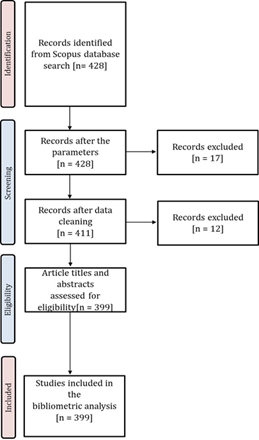
Figure 1 PRISMA flow diagram showing the flow of the search in the identification and screening of sources for the bibliometric analysis
Using the previously mentioned search parameters and the advanced search feature, the documents were identified. A data cleaning technique was performed to confirm any missing or wrongly entered information. This method involved two unique steps: (i) verifying by cross-checking the data in the columns that the field titles correspond to the data content of the fields, and (ii) checking the field (column) entries to make sure that no important information is missed (Ramirez et al., n.d.). As soon as an error was discovered, it was immediately removed.
Following confirmation of the final data set, the list was arranged from highest to lowest citation count. Citations per publication (CPP) was calculated by dividing the total number of citations received by all publications by the total number of publications, providing an average citation count per publication. The following details were downloaded: author(s), author(s) ID, title, year, sources (journal title), volume, issue, times cited, link, abstract, author keywords, and publisher information for further analysis in this study.
Data analysis
This review analyzed bibliographic data from Scopus database publications on PBM applications in dentistry to describe their characteristics. This information contains the year of publication, amount of citations, contributing and collaborating countries, contributing researchers, author keywords, and contributing journals. In addition, the total number of articles was included to supplement the findings.
In this study, citation analysis, co-authorship between countries, co-citation of cited authors, and keyword co-occurrence were studied using VOSviewer software (van Eck & Waltman, 2014). Additionally, graphs showing trend analysis for the rise in highly referred publications and their geographic distribution were made using Microsoft Excel. VOSviewer creates distance-based maps used in bibliometric investigations (van Eck & Waltman, 2010). A 'thesaurus file' was created and used in keyword co-occurrence analysis to get rid of duplicate terms.
VOSviewer also visualizes bibliometric networks (van Eck & Waltman, 2014). To interpret the software's outputs, bibliometric networks' nodes and edges are required. Van Eck and Waltman state that the following things need to be taken into account while discussing nodes and edges:
The size of the circles, or nodes, represents the frequency of various entities, like the quantity of publications or citations;
The distance between nodes shows how related they are to one another (nodes that are near to one another are more related);
edges show the strength of the relationship and the relationship between two nodes; and
The color of a node represents its category.
A collection of entities that are closely related to one another are represented by the colors (van Eck & Waltman, 2017).
Results
The pattern of publications and citations
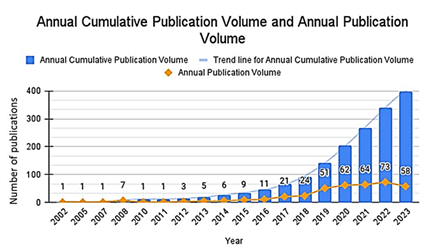
Annual changes in the published literature reveal a quantifiable trend of research and advancement in any area (Snyder, 2019). Between 2002 and 2023, 399 studies on the applications of PBM in dentistry were published. The cumulative and annual publication volumes showed an overall rising trend as depicted in Figure 2, indicating an increase in interest among scholars in the area. The graph shows a consistent increase in publications over time, with one article in 2002 and 58 by 2023.
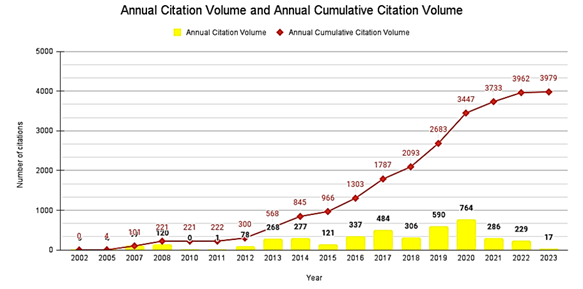
The cumulative citation volume exhibited an overall upward trend. The maximum annual citation volume was achieved in the years 2019 (n = 590) and 2020 (n = 764), following which there has been a downward slope. The annual and cumulative citation volume from 2002 to 2023 is depicted in Figure 3.
International contributions and collaborations
Among the 1264 organizations that have published relevant articles, 64 have produced more than one publication. The International Network for Photomedicine and Photodynamic Therapy, Universal Scientific Education and Research Network, Tehran, Iran produced the majority of the articles (n = 11). Poznan University of Medical Sciences, Poznań, Poland, and North Carolina State University, North Carolina, USA had the largest number of citations (n=197). Aja University of Medical Sciences, Tehran (8 publications, cited 77 times) and Shahid Beheshti University of Medical Sciences, Tehran (5 publications, cited 14 times), were placed second and third, respectively. Table 1 summarizes the top 10 organizations with maximum publication output
Table 1 Top-10 organizations with maximum publication output
| Name of the organization | Number of publications | Total citations |
|---|---|---|
| International Network for Photo Medicine and Photo Dynamic Therapy (INPMPDT), Universal Scientific Education and Research Network (USERN), Tehran, Iran | 11 | 89 |
| Radiation Sciences Research Center, Laser Research Center in Medical Sciences, Aja University of Medical Sciences, Tehran, Iran | 8 | 77 |
| Laser Application in Medical Sciences Research Center, Shahid Beheshti University of Medical Sciences, Tehran, Iran | 5 | 14 |
| Laser Research Center of Dentistry, Dentistry Research Institute, Tehran University of Medical Sciences, Tehran, Iran | 4 | 19 |
| Department of Restorative Dentistry, School of Dentistry, Universidade Federal De Minas Gerais, Belo Horizonte, Brazil | 3 | 62 |
| Leicester School of Pharmacy, De Montfort University, Leicester, United Kingdom | 3 | 55 |
| Department of Periodontology, School of Dental Medicine, Stony Brook University, Stony Brook, NY, United States | 3 | 34 |
| Department of Periodontology, Dental Faculty, Laser Research Center in Medical Sciences, Aja University of Medical Sciences, Tehran, Iran | 3 | 32 |
| Biomaterials Unit, University of Birmingham, St Chads Queensway, Birmingham, United Kingdom | 3 | 9 |
| Department of Histology and Embryology, Poznan University Of Medical Sciences, Poznań, Poland | 2 | 197 |
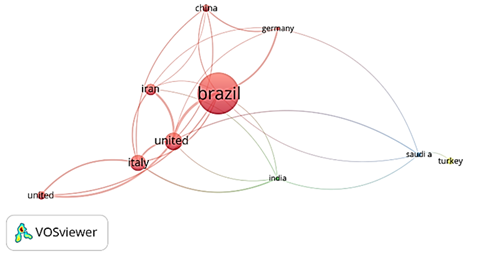
The top 10 nations for publications on PBM uses in dentistry are displayed in Table 2. Brazil (n=134) was the country that contributed the most number of publications, followed by Italy (n=52) and the United States of America (n=57). The collaboration network map of the top 10 nations in terms of co-occurrence counts is displayed in Figure 4. The network visualization illustrates the research collaboration between countries, with color coding indicating different clusters of association, where red represents Brazil, China, and Iran, green indicates the United States and India, and blue denotes Saudi Arabia and Turkey, with circle size reflecting the volume of publications. With a total link strength of 51, Brazil partnered with 26 countries, which is the largest amount of collaboration among the countries. Italy and the United States collaborated with the same number of countries (number of links = 25); however, the United States had a higher link strength (link strength = 66) compared to Italy (link strength = 54). This was followed by Iran (links = 18, link strength = 30) and India (links = 17, link strength = 19) in the fourth and fifth positions.
Table 2 The top 10 countries in terms of publications
| Country | Total Publications | Total Citations | Average citations |
|---|---|---|---|
| Brazil | 134 | 1339 | 9.99 |
| United states | 57 | 1019 | 17.88 |
| Italy | 52 | 601 | 11.56 |
| Iran | 37 | 284 | 7.68 |
| United Kingdom | 27 | 548 | 20.30 |
| China | 24 | 181 | 7.54 |
| Turkey | 23 | 210 | 9.13 |
| Saudi Arabia | 15 | 189 | 12.60 |
| India | 13 | 157 | 12.08 |
| Germany | 12 | 37 | 3.08 |
Contributing Researchers and Author Co-Citation Network
A total of 1818 authors contributed to the 399 publications on applications of PBM in dentistry. Two hundred and sixty-three authors had authored more than one publication. They were all accomplished and active authors in their specialty. The top 10 researchers with the most publications are shown in Table 3, along with their affiliations. From the table, it was evident that Dr Reza Fekrazad had authored the maximum number of publications (14 publications, cited 133 times). Of these 1818 authors, links to their contributions were present for 18 authors. It is evident that the co-authorship groupings fall into four different clusters. The network visualization illustrates author collaboration clusters, with green, blue, yellow and red indicating different research groups, while the size of the circles reflects the prominence or activity level of each author, and the connecting lines represent collaborative relationships between them.
Table 3 The top 10 researchers in terms of publications
| Authors | Total publications | Total citations | CPP | Affiliation |
|---|---|---|---|---|
| Reza Fekrazad | 14 | 133 | 9.50 | AJA University of Medical Sciences |
| Sandra Kalil Bussadori | 13 | 56 | 4.31 | Nove de Julho University - UNINOVE |
| Márcia Martins Marques | 10 | 167 | 16.70 | University of São Paulo |
| Maria Stella Moreira | 10 | 149 | 14.90 | University of Sao Paulo |
| Steven Parker | 9 | 120 | 13.33 | De Montfort University |
| Kristianne Porta Santos Fernandes | 9 | 41 | 4.56 | Nove de Julho University - UNINOVE |
| Paul R. Cooper | 7 | 184 | 26.29 | University of Otago |
| Eugenia Anagnostaki | 7 | 116 | 16.57 | De Montfort University |
| Mark Cronshaw | 7 | 114 | 16.29 | De Montfort University |
| Leila Gholami | 7 | 56 | 8.00 | Hamadan University of Medical Sciences |
CPP: Citations per publication
Keyword Co-occurrence Mapping
Of the 2215 keywords, 138 occurred more than five times. Of the 695 keywords, 51 occurred more than five times. The top 10 keywords that appeared in the majority of the publications are listed in Table 4. The keywords "photobiomodulation" (occurrences, 166; total link strength, 249), "photobiomodulation therapy" (occurrences, 54; total link strength, 73), "laser" (occurrences, 45; total link strength, 91), "low-level laser therapy" (occurrences, 44; total link strength, 92), and "low-level light therapy" (occurrences, 35; total link strength, 56) were the top five keywords by occurrence weight in the co-occurrence network visualization of the keywords (Figure 5).
Table 4 The top 10 keywords with their link strength and occurrences
| Keywords | Link strength | Occurrences |
|---|---|---|
| Photobiomodulation | 249 | 166 |
| Photobiomodulation therapy | 73 | 54 |
| Laser | 91 | 45 |
| Low-level laser therapy | 92 | 44 |
| Low-level light therapy | 56 | 35 |
| Dentistry | 68 | 24 |
| Diode laser | 43 | 19 |
| Laser therapy | 35 | 18 |
| LLLT | 26 | 15 |
| Low level laser therapy | 25 | 15 |
LLLT: Low-level laser therapy
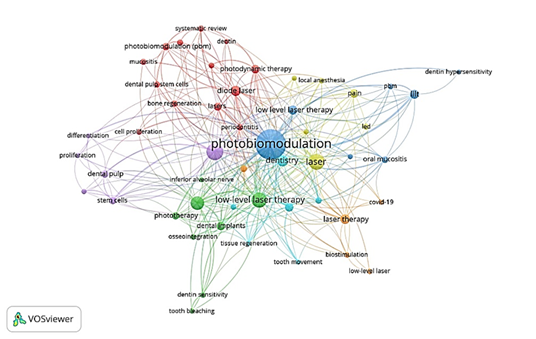
Figure 5 Co-occurrence network of the most frequently used author keywords. Each color represents a distinct group of concepts that frequently co-occur in the analyzed publications. Red indicates effects and applications of PBM related to stem cells, and bone regeneration, blue is focused on PBM, and green describes use of low-level laser therapy (LLLT) for dental implants, osseointegration and dentin sensitivity.
Key Journals
Additional research was conducted to identify and evaluate the top journals that published articles on PBM applications in dentistry. The results showed that papers are scattered among numerous journals. In particular, a total of 151 journals published relevant articles on applications of PBM in dentistry. Only 14 of these publications, meanwhile, have released more than five papers. The features of the top 10 journals are shown in Table 5 in ascending order based on the total number of articles for brevity.
Table 5 Top 10 journals with maximum publications and their characteristics
| Source Title | TP | TC | CPP | CiteScore | Q | h-index | SNIP | SJR | |
|---|---|---|---|---|---|---|---|---|---|
| Lasers in Medical Science | 52 | 516 | 9.92 | 4.4 | Q2 | 81 | 1.184 | 0.529 | |
| Photobiomodulation, Photomedicine, and Laser Surgery | 33 | 224 | 6.79 | 4.5 | Q3 | 19 | 0.927 | 0.439 | |
| Photodiagnosis and Photodynamic Therapy | 16 | 129 | 8.06 | 5.3 | Q2 | 59 | 0.965 | 0.633 | |
| Journal of Lasers in Medical Sciences | 12 | 123 | 10.25 | 2.9 | Q3 | 29 | 0.889 | 0.338 | |
| Lasers in Dental Science | 12 | 25 | 2.08 | 0.7 | Q3 | 6 | 0.258 | 0.168 | |
| Photomedicine and Laser Surgery | 11 | 324 | 29.45 | 4.5 | Q3 | 77 | 0.927 | 0.439 | |
| Journal of Photochemistry and Photobiology B: Biology | 10 | 93 | 9.30 | 13.4 | Q1 | 137 | 1.417 | 0.872 | |
| Progress in Biomedical Optics and Imaging - Proceedings of SPIE | 10 | 17 | 1.70 | 1.2 | Q3 | 60 | 0.208 | 0.209 | |
| Medicine (United States) | 8 | 40 | 5.00 | 2.9 | Q3 | 163 | 0.799 | 0.46 | |
| Clinical Oral Investigations | 7 | 84 | 12.00 | 6.3 | Q1 | 94 | 1.516 | 0.91 |
TP: Total publications; TC: Total citations; CPP: Citations per publication; SJR: SCImago journal rank; SNIP: Source-normalized impact per paper; Q: Quartile
As indicated in Table 5, the journal ‘Lasers in Medical Science’ had the most number of publications (52 publications, cited 516 times), followed by Photobiomodulation, Photomedicine, and Laser surgery (33 publications, cited 224 times), and Photodiagnosis and Photodynamic therapy (16 publications, cited 129 times). It is also evident that among all the above top journals, only three journals belong to the dentistry category (Lasers in Dental Science, Clinical Oral Investigations, and Dentistry Journal). The majority of the journals belonged to the Radiology, Nuclear Medicine, and Imaging category.
One of the most obvious findings from Table 5 is that two of the top 10 journals are classified Q1 by ScimagoJR, while two and six journals each are placed in Q2 and Q3, respectively. Next, we examined the source-normalized impact per publication (SNIP) ratings, which express the average number of citations received by a certain journal per paper as a proportion of the journal's potential for citations in the chosen field of study (Waltman et al., 2013). When a publication's SNIP score is more than one, it means that its average citation per article in the journal surpasses the potential for citation in the relevant field. In our analysis, five journals had an SNIP score of greater than one, indicating that these journals have a significant citation impact. The Journal of Photochemistry and Photobiology B: Biology, which ranked Q1, had the highest CiteScore of 13.4, while Progress in Biomedical Optics and Imaging - Proceedings of SPIE had the lowest CiteScore of 1.2.
Discussion
A bibliometric and visualization analysis was conducted on research articles published on the applications of PBM in dentistry. The findings reveal patterns of PBM usage in dental practice and research. Over the past 20 years, the number of publications has consistently increased. Lasers in Medical Science was identified as the most productive journal. The most prolific and well-known writer was Dr. Reza Fekrazad, who had 14 publications and 133 citations. Brazil and the International Network for Photomedicine and Photodynamic Therapy, Universal Scientific Education and Research Network, Tehran, Iran, were the most prolific nations and organizations, respectively. The main research forces in this subject were institutions and researchers from Brazil, Italy, and the United States; there was widespread and close international interaction.
Over time, the amount of literature has progressively expanded. Many researchers have dedicated their efforts to this specialized research topic, resulting in more meaningful scientific breakthroughs. The last 20 years' development trajectory revealed two phases: the first, from 2002 to 2016, had a slow rate of development, and the second, from 2017 to 2023, saw a rapid rate of development. This result suggests that there might be some important issues in this subject that have not yet been resolved. As a result, there is still room for research in this field; therefore, spending money on supplies and labor is worthwhile. This suggestion aligns with the clinical context. Despite a great deal of scientific research and some clinical uses over the past 20 years, PBM has not yet become a standard treatment or been extensively promoted. A more thorough investigation is required.
The dominant role of certain countries and institutions in PBM research is noteworthy. Brazil, in particular, stands out as a leader in the field, contributing more publications and researchers than other nations. This could be attributed to both substantial financial investments from local research foundations and the country's established academic infrastructure, particularly at institutions like the University of São Paulo and Nove de Julho University. The proximity of leading Brazilian researchers, such as Dr. Reza Fekrazad, to these institutions may have further fueled collaboration, fostering a concentrated research environment that drives PBM innovation. The strong presence of researchers from Italy, the United States, and Iran also underscores the importance of international collaboration in advancing the field. Such global partnerships have enhanced the breadth of research, with extensive cross-border cooperation that supports the maturation of PBM research in dentistry.
One of the most compelling aspects of this study is the role of collaboration networks in shaping the direction of PBM research (Castañer & Oliveira, 2020). Despite some countries and institutions having numerous international partners, their individual publication output remained modest, which may indicate emerging research forces that could gain prominence in the coming years. The collaborative networks suggest that research on PBM is increasingly interdisciplinary, with a blend of expertise from various scientific fields contributing to its development. As PBM applications continue to evolve, it is essential that international collaboration remains a priority, not only to bridge gaps in knowledge but also to foster the development of standardized treatment protocols that are universally applicable.
The most significant hotspots in the field over the previous 20 years, as determined by the collaboration analysis of keywords, were photobiomodulation, photobiomodulation therapy, laser, and low-level laser therapy. Keywords, a simplified version of article topics, are examined for co-occurrence to determine research directions and highlights (Su & Lee, 2010). It implies that for high-degree terms, the tendency for co-occurrence increases significantly (Radhakrishnan, Erbis, Isaacs, & Kamarthi, 2017).
Researchers may find it useful to use the journal analysis to select journals to submit their work to (Suiter & Sarli, 2019). In all, 151 journals released works in this area. The top ten journals with the highest number of articles published 42.85% of them. Six among the top 10 journals were ranked Q3. One of the most striking elements of the list is that publications published in journals with a low impact factor received significant citations. This suggests that citations depend less on the journal impact factor and more on the research topic's content and scientific "popularity" among scholars (Caon, Trapp, & Baldock, 2020).
Limitations
Only one database was used to conduct the literature search. While other databases, such as WoS, Dimensions, and PubMed, are valid sources, the SCOPUS database was chosen due to its extensive coverage. It is acknowledged that using data from a different database or a combination of databases could yield slightly different results. Additionally, while the search parameters were designed to focus on the topic of the investigations, it cannot be guaranteed that every publication was fully relevant. Self-reference bias was not considered in this study; however, it is believed that the study still provides valuable insights into the overall situation and progress in this field.
Future perspectives
Looking ahead, the use of PBM in dentistry is expected to develop further, with great opportunities for clinical and research breakthroughs. As this study shows, there is a growing corpus of literature on PBM, but important areas remain unexplored, including long-term clinical results and standardized treatment procedures. Future research should address these gaps, ensuring that PBM applications are tailored to varied dental diseases and patient populations. Furthermore, there is an opportunity for interdisciplinary collaboration to improve PBM techniques and integrate new technology into clinical practice, such as sophisticated laser systems and biomaterials. The increasing understanding of biological pathways in response to PBM may lead to more tailored and better treatments. Furthermore, investigating the role of PBM in conjunction with other therapy modalities may open up new possibilities for comprehensive dental care. Finally, a more standardized and evidence-based strategy will be required to incorporate PBM into ordinary dentistry treatment and improve patient outcomes.
Conclusion
This study highlights a significant increase in PBM research over the past 20 years, with key journals such as Lasers in Medical Science and Photobiomodulation, Photomedicine and Laser Surgery playing pivotal roles in disseminating important findings. Dr. Reza Fekrazad emerged as a leading contributor, and Brazil stood out as the most prolific country, with the International Network for Photomedicine and Photodynamic Therapy being a major institutional player. The United States, Italy, and Iran also made substantial contributions to the field. While international collaboration has been strong, the study identifies an opportunity for more effective coordination among authors, institutions, and countries to accelerate PBM advancements.
Looking ahead, the growing body of PBM research underscores its potential to revolutionize dental care, yet there are still key gaps that need to be addressed. These include optimizing treatment protocols, improving standardization across clinical practices, and exploring the long-term effectiveness of PBM in dentistry. To fully realize PBM’s potential, further collaboration across borders and disciplines will be essential. Future research should focus on harmonizing PBM applications in clinical settings and incorporating emerging technologies to enhance treatment outcomes. The findings from this study not only contribute to the scientific understanding of PBM but also lay the groundwork for future advancements that could shape the future of dental practices, making PBM a standard, non-invasive treatment option with broader, more effective clinical applications.
Authors' contribution
Conceptualization, R.M. and S.M.; data curation, R.M. and S.M.; formal analysis, R.M. and S.M.; investigation, R.M. and S.M.; methodology, R.M. and S.M.; project administration, R.M. and S.M.; resources, R.M. and S.M.; software, R.M.; supervision, S.M.; validation, S.M.; visualization, S.M.; writing-original draft, R.M.; writing-review and editing, S.M.

