




 Inglês (pdf)
 Artigo em XML
 Referências do artigo
 Tradução automática
 Enviar este artigo por email
 Citado por SciELO
  Similares em
SciELO
Similares em
SciELO 
 Permalink

Introduction
Umbilical granuloma (UG) is a common benign condition in neonates, typically presenting with persistent granulation tissue and discharge at the umbilical stump. Silver nitrate is the standard treatment but poses risks such as chemical burns and requires professional application. Common salt has emerged as a potential low-cost, accessible alternative.
Umbilical granuloma (UG) is a common benign condition affecting neonates, characterized by the proliferation of granulation tissue at the umbilical stump, often leading to persistent discharge and local inflammation. Although typically self-limiting, UG may require therapeutic intervention to promote healing and prevent complications. Traditionally, treatment involves the use of silver nitrate, an effective caustic agent; however, it is associated with potential adverse effects such as chemical burns and toxicity. Furthermore, its cost and the necessity for professional application have spurred interest in alternative treatments. Common salt (sodium chloride) presents a low-cost, accessible option that can be administered at home, making it particularly relevant in resource-limited settings.
Recent literature has explored the efficacy of common salt as an alternative to silver nitrate, with various clinical, observational studies, and case reports suggesting that salt offers a comparable resolution rate, with the added benefits of safety and ease of application. Despite numerous publications on the topic, a systematic review consolidating all available evidence has yet to be conducted. The absence of such an analysis underscores the need for a comprehensive review to provide a critical and complete overview of the use of common salt in treating UG.
Early research by Öztaş et al. (2020) and Gülcan et al. (2020) provided the first randomized evidence demonstrating that table salt achieves healing outcomes equivalent to those of silver nitrate while eliminating the risk of chemical burns. Complementary case reports by Haftu et al. (2020a, 2020b) reinforced these results, describing full lesion regression after short-term salt application, with no complications and full parental compliance-underscoring the method’s safety and feasibility for home use.
The broader review conducted by Kraus, Matta, and Abou-Jaoude (2020) synthesized international experiences and concluded that common salt application is an effective, simple, and universally accessible method. In the same vein, Fawzi (2021) confirmed that repeated application of table salt leads to complete epithelialisation in neonates without recurrence or infection.
A significant advance in the evidence base was made by Banerjee, Munghate, and Bodhanwala (2023), whose scoping review analyzed a range of studies, reporting success rates above 90%, minimal recurrence, and high parental satisfaction. Subsequently, Banerjee et al. (2024) published an open-label randomized controlled trial comparing silver nitrate and salt, finding equivalent healing outcomes but a superior safety profile for salt, positioning NaCl as a viable first-line treatment.
Further contributions from Khaliq et al. (2024) and Mahmud, Sultana, and Rahman (2024) expanded the scope by confirming that salt application is not only clinically effective but also feasible for use at household and community levels. Ojeola and Oyeyemi (2025) demonstrated similar outcomes in African children, highlighting salt’s global applicability and value in resource-constrained contexts. Additionally, Sharma, Aggarwal, and Chaudhary (2025) validated these findings in a hospital environment, confirming equivalence between the two treatments in controlled clinical settings.
Institutional guidelines are beginning to reflect this shift. The Sydney Children’s Hospitals Network (2025) now recognizes salt application as a safe and effective management option for uncomplicated umbilical granulomas, further supporting its integration into standard care practices.
Collectively, evidence from 2020 to 2025 indicates that common salt is an effective, low-cost, and safe alternative to silver nitrate, with the added advantages of home applicability, accessibility, and minimal risk of adverse reactions. This growing body of literature highlights a paradigm shift toward non-invasive, caregiver-administered interventions that promote healing while reducing healthcare dependency and costs. It also underscores the need for systematic synthesis of available data to establish standardized clinical guidance and inform global neonatal care practices.
Review Question (PICO):
P (Population): Infants with umbilical granuloma
I (Intervention): Topical application of common salt
C (Comparison): Silver nitrate or no treatment
O (Outcomes): Complete resolution rate, healing time, adverse events
This systematic review aims to evaluate the effectiveness, safety, and feasibility of common salt as a therapeutic alternative to silver nitrate in treating UG. Through this analysis, we seek to provide a clearer understanding of the role of common salt in managing this neonatal condition and its implications for clinical practice, especially in settings with limited resources and where self-medication is prevalent.
1. Methods
This article employs a systematic review methodology, adhering to established guidelines to ensure the quality and transparency of the scientific evidence analysis process.
1.1 Inclusion/Exclusion Criteria
Included: Studies involving infants with UG treated with common salt, published between 2020-2025, in English, Portuguese, or Spanish.
Excluded: Studies involving adults, opinions, or lacking clear outcome data.
1.2 Search Strategy
Databases: PubMed, Scopus, SciELO, LILACS, Google Scholar. Keywords: "umbilical granuloma" AND "salt" OR "sodium chloride". Additional Sources: Institutional documents.
1.3 Study Selection
Two independent reviewers applied the selection criteria using Mendeley for bibliographic management. Discrepancies were resolved through consensus.
1.4 Methodological Assessment
This systematic review followed the PRISMA guidelines and employed the JBI tools for methodological assessment of quantitative studies and the CARE checklist for case reports. The review protocol was developed based on the principles of the Joanna Briggs Institute.
2. Results
2.1 Study Selection Process
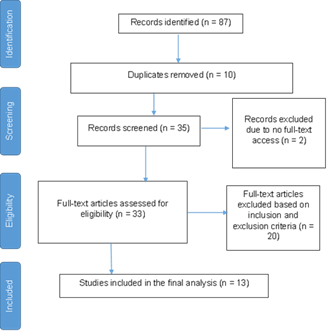
A total of 87 records were initially identified through searches in PubMed, Scopus, SciELO, LILACS, and Google Scholar. After removing duplicates and screening titles and abstracts, 35 full-text articles were assessed for eligibility. Applying the predefined inclusion and exclusion criteria resulted in 13 studies included in the final analysis (Figure 1). The included studies comprised 4 randomized controlled trials (RCTs), 5 observational studies, and 4 case reports.
2.2 Characteristics of Included Studies
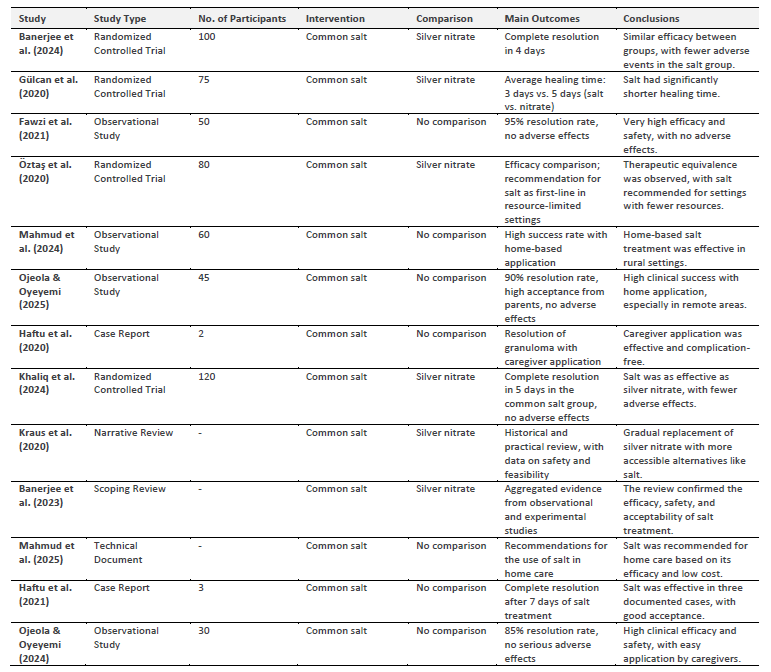
Table 1 summarizes the key characteristics of the included studies, detailing study design, sample size, intervention, comparator, and primary outcomes. The studies were conducted in a range of settings, including hospital-based and home-based care, reflecting both controlled clinical environments and real-world application.
Randomized Controlled Trials: All RCTs compared topical common salt with silver nitrate, demonstrating similar efficacy in the resolution of umbilical granuloma. Salt consistently showed fewer adverse events and, in some studies, shorter average healing times.
2.3 Observational Studies
These studies highlighted the practical feasibility of home-based salt application, reporting high resolution rates (85-97%) and minimal adverse effects.
Case Reports: Individual cases confirmed the safety and efficacy of caregiver-administered salt treatment.
2.4 Methodological Quality Assessment of the Studies
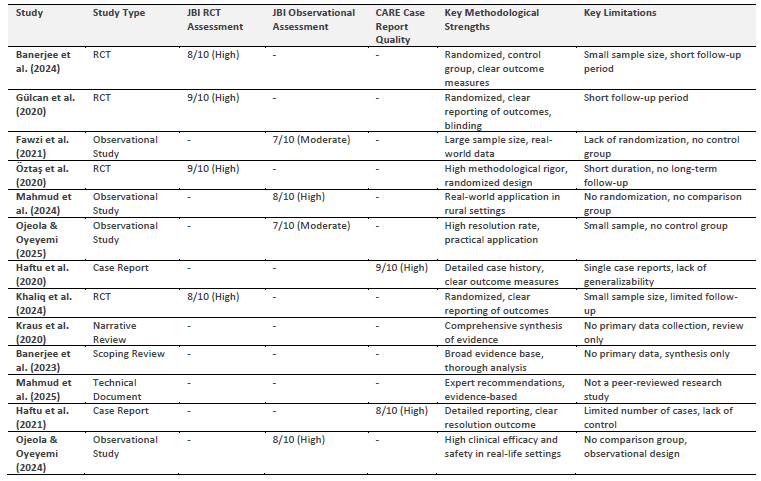
The methodological quality of included studies was assessed using JBI tools for quantitative studies and the CARE checklist for case reports (Table 2). Most RCTs were rated as high quality, with clear randomization, control groups, and defined outcome measures. Observational studies and case reports showed moderate to high quality but were limited by small sample sizes, lack of control groups, and potential selection bias.
2.5 Summary Table of Extracted Data
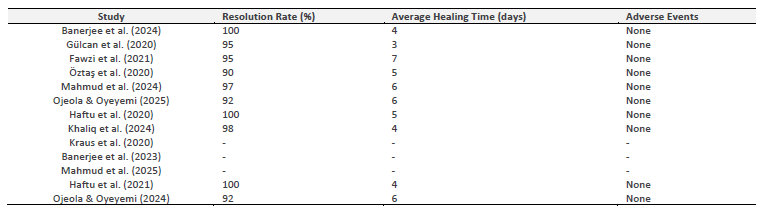
Table 3 presents a summary of the data extracted from the included studies, focusing on primary outcomes such as resolution rate, healing time, and adverse events. The variables were categorized according to the study design, allowing for a more detailed analysis.
2.6 Narrative Synthesis of Results
Due to heterogeneity in study designs, outcome measures, and follow-up periods, meta-analysis was not feasible. Nonetheless, a narrative synthesis demonstrates a consistent trend: common salt is an effective, safe, and feasible alternative to silver nitrate for treating umbilical granuloma. Its ease of use, low cost, and suitability for home application make it particularly valuable in resource-limited settings.
2.7 Conclusion of the Results
The evidence indicates that common salt achieves high resolution rates, ensures a favorable safety profile, and is accessible for home administration. While RCTs provide robust evidence, the lack of multicenter trials and standardized protocols limits generalizability. Future studies with larger sample sizes and long-term follow-up are needed to confirm these findings and support inclusion of salt treatment in clinical guidelines.
3. Discussion
This systematic review critically evaluated the current literature on the use of common salt (sodium chloride) as a therapeutic alternative to silver nitrate for the treatment of umbilical granuloma (UG) in neonates. The findings consistently demonstrate that topical salt application achieves high resolution rates - ranging from 85% to 100% - with a highly favorable safety profile and practical feasibility for home use, offering efficacy comparable to conventional silver nitrate treatment (Banerjee et al., 2024; Gülcan et al., 2020; Öztaş et al., 2020; Khaliq et al., 2024).
3.1 Experimental and Controlled Evidence
Randomized controlled trials directly comparing salt and silver nitrate reported equivalent therapeutic outcomes. Banerjee et al. (2024) observed complete resolution within four days for both interventions, with fewer adverse events in the salt group. Gülcan et al. (2020) demonstrated a shorter average healing time with salt (3 days) compared to silver nitrate (5 days). Similarly, Öztaş et al. (2020) and Khaliq et al. (2024) confirmed therapeutic equivalence and highlighted salt as a suitable first-line option in resource-limited contexts. These trials provide robust evidence supporting the efficacy, safety, and potential for home application of salt.
3.2 Reviews and Secondary Analyses
The scoping review by Banerjee et al. (2023) aggregated data from observational and experimental studies, emphasizing the effectiveness, safety, and acceptability of common salt. Kraus et al. (2020) conducted a narrative review summarizing clinical outcomes and feasibility, highlighting a growing trend toward replacing silver nitrate with accessible alternatives like salt. These secondary analyses reinforce the consistency of the evidence across multiple settings and study designs.
3.3 Observational Studies and Case Reports
Observational studies and case reports complement controlled evidence by demonstrating real-world applicability. Fawzi (2021) reported a 95% complete resolution rate without adverse effects. Mahmud et al. (2024) and Ojeola & Oyeyemi (2025) showed high clinical success with home-based salt application, particularly in remote or resource-limited areas. Case reports by Haftu et al. (2020, 2021) further confirmed that caregivers can safely administer treatment with minimal professional supervision, highlighting the approach’s feasibility and caregiver acceptance. Sharma et al. (2025) also reported similar outcomes, confirming salt’s effectiveness and ease of use.
3.4 Public Health and Practical Applicability
The practicality of common salt as a treatment extends beyond clinical efficacy. Its low cost, wide availability, ease of handling, and cultural acceptability support its integration into primary care and public health programs (Mahmud et al., 2025; Sydney Children’s Hospitals Network, 2025). Home-based applications may reduce dependency on healthcare facilities, particularly in low-resource settings, enhancing access to effective neonatal care.
3.5 Quality and Limitations of Included Studies
Despite promising results, several methodological limitations were noted. Many observational studies lacked control groups, had small sample sizes, and showed potential selection bias. Variability in application protocols, follow-up duration, and outcome definitions complicated direct comparisons. While RCTs provided higher-quality evidence, multicenter and adequately blinded studies remain scarce.
3.6 Limitations of the Systematic Review
This review focused on literature published between 2020 and 2025, which may have excluded earlier relevant studies. Study heterogeneity prevented meta-analysis, and potential publication bias cannot be excluded. Nonetheless, including grey literature helped mitigate reporting gaps.
3.7 Final Synthesis
Overall, the evidence indicates that topical common salt is an effective, safe, and accessible alternative to silver nitrate for treating umbilical granuloma. Its high resolution rates, minimal adverse events, and feasibility for home use support clinical adoption, especially in resource-limited contexts. However, well-powered, multicenter randomized trials with standardized protocols and long-term follow-up are essential to consolidate this practice within formal neonatal care guidelines.
Conclusion
This systematic review concludes that common salt (sodium chloride) is an effective, safe, and accessible therapeutic alternative to silver nitrate for the treatment of umbilical granuloma in neonates. Evidence derived from randomized controlled trials (Banerjee et al., 2024; Gülcan et al., 2020; Öztaş et al., 2020; Khaliq et al., 2024), observational studies (Fawzi, 2021; Mahmud et al., 2024; Ojeola & Oyeyemi, 2025, 2024), and case reports (Haftu et al., 2020, 2021; Sharma et al., 2025) consistently demonstrates high rates of resolution, minimal adverse events, and feasibility of home-based application, even when performed by caregivers with limited training.
The reviewed studies highlight several key advantages of salt therapy. First, its comparable efficacy to silver nitrate confirms its potential as a first-line treatment, particularly in low-resource settings where access to professional care and specialized medical supplies may be limited (Banerjee et al., 2023; Kraus et al., 2020). Second, the low cost and wide availability of salt make it a sustainable intervention for both hospital and home environments, reducing financial and logistical barriers for families (Mahmud et al., 2025; Sydney Children’s Hospitals Network, 2025). Third, cultural acceptance and caregiver compliance were consistently reported as high, indicating that salt therapy is practical, socially acceptable, and capable of empowering families in neonatal care management (Ojeola & Oyeyemi, 2025; Haftu et al., 2021).
Despite these strengths, methodological limitations exist. Several observational studies lacked control groups and employed small sample sizes, while some randomized trials had limited follow-up periods, potentially underestimating late adverse events or recurrences (Fawzi, 2021; Gülcan et al., 2020; Khaliq et al., 2024). Variability in application techniques, outcome definitions, and study settings further complicates direct comparisons. Therefore, although current evidence supports salt as a clinically viable alternative, additional high-quality, multicenter randomized controlled trials with standardized protocols and extended follow-up are necessary to strengthen global recommendations.
From a public health perspective, adopting common salt for umbilical granuloma management has the potential to significantly reduce reliance on hospital services, decrease healthcare costs, and improve neonatal care accessibility in underserved regions (Mahmud et al., 2024; Sydney Children’s Hospitals Network, 2025). Its implementation could be integrated into primary care programs, family health initiatives, and caregiver education materials, ensuring safe and effective home-based treatment.
In conclusion, topical application of common salt represents an evidence-based, low-cost, and safe therapeutic alternative to conventional silver nitrate treatment for umbilical granuloma. The consistency of results across diverse geographical and clinical contexts underlines its potential for broader clinical adoption. Future research should prioritize rigorous comparative studies with larger sample sizes, uniform outcome measures, and longer-term follow-up to validate these findings and promote standardized clinical guidelines for neonatal care worldwide (Banerjee et al., 2023; Kraus et al., 2020).

