




 Inglês (pdf)
 Artigo em XML
 Referências do artigo
 Tradução automática
 Enviar este artigo por email
 Citado por SciELO
  Similares em
SciELO
Similares em
SciELO 
 Permalink

Introduction
Mpox: from a re-emerging infectious disease to an outbreak
Mpox, or monkeypox, is a re-emerging zoonotic infection caused by a virus of theOrthopoxvirusgenus. Clinically, it is characterised by fever, lymphadenopathy and a progressive rash evolving from papules and vesicles to pustules and crusted lesions. Transmission occurs mainly through direct contact with skin lesions or body fluids, contaminated materials, and, in specific circumstances, through respiratory droplets during prolonged close contact (World Health Organization [WHO], 2025).
Historically restricted to Central and West Africa, Mpox gained international relevance in May 2022 when multiple non-endemic countries detected clusters of cases (European Centre for Disease Prevention and Control [ECDC], 2024). Between January 2022 and March 2025, more than 137,000 laboratory-confirmed cases and over 300 deaths were reported worldwide, demonstrating its potential for sustained human-to-human transmission (WHO, 2025). In July 2022, the WHO designated Mpox as a Public Health Emergency of International Concern, reinforcing the urgency of robust surveillance, timely diagnosis and strengthened prevention and control strategies (Eurosurveillance Editorial Team, 2024).
Mpox: relevance of nursing interventions during outbreaks
The International Council of Nurses (ICN) defines nursing as a profession committed to promoting health, safety and high-quality care through culturally safe, collaborative and person-centred approaches. Nursing practice integrates scientific knowledge, clinical expertise, ethical principles and therapeutic relationships grounded in social justice, contributing to the resilience and functioning of health systems (ICN, 2021).
During Mpox outbreaks, nurses play a central role in early case recognition, infection prevention and control (IPC), patient education and psychosocial support. These interventions are essential for limiting transmission and reducing morbidity (Sobaikhi et al., 2023). To perform these responsibilities safely, nurses require consistent access to personal protective equipment (PPE), updated clinical guidance and institutional support, including involvement in public communication and anti-stigma efforts (ICN, 2022).
Core nursing interventions directly contribute to outbreak containment and include appropriate PPE use, rigorous hand hygiene, patient isolation, environmental hygiene, safe waste management and systematic risk assessment (WHO, 2025). Nurses also ensure continuity of care for individuals requiring adapted interventions (such as people living with HIV, pregnant and breastfeeding women, and children). Their responsibilities extend to surveillance activities including symptom monitoring, accurate application of case definitions and participation in contact tracing, facilitating early outbreak detection and timely public health action (Gilmore et al., 2024; WHO, 2025). These activities align with WHO recommendations for enhanced surveillance, vaccination strategies, national preparedness plans, risk communication and equitable access to countermeasures (WHO, 2025).
Mpox: Nurses’ knowledge, attitudes, and practices
Understanding nurses’ knowledge, attitudes and practices (KAP) is fundamental for strengthening Mpox preparedness and response. The KAP framework is commonly used in public health to examine what individuals know, how they perceive a health threat and how they behave in relation to it (Jahromi et al., 2023). In nursing, KAP assessments highlight training needs, competency gaps and organisational barriers that may hinder effective IPC implementation (Jahromi et al., 2023).
Knowledge gaps or misconceptions regarding transmission, diagnosis, vaccination or IPC procedures may delay recognition of suspected cases or result in incorrect application of preventive measures. Attitudinal factors (such as fear of infection, low confidence in institutional preparedness or concerns about stigma) can also reduce engagement in outbreak control (Jahromi et al., 2024). Furthermore, limited PPE availability, inconsistent organisational guidance and scarce training opportunities negatively influence daily practice and adherence to IPC protocols (Sobaikhi et al., 2023; ICN, 2022).
Several studies show that, although nurses often demonstrate basic knowledge of Mpox symptoms and transmission, substantial gaps persist in diagnostic criteria, vaccination strategies and outbreak-specific IPC recommendations (Jahromi et al., 2024; Sobaikhi et al., 2023). These findings reinforce the importance of continuous education, accessible clinical guidelines and psychological support to ensure safe and high-quality care during infectious disease outbreaks (ICN, 2024). Strengthening nurses’ KAP is therefore essential both to protect health professionals and to prevent community transmission.
Given the expanding body of research on Mpox and its implications for nursing practice, synthesising the available evidence is necessary to guide policy development, educational planning and workforce preparedness. Scoping reviews allow mapping the extent, nature and characteristics of existing literature, identifying research gaps and informing strategies for future action (Peters et al., 2020). Although individual studies have explored nurses’ KAP regarding Mpox, the evidence remains dispersed and has not yet been synthesised comprehensively. Addressing this gap is important to consolidate current knowledge and support targeted training, organisational planning and policy development.
This scoping review was therefore guided by the following question: What are the knowledge, attitudes and practices regarding Mpox among nurses?
2. Methods
This scoping review was conducted in accordance with the Joanna Briggs Institute (JBI) methodology for scoping reviews. Its primary aim was to map the available evidence concerning nurses’ KAP regarding Mpox, identify existing knowledge gaps and inform future educational and policy strategies.
The PCC mnemonic (Population, Concept, Context) guided the inclusion criteria. The population included nurses regardless of specialty, role, or practice setting. The concept focused on knowledge, attitudes, and practices related to Mpox, while the context encompassed studies conducted in any geographical region.
An initial exploratory search was performed to identify relevant keywords and index terms. The final search strategy combined the following terms using Boolean operators: (mpox OR monkeypox) AND (knowledge OR attitudes OR practices) AND (nurses OR nursing staff OR nurse).
Searches were conducted between 1 and 3 September 2025 across five databases: Google Scholar, MEDLINE, B-On, ProQuest, and PubMed. Reference lists of included studies were also screened to identify additional relevant publications.
Studies employing quantitative, qualitative, or mixed-methods designs were considered eligible, along with systematic reviews and grey literature, provided that full texts were available in English, Spanish, or Portuguese. No publication date limits were applied due to the recent emergence of Mpox as a public health concern.
Two reviewers independently screened all records using Rayyan QCRI software. Titles and abstracts were reviewed in a blinded manner, and discrepancies were resolved through discussion or consultation with a third reviewer. Full-text articles were retrieved for studies deemed potentially eligible, and reasons for exclusion were recorded and presented in a PRISMA flow diagram.
Data extraction was independently carried out by two reviewers using a standardized form. Extracted data included study title, authorship, publication year, study design, population characteristics, objectives, and key findings.
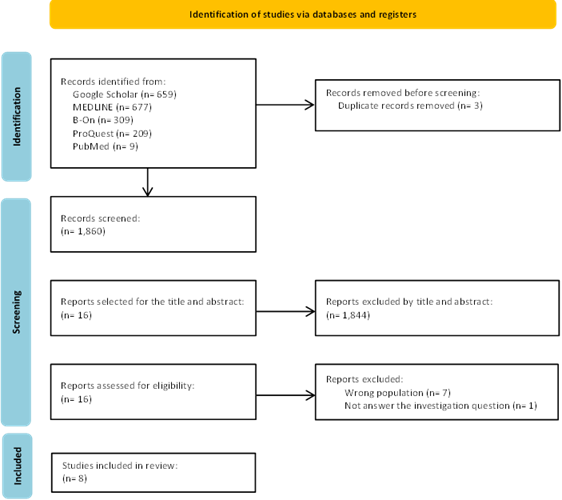
A total of 1,863 records were identified through database searching: Google Scholar (n= 659), MEDLINE (n= 677), B-On (n= 309), ProQuest (n= 209), and PubMed (n= 9). After removing 3 duplicates, 1,860 records remained.
A total of 1,860 records were screened by title and abstract, and 1,844 were excluded at this stage. This left 16 records for full-text retrieval.
All 16 full-text reports were successfully retrieved and assessed for eligibility. Following full-text assessment, 8 reports were excluded: 7 due to an ineligible population and 1 for not adequately addressing the research question. No additional records were identified through reference list screening.
Ultimately, 8 studies met the inclusion criteria and were included in the final review.
3. Results
All included studies were published between 2023 and 2025. Six studies employed cross-sectional survey designs primarily focused on assessing nurses’ KAP and preparedness regarding Mpox. Two additional studies used experimental approaches (one quasi-experimental and one pre-experimental) to evaluate the effectiveness of structured educational interventions, such as nano-teaching sessions, in improving nurses’ knowledge, attitudes and confidence in Mpox management.
Across studies, nurses constituted the primary population of interest and represented diverse clinical contexts. Participants included hospital-based nurses (e.g., in Turkey and Egypt), pediatric nurses, primary healthcare nurses, and other clinical practitioners whose specific work settings were not always specified. This variation reflects the essential and wide-ranging role of nurses in infectious disease outbreaks.
Geographically, the studies were conducted in Egypt, Bangladesh, China, Turkey and Saudi Arabia, representing lower-middle-income and upper-middle-income countries. This distribution demonstrates global concern regarding Mpox preparedness among nursing workforces and highlights the particular impact of outbreaks in regions where health systems face substantial strain.
Despite methodological diversity, consistent trends emerged across studies. Nurses generally demonstrated low-to-moderate knowledge levels, with recurring gaps concerning transmission routes, isolation procedures and diagnostic or triage criteria. Attitudes toward Mpox management were broadly positive, indicating willingness to learn, adhere to preventive measures and engage in outbreak response. However, discrepancies between attitudes and actual practices were evident. Adherence to recommended measures was strongly influenced by institutional conditions, including resource availability, access to training and clarity of protocols.
Systemic factors played a prominent role in shaping practice. Limited PPE availability, unclear organisational guidance and inconsistent training opportunities were frequently reported barriers. These factors contributed to variability in adherence to infection prevention and control recommendations, underscoring the need for strengthened institutional support and standardized clinical protocols.
The characteristics of the included studies (including authorship, publication year, study design, population, objectives and main findings) are presented inTable 1.
Table 1 Characteristics of the included studies
| Title, authorship and year of publication | Study type | Population | Objective | Main results and conclusions |
|---|---|---|---|---|
| Challenges and Counteracting Strategies Including Optimum Health Service Practices for Frontline Nurses During the Mpox Outbreak and Futuristic Vision (Ahmed et al., 2024) | Qualitative | Nurses | To assess challenges faced by nurses during the Mpox outbreak and propose strategies/health service practices. | Main challenges: lack of training, shortage of PPE, inadequate staffing, psychological support, and clear protocols. Recommendations: workshops, institutional policies, protective measures, psychosocial training. Protecting and empowering nurses requires education, correct use of PPE, peer support programs and clear communication of protocols. |
| Knowledge and Attitudes Toward Monkeypox (Mpox) Among Nurses in China: A Cross-Sectional Study (Gao et al. 2024) | Cross-sectional | Nurses in unspecified healthcare institutions (China) | To assess knowledge and attitudes regarding Mpox among Chinese nurses. | Findings: incomplete knowledge in specific areas; generally positive attitudes. Recommendations: improvement of practices and training. Suggested implementation of national/local training programs and screening protocols. |
| Effect of Monkeypox Nano-Teaching Sessions Versus Self-Learning on Nurses’ Knowledge, Attitude, and Confidence in Disease Diagnosis and Management (Ibrahim et al., 2024) | Quasi-experimental | Nurses at a university hospital (Egypt) | To assess effectiveness of nano-teaching sessions versus self-learning in improving knowledge, attitudes and confidence. | Nano-teaching sessions were more effective than self-learning in enhancing knowledge and attitudes in Mpox diagnosis and management. Highlights the importance of innovative educational strategies tailored to nurses’ clinical needs and patient outcomes. |
| Nurses’ Knowledge and Anxiety About Human Monkeypox Virus Infection: A Cross-Sectional Study (Karacan et al., 2025) | Cross-sectional | Nurses at the hospital and primary healthcare institutions (Turkey) | To assess nurses’ knowledge and anxiety levels related to Mpox. | Knowledge was variable; higher knowledge correlated with lower anxiety in some domains. Nurses with higher exposure or without prior training reported higher anxiety. Continuous education and institutional support are essential to reduce anxiety. |
| Evaluation of Nurses' Perception of Monkeypox in Terms of Epidemic Anxiety, Stress Levels, and Compliance With Isolation Measures (Kocatepe et al., 2025) | Cross-sectional | Hospital nurses (Turkey) | To assess perceptions, anxiety/stress levels and adherence to isolation measures. | High levels of anxiety were reported. Compliance with isolation measures correlated with perceived risk and prior training. Knowledge strongly influenced preventive behaviour. |
| Knowledge and Attitude Regarding Human Monkeypox Virus Infection Among Nurses: A Cross-Sectional Study (Rony et al., 2023) | Cross-sectional | Nurses in unspecified healthcare units (Bangladesh) | To assess knowledge and attitudes regarding Mpox. | Overall knowledge was low to moderate; attitudes were favourable (willingness to learn and follow measures). Gaps in practice were mainly due to lack of resources and training. Recommendations: educational programs, integration of Mpox into infection control training, and provision of PPE. |
| Are Pediatric Nurses Prepared to Respond to the Monkeypox Outbreak? (Sadek et al., 2024) | Cross-sectional | Paediatric nurses (Egypt) | To assess preparedness of pediatric nurses regarding Mpox. | Knowledge was variable; many reported lack of specific training and uncertainty about diagnosis/triage in paediatric. Attitudes were positive, but clinical confidence was low. Recommendations: tailored educational materials, simulations, and local protocols to improve readiness. |
| Knowledge and Attitude Regarding Monkeypox Among Saudi MOH Primary Healthcare Nurses in Jeddah: A Cross-Sectional Study (Theban et al, 2024) | Cross-sectional | Primary healthcare nurses (Saudi Arabia) | To assess knowledge and attitudes regarding Mpox. | Knowledge was low to moderate in specific areas (transmission, protocols). Attitudes were generally favourable. Gaps highlight the need for training. Recommendations: targeted education and local updates to improve PHC nurses’ response capacity. |
4. Discussion
This scoping review identified eight studies examining nurses’ knowledge, attitudes and practices (KAP) in relation to Mpox. Although the studies varied in setting, design and methodological quality, consistent patterns emerged regarding gaps in nursing education, perceived preparedness and the organisational conditions that influence clinical behaviours during emerging infectious disease outbreaks.
Across the included studies, nurses demonstrated limited to moderate levels of knowledge. While most participants were familiar with Mpox symptoms and general transmission modes, substantial gaps persisted in key areas such as diagnostic criteria, specific isolation procedures and triage protocols for suspected cases (Theban et al., 2024; Rony et al., 2023; Gao et al., 2024; Sadek et al., 2024). The variation observed between countries and practice settings suggests that Mpox and other emerging infections are not yet systematically integrated into nursing curricula or continuous professional development programmes. These findings are consistent with broader literature indicating that insufficient foundational knowledge undermines outbreak readiness and contributes to uncertainty among frontline healthcare workers (Sobaikhi et al., 2023).
Nurses’ knowledge of Mpox
Across the included studies, nurses demonstrated limited to moderate knowledge levels, with variability across countries and clinical contexts (Theban et al., 2024; Rony et al., 2023; Gao et al., 2024; Sadek et al., 2024). While most participants were familiar with common symptoms and general transmission modes, substantial gaps were noted in diagnostic criteria, isolation procedures and triage protocols for suspected cases.
These findings suggest that Mpox and other emerging infections have not yet been fully integrated into nursing curricula or continuing professional development programmes. This aligns with broader evidence showing that insufficient foundational knowledge undermines outbreak preparedness and increases uncertainty among frontline healthcare workers (Sobaikhi et al., 2023).
Structured training emerged as an important factor. In China, nurses with previous emergency or IPC training demonstrated higher preparedness for Mpox (Gao et al., 2024). In Egypt, nano-teaching sessions significantly improved knowledge and readiness compared to self-learning strategies (Ibrahim et al., 2024). These findings reinforce WHO recommendations advocating regular and context-sensitive training to strengthen outbreak preparedness (WHO, 2023; WHO, 2025).
Nurses’ attitudes towards Mpox
Despite knowledge deficits, nurses consistently expressed positive attitudes toward Mpox prevention and control. Participants showed willingness to learn, adhere to preventive measures and contribute to containment efforts (Theban et al., 2024; Rony et al., 2023; Gao et al., 2024). These favourable attitudes provide a strong basis for capacity-building initiatives.
However, positive attitudes did not always translate into confidence in clinical decision-making. Paediatric nurses, for example, reported limited confidence when managing suspected Mpox cases due to insufficient paediatric-specific protocols and inadequate training (Sadek et al., 2024). Psychological factors also played an important role. Limited training and unclear institutional guidance were associated with higher anxiety and stress, whereas greater knowledge was linked to reduced anxiety and stronger professional confidence (Karacan et al., 2025; Kocatepe et al., 2025).
WHO guidance emphasises that reinforcing positive attitudes requires transparent communication, accessible protocols and psychosocial support to help maintain motivation and reduce misinformation-related anxiety (WHO, 2023; WHO, 2025).
Nurses’ practices in response to Mpox
Although nurses reported motivation and willingness to implement recommended measures, actual adherence to infection prevention and control (IPC) behaviours varied across settings. Inconsistencies were observed in PPE use, patient isolation procedures and implementation of diagnostic processes (Ahmed et al., 2024; Kocatepe et al., 2025).
These inconsistencies were largely influenced by systemic rather than individual factors. Nurses frequently reported limited PPE availability, unclear or frequently changing protocols, inadequate institutional guidance and restricted access to training opportunities. These organisational constraints are consistent with evidence from other infectious disease emergencies, where structural conditions strongly shape clinical behaviour (Jahromi et al., 2024).
Qualitative findings also underscored the importance of supportive organisational environments. Nurses described inconsistent communication from health authorities, limited emotional support and restricted access to essential resources, all of which hindered the application of safe practices (Ahmed et al., 2024).
Intervention studies demonstrated that targeted educational approaches, such as nano-teaching sessions, can enhance knowledge, confidence and preparedness. However, without supportive institutional infrastructures, educational interventions alone are insufficient to ensure sustained adherence to IPC guidelines.
Across the domains of knowledge, attitudes and practices, a clear pattern emerged. Nurses showed motivation and willingness to engage in outbreak response, but knowledge gaps and systemic barriers hindered consistent implementation of recommended measures. Preparedness therefore requires an integrated approach that encompasses educational reinforcement, psychological support and organisational strengthening.
Embedding emerging infectious disease content into nursing education, providing stable and clear IPC protocols, ensuring adequate access to resources and cultivating supportive working environments are fundamental for improving preparedness and strengthening the resilience of health systems facing current and future outbreaks.
Evidence strengths and limitations
The current evidence presents several methodological limitations. Most of the included studies employed cross-sectional designs, which restrict the ability to establish causal relationships and to assess long-term knowledge retention (Gao et al., 2024; Karacan et al., 2025; Kocatepe et al., 2025; Rony et al., 2023; Sadek et al., 2024; Theban et al., 2024).
Measurement instruments were heterogeneous and, in some cases, lacked formal validation, while the frequent use of convenience sampling reduced representativeness and limited the generalizability of findings. Additionally, the scarcity of qualitative research constrained a deeper exploration of nurses’ perceptions, motivations, and lived experiences related to Mpox.
Despite these limitations, intervention studies offered more robust and actionable evidence. For instance, in Egypt, nano-teaching sessions were shown to be more effective than self-learning in improving nurses’ knowledge, attitudes, and confidence in Mpox management (Ibrahim et al., 2024).
Likewise, other structured educational interventions emphasized the potential of targeted training programs to strengthen preparedness and foster positive attitudes toward infection prevention and control (Ahmed et al., 2024).
Conclusion
This scoping review synthesised current evidence on nurses’ knowledge, attitudes and practices regarding Mpox. The findings indicate that, although nurses demonstrate strong motivation and positive attitudes toward infection prevention and patient safety, important limitations persist in their knowledge and preparedness. These gaps reflect the incomplete integration of emerging infectious diseases into nursing education and the insufficient availability of structured and context-specific training opportunities.
In clinical practice, nurses’ willingness to follow recommended measures was often constrained by organisational factors such as limited institutional support, inconsistent protocols and restricted access to protective equipment. These systemic challenges hinder the translation of knowledge and attitudes into consistent and effective action. The evidence shows that preparedness is strengthened when educational reinforcement is matched with organisational clarity, adequate resources and supportive working environments.
To improve Mpox preparedness, two areas require particular attention. The first is the integration of emerging infectious disease content into both pre-service and continuing nursing education. The second is the development of institutional systems that ensure stable IPC guidance, adequate supplies and ongoing professional support. Future research should explore long-term strategies capable of sustaining preparedness, resilience and adherence to best practices, including the evaluation of different educational and organisational models.
Empowering nurses through adequate knowledge, confidence and supportive institutional structures is essential for effective outbreak response and for reinforcing the resilience of health systems facing current and future infectious disease threats.
Authors' contribution
Conceptualization, R.G. and L.L.; data curation, R.G., J.C. and L.L.; formal analysis, R.G., J.C. and L.L.; investigation, R.G., J.C. and L.L.; methodology, R.G., J.C. and L.L.; project administration, R.G.; resources, R.G. and L.L.; software, R.G., J.C. and L.L.; supervision, R.G. and L.L.; validation, R.G., J.C. and L.L.; visualization, R.G., J.C. and L.L.; writing - original draft, R.G., J.C. and L.L.; writing - review & editing, R.G., J.C. and L.L.

