




 Inglês (pdf)
 Artigo em XML
 Referências do artigo
 Tradução automática
 Enviar este artigo por email
 Citado por SciELO
  Similares em
SciELO
Similares em
SciELO 
 Permalink

Introduction
Countries worldwide are striving to enhance the competitiveness of their populations in the workforce by providing access to high-quality higher vocational education (Indrawati & Kuncoro, 2021; Yang & Lin, 2014). This type of higher education plays a crucial role in preparing graduates with the necessary technical qualifications and the ability to adapt quickly to the dynamic changes in industry demand (Kriesi & Sander, 2024). However, similar to trends observed in several developed countries a few decades ago, such as Spain (Sánchez-Queija et al., 2023), China (Yang & Lin, 2014), Australia and the UK (Webb et al., 2017), higher vocational education in a developing country like Indonesia is commonly perceived as less prestigious and of lower quality than academic universities. This perception is consistent with regional analyses across ASEAN, which highlight persistent challenges in aligning curricula with labor market needs, strengthening industry-education linkages, and equipping institutions to navigate digital and green transitions (Lim et al., 2023)
While higher vocational education in those developed countries has increasingly demonstrated its ability to enhance its reputation to be on par with academic higher education, higher vocational education in Indonesia remains perceived as left behind. As a result, prospective students and parents in Indonesia continue to favor universities or institutes that serve academic higher education (Indrawati & Kuncoro, 2021; Tabor, 2015). Moreover, the polytechnics, which serve as vocational higher education institutions in Indonesia, face persistent challenges in ensuring that their graduates secure employment quickly (OECD/Asian Development Bank, 2015). Consequently, the employment projection of polytechnic graduates has not significantly increased the attractiveness of polytechnics to prospective students and parents. This situation poses a significant challenge to improving the quality and accessibility of higher vocational education in the country.
The present study aims to evaluate and explore factors that shape polytechnic students' satisfaction with their educational experiences and their self-confidence in securing employment within their field of study. A convergent-parallel mixed methods design was employed, allowing for the simultaneous collection and analysis of both quantitative and qualitative data (Edmonds & Kennedy, 2017). The integration of these data strands during the interpretation stage facilitated the development of a more nuanced and integrative understanding of student satisfaction and perceived employability within a polytechnic context, particularly in Indonesia. By identifying contextual key factors, this study provides actionable recommendations for aligning polytechnic education with prospective students, parents, and industry demands, ultimately enhancing the perceived quality of the institution and its competitiveness within increasing access to higher vocational education.
1. State of the art
To foster a more positive perception of the quality of higher vocational education, this study takes into account student satisfaction and perceived employability. In the landscape of higher education quality, student satisfaction has been emphasized as a critical focal point (Prakash, 2018). It refers to students' cognitive and affective assessment of various aspects related to their educational experience, such as student-designed curricula, lecture profiles, and facilities (Mark, 2013). Parallel to this, perceived employability emerges as a critical learning outcome, especially for students in higher vocational education (de Oliveira Silva et al., 2020; Sánchez-Queija et al., 2023). It comes from the study of employability, i.e., an individual's ability to maintain the job they have or to get the job they want (Fugate et al., 2004). Unlike existing notions of employability that focus on external market demands, perceived employability centers more on the individual’s self-assessment and confidence in their employment prospects. Thus, perceived employability in this study is an individual student's subjective perception of the likelihood of obtaining and retaining a job and securing a new job if necessary in the future (Vanhercke et al., 2014). Given the pivotal role of student satisfaction and perceived employability in determining the perceived quality of higher education (Prakash, 2018; Sánchez-Queija et al., 2023), this study investigates the factors underlying these constructs.
Extensive research has been conducted on the determinants of student satisfaction, resulting in the formulation of various conceptual models that are both theoretically robust and empirically substantiated (Santini et al., 2017). While studies on perceived employability remain relatively limited in higher education, the existing conceptual frameworks are nonetheless well-established from a theoretical and conceptual standpoint (Álvarez-González et al., 2017). However, previous studies on these two concepts remain focused on a general higher education context and have limited examination on a specific one regarding the dichotomy of higher education tracks, namely, academic (e.g., universities) and vocational (e.g., polytechnics, or polytechnic institutes, or polytechnic universities) (Kriesi & Sander, 2024). Compared to the vocational track that imparts occupation-specific theoretical and practical knowledge, academic universities impart larger proportions of general knowledge (Tuor & Backes‐Gellner, 2010). While the distinction between academic and vocational tracks in higher education has become increasingly blurred in many developed countries (Kriesi & Sander, 2024), it remains pronounced in developing contexts such as Indonesia, where this dichotomy may influence students’ perceptions of employability and satisfaction.
2. Methods
This study employed a convergent-parallel mixed methods approach, in which quantitative and qualitative data were collected simultaneously, analyzed separately, and then compared to provide a more comprehensive understanding of student satisfaction and perceived employability in Indonesian polytechnics (Edmonds & Kennedy, 2017). This study was conducted in East Java province, Indonesia, which has the largest number of polytechnic students in the country (Handini et al., 2020). The participants consisted of 356 final-year students, from a total population of 4,784 final-year students enrolled in four-year diploma programs at four state polytechnics located in the province. Participants were spread proportionally across 39 study programs. The demographic characteristics of the participants are presented in Table 1.
Table-1 The demographic characteristics of participants
| N | % | |
|---|---|---|
| Gender Male Female | 150 206 | 42 58 |
| Type of Study Program Engineering Non-engineering | 247 109 | 69 31 |
| Tuition Status Full-tuition scholarship Partial scholarship Non-scholarship | 29 79 248 | 8 22 70 |
| Internship placement Private or public company State-Owned Enterprise Government agency | 197 82 77 | 55 23 22 |
| Competencies Certifications Certified Not certified | 196 150 | 55 45 |
As shown in Table 1, 58% of participants are female and 42% are male. The majority (69%) are enrolled in engineering study programs, while 31% are studying non-engineering fields. In terms of tuition status, 70% are self-funded, while 22% receive partial scholarships, and 8% have full-tuition scholarships. For internship placements, 55% are in private/public companies, 23% in state-owned enterprises, and 22% in government agencies. Lastly, 55% hold competency certifications, while 45% are uncertified. The table shows that the study includes participants who are proportionally spread across key demographic characteristics and polytechnics, ensuring a representative sample for a balanced perspective from diverse backgrounds and experiences.
2.1 Data Collection Technique
The data collection process employed a self-administered e-questionnaire incorporating closed-ended items to capture quantitative data and open-ended items to obtain qualitative insights. The questions used to collect data consisted of three parts. First part: five closed-ended questions of demographic characteristics, i.e., gender, type of study program, tuition status, internship placements, and certifications earned. Second part: twelve closed-ended questions, comprising six items measuring student satisfaction, adapted from Brown and Mazzarol (2009) (e.g., “I am satisfied with my decision to choose a polytechnic for my studies”), and six items measuring perceived employability, adapted from Rothwell et al. (2008) (e.g., “I am confident that I can easily find a job in my field after graduation”). Participants responded on a five-point Likert scale, ranging from 1 (strongly disagree) to 5 (strongly agree). Third part: two open-ended questions for qualitative data. These two questions were as follows: (1) “What factors influence your satisfaction with the educational services provided at the polytechnic?” and (2) “What factors influence your self-confidence in securing employment within your field of study?” The open questions were designed to elicit rich, detailed responses, allowing participants to express their personal experiences and perspectives more freely. The integration of both data types enabled a deeper analysis, where qualitative insights complemented and expanded upon the patterns observed in the quantitative responses.
The questionnaire was deployed via an open-source application installed on the enumerator’s mobile device, enabling face-to-face interactions with respondents and administered using convenience sampling. This technique minimized the potential for procedural bias by enabling enumerators to directly clarify any questionnaire items that respondents may not understand. Data collection was conducted from April to August 2024. This study received approval from the Research Ethics Committee of the State University of Surabaya (No.0033/UN38.III.1/DL.01.02/2024), ensuring adherence to ethical standards for research involving human participants. Respondents were assured their data would remain confidential and could choose whether to participate; hence, they consented.
2.2 Data Analysis
For the quantitative strand (QUAN strand), both student satisfaction and perceived employability scores were subjected to descriptive and inferential analyses. In addition to central tendency across demographics, the aggregate scores were calculated by summing all six items, respectively, giving potential scores ranging from 6 to 36, and were then grouped into tertiles. The Kruskal-Wallis test and the Mann-Whitney U test were employed to investigate any differences in scores across demographic characteristics, along with the correlation analysis between these two constructs using Spearman’s rank-order. For the qualitative strand (QUAL Strand), responses to the two open-ended questions were analyzed using summative content analysis (Hsieh & Shannon, 2005). Utilizing NVivo, the process involved open coding to identify recurring patterns, followed by categorization into broader thematic domains (Feng & Behar-Horenstein, 2019).
The reliability criteria were confirmed to be met satisfactorily throughout the process. In the reporting and integrating the mixed-methods findings, a bidirectional framework was adopted, in which a simultaneous quantitative and qualitative approach drives the final interpretation (Moseholm & Fetters, 2017). This integrated framing allowed the strengths of each strand to inform and enrich the other, thereby guiding a more nuanced and comprehensive final interpretation of the results.
2.3 Validity and Reliability criteria
Item-total correlation values above 0.30 of student satisfaction and perceived employability scores indicated adequate validity. Crohn's alpha value was calculated to ensure the reliability of scales: α=0.89 and 0.92 for student satisfaction and perceived employability, indicating good reliability. There were two reliability criteria in the content analysis of open-ended responses: (i) intra-rater reliability: did the same coder consistently produce identical results? and (ii) inter-rater reliability: did identified codes lead to the same category by different people? For intra-rater reliability, a researcher member coded the open-ended responses twice, with a two-week interval between the first and second coding. The results of the second coding represented the final outcome reported in this study. The intra-reliability score was calculated as the percentage of matching codes relative to the number of identified codes. This yielded an average score of 96% for the first set of open-ended responses and 92% for the second set. Inter-rater reliability was determined by inter-judge reliability in categorizing identified codes (Leiva et al., 2006), which compared the code count of the researcher with that of another judge outside the research team to reduce common bias. It was represented by Krippendorff’s α, calculated by the K-Alpha Calculator (Marzi et al., 2024), yielding 86% for categorizing codes from the first set of open-ended responses, and 94.7% for the second set.
3. Results
3.1 Quantitative Findings: QUAN Starnd
As shown in Figure 1, the student satisfaction score exhibited a slight positive skew (mean = 24.83, SD = 3.67, range = 8-30), with 7.2% achieving the maximum score of 30. Most respondents were classified in the medium (37.2%) or low (33.8%) tertiles, suggesting a generally moderate-to-high level of satisfaction among the students. The perceived employability score showed a slight negative skew (mean = 24.58, SD = 3.49, range = 6-30), with 9.5% achieving the maximum score and most classified in the medium (37.2%) or low (33.8%) tertiles, indicating generally moderate-to-high scores.
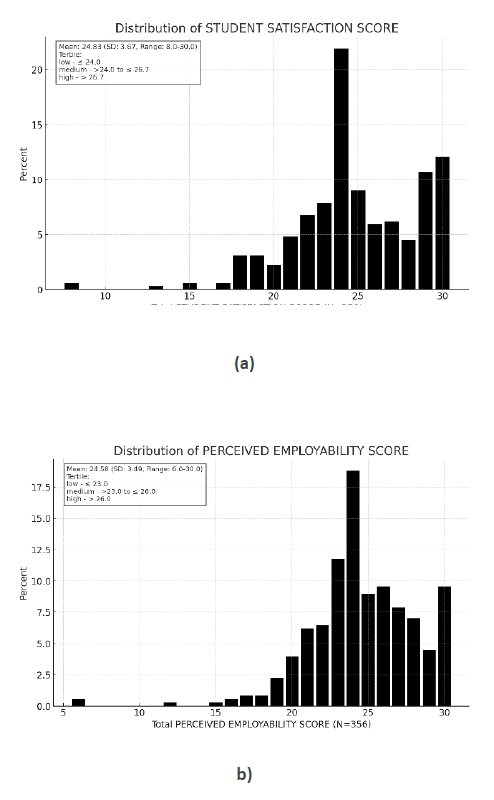
The results of the difference test presented in Table 2 indicate that there were no statistically significant differences in perceived employability and student satisfaction across participant characteristics (p-value > 0), with the exception of tuition status. A follow-up post-hoc analysis revealed that students with partial scholarships reported higher satisfaction compared to those with non-scholarship or full-tuition scholarships. Additionally, a Spearman's rho correlation analysis showed a significant positive correlation between student satisfaction and perceived employability (r = 0.862; p < 0.001), suggesting that higher levels of student satisfaction are associated with an increased perceived employability.
Table 2 The different tests on student satisfaction and perceived employability
| Student satisfaction | Perceived Employability | |||
|---|---|---|---|---|
| Factor (Different test) | Mean (SD) | Statistical value (p-value) | Mean (SD) | Statistical value (p-value) |
| Gender (Mann-Whitney) Male Female | 4.16 (0.61) 4.12 (0.61) | 15,927 (0.616) | 4.09 (0.54) 4.11 (0.57) | 14,990.5 (0.630) |
| Type of Study Program (Mann-Whitney) Engineering Non-engineering | 4.17 (0.63) 4.10 (0.58) | 14,150.5 (0.253) | 4.06 (0.58) 4017 (0.52) | 16,830.5 (0.091) |
| Tuition Status (Kruskal-Wallis) Non-scholarship Partial scholarship Full-tuition scholarship | 4.08 (0.60) 4.51 (0.48) 4.20 (0.64) | 13.339 (0.001) | 4.11 (0.52) 4.29 (0.42) 4.04 (0.70) | 4.318 (0.115) |
| Internship placement (Kruskal-Wallis) Private or public company State-Owned Enterprise Government agency | 4.15 (0.63) 4.13 (0.61) 4.13 (0.57) | 0.320 (0.852) | 4.10 (0.60) 4.09 (0.52) 4.15 (0.51) | 0.440 (0.803) |
| Certification (Mann-Whitney) Certified Not certified | 4.21 (0.60) 4.08 (0.62) | 13,887.5 (0.061) | 4.13 (0.50) 4.09 (0.60) | 5,562.0 (0.903) |
| Total | 4.14 (0.61) | 4.10 (0.56) | ||
3.2 Qualitative Findings: QUAL Strand
3.2.1 Content Analysis of the First Set of Open-ended Responses
Participants responded to the first open-ended question- What factors influence your satisfaction with the educational services provided at the polytechnic?”-yielding a total of 2,866 words. The content analysis generated 22 codes with a total of 440 code references. The codes were then categorized into eight categories, in weight ordering: (i) curriculum; (ii) facilities and infrastructure; (iii) lecturer qualifications and expertise; (iv) administrative services and staff; (v) learning environment comfort; (vi) skill development; (vii) employment quality; and (viii) institutional reputation. Based on Figure 2, the distribution of identified categories shows a proportional pattern across the four polytechnics. This suggests that the coding results capture a consistent categoric emphasis across sites, reinforcing the credibility of the qualitative findings. The categories were then loosely organized into three themes: academic (47.8%), non-academic (38.6%), and employability-related (13.6%) (see Table 3).
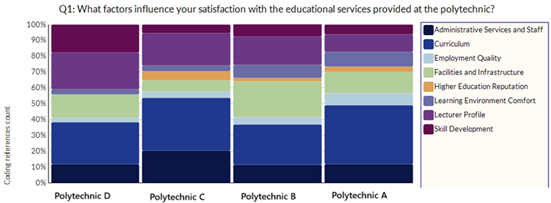
Figure 2 Distribution of categories from the first set of open-ended responses across polytechnics (source: author’s work with NVivo)
Table 3 Code category, rank, and emerging themes from the first set of open-ended responses
| Rank | Category | Code count | % | Theme |
|---|---|---|---|---|
| 1 | Curriculum | 146 | 33.2 | Academics |
| 2 | Facilities and Infrastructure | 67 | 15.2 | Non-academics |
| 3 | Lecturer profile | 64 | 14.6 | Academics |
| 4 | Administrative services and Staff | 56 | 12.7 | Non-academics |
| 5 | Learning environment Comrt | 34 | 7.7 | Non-academics |
| 6 | Skill development | 33 | 7.5 | Employability |
| 7 | Employment quality | 27 | 6.1 | Employability |
| 8 | Institutional reputation | 13 | 3 | Non-academics |
| 440 | 100 |
The theme “academics” refers to the educational content, structure, and quality of the material delivery. It focuses on the curriculum-industry alignment and the quality of lectures, as outlined by some respondents below:
“The material learnt aligns well with current industry trends and real-world conditions...” (R10, engineering student).
“It is important for a lecturer to have a strong mastery of the material they deliver.” (R98, non-engineering student)
The theme “non-academics” refers to the physical environment, administrative services, and student support services that complement the learning process. It predominantly relates to learning facilities, administrative services, and a comfortable environment. Some respondents responded to the open-ended question below:
"The learning facilities are well-equipped to support both theoretical and practical education." (R123, engineering student).
"The learning environment is safe and comfortable ..." (R21, non-engineering student)
The theme “employability” refers to the extent to which educational services enable graduates to be successfully integrated into the job market. It relates to the institution's ability to equip students with the tools necessary to succeed professionally, industry partnerships, and networking opportunities that facilitate students' careers, as outlined by some respondents below:
"A program designed to equip individuals with the necessary skills and knowledge to succeed in the workforce."(R145, non-engineering student)
"My educational institution has strong partnerships with industries, providing valuable networking opportunities and job recommendations for students."(R341, engineering student)
3.2.2 Content Analysis of the Second Set of Open-ended Responses
Participants responded to the second open-ended question (Q2)-"What factors influence your self-confidence in securing employment within your professional field?”-yielding a total of 2,792 words. The content analysis generated 26 codes with a total of 461 code references. The codes were then categorized into five categories, in weight ordering: (i) human capital, (ii) knowledge and skills acquired, (iii) social capital, (iv) higher education reputation, and (v) perception of labor market conditions. This balanced spread (see Figure 2) suggests that the coding results capture a consistent categorical emphasis across sites, thereby reinforcing the credibility of the qualitative findings. The categories were then loosely organized into two themes: (i) internal employability (90.7%) and (ii) external employability (9.3%) (see Table 4).
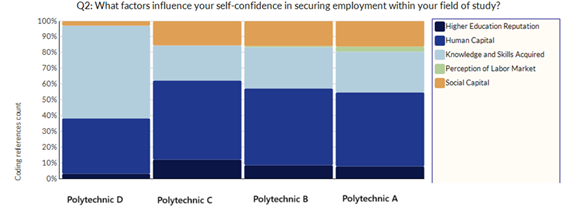
Figure 3 Distribution of categories from the second set of open-ended responses across polytechnics (source: author’s work with NVivo)
Table 4 Code category, rank, and emerging themes from the second open-ended responses
| Rank | Category | Code count | % | Theme |
|---|---|---|---|---|
| 1 | Human Capital | 222 | 48.2 | Internal Employability |
| 2 | Knowledge and Skills Acquired | 130 | 28.2 | Internal Employability |
| 3 | Social Capital | 66 | 14.3 | Internal Employability |
| 4 | Higher Education Reputation | 35 | 7.6 | External Employability |
| 5 | Perception of Labour Market Conditions | 8 | 1.7 | External Employability |
| 461 | 100 |
The theme “internal employability” refers to what students can get from themselves and their institution to enhance an individual's capability to secure and maintain employment opportunities. It encompasses the personal and institutional development mechanisms, such as skill-building, professional exposure, and networking, that empower students to proactively enhance their employability within the labor market. Below are some open-ended responses related to this theme:
“Gaining practical experience during an industrial internship, along with being equipped with essential skills needed for future employment.” (R57, engineering student)
“Relevant certifications and training that align with the professional field.” (R58, engineering student)
“A strong network with alumni from various backgrounds.” (R213, non-engineering student)
The theme “external employability” refers to students' perceptions of how external stakeholders, particularly potential employers, recognize them and their institutions, regarding an individual’s potential to be absorbed in the job market. It encompasses external signals, validation, and opportunities influencing students’ beliefs about their chances of being hired and succeeding in their careers. Some respondents responded to the open question below:
“Many leading companies actively recruit graduates from my campus.” (R117, non-engineering student)
“The presence of successful alumni in the workforce .....” (R110, non-engineering student)
“High number of job vacancies published.” (R342, non-engineering student)
“The high demand of industries for graduates from my field of study.” (R112, engineering student)
4. Discussion
The quantitative findings indicate that student satisfaction is at a moderate to high level, with a slight positive skew in the distribution of scores, suggesting that most students are generally satisfied with their educational experience. Meanwhile, the finding for perceived employability reveals a slight negative skew in the distribution of scores, yet it remains within a moderate to high range. Student satisfaction and perceived employability levels are largely consistent across demographic groups, with the study revealing a significant positive correlation between these two constructs.
Several studies support this relationship, with multiple theoretical underpinnings from educational, psychological, and economic perspectives. From an educational standpoint, learning theory posits that students’ perception of their career readiness-captured through perceived employability-significantly shapes how they evaluate their overall educational experience (Smith & Worsfold, 2014). Psychologically, social exchange theory offers a complementary view by suggesting that perceived employability contributes positively to students' academic and life satisfaction (Ma & Chen, 2024). Economically, the theories of human capital and signaling further support this connection. Human capital theory views education as an investment that enhances skills and competencies, which in turn improve employability prospects (Lenton, 2015). Signaling theory, on the other hand, emphasizes how academic credentials serve as indicators of workforce potential in the job market, such that perceived employability has a significant influence on student satisfaction (Lenton, 2015).
The summative content analysis of written responses reveals that three main factors contribute to student satisfaction: academics, non-academic factors, and employability. Each theme encompasses distinct categories that collectively shape students' perceptions of their educational experience. Academics and non-academic factors represent two critical dimensions of service quality that significantly contribute to shaping student satisfaction within higher education, as outlined by Gupta & Kaushik (2018). The emergence of employability illustrates that vocational students assess their satisfaction based on the effectiveness of the institution in preparing them for the job market, which is a fundamental objective of higher vocational education (Sánchez-Queija et al., 2023). The predominant factor of student satisfaction, namely academics, which primarily encompasses curriculum design and lecturer expertise, shows that students generally demonstrated a strong interest in what they learned and were aware of the skills and knowledge required for success in the job market. This finding appears to align with the "students as learners" perspective stated by Groccia (1997). According to this perspective, learning is emphasized as an outcome of students' efforts to engage with the curriculum rather than a service they passively purchase.
Based on the written responses, the content analysis revealed that their confidence in securing employment within their field of study is shaped by two overarching factors: internal employability and external employability. These factors correspond with the two primary dimensions outlined in Rothwell et al.'s (2008) conceptualization of perceived employability. External employability pertains to students' perceptions of how outside labor market conditions evaluate them and their institutions, while internal employability is related to skills and self-confidence, which are closely tied to beliefs in personal efficacy. The finding indicates that students mostly attribute their perceived employability to personal competencies and networking, rather than external labor market conditions. Rather than the role of labor market conditions as signals to perceived employability, this finding supports human capital theory in labor economics, providing valuable insights into the nature and determinants of perceived employability (Donald et al., 2024). In this theoretical basis, individuals are seen as "investors" in themselves, seeking to improve their economic outcomes by acquiring productive capabilities. This finding differs from the study of Gedye and Beaumont (2018), who found that UK students focus more on employers' expectations (extrinsic factors) than on their own offerings (intrinsic factors). This is expected since the job market in the UK is more stable. In contrast, students in developing countries like Indonesia face uncertain job markets, so they prioritise improving their skills and qualities (intrinsic factors) to enhance their employability.
Theoretical and Practical Contribution
The empirical evidence of the relationship between student satisfaction and perceived employability supports the theoretical claim, particularly within higher vocational education, where career outcomes are a core concern. In shaping student satisfaction, this finding advances Groccia's (1997) “students as learners” perspective by demonstrating that, in the vocational track of higher education, student satisfaction is primarily shaped by academic factors-particularly curriculum design and lecturer expertise. In shaping perceived employability, the finding supports the human capital theory of Gary S. Becker (1993) by emphasizing internal employability-especially students’ skills and competencies, as key drivers of perceived employability in uncertain labor markets. Students tend to view employability as being more focused on “what the student has” to offer the employer (intrinsic) rather than “what employers want” (extrinsic). Polytechnics need to strengthen their curricula to align with industry demands, thereby boosting student satisfaction over other factors. Additionally, institutions must foster stronger industry collaborations to enhance graduates’ human capital, as students prioritize their own skill development. These actionable recommendations align polytechnic education with prospective students, parents, and industry demands, ultimately enhancing the perceived quality of polytechnic.
Conclusion
Student satisfaction and perceived employability levels are consistent across demographic groups, with a significant positive correlation found between these two constructs. Three overarching factors contributing to student satisfaction are academics, non-academics, and employability. Two overarching factors contributing to perceived employability are internal employability and external employability. This study offers an innovative contribution to the international literature by exploring the factors that shape student satisfaction and perceived employability, and by conceptualizing and empirically demonstrating the interrelation between these two constructs within higher vocational education.
Limitation
Several limitations are acknowledged in this study. First, the collection of both quantitative and qualitative data was conducted simultaneously through a single instrument. The single-instrument approach may limit follow-up opportunities typically needed in qualitative inquiry. Second, the analysis and interpretation of the data may have unequal representation due to the limited number of questions. This could lead to the quantitative data overshadowing the findings, which undermines the convergent design's goal of balancing both data types during integration. Third, while using open-ended questions provides valuable qualitative insights with reliability criteria adopted in the content analysis, the analysis is subject to the limitations of content analysis, including potential researcher bias in coding and categorization. Fourth, this study employed self-completion questionnaires, which may have introduced potential response bias. Future studies should employ more detailed qualitative methods, such as semi-structured interviews or focus group discussions. These approaches will allow researchers to gather richer, more nuanced responses than what written open-ended survey questions can provide.
Acknowledgements
The authors would like to express sincere gratitude to the Ministry of Higher Education, Science, and Technology of the Republic of Indonesia. The author is also indebted to all faculty members of the Faculty of Administrative Science at the University of Brawijaya, who provided support, encouragement, and assistance throughout the work process.
Authors' contribution
Conceptualization, S.G.; data curation, S.G. and H.N.U.; formal analysis, S.G. and A.K.; funding acquisition, S.G.; investigation, S.G.; methodology, S.G. and H.N.U.; project administration, S.G.; resources, S.G.; software, S.G.; supervision, H.N.U., A.K. and E.Y.; validation, H.N.U., A.K. and E.Y.; visualization, S.G.; writing- original draft, S.G.; writing- review & editing, H.N.U., A.K. and E.Y.

