




 Inglês (pdf)
 Artigo em XML
 Referências do artigo
 Tradução automática
 Enviar este artigo por email
 Citado por SciELO
  Similares em
SciELO
Similares em
SciELO 
 Permalink

Introduction
In recent years, significant changes have been observed at the social level. Such transformations have affected all social institutions, including those related to education. The expansion of knowledge and information has generated a series of demands on teachers that include the mastery of new competencies; that is, in the midst of a world dominated by technology and connection, it is necessary for teachers to possess and practice digital competencies. This type of competence implies that teachers in training are committed to this process to acquire learning that will allow them to develop optimally in the digital society (Lund et al., 2014; Mannila et al., 2018; Revuelta-Domínguez et al., 2022).
Once the training stage is completed, the teaching professional must be able to manage and take advantage of the benefits of technology in the academic environment (Hernández et al., 2018). Several studies have managed to demonstrate the importance of teachers being equipped with a series of skills to teach in a digital environment; thus, by having such skills, a more flexible and interactive teaching-learning process will be possible in which the student will manage to develop digital skills for future success (Vargas-Murillo, 2019; Oliva-Cruz & Mata-Puente, 2023). For Gómez-Trigueros (2023), it is of utmost importance that such training includes the use of technological tools in an equitable, fair, and responsible manner. Hence, it is a priority for educational policies to focus on teacher training based on ethical knowledge. In short, the management and use of technology in education must be based on values of equity, truth, and responsibility, both on the part of teachers and school administrators.
The acquisition of digital competencies requires the development of comprehensive, collaborative, and open training programs that allow a progressive process. In this way, it will be possible to achieve digital competencies adapted to the needs of each future teacher, of the institutions, and of the students themselves. It is essential to have trained teachers with a solid professional ethic who are able to transmit knowledge to their students in a safe way; such training must make them competent and capable of making appropriate use of technology (Pérez-Calderón et al., 2021).
However, the reality evidences that a considerable number of teachers do not have adequate training to use digital technology in the school environment, which makes it difficult for them to generate an innovative and enriching teaching methodology for their students (Villarreal-Villa et al., 2019). This situation became quite evident with the appearance of COVID-19, since the figure of imposed remote education allowed showing the existing digital gap in the educational environment. Many teachers stated that they did not feel prepared to perform their work because they presented deficiencies in terms of technological management; this became more complicated, since there was no knowledge feedback based on the use of technological tools (Díaz, 2024; Matamoros, 2024). This situation showed that although teaching competence is important when providing much more appropriate learning materials, technological advancement is not, in many cases, balanced with teachers' competence to use technology in the educational process.
In view of the above, Mirete et al. (2020) suggest that university teachers, in addition to knowing the new theories of their specialty, should handle methodologies that facilitate student learning, including those supported by information and communication technologies (ICT). In this sense, more than updating their knowledge, teachers are obliged - in accordance with their ethical responsibility - to preserve, improve, and update their level of digital competence and thus help generate knowledge and adequately educate students. This process necessarily requires constant specific training, for which social characteristics, demographic factors, and years of experience must be taken into account (Hinojo-Lucena et al., 2019). Althubyani (2024) adds that the level of digital competence of teachers is influenced by some factors, among which are perceived usefulness, subjective norms, and ease of use.
This group of factors shows that there are currently teachers who are reluctant or find it difficult to use technology in their pedagogical work. For this reason, institutional leadership plays a significant role in motivating teachers to increase their levels of digital competence through education, mainly in the use of technology in academic environments (Dias-Trindade et al., 2020).
Teachers are important because they are in charge of designing and planning the transmission of knowledge to their students. Therefore, they need to receive training and have the technological and pedagogical tools in the context of digital competence to perform this task. Hence, it should become a content that supports teachers to develop professionally and serves for the implementation of innovative, creative, and dynamic strategies (Guillén-Gámez et al., 2021). In addition, this pedagogical process is generated through the transversal introduction of digital literacy to the student community. This could facilitate training in modern competencies and improve the educational success of the student body (Flores-Tena et al., 2021; George-Reyes, 2021).
The objective of the proposed systematic review is to establish the impact that digital teaching competencies (DTC) have on the academic performance of students, as well as to provide a broader overview of the studies conducted on teaching competence in digital technology as a predictor of student success.
In this way, it will be possible to provide a holistic and updated view of the influence that teaching competencies, in relation to digital technology, have on the results achieved by students. Thus, this review seeks to answer the following questions:
2. Methods
A systematic review of the literature was carried out to answer the research questions posed. This type of review is characterized by being orderly and organized, scientifically rigorous, and non-arbitrary. In addition, it is comprehensive, as it includes the totality of studies related to a specific topic; it is explicit, as it explains in detail how to locate the sources and the criteria considered; and it is reproducible, as it allows other researchers to verify the process (Onwuegbuzie & Frels, 2015; Rodríguez et al., 2024). The proposed systematic literature review used the Scopus and Web of Science (WoS) databases. These databases were chosen because they show a broader multidisciplinary view of science and integrate the most important sources, including open-access scientific journals, technological innovation studies, internet sources of scientific content, and papers resulting from conferences and congresses (Huanca-Arohuanca 2022). In addition, a specific time range was selected between 2014 and 2024.
2.1 Search process
A three-level structural equation proposed by López-Martín (2023) was used for the search. The search was limited to the fields title, abstract, and keywords (Table 1). Likewise, the NEAR/1 proximity operator was used to retrieve records; for this purpose, the terms combined by the operator are separated by a maximum of one word; likewise, the asterisk was used to delimit the roots of the words.
Table 1 Search strategy
| Levels | Search string (WoS y Scopus) |
|---|---|
| First (included terms that allowed locating teachers' digital competencies). | (teach* NEAR/1 (“digital competence*” OR “professional* strategies *” OR “characteristic*” OR “skill*” OR “abilit*”). |
| Second (incorporated keywords related to students' academic performance). | (“logro del estudiante*” O “resultado del estudiante*” O “resultado del estudiante*” “logro del estudiante*” O “rendimiento* académico*” O “logro* académico*” O “resultado* académico*”) |
| Third (keywords related to teachers' characteristics were added). | (“age*” OR “gender* experience*” OR “educational level*” OR “training*” OR “years of service*” OR “primary” OR “secondary” OR “university*” OR education*”). |
On the other hand, inclusion and exclusion criteria were established considering the keywords and the objective set about teaching competence in digital technology. The eligibility criteria are presented below (Table 2).
Table 2 Eligibility criteria
| Inclusion criteria | Exclusion criteria |
|---|---|
| Articles published in high quality scientific journals that underwent a peer review process. | Studies not related to the objective of this review. |
| Studies published in Spanish or English. | Publications in areas other than education. |
| Papers published between 2014 and 2024. | Books or book chapters, conference papers and doctoral or master's theses. |
| Open access publications | Studies that do not present clear empirical data or without methodological support. |
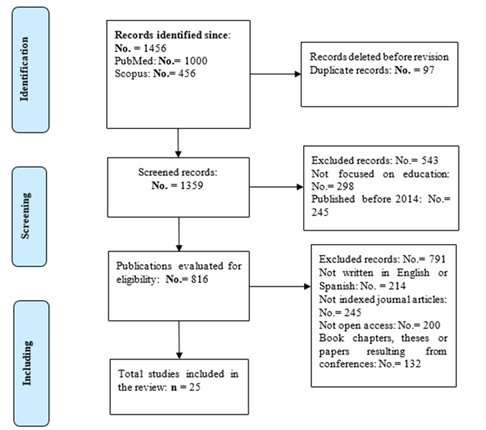
A total of 1456 articles were found, of which 1000 belonged to Scopus and 456 to WoS. Initially, 97 documents were eliminated because they were duplicates; this process generated 1359 records that went on to the screening process. At this stage, 543 were excluded because they were not focused on the educational area (n=298) and because they were published before 2014 (n=245). This process resulted in 816 records, which were reviewed by title, abstract, and keywords. In the last step, 791 documents were eliminated, specifically for being published in a language other than Spanish or English (n=214); in addition, they did not belong to indexed journals (n=245), 200 did not present open access and were conference papers, book chapters, or theses (n=132). The total number of documents resulting from this process was 25, which were reviewed since they met the established eligibility criteria.
2.2 Analysis process
The information obtained from the studies reviewed was organized as follows: on the one hand, the metadata of each study, i.e., its general data, were extracted and organized. These were categorized by author(s), document title, abstract, keywords, year of publication, database, document type, language, and journal name. Secondly, some categories were established to classify the selected studies, which were oriented to objective, type of study, country where the study was conducted, and criteria established for the existence of digital competence in teaching. In relation to the type of study, all quantitative, qualitative, and mixed documents were considered.
3. Results
The most important characteristics of the studies reviewed are presented below (Table 3).
Table 3 Characteristics of the articles submitted for review
| Author/year/country | Type of study | Sample/instrument | Journal/language/database |
|---|---|---|---|
| Basantes et al. (2022). | Systematic review | Sustainability. English. Scopus/WoS | |
| Althubyani (2024) Saudi Arabia | Mixed | 611 teachers/ Questionnaire - Semi-structured interview | Sustainability. English. Scopus/WoS |
| Holik et al. (2023) 9 European countries | Quantitative | 292 teachers. Questionnaire | International Journal of Engineering Pedagogy (iJEP). English. Scopus/WoS |
| Jiménez et al. (2020) Spain | Quantitative | 485 Master of Education students/simplified questionnaire based on DigComp model | Sustainability. English. Scopus/WoS |
| Pérez-Calderón et al. (2021) Spain | Quantitative | 109 teachers/ Questionnaire | International Journal of Environmental Research and Public Health. Inglés. Scopus |
| Saikkonen, & Kaarakainen (2021) Finland | Quantitative | 4988 teachers/ ICT skills test-questionnaire | Computers & Education. Inglés. Scopus |
| Gómez-Trigueros (2023) Europe | Mixed | 1051 students/ Questionnaire-interviews | Contemporary Educational Technology. English. Scopus |
| Hämäläinen et al. (2021) 11 European countries | Quantitative | 2590 respondents/ PIAAC and TALIS datasets | Computers in Human Behavior. English. Scopus |
| Hanaysha et al (2023) United Arab Emirates | Quantitative | 321 students/ Questionnaire | International Journal of Information Management Data Insights. English. Scopus |
| Alieto et al. (2024) Philipines | Quantitative | 300 teachers/ Attitude toward Online Learning y la herramienta Teacher's Technological Competence Tool | Heliyon. English. Scopus |
| Cabero-Almenara et al. (2021) Spain | Quantitative | 1194 teachers/custom tool | British Journal of Educational Technology. English. Scopus/WoS |
| Prieto-Ballester et al. (2021). Spain | Quantitative | 177 participants/ Digital Teaching Competence Questionnaire | Education Sciences. English. Scopus/WoS |
| Akram et al. (2021) Pakistan | Quantitative | 260 teachers/ Questionnaire | Front. Psychol. Inglés. Scopus/WoS |
| Almulla (2022) Saudi Arabia | Quantitative | 350 teachers/ Questionnaire and structural equation modeling | Sustainability. English. Scopus/WoS |
| De Obesso et al. (2023) Spain | Quantitative | 243 students/ DigComEdu | Technological Forecasting and Social Change. English. Scopus |
| Fernández-Batanero et al. (2021) | Systematic review | Education Sciences. Inglés. Scopus/WoS | |
| Zhu et al. (2024) China | Quantitative | 402 professors/ the Digital University Leadership subscale; the Digital Teaching Competence subscale; and the Teacher Technology Behavior subscale. | International Journal of Learning, Teaching and Educational Research. English. Scopus |
| Dang et al. (2024) Vietnam | Quantitative | 626 teachers/ Questionnaire | Heliyon. Inglés. Scopus |
| Muammar et al. (2023) United Arab Emirates | Quantitative | 51 teachers/ Questionnaire | Education and Information Technologies. English. Scopus |
| Lucas et al. (2021) Portugal | Quantitative | 1071 teachers/ DigCompEdu | Computers & Education. English. Scopus |
| Lindfors et al. (2021) Sweden | Qualitative | 14 teacher trainers/interviews | Education Inquiry. English. Scopus/WoS |
| Mercader & Gairín (2017) Spain | Mixed | 527 teachers/questionnaires and interviews | REDU. Revista de Docencia Universitaria. Spanish. WoS |
| Bustos & Gómez (2018) Mexico | Quantitative | 12 teachers/questionnaires and interviews | Revista de Investigación Educativa 26. Spanish. WoS |
| Martínez-Garcés Y Garcés-Fuenmayor (2020) Colombia | Quantitative | 67 teachers/two questionnaires | Educación y humanismo. Spanish. Scopus |
| Domingo-Coscollola et al. (2020) Spain | Mixed | 11 students-10 teachers/analysis of documentation, focus groups and questionnaires. | Revista de Investigación Educativa. Spanish. Scopus/WoS |
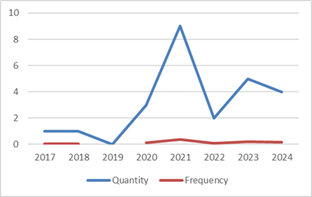
To answer the first research question - what has been the evolution of international scientific production on teaching competence in digital technology - 25 studies were analyzed, of which 23 were published in the last five years. This information demonstrates the importance of the DTC in the educational process and the need for teachers, at different levels, to be able to develop it in order to contribute to the academic success of students and to face the challenges of their profession. Figure 2 shows the number of articles published over a period of eight years, since, although the time span established in the review was from 2014, only studies whose publication date is from 2017 were analyzed.
Likewise, of the total number of documents examined, 48 % (12) were published in journals indexed in Scopus, 12 % in WoS, while 40 % of the studies were published in journals indexed in both Scopus and WoS. Regarding language, 84 % of the articles were published in English and only 16 % in Spanish.
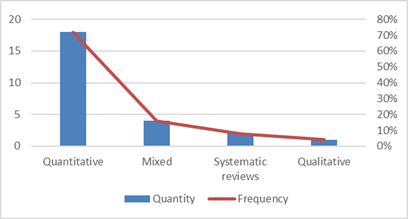
Regarding the methodology used, 72 % are quantitative research, which constitutes the largest proportion of the documents analyzed. Mixed studies represent 16 %; systematic reviews, 8 % and qualitative research, only 4 % of the total number of documents reviewed (Figure 3). These percentages show that qualitative studies are the least common and least used to analyze the effect of DTC on students' academic success.
With respect to the second question posed -what factors intervene in the development of the DTC-, several thematic groups were identified that explain the factors that favor or do not favor the development of these competencies. These are the following: low technological knowledge and skills of teachers, few professional training programs in digital technologies (Althubyani, 2024); internal or personal factors, for example, motivation, attitude, low efficiency of the teacher's personality and social relationships (Akram et al., 2021; Cabero-Almenara et al., 2021; Lucas et al., 2021; Holik et al., 2023). Factors related to gender, age, years of experience, or educational level were also identified (Pérez-Calderón et al., 2021), as well as sociodemographic factors (Saikkonen & Kaarakainen, 2021).
Authors such as Hämäläinen et al. (2021), instead of calling them “factors”, call them “external barriers” or “first-order barriers”. These barriers include a lack of resources or institutional support, which hinder the use of technology to foster students' digital competencies. There are also internal or second-order barriers, for example, skills, attitudes, and knowledge that can facilitate a digital transformation.
On the other hand, Lucas et al. (2021) make a better classification of these factors, including them in two large groups: personal and contextual. The former include gender, age, ease of use, teaching experience, confidence in handling digital technology, willingness to learn about new technologies, use of social networks and number of years using digital technology in teaching. Contextual factors include infrastructure, availability, digital competence and access to technology, as well as classroom equipment, student access to technology, network infrastructure, school facilitation, curriculum facilitation and peer influence on technology use.
4. Discussion
The systematic review aimed to establish the impact that DTC have on students' academic performance. In this sense, it was found that teachers' digital competencies are extremely important to contribute to students' academic success. This process starts with the training of teachers, who will have the responsibility to use innovative strategies when imparting knowledge related to their professional area. In this sense, Lindfors et al. (2021) posit that the professionals in charge of training future Swedish teachers perceive individual, collegial and organizational scenarios to fulfill their dual didactic task. On the one hand, they must use digital technology in order for student teachers to graduate; on the other hand, they must ensure that professional digital competence is acquired and practiced in their future working life.
The studies showed the relevance of teachers being trained in issues related to ethics in the use of technologies. Therefore, it is necessary to properly prepare them in the ethical use of the digital tools with which they will work, and which will contribute to the formation of ICT-competent citizens of the information and communication society. Many teachers in training recognize the importance of knowing how to safely handle content hosted on the Internet. They also stress the importance of respecting the authorship of the contents and the need to use them responsibly, but they do not know the pedagogy to perform this task in their professional activity. These results coincide with other studies on technology and teaching, which emphasize the importance of the ethical use of ICTs (Gómez-Trigueros 2023).
Another aspect of utmost importance in this stage of training is the one pointed out by Lindfors et al. (2021), which refers to the conditions found at different levels of educational and teacher training institutions. Despite the consensus on professional digital competence (PDC) as a key point for teachers, teacher educators had their own picture of their PDC, which, in one way or another, limited their ability to function as digital role models. The study showed that there were teacher educators who were comfortable using fairly basic technology, such as PowerPoint or a learning management platform; however, they desired more advanced usage knowledge and a deeper understanding of it. When this happened, they became aware of their didactic work, making it easier for student teachers to develop their PDC and at the same time learn how to integrate technology into classroom practice.
Once these objectives have been achieved, a new stage begins in which the teaching professional puts into practice what he or she has learned; however, to do so, he or she must keep up to date with the technological changes that are constantly appearing. Althubyani (2024) conducted a study in which it was observed how science teachers presented an average level of digital competence. Generally speaking, this occurred due to insufficient professional training in digital technologies. Such professional development programs are vital to increase the level of DTC.
In the case of university institutions, ICTs play a crucial role in guaranteeing academic offerings on the main campus, because they provide all students with access to the same set of educational programs, regardless of their location. Hence, their work should focus on providing training to teachers to improve their competencies or redesigning classrooms to optimize the learning environment. In addition, the adoption of new technologies allows them to stay up-to-date and, in a position, to provide students with better learning (Hanaysha et al., 2023). This type of successful pedagogy implies that the teacher has a deep understanding of how to achieve student learning. This will be achieved through well-designed learning content and effective assessment, for which it is necessary to use, for example, digital platforms in instruction (Alieto et al., 2024).
The reality observed in the midst of Industry 4.0 demands that university professors know how to manage, explore, and handle the digital resources they have, keeping up to date with the accelerated technological and knowledge advances (Dang et al., 2024). In this sense, Basantes et al. (2022) assert that the updating of university teachers in terms of technopedagogical strategies requires a real commitment on their part to accept and take responsibility for the transformations that will occur with this process. In order to achieve this purpose, it is necessary for university institutions to generate digital organizational structures that allow them to provide students with personalized learning opportunities adapted to their needs, as well as to actively participate in the classroom (Muammar et al., 2023).
Undoubtedly, the role of teachers in the introduction and use of technology in teaching is quite important; for this reason, it is necessary to take into account the factors that condition the learning or updating of their digital competencies. The studies yielded important data in this regard and show multiple factors that intervene in the development of digital competencies by teachers. These factors include the “lack” of experience in handling technological tools (Fernández-Batanero et al., 2021; Lindfors et al., 2021; Lucas et al., 2021), institutional support (Hämäläinen et al., 2021; Lindfors et al., 2021), time (Lindfors et al., 2021), access and financial support (Alieto et al., 2024), and causes related to “teacher resistance to change” (Domingo-Coscollola et al., 2020).
Undoubtedly, the role of teachers in the introduction and use of technology in teaching is quite important; for this reason, it is necessary to take into account the factors that condition the learning or updating of their digital competencies. The studies yielded important data in this regard and show multiple factors that intervene in the development of digital competencies by teachers. These factors include “lack” of experience in handling technological tools (Fernández-Batanero et al., 2021; Lindfors et al., 2021; Lucas et al., 2021), institutional support (Hämäläinen et al., 2021; Lindfors et al., 2021), time (Lindfors et al., 2021), access and financial support (Alieto et al., 2024), and causes related to “teacher resistance to change” (Domingo-Coscollola et al., 2020).
Lucas et al. (2021) confirm the prevalence of personal factors over contextual factors (availability, infrastructure, access to technology and digital competence) in the development of DTC. Gender was found to be a significant predictor of digital competence, as it favored male teachers; also, male teachers were more proficient in using digital technologies in collaboration with their peers, improving assessment, and enabling their students to achieve digital competencies. This finding is supported by Akram et al. (2021), who assert that male teachers' TPACK (program for learning all the necessary resources and tools on educational technology) was significantly higher than that of female teachers. Thus, male teachers showed more positive attitudes, competencies, and knowledge in relation to the use of technology, showing that female teachers require more support to acquire digital competencies.
Another personal factor found was the age of the teachers. The studies showed that digital activity among male teachers decreases as they get older, in contrast to what happens among female teachers. The management of these competencies among male teachers is concentrated among those under 45 years of age. Likewise, and equally important as age, their perceptions of their own digital competence in relation to the requirements of the profession in terms of digital self-efficacy are particularly high for younger teachers; however, they decrease significantly with aging. Hence, interventions should target teachers with an age range exceeding 30 to 39 years, as well as teachers older than 50 years (Saikkonen & Kaarakainen, 2021).
On the other hand, Almulla (2022) points out that perceived usefulness, perceived ease of use, and teachers' attitude towards the use of digital tools and teachers' behavioral intention to use digital tools affect the use of digital tools in the pedagogical setting. This study, conducted based on the educational situation generated by COVID-19, shows that the adoption of digital tools during this stage improved online teaching skills and competencies. During 2020, there were a few teachers who managed to be innovative by putting their digital competencies into practice; therefore, updating in terms of the management and use of technology was necessary (Martínez-Garcés & Garcés-Fuenmayor, 2020).
For Hämäläinen et al. (2021), the DTC is generated as a function of several factors. External barriers or contextual factors are not as important for achieving digital competencies; instead, these authors suggest focusing on internal barriers, e.g., skills, attitudes, and knowledge, as they can facilitate digital transformation. Future teachers' views on the usefulness and importance of technology may predict their desire to achieve the digital transformation of schools. For this reason, they assert that ease of use, teacher attitudes towards technologies in education, and the strategies employed by teacher training institutions are positively associated with self-perceived competence.
Generally speaking, the impact of DTC is reflected in the adoption and inclusion of technology in educational practices, in the design of novel and engaging instructional activities, in student assessment, motivation, interaction in online discussions, and in the stimulation of creative thinking of individual students (Althubyani 2024). It also highlights the usefulness of digital technology in both educational and professional settings, which is evidenced by the ability of digital technology to save time and effort.
The resources provided by ICT have a direct and indirect impact on student performance and achievement, since they positively affect their participation. It follows that teaching competence has a direct and indirect impact on academic performance through student engagement; that is, students' perceptions of the efficiency of their instructors can be used to measure the level of commitment among them to the pedagogical process (Hanaysha et al., 2023). In this regard, Dang et al. (2024) confirmed that the higher the teaching and learning competence of the teacher, the higher the learning value obtained by the students. Thus, the role of teaching and learning competence becomes the central dimension of the DTC.
Teachers who excel in helping their students acquire digital competencies not only have a deep understanding of digital technologies but are also able to teach how to advance, evaluate, and leverage these tools effectively. Likewise, these professionals generate an environment that promotes critical thinking, digital literacy, and the ethical use of technology. Not to mention that it prepares students to leverage such competencies for research, collaboration, and problem solving (Muammar et al., 2023; Dang et al., 2024).
In sum, it is necessary to improve the level of DTC, as this can effectively increase the positive impact of digital leadership on technological behavior, emphasizing the important mediating role of digital competence. Accordingly, institutions should encourage the development of training programs to improve the technical skills of teachers, in addition to fostering an understanding of how technology can be successfully integrated into pedagogical practices (Zhu et al. 2024). It is time for teachers to let go of the idea that technology provides a supplemental teaching tool, and assume that technology is essential to achieving successful student performance outcomes. Effective teaching requires the use of effective technology, and how it is used requires effective and practical digital competencies. Thus, digital technology enables the teacher to teach in a faster, easier, and more entertaining way by adopting new approaches that will improve instruction, learning content or context, instruction, and assessment (Lucas et al., 2021; Basantes et al., 2022; Muammar et al., 2023; Alieto et al., 2024; Althubyani, 2024).
Conclusion
The review showed that the DTC has a significant impact on the academic success of students, since by adopting digital technologies it is possible to promote the development of students' digital competencies to face the demands of the digital society that prevails in the 21st century. In this sense, it was evidenced that teachers must be competent in the use of digital technology for specific areas, for example, communication, cooperation, resource management, educational activities, assessment methodologies, pedagogical strategies, and empowerment. All of these will be useful to achieve the effective digital competence of their students.
Currently, teachers have very high levels of digital competence in multiple dimensions; however, older teachers are more vulnerable and suffer the most severe lack of digital information skills. This situation contrasts with their years of professional experience and leads them to low participation in continuous training on digital issues. This occurs because younger teachers have had access to digital technologies and have started using them earlier than older teachers. This reality influences their use in their teaching practice. Therefore, it is necessary to provide professional training so that older teachers can develop real digital competence.
Other aspects that intervene at the moment of learning digital skills, such as the lack of ICT training opportunities, the high cost of training, inadequate facilities, and lack of institutional support, were evidenced. In addition, the development of digital competencies of each teacher depends on multiple factors, as observed in most of the studies reviewed. For example, it is necessary to assess contextual factors, as well as personal factors or internal barriers, teacher motivation and attitude, and sociodemographic factors, among others.
Finally, a positive attitude towards the acquisition of digital competencies among teachers translates into greater flexibility in the execution of tasks, better accessibility, pedagogical innovation, and opportunities for students' self-regulated learning. Digital literacy is critical to increasing the quality of student performance and success. Digital competence has proven to be paramount at all educational levels, as it directly impacts student learning and digital competencies. For this reason, it is necessary to properly prepare future teachers to generate an ethical use of technology and, ultimately, to train citizens of the information and communication society who are competent in ICT.
Authors' contribution
Conceptualization, A.P., M.M., J.S. and I.M.; data curation, A.P. and M.M.; formal analysis, A.P. and J.S.; funding acquisition, A.P. and M.M.; investigation, A.P., M.M., J.S. and I.M.; methodology, A.P. and M.M; project administration, A.P.; resources, M.M.; software, J.S.; supervision, I.M.; validation, A.P., M.M., J.S. and I.M.; writing-original draft, A.P., M.M., J.S. and I.M.; writing-review & editing, A.P., M.M., J.S. and I.M.

