




 Inglês (pdf)
 Artigo em XML
 Referências do artigo
 Tradução automática
 Enviar este artigo por email
 Citado por SciELO
  Similares em
SciELO
Similares em
SciELO 
 Permalink

Introduction
The education of midwives faces the ongoing challenge of preparing professionals capable of responding effectively to complex and emotionally demanding clinical contexts. Clinical simulation has become established as a preferred methodology in health education, as it enables the safe and progressive development of essential competencies (Cant & Cooper, 2016). In particular, debriefing - understood as a structured moment of reflection following simulation - has demonstrated a decisive role in the consolidation of learning, the promotion of self-confidence, and the development of both technical and non-technical competencies (Rudolph et al., 2007).
In the field of Maternal Health, exposure to critical scenarios during clinical training is often limited, which reinforces the need for active methodologies that promote the acquisition of practical competencies in controlled environments. Clinical simulation helps to address these gaps by reproducing highly complex situations, such as obstetric emergencies, communication of bad news, and decision-making under time constraints. In these contexts, debriefing constitutes an essential component for transforming simulated experiences into meaningful learning, fostering critical reflection, and facilitating the integration of theory and practice.
More recently, innovative simulation modalities have emerged, such as educational escape rooms, which integrate gamification elements with clearly defined pedagogical objectives. These approaches have been explored in Nursing education, suggesting potential to enhance clinical reasoning, teamwork, and active participant engagement within interactive learning environments (Atasever et al., 2025; Fernandes et al., 2025; Reinkemeyer et al., 2022; Çakmak & Kaymaz, 2024). However, their specific application in the field of maternal and obstetric health remains limited, which justifies a more comprehensive analysis of the role of debriefing associated with simulated practice in this context.
Despite the growing use of clinical simulation in Nursing education programmes, the specific impact of debriefing associated with simulated practice in the training of midwives remains insufficiently systematised in the literature. Therefore, this scoping review aims to map the available evidence on debriefing in simulation within the context of maternal and obstetric health, identifying the models used, the competencies developed, as well as the barriers and facilitators reported.
1. Theoretical framework
The present theoretical framework aims to provide conceptual support for this scoping review by clarifying the main pedagogical assumptions underlying clinical simulation and structured debriefing in maternal and obstetric health education.
Clinical simulation in maternal and obstetric health education
Over recent decades, clinical simulation has become established as an essential pedagogical methodology for competency development in healthcare, enabling the integration of theory and practice within a controlled and safe environment (Cant & Cooper, 2016). In maternal and obstetric health education, this approach is particularly relevant, as it allows progressive exposure to complex and high-risk clinical scenarios, such as obstetric emergencies, thereby promoting the acquisition of technical and non-technical competencies that are indispensable for professional practice. By providing realistic experiences without risk to the person receiving care, simulation supports experiential and reflective learning, contributing to the development of clinical reasoning, decision-making skills, and trainee confidence. This methodology is especially pertinent in contexts where real clinical exposure is limited, as is frequently the case in specialised training in Maternal and Obstetric Health.
1.2 Debriefing as a central component of clinical simulation
Debriefing constitutes the core phase of the clinical simulation process and is described as a structured and guided discussion that takes place after the simulated experience, with the aim of promoting reflection on action and consolidating learning (Fanning & Gaba, 2007; Rudolph et al., 2007). It is during this phase that the lived experience is critically analysed, enabling participants to identify and acknowledge weaknesses and to attribute meaning to their decisions and behaviours.
Dreifuerst (2012) highlights debriefing as a catalyst for clinical reasoning and decision-making, integrating cognitive, affective, and psychosocial dimensions of learning. The effectiveness of debriefing largely depends on its structure and on the pedagogical competence of the facilitator, who must create an environment of psychological safety and stimulate participants’ critical reflection (INACSL Standards Committee, 2021).
1.3 Models of structured debriefing
Several models of structured debriefing have been described in the literature with the aim of guiding reflection and maximising learning. Among the most widely used is the Advocacy-Inquiry model, developed by Rudolph et al. (2007), which combines structured observation with intentional questioning, thereby promoting self-reflection and critical thinking.
The Diamond Debriefing model, proposed by Jaye et al. (2015), organises the reflective process into three phases: description, analysis, and application, facilitating a logical and progressive learning pathway. This model has been widely applied in demanding clinical contexts, as it allows for a systematic exploration of the simulated experience.
Kolb’s experiential learning model (1984) posits that learning occurs through a continuous cycle involving concrete experience, reflection, conceptualisation, and active experimentation. This theoretical framework aligns with the nature of clinical simulation and reinforces the importance of debriefing as an integrative element of the educational experience.
Despite their structural differences, these models share common principles, namely the centrality of the learner in the learning process, the promotion of critical reflection, and the importance of psychological safety as a prerequisite for meaningful learning (Sawyer et al., 2016).
1.4 Dimensions of debriefing in Nursing education
The conceptual model underpinning this review is therefore based on the interaction between clinical simulation and structured debriefing as a pedagogical process of experiential learning. This interaction can be understood through three complementary dimensions (Coutinho et al., 2014):
Affective, which involves emotional regulation and self-confidence;
Cognitive, which promotes critical analysis and knowledge consolidation;
Psychosocial, which integrates relational and collaborative competencies.
The articulation of these dimensions contributes to the overall development of competencies among midwives, fostering the provision of safe, effective, and humanised maternal and obstetric care.
1.5 Innovative approaches in clinical simulation
In recent years, innovative approaches to clinical simulation have emerged, integrating elements of gamification and active learning, such as educational escape rooms. These strategies have been explored in Nursing education, with promising results in terms of student motivation, engagement, and knowledge retention (Fernandes et al., 2025; Reinkemeyer et al., 2022; Ghiamikeshtgar et al., 2024; Çakmak & Kaymaz, 2024).
The combination of these approaches with structured debriefing may enhance the reflective process, promoting deeper and more meaningful learning. However, evidence specific to the context of maternal and obstetric health remains limited, which justifies the need to systematically map existing studies.
In summary, the literature indicates that structured debriefing is a central element of clinical simulation and an essential mediator of meaningful learning. In the context of midwifery education, its systematic application enables the consolidation of both technical and non-technical competencies. Nevertheless, gaps remain regarding the standardisation of models, facilitator training, and the evaluation of long-term outcomes.
2. Methods
This scoping review was conducted in accordance with the methodology proposed by the Joanna Briggs Institute (JBI). The review process was guided by the Preferred Reporting Items for Systematic Reviews and Meta-Analyses extension for Scoping Reviews (PRISMA-ScR) checklist.
The present scoping review was guided by the following research question: What are the outcomes of debriefing associated with simulated practice in the development of competencies among midwives?
The Population, Concept, and Context (PCC) framework was used to formulate the research question and to define the search strategy. The Population (P) comprised midwives, the Concept (C) was debriefing associated with simulated practice, and the Context (C) was professional education in Maternal and Obstetric Health.
Inclusion and exclusion criteria were defined a priori and systematically applied throughout the study selection process, in accordance with the research question and the PCC framework.
Studies were included if they met all the following criteria:
Quantitative, qualitative or mixed-methods studies, as well as relevant systematic reviews;
Participants were nursing students or health professionals involved in education or training in Maternal and Obstetric Health;
Use of clinical simulation associated with debriefing, regardless of the model adopted;
Academic or professional training context in Maternal and Obstetric Health;
Articles published between 2015 and 2024;
Publications written in Portuguese, English, or Spanish;
Availability of full-text articles.
Studies were excluded if they:
Did not include debriefing associated with simulated practice;
Were not situated within the context of Maternal and Obstetric Health;
Were limited to theoretical descriptions, editorials, commentaries, or opinion papers without empirical data;
Were duplicates or did not provide access to the full text.
2.1 Sample
This scoping review included quantitative and qualitative studies, as well as systematic reviews, that addressed the impact of debriefing associated with simulated practice in the education of midwives.
Quantitative studies with experimental designs were included, namely randomised controlled trials, non-randomised trials, and quasi-experimental studies, such as before-and-after studies. Observational studies were also considered, including descriptive studies, cohort studies, cross-sectional studies, case studies, and case series.
Qualitative studies exploring the experiences of students or professionals with the use of simulation and debriefing were also included. Among the qualitative designs considered were phenomenological approaches, ethnographic studies, and grounded theory studies, among others.
Inclusion and exclusion criteria were applied based on the review question and aligned with the PCC framework.
2.2 Data collection instruments
Data collection was completed over a two-week period from May 1st to May 15th, 2025. The following electronic databases were searched: CINAHL, MEDLINE, Cochrane Database of Systematic Reviews, MedicLatina, and Nursing & Allied Health Collection: Comprehensive.
Grey literature databases were also consulted, namely the Portuguese Open Access Scientific Repository.
The search strategy was developed using controlled terms and keywords combined through Boolean operators. The following search string was applied: “(Structured Debriefing” OR “Debrief*”) AND (“Simulation Training” OR “Simulated Practice”) AND (“Obstetric Nursing” OR “Maternal Health” OR “Midwif*”).
Filters were applied to include only full-text articles written in Portuguese, English, or Spanish that involved health professionals in simulated practice contexts with debriefing.
Data extraction and synthesis
Data extraction was performed independently by two reviewers using a previously developed extraction instrument aligned with the objectives of the review. This instrument was based on the JBI data extraction model and was refined throughout the extraction process, as necessary.
In cases of disagreement between reviewers, decisions were reached by consensus.
For each included study, the following data were extracted: title, authors, year of publication, country of origin, and study design. In addition, the following elements were identified: study objectives, methods used, participant characteristics, type of simulation applied, debriefing model implemented, and competencies developed.
The extracted data were organised and presented in tabular format to facilitate analysis and comparison across studies (Table 1).
The purpose of data presentation was to provide a comprehensive and systematic overview of the impact of debriefing integrated with simulated practice on the education and competency development of midwives.
3. Results
The results of the search and study selection process are presented in Figure 1, following the PRISMA-ScR flow diagram.
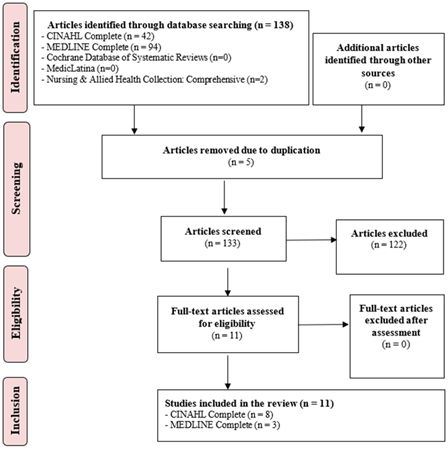
A total of 138 articles were initially identified. After the removal of duplicates and the application of the inclusion and exclusion criteria, 11 studies were considered eligible and included in this scoping review. These studies addressed the use of debriefing associated with simulated practice in maternal and obstetric health education and training contexts.
3.1 General characteristics of the included studies
The included studies were published between 2015 and 2024 and were conducted across diverse geographical contexts. Most studies were carried out in the United States of America (n = 3), followed by Brazil and New Zealand (n = 2 each), and Ireland, England, South Africa, and Australia (n = 1 each).
Regarding methodological design, quantitative descriptive studies predominated (n = 6), followed by qualitative studies (n = 3) and mixed-methods studies or reviews (n = 2). Participants primarily included Nursing and Midwifery students, as well as health professionals and facilitators involved in educational processes.
The main characteristics of the included studies are summarised in Table 1.
Table 1 Characteristics of the included studies
| Author and year | Title | Country | Study design | Study objective | Participants | Type of simulation | Debriefing model | Developed competencies |
|---|---|---|---|---|---|---|---|---|
| Dias et al., 2024 | Simulation as an Innovative Teaching Pedagogy for Baccalaureate Male Students Undertaking a Maternal Health Course in the Arab world: A Pilot Project | USA | Quantitative | To evaluate the use of simulation as an innovative pedagogical approach for male students in a maternal health course | Male students | Low-fidelity simulation | Structured / Reflective | Critical thinking, communication, and psychomotor skills |
| Raney et al., 2020 | Training and evaluating simulation debriefers in low-resource settings: lessons learned from Bihar, India | USA | Quantitative | To evaluate the training and performance of debriefing facilitators in a low-resource setting (Bihar, India) | Facilitators | In situ | Diamond Debriefing | Communication, leadership, debriefing, and management |
| Moloney et al., 2022 | Final year undergraduate nursing and midwifery students' perspectives on simulation-based education: a cross-sectional study | Ireland | Quantitative | To evaluate a simulation-based education initiative with final-year nursing students | Final-year nursing students | High-fidelity simulation | Structured / Self-assessment | Confidence, decision-making, critical reflection |
| Silva et al., 2021 | Management of severe preeclampsia in the puerperium: development and scenario validation for clinical simulation | Brazil | Quantitative | To develop and validate a simulation scenario on severe postpartum pre-eclampsia | Health professionals | Validated simulation scenario | Structured checklist | Management of pre-eclampsia, clinical reasoning |
| Macdiarmid et al., 2020 | The experience of facilitating debriefing after simulation: A qualitative study | New Zealand | Qualitative | To explore the experiences of health professionals facilitating debriefing after simulation | Clinical facilitators | Real clinical setting | Reflective, adaptive | Leadership, emotional management, and learning support |
| Brasil et al., 2018 | Use of the design and self-confidence scales in the assessment of maternal-child realistic simulation | Brazil | Quantitative | To evaluate realistic maternal and infant simulation using design and self-confidence scales | Nursing students | Realistic simulation | Post-simulation debriefing plus questionnaire | Satisfaction, self-confidence, and clinical decision-making |
| Lutgendorf et al., 2017 | Multidisciplinary In Situ Simulation-Based Training as a Postpartum Hemorrhage Quality Improvement Project | USA | Quantitative | To evaluate comfort and performance in a postpartum haemorrhage scenario following in situ simulation training and structured debriefing | Multidisciplinary team | High-fidelity simulation | Advocacy-Inquiry | Obstetric emergency management, transfusion protocol adherence |
| Amod & Brysiewicz, 2019 | Promoting experiential learning through the use of high-fidelity human patient simulators in midwifery: A qualitative study | South Africa | Qualitative | To explore how high-fidelity simulators promote experiential learning in obstetric emergencies | Midwifery students | High-fidelity simulation | Kolb-based debriefing plus focus groups | Critical reflection, theory-practice integration |
| Coffey, 2015 | Learning by simulation - is it a useful tool for midwifery education? | New Zealand | Review | To pedagogically explore the use of simulation in midwifery education | Review of 15 studies | Mixed simulation modalities | Reflexive | Self-confidence, teamwork |
| Knight et al., 2015 | An Introduction to Unexpected Grief for Pre-Licensure Nursing Students: A Simulation and Interprofessional Expert Panel Regarding Fetal Demise | England | Quantitative | To provide a safe learning experience on unexpected bereavement, stillbirth, for pre-licensure nursing students | Nursing students | High-fidelity simulation plus simulated patients | Interprofessional debriefing | Therapeutic communication, emotional management |
| Sivertsen & McNeill, 2016 | Re-do stations after high-fidelity simulation debrief in nursing education | Australia | Quantitative | To evaluate the impact of a “re-do” station following debriefing in clinical simulation among nursing students | Final-year nursing students | High-fidelity simulation plus re-enactment | After Action Review | Confidence, anxiety reduction, deliberate learning |
3.2 Types of simulation and debriefing models
Regarding the type of simulation used, high-fidelity simulation was the most frequently reported modality (n = 7), followed by in situ simulation, validated clinical scenarios, and simulation using mannequins and simulated patients. These scenarios mainly focused on highly complex situations, such as obstetric emergencies, management of pre-eclampsia, postpartum haemorrhage, and communication in bereavement contexts.
Debriefing was predominantly implemented in a structured manner, using different models. The most frequently identified models were Advocacy-Inquiry (n = 3) and Diamond Debriefing (n = 2). The use of Kolb’s experiential learning cycle was also reported, as well as complementary strategies such as peer review, re-enactment stations, and After Action Review.
3.3 Competencies developed through debriefing
The analysis of the studies revealed that debriefing associated with simulated practice contributed to the development of a wide range of technical and non-technical competencies.
In terms of technical competencies, the studies highlighted improvements in the management of obstetric emergencies, including postpartum haemorrhage, severe pre-eclampsia, and the application of specific clinical protocols.
Regarding non-technical competencies, consistent gains were identified in therapeutic communication, clinical reasoning, decision-making, leadership, and emotional regulation. In addition, most studies reported increased self-confidence and a greater perceived readiness for clinical practice following participation in simulations with structured debriefing.
3.4 Evaluation instruments and identified barriers
The instruments used to assess outcomes varied across studies and included self-confidence scales, satisfaction questionnaires, self-assessment tools, and clinical performance evaluations. Only two studies employed internationally validated instruments, highlighting substantial heterogeneity in outcome assessment.
Among the main barriers to effective debriefing implementation were limitations in material resources, time constraints, and insufficient facilitator training. Conversely, the presence of experienced facilitators and the consistent use of structured debriefing models were identified as key facilitators of the learning process.
In summary, the results indicate that structured debriefing, when integrated into simulated practice, is associated with the development of essential competencies in the education of midwives, despite the methodological and contextual diversity of the included studies.
4. Discussion
This scoping review aimed to map existing evidence on the impact of debriefing associated with simulated practice in midwifery education. The findings allow the identification of consistent trends, although they are based on a body of evidence that remains heterogeneous, both in methodological terms and regarding application contexts.
Across the included studies, structured debriefing is consistently identified as a central component in the development of non-technical competencies, particularly in areas such as communication, clinical reasoning, decision-making, and teamwork. These findings are aligned with international literature, which recognises debriefing as an essential mediator of meaningful learning in clinical simulation (Dreifuerst, 2012; Sawyer et al., 2016; Cheng et al., 2015). In maternal and obstetric health contexts, these competencies are especially relevant given the inherent clinical complexity and emotional demands of care situations.
With regard to debriefing models, the results suggest that structured approaches, such as Advocacy-Inquiry and Diamond Debriefing, are widely used and associated with positive outcomes, particularly in scenarios involving high clinical demands. These models appear to facilitate guided reflection and reduce participant anxiety, thereby promoting psychologically safe learning environments. However, the available evidence does not allow for robust comparisons between different models, as few studies systematically analyse the relative effectiveness of each approach.
In relation to technical competencies, the included studies indicate improvements in the management of obstetric emergencies and the application of specific clinical protocols. Nevertheless, most assessments rely on perception-based or self-reported measures, which limit the objectivity of the findings. The scarcity of validated instruments and observational performance measures represents a significant gap identified in this review.
Another critical aspect concerns the training and experience of debriefing facilitators. Several studies emphasise that the pedagogical competence of the facilitator directly influences the quality of the reflective process, with insufficient training identified as one of the main barriers to effective debriefing implementation (Raney et al., 2020; Gardner, 2013). This reinforces the need to invest in the pedagogical development of professionals involved in clinical simulation.
Regarding innovative approaches, such as educational escape rooms, the findings suggest potential to enhance participant engagement and motivation. However, evidence within the specific context of maternal and obstetric health remains limited and is largely concentrated in other areas of Nursing education. This limitation currently precludes firm conclusions regarding the impact of these strategies on the acquisition of critical clinical competencies.
Overall, this scoping review highlights important gaps in the literature, including the lack of longitudinal studies assessing competency retention over time, the limited number of comparative studies between debriefing models, and the insufficient standardisation of evaluation instruments. These gaps hinder the generalisation of findings and the formulation of evidence-based recommendations, reinforcing the need for more structured future research.
Conclusion
This scoping review mapped the available evidence on debriefing associated with simulated practice in the education of midwives. The findings indicate that structured debriefing is a central component of clinical simulation and is associated with the development of essential technical and non-technical competencies for safe obstetric practice.
Consistently, the included studies demonstrate gains in communication, clinical reasoning, decision-making, emotional regulation, and participant self-confidence. These contributions reinforce the pedagogical relevance of debriefing as a mediator of experiential learning, particularly in complex and emotionally demanding clinical contexts such as maternal and obstetric health.
Despite the identified benefits, the available evidence presents important limitations, including methodological heterogeneity, limited use of validated instruments, and a scarcity of comparative and longitudinal studies. These gaps constrain the generalisability of findings and limit the formulation of robust pedagogical recommendations.
From an educational practice perspective, the results of this review suggest the importance of systematically integrating structured debriefing into Maternal and Obstetric Health training programmes, as well as investing in the pedagogical training of facilitators. Innovative simulation approaches may represent a promising complement, provided they are accompanied by rigorous and well-structured debriefing processes.
In summary, this scoping review highlights the potential of debriefing associated with simulated practice in the education of midwives, while also identifying priority areas for future research. These findings contribute to the development of more effective and evidence-informed educational practices.
Author´s contribution
Conceptualization, J.Q. and M.N.; data curation, J.Q. and M.N.; formal analysis, J.Q. and M.N.; investigation, J.Q. and M.N.; methodology, J.Q. and M.N.; project administration, J.Q. and M.N.; resources, J.Q. and M.N.; software, J.Q.; supervision, J.Q. and M.N.; validation, J.Q. and M.N.; visualization, J.Q. and M.N.; writing - original draft, J.Q. and M.N.; writing - review & editing, J.Q. and M.N.

