




 Inglês (pdf)
 Artigo em XML
 Referências do artigo
 Tradução automática
 Enviar este artigo por email
 Citado por SciELO
  Similares em
SciELO
Similares em
SciELO 
 Permalink

Introduction
Educational systems worldwide recognize formal learning as a fundamental catalyst for societal transformation across economic, social, and political dimensions. This comprehensive process equips individuals with essential competencies, knowledge, and behavioural patterns necessary for meaningful societal participation. Education serves as the primary vehicle through which communities transmit cultural heritage, accumulated wisdom, and contemporary innovations to successive generations, thereby ensuring continuous societal evolution and progress (Onyekwelu & Kpee, 2022; Nkedishu & Okonta, 2023). Generally, there is emphasis that instructional leadership significantly influences teacher professional development and growth, highlighting the critical role of educational administrators in shaping institutional outcomes. The Nigerian National Education Policy Framework (Federal Ministry of Education, 2023) positions education as the cornerstone for national development and societal advancement. Secondary education represents the crucial transitional phase between primary and tertiary learning, preparing students for advanced academic pursuits or direct workforce entry. This educational tier aims to develop critical thinking abilities, foster appreciation for diverse perspectives, instill work ethics, promote civic responsibility, and cultivate productive citizenship (Federal Republic of Nigeria, 2023).
Within educational institutions, educators who are referred to as teachers constitute the fundamental human resource responsible for translating policy directives into practical learning experiences. The quality and effectiveness of any educational system directly correlate with the competence, commitment, and performance levels of its teaching personnel. Educators constitute the functional core of the school system, translating curriculum objectives into practice, guiding instructional activities, and supporting students’ academic, social, and personal development in diverse ways (Walter & Wynard, 2024). Teaching effectiveness encompasses multiple competency areas, including pedagogical skills, content mastery, lesson planning and delivery, student assessment capabilities, classroom management proficiency, extracurricular involvement, mentorship qualities, and professional development engagement (Tante, 2024). Evaluating educator effectiveness involves a comprehensive assessment of instructional delivery quality, student achievement outcomes, attendance patterns, punctuality records, adherence to professional standards, and classroom environment management. A related study conducted in Delta State, Nigeria, revealed that while public secondary schools predominantly depend on government funding and private schools rely on tuition fees, both school types utilize diverse funding sources and adopt similar financial management practices, including budgeting, financial forecasting, and internal auditing, to enhance operational effectiveness (Nkedishu, et. al., 2024).
Statement of the Problem
Recent educational assessment data reveal concerning trends in secondary school performance across Anambra State, with stakeholders expressing dissatisfaction regarding teaching quality and learning outcomes. Despite significant government investments in educational infrastructure, salary enhancements, professional development opportunities, and resource allocation, the anticipated improvements in educational standards remain elusive. While individual educators demonstrate exceptional effectiveness, systemic challenges persist, including irregular attendance, inadequate lesson preparation, limited instructional innovation, and reduced professional commitment among certain educators. Preliminary observations suggest potential correlations between administrative leadership characteristics and educators' effectiveness. School principals, as institutional leaders, significantly influence organizational culture, professional standards, and performance expectations through their attributes, leadership approaches, and administrative practices. This investigation seeks to examine how specific principals' personal attributes impact the professional effectiveness of educators within Anambra State's public secondary schools.
Research Questions
This study addresses the following research inquiries:
What is the profile of principals' personal attributes in Anambra State public secondary schools?
What is the nature of the relationship between principals’ administrative experience and educators’ effectiveness?
How does principals' age correlate with educators’ effectiveness?
What is the interactive impact of principals' gender on educators’ effectiveness?
How do principals' administrative experience, age, and gender correlate with educators’ effectiveness?
Research Hypotheses
The following null hypotheses guided this investigation at α = 0.05:
Principals' administrative experience is not related to educators' effectiveness.
Principals' age is not correlated with educators’ effectiveness.
Principals' gender is not correlated with educators’ effectiveness.
Principals' experience, age, and gender have no significant interactive impact on educators' effectiveness.
1. Theoretical framework
Theoretical Framework
Educational leadership theories offer valuable insights into how principals' attributes shape school performance. Transformational leadership, grounded in Burns (1978) and Bass (1985), centers on four core dimensions: idealized influence, inspirational motivation, intellectual stimulation, and individualized consideration, which demonstrably foster teacher motivation, job satisfaction, commitment, and thus enhance student outcomes. However, critiques emphasize its limitations in non-Western contexts; for example, several scholars note that in many African settings, transformational approaches need integration with indigenous leadership models and culturally responsive adaptations to be truly effective. Instructional leadership theory, as commonly outlined in educational leadership literature, focuses on principals’ active involvement in curriculum oversight, teaching supervision, and facilitating professional development to directly impact academic achievement (Leithwood et al., 2004), yet some researchers argue that this narrow focus often overlooks essential organizational competencies such as administrative management, resource allocation, and stakeholder engagement required for holistic school success (Igwebuike et. al., 2013; Day et al., 2016; Tepe et al., 2024).
Principals' Administrative Experience and Educators' Effectiveness
Research examining the relationship between administrative experience and leadership effectiveness presents mixed findings. Osiesi et al. (2024) reported evidence that aligns with the present focus on teaching effectiveness by demonstrating the role of experience and professional growth in educational outcomes. In their longitudinal study of 156 school leaders across five African countries, they found a strong positive relationship between years of professional experience and performance outcomes (r = 0.67, p < 0.001). Principals with over 10 years of experience outperformed their less experienced counterparts in key effectiveness indicators, including conflict resolution, strategic planning, and staff retention. However, Kebe et al. (2025) present contrasting evidence, arguing that experience duration alone is insufficient to predict leadership effectiveness. The authors found that principals with diverse professional backgrounds and continuous professional development showed superior performance regardless of tenure length. This finding challenges the assumption that administrative longevity automatically translates to enhanced effectiveness. Bonini et al. (2024) provide a synthesis of the leadership performance literature through a comprehensive review and meta-analysis examining the relationship between leadership and organizational adaptive performance. Drawing on 32 empirical studies (31 included in the meta-analysis) with 52 effect sizes and a cumulative sample of 11,640 participants, the authors found a significant positive association between leadership and adaptive performance (r = .37, p < .001). While earlier studies had emphasized the role of transformational and self-leadership, Bonini et al. observed that the effectiveness of leadership was not determined by leadership style alone. Instead, their qualitative and quantitative analyses revealed that contextual factors, the nature of work, and organizational conditions mediated leadership’s influence, with motivational and relational mechanisms playing central roles. These findings suggest that leadership enhances adaptability primarily through supportive environments and interpersonal processes, rather than through any single dominant leadership style. Grissom, Loeb, and Master (2013) found that experienced principals who engage actively in instructional leadership, such as teacher evaluation, mentoring, and curriculum guidance, significantly enhance teacher performance and student outcomes. Similarly, Grissom and Loeb (2011) used a triangulated evaluation approach and discovered that managerial competence, developed over time through practical experience, was the most consistent predictor of leadership success in schools. These findings are corroborated by Loeb, Kalogrides, and Horng (2010), who emphasized that experienced principals are more effective at staff management, goal setting, and creating supportive school climates, all of which boost teacher productivity.
Principals’ Age and Educators' Effectiveness
The relationship between chronological age and leadership effectiveness remains contentious in educational leadership literature. Ereh et al. (2025) his study investigated differences in administrative practices among public secondary school principals in Akwa Ibom State, Nigeria, based on age, using an ex-post facto design. Results showed significant age-related differences, with principals aged 55-65 outperforming younger ones in stakeholder management (M = 4.2 vs. 3.1), community engagement (M = 4.0 vs. 2.8), and crisis management (M = 3.9 vs. 2.9), attributed to greater wisdom, professional networks, and interpersonal skills. It was concluded that age significantly predicts administrative effectiveness. Recommendations included prioritizing older, experienced principals for leadership roles due to their superior performance. Contrarily, age-based performance advantages may reflect cohort effects rather than developmental benefits. Their comparative analysis suggests that older principals may appear more effective due to selection bias, with less successful administrators leaving the profession earlier. The researchers contend that technological adaptation challenges and resistance to educational innovations may offset experience-based advantages among senior administrators (Polat et al., 2019). Appiah et al. (2024) offer a balanced perspective, noting that age-effectiveness relationships vary significantly across cultural contexts. Their study revealed that in traditional African societies, age commands respect and facilitates community cooperation, enhancing administrative effectiveness. However, in rapidly changing educational environments, younger principals may demonstrate superior adaptability and innovation capabilities. In contrast, the relationship between a principal’s age and educator effectiveness has been shown to be marginal. Hattie (2008) argued that age does not automatically confer leadership competence unless it is accompanied by deliberate learning and reflective practice. Grissom and Loeb (2011) similarly concluded that while age can bring maturity, it does not necessarily enhance school outcomes unless combined with active professional development and leadership skill-building.
Principals Gender and Educators Effectiveness
Gender representation in educational leadership has evolved significantly over recent decades, with important implications for institutional effectiveness. The study investigates the gender disparities in leadership positions within Nigerian universities, focusing on principal officers such as Vice-Chancellors, Deputy Vice-Chancellors, Registrars, Bursars, and Librarians. Analyzing data from the 2019 Nigerian University System Statistical Digest. The study employs ANOVA statistics to establish the statistical significance of these disparities and highlights the need for targeted interventions to rectify these imbalances. The research reveals striking imbalances in gender representation across these roles. The findings demonstrate that, despite notable progress in some areas, women remain significantly underrepresented in key leadership positions, with a pronounced gender gap persisting across various types of universities (federal, state, and private). The recommendations offered encompass gender-neutral selection processes, affirmative action policies, leadership development programs, mentorship initiatives, educational campaigns, and regular data collection to promote gender equity. These proposed strategies aim to create a more inclusive academic environment where leadership positions are accessible to all based on qualifications and merit, ultimately fostering diversity and enriching the higher education landscape in Nigeria. However, this perspective faces criticism from Pounder and Sanzo (2023), who argue that gender-based leadership generalizations risk perpetuating stereotypes. Their analysis of 134 principals across West Africa found no significant gender differences in core leadership competencies, suggesting that individual characteristics and training backgrounds matter more than gender identity. Osiesi et al. (2024) offer a complementary critical perspective by suggesting that the growing presence of women in educational leadership may be linked less to gender-based advantage and more to structural conditions within the profession. From a feminist standpoint, they argue that declining professional status and relatively low remuneration in education can discourage male participation, particularly as more lucrative career options emerge elsewhere. Consequently, leadership roles in education may increasingly be occupied by women, not by default superiority, but as a reflection of broader labour market dynamics. Eagly and Karau’s (2002) role congruity theory explains how social expectations may shape perceptions of female leaders, but empirical evidence indicates little to no actual performance differences between male and female principals. Eagly, Karau, and Johnson (1992), in a meta-analytic review, found that although women tend to adopt more democratic leadership styles and men more autocratic ones, these styles do not translate into significant differences in outcomes. Likewise, studies by Shaked, Glanz, and Gross (2018) and Hallinger et al. (2016) affirmed that school leadership success is primarily a function of professional behaviours and leadership strategies, not gender. Wallace Foundation (2021) and Darling-Hammond et al. (2022), Ekwevugbe and Efetobor (2025) argue that the most effective school leaders combine instructional, managerial, and interpersonal competencies to positively influence teaching and learning. These scholars emphasize that leadership development should focus on building core competencies and fostering reflective practices over time. The current study corroborates these findings by showing that while age and gender contribute marginally, it is administrative experience that serves as the dominant predictor of educators' performance. Therefore, professional development, mentoring, and strategic succession planning must be prioritized in principal preparation programs.
Critical Gaps and Theoretical Limitations
Despite extensive research, several critical gaps persist in understanding principal-teacher performance relationships. Appiah et al. (2024) note the predominance of Western-derived theoretical frameworks that may inadequately address African educational contexts. They argue for developing indigenous leadership theories that incorporate traditional authority structures and community-based decision-making processes. Zhang et al. (2025) draw attention to methodological weaknesses in the existing literature, especially the heavy dependence on cross-sectional designs that limit causal inference. To address this gap, they recommend longitudinal approaches that follow principal-teacher relationships over time, allowing for deeper insights into developmental dynamics and sustained effects. The literature reveals ongoing debates regarding the relative importance of demographic characteristics versus behavioural factors in determining leadership effectiveness. While some researchers emphasize the significance of age, experience, and gender, others argue that leadership behaviours, professional competence, and contextual factors are more influential. This theoretical tension necessitates continued empirical investigation to clarify these relationships and inform evidence-based leadership development practices.
2. Methods
Research Design
This study employed a descriptive cross-sectional survey design to examine the impact of principals' personal attributes and educator effectiveness. The approach facilitated systematic data collection from representative samples while enabling statistical analysis of correlational patterns.
Population and Sampling
The target population comprised all teaching personnel and administrators in Anambra State public secondary schools. According to the State Post-Primary Schools Service Commission (2024), the state operates 247 public secondary institutions employing 9,856 teachers and 247 principals. Using systematic, purposive, and random sampling techniques, the study selected 150 teachers and 150 principals across all 21 local government areas within the state's three senatorial districts.
Instrumentation
Data collection utilized two validated instruments. Educator Performance Assessment Scale (EPAS): A 25-item questionnaire measuring teaching effectiveness across five dimensions: instructional delivery, professional commitment, student engagement, classroom management, and collaborative participation. The instrument employed a four-point Likert scale ranging from "Strongly Agree" (4) to "Strongly Disagree" (1). Principal Characteristics Inventory (PCI): A demographic questionnaire capturing administrative personnel attributes, including age, gender, educational qualifications, years of administrative experience, and professional development participation. Both instruments underwent validation by educational research experts and demonstrated acceptable reliability coefficients (α > 0.80) during pilot testing.
Data Collection and Analysis
Data collection occurred over six weeks during the 2024 academic session. Research assistants distributed questionnaires to participating schools and provided completion guidelines to ensure data quality. Statistical analysis employed descriptive statistics (means, standard deviations, frequencies) for research questions and inferential statistics (Pearson r and regression) for hypothesis testing at a significance level of 0.05.
3. Results
Research Question 1: What is the profile of principals' personal attributes in Anambra State public secondary schools?
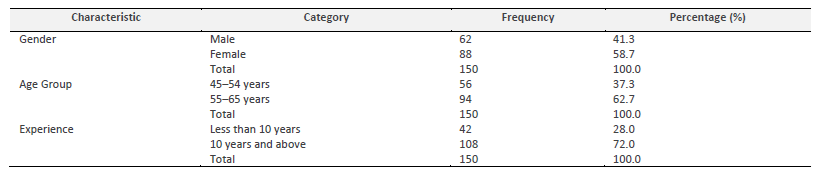
In response to Research Question 1, the profile of principals’ personal attributes in Anambra State public secondary schools, as presented in Table 1, shows that a majority of the principals are female (58.7%), while 41.3% are male. Most principals fall within the 55-65 years age group (62.7%), indicating a relatively older leadership demographic, compared to 37.3% aged between 45-54 years. Additionally, a significant majority (72.0%) of the principals have 10 years or more of administrative experience, while only 28.0% have less than 10 years. The profile of principals' personal attributes in Anambra State public secondary schools is predominantly female, experienced, and older.
Research Question 2: What is the nature of the relationship between principals’ administrative experience and educators’ effectiveness?

In response to Research Question 2, Table 2 reveals that principals' administrative experience is highly and positively related to educators' effectiveness, with a strong correlation coefficient (r) of 0.824. This indicates a strong linear relationship between the two variables. The coefficient of determination (r² = 0.679) shows that 67.9% of the variance in educators’ effectiveness can be explained by principals' administrative experience. This means that more experienced principals tend to foster higher levels of educator effectiveness in public secondary schools in Anambra State.
Research Question 3: How does principals' age correlate with educators’ effectiveness?

In response to Research Question 3, Table 3 shows that principal's age has a low positive correlation with educators’ effectiveness, with a correlation coefficient (r) of 0.163. The coefficient of determination (r² = 0.027) indicates that only 2.7% of the variance in educators’ effectiveness can be explained by the age of the principal. Although the relationship is positive, it is weak and suggests that principal age has minimal influence on how effective educators are in Anambra State public secondary schools. Therefore, while age may contribute slightly, it is not a strong predictor of educator effectiveness.
Research Question 4: What is the interactive impact of principals' gender on educators’ effectiveness?

In response to Research Question 4, Table 4 indicates that the principal's gender has a very low positive correlation with educators’ effectiveness, with a correlation coefficient (r) of 0.063. The coefficient of determination (r² = 0.004) reveals that only 0.4% of the variance in educators’ effectiveness can be explained by the gender of the principal. This implies that principal gender has virtually no meaningful impact on educator effectiveness in public secondary schools in Anambra State. Although the correlation is slightly positive, the relationship is negligible and statistically insignificant.
Research Question 5: How do principals' administrative experience, age, and gender correlate with educators’ effectiveness?
Table 5 Relationship between principals' administrative experience, age, and gender correlates with educators’ effectiveness

In response to Research Question 5, Table 5 shows that when principals' administrative experience, age, and gender are considered together, there is a high positive correlation between these combined personal attributes and educators’ effectiveness, with a correlation coefficient (r) of 0.833. The coefficient of determination (r² = 0.694) indicates that 69.4% of the variance in educators’ effectiveness can be explained collectively by the principals’ administrative experience, age, and gender. Among these variables, administrative experience appears to be the strongest contributor to the relationship. This finding suggests that while age and gender have minimal individual influence, their combined effect, especially alongside experience, plays a significant role in shaping educator effectiveness in Anambra State public secondary schools.
Hypothesis 1: Principals' administrative experience is not related to educators' effectiveness.

Table 6 presents the result of a Pearson correlation analysis between principals' administrative experience and educators' effectiveness. The analysis reveals a strong positive correlation (r = 0.824), which is statistically significant at the 0.05 level (p = 0.000). This means there is a significant relationship between principals' administrative experience and educators’ effectiveness.
Hypothesis 2: Principals' age is not correlated with educators’ effectiveness.

Table 7 presents the result of a Pearson correlation analysis between principals' age and educators’ effectiveness. The correlation coefficient is r = 0.163, which indicates a low positive correlation, and the relationship is statistically significant at the 0.05 level (p = 0.046). Although the correlation is weak, the result indicates that principal age is significantly and positively related to educators’ effectiveness in public secondary schools in Anambra State.
Hypothesis 3: Principal's gender is not correlated with educators’ effectiveness.

Table 8 presents the result of a Pearson correlation analysis between principal gender and educators’ effectiveness. The correlation coefficient is r = 0.063, indicating a very low positive correlation, and the result is not statistically significant at the 0.05 level (p = 0.442). There is no significant relationship between principal gender and educators’ effectiveness in public secondary schools in Anambra State.
Hypothesis 4: Principals' experience, age, and gender have no significant interactive impact on educators' effectiveness.



In testing Hypothesis 4, which states that principals' administrative experience, age, and gender are not correlated with educators’ effectiveness, the regression analysis in Table 9 shows a strong and statistically significant combined relationship between these variables and educator effectiveness, with a multiple correlation coefficient of R = 0.833 and an R² = 0.694, indicating that 69.4% of the variance in educator effectiveness is explained by the three predictors. The overall model is statistically significant (F(3,146) = 110.578, p = .000). Among the predictors, principals’ administrative experience has the strongest and most significant contribution (β = 0.816, p = .000), followed by age (β = 0.115, p = .013), while gender has no significant effect (β = 0.046, p = .318). Therefore, the null hypothesis is rejected, and it is concluded that principals' administrative experience, age, and gender, particularly the first two, significantly correlate with educators’ effectiveness in public secondary schools in Anambra State.
4. Discussion
The profile of principals' personal attributes in Anambra State public secondary schools is predominantly female, experienced, and older. The dominance of female principals in the system may be due to gender-sensitive recruitment and promotion policies in the education sector, where women are often given leadership opportunities due to their perceived nurturing, administrative diligence, and long-term career stability in education. The prevalence of older and more experienced principals likely reflects the career structure in the civil service, where promotion to principalship typically requires long service years, allowing only senior educators to attain such positions. Additionally, delayed retirement or limited opportunities for early leadership transition may also contribute to the older age profile. This finding supports existing literature that highlights how gender equity initiatives, civil service promotion systems, and cultural perceptions of leadership roles influence the demographic composition of school leadership. According to Eagly and Karau (2002), gender role congruity theory suggests that women are more likely to be accepted into leadership roles in nurturing environments like schools, where their interpersonal and administrative strengths are valued. Hargreaves and Fullan (2012) further emphasize that female leaders are often perceived as collaborative and relational, making them suitable for educational leadership. Angwaomaodoko (2023) observed that in the Nigerian context, women increasingly occupy leadership roles due to policies that encourage their upward mobility in public service. The Wallace Foundation (2021) and Darling-Hammond et al. (2022) also note that principal positions are often attained after decades of teaching and administrative service, which explains the dominance of older and experienced individuals in these roles. Moreover, Research Outreach (2023) asserts that structural bottlenecks and a lack of leadership succession planning often delay generational transitions in school leadership, reinforcing an aging principal cadre. This finding strongly supports the assertions of Pounder and Sanzo (2023), who emphasized that administrative experience significantly correlates with institutional leadership effectiveness, particularly in developing educational contexts. Similarly, Kebe et al. (2025) found that experienced principals possess refined skills in professional development facilitation and teacher mentorship, which directly contribute to enhanced teaching quality.
There is a strong and statistically significant positive correlation between principals' administrative experience and educators’ effectiveness (r = 0.824, p < 0.05). 67.9% of the variation in educator effectiveness is explained by administrative experience. The significant positive relationship between principals' experience and educator effectiveness (r = 0.824) suggests that leadership expertise gained over time translates into better decision-making, instructional supervision, conflict resolution, teacher mentoring, and school management. Experienced principals are more likely to have developed effective leadership styles, cultivated professional networks, and understood the internal dynamics of school environments, all of which contribute to supporting and enhancing teachers' professional performance. This finding aligns with extensive research emphasizing the critical role of principal experience in shaping school effectiveness and teacher performance. Grissom, Loeb, and Master (2013) found that principals with more years in leadership demonstrate superior instructional leadership and exert greater influence on teacher quality and student achievement. Similarly, Darling-Hammond et al. (2022) stress that experienced principals are better equipped to support educators through mentoring, data-informed decision-making, and fostering collaborative school cultures. The Wallace Foundation (2021) also reports that leadership effectiveness improves with time as principals refine their skills in supervision, strategic planning, and teacher development. According to Ping He et al. (2024), administrative experience significantly predicts teacher motivation and professional growth, particularly in resource-constrained environments. Furthermore, the UNC School of Education (2022) highlights that sustained leadership tenure enables principals to build trust, implement long-term reforms, and drive instructional improvements. Osiesi et al. (2024) demonstrated that administrative tenure directly impacts organizational effectiveness through improved staff supervision and resource management capabilities. Gechere et al. (2025) further corroborate these findings, noting that experienced principals exhibit superior instructional supervision skills, leading to measurable improvements in teacher classroom performance and student engagement levels.
Principals' age has a low but statistically significant positive correlation with educator effectiveness (r = 0.163, p = 0.046). Only 2.7% of the variance in educator effectiveness is accounted for by age. While age correlates slightly with educator effectiveness (r = 0.163), it explains very little variance (2.7%). This implies that age alone does not equate to leadership competence unless it is complemented by experience and professional development. Younger principals may possess innovation and energy, while older ones offer maturity and wisdom; however, it is the practical application of accumulated experience, not chronological age, that drives educator outcomes. These findings are supported by a growing body of educational leadership literature emphasizing that demographic traits alone, such as age and gender, do not determine leadership effectiveness, but must be contextualized within experience and professional competence. Regarding age, studies like Hattie (2008) and Hallinger et al. (2016) suggest that while older leaders may bring maturity and institutional memory, their effectiveness is only realized when combined with active leadership engagement and skill development. Grissom and Loeb (2011) also note that age correlates weakly with outcomes unless linked to contextually relevant experience and training.
Principals' gender has a very weak, statistically insignificant correlation with educator effectiveness (r = 0.063, p = 0.442), explaining only 0.4% of the variance. The weak, non-significant correlation between principal gender and educator effectiveness (r = 0.063) highlights that leadership effectiveness is not determined by gender, but rather by leadership style, interpersonal skills, and management capacity. This finding supports a gender-equitable perspective on school leadership, reinforcing that both male and female principals can be equally effective when given equal opportunities and responsibilities. In terms of gender, extensive meta-analyses (e.g., Eagly & Karau, 2002; Shaked et al., 2018) reveal that male and female principals exhibit comparable levels of effectiveness, with differences more rooted in leadership style than performance. Education Next (2005) and Angwaomaodoko (2023) emphasize that when structural barriers are minimized, both genders lead schools successfully, reinforcing that gender is not a significant predictor of educational leadership outcomes.
Principals’ administrative experience, age, and gender collectively have a strong, statistically significant correlation with educator effectiveness (R = 0.833, R² = 0.694, p = 0.000). The model explains 69.4% of the variance in educator effectiveness. When considered together, these personal attributes strongly predict educator effectiveness (R² = 0.694), primarily due to the overwhelming contribution of administrative experience. This indicates that while gender and age may serve as background factors, it is experience that mediates their collective influence, making it the dominant predictor. This emphasizes the need for leadership development, mentorship, and strategic succession planning that values competence over demographic traits. The strong collective impact of administrative experience, age, and gender (R² = 0.694) aligns with multidimensional leadership models promoted by Darling-Hammond et al. (2022) and the Wallace Foundation (2021), which highlight that the intersection of experience, contextual awareness, and leadership capacity drives educator effectiveness, not demographic factors in isolation. The finding reinforces calls from the UNC School of Education (2022) and Ping He et al. (2024) for policy reforms focused on leadership development pipelines, mentorship, and performance-based advancement, rather than age- or gender-based assumptions.
Conclusion
Based on the findings of this study, it is concluded that principals’ personal attributes significantly influence educator effectiveness in public secondary schools in Anambra State, with administrative experience emerging as the most critical factor. While age and gender individually show minimal predictive power, their combined influence, particularly when mediated by experience, demonstrates a strong impact on educator outcomes. The study affirms that effective school leadership is not a function of personal attributes but of the practical application of professional expertise, leadership competence, and administrative skill. Therefore, efforts to improve teacher effectiveness and overall school performance should focus on strengthening leadership capacity, rather than relying solely on tenure, seniority, or demographic representation.
Implications and Recommendations
The findings of this study imply that principals’ administrative experience is a critical determinant of educator effectiveness in public secondary schools, far more influential than age or gender. While older and female principals predominate in Anambra State, it is not their demographic profile but their accumulated leadership experience that enhances teacher performance. The weak relationship between age and educator effectiveness suggests that maturity alone does not guarantee leadership success unless accompanied by relevant administrative competence. Similarly, the insignificant influence of gender reinforces the notion that effective school leadership is gender-neutral, grounded instead in professional capacity, leadership style, and contextual responsiveness. Collectively, the results highlight the need for education stakeholders to prioritize experience-based leadership development, performance-driven recruitment, and inclusive succession planning to ensure that the most competent individuals, regardless of age or gender, are entrusted with school leadership responsibilities.
Recommendations
The following were recommended:
The Ministry of Education and school boards should invest in continuous professional development, mentoring, and leadership training for aspiring and serving principals, with a focus on instructional supervision and staff management.
Appointments to principalship should be competence-based rather than age- or tenure-based. Criteria should include demonstrated leadership ability, prior performance in school management, and evidence of commitment to teacher development.
Maintain equal access to leadership roles for male and female educators. While gender does not predict effectiveness, policies should ensure inclusivity and remove barriers that hinder either gender from assuming leadership.
Develop a structured system to identify and prepare potential school leaders early in their careers. This ensures leadership continuity and minimizes the reliance on delayed promotions or late-career appointments.
Introduce performance-based evaluation tools that measure how well principals use their experience to drive educator effectiveness. Encourage accountability frameworks that link leadership outcomes to measurable teacher performance indicators.
Promote a balance of younger and older principals to blend innovation with wisdom. Provide leadership roles to promising younger educators while pairing them with experienced mentors for guided practice.
Acknowledgements
The Authors acknowledge and appreciate the enabling research environment provided by the Management of the Delta State University, Abraka.
Authors' contribution
Conceptualization, V.N. and A.O.E.; data curation, R.A.; formal analysis, V.N.; funding acquisition, V.N., A.O.E. and R.A.; investigation, V.N., A.O.E. and R.A.; methodology, V.N.; project administration, A.O.E. and R.A.; resources, V.N., A.O.E. and R.A.; software, V.N.; supervision, V.N., A.O.E. and R.A.; validation, A.O.E.; visualization, V.N.; writing- original draft, V.N.; writing- review & editing, A.O.E. and R.A.

