




 Inglês (pdf)
 Artigo em XML
 Referências do artigo
 Tradução automática
 Enviar este artigo por email
 Citado por SciELO
  Similares em
SciELO
Similares em
SciELO 
 Permalink

Introduction: definition of the problem and its relevance
Beyond the variety of designations that various authors have used to refer to contemporary Western societies, all tend to agree on a historical scenario characterised by global social transformations that have affected traditional institutions and different areas of people’s daily lives. All those transformations result from a technological revolution whose major scientific advance is the emergence of information and communication technologies (ICTs). Among other effects, ICTs have allowed the dissociation of time and space, the interaction of the “absent”, and therefore the connection of geographically distant places (Giddens, 1994).
To better illustrate the impacts mentioned above, it is essential to invoke one of the social phenomena that have evolved the most thanks to these tools. We are referring to contemporary migratory processes, whose particularities lie in forming multiterritorialised identities (Melella, 2016), establishing new linkage dynamics and renewing transnational social practices. In this way, it can be said that ICTs have helped to overcome the sense of uprooting generally associated with international migration processes. Nowadays, the rupture caused by geographical distance is attenuated by an “imagined presence” that is virtuality expressed and allows immigrants to remain involved with their country of origin (Melella, 2016).
This article seeks to understand some of the influences of the use of what is globally one of the most popular communication platforms - the digital social networks (DSNs) - in the daily lives of immigrants. Furthermore, it aims to understand how these practices contribute to the construction of a transnational space (Faist, 2015), considering that this expression refers to the maintenance of ties between the immigrants and their country of origin as well as the formation of relationships with their compatriots.
As an empirical case, we have chosen to analyse the Peruvian community residing in Portugal, which has never been the object of any study. Peruvian immigration has been present in Portugal for over thirty years. According to the statistics from the Serviço de Estrangeiros e Fronteiras (Gabinete de Estratégia e Estudos, 2023), in 2021 there were 466 Peruvian immigrants living in Portugal. Regarding their geographical distribution, Peruvian citizens are mainly located in Lisbon (the country’s capital), its surroundings and its second-largest city, Oporto. There is also a tiny proportion who live in small towns and rural areas in the country’s interior, as well as in the autonomous region of Madeira Island.
The general objective of the exploratory research presented in this article was to know the role played by DSN in the interactions and relationships with the society of origin, the receiving society, as well as with the community of compatriots. The research problem was then the following: what is the social impact of the use of DSNs on the Peruvian community living in Portugal? Therefore, we will focus on analysing the communication and symbolic production practices that arise from appropriating digital platforms and instant messaging services.
The article is structured as follows: the theoretical and conceptual framework is presented in sections 2 and 3. Section 2 discusses the role ICTs can play in transforming traditional immigrants into “e-migrants”, while section 3 examines the role of DNSs in the construction of transnational spaces. Section 4 presents the research methodology that underpins the empirical component of this article, and section 5 discusses the main findings. This section is divided into the following subjects: use and frequency of use of DSN, motivations for joining virtual communities, participation in activities disseminated through the networks, and the Facebook group “Peruvians in Portugal” as a particular virtual community. Section 6 aims to contribute to the discussion on the relationship between virtual spaces and national identity. The article concludes with some final remarks and considerations about the use of ICTs by Peruvian immigrants living in Portugal.
Being an “e-migrant” in the era of ICTs
Like many other global communication phenomena, DSNs have been at the centre of debate and reflection. Migration processes have not been immune to the emergence of the Internet and online social networks. On the contrary, these technologies have rapidly transformed into fundamental tools to generate, preserve, and extend personal, cultural, or social networks in a transnational sense (Riezu et al., 2014). It is worth saying that the very condition of migrants has changed from the figure of the “uprooted migrant” to the situation of the “connected migrant”, characterised by autonomy and freedom from geographical constraints (Diminescu, 2008). The convergence of these two themes of social importance - international migration and DNSs - has revealed new social practices that deserve to be studied. As Bilecen and Lubbers (2021) pointed out, DSNs play essential roles in pre-migration, transit and post-migration phases and the formation of transnational communities. In a similar investigation on the role of ICTs in the establishment of migrant transnational ties, Peñaranda (2010) concluded that the consequences of this relationship could be grouped into three analytical axes: (a) the “generation of technological proximities” - ways to reduce the geographical distance with a symbolic approximation that may occur through voice (audio), image (photographs and videos), and gift sending; (b) the “connected presence” - ICTs allow daily interactions and exchanges between migrants and their loved ones. It also can be said that the connected presence represents what would traditionally be like “sharing daily life”; (c) “embodied speed (velocidad incorporada)” - the immediacy with which any type of ICT-mediated material is sent or received reinforces the feeling of physically being present and connected even though being away.
In an effort to understand the relationship between migratory processes and ICTs, it is possible to identify several approaches. Benítez (2011) describes four fields that stand out in this regard: the first refers to the role that ICTs play as a fundamental component that intervenes in the entire migration process (from the departure decision, during displacement, to the arrival at the destination or even the return stage) besides helping to maintain links and communicational connections. The second approach highlights ICTs as instruments to facilitate sending remittances, thereby reducing costs and time in this economic activity. This economic approach also considers the role of these tools in local projects that contribute to the development of migrant communities. The third approach focuses on the impact of ICTs at the transnational level. Benítez points out that the study of the use of ICTs must be contextualised in time and space to understand the new everyday routines of migrants through online social networks. For Benítez (2011), the last field of research refers to the consequences of the digital gap, understood as a new form of social inequality derived from unequal access to new ICTs.
It seems to be relevant to address here the concept of “e-migrant”, proposed by Olivera, to refer to those who have gone through a migration process which, due to the use of ICTs, has not meant the abandonment of the main links with their place of origin (Olivera, 2011). The concept of e-migrant requires the incorporation into the same analytical framework of the country of origin and the destination country and highlights the creation of a social space of interactions in a network which in turn interacts with the face-to-face social relationships. According to Quéau (1993) , e-migration implies a hybridisation between the real and the virtual).
What Olivera is referring to is that technological innovations have established a new context in which migration can no longer be analysed as a mobility process that involves two distant places with independent social networks and social structures. On the contrary, contemporary e-migration defines the mobility processes of the persons who have physically left their country but who haven’t abandoned their cultural roots, mainly due to the interactivity provided by the implosion of communication technologies (Olivera, 2013). Social ties are no longer limited to a geographical territory, a situation that strongly differs from the migrations of the past. Now individuals can maintain connections at the global level, building transnational social spaces in which cultural resources and values are exchanged, restructured, and regulated. Migrants are now situated within multiple social fields, at various degrees, and in multiple places, including those who have moved and those who have stayed (Levitt and Schiller, 2004).
DSN and transnationalism
In its broadest sense, transnationalism refers to “the occupations and activities that require regular and sustained social contacts over time across national borders for their implementation” (Portes, Guarnizo and Landot, 1999: 219). In the contemporary context, distinguished by the intensity of the connections between physically remote places, the meaning of transnationalism has often been confused with the one of globalisation. For this reason, Sinatti (2008) raises the need to differentiate the two concepts: while globalisation includes broader phenomena, such as the global movements of capital and macro-economic processes, which frames it in the dominant networks, transnationalism commonly focuses on the minor flows, such as political, cultural and economic practices. On the other hand, globalisation processes generally concern all individuals in the world regardless of where they live, while transnational activities usually spread from one nation-state to another (Sinatti, 2008).
One of the pioneering conceptualisations of the subject of transnationalism from the analytical perspective of migration was proposed by Schiller, Basch and Szanton-Blanc at the beginning of the 1990s. The conceptualisation explains transnationalism as the development of social fields connecting the sending and the receiving countries through the establishment and maintenance of relationships that go beyond geographical spaces, thanks to which, migrants (who in this context are also called “transmigrants”) have the possibility of intervening and participating in more than one society (Schiller, Basch and Szanton-Blanc, 1992; Solé, Parella and Cavalcanti, 2008).
In contemporary migrations, the intensity of transnational practices and flows has arisen and diversified due to several technological innovations. In this sense, as Peñaranda points out, “the current practices, relationships and links are not only more intense than in previous times but are also affected by the possibility of being able to be carried out simultaneously, here and there” (2010: 240). In a transnational migration context, the notion of “distance” no longer alludes to a schism but to the possibility of being “present” in a place despite being geographically far away (Peñaranda, 2010).
Transnationalism has its particularities that lie mainly in the new forms of relationships between territories and political and sociocultural orders since these forms dictate how individuals configure their belongings and identities in a constantly changing world (Ribeiro, 2003). According to Ramírez (2007) individuals have stopped following the old patterns of inclusiveness through political entities (e.g. the nation-state) or territories (e.g. country of birth). Now, international migrants design new forms and levels of integration, as a consequence of which transnationalism can no longer be understood from a territorial logic but as a “diffuse and disseminated network” where the space is reconfigured and a recent political-cultural domain called cyberspace and cyberculture is established (Ramírez, 2007).
Although the first studies on transnationalism have focused on its economic dynamics, it is also necessary to pay attention to the “familiar” and “affective” aspects since they constitute important resources that migrants mobilise to better cope with migration. As Parella and Cavalcanti stated: “It is not just economic ties that flow within transnational communities and families. The functions of affection and care are recomposed with migration. They are also part of the resources that flow through networks, shaping the relations of ‘reciprocity’ that govern the migratory chains” (Parella and Cavalcanti, 2008: 225). So, it is also essential to observe how the forms and meanings produced at the family level are being reconfigured. In a migration context, a new social construction emerges: the “transnational family” or “multi-local family”. As Bryceson and Vuorela (2002) point out, in this type of family, some of its members live in distant spaces for a short or long period. However, this does not prevent them from staying together through the sense of well-being they develop by continuing to belong to their community. The authors also mention that the particularity of these transnational families lies in the flexibility of their relations with the country of origin. According to them, “today’s transnational families are characterised by a more flexible relationship to their place of origin, ethnicity or national belonging” (Bryceson and Vuorela, 2002). Unlike the families involved in the migratory processes of the past, the penetration of technologies helps to maintain the continuity of social relations between members, facilitating the management of the family unit. This is expressed, for example, when the sentimental cost of the separation is attenuated or when all the members of the family, despite their physical distance, are regular participants in essential decisions (Parella and Cavalcanti, 2008).
The concepts of transnationalism and transnational spaces have provided dynamism and flexibility to the study of the new forms of relationships between migrants and between migrants and their country of origin in a context in which the significance of time and space has been reconfigured and where the irruption of information, communication, and transport technologies have facilitated the “uprooted” migrant becoming a “connected” one.
Methodology
Considering that the research presented here falls within a sociological perspective, two methodological lines have been mobilised: one to portray the Peruvian immigrants living in Portugal and another to evaluate their use of DSNs in the construction of a Peruvian transnational community. A two-stage sequential design was then adopted. The first stage included the collection and analysis of qualitative information. To explore some of the characteristics of the studied group, a set of semi-structured interviews was carried out, and its content was analysed. In the second stage, to deepen the knowledge about the main variable - the role played by the DSNs in the lives of Peruvian immigrants in Portugal - quantitative methods were applied through data-collection techniques, such as an exploratory online survey and statistics obtained from the web service GryTics,1 a social media analytics platform specialised in Facebook groups. This design allowed the triangulation of the information obtained and to contrast and confirm the qualitative and quantitative data to achieve a greater validity of the investigation.
Table 1 List of interviewees
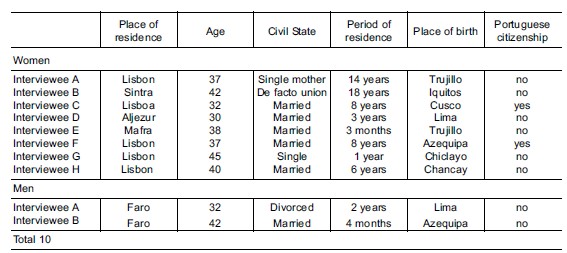
Source: Own elaboration based on the sample obtained through the structured interviews carried out between 29 October 2016 and 15 April 2017.
The first stage comprises 10 interviews applied to a snowball non-probabilistic sample of eight women and two men. The process of conducting the interviews and approaching the interviewees was facilitated by the fact that the second author is, herself, Peruvian. All interviews were conducted in Spanish and digitally recorded. The average duration was 50 minutes. The anonymity of all interviewees was guaranteed, and after transcription, the content of the interviews was coded and analysed using the NVivo 12 Plus software. This procedure allowed a first approach to the general characteristics of the Peruvian community living in Portugal, motivation for the migration, adaptation and integration in the new country, and the degree of familiarity with the use of DSN.
In the second stage of the investigation, DSNs and instant messaging platforms (PMIs) were used, since they enabled access to the Peruvians’ virtual communities, such as the Facebook groups Peruanos em Portugal (“Peruvians in Portugal”), Peruanos residentes en Portugal (“Peruvians residing in Portugal”), Peruanos en Portugal/Norte (“Peruvians in Portugal/North”) and the WhatsApp group Peruchos en Portugal (“Peruchos in Portugal”).
Regardless of the virtues of the traditional methods and techniques of classical sociology and ethnography, leaving aside the tools provided by the online world would be omitting a contemporary space of social interaction and social construction of reality. As Ruiz-Velasco (2003) points out, it is there where new ways of living are developed, new ways of being and presenting ourselves. It was precisely through these platforms that more informants could be contacted, and the survey had a greater reach. This strategy has already shown its advantages in other investigations on similar subjects (see Larrea and Marques, 2015).
The second sample is made up of the responses to a survey that was disseminated through online communication platforms between 4 June and 18 September 2017. The purpose of this exploratory online survey was to know the role played by DSNs in the daily life of Peruvian immigrants in Portugal. It is necessary to reiterate that the survey was only disseminated on the Internet since the objective was to reach an audience proficient in ICTs. Of the 33 participants (7% of the universe), 25 are women, and eight are men. Likewise, of the total number of respondents, half of them belong to the age group between 26 and 35 years, 7 are between 36 and 45 years old, 3 are between 46 and 55 years old; 3 of people are over 56 years old; and 3 belong to the age group between 18 and 25 years old. For the creation of the questionnaire, Google Forms, a free package that allows the easy collection of information through online forms, was used.
One of the advantages of an online survey is that through a link, it is possible to publish and distribute a questionnaire on web pages, blogs, emails, DSNs, or any digital platform. In this case, it was decided to use Facebook since this was the best way to reach the members of online groups, such as “Peruvians in Portugal”, “Peruvians residing in Portugal”, and “Peruvians in Portugal/North”. In addition to this, the survey was also shared in communities formed in instant messaging services, such as WhatsApp.
With the rise of online communication platforms, the need to know their users’ profiles and behaviour has also grown. In this sense, “web analytics”, also known as “digital analytics”, is an activity capable of gathering, measuring, evaluating, and reporting Internet data. Nowadays, there are various tools to study the activity of any digital platform - blogs, websites, online networks, etc. This research used an application that describes and measures the processes that take place in DSNs: GryTics. This tool allows the obtention of different types of statistics and indicators that may be grouped as follows: (a) “basic statistics”, e.g. those that provide an overview through a summary of general indicators (number of “likes”, “comments”, “messages”, number of active members, etc.; this function identifies the percentage of each activity carried out by the group and indicates the participation rate of the most involved members; (b) “message statistics” that help to determine the topics that most interest the participants of a Facebook group; (c) “statistics about members”, a function that identifies the most dynamic and influential members of a virtual community.
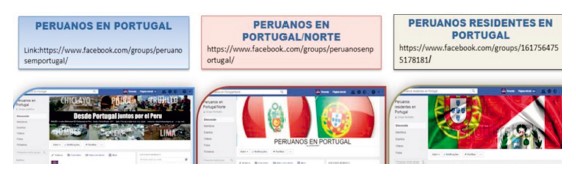
Source: Images captured from Facebook all the time of the research
Figure 1 Facebook groups where the questionnaire was distributed
GryTics was used as an interesting approach to the activities and contents of the Facebook group “Peruanos en Portugal” (Peruvians in Portugal). Created in 2010, this group was the first virtual community on Facebook made up of Peruvian citizens residing in Portugal, and, at the time of the research, it had more than 500 members. The results of this procedure complemented the information obtained through the other methods, namely the interviews and the online survey.
Peruvian “e-migrants” in Portugal and their use of DSNs
According to what was expressed by the interviewees, it can be said that the whole group is familiar with the use of ICTs. Although the level of use may vary according to factors such as sex, age, and level of education, all seem to have the basic knowledge required. Another reflection that emerged from the responses of the interviewees is that the most popular DSN among this group of immigrants is Facebook, perhaps influenced by the fact that in their country of origin, it is also the most used.
Facebook has also become a primary means of communication and interaction to obtain, disseminate, or advertise information related to these persons. All interviewees stated they were part of at least one of the virtual Peruvian communities on that platform. The assessment that this group makes of this digital social network, in addition to the communication benefits, lies in the emotional benefits that stem from its use. For example, an intensive flux of communication between e-migrants and their relatives who stayed in Peru can counteract the feelings of longing and melancholy. In this sense, Peruvian immigrants in Portugal still maintain strong connections to their previous lives. As this interviewee puts it:
Social networks have changed the way we communicate with our families. In a single sentence, I can say that they have cut the physical distance. [Interviewee F, woman, 37 years old]
Social media helps to bridge that distance, which is often painful. Without a doubt, this medium has brought many good things. [Interviewee H, woman, 40 years old]
As neatly expressed in their statements, immigrants feel the need to maintain affective ties with their relatives in Peru, a necessity that, to a great extent, they satisfy through DSN given their 2.0 qualities (Calderon-Canola, 2012)2
Through social media, we can communicate with our families and, thanks to the webcam, even feel physically there (in Peru). Social media helps to bridge that distance, which is often painful. Without a doubt, this medium has brought many good things. [Interviewee H, woman, 40 years old]
This excerpt is particularly revealing because it indicates that the appropriation of the DSN by immigrants is not only linked to the communicative sphere but also to the figure of an “imagined presence” (virtually being there), allowing the fluidity of affective ties and neutralising the “nostalgia” caused by physical distance (Melella, 2016).
Social networks keep us close to family and friends; thanks to them, we communicate more frequently, and thus the nostalgia calms down a bit. [Interviewee A, woman, 57 years old]
Use and frequency of use of DSN
All the respondents to our survey stated that they have a Facebook account, thus confirming the information from the interviews that this is the most popular digital social network among the Peruvian community in Portugal. 14 of them (42.4%) are also on Instagram, and 14 (42,4%) have an account on LinkedIn. At the time of the research, Twitter only reached 5 (15.1%) of the respondents. It is essential to highlight that although blogs are not DSN but rather personal web pages where the author periodically publishes topics of interest, they managed to have the preferences of 4 of the respondents (12.1%). Lastly, in the “others” option, where respondents were free to write other options that were not predetermined, 3 of them (9.1%) included the use of e-mail despite it not being a DSN.
Regarding the frequency of use, it can be observed that most of the Peruvian immigrants who answered the survey may be considered to be very active on Facebook since 14 (42.4%) stated they usually check the platform “several times a day”, and 6 (18.2%) said they do it in a daily basis. The opposite situation occurs with LinkedIn, which, despite occupying second place in terms of registered users, is also the social network with the lowest level of attendance.
Motivations for joining virtual communities.
The information obtained from the interviews and from the survey reveals that all the informants visit, belong to, or follow some Facebook group. The groups “Peruvians in Portugal”, “Peruvians residing in Portugal”, and “Peruvians in Portugal/North” are the most popular.
Concerning the level of participation in those Peruvian virtual communities, 12 (36.4%) of the survey respondents stated that they mainly have an “observer” role, which means that they are users who usually do not propose content. Still, they are receivers of the published information. On the other hand, 11 of them (33.3%) indicated that they have “little participation”, which means that they sporadically intervene in these platforms, either with news or opinions that interest the group 7 ( 21.2%) users intervene regularly, while only 3 (9.1%) state that they “actively participate”; that is, they are aware of what happens in these virtual spaces and collaborate with content that is useful for the entire virtual community.
To determine the main motivations to join or follow virtual communities, the survey presented a predetermined list of reasons from which the respondents had to choose (they were also given the possibility of adding alternatives that best describe their reality). From the information obtained, it can be concluded that the primary motivation driving Peruvian immigrants to be present on social media platforms is to “know the news on events and meetings of the Peruvian community in Portugal”. This motive was supported by 64.5% of respondents. Another justification - that was supported by 48.4% - was the need to “disseminate information concerning Peru or Portugal”. One must not forget that online platforms also have a communication function whereby users can be news broadcasters . Next, with a figure close to 45.2%, is the motivation to “meet other compatriots”, an ordinary situation that characterises immigrants since, after making new contacts, they form social and support networks, which can become sources of sociability and cooperation and mutual solidarity in the destination country (Setién et al., 2011). But these platforms are also considered as a means of helping to “reduce nostalgia”, as indicated by 29% of the respondents who said they follow them to counteract the longing for their home country. Finally, another motivation that stood out for almost 26% of the participants was the “search for information or advice on residence in Portugal”. This is to say that e-migrants use virtual communities as tools to obtain knowledge from compatriots who have already gone through different experiences related to the adaptation process.
Participation in activities disseminated through the networks
Peruvian migrants living abroad participate enthusiastically in several events linked to their country (Gonzáles-Lara, 2009). Among these events are, for instance, the celebration of Independence Day (July 28), Mother’s Day (2nd Sunday of May), Creole Music Day (October 31), and various religious gatherings, such as mass and the procession in honour of the Señor de los Milagros (Lord of Miracles), Christmas, and New Year festivities. These traditional events, which include popular music, typical dances, and gastronomy, are widespread in Peruvian groups living abroad since they express or reinforce their cultural identity and sense of community. However, the dissemination of these events is of the utmost importance because their level of participation will depend on it. Today, it is well known that DSNs are also powerful (and free) dissemination and promotional tools. The institutions connected to migration (such as embassies, consulates, or associations) and the immigrants themselves have been able to take advantage of this potential.
The first figure that emerges from this dimension is that 85.7% of people who took notice of these activities through online platforms have physically participated in at least one of them. In comparison, only 14.3% have been indifferent to the information. Regarding the activities that were better received, close to 60% of the respondents stated that they have “attended meetings during holidays”. Among these events are Independence Day, religious meetings commemorating the Señor de los Milagros, etc. It is worth noting that these events are usually organised by the Embassy of Peru in Portugal. In the second place, we find “social gatherings” (reuniones de convivio), with 37.5% confirming their participation. These meetings are initiatives of Peruvian immigrants and do not necessarily include the entire community but rather groups determined by some affinity. Finally, with the same percentage (25.0%) are the “cultural events”, such as the visit of the Peruvian ship Union to the port of Lisbon3 and exhibitions of Peruvian products, among others, and “solidarity activities”.
Survey respondents were also asked to assess the importance of these platforms for their community and, on the other hand, if they fulfil the role of an integrating tool. In the first case, 72.7% of those who participated considered DSNs to be fundamental tools for developing the Peruvian community in Portugal, while the remaining 27.3% were hesitant, answering only with “maybe”. However, it should be noted that there were no negative answers to this question.
Although all recognise the positive impact that DSNs have on their daily lives, these platforms cannot be responsible for the migrant’s integration (or the lack of it) into the host societies since this process depends mainly on institutions responsible for the migration policies. Notwithstanding, when asked if these DSNs had helped their integration into the Peruvian community in Portugal, 51.5% of these migrants answered affirmatively, while with the same percentage (24.2%) were those who said “maybe” and those who gave a negative answer. The majority of the interviewees also stated that the use of DSN contributed to their integration into Portugal.
A particular virtual community: the Facebook group “Peruvians in Portugal”
Virtual communities can be generically defined as groups of individuals who meet “electronically” to address issues of mutual interest, where there is no physical distance that restricts their participation. However, this occupation of the virtual space does not free them from the “off-line” world since this appropriation aligns with the previous knowledge, experiences, and imaginaries of its users (Sandoval and Guerra, 2010). In the case of the “virtual communities of migrants”, social actors share the national origins and symbolic bonds that are products of their condition as immigrants (Saturnino, 2015). According to Sandoval and Guerra (2010), in the first stage, transnational communities formed by migrants were “imagined communities”, i.e. politically constructed symbolic abstractions. But with the incorporation of virtuality - mediated by ICTs and the Internet, those communities extend their presence and tangibility.
A brief search on Facebook located three groups related to the migration from Peru to Portugal. However, after analysing the number of members, length of activity, and level of participation of each of them, the group “Peruvians in Portugal” (Peruanos en Portugal), the first virtual community created on Facebook in 2010, which has greater popularity and frequency of intervention from its members, was chosen. During the data-collection stage, this virtual community had 534 members, whose common reality is defined as Peruvian immigrants residing in Portugal. However, some cases also include family members (specifically Portuguese spouses) and returned immigrants.
As we had already anticipated in the research methodology, in this phase, one of the tools used in the analysis was the GryTics service. However, considering the vast flow of data that has spread since the creation of “Peruvians in Portugal”, the information collection was focused on the period from 30 November 2016 to 29 November 2017.
The objective of this analysis was to understand the activity of this group as “a transnational online community”, so the emphasis has been placed on the production and dissemination of messages. First, it should be noted that the administrators of the group “Peruvians in Portugal” present this virtual space not only as a communication forum but also as a platform for reciprocal help between compatriots:
Hello to all Peruvians who live in Portugal and are encouraged to join this group. This group was born to be able to communicate and create a more united and participative community. It can be used to organise meetings, activities, national holidays, or to request help and information. We hope we can always help each other. [Group “Peruvians in Portugal”, 20104
This introductory message, in addition to highlighting the group’s objectives, assumes a code of conduct that everyone within the community is expected to practise. Regarding the level of activity, 309 members were considered “active”, that is to say, users who have intervened in the platform on several occasions and have played the role of “editors” (64 users who disseminated information on the mural), “commenters” (107 users who gave their opinion on the posts), or as “reactive members” (276 users who responded with a “like” or with an emoticon to the posted information).
According to the statistics provided by GryTics, we can also observe that the number of active members in the FB Group “Peruvians in Portugal” is irregular throughout the year. Only during the months of February, March, and April was a uniform number of active users maintained (between 88 and 89). In this time interval, the content highlighted by the administrators and users, beyond cultural news, was information about the effects of the climatic phenomenon El Niño Costero5 On the other hand, after a decrease, the activity level augmented during July. This is the month of the most important event for the Peruvian community: the celebration of Independence Day, during which it is common to find publications referring to events and social gatherings in virtual space. Finally, during October and November, there was also a growth in the number of active users advertising or commenting on the two events: the “Creole Song Day” and the “Procession of the Lord of Miracles”, all this in addition to the sports news related to the Peruvian Soccer Team in the 2018 World Cup in Russia. According to one of the interviewees:
I think that social networks are an important means of communication for us immigrants; it is because they allow communication with the family to be more frequent, and we can also be better informed about the news in our country. [Interviewee E, woman, 38 years old]
At the beginning of 2017, Peru was affected by the climatic phenomenon El Niño Costero. The news about this phenomenon was spread internationally, not only through traditional mass media but also on social media. Evidently, in the Facebook community “Peruvians in Portugal”, there was great concern about family members, friends and compatriots who were going through hard times in Peru. Some of its members began to organize solidarity activities, namely making their bars and restaurants available to raise funding events. One of those events was called Juntos pelo Perú and the online invitation was the following:
Our brothers in northern Peru need us now, not later, not in a year from now, just at this moment, when you are at home, and they lost everything […]. Any form of help that goes beyond giving a like is more than welcome. Remember that they lost everything, and you only have to lose a little to help them. [Facebook page of Bar Wine & Pisco, 2017]
When addressing the issue of migration, it is impossible not to consider the issues of adaptation and integration in the destination country, a double process through which immigrants seek full participation in the host society and also seek to belong to the communities related to their homeland. In this last case, immigrants seem motivated by factors such as nationality and the sharing of their migrant situation (Lestage, 2001). The shared social situation and cultural background, added to the adaptation effort, reinforce a certain predisposition to homophily, resulting in the establishment of social relationships between individuals who belong to the same expatriate group. Peruvian immigrants, as migrants from other origins, seek to rebuild social networks with their compatriots in their new country of residence, taking advantage of virtual space to form support communities.
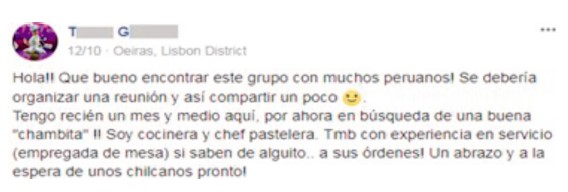
According to the list provided by GryTics, the following publication was the one that obtained the highest score during this study.
As can be seen in figure 2 6 when the user published that message, she had only lived in Portugal for a month and a half; that is, she had just begun her adaptation process. Even though we do not know her migration process, her desire to expand her contacts with their compatriots and to be a part of the Peruvian community can be deduced from her expressions. On the other hand, she requested information on job offers in the areas of cooking and pastry. This request for help with job placement in the destination country highlights the role of transnational virtual communities (Sandoval and Guerra, 2010) as sources of social support that facilitate the adaptation process of its members.
In the integration process into the new country, one of the most critical conditions for the immigrants is to have a legal status that allows them to fully participate in the new society. Peruvian e-migrants are very aware of these issues. They participate in social media also to clarify their doubts about legal and political aspects. In the following post (figure 3) - ranked second in reactions and comments received - a woman shares her plans to migrate to Portugal and consults her compatriots about the needed legal documentation to work and study in Portugal7
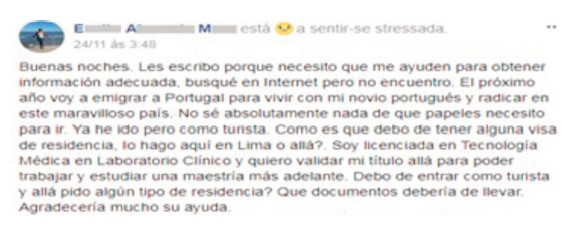
This post received 53 responses, among which the sharing of different migratory experiences, advice about the institutions involved, information on helpful and even welcoming greetings, and wishes of luck for her future life in Portugal stand out.
Virtual space and Peruvian identity
As Saturnino (2015) states, after experiencing displacement from their homeland, after being separated from their loved ones, and feeling increased longing, immigrants manage to minimise those situations by locating cultural symbols - such as customs, habits, modes of language, etc. - that help them to express their national identity. In this case, this type of identity refers to the manifestation of the so-called Peruanidad (“Peruanity”). This term alludes to the Peruvian identity and the reincorporation of cultural traditions and elements of “collective nostalgia” (Gonzáles-Lara, 2010).
Gonzáles-Lara, a Peruvian sociologist, reiterates that Peruvian immigrants redefine their “Peruanity” through a set of symbolic dimensions that combine “the Andean, the Afro-Peruvian, the religious traditions of the colony, the African tradition, the Chinese-Cantonese tradition, as well as the Spanish and Western traditions” (2010: 40). According to the same author (Gonzáles-Lara, 2010), this multiculturalism has resulted in a vast creative production that is evidenced, for example, in the gastronomic variety, in the 3,000 popular festivals, the 1,500 musical genres, or the countless rituals that exist in Peru. All these expressions constitute the sources that nourish the roots, memories, and links between immigrants and their country.
In the online world, the Peruanity of e-migrants in Portugal manifests itself through audio-visual and written publications, which allude to cultural elements of their national identity. One of the most frequent topics is gastronomy, as for Peruvians, cooking represents the manifestation of the miscegenation of all cultures. In this sense, even though the Peruvian community in Portugal is numerically very small when compared to other groups residing in Europe, they take advantage of the virtual space to deal with situations such as the low supply of culinary products or to promote the few Peruvian restaurants that exist in Portugal, turning them into gastronomic social spaces through social gatherings.
Final considerations
The aim of this article was not to present theories or hypotheses that warn that with the development of social relationships through cyberspace, individuals have renounced or considered less significant their physical or personal social ties. It was also not intended to affirm that with the birth of new forms of online communities, traditional community ties have been replaced. What has been raised is the idea that ICTs, the Internet, and mainly DSNs have lessened the “friction of space”, a term used by Hampton (2006) to refer to the costs and time required to establish communications at a distance. In this study, it was maintained that migrant populations are taking advantage of this new technical situation, since online communication largely facilitates the social interactions between them and their country of origin, counteracting the effects of physical distance. Besides the effect of diminishing the “friction of space”, DSNs increase the possibility of reaching a more diverse public, thereby allowing the establishment of relationships between people who are not geographically close. This means that today individuals and groups can create and maintain their social networks based on shared interests or mutual cultural identification, as in the Peruvian virtual communities on Facebook.
First, we intended to know how the DSNs contributed to the maintenance of the links between Peruvian immigrants living in Portugal and their country of origin. We wanted to discover their relationships with the place where they were born and lived - their “spaces of nostalgia” (López and Morán, 2015) - in the “age of the connected immigrant” (Diminescu, 2008).
In spite of the geographical distance, the e-migrant continues to maintain significant social roles in their community of origin, maintains family ties, and establishes new social bonds in their new country. This is why international migrations are described as a transnational phenomenon (Peñaranda, 2010). E-migrants can be there (in Peru) without being there. This connected presence allows the continuity in the present of their old everyday lives and helps them to neutralise or at least minimise the feelings of nostalgia and longing caused by physical distance. In their transnational coexistence, Peruvian immigrants in Portugal use online platforms, such as Facebook, to share their daily lives and to continue taking care of their families despite the geographical separation (Peñaranda, 2010).
The second objective of this study was to discover if the use of DSNs contributed to the interaction between the Peruvians living in Portugal. Here we can allude to the birth of a new dimension of social life; we refer to “virtual communities”, spaces not limited by physical territory, where symbols, agreements, and recognition are produced, contributing to the cohesion and identity of the groups (López and Morán, 2015). In the case of Peruvian immigrants, nearly 100% of them participate in virtual communities on Facebook. For this reason, we made a more detailed analysis of the online group “Peruvians in Portugal”, the oldest community with the greatest number of users and with a higher level of interaction. Beyond the symbolic production that emerges here, it is also important to highlight that among the reasons why Peruvian e-migrants integrate these virtual communities is because they want to have information about cultural events and because they are predisposed to meet other compatriots. These two reasons are linked to their interest in joining their community not only virtually but physically; proof of this is that most of the respondents to the survey and the interviewees said they had attended some Peruvian sociocultural event after learning about it through the DSN. These parallel forms of interaction enable social integration, enhance feelings of belonging, and stimulate the reconstruction of identity (Sandoval and Guerra, 2010).
Another purpose of this study was to discover if the online practices of the Peruvian immigrants in Portugal influence their off-line activities. Invoking some of the concepts of the theoretical framework of this research, it is supposed that the best way to approach this issue is based on the theory of “hybridisation between the real and the virtual”, that is to say, that currently some social or cultural practices born in a real/corporeal setting can be extended to the virtual world, and the same happens with the dynamics that occur through the Internet, and that can expand to off-line reality (Quéau, 1993). This study concluded that DSNs foster the tangibility of the immigrant’s imagined communities: practices that take place in cyberspace also materialise through real (co-)presences (Ramírez, 2007). It is also important to highlight that the process of integrating e-migrants can be improved by the use of the “social capital and knowledge capital” (Ramírez, 2007) obtained in the virtual world. Within the virtual community “Peruvians in Portugal”, e-migrants can find a job or have their administrative procedures facilitated thanks to their interaction on the platform.
All these reflections reinforce one of the conjectures raised at the beginning of this article, which can be summarized as the growing influence that the use of DSNs has on strengthening the transnationalism of the community of Peruvian immigrants in Portugal.
This case study demonstrates that, in a migratory process, distance is no longer synonymous with uprooting but rather represents the continuity of being present despite the geographical distance (Peñaranda, 2010). It also highlights that the term “family” is now redefined as “trans-local family” (Bryceson and Vuorela, 2002) and that “home” ceased being a common physical place of residence to become a social construction that represents mutual obligations of the members of a family despite the distance (Parella and Cavalcanti, 2008).
The acquisition of the transnational character of these conceptual categories is due not only to the development of the transport industry but also to the irruption of ICTs and the establishment of unprecedented communication platforms such as DSNs, which in turn were established as new online social spaces where social actors - in this article, Peruvian e-migrants - reproduce their social relationships, settle their belongings, recreate feelings and imaginaries (such as nostalgia, joy, sadness, worry, national pride, etc.), and express their cultural identity.
Funding
This paper is financed by Portuguese national funds provided by FCT- Foundation for Science and Technology through the project UID/04020: Research Center for Tourism, Sustainability and Well-being.

