




 Inglês (pdf)
 Artigo em XML
 Referências do artigo
 Tradução automática
 Enviar este artigo por email
 Citado por SciELO
  Similares em
SciELO
Similares em
SciELO 
 Permalink

Introduction
Qualitative research conducted in border zones presents researchers with a myriad of complexities and ethical dilemmas in terms of access, field relations and safety and security considerations. The concept of the “border as an unstable place”, as discussed by O’Leary, Deeds and Whiteford (2013), underscores the fragmented and unstable nature of such field research. Research in border regions often focuses on clandestine activities such as human smuggling, contraband trafficking or the cross-border movement of “illegal” or “undocumented” migrants. Rapidly evolving policy changes can further complicate research efforts and exacerbate the vulnerable status of participants. Border scholars emphasize the need for field researchers to remain sensitive to emerging punitive social and political climates. In recent decades, there has been an increasing interest in empirical border studies, however, the discussion of the practical and ethical challenges surrounding empirical border research remains insufficient, in particular in less democratic or non-democratic settings.
In this article, drawing on my own research experience in two distinct border regions - one between Algeria and Morocco, and the other between Algeria and Tunisia -, I reflect upon the particular challenges and obstacles of doing qualitative fieldwork in border areas. The insights discussed here are grounded in ethnographic fieldwork conducted between 2021 and 2024 as part of my PhD research at the SNS in Florence. While the initial plan included fieldwork on both sides of the border, research was ultimately carried out only on the Moroccan and Tunisian sides, as political tensions and restrictive conditions made access to the Algerian side unattainable. The doctoral research underlying this article scrutinizes local security dynamics and their effects on communities across North African borderlands. Research in North African borderlands is challenging due to the difficulty of gaining access to regions characterized by political sensitivity and strategic importance. The lack of transparency or outright secrecy and surveillance surrounding security issues adds complexity as it impacts the reliability and quality of data collected. The second set of challenges revolves around heightened risks to researchers, their collaborators, and participants. These risks include physical threats, compromised confidentiality, and the possibility of exposure to repressive measures by state security agencies. Additionally, ethical dilemmas arise in dealing with vulnerable populations and government entities. What are practical and ethical solutions to the challenges and barriers when conducting qualitative research in difficult places and with a difficult audience? By exploring this question, this article contributes to an ongoing debate about responsible scholarship, seeking to inform university instructors, students and researchers from various disciplines as well as practitioners and policymakers involved in research within challenging contexts.
The article begins with a brief overview of my research project on local security provision in both the Algeria-Morocco and the Algeria-Tunisia border regions. It then proceeds with a section on the challenges that emerged before, during and after the conclusion of my fieldwork. This includes not only gaining access and handling bureaucratic hurdles, but also general ethical and safety considerations when dealing with vulnerable populations. The subsequent sections reflect on the ways in which I engaged with and responded to these challenges. The article concludes by discussing the broader implications of these findings for qualitative data collection in highly securitized border areas.
Fieldwork in North African borderlands
My research focuses on diverse perceptions of security in North African borderlands, exploring the strategies and practices employed by various actors in the security field, alongside the narratives and practices of individuals navigating daily life amidst the unique conditions of the borderlands. As illustrated in Figure 1, most of the research was conducted between 2021 and 2024 in four regions in Tunisia (Gafsa, Kasserine, Kef, Jendouba) and in the Oriental region in Morocco. I conducted in-depth interviews in Tunisia (n = 37) and in Morocco (n =32) and held informal conversations with over 60 research participants in both countries. Interviews were conducted with NGO staff members, journalists, teachers, staff members of local administration, police officers, civil society activists, people involved in smuggling activities (petrol smuggling and drug smuggling) and local residents living in border towns or remote rural border villages. Additional expert interviews were carried out with legal and scientific experts and security practitioners based in the national capitals Tunis and Rabat. In the course of my research in Western Tunisia and Eastern Morocco, I accompanied and assisted local NGOs in their work with rural border communities, attended public events and conducted field trips to border posts and rural villages close to the border. Immersion in each of these places provided an in-depth look at local dynamics beyond the fairly artificial boundaries of interviews.
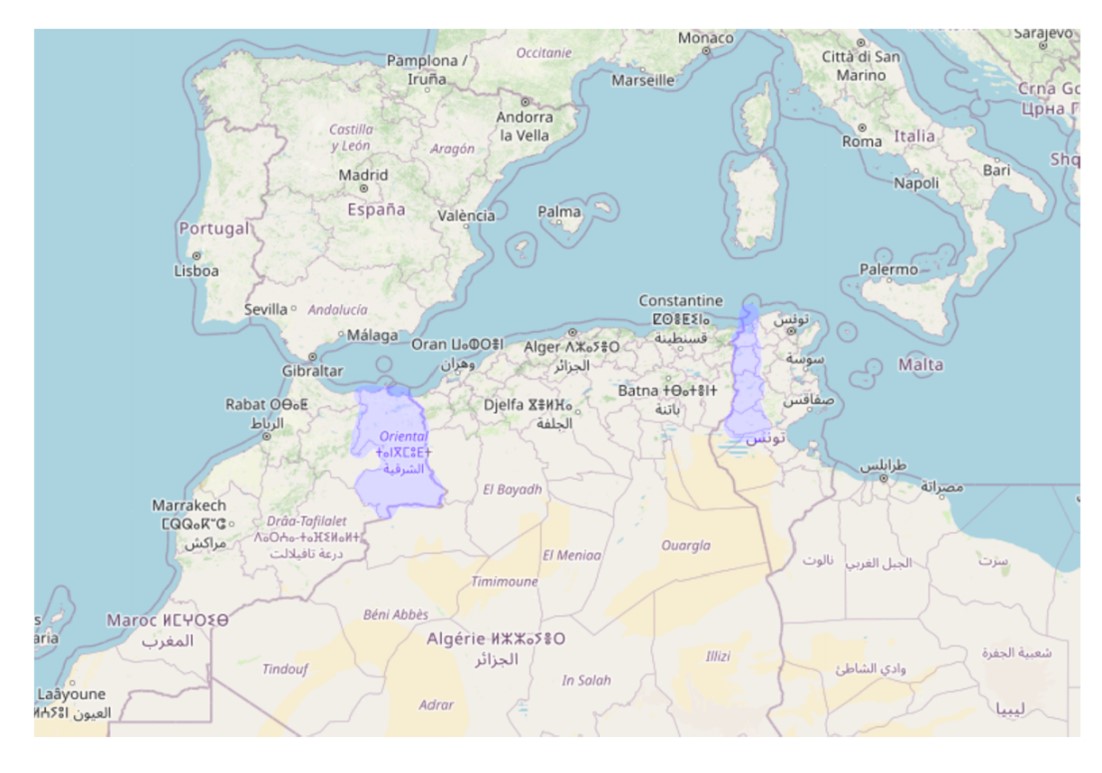
Source: OpenStreetMap 2025; author’s elaboration.
Figure 1 Map showing the main fieldwork sites: the Oriental region of Morocco and Western Tunisia
Border regions in Eastern Morocco and Western Tunisia have long been marginalized, rooted in colonial-era territorial divisions and shaped by unjust post-independence policies that favored coastal centers over peripheral border areas. Both the Algerian-Moroccan and Algerian-Tunisian borderlands are marked by high unemployment, outmigration, and a dependence on informal cross-border exchanges, as formal economic opportunities are scarce. Recurrent political tensions between Algeria and Morocco, restricted mobility caused by border closures and border fortification efforts have further disrupted local livelihoods. Communities living in these areas are not only systematically excluded from development policies and economic opportunities, but also face both geographical and socio-political isolation due to their borderland location.
Fieldwork challenges and strategies in complex borderland environments
I am not the only qualitative researcher to have encountered significant challenges while conducting fieldwork in Northwest Africa’s border regions. Anthropologists such as Scheele (2012), who conducted ethnographic research along the Algeria-Mali border, and Drury (2018, 2019), with his work on the Mauritania-Western Sahara border, have reflected on the methodological and practical difficulties that arise in these contexts. Drury (2018: 38) highlights the presence of intense state surveillance as a central obstacle, while Scheele (2012: 19) describes the particular hardships of conducting ethnographic research in the Sahara, where building deep social relationships takes time, and fieldwork is further complicated by multilingualism, demanding traveling conditions, and social norms that restrict unaccompanied movement.
Moreover, the geopolitical divisions of the region - particularly the contested borders between Morocco, Mauritania, and Algeria - add further complexity to fieldwork-based research. As noted by Villalón and Silva (2022), these borders are not only disputed internationally but also locally challenged, making them dynamic and politically sensitive research environments. For fieldworkers, such contested geographies raise specific ethical and practical concerns, especially when interacting with state officials (Villalón and Silva 2022: 336). Boulay (2017: 214) further emphasizes that conducting research on taboo subjects in authoritarian contexts adds an additional layer of complexity to fieldwork. In my case, the border itself was a politically sensitive topic, which added significant complexity to the research context and required careful navigation of political sensitivities and state suspicion toward my inquiry. Against this background, the following section addresses the specific challenges I encountered while conducting fieldwork in these volatile research settings.
Accessing the inaccessible
The first section of this article addresses a problem that should be of great concern to any qualitative researcher with the intention of conducting fieldwork with marginalized communities in border regions: How does one gain access? During my fieldwork in North Africa, two different points of access evolved that posed problems to the research endeavor: official access and local community access. Border issues are politically charged topics in both countries. Furthermore, the secrecy surrounding security issues, exacerbated by Morocco’s ongoing border conflict with Algeria, contributes to a securitarian approach by state institutions towards researchers, civil society activists, and journalists in border matters, who are often viewed with suspicion and accused of undermining national security.
Gaining official access in this difficult environment entailed negotiating bureaucratic barriers and securing the required legal permissions. In my case, obtaining such a permit became unavoidable, particularly when accessing restricted border localities or engaging with official authorities. The process proved challenging: in Tunisia, I had to wait for six months, while in Morocco, despite enduring a lengthy wait, the permit was ultimately rejected. In Tunisia, the changing political context added a layer of complexity. In July 2021, Tunisia faced a significant political upheaval with the suspension of parliament by president Kais Saied. This move led to widespread protests and raised concerns about the country’s democratic trajectory in the post-2011 political landscape. Prior to July 2021, I was more optimistic about engaging with official actors, but these events completely changed the situation on the ground. Official actors refused to participate in discussions or interviews, citing various reasons such as bureaucratic constraints or concerns about the sensitivity of the research topics. Additionally, turnover in municipal positions meant that staff who had previously agreed to participate were no longer available upon my return to the field. While the denial of research permission and long waiting times did not signify the end of my fieldwork, they required a certain degree of creativity and flexibility in terms of research design and methods on my part, which I will further elaborate on below.
Navigating access to local border communities also came with some challenges. While people in general were quite open and willing to talk to foreigners and share their experiences, rural communities at the border proved difficult to access due to their closed nature and inherent mistrust towards outsiders. Gatekeepers were often needed to facilitate entry. Restricted mobility and underdeveloped transport infrastructure posed further obstacles, both in terms of physical access to the field and in terms of travel restrictions. The identification of gatekeepers proved to be a time-consuming task. It took me several weeks to connect with relevant actors who could assist me with my research, even though I had previously established relevant academic and civil society contacts in Tunisia.
Risk to researchers and participants
The second set of challenges encountered during my fieldwork revolves around heightened risks to researchers, their collaborators, and participants. Alongside matters of personal security, researchers may encounter dangers directly related to their work, such as potential arrest and interrogation by law enforcement or facing threats, harassment, or violent attacks from research subjects or security forces. Furthermore, research conducted in less- or non-democratic settings must consider the potential risks to participants’ well-being and livelihoods because the research may put them at risk of repressive measures by state institutions.
The security risks of my fieldwork primarily revolved around negotiating my positionality as a white, middle-class female researcher with limited local language skills and local contextual knowledge. This heightened visibility made me immediately noticeable to local authorities, such as in Figuig, where military personnel questioned my presence upon entry. Additionally, during my stay, individuals I interviewed in smaller rural communities like Figuig and Jerada were queried by local law enforcement about our conversations and the purpose of my visit. Similar encounters occurred in Tunisia, particularly in Reydeyef and Feriana, where police inquired about my presence and intentions. These experiences left both my research participants and myself feeling exposed and vulnerable. Furthermore, there was a singular incident in June 2022 where local security forces interrogated me, leading to my expulsion from Kasserine.
Field researchers must consider not just their personal security but also the possibility of arrest, intimidation, and harassment of locals. My expulsion from Kasserine drew the local authorities’ attention to my interlocutors and my local support network. This episode underscores the challenges of anticipating and mitigating risks and consequences for research participants, which are often difficult for both the researcher and the participants to foresee. Consequently, the protection of participants’ well-being must be given highest priority. In particular, notions of “informed consent”, “do not harm” and anonymity are of relevance when conducting ethically sound research in less- or non-democratic countries and interacting with often vulnerable populations.
Informed consent involves researchers presenting themselves to participants, informing them about the research and its potential consequences, and ultimately obtaining their explicit agreement. During my fieldwork, I followed this principle by maintaining an open and transparent communication about my role as a researcher and the purpose of my stay. Consent was asked orally to avoid any paper traces and to minimize suspicion. As Villalón and Silva (2022: 342) argue for localities in Northwest Africa, formal informed consent procedures like consent forms rooted in Western University norms can generate mistrust, as they conflict with kinship-based social systems where trust is built through personal relationships rather than formal documentation. In every interview or conversational situation, I provided detailed information about my research in a comprehensive manner and opened the space for questions regarding my research project. A different strategy, however, was deployed in my communication with local authorities. During superficial encounters with local law enforcement, I framed my research topic in a development language, stating that my intention is the exploration of practical solutions and interventions aimed at enhancing the well-being and livelihoods of border communities. In a comparable way, Boulay (2017: 218) framed his anthropological research as a general study on pastoralism as a strategic cover for his fieldwork in Moroccan-occupied Western Sahara. This tactic, similar to a selective and strategic form of deception described by Wackenhut (2018) in the context of Egypt, allowed me to operate in border regions without raising suspicion or risking expulsion by local law enforcement. Additionally, being affiliated with local civil society organizations or research institutes proved another useful method aimed at avoiding the suspicion of local authorities. In terms of anonymity and security, finding suitable locations for interviews and ensuring privacy was a challenge. Given the sensitive content of the conversations, interviews and informal meetings were held in safe places, for both the interview partners and myself. Often chosen by my interlocutors themselves, interviews and informal encounters took place in public cafes or private homes, allowing for more deeper and openhearted conversations. However, this raised concerns about recording and documenting these interactions. When talking to individuals in public spaces, I never asked for the permission to tab-record the discussions as this would have created unfavorable attention and might have created feelings of irritation. Interviews were primarily documented through handwritten notes rather than audio recordings.
Personal, sensitive or secret information has been treated with great respect. Names and precise locations were not stored together with field notes and interview data. Any written evidence has been destroyed and I developed a coding system to identify research participants. In some cases, key words were noted on a smartphone and later in privacy expanded upon in detailed field documentation. Another strategy was to take notes in unclear handwriting in my native language German, as it is not widely spoken in the Maghreb region.
Ethical considerations in research with vulnerable populations
Another set of challenges arise when conducting research with populations who lack resources or experience in systematic marginalization. Fieldwork in such contexts requires sensitivity to power dynamics and an understanding that researcher-participant relationships are influenced by broader systems of oppression, shaped by histories of colonialism, development, and globalization. Scholars have provided valuable guidance on how to recognize these dynamics and address the inherent power imbalances when engaging with historically marginalized communities (see e.g. Brown and Strega 2005; Sultana 2007; Asselin and Basile 2018).
Since the beginning of my research, I have followed three fundamental steps to interact with vulnerable communities in an ethical manner. Firstly, I placed a high priority on having a solid understanding of the knowledge structures, power dynamics, and the broader context within which these communities operate. Preparing for community entry, I familiarized myself with the past and present experiences of the population using a variety of sources, from academic literature to media representations.
Secondly, I embraced the principle of reflexivity as an ongoing process, informing different stages of my research and engaging with my role as a researcher in a reflexive and self-critical way. The principle of reflexivity involves a commitment of “making explicit the play of power relations in your research process” (Ramazanoğlu and Holland 2002: 158), ranging from issues arising in fieldwork to considerations of presenting the data. In the field this required a constant reflection on existing power relations, my evolving positionality in the study sites (Mikecz 2012, see also Mwambari 2019) and the ways I structured the encounters with my research participants. This procedure further allowed to take seriously the active role of participants in the research site, including their expectations, interpretations and contradictions towards my research endeavour (Fujii 2018).
Lastly, I emphasized non-hierarchical interactions and mutual learning to avoid exploitative research practices. In general, I was open to engaging in a much more personal and sometimes emotionally challenging way, showing openness to the concerns and experiences of my local contacts beyond the research scope. This commitment also involved giving something back to the communities I worked with; for example, in the Tunisian border town Feriana, I collaborated closely with a local civil society organization, offering my expertise in international funding schemes. Similarly, in Oujda, Morocco, I volunteered for a local charity initiative working with families in need. While I recognize the value of such engagement, I also acknowledge the practical limitations that may arise for such commitment when conducting research across diverse fieldwork locations. After the completion of my fieldwork, I intend to make aspects of my findings accessible to people in the field.
Trust-building and collaboration with local entities
Trust-building represents a major approach in ethnographic field research, where interactions in the field are based on good relationships and empathy, transparency, honest self-representation and mutual exchange of trust (Hosokawa 2010; LeCompte and Schensul 2010). In my case, establishing trust in a rather limited time frame and across various locations presented a significant challenge. To overcome this, I invested in creating local and regional support networks of key informants, gatekeepers, and intermediaries that could facilitate entry at the community level. Pre-existing contacts allowed me to make first connections to the field, often leading to further introductions. Access via personal networks is essential under conditions of state repression as common acquaintances can create initial trust even in cases where people are initially hesitant or suspicious. Its significance became also evident when it came to easing interactions with official actors, as recommendations from colleagues or friends often facilitated connections.
My entry point into most field sites in Morocco and Tunisia were civil society organizations and local researchers operating at the local and regional level, as also suggested by Glasius et al. (2018: 57) as a useful strategy for navigating access in authoritarian contexts. These collaborations brought many benefits: they provided logistical support such as transportation and access to safe and neutral location for interviews, connections to local communities in remote border areas and established networks to potential intermediaries and gatekeepers throughout the region. In Oujda, I established connections with several individuals originally from Figuig, which facilitated the logistics of my subsequent research visit to Figuig and facilitated access to key informants in the area. Maintaining trust with my participants was also important while exiting from the field. I ensured this by exchanging contact information with my interlocutors and implementing a regular check-in system. This enabled me to address any questions they might have had regarding the research, and also facilitated communication when I returned to the field.
However, depending heavily on personal networks can create bias in the sample of respondents. For instance, while collaborating with the sole civil society organization in Feriana, it became challenging to approach individuals with mistrusts towards professionalized NGOs. Additionally, local organizations may seek to control the research process, which can impact the researcher’s ability to access certain information. I have frequently encountered situations where certain topics, such as drug-related issues, were avoided in conversations, perhaps with the intention of safeguarding me as a female researcher. However, my positionality as a female researcher also provided unique opportunities, as I was able to access insights from women that a male researcher might not have been able to obtain.
Researchers need to be aware of this potential bias and should try not to become overly reliant on key informants. Being in the field and interacting with community members, such as at meetings or public community events, also helped me expand my network. In addition, I sought engagement with a diverse spectrum of organizations and stakeholders operating in border areas. Finally, my aim was to engage with respondents from diverse social and personal backgrounds, including those holding diverging viewpoints.
Flexibility in research strategies
Another important takeaway from my fieldwork experience in North African borderlands is the importance to adapt to evolving conditions and maintain flexibility throughout the research process. In order to effectively address emerging issues and take advantage of potential opportunities, qualitative researchers in authoritarian settings should adjust their research strategies and revise their methodologies when faced with unforeseen challenges or rapid changes in the political environment (Malthaner 2013). In my situation, this involved departing from my initial research plan by adjusting both the selection of research areas and the chosen research methods.
In terms of research design, I initially wanted to include the perspective of state security providers to obtain a more holistic understanding of local security dynamics. Although Tunisia before July 2021 offered a relatively open environment for such research endeavors, I only encountered suspicion and reluctance among government-related actors in the Kasserine governorate, my initial field site. Combined with restricted mobility, this situation led to a feeling of being at a dead end. Faced with these constraints, I decided to broaden my research focus beyond the Kasserine governorate and instead look at variations in political and economic resources across different border regions in Western Tunisia.
The political sensitivity of my research and the difficult access to border communities demanded flexible methods of data collection and a context-sensitive approach, rather than imposing a rigid methodological framework from the outset of my project. The main methods of data collection included semi-structured interviews, participant observations, the review of policy documents, secondary literature and relevant statistics as well as various informal conversations. Combining these different methods of analysis allowed me to study “what people do as well as what they say and enables an insightful examination of any discrepancies between thoughts and deeds” (Herbert 2000: 552). This approach enabled me to navigate the various constraints and limitations that appeared throughout the project. Even though it was not possible for me to fully immerse myself in the rural areas at the border, I was still able to conduct shorter visits to these places, which gave me a few insights into the daily life there. These visits, unfortunately, were rather sporadic since the area is not open to public and personal connections are required to schedule them. Despite these difficulties, I remained open to spontaneous encounters and seizing opportunities as they arose. I found that observations during community events provided valuable insights into local dynamics and perspectives. Informal conversations enabled a more thorough discussion of controversial topics outside the artificial limits of official interviews. This methodological flexibility enabled me to respond to any unexpected developments or unanticipated incidents that occurred throughout the ongoing research. In border research, flexibility is essential for addressing the complex nature of the field while maintaining a methodological responsiveness to the needs and reality of the communities I was researching.
Keeping security and risk assessments relevant
Safety considerations for fieldwork-based research in volatile and closed environments require a comprehensive approach that prioritizes continuous risk assessment and adaptation to evolving circumstances. As I prepared for my first round of fieldwork in 2021, significant attention was given to the development of a comprehensive risk and security assessment plan. Valuable resources in this endeavor included established manuals tailored for field researchers (e.g. Grimm et al. 2020) and those offered by humanitarian organizations such as the United Nations (United Nations 2006; United Nations Department of Safety and Security 2017).
These assessments encompassed contextual analysis, familiarizing myself with the geographical, social, political, and historical environments, and identifying potential threats. While travel advice from European foreign affairs provided a basic framework, exploratory discussions with colleagues and research contacts offered a more nuanced understanding of the situation on the ground (Glasius et al. 2018: 29). In the case of Tunisia, where I had previously conducted research for my master’s thesis, I leveraged existing local networks and engaged in online pre-talks with relevant stakeholders. In Morocco, I initially resided in the urban area of Oujda to ensure safety and anonymity before expanding my research activities to remote border regions through established contacts. The risk and security assessment plan also included a check-in routine with my supervisors as well as arrangements for emergency situations.
While pre-fieldwork assessments proved to be helpful, throughout my fieldwork journey, it became evident that these security assessments had to be regularly updated to remain relevant. Guidance and the support of trusted local partners ensured my safety in the field. In contrast, my supervisors encountered difficulties in providing advice remotely due to their detachment from on-the-ground developments. This was especially noticeable amid Tunisia’s shifting political landscape in July 2021, but also in encounters with local law enforcement. These experiences clearly showed that we as field researchers rely on deep knowledge of the field and local guidance for protection in dangerous and unpredictable environments. Building and maintaining these field relationships are critical for engaging meaningfully with the shifting dynamics of the research context.
Conclusion
The challenges of fieldwork in border zones are in many respects similar to those under “normal” conditions. Yet, in these contexts, certain fundamental aspects of field research - gaining access, researcher safety and protecting informants and vulnerable communities - are made more complex by the unique characteristics of their surroundings and the potential risks they imply. Trust-building and collaboration with local entities is vital in facilitating entry into otherwise inaccessible areas and providing invaluable contextual knowledge. This article’s personal reflections emphasize the complexities of navigating the sensitivities inherent in researching vulnerable or marginalized communities, highlighting how this collaboration has been crucial not only in gaining access to these populations but also in shaping a nuanced approach to research interactions and the process of leaving the field.
Research in border areas requires a large degree of flexibility to adapt to changing circumstances and mitigate potential risks while also capitalizing on emerging opportunities. In such environments, ethical questions, such as do-not-harm, informed consent, protection of participants identity should be given the highest priority. Furthermore, security and risk assessments must be constantly contextualized and regularly updated to align with the ever-evolving political landscape. Trust-building between the researcher and research participants and a meaningful engagement in the research field are crucial elements when conducting research in the areas of extreme surveillance. My fieldwork among marginalized border populations required patience and ongoing involvement, particularly in light of the complex histories of state absence and violence in both regions. At the same time, I was continuously struck by the resourcefulness and solidarity within these communities. These experiences underscored the importance of respectful research approaches that remain attentive to both vulnerability and local agency. Such a stance is critical for moving focus away from the traditional portrayal of borders as places of political contention and towards a better understanding of their relevance for the people who live there.

