




 Inglês (pdf)
 Artigo em XML
 Referências do artigo
 Tradução automática
 Enviar este artigo por email
 Citado por SciELO
  Similares em
SciELO
Similares em
SciELO 
 Permalink

The caregivers’ upbringing (parents and others related to the children) is a fundamental aspect of guaranteeing the integral development of children, which is influenced by educational, economic, cultural, and political contextual conditions. In this sense, focusing on the conditions of economic deficit or poverty is a great challenge, since this becomes a conditioning factor during upbringing, increasing the difficulty for adults of meeting children’s basic needs, such as food, housing, medical care, and education. The child's development is thus affected and the possibilities of enhancing their capabilities limited. In fact, living in these conditions increases exposure to violence, health problems, educational deficit, and lack of food and goods (Centro Iberoamericano de los Derechos del Niño [CIDENI] et al., 2021; Morán-Mariños et al., 2019). Raising children in poverty can generate developmental delays or deficiencies, including in the nervous and peripheral system, motor skills, and nutritional status; as well as their linguistic, cognitive and emotional development (Alvarez Ortega, 2019; De los Reyes-Aragon et al., 2016; De Souza Morais et al., 2021; Lipina & Segretin, 2015). According to the family stress model (FSM), poverty conditions directly affect the parent-child relationship, as they cause high levels of stress and anxiety in adults responsible for children. Their ability to provide a stable and emotionally enriching care environment is impaired, thus impacting dimensions of physical, socioemotional and cognitive development (Masarik & Conger, 2017).
It is essential to ensure the wellness and dimensions of Social, Physical, Emotional, Professional, Intellectual, Environmental and Spiritual development (Pan American Health Organization [PAHO] & World Health Organization [WHO], 2008). Therefore, adults must implement caring practices to stimulate the child in their different areas of development: corporal, socioemotional, sociocognitive, linguistic-communicative, ethical-moral, aesthetic and transcendental (Amar et al., 2016), to promote the child's development and learning by stimulating the formation of their identity and social belonging (Molano Vargas et al., 2018). Caregiving practices have been examined from their multiple dimensions (Ferguson et al., 2022; Hoang & Kirby, 2020; Twintoh et al., 2021). However, more studies are needed that implement an individual-centered approach to determine parent profiles from their caregiving practices in the Colombian context. This is due to research from outside the country that establishes profiles from intrinsic characteristics with which parents identify themselves in enrichment practices, attitudes, as well as emotional resources (Iruka et al., 2018), or profiling sustained in parental support to improve children’s self-control in conditions of poverty (Park et al., 2022).
Profiling caregiving practices in terms of their attitudinal characteristics is useful for intervention plans aiming to improve infant care. Such profiling based on attitudinal characteristics is valuable for intervention plans aimed at enhancing infant care. Existing studies on childcare profiles focus primarily on the consequences of parenting for the child's physical and cognitive development, but omit the variations in parenting practices that adults may have depending on the child's gender, and which may or may not favor the widening of gender gaps (Akkan, 2019). Studies that address childcare must therefore consider parenting based on gender equality as an important aspect that allows the generating of inputs for future interventions aimed at reducing gender gaps.
This behavioral model applied to parenting practices has been used to understand parental protective behavior (Woo et al., 2022), but so far, no studies have been found that implement it in classifying parental roles based on the Theory of Planned Behavior (TPB) and involving sexism in parenting. Hoffman and Kloska's (1995) study of roles within marriage and parenting based on infant sex role assignment is the most similar of those found so far.
From the previous studies, there is thus a tendency to analyze the constructs isolated from each other to determine caregiver profiles. However, it is possible to implement the dimensions of a profile model to obtain results with greater consistency, in terms of personal characteristics that may influence practices based on conceived ideas of self and gender. This research implements the TPB, which attempts to predict behavior and to explain an individual's intention, considering attitude (i.e., the personal evacuation about behavior), subjective norm (i.e., a person’s beliefs about what others expect them to perform), and perceived behavioral control (i.e., a person's belief about their ability to behave in a particular way; Ajzen, 2020; Conner & Armitage, 1998).
The application of the TPB to classify different parenting typologies in contexts of poverty is particularly beneficial, since this model allows the prediction of specific and easily observable behaviors, such as childcare. So much so that in its three components (attitude, subjective norm and perceived behavioral control), the perception of behavioral control acquires special relevance in contexts of poverty, where the economic difficulties of adults may restrict their ability to make decisions regarding childcare. Similarly, about the subjective norm, its operation in childcare practices is highlighted, because it can be influenced by internalized social norms, so the sociocultural context takes on a profound value in the way in which childcare providers exercise caregiving. In line with these considerations, this study employs a cluster analysis to identify different caregiving role profiles based on the TPB dimensions related to caregiving practices and non-sexist parenting, and is conducted using a sample of low-income Colombian adults with children under 5 years of age.
Method
Participants
The participants were 495 adults who have children aged from 11 to 59 months, registered in the Child Development Centers (CDI) of the municipalities of Santa Lucía, Manatí, Repelón, Luruaco, and Barranquilla. The first four municipalities correspond to rural areas (91.1%), while Barranquilla belongs to the urban center (8.8%) of the Atlántico Department, in northern Colombia. The main participants were women (94.2%) with no university education (95.3%), who were dedicated to housework (76.7%) or active in the labor market (18.3%). Most surveyed reported low monthly incomes (Quartile 1 = $48.11, Quartile 2 = $76.98, Quartile 3 = $114.50; dollar equivalents based on the representative rate for the month of September 2022). The family structure reported by participants was, primarily, extended (51.3%) and nuclear (39.8%). A total of 86.46% of the participants were mothers of the children enrolled in the CDI. Fathers constituted 4.04% of the participants, grandmothers accounted for 6.46%, while the remaining 3.04% identified themselves as stepmothers, aunts, or siblings of the children. This study involved mostly those who did not self-identify as part of a Colombian ethnic minority (83.3%; see Table 1).
Table 1 Sample description
| Frequency (%) | |
|---|---|
| Gender | |
| Female | 458 (94.23) |
| Male | 28 (5.76) |
| Education | |
| Undergraduate studies | 22 (4.64) |
| High school or less | 452 (95.36) |
| Occupation | |
| Homemaker | 376 (76.73) |
| Student | 24 (4.89) |
| Employed | 90 (18.37) |
| Living area | |
| Urban | 44 (8.81) |
| Rural | 455 (91.18) |
| Ethnicity | |
| Ethnic minority: Yes | 73 (16.82) |
| Ethnic minority: No | 361 (83.18) |
| Family relationship | |
| Mother | 428 (86.46) |
| Father | 20 (4.04) |
| Grandmother | 32 (6.46) |
| Other | 15 (3.04) |
| Family structure | |
| Extended | 262 (55.04) |
| Single parent | 46 (9.66) |
| Nuclear | 168 (35.29) |
| Reconstituted | 0 (0) |
Measures
Theory of Planned Behavior. A set of 18 items, in a Likert-type format, with five response options (1 = 'Strongly disagree', 5 = 'Strongly agree'), was designed, based on the TPB, to measure self-efficacy in childcare (6 items; α = .75; 'I have no way to solve the problems I face when caring for my child'), the subjective norm on caregiving practices (7 items; α = .92; ‘People who are important to me…they consider physical activity and playing to be healthy for my child'), and behavioral intention related to childcare (5 items; α = .84; 'I intend to learn more about parenting so that my child will grow up well'; See supplementary materials). The construction of this scale was undertaken while adhering to the guidelines put forth by Clark and Watson (2019), because it was necessary to use a measure adapted to the target population. These guidelines emphasize the importance of crafting items that are straightforward, free from ambiguity, linguistically suitable for the target population, and resistant to becoming outdated over time. Researchers of this study also examined the structure of some TPB scales before developing the items (see a previous TPB scale at Muzaffar et al., 2014). Once items were developed, three psychologists with experience in psychometric studies verified if the content of each statement was appropriate and enough.
Attitudes Towards Childcare Questionnaire. This questionnaire includes 35 items, responded to through a five-level Likert-type scale (1 = 'Strongly Disagree', 5 = 'Strongly Agree'), that includes ratings of different childcare patterns. Considering that this study is part of an intervention project on attitudes towards childcare, it was necessary to adapt the items so that they measure attitudes and not specific behaviors. In this study, we adapted and added new items to the instrument developed by Amar et al. (2016). The new version of the instrument was reviewed by expert judges. For this study, the number of items that make up the subscales of the Amar et al. (2016) instrument used to measure childcare behaviors were adapted and reduced by Confirmatory Factor Analysis. Using lavaan (Rosseel, 2012), a first structural model was designed that included a total of 40 items, of which five were deleted to improve Goodness-of-fit. Goodness-of-fit was tested by the robust version of Comparative Fit Index (CFI), Tuker-Lewis Index (TLI) and Root Mean Square Error of Approximation (RMSEA) and the estimator implemented was the Robust Maximum Likelihood (see psychometric properties at https://osf.io/ktd4s/). The final version of the instrument measures ratings of different dimensions of childcare, including caring for cognitive abilities (α = .90; 'Reading stories or tales to the child'; 8 items), feeding (α = .82; 'Having the parent find a way for the child to eat'; 3 items), sleep (α = .79; 'Accompanying a child that wakes up early'; 3 items), health (α = .93; 'Up-to-date vaccinations'; 6 items), emotions (α = .71; 'The parents know when the child is sad'; 4 items), the ethical dimension (α = .82; 'The family has clear rules'; 6 items), and transcendence (α = .91; 'When they grow up, they strive to achieve their goals'; 5 items). For the reader's clarity, the ethical dimension refers to the principles on which actions are guided, while transcendence is related to the search and self-analysis of oneself and one's capabilities to achieve self-actualization (Amar & Martínez, 2011).
Sexist Attitudes in Parenting Scale. To measure the sexist attitudes when raising children, the subscale of gender attitudes toward parenting developed by Hoffman and Kloska (1995) was used. The subscale consists of seven items (e.g., 'It is more important to raise a son to be strong and independent than to raise a daughter that way'). In this study, a process of linguistic adaptation and psychometric analysis of the measure was conducted to ensure its validity and reliability. First, three psychologists proficient in both English and Spanish undertook translations of the original items, employing a triangulation approach for each of them. Following the data collection phase, a Confirmatory Factor Analysis was conducted to ascertain the factorial structure that best aligned with the gathered observations. A similar procedure to the Attitudes Towards Childcare Questionnaire was performed. It was therefore necessary to eliminate items 2 ('I would encourage and support a daughter to be educated as much as a son '), 3 ('It is just as important to guide a daughter to a good job as a son'), and 7 ('I see nothing wrong with giving a boy a doll to play with'), because they showed psychometric inconsistencies. Also, the range of responses was expanded from four levels to five (1 = 'Strongly disagree', 5 = 'Strongly agree'), to allow for neutral responses by study participants. The reliability of the final version of the instrument in this study was as high as in the original study (α = .84).
Demographic characteristics. Different questions were designed to collect sociodemographic information. Participants were asked about household income, membership of an ethnic group (Yes; No), identification as displaced or migrant (Yes; No), age, gender (male, female, other), educational level (No studies, primary, high school, technical, undergraduate, graduate), occupation (homemaker, student, informal worker, unemployed, formal worker, pensioner), relationship with the child (mother, stepmother, father, stepfather, uncle, aunt, grandfather, grandmother, brother, sister, other), attendance at a child development center or children's home; among other aspects.
Procedure
This research corresponds to the baseline analysis of a psychosocial intervention project on childcare practices and healthy lifestyles in the Atlántico Department. Adults over 18 years of age, who had a caregiving role for children linked to child development centers in the department, were contacted through district agencies. They were asked to fill out an informed consent form explaining the voluntary nature of their participation and the aim of the project. Those who decided to participate in the study were asked to fill out the printed forms. The application of the survey was conducted in groups of 10 to 20 people by psychologists trained in data collection and community research. This study was reviewed and endorsed by a committee of experts in ethical research from Universidad del Norte [N° 198/2019].
Data Analysis
Once the responses were collected, we proceeded with the imputation of missing values using Predictive Mean Matching, implemented in the 'mice' function package (Van Buuren & Groothuis-Oudshoorn, 2011) in R, given its usefulness for quantitative data. The Cronbach's Alpha (α) was calculated to assess the reliability of the scales for the sample of this study. Reliability was analyzed with the functions of the 'psych' package (Revelle, 2023). Once the scores in each scale were calculated, means, standard deviations, and correlations between the scales of the study were computed. The participants were profiled using a non-hierarchical clustering algorithm. For the cluster analysis, the Euclidean distance matrix was used and the K-means clustering method was performed. A limitation of the K-means method is that it requires setting several clusters a priori before extraction, therefore, the 'NbClust' package (Charrad et al., 2014) was used to determine the optimal cluster number. Once participants were classified, ANOVA analyses and multiple comparisons were performed to compare the scores of the TPB variables and gender attitudes in parenting, according to the classification offered by the K-means. Finally, utilizing the chi-square test for independence, the potential association between membership of clusters and sociodemographic characteristics was examined.
Associations between the study’s variables
Partial correlation analyses showed high correlations between attitudes toward childcare, intention to change, self-efficacy, and subjective norm, as expected (see Table 2). Specifically, in the case of sexist attitudes, negative correlations were found with the childcare self-efficacy scale, and the subjective norm, but small negative associations were observed with various dimensions of childcare. In the case of self-efficacy in caregiving, moderate positive correlations were detected with cognitive care, sleep care, health care, ethical care, emotional care, and transcendence care. However, there was a weak positive correlation with dietary care. Similarly, behavioral intention exhibited moderate positive correlations with various caregiving dimensions, except for feeding care. Upon examining the relationships of the subjective norm with the other scales, it was observed that, in general, correlations with childcare were low (.27 < r < .34), as were those with self-efficacy. However, a moderate negative relationship was found with non-sexist parenting (See Table 2).
Table 2 Correlation between TPB measures and non-sexist attitudes in parenting
| CO | FE | SL | HE | ET | EM | TR | SF | BI | SN | |
|---|---|---|---|---|---|---|---|---|---|---|
| CO | - | |||||||||
| FE | 0.335*** | - | ||||||||
| SL | 0.686*** | 0.323*** | - | |||||||
| HE | 0.750*** | 0.411*** | 0.733*** | - | ||||||
| ET | 0.719*** | 0.335*** | 0.709*** | 0.832*** | - | |||||
| EM | 0.649*** | 0.223*** | 0.639*** | 0.680*** | 0.723*** | - | ||||
| TR | 0.658*** | 0.289*** | 0.610*** | 0.727*** | 0.801*** | 0.734*** | - | |||
| SF | 0.377*** | 0.156*** | 0.362*** | 0.428*** | 0.393*** | 0.363*** | 0.362*** | - | ||
| BI | 0.428*** | 0.221*** | 0.450*** | 0.458*** | 0.483*** | 0.354*** | 0.414*** | 0.200*** | - | |
| SN | 0.270*** | 0.317*** | 0.284*** | 0.337*** | 0.291*** | 0.238*** | 0.309*** | 0.327*** | 0.155** | - |
| NSP | -0.083 | -0.156 | -0.118 ** | -0.178*** | -0.111 * | -0.101* | -0.188*** | -0.355*** | 0.118** | -0.536*** |
Note: ***p < .001, **p < .01, *p < .05, CO = cognitive, FE = feeding, SL = sleep, HE = health, ET = ethical, EM = emotional, TR = transcendence, SE = self-efficacy, BI = behavioral intention, SN = subjective norm, NSP = non-sexist parenting.
Caregiver’s profiles
The cluster analysis allowed us to identify three profiles (61.11% accumulated variance). First profile of caregiving (cluster 1) was identified as having intermediate scores in attitude towards childcare and self-efficacy, as well as the highest scores on the scale of non-sexist attitudes in parenting and the lowest subjective norms (see table 3). The second profile identified was characterized by lowest scores in attitude toward childcare, self-efficacy, behavioral intention, but with intermediate scores, between clusters 1 and 3, on the scales for subjective norm and non-sexist attitudes. On the other hand, the third cluster was comprised by participants with high scores on the scales of attitudes towards caregiving, self-efficacy, and subjective norms, and with the lowest non-sexist attitudes, when compared to clusters 1 and 2 (see figure 1). The most significant differences among the clusters are evident in non-sexist parenting, F(2,489) = 370, p < .001, η2 = .601, and healthcare caregiving, F(2,489) = 284.9, p < .001, η2 = .475); whereas the smallest differences among the clusters are observed in sleep care, F(2,489) = 36.2, p < .001, η2 = .128, and behavioral intention, F(2,489) = 61.36, p < .001, η2 = .170; Table 3).
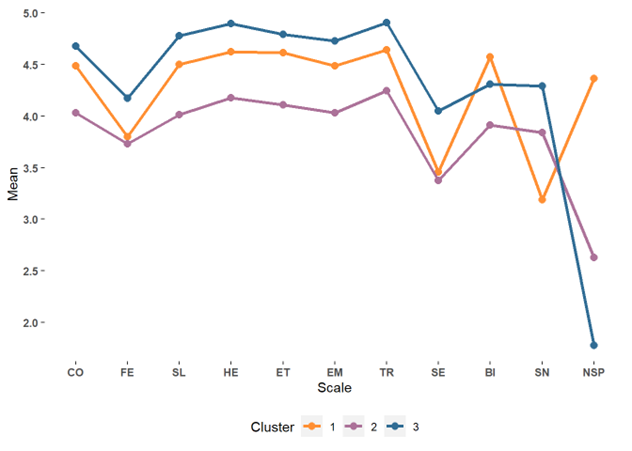
Figure 1 Children parenting profiles based on TPB dimensions and gendered attitudes. Note. CO = cognitive, FE = feeding, SL = sleep, HE = health, ET = ethical, EM = emotional, TR = transcendence, SE = self-efficacy, BI = behavioral intention, SN = subjective norm, NSP = non-sexist parenting.
Table 3 Differences by profile
| General | Cluster 1 | Cluster 2 | Cluster 3 | F | η2 | |
|---|---|---|---|---|---|---|
| Cognitive | 4.38 (.51) | 4.49 (.57) | 4.03 (.25) | 4.68 (.35) | 176* | .372 |
| Feeding | 3.94 (.61) | 3.80 (.72) | 3.73 (.43) | 4.17 (.59) | 185* | .400 |
| Sleep | 4.42 (.59) | 4.50 (.65) | 4.01 (.32) | 4.78 (.39) | 36.2* | .128 |
| Health | 4.56 (.51) | 4.63 (.50) | 4.18 (.31) | 4.89 (.22) | 284.9* | .475 |
| Ethical | 4.48 (.49) | 4.61 (.44) | 4.11 (.30) | 4.79 (.27) | 260.5* | .458 |
| Emotion | 4.41 (.52) | 4.49 (.58) | 4.03 (.26) | 4.73 (.36) | 191.4* | .422 |
| Transcendence | 4.59 (.52) | 4.64 (.57) | 4.25 (.39) | 4.90 (.21) | 184.9* | .380 |
| Self-efficacy | 3.70 (.67) | 3.46 (.62) | 3.38 (.46) | 4.05 (.65) | 78.78* | .244 |
| Behavioral intention | 4.17 (.57) | 4.57 (.54) | 3.91 (.39) | 4.31 (.53) | 61.36* | .170 |
| Subjective norm | 3.95 (.62) | 3.19 (.87) | 3.84 (.34) | 4.29 (.43) | 146* | .380 |
| Non-sexist parenting | 2.47 (1.10) | 4.36 (.71) | 2.63 (.74) | 1.78 (.66) | 370* | .601 |
Note: Standard deviation between parentheses. Degrees of freedom = (2/489). *p < .001, η2 = size effect.
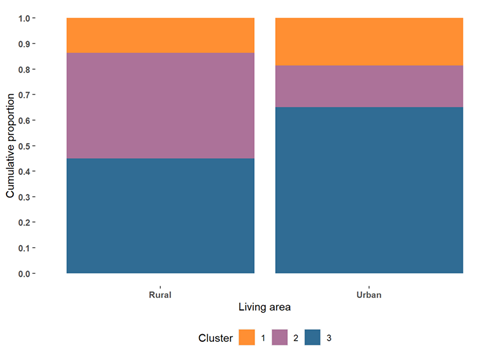
Likewise, the potential association between membership in clusters and sociodemographic characteristics was evaluated. The results showed that out of the assessed sociodemographic characteristics, only the participants' living area was associated with cluster membership, χ 2(2) = 10.33, p = .005. Thus, it could be established that cluster 1 is similarly composed of individuals living in both rural areas (13.68%) and urban areas (18.60%). On the other hand, cluster 2 is predominantly composed of those living in rural areas (41.28%) compared to those who do not (16.27%). In contrast to cluster 2, the results indicate that cluster 3 is mainly constituted by individuals residing in urban areas (65.11%) as opposed to those in rural areas (45.03%), with the latter being the cluster with the highest number of individuals (see Figure 2). No significant associations were found between cluster membership and educational level, χ 2(2) = 4.56, p = .102, occupation, χ 2(4) = 8.91, p = .063, relationship to the child, χ 2(14) = 11.05, p = .682, affiliation with an ethnic minority, χ 2(2) = 0.314, p = .854, or family type, χ 2(4) = 6.99, p = .136.
Discussion
This study aims to identify different profiles of low-income child care providers, based on the measurement of attitudes towards caregiving, TPB components (behavioral intention, subjective norm, self-efficacy) and non-sexist attitudes. The results revealed three caregivers’ profiles, since they show tendencies in the cognitive, nutrition, sleep, health, ethical, emotional, transcendence, self-efficacy, behavioral intention and subjective norm dimensions. From the findings, the significant differentiation found in the profiles based on the non-sexist parenting practices of the childcare providers stands out.
This first profile corresponds to adults with intermediate attitudes towards caregiving and self-efficacy, but with the highest behavioral intention and non-sexist attitudes, as well as the lowest subjective norms. In other words, they express a greater behavioral disposition toward caregiving. Furthermore, caregivers who fit this profile exhibit a low subjective norm, indicating that socially shared norms about caregiving practices do not play a predominant role in their parental approach. Considering that sexism is rooted in social structures, it is thus suggested that gender roles are associated with gender-specific expectations and behaviors (Malonda et al., 2017). Therefore, having a low score on the subjective social norm in caregiving practices could explain the low scores on non-sexist practices. So this cluster presents the most favorable characteristics for carrying out parenting based on gender equality, because their practices may entail the involvement of children in activities without differentiation of expectations and/or skills determined by society based on gender (Rezende de Moura, 2021). It is interesting to note that the caregivers are in rural and urban areas, so this cluster gathers the best scores from both areas.
A second profile presented lower scores on attitude toward caregiving, self-efficacy, and behavioral intention, and had intermediate scores on subjective norm and sexist attitudes. The low scores in attitude characterize this profile as having a low predisposition to behavior focused on parenting practices. This may be due to the lack both of quality time and knowledge of the parenting procedure, which may result in difficulties in child development (Yue et al., 2017). Although this second profile contains the attitudes not as marked as the first profile, it does present the most marked sexist attitudes, which may be due to belonging to a society that has transmitted power imbalance and inequality between men and women (Abi Rached et al., 2021). However, this profile presents a decrease in these types of behaviors compared to the third profile. This profile is especially present in the rural area, considering the difficulties in the socioeconomic conditions of caregivers. As suggested by Yue et al. (2017), in the rural areas, the economic dynamics and, mostly extended, family structures can make it difficult to have quality time for parenting. In addition to this, caregivers have a primary and high school education level compared to university and professional levels in the urban area (Amar et al., 2023).
The third profile, most representative of our participants, was characterized as having the highest attitudes towards child care practices, self-efficacy in parenting and the most sexist attitudes, besides presenting a moderate behavioral intention related to child care, which has an impact on child development. Although the total impact of these practices cannot be determined, it can be indicated that an indulgent practice presents better results than an authoritarian parenting practice (García & Gracia, 2013). These characteristics indicate that the third profile tends to have a positive attitude towards childcare and to be more influenced by social norms and traditional gender conceptions with respect to the other profiles (Morawska, 2020). Parenting with sexist attitudes influence children’s preference for activities based on traditional gender roles (Boe & Woods, 2018), which promotes the prolongation of gender gaps, due to their impact on individuals’ future decisions and by fostering the division of labor (Cortés & Pan, 2023; Wood & Eagly, 2002).
This third profile is predominant in urban areas, characterized by a larger percentage of individuals with higher education levels. A baseline study (of the same population) exemplifies this disparity, revealing that 54% of the urban population has a university education; while in rural areas, this figure is less than or equal to 5%. In addition, the urban environment benefits from wider access to social services, conditions that favor more positive attitudes towards child care practices (Amar et al., 2023). In relation to the childcare subscales, remarkably similar scores are evident among the three profiles, highlighting that profile one consistently maintains an intermediate score between profiles two and three. However, in variables, such as subjective norm and non-sexist care, a reversal in scores is observed, revealing particularly marked differences in the non-sexist attitude variable. Two predominant trends are therefore identified: first, there are caregivers with high scores on non-sexist parenting (cluster 1); second, there are caregivers with low scores, indicating sexist attitudes in parenting (clusters 2 and 3).
Caregiving practices are influenced by gender roles, implying that society perceives boys and girls as inherently different and, therefore, in need of distinct care. Consequently, masculinity is often associated with power and rationality; while femininity is linked to passivity and affection, perpetuating gender roles. This research highlights the correspondence that can exist between caregiving practices and sexism in certain groups who assume the role of parents. The current findings are especially useful for more targeted interventions as it identifies aspects of caregiving practices that require greater attention (Salamanca et al., 2019). In this study, for example, the distinctive aspect of these profiles is sexist parenting. Caregivers with non-sexist attitudes constitute a minority, specifically in cluster number one. The need to implement interventions to reduce sexist attitudes implies specific actions targeting behavioral intention and subjective norms. So it is imperative to strengthen caregivers with a more flexible, open and critical education towards the predominant sex roles in the corresponding sociocultural contexts (Mesman & Groeneveld, 2018).
One of the main limitations of the study is that the results are not generalizable for two reasons: first, it did not have probability sampling, since access to participants depended mainly on their availability and willingness to participate. Moreover, participants were contacted through district agencies from the records of children attending child development centers. Therefore, the profiles obtained in this study are of adults with children aged 0 to 5 years attending these development centers. Future research should include participants with children without government care, because being from a low-income population and not having government support for childcare, they are less likely to be able to provide the adequate care that is conducive to child development. Furthermore, future research could explore the relationships of these profiles with variables of interest such as age, gender, and ethnicity, both for the adults and the children.
Credit authorship contribution statement
Jose Amar: Funding acquisition; Investigation; Methodology; Project administration; Resources; Leinys Orozco: Conceptualization; Investigation; Writing - Original Draft; Writing - Review & Editing. Duban Romero: Data Curation; Formal analysis; Investigation; Methodology; Visualization; Writing - Original Draft; Writing - Review & Editing. Jeremías Aragón: Conceptualization; Investigation; Writing - Original Draft; Writing - Review & Editing. Jorge Palacio: Conceptualization; Investigation; Methodology; Writing - Original Draft; Writing - Review & Editing.

