




 Inglês (pdf)
 Artigo em XML
 Referências do artigo
 Tradução automática
 Enviar este artigo por email
 Citado por SciELO
  Similares em
SciELO
Similares em
SciELO 
 Permalink

Introduction
On March 2, 1924, the New York Times ran an article titled “New Women of Mexico Striving for Equality” (1924). The article highlighted two organizations: Free Women (Mujeres Libres), established by María Casas y Miramón in 1922, and the Cooperative Union of Women of the [Hispanic] Race (Union Cooperativa de Mujeres de la Raza), established by Sofía Villa de Buentello in 1923 (Ramos Escandón, 2002).1 Indeed, these were not the first women’s organization. In 1919 a group of women established the Mexican Feminist Counsel (Consejo Feminista Mexicano) (Lau Jaiven, 2011). And in 1921 Elena Arizmendi, another of the founders of Women of the [Hispanic] Race, had served as founding vice-president of the International League of Iberian and Hispanic American Women (Cano, 2010). While we know the history and trajectories (professional, political) of Villa de Buentello and Arizmendi, the histories of other prominent women activists are less clear. Indeed, we are left with the question as to who the women were who filled the ranks of the many women’s organizations that flourished in 1920s Mexico City. According to Villa de Buentello, interviewed for the New York Times article, members of Women of the [Hispanic] Race were primarily professional women and office workers. “It is from these professional women and office workers,” Villa de Buentello told the New York Times, “that the feminists are recruiting their forces” (1924). The New York Times article, written by an unidentified writer, characterized the women as “feminists, largely middle class” (1924). This essay complements scholarship on a handful of prominent women activists such as Arizmendi and Villa de Buentello (Cano, 2010; Ramos Escandón, 2002) and that on organizations active in Mexico City during the decade of the 1920s (Lau Jaiven, 2011) by identifying some of the women who likely filled the ranks of women’s organizations and feminist congresses in 1920s Mexico City.
The effervescence of women’s activism in 1920s Mexico City occurred within the context of broad shifts in women’s workforce participation in factories, offices, and the service sector. Women’s workforce experiences informed their concerns, fed their activism, and gave shape to their organizational strategies. While acknowledging the wide gamut of women’s work force participation, this essay focuses on the role of female public employees as organizers and as contributors to intellectual project--or what historian Dorothy Sue Cobble calls labor feminism-- of the women’s movement (Cobble, 2004). The emergence of a work-based feminist identity is visible, for example, in the public employee magazine Orientación (1922-1923). Alongside columns on how to arrange flowers, dressmaking patterns, beauty contests, and a social page, female public employees developed a rich analysis of their experiences as working women. Rather than a set of frivolous activities and engagements, such activities were integral to developing conversation about what these women considered the challenges facing middle-class women who worked outside of the home. In response to criticisms that they work outside of the home, they developed a defense of their right to work. In response to doubts about their abilities, they argued that they were better at their jobs than men. Faced with social disdain for having foregone marriage and children, and dismissed as living “useless lives,” they gave meaning to their working lives. Women public employees also decried occupational segregation, the gendered wage gap, and, as a result, the power that men exercised over women. Their criticism of the unequal exercise of social and emotional power by men over women had resonance in and beyond the workplace.
Workforce participation and legal status, 1900-1930
Women’s activism was informed by many experiences, including their workforce participation. While at the national level women’s employment stagnated between 1900 and 1930, in Mexico City women took an unprecedented number of new jobs (Rendón Gan, 2003; Porter, 2003). This was particularly true for women who identified as middle class. During the late nineteenth century women who identified as middle class filled the ranks of the teaching profession and, eventually, low-waged white-collar employment. Teaching had initially represented an opportunity for intellectual life and access to middle-class professions, granted, those jobs were associated with the traditionally feminine roles of mothering. Between 1875 and 1905, the percentage of female primary school teachers increased from 57% to 76% (González Jiménez, 2009). With the feminization of primary educational instruction, there was also a decline in working conditions and teaching became less attractive by the turn-of-the-century (Bazant, 1993).
At the turn-of-the-century growing numbers of women went to work in government offices. To facilitate the expansion of business, increase access to education, and expand a range of public services, the Mexican federal government grew significantly in the first decades of the twentieth century. Between 1895 and 1910 the number of women in Mexico City employed as public employees more than tripled so that women went from 3 to nearly 13 percent of the rapidly expanding public employee work force. During roughly the same period, the proportion of women employed in private sector offices also rose, from 12 to 18 percent in 1910 (El Colegio de México, 1964). With the Mexican Revolution (1910-1917), government leaders expanded federal, state, and municipal bureaucracy to, for example, mediate land disputes, draw up labor agreements, and expand access to education. All these initiatives required growing numbers of people to take dictation, type memorandum, mail letters, and file paperwork. Between 1921 and 1930 there was a 2,000 % increase in the number of women working as public employees, though men remained the majority (Porter, 2018a).
As with other sectors of the workforce, government offices hired women according to pre-established patterns of occupational segregation. Women were hired largely as apprentices, shorthand typists, secretaries, and clerks. Throughout the 1920s most women who worked in government offices remained at the lower ranks of the occupational ladder as, for example, entry-level assistants, typists, and secretaries. Occupational segregation facilitated the flow of tasks but also laid the groundwork for women's subordination to men. Male managers dictated correspondence to secretaries and directed the work of female clerks, archivists, and telephone operators. Women were encouraged to mold their behavior to the demands of male authority, often to be silent, like the “Remington Noiseless” typewriter upon which they conducted their work. Although government salaries were standardized by job category, occupational segregation and disregard for seniority meant that women received lower wages than their male colleagues (Porter, 2018a).
The 1920s were a decade during which women had one foot in the past and one in the future. This moment of transition is evident in the legal changes made in 1917. As Venustiano Carranza took office as president he declared the Family Relations Act (Ley de Relaciones Familiares). The Family Relations Act drew on the 1884 Civil Code and was meant to respond changes put into motion by the recent legalization of divorce (1915). It addressed marriage, parental authority, concubinage, and control over property in the case of divorce. While the Family Relations Act afforded women an increased role within marital relations, it reinforced that a woman needed her husband’s formal permission to take a job. The newspapers filled with conversation about the possible impact of the Act and the courts overheard cases that continued to refine the practice of the written law.
A few months following the Family Relations Act, a new constitution established guarantees for working women. Even before the violent stage of the Mexican Revolution subsided, the winning faction called for a constitutional convention. The men who served on the committee for Article 123 drew on the Constitution of 1857, international trends in protective labor legislation, and considering the mobilization of women across the workforce. Article 123 granted an 8-hour day, the right to organize, and standards for worker health and safety. In the spirit of worldwide protective labor legislation, Article 123 also made provisions for working women. Section V stipulated, among other things, that a pregnant woman would not be allowed to perform heavy work three months prior giving birth. She had the right to a month’s rest after childbirth, during which time she should receive her full salary and benefits, without threat of losing her job. Upon returning to work and during the time she was nursing, employers were to provide women with two extra half-hour breaks per day and a designated space for nursing. Section VII called for equal pay for equal work regardless of nationality or sex. Section VI established a minimum wage; however, it was defined as that necessary for the male head of household. In describing these rights, Article 123 utilized the word obrero and while it stated that it applied to workers and employees alike, whether these rights applied to public employees was a question of significant debate. Throughout the 1920s the Supreme Court heard cases asking that this distinction be clarified. While some findings argued that Article 123 applied equally to workers, employees, and public employees, ultimately the courts ruled that public employees, because they worked for the state, could not strike against their employer. The distinction set the conditions for how public employees would organize to address workplace concerns.
Women organize around labor concerns
Women’s activism flourished during the 1920s, as they fought for increased access to education and public life, for the right to vote and be voted into office, and for rights as workers. By the 1920s working women had a long, robust history of taking to the streets to demand their rights as workers. To name but a few major actions: cigarette workers took to the streets to protest working conditions in the 1880s; textile workers during the 1910s; seamstresses, including the Needle Strike, in 1914; and women across the workforce in the 1916 general strike. In the decade of the 1910s a group of women who identified as middle-class--teachers prominent among them--formed the anti-reelection group “Hijas de Cuauhtémoc” and then, with the assassination of President Francisco I. Madero and Vice-President José Pino Suárez in February 1913, established “Club Lealtad” and protested graveside for months on end. Then, in May 1919 teachers went on strike in Mexico City. The strike made an impression on the public when women teachers protested by lying across the streetcar tracks. Government representatives found this troubling, in part because of the spectacle of women protesting in such dramatic fashion, but also because of the growing support the teachers had from textile workers, bakers, drivers, and streetcar workers. In 1921 operators at Ericsson Telephone Company also drew attention when they took to the streets to demands a wage increase and an end to disrespectful treatment on the part of management and customers alike. Alongside reports of the strike, the newspapers ran cartoons that ridiculed the operators as spoiled and misbehaving young ladies.
Building on the robust example of working-class women and the emerging momentum of middle-class organizing, the ranks of women’s organizations swelled during the decade of the 1920s. To name but a few, on October 31, 1919, a group women established what came to be called the Mexican Feminist Council (Consejo Feminista Mexicano, CFM). The CFM brought together women from across different political commitments and occupations: public employees, teachers, and activists among them. In 1921 Elena Arizmendi was the founding vice-president of the International League of Iberian and Hispanic American Women (Liga Internacional de Mujeres Ibéricas e Hispanoamericanas) (Cano, 2010). In 1922 María Casas y Miramón established Free Women (Mujeres Libres). In 1923, Arizmendi joined Sofía Villa de Buentello to co-found the Mexico-based Women of the [Hispanic] Race (Union Cooperativa de Mujeres de la Raza). Public employees, who did not have a clear legal right to unionize against their employer (the State) filled the ranks of women’s congresses.
Orientación, 1922-1923
By the early 1920s thousands of women worked in federal and city government offices across Mexico City. Not only were they a sizeable group, but they represented a new generation of female public employees. As public employees, their right to organize was limited; they could not form unions. Nevertheless, some began to organize, and their motivations ranged from an interest in social and cultural activities to making demands as workers and as women. As Mario Barbosa shows, for the vast number of public employees working conditions could be precarious (Barbosa Cruz, 2020). In the early 1920s, in response to government-imposed wage deductions meant to pay the national foreign debt, high-level bureaucrats established the short-lived National Confederation of Public Administration. Rank-and-file employee, particularly those in the Ministry of the Interior and the Ministry of Public Education (est. 1921) also formed their own organizations. By turning to the publication Orientación (1922-1923) we can identify key individual women who would become active in the public employee and women’s movements.
The magazine Orientación began publication July 1, 1922. A bi-monthly magazine, dedicated to employees, the editors proposed different slogans for the magazine, including “With the goal of elevating employees’ spirit and defending their rights,” “Free Bimonthly--Socialist Ideals,” and, when it concluded publication on September 16, 1923, “Free bimonthly dedicated to the middle class and to employees”2. The first issue of Orientación opened with discussion of concerns: employee wellbeing, salaries, and respect. Piqued by an article titled “The problem with our middle class,” written by Ramón Córdova (1921) published in El Maestro, the magazine for the teaching profession, Orientación countered negative portrayals of the middle class in general, and public employees in particular. The El Maestro article described public employees as characterized by “a tradition and history of cowardice, a motley group educated in the practice of empleomanía (over-dependence on government jobs).” Córdova referred to public employees as “slaves to their employer and suffering from moral slavishness…They are parasites” (Córdova, 1921, p. 540). Orientación editors were “humiliated.” Such words, the editor wrote, “wounded a class that for its social importance and intellectual level, or, if for nothing else due to its size, is deserving of respect” (“La redacción,” 1922, p. 2).
Respect and understanding were also issues of concern for the women contributors to Orientación. The first issue of the magazine did not list women on the masthead but did include a “Women’s page.” The page nicely represents the combination of interests of the women contributors, which ranged from workplace concerns to opportunities for social enrichment and engagement. The unidentified author of the women’s page laid out hopes for the section, including combating misunderstandings about feminism and addressing issues of interest to women. Alongside the statement of goals appeared a poem by Mexican poet Amado Nervo and advice on how to care for freshly cut flowers (1922, July 1, p. 12). In September María Tapia, a teacher and president of the Feminist Society (Sociedad Feminista), took over the women’s page, signing her name to columns. Soon after, the magazine included a “Social page” that featured photographs and short descriptions of women who worked in different government offices. The magazine sponsored competitions beauty contests (see image 4, for example), and articles on poetry, theater, and literature. Over the course of the life of the magazine many women from across government offices collaborated as writers, advocates, and members of a community.
María Tapia and her fellow collaborators sought to clear up what they considered misconceptions about feminism. In an early interview by Concepción Palazios, a fifth-year student in medicine and originally from Central America, Tapia lamented that the word feminism had been “devalued,” and that some men and women were “disgusted” by the word. Tapia countered such misunderstandings by defining feminism in palatable terms, as “that which relates to women; we should be very proud and declare openly that, yes, we belong to a feminist organization” (Palazios, 1922a, p. 12). She offered up a slogan that, for her, encapsulated feminism as standing “for the moral, intellectual, and material improvement of women” (Palazios, 1922a, p. 12). Her feminism was informed by the liberal tradition and equality in the law, all with a dose of sentimentalism. In this last regard, Tapia called for men to think of women as their intellectual and sentimental equal, complementing each other “as nature, in its wisdom” calls for (Palazios, 1922a, p. 12).
In subsequent issues, Tapia addressed the resistance that she had her female colleagues faced in the workplace. She was well-aware of grumbling that women did not belong in government offices. In response, Tapia wrote that women were not only better than men at their jobs, but they were also better at governance. To make her argument she drew on the association of women with domestic responsibilities: “What is politics but the wise management of a large home” (Tapia, 1922c, p. 16). María Tapia also drew on Catholic literary figures to defend women’s right to work outside of the home. One such figure was Armando Palacios Valdés, a nineteenth century Asturian writer known for his realist and naturalist novels and his literary criticism. He was also a self-declared feminist. Palacios Valdés was the author of “Women and Governance” ("El Gobierno de las Mujeres"), in which he expressed concern for the status of women and argued for the positive influence of literature on women. Tapia quoted Palacios Valdés as writing: “Woman is equal to man in rights and responsibilities because she is, like him, made of God and redeemed by the blood of Christ” (Tapia, 1922b, pp. 10-11). Yet other contributors emphasized women’s professional preparation, pointing out that women now had access to a solid education, and that as a result they had been able to enter the professions and perform as well as, if not better than men “without,” one contributor took pains to emphasize, “as a result, neglecting the responsibilities we have in the home” (Gonzalez, 1922c, p. 13).
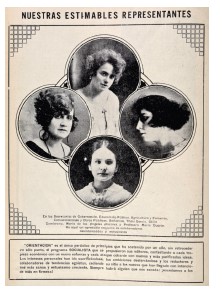
Image 1 Nuestras estimables representantes (1923, July 1). Orientación, p. 8. From the top moving clock ways: Srta. Thaís García, Ministry of the Interior; Otilia Zambrano, Ministry of Public Education; Srita. María de los Angeles Anzúrcz, Ministry of Agriculture and Development; and the teacher María Duarte, Ministry of Public Education.
In the second year of Orientación four new women became official contributors: María Duarte, María de los Angeles Anzúrcz, Thais García, and Otilia Zambrano. While full biographies of the first two contributors remain to be investigated, we have more information about the latter two: Thais García and Otilia Zambrano. García began her career as a teacher in the Children’s Hospice in July 1922. Three months later she shifted from teaching to administration and took a job as a clerk. García later moved to the Migration Office in the Ministry of the Interior, where she had a long career. García went on to play a central role in the public employees’ movement and the women’s movement in the 1930s. In the absence of robust constitutional protections, as had been made for workers (obreros), García supported the passage of a legal statute to regulation the work of public employees (empleados públicos). As for Otilia Zambrano, after attending the Miguel Lerdo de Tejada Commercial School, she began her career in 1923, as a second-level stenographer in the Department of Schools in the Ministry of Public Education. Zambrano later rose up through the ranks of the Ministry of Public Education to, in the 1930s, serve as head of the Administrative Section the Department of Monuments and, in 1938, as interim secretary of the National Museum of Archaeology, History, and Ethnography. Zambrano also played a leading role in the public employee and women’s movements (Porter, 2018b).
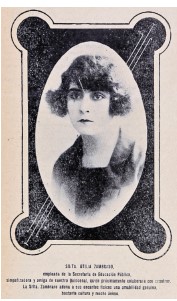
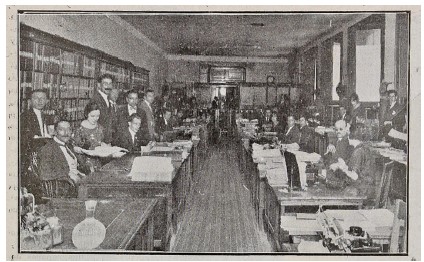
While both García and Zambrano became outspoken advocate for women’s rights in the 1930s, as contributors to Orientación in the early 1920s they engaged in subtle advocacy for women. Theirs was a generation of women trained in the world of romantic love, courtship, and marriage, a generation of that entered office work as a new space of encounter between women and men. (See image 3, for example). Women contributors to Orientación explored the challenges and opportunities such encounters represented and frequently wrote on romantic relationships with men. While some contributors celebrated romantic encounters, Thaís García, for example, criticized men who played at romantic conquest. “They consider something theirs, entirely and definitively theirs, and as soon as they repudiate it, they lose it and, upon returning to reality, stretched out on their laurels, finding themselves left with nothing but dead roses, Eden lost, and happiness so far away” (García, 1923, p. 12). García continued:
We women, drawing on an innate pride of our gender, have continuously contributed to men believing themselves to be lords and masters; but in the age in which we live, all that is becoming an old legend, because we no longer want to be slaves, nor do we allow ourselves to be tyrannized.…Women are always asked to be humble to the point of excess and, in contrast, men display boundless self-pride. (García, 1923, p. 11)
While focusing on the game of love and courtship, García was also making a critique of working conditions grounded in gendered occupational segregation that reinforced women’s subordination to men. Her call to women to, in the face of such circumstances, to change their expectations and their behavior served as a more general call to action.
Contributors to Orientación often directed themselves to women, calling on them to engage in change. How that change should be made, however, was a question of debate. Otilia Zambrano appealed to women “not to go to ridiculous extremes” but rather to engage in what she characterized as the feminine art of influence.
We must follow the evolution of ideas over time, but without ceasing to preserve in our innermost selves something of that very feminine ideal, that which imparts harmony in the darkened spirit of man. When we succeed in making man less vulgar, less selfish, less immoral, our feminist work will be well underway, since man, then, his spirit filled with the clear light of truth, will be able to understand women’s condition and, adhering more to morality, will be more humane, more noble, and less harsh and clumsy in his judgment of us. (Zambrano, 1923, p. 10)
While an appeal to the art of influence might not seem a challenging position to take, Zambrano was able, nevertheless, to lay out a critique of masculinity. In effect, she characterized men as vulgar, dark, selfish, immoral, inhumane, base, harsh, and clumsy.
Many of the women contributors to Orientación considered work experiences to be at the heart of their feminism. Thaís García wrote that women who did not work outside of the home, either because they chose to focus on domestic concerns, or simply because they were well off enough not to need to work, could not be a true source of feminism. “Feminism has existed,” she argued “since the moment we women have had to demand of men that which had previously been denied us, that is, the right to earn a living by working” (García, 1923, p. 10).
In the pages of Orientación we see the emergence of a conversation among women who identified as middle class taking on a class consciousness rooted in their working lives.
Humanity in these times can be divided into two classes: those who, like octopuses, suck and absorb the life out of others, and the victims, to whom their executioners only leave a miserable existence. Unfortunately, current conditions place middle-class women among the latter. And we must not harbor illusions. We must face the reality that among the victims, the middle-class woman is the most oppressed. Doubly a worker, required to be educated like those of the wealthy class and, at the same time, to maintain decency in all things, she must also work like those of the humble class. (Tapia, 1922a, p. 10)
As middle-class women, the question of domestic responsibilities loomed large. Several articles sought to affirm women’s commitment to domestic responsibilities, puericulture, and productive use of one’s leisure time, but begged the reader not to judge the housewife who, for financial reasons, must work in a factory, classroom, or office (Leblanc, 1923, p. 7).
The circumstances of women who had to work to support family was an important concern these women characterized as particular to the middle-class (though, of course, combining home and work was not solely a middle-class experience). One contributor, Rebeca García wrote on the self-sacrificing qualities of women who forewent the pleasures of marriage and having children of their own so that they could work to support a mother, siblings, nieces, and nephews. Such women became spinsters, living what outside observers unfairly called “useless lives” (García, 1922, p. 10). García pointed out, however that such women, working as teachers, office workers, doctors, and lawyers, in fact made important contributions to society. They had chosen another path, one that could be considered virtuous because it still implied sacrifice and a life of service to others.
The magazine Orientación also reported on the various contests sponsored by Mexico City magazines and newspapers--for example, the contest for the “best secretary.” In 1923, the magazine launched its own contest for “Queen of Public Employees.” Scholars have noted that such contests contributed to the construction of national identity, racial ideologies, and gender norms. The contests, which at first glance might seem frivolous, can also be understood as integral to a political culture and practice in which women engaged prior to obtaining the legal right to vote. After all, what did these contests entail? Women, or a supporter, put forth their candidacy. Supporters mobilized and encouraged voting. The magazine published updates that included the name of the contestant, her job affiliation (which department she worked for), and a running tally of votes not unlike an election poll. The winner, Thaís García, was celebrated at a public event with music and dancing that lasted well into the wee hours of the morning (1923, September 16a, p. 27).
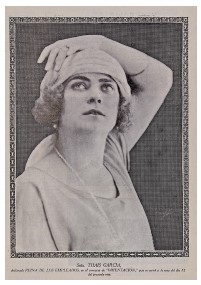
Image 4 “Srta. Thaís García declared QUEEN OF EMPLOYEES in the “Orientación” competition.” (n.a., 1923, September 16a, p. 27).
The women’s engagement in beauty contests, critiques of love relations, and defense of feminism did not contradict but rather complemented their faith in the power of activism rooted in the workplace. Public employees were acutely aware of labor organizing around them and the gains made by workers (as distinct from white-collar employees). Orientación published news items related to organized labor, from an article on the French Confederation of Intellectual Workers to labor issues in Mexico. Office workers aware of the gains made by organized labor. Consuelo González wrote: Let the example of THE WORKERS OF THE WORLD serve as an incentive for our struggle…each of us must become an active fighter until we achieve THE VICTORY OF RATIONAL FEMINISM IN MEXICO” (González, 1922c, p. 13). Yet another contributor was not timid about claiming herself and Orientación readers as “WELL-INTENTIONED SOCIALISTS.” (O. de Iñíguez, 1923, p. 10). Her claims came with an argument about the treatment of women in the workplace. Men hired women, she pointed out, to work in deplorable conditions. Indeed, the pages of Orientación offered the space for contributors to point out occupational segregation of the work force, the gendered wage gap, and gendered power dynamics at work.
Public Employees Fill the Ranks of Women’s Rights Organizations
The vibrancy of the activities and written culture produced by the contributors to Orientación helps us understand who many of the women may have been who filled the seats of women’s congresses during the decade of the 1920s. Feminist activist Sofía Villa de Buentello, for one, thought of female office workers as one of her primary audiences. Indeed, while Villa de Buentello is most known for her activism for legal reform, thus forming a part of the liberal feminist tradition in Mexico (Ramos Escandón, 2002), she also played an important role in organizing office workers. Villa de Buentello’s own business card presented herself as an educator and shorthand instructor. She is well-known for her 1921 pamphlet “Woman and the Law” (La mujer y la ley) analyzing the legal status of women, but she also concerned herself with women’s economic status. In “Woman and the Law” Villa de Buentello concluded that it was “economic factors that really determine the lamentable dependency of women.” She sent a copy of “Woman and the Law” President Obregón, asking that he read it and offer his opinion. She hoped the government would pay for copies of the book that she could then distribute to women employed in government offices. Although the president responded politely, it is unclear whether the government ever purchased the books. Villa de Buentello sent her next book, La verdad sobre el matrimonio (The Truth About Marriage), to the wife of the president, Señora Obregón, and again asked that the president pay for its distribution. Orientación wrote a column recommending the book to its readers (“Un Libro de Interés,” 1923). Clearly, Villa de Buentello considered female clerical workers as a target audience and felt that her ideas would resonate with them.
Evidence of the connections between public employees and several women’s organizations appeared throughout Orientación. In 1922, for example, the women met with the executive committee of the CFM, which would have included prominent women like Elena Torres who was, herself, a public employee. The Orientación women praised the work CFM for their realistic, grounded, and successful program and joined in several campaigns, including one to collect clothing for children in need. The campaign quickly attracted donations made by employees from across federal offices (“En el Consejo,” 1922; “Invitación,” 1923). They also established close ties with the Coeducational Union of Worker-Students (Unión Mixta de Obreros Estudiantes) and the establishment of a boarding house for working women (O. de Iñíguez, 1923; “Página femenina,” 1923).
With government support, the following year the cfm convened the First Feminist Congress of the Pan-American League, held at the Business and Administration School at the National University of Mexico (May 20-30, 1923). The location signaled ties between the feminist movement and many women office workers who attended the congress. The government gave its female office workers the day off to attend. Orientación collaborators published the report they contributed to the congress on women’s working conditions, including the issue of occupational segregation and the way gap (O. de Iñíguez, 1923). Congress participants developed a program that included support for a federal labor law, agrarian reform, social security, and civil code reform. They also proposed to establish a government employee union and a day care for the children of working women. Such was the enthusiasm for some of the speakers, including Sofía Villa de Buentello, that the text her speech was printed as a pamphlet to be distributed to the public.
In 1924 the organizations Women of the [Hispanic] Race and Free Women joined forces, claiming more than fifteen hundred members, with typists and teachers representing the core of the organization. According to Villa de Buentello and Casas y Miramón, more than 90 percent of their membership was office workers and professional women, many of whom had participated in the urban literacy campaign led by Eulalia Guzmán. Together, the two groups called on presidential candidates in the 1924 election cycle to formulate a platform on women’s issues. In return, they would consider an endorsement. Villa de Buentello informed the New York Times that they were not impressed with the presidential candidates’ sweet-tongued, vacuous pronouncements. The group hoped for an end to bloodshed and war and denounced Presidents de la Huerta and Calles, whose warmongering, they argued, got in the way of women’s efforts to reform divorce laws and the progress of the country more generally.
Office workers continued to fill the seats at women’s conferences. The International League of Iberian and Hispanic American Women held the Racial Uplift Congress on July 5 and 6, 1925. Sofia Villa de Buentello was elected president of the congress, which was held at the Palace of Mines and attracted more than two hundred attendees. The newspaper El Demócrata reported that large numbers of stenographers, typists, and other office workers, especially from the Ministry of the Interior, the Ministry of Public Education, and the Ministry of Industry, Commerce, and Labor attended (“Congreso Mujeres de la Raza,” 1925). Some conference-goers identified themselves to the newspaper by their workplace affiliation, including María Angulo at the National School of Business and Administration (Escuela Superior de Comercio y Administración) where she had worked for roughly 20 years; Rosario Ochoa de Palacios at El Colegio Teresiano, known for offering commercial education for women; María Luisa Ross at the Ministry of Public Education; Refugio Garcia at the Department of Indigenous Affairs; Doctor Antonia L. Ursúa at the Department of Health; Fidelia Brindis representing the Teachers Union; Sara Pérez representing the Mexican Society of Women Shorthand Typists; and Reinera Penagos and Rosa Narváez from the Teachers Union. Congress participants, in identifying themselves to the press by the government office where they were employed, were communicating their own professional credentials and identities, as well as claiming some of the political legitimacy of those offices. The identification was also strategic and made known that the government had, in its very own offices, women who demanded change.
Conclusion
Many of office workers who wrote articles on romantic love and participated in beauty contests for Orientación also filled the auditoriums of women’s congresses. Their interest in beauty competitions, celebrations of femininity, and engagement with Catholic culture, rather than impeding them from taking “radical” positions, served as starting points. As young women, new to the workforce, Thaís García, Otilia Zambrano, Rebeca García, María Duarte, and others developed a critique of the gendered dynamics of work. By employing the emotions and language of love and courtship they simultaneously made a labor critique. And, building on activities like Orientación magazine, they gained experience exercising their voice in the public sphere. Their experiences served as the basis of their subsequent organizational activities in the 1930s when they served as a driving force in both the public employee and women’s movements. Thaís Garcia, who continued working in the Ministry of the Interior, would go on to be an important organizer of public employees and represented public employees who supported the passage of a civil service law. Otilia Zambrano continued a long career in the Ministry of Public Education.
On May 19, 1939, as the presidency of Lázaro Cárdenas del Río came to a close, three thousand women marched to the steps of the Chamber of Deputies to demand ratification of women’s right to vote. The crowd was filled with women who had begun working as public employees in the 1920s, some of them contributors to Orientación, others central figures in the public employees’ movement. They came from the Union of Education Workers of the Mexican Republic (Sindicato de Trabajadores de la Enseñanza de la República Mexicana), the Federation of State Workers’ Unions (Federación de Sindicatos de Trabajadores al Servicio del Estado), and a host of other organizations. The women marched, as they had many times before, from the Juárez Hemicycle monument, down Donceles Street, to the steps of the Chamber of Deputies, where Thaís Garcia (Ministry of the Interior) and Otilia Zambrano (Ministry of Public Education) spoke (“Un Mitin,” 1939). Surveilled by government spies, they argued, as they had many times before, that true democracy would not exist until women had the vote.

