



 Inglês (pdf)
 Artigo em XML
 Referências do artigo
 Tradução automática
 Enviar este artigo por email
 Citado por SciELO
  Similares em
SciELO
Similares em
SciELO 
 Permalink

Introduction
The European Union (EU), even in its pre-Maastricht iteration as the European Economic Community (EEC), answered the challenges it faced in its immediate neighbourhood through a dual enlargement process. The first aspect of this enlargement is functional and institutional, culminating in the political challenge posed to the sovereignty of its Member States (EUMS),de factoandde jure, negotiated with Brussels through the system of EU and EUMS competences, either exclusive to each other or even shared.
The second aspect follows along with the first and constitutes the subject of this brief research: geopolitical enlargement, with the gradual inclusion of European states in the EU as the end result of their respective accession processes. The temporal and thematic focus from the subject to the object of study is justified by the extraordinary nature of the Russian invasion of Ukraine in February 2022, which, at the time of this research’s completion, entails a war with no end in sight. Unlike the only instance of ‘counter enlargement’ observed in the history of European integration by the EEC/EU - the withdrawal of the United Kingdom after a national referendum in 2016, formalised in 2020 (the so-called ‘Brexit’) - the Russo-Ukrainian War is the antithesis of a negotiated solution with the EU. Although there are formally only two belligerent states, the EU openly supports Ukraine’s war effort.
In terms of geopolitical enlargement, this has resulted in an apparent galvanisation not only of Ukraine’s accession process to the EU, which until then had no formal component other than a ‘desire’ on the part of the current Ukrainian leadership, but perhaps with other accession processes, new and older. Clarifying this galvanisation, i.e. assessing the start of this war as a driving force behind EU enlargement, is the aim of this research and our guiding question.
Academic literature on EU enlargement is often related to the Russo-Ukrainian War, with an emphasis on EU-associated think tanks, the EU Institute for Security Studies and the European Council on Foreign Relations. However, linking the two themes, which together constitute the object of this research, risks a high degree of subjectivity due to the uncertainty surrounding the outcome of the war and the opinion one might have of the two belligerent states and the rationale for the invasion itself.
The above component will not be overlooked, at the risk of distorting the subject and the object alongside it. The final sections of the research will focus here, by remarking on the prospects and challenges facing the current states currently in the EU accession process. However, the methodological response to this uncertainty lies in the priority given to the EU’s geopolitical enlargement, in the definition of periods of analysis - pre- and post-invasion - and in the choice of primary sources that are as objective as possible, the so-called ‘progress reports’ of the European Commission,2 non-normative executive documents of a programmatic nature, among others issued by it. As far as the reports are concerned, the use of uniform language that allows for numerical conversion does not imply the full objectivity of these sources. However, the sources shaping the reports are so varied, as they themselves point out, between ‘contributions [from the acceding state], EUMS, EU institutions, and international and non-governmental organisations (NGOs)’,3 that political bias (subjectivity) is hampered by the rigorous consideration of the sources made available. This inevitable but mitigated subjectivity underpins, in our view, the choice of this and other official primary sources regarded as objective.
The qualitative aspect that guides this research is partly addressed by the use of the same sources, which are not limited to quantitative aspects, and in part by reference to our previous bibliography, if not with the same object of study, certainly with a fully or partially identical subject.
Summary of the EU enlargement process
The process of EU accession is set out in articles 2 and 49 of the Treaty on European Union (TEU),4 the former setting out the EU values that must be harmonised among countries wishing to join, and the latter being procedural in nature. The process is explained on the official website of European Union law, EUR-Lex,5 with simpler alternative explanations, revisited by the author in the context of the Bosnian and Georgian processes.6
In summary, a state becomes an applicant by formally requesting accession from the EUMS holding the Presidency of the Council of the European Union (Council) in that specific semester. Once this request has been circulated to the other EUMS, they unanimously decide to request an opinion from the Commission, which is submitted for consideration to the European Parliament (EP) and the European Council, the latter granting candidate status by unanimous decision. With said approval, the applicant becomes a candidate and agrees with the Commission on a pre-accession strategy after completing the screening process to familiarise the candidate with the EU’s legislative conglomerate, theacquis. The Commission assesses the candidate in light of the so-called ‘Copenhagen Criteria’,7 the first criterion being political, which must be met at this stage of accession (democratic rule of law). The remaining, economic (functioning market economy) and theacquis, must be achieved during formal negotiations, supported by the EU through the Instrument for Pre-Accession Assistance, and coordinated by the Commission and the European Council. In these negotiations, the intergovernmental conferences (IGCs) of the General Affairs Council (European Council) set the pace for the opening and closing of theacquis’ 33 chapters, which, since the 2021 revised methodology, are distributed across six clusters,8 with priority given to the fundamental cluster and its chapters 23 and 24, in symbiosis with the political and economic criteria, and their refinement. These chapters can be regarded as the criteria for the rule of law.
Once all 33 chapters have been closed, an accession treaty is prepared, approved by the Council and the EP, and ratified by all EUMS and the candidate country. The now ‘acceding state’ becomes an EUMS on the date provided in the accession treaty.
It should be noted that, although official EU sources, e.g. Commission communiqués, recognise the status of ‘potential candidate’, the term does not appear in the treaties. This can be defined as a country that is recognised as having a European perspective, i.e. a legitimate desire to join the EU and align itself with its values, as well as candidate status,givencertain conditions, which the progress reports defined as ‘steps’ or ‘conditions’ in the cases of Eastern Europe and Bosnia and Herzegovina (Bosnia). With the granting of candidate status to these countries, only Kosovo is considered a potential candidate, not even earning an opinion from the Commission on its accession bid, a natural consequence of the incomplete recognition of its sovereignty by the EUMS.9
The study on the concepts of ‘power’ and ‘influence’ in International Relations warrants a mention here. If, in the view of the more ‘traditional’ rationalist schools in the discipline, power can lead a political entity to take a decision, whether contrary to its interests or not, proportional to its capabilities in an (ideally) rational manner, by force or threat of its use by a political entity, influence tends to be surreptitious, leading one party to take a decision contrary to its interests as it has been convinced by another party, through diplomacy or economics (in particular, but not exclusively), that the decision taken is as beneficial or even more to the first party’s interests.
With nuances, the concepts would be revisited in the form of hard power and soft power by Joseph Nye. For this author,
‘The soft power of a country rests primarily on three resources: its culture (in places where it is attractive to others), its political values (when it lives up to them at home and abroad), and its foreign policies (when they are seen as legitimate and having moral authority)’.10
The accession process is a clear instance of soft power, but not a surreptitious one. On the contrary, the applicant states, and later candidates are aware of the criteria and terms of the accession process for each country that has joined the EU since the end of the Cold War.11 If political values and ‘foreign policies’, which we can simplify as foreign policy decision-making processes, correspond almost intuitively to the Copenhagen Criteria, culture is also not incompatible with the ‘common values’ expressed in Article 2 of the TEU.12
Furthermore, the soft nature of this EU influence can be highlighted not only in terms of galvanisation, but also in terms of the slowness and/or suspension of accession processes, which do not depend solely on the EU in coordination with the EUMS, but also on unilateral decisions by the candidate country, as we shall see below.
The concept of ‘sphere of influence’ is also revisited, with nuances, through the European Neighbourhood Policy (ENP), established in 2004 and divided into two groups: the Southern Mediterranean, stretching from the Arab Maghreb states to those of the Middle East and Israel, and the Eastern Partnership, to which we will return later (and its states13). Despite the designation, the creation and maintenance of a sphere of influence has not historically been exercised solely through the influence defined above. The Russo-Ukrainian War provides sufficient evidence. However, equating the ENP partner states with this type of sphere is not entirely accurate, as this neighbourhood policy was revised in 2011 by the EU, not by discretionary decision, but in response to the events of what became known as the ‘Arab Spring’. A further review took place in 2015, in response to Russia’s annexation of Crimea and the start of the Russo-Ukrainian War, confined to the Ukrainian Donbass regions.
The relationship between the ENP and the accession process’s countries appears to be mutually exclusive, with the former diminishing as the latter expands. Although the accession processes in the Western Balkans did not begin until after the creation of the ENP, their discussion is contemporary with the initial formalisation of an accession prospect, at the first EU-Western Balkans Summit in June 2003 in Thessaloniki (Greece).14 The Western Balkans’ exclusion from the ENP prompts a brief question, even if not directly related to the object of the study, as to whether it should be reviewed again in light of the most recent accession processes among the ENP states, specifically the Eastern Partnership, leaving it to those states that wish to continue cooperating with the EU, but not to join it.
Quantitative analysis and progress reports
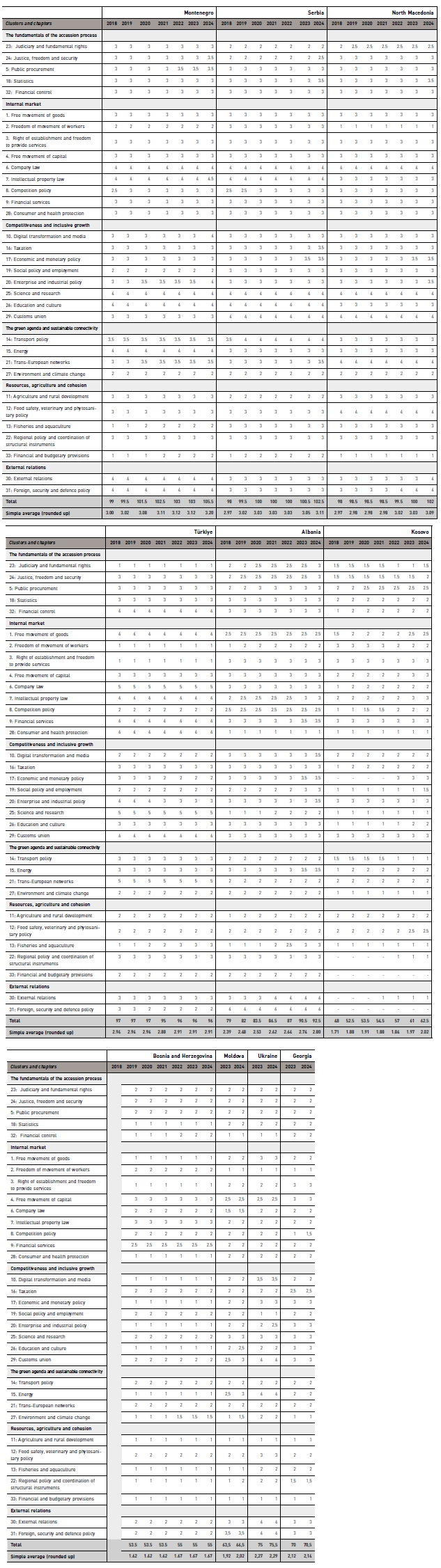
A simple, uniform metric for the individual processes is provided by the Commission’s jargon in its progress reports, indicating for each chapter an advanced stage (well advanced), satisfactory (good level of preparation), moderate (moderate level), indicative (some level) and initial (early stage), in descending order. In addition, the Commission often assigns transitional qualitative ratings, which we can quantify by numbers.15
Although the narrative of EU accession is part of Ukraine, Moldova and Georgia’s political discourse, these countries only entered the ‘calculations’ with the first step of the process outlined in the section above: the formal membership application, days after the start of the Russian invasion of Ukraine. The reports do not cover a calendar year and are usually published in October or November, so the 2022 reports are ‘nebulous’ in their coverage of the driving-force effect that this article seeks to ascertain. Furthermore, due to the reports’ complexity, which combines contributions from the Commission itself, but also from the respective countries concerned, the EP and other interested parties, it was not possible to draw up these reports for the three new applicants in 2022. ‘Analytical reports’ were published in early 2023, with the same structure as the progress reports, which in turn were published at the end of that year for the ten countries, thus extending to new European latitudes.
The figure on the following page is not so relevant for Eastern Europe, insofar as it is illogical to distinguish between a pre- and post-invasion period for those countries. Nevertheless, as mentioned above, there is a discursive aspect and an embryonic version of integration that was pursued through bilateral association agreements implemented by the EU and its counterparts.
However, the geographical expansion of the enlargement process is itself noteworthy, which, since Croatia’s accession in 2013, had been limited to Türkiye and the Western Balkans.
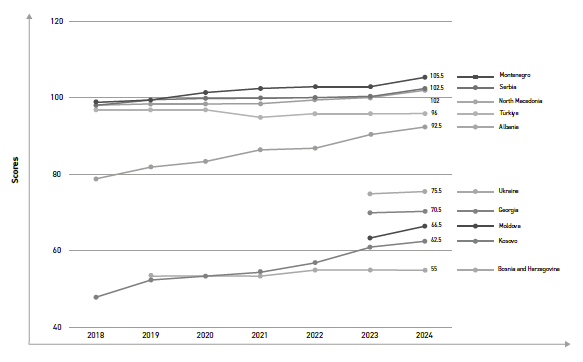
Figure 1 >Total score for candidate and potential candidate countries between 2018 and 2024. Source: Author’s own elaboration, based on data from progress reports presented by the European Commission on the official website of the Directorate-General for Enlargement and the Eastern Neighbourhood.16 Accessed on: 1 January 2025. Available at:https://enlargement.ec.europa.eu/index_en.
Of these seven countries, the quantitative analysis observes subgroups and trajectories. In a first subgroup, Serbia and North Macedonia maintained their progress in the post-invasion period, accelerated with Podgorica, which remains the best placed inacquisincorporation. Türkiye, in the longest process of any candidate, past or present, separates itself further from the first subgroup, not due to a slower progress in relation to others, but rather instances of backsliding. These stem from circumstances that have been known since the alleged failed coup (or ‘self-coup’) in 2016, the consolidation of power by the current President, the persecution of ethnic minorities, among other aspects that clash with the fundamentals cluster, among which chapters 23 and 24, as we have already mentioned, stand out as being of greater importance, to the extent that considerations on these issues warrant as much writing as the remaining 31 chapterscombined. There have also been setbacks in Turkish economic and monetary policy, in a general picture that can be seen as unrelated to the circumstances of the Russo-Ukrainian War. 2024 saw efforts to relaunch the high-level dialogue and improve relations with Greece, but still without dividends.17
Albania is another country isolated from subgroups, but, unlike Türkiye, it shows a positive trajectory in terms of convergence with the first subgroup, further intensified in the post-invasion period, with progress in several chapters, including the fundamentals. It should be noted that all progress reports warrant several mentions to Ukraine, particularly in the external relations cluster and in the section (outside the chapters) on ‘good neighbourly relations and regional cooperation’, an offshoot of the political criterion. Tirana hosted the Western Balkans Summit in 2024, which welcomed the Ukrainian President as a guest for the first time.
A second subgroup can be identified, but with more difficulty due to their shorter trajectories, comprising the trio from Eastern Europe, but also Kosovo, which has progressed at a comparable pace only to Albania. It is not irrelevant that, due to non-recognition by some EUMS, earlier progress reports on Kosovo did not refer to ‘chapters’per seand omitted some of them. Some chapters have now been considered, automatically increasing the country’s score, but those most relevant to international relations, i.e. the external relations cluster, are still absent. This affects the total score, but not the chapter average, as shown in the figure below.
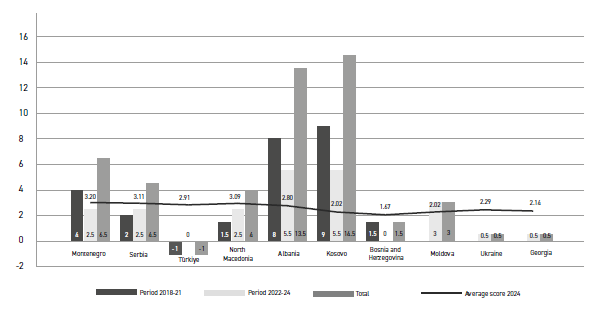
Figure 2 >Variation in scores of candidate and potential candidate countries, and chapter average in 2024. Source: Author’s own elaboration, based on data from progress reports presented by the European Commission on the official website of the Directorate-General for Enlargement and the Eastern Neighbourhood. Accessed on: 1 January 2025. Available at:https://enlargement.ec.europa.eu/index_en.
Bosnia is a similar case to Türkiye in quantitative terms, with complete stagnation contributing to its distancing from the subgroup to which it previously belonged. Without going into detail here about the circumstances of Bosnian domestic and foreign policy,18 we note only that the stagnation in the overall score is accompanied by stagnation in particular chapters, with no progress in some being offset by others’ setbacks.
The subgroups identified in this brief quantitative analysis are limited to this study and bear no relation to the trend towards ‘coupling’ that the EU favours in accession processes. For reasons of logistical pragmatism, past EU enlargements have covered two or more countries, except for Greece and Croatia, due to the slowness of some candidates or acceding states in relation to others in the same (possible) wave, which have since joined.19 We shall return to couplings in the following section.
Qualitative aspects of individual and/or coupled accession processes
Concerning individual accession processes, the figure below shows more clearly not only the geographical expansion of the EU enlargement process, which is in itself a remarkable challenge, if not for the state of play on the territorial integrity of Ukraine, Moldova and Georgia as a basic aspect of their sovereignty, but furthermore the acceleration of the individual processes’ stages, both in Eastern Europe and the Balkans.
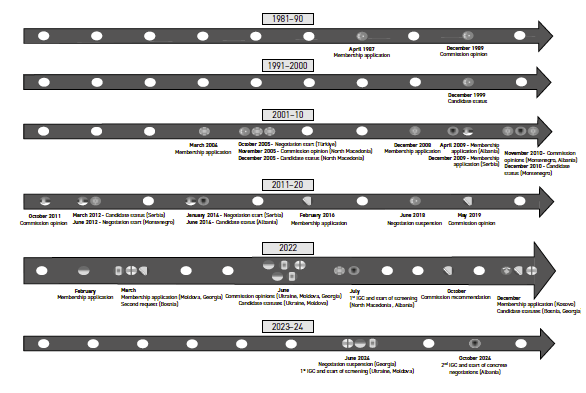
Figure 3 >Chronology of the accession processes of candidates and potential candidate. Source: Author’s own elaboration, based on data from progress reports presented by the European Commission on the official website of the Directorate-General for Enlargement and the Eastern Neighbourhood. Accessed on: 1 January 2025. Available at:https://enlargement.ec.europa.eu/index_en.
Other steps might have been included, such as Commission opinions in favour (or not) of starting negotiations, and some might even have been omitted, such as the first IGC, which does not mark the formal opening of negotiations, but rather the screening. However, in the author’s view, these are the most significant, most concrete, closest to the treaties’ letter and the information on official EU websites. Furthermore, they represent a balanced mix of initiatives by different actors: applicant states (membership application), the Commission (opinions), and the EUMS/European Council (candidate status), or even all of these (negotiations).
The EU’s preference (and the political willingness of the candidates) for couplings was relatively intuitive with Serbia and Montenegro, given the peaceful division of the former state by referendum and mutual agreement between the new political entities. In the case of North Macedonia, despite preceding Albania by a few years in the initial stages, the unanimity requirements in the European Council prevented Macedonian progress at a similar pace to the other candidates in the first two decades of the century. The name ‘Former Yugoslav Republic of Macedonia’ (FYROM) clashed, in the natural renaming to ‘Macedonia’, with the region of the same name in Greece, already an EUMS, and, at a deeper level, with the heritage of ancient Macedonia and its rulers. Once this issue was resolved, relations with Bulgaria, also involving historical issues of national identity, were raised as ‘irritants’, with little progress being made.20 The new coupling is a natural consequence of the Russo-Ukrainian War and the greater or lesser political rapprochement with Russia. Within the framework of the Eastern Partnership, a forum for cooperation between the EU and the six Eastern European countries that are not EUMS - Ukraine, Moldova, Georgia, Armenia, Azerbaijan and Belarus - the first three formed an ‘association trio’ in 2021, with the stated aim of joining the EU, but short of a formal application. Once the applications were submitted in 2022, the intuitive judgement that the trio’s individual processes would follow a similar course was revised to the detriment of the Commission’s opinions in June 2022, in which Ukraine and Moldova were required to comply with certain ‘steps’ to gain candidate status, and Georgia with ‘priorities’. In an unprecedented move, which for some countries took years, Kyiv and Chisinau obtained the endorsement of the Commission and all EUMS at the European Council in a matter of days.
The geopolitical divide across the Black Sea, separating Georgia from the others, is shaped by the ‘continuation of crucial challenges due to the overly divided political landscape’,21 the adoption of the so-called ‘Foreign Agents Bill’ as a precedent for scrutinising any NGOs on suspicion of acting against the government under the assumption of foreign influence. In addition, there have been pro-EU demonstrations and the Georgian government’s decision to suspend the accession process until 2028, in response to a similar decision by the European Council in June 2024, reiterated in October, conditioning the resumption of the process not on a date, but on Georgia’s return to the ‘European path’.22
Turning back to the Western Balkans, the acceleration of individual processes demonstrates a distinction already explored between Bosnia and Georgia,23 currently the most recent candidates. While an overly divided political scenario is not an unfamiliar assessment of Bosnian domestic politics, this is not the case in relation to zero-sum games between the EU and Russia. There is indeed a consensus among the three largest ethnic groups - Bosniaks, Bosnian Croats and Bosnian Serbs - represented in the Presidency, that the EU is a goal in itself. But there are also differences over relations with Russia, to which the Bosnian Serbs are more attached, for cultural and historical reasons that predate the idea of European integration. But Brussels and Moscow are not ‘two sides of the same coin’.
Regarding the older candidates, decoupling is a sensitive political issue, all the more so the longer the coupling has lasted. In the case of Albania and North Macedonia, the formal start of negotiations with the former seems to close a joint dossier, to the detriment of Skopje. If the Russian invasion of Ukraine has a galvanising effect on EU enlargement, this effect is also shaped, in part, by the extent of the EUMS’ interests.24
Individual and joint prospects and challenges
The previous section anticipated aspects of bilateral relations between candidates and EUMS, in addition to discussing couplings. The latter are, by and large, considered to be positive, as they result from the candidates’ endorsement and facilitate the management of dossiers by the EU, in a decades-old practice. It is not unreasonable, though, to include a category of ‘negative coupling’ concerning Serbia-Kosovo relations. While Belgrade’s non-recognition of Kosovo’s independence legitimises the same judgement by EUMS that do not recognise Kosovo, making it a potential candidatead aeternum, the EU’s25 dossier management under the Belgrade-Pristina Dialogue requires some concessions from Serbia, which is viewed more negatively by the Commission due to the former’s proximity to Russia, for reasons briefly outlined above in the Bosnian Serbs’ case, and which translates into one of the lowest scores among candidates in the external relations cluster. Greater dialogue between the two countries may make it possible to settle this negative coupling, but a positive coupling is unrealistic in the same terms as the others, given the gap between Belgrade and Pristina in their stages of negotiation for accession.26
Montenegro stands out as the exception in terms of accession prospects and challenges, unaffected by major bilateral irritants, either with its Balkan neighbours or with the EUMS, seeing the Russo-Ukrainian War as an opportunity to reiterate its alignment with the EU. In her assessment of bilateral disputes in the Western Balkans, Kelmendi27 simply omits Podgorica.
As for Albania, relations with neighbouring Italy and Greece are of the utmost importance, marked by circumstantial irritants that fall short of the other challenges outlined in this section (and the Macedonian case).28
The circumstances of the wars that led to the break-up of Yugoslavia continue to raise obstacles that are still seen as recent, three decades later, between Croatia and Serbia, and the former with Bosnia. While Zagreb’s demands on Belgrade are motivated by history, the Russo-Ukrainian War provides new grounds that prevent a clear-cut positive answer to the research question. On the other hand, if the unanimity requirements allow Croatia to block the opening of further negotiation chapters with Serbia, its demands on Sarajevo are based on the influence it wields in Bosnia, where it continues to advocate perfect equality between the three largest ethnic groups, despite being outnumbered by the other two.
It is illogical to discuss Ukraine and the invasion of its territory as an influence on its own process, as it is a fact that the course of the war influences (and will influence) its individual process in the most basic sense of the country’s territorial integrity. Regardless, as a candidate country, it could not be excluded from the above assessments.
At the time of writing, Moldova and Georgia are at a crossroads in the aftermath of their 2024 elections. Both marked by accusations of Russian (and Western, on the part of pro-Russian parties and politicians) interference, Moldova remained pro-European, albeit by a narrow margin, and Georgia appears to have settled its political division (and institutional rivalries between the government and the president) in favour of a rapprochement with Moscow. Both countries share problems of territorial integrity, with separatist portions supported by Russia, even if ‘softened’ by years without conflict, in contrast to Ukraine. However, while Moldova has an obvious ‘patron’ in Romania,29 with which it shares a religious, ethnic and cultural majority and some historical political unity, Georgia suffers from not only geographical but also geopolitical isolation.30 The impact of the Russian invasion of Ukraine on Moldova is evident, at the very least, in its shared border with Ukraine (albeit in the portion not occupied by Russia), concerns about its own territorial integrity, and, more recently, the joint management of dossiers by the EU in the latest coupling.
Conclusion: a partial driving force
The onset of the Russian invasion of Ukraine in February 2022 posed some global challenges for the EU that go beyond the scope of this article. It is clear that the EU, faced with the challenge posed by the Eastern European countries, in circumstances that were not their responsibility alone, decided to take an ambitious approach: to focus on increasing the geographical scope of the general enlargement process, now divided into three geographical areas (Türkiye, the Western Balkans and Eastern Europe), without alienating the old geographies in favour of a more ‘fiery’ and media-savvy Eastern Europe.
Indeed, not only was Eastern Europe included in the enlargement process, but this did not slow down the inclusion of new individual processes. On the contrary, the pace at which Ukraine and Moldova reached the initial stages was unprecedented, and, to a lesser extent, Georgia, while the Balkan processes were also sped up, particularly those that had experienced the greatest delays, such as Bosnia, Albania and North Macedonia. Kosovo has not yet been able to capitalise on the dynamic effect of the accession processes.
Despite the decoupling between Albania and North Macedonia, which is seen as negative, the organisation of the first IGC (and the second, in the case of Albania) also shows that the extension of the war, with no end in sight at this stage, has not made this driving force a mere epiphenomenon.
The Turkish case is the most distinctive and contributes to making this driving force somewhat partial. When reading about bilateral relations between the EU and each of the countries discussed in this article, the issue of accession is often the main one. With Türkiye, its geopolitical position brings into consideration other geographies of interest to the EU, starting with the Middle East, as well as migration policy and agreements with Ankara in this area. Türkiye’s advances, setbacks, or stagnation in its EU accession process, approaching four decades since its formal application (1987), show greater imperviousness to the Russo-Ukrainian War, with priority given to rule of law issues, which is to say, Turkish domestic policy.
Russia’s influence is no novelty brought about by the invasion of Ukraine, and neither is it its ascertainment. However, the absence of a foreign policy revision from candidate countries towards Russia, or, worse still, a revision in the direction of rapprochement with Russia - as in Georgia’s case - has become a matter of the utmost importance for, at least, the Commission’s stance.31 This position is included in theacquis’ external relations cluster, in the section on good neighbourly relations and regional cooperation in the progress reports (part of the Copenhagen political criterion), and, perhaps most importantly, in EUMS’ reaction as final decision-makers in the European Council for each stage of the accession process, whose political contribution is fundamental in defining this driving force, both in the EU’s institutional decision-making processes and in the bilateral relations that they conduct, on a sovereign and independent basis, with the states involved in the accession process. Some EUMS themselves display a closeness to Russia, such as Hungary and Slovakia, but this is, for now, the exception that proves the rule.