




 Inglês (pdf)
 Artigo em XML
 Referências do artigo
 Tradução automática
 Enviar este artigo por email
 Citado por SciELO
  Similares em
SciELO
Similares em
SciELO 
 Permalink

Introduction
‘Enlargement fatigue’ is a phenomenon that refers to a political reaction to the long process of institutional adaptation required by the European Union (EU) to accommodate the accession of a large number of new Member States (12 in addition to the 15 existing members) into the organisation between 2004 and 2007. This widely analysed phenomenon3 has been identified as one of the factors contributing to a stalemate in the enlargement policy which, apart from Croatia in 2013, has not brought any new EU member. Many internal factors within the candidate states, where the required political and institutional reforms have been very slow, have contributed to the protracted nature of this process.
However, alongside this ‘enlargement fatigue’, some authors refer to a simultaneous ‘accession fatigue’,4 i.e. a sense of discouragement among the current candidate states as the whole process has been dragging on for many years. The decline in popular support for EU accession is evident, for example, in North Macedonia,5 where the prospect of EU accession was traditionally one of the few political projects that enjoyed a certain degree of consensus in the public opinion6 and among political parties of various ideological backgrounds and ethnic origins.
At this point, rather than questioning the relative progress and scope of the reforms carried out in the candidate states and their shared responsibility for the delays, what may arouse our curiosity is trying to understand the exact role of the EU itself in the protracted nature of this process and in what has been identified as ‘accession fatigue’. The primary objective of this article will be to explore some explanatory hypotheses that may help us understand this dichotomy in the EU’s stance towards the candidates from the CEECs (Central and Eastern European Countries)7 and those from the Western Balkans.8 Our point of departure will be: how and why has the EU, which was so quick to assist and embrace the CEECs, not acted as swiftly as in the past? In order to answer this question, we shall attempt to conduct a historical analysis of the process of EU enlargement after 2004, by identifying and analysing its key moments and using the specific process of North Macedonia as a case study. Factors such as the multiplication of conditions and prerequisites to be met, the absence of deadlines as an incentive for structural reforms and, finally, some politicisation of the enlargement process - insofar as it is often withheld by the national agendas of some Member States - which delays and blocks accession procedures, will be explored.
In this paper, we will first outline a number of elements that allow us to compare the enlargement processes prior to 2004-7 with those that followed. We will then analyse the specificities of the enlargement processes after 2004-7 and survey hypotheses for this dissimilarity. Finally, we will present North Macedonia’s application process as a case study illustrating the hesitation by the EU regarding its own enlargement.
Contrast between the enlargements before 2004-7 and the following accession processes
In the early decades of the European integration process, the procedures and rules for admitting new members were rather informal, as there was no roadmap for its implementation. The very nature of the Communities, which were predominantly economic at that time, did not require significant political reforms, and negotiations focused in being prepared for the single market. The establishment of the EU and the applications for membership that popped up throughout the 1990s required European institutions not only to set specific conditions for EU membership (which led to the establishment of so-called ‘Copenhagen Criteria’ in 1993),9 but also to strengthen their internal mechanisms for monitoring compliance with these conditions. Specific criteria and targets were essential given the amount of economic and political reforms required to the CEECs, which had just emerged from decades of communist political systems and planned economies and were seeking to adapt their internal structures to the single market.
Some guiding principles may be found behind this enlargement dynamic, i.e. the goals to be achieved through EU accession processes in very specific political contexts. While the first enlargements (in the 1970s and 1980s) can be understood in the context of the economic strengthening of the Western bloc during the Cold War, the enlargements that took place in 2004 and 2007 responded to the need to guarantee ‘peace and security in Europe [which] depend on the success of these reinforcements’.10 This period coincides with a time in which the EU is trying to build for itself a status of a ‘normative’ power11 or an ‘ideal’ power,12 a political and economic actor which, through example, conditionality and shared prosperity, shapes its immediate neighbourhood according to its values and on its terms, aiming at an international political relevance matching its economic role.13 Thus, the principle of conditionality as a stimulus for reforms14 and for the progressive ‘Europeanisation’ of these societies15 would be an instrument for the EU to guarantee its own security.16
We can identify a third phase of enlargement processes associated with a very specific historical and geopolitical context, in which the Western Balkan states were attracted immediately after the enlargements that took place in 2004 and 2007. Despite some procedural and normative continuities with the previous phase, the EU’s approach to this region must be understood from a differentiated outlook on these new candidate states, but also because the EU was different itself. On the one hand, enlargement to the Western Balkans was conceived from a post-conflict reconstruction perspective, in which the promise of enlargement would be an incentive for reforms and as an instrument for political stabilisation.17 On the other hand, the growing relevance of the EU security dimension after the Treaty of Nice (2003) and in documents such as the European Security Strategy,18 the European Union Global Strategy for Foreign and Security Policy19 and the Strategic Compass for Security and Defence20 is also reflected in the way the EU interacts with candidate countries, its immediate neighbours. The optimism still present in the European Security Strategy (‘Europe has never been so prosperous, so secure and so free’) has given way to a certain existential distress in the European Union Global Strategy on Foreign and Security Policy (‘The purpose and even the existence of our Union [are] being [questioned]’).21
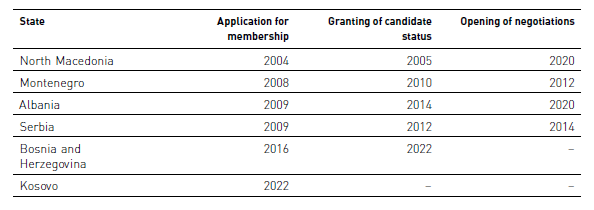
The contrast between the current negotiation processes and those before 2004-7 is also evident when comparing the period between the formal application for membership and the accession itself. Looking at some the longest accession processes, between the application for membership and the effective entry into the Community structures, the Cyprus process took fourteen years (from 1990 to 2004), those of Hungary and Poland took ten years (from 1994 to 2004), those of Bulgaria and Romania took twelve years (from 1995 to 2007) and that of Croatia took ten years (from 2003 to 2013). From the table below, we can see that the Western Balkan states that have already entered the negotiation phase all submitted their applications for membership before 2010, more than sixteen years ago.
Table 1 >Timeline of the Western Balkan states’ application process to the European Union.Source: Elaborated based on data from official documents of the European Commission and the European Union. Accessed on: 1 January 2025. Available at:https://commission.europa.eu/strategy-and-policy/policies/eu-enlargement_en; https://enlargement.ec.europa.eu/document/download/1fec0e03-a7b6-4225-b357-d3549fbc63ac_en?filename=EU-KS%20FS.pdf.
Specific features of the enlargement processes after 2004-7
A more detailed analysis of the negotiation processes of the candidates after 2004-7 can help us identify elements that explain this protracted negotiation period.
Although the conditionality model used for the candidates that joined the EU during the aforementioned period - based on the application of the Copenhagen Criteria - remained unchanged, the model designed for the accession of the Western Balkan states has some particular features. Given the more or less direct involvement of most of these states in the wars that led to the break-up of Yugoslavia, the EU introduced a more robust approach that integrates both a multilateral component, initiated with the Stability Pact for South-Eastern Europe in 199922 and a bilateral component that includes the conclusion of stabilisation and association agreements.23 On the other hand, the intensification of economic relations between candidate states was encouraged by the inclusion, in 2006, of the Western Balkans in the Central European Free Trade Agreement, which had already included the CEECs during the 1990s, subsequently complemented by the launch of a regional economic area in 2017 and a regional common market in 2020.24 Finally, cooperation with the International Criminal Tribunal for the former Yugoslavia was also imposed as a condition for further rapprochement with the EU.25 The pinnacle of the integration thrust in the Western Balkans was probably the Thessaloniki Summit26 held between the EU and the states of this region in 2003.
In fact, twenty-two years after that initial impetus, Croatia’s integration was the only visible result; and although negotiations with the remaining candidates began in 2012, European Commission President Jean-Claude Juncker, having to deal with the reluctance of some EU Member States, stated in 2014 that there would be no significant progress in the enlargement process over the following five years.27 The management of crises and sensitive political issues (the invasion of Crimea, Brexit, the refugee crisis) also narrowed the attention of the European institutions.28
The European Commission tried to lead a new phase by presenting an EU strategy for enlargement to the Western Balkans in 2015,29 accompanied by the European Union Global Strategy for Foreign and Security Policy in 2016.30 However, the caution towards the Enlargement Policy at this point is clear. On the one hand, a more geopolitical and pragmatic formulation of the Enlargement Policy stands out,31 compared to the more normative tone of the previous accession processes: a new balance between values and interests would be summarised in the expression ‘principled pragmatism’ across the Global Strategy.32 On the other hand, the reference to the settling of bilateral problems between candidate states as a precondition for accession33 seems to add another element of conditionality to the whole process, shifting the focus from the necessary reforms of the rule of law to the resolution of these political obstacles.34 However, not only no precise targets or dates for accession are set in the multilateral dialogue between the EU and the candidates, but in some of the documents - such as the final declaration of the EU-Western Balkans Summit in Sofia35 or the final declaration of the EU-Western Balkans Summit in Zagreb36 - the terms ‘accession’ or ‘enlargement’ are not even mentioned, replaced by a ‘European perspective’,37 creating uncertainty among this group of states due to the lack of commitment to specific targets or dates for accession. Initiatives aimed at relaunching the enlargement process, but mainly the opening of accession negotiations with North Macedonia and Albania upon the recommendation of the Commission, suffered a huge setback in 2019 when they were blocked by France, supported by the Netherlands and Denmark, on the grounds that the EU should first undertake internal reforms, which should become the priority over enlargement.38 In response to this impasse, the Commission would present a ‘new methodology’ for accession processes in 202039 to be implemented in the ongoing negotiation processes. Among the innovations introduced are the grouping of the negotiation chapters into six clusters and the principle of negative conditionality, which allows the reversion of the accession process in case of stagnation or regression in reforms.40
Following Russia’s invasion of Ukraine in 2022 and the subsequent application for membership by Ukraine, Moldova and Georgia, the Enlargement Policy was reviewed, so much that France, which had slowed down the enlargement process a few years earlier, renewed its interest in this policy. An example of this would be the report presented jointly with Germany on the enlargement process, in which, among other elements, included a proposal of ending with the vote by unanimity in the EU Council.41 Milosavljevic and Petrovic42 identify this most recent trend as a reflection of the ‘geopolitisation’ of enlargement, i.e. the current impetus behind this policy is largely due to the need to include the states of the former European Neighbourhood Policy, such as Ukraine and Moldova, in the enlargement process: accession would be a response to their vulnerability vis-à-vis Russia. From this brief description, a few distinctive elements stand out that can help us understand the unusual length of the most recent accession processes. Cemalovic,43 for example, speaks of increased conditionality imposed on the Western Balkans, in a process that is now more politicised in contrast to the more technocratic processes of the past; in fact, in the most recent reports, the Commission’s recommendations are no longer automatically followed by the Council, contrary to previous practice.44 Basheska45 refers to an over-politicisation of the negotiation processes, over the previous priority given to internal reforms to strengthen the rule of law; this position is supported by Butnaru-Troncota,46 since the EU’s approach to the Western Balkans would have shifted from ‘transformative power’ to ‘transactional power’ due to the instrumentalisation of the enlargement process by Member States in line with their national political priorities.
The EU’s own institutional idiosyncrasies are evident in the model adopted for the negotiations. It is a process in which several of the internal tensions in the background of the functioning of the European institutions are recognisable. On the one hand, because the institutions acting according to the supranationality (the Commission) and intergovernmentalism (the Council) principles are simultaneously involved, which is also visible in the role that each plays throughout the process: the more technical dialogue with candidates is almost entirely conducted by the Commission, while any vote (candidate status, start of negotiations, opening and closing of negotiation chapters) requires the unanimity of the members of the Council. On the other hand, these same tensions fuel a certain duality of conditionality: one more technical and the other more political. This duality is reflected in the perception that there are ‘informal criteria’ for accession, external to the Copenhagen Criteria, which may block the entire negotiation process for years, alienating and discouraging candidate countries that see no tangible results from their efforts to align themselves with the EU and implement reforms, and consider their time to have been wasted. The particular case of North Macedonia illustrates these trends, as we shall see in the following section.
The perpetuation of the candidate status: The case of north Macedonia
North Macedonia, still officially known as the Former Yugoslav Republic of Macedonia (FYROM),47 was part of the group of states integrated into the aforementioned Stabilisation and Association Process and the Stability Pact in 1999. It was also the first Balkan signatory to a Stabilisation and Association Agreement with the EU in 2001, which entered into force in 2004. This relatively early signature, compared to the other neighbouring states, was part of the pacification and stabilisation process that the international community was keen to ensure after a near civil war that year between Macedonian government forces and Albanian paramilitary groups. The Ohrid Framework Agreement reached in 2001 and mediated by the United States and the EU stipulated a set of reforms, whose compliance represented an additional layer of conditionality for future EU membership.
Following the Thessaloniki Summit (2003), FYROM submitted its application to the EU in 2004, obtaining official candidate status the following year. However, negotiations would only begin in 2020 with a much-awaited endorsement from the Council, despite successive annual recommendations from the Commission. In 2012, a specific initiative was also created for FYROM, for which there was no apparent continuity, a ‘High Level Accession Dialogue’48 led by the then European Commissioner for Enlargement, Stefan Füle, and the Macedonian Prime Minister Nikola Gruevski, which aimed to ‘inject new dynamism into the accession reform process, strengthening confidence and encouraging the country’s European perspective’.49
This long stagnation in FYROM’s accession process was largely due to two parallel factors that hindered any progress. On the one hand, FYROM experienced a period of authoritarian drift under the VMRO-DPMNE governments of Nikola Gruevski (2006-16). A series of public allegations made by opposition leader Zoran Zaev50 concerning serious irregularities directly involving members of the government triggered a wave of popular protests - theProtestiram(‘I protest’)51 - and led to Gruevski’s resignation in 2016.52 Among the many allegations, the most notable were political pressure on the judicial system,53 wiretapping and censorship of the media,54 irregularities in electoral processes,55 irregularities in public works tenders, favouritism towards companies close to VMRO-DPMNE, and misappropriation of funds for acquiring goods and property on behalf of party members,56 among others.
On the other hand, the opening of negotiations has been systematically vetoed by Greece since North Macedonia’s independence in 1991. At the heart of the bilateral dispute was the use by the Skopje government of ancient national symbols and myths, which Greece considers historically its own, but which could also, in the long term, evolve into irredentist arguments about territories in northern Greece.57 Following a provisional agreement brokered by the United Nations in 1995,58 North Macedonia committed itself to respect international borders and relinquished the use of some of the more controversial symbols, and Greece agreed to establish diplomatic relations. The recognition of the official name of its new neighbour remained an open question due to the use of ‘Macedonia’ in its official name,59 with the name ‘FYROM’ being provisionally retained. A period of friendly relations between these two neighbouring states would begin, so much so that Greece, during its Presidency of the Council of the EU in 2003, promoted the aforementioned Thessaloniki Summit, after which FYROM submitted its application to join the EU. However, the unilateral and unconditional recognition of the name ‘Republic of Macedonia’ by the United States in 2004 triggered a nationalist reaction on the part of successive Greek governments regarding the outstanding issue of FYROM’s official name: Greece started to veto any progress in its neighbour’s application until the dispute over its official name was resolved.60 However, here too, the nationalist agenda of the Gruevski government would add new difficulties to bilateral relations with Greece, which saw many of the measures implemented as a provocation (the use of national symbols from Classical Antiquity such as Alexander the Great and Philip II, or the ambitious plans to ‘antiquise’ the capital with the Skopje 2014 urban development project).61
This bilateral dispute only ended in 2018 when the Greek and Macedonian heads of government signed the so-called Prespa Agreement62 in which, in addition to reinforcing the issues already agreed in the 1995 Interim Accord, the Macedonian state agreed to change its name to the Republic of North Macedonia, among other issues related to the use of the adjective ‘Macedonian’ in the designation of the nationality of its citizens and its official language.63 Despite all the controversy both in North Macedonia and Greece,64 the agreement effectively entered into force, removing the biggest obstacle to North Macedonia’s accession to the EU.
What stands out from Greece’s veto on the opening of accession negotiations with this state is the high degree of dependence of the entire EU enlargement process on potential blockades by one of the Member States. In other words, the accession process of a candidate state can become totally dependent on its political instrumentalisation, ultimately adding a new layer of indirect conditionality beyond that arising from the need to comply with the Copenhagen Criteria, making the path to full membership even more costly. In the case of the Greek blockade, some authors argue that the Greek position was illegal because it violated the content of the 1995 Interim Accord and the principle of sovereign equality.65 On the other hand, the need to settle these bilateral disputes forces candidates to prioritise the overcoming of these obstacles and to postpone reforms to meet the accession criteria.66 Finally, another question arises: should outstanding bilateral issues involving a candidate state to the EU be settled before its accession or should they be dealt separately (even after accession)? Not only North Macedonia, but also states such as Serbia, Kosovo and Bosnia and Herzegovina are prevented from moving forward with accession negotiations (or even formalising their application). Basheska67 also points out that any bilateral agreement could potentially become a dead letter after accession.
Although the Prespa Agreement allowed Greece to lift its veto on the opening of negotiations with North Macedonia, the process was again compromised by France’s challenge to the entire procedure in 2019, as mentioned above. It should also be noted that the ‘new methodology’ adopted by the EU in 2020 applies only to candidates that are about to start the negotiation process, such as North Macedonia and Albania, but not to candidates that are already at a more advanced stage, such as Serbia and Montenegro.68
Following the presentation of this ‘new methodology’, North Macedonia faces a new obstacle: Bulgaria’s blockade for reasons which, as in the Greek case, revolve around nationalist differences on linguistic issues, national identity, common historical heritage and mutual recognition of national minorities. Despite a bilateral treaty of friendship, good neighbourliness and cooperation in 2017 and the subsequent creation of a joint commission to monitor its implementation,69 frequent disagreements and difficulties in implementation led the Bulgarian government to veto negotiations with North Macedonia after they had already begun. However, this veto was eventually lifted in 2022 under pressure from the EU.70
Concluding remarks
When examining the current EU accession processes, one cannot ignore the many internal constraints and the frequent responsibility of the governments of the candidate countries in failing to meet the accession criteria and postponing the required reforms. However, it is no less realistic to also consider the impact that the flagrant erratic nature of the accession process has had on the political commitment of the candidate states. The ever-increasing conditionality beyond the Copenhagen Criteria, the lack of clear incentives (beyond financial ones) and the failure of the EU to set tangible targets contributed to the political impasse in which the Western Balkan states seemed to be stuck, were it not for the recent revitalisation of the Enlargement Policy in the context of Ukraine’s application for membership. Throughout this article, we have raised some hypotheses that may help us identify the causes for the prolongation of an accession process that has fuelled a perception of ‘fatigue’ in the candidate countries. We would highlight the lack of a guiding political axis that gives some coherence to the enlargement process in the Western Balkans and from which concrete goals and objectives can be outlined; an uncertain articulation between the normative objectives of this Enlargement Policy and its more recent geopolitical dimension; and the frequent politicisation of the enlargement process by EU Member States. An analysis of the specific case of North Macedonia allows us to illustrate empirically the relevance of these hypotheses.

