




 Inglês (pdf)
 Artigo em XML
 Referências do artigo
 Tradução automática
 Enviar este artigo por email
 Citado por SciELO
  Similares em
SciELO
Similares em
SciELO 
 Permalink

INTRODUCTION
Sports training has been commonly carried out based on a great search for scientific evidence to justify the use of training protocols (Barbanti et al., 2004). Bearing in mind that the difference between the champion or runner-up of a race can be a matter of small details, professionals in the area seek to use the most effective and efficient methods in order to allow the athlete to reach the best of his physical performance during a race. Confirming the argument, it is possible to cite the evolution of world records in the 5,000 m race. The first record was the mark of 14:36.06, held by Hannes Kolehmainen, in a time of empiricism in the sport. The current record was made by Joshua Cheptegei, with the mark of 12:35.36, in a period of a significant increase in studies on physical performance (World Athletics, 2022).
For the 5,000 m race, there is a predominance of aerobic, followed by lactic anaerobic and alactic anaerobic energy metabolism (Bompa, 2001; Dantas, 2014; Støren et al., 2008). Therefore, it is possible to associate some predictive variables for this distance, such as the maximal oxygen uptake (VO2max), the lactate threshold (intensity of effort before the exponential increase of blood lactate relative to resting levels), running economy (energy demand for a given velocity of submaximal running) and vVO2max (first speed at which VO2max is reached) (Batista, 2019; Denadai et al., 2004; Guglielmo et al., 2012; Souza et al., 2014).
Due to the large number of participants in this test (Fonseca, 2012), there are a large number of training protocols studied in the literature that seek to improve performance in the referred distance, such as interval (Denham et al., 2015; Etxebarria et al., 2014) and neuromuscular training (Nummela et al., 2006; Paavolainen et al., 1999). However, such knowledge is not compiled, and for some types of intervention, there is still no consensus on which ones are really effective and how they should be applied.
Gathering the scientific literature, in a systematic way, is justified by the elaboration of a document that will allow, in a more objective, quick and easy way, to guide athletes and well trained runners coaches. In this way, they will have scientific support for their choices regarding the really effective protocols to improve performance in the 5,000 m race, as well as to improve physiological variables that predict this performance. This kind of study was not found in the literature for the 5,000 m distance or other Olympic events.
Thus, this study aimed to systematically review the literature on physical training protocols applied to athletes and well-trained runners who have investigated their impacts on performance in 5,000 m races and/or on physiological markers in effort that are recognised as predictors of performance in this distance.
METHODS
Experimental approach of the problem
This systematic review was carried out according to the criteria present in the Preferred Reporting Items for Systematic Reviews and Meta-Analyses (PRISMA) and was registered in the International Prospective Register of Systematic Reviews (PROSPERO) under the identification CDR42022308290. The search was performed using Web of Science, PubMed and Scopus databases through September 2022. The following string was used in the search ("HIIT" OR "interval training" OR "sprint" OR "strength training" OR "plyometric training" OR "running" OR "warm up" OR "cool down" OR "training" OR "recovery") AND ("performance" OR "running economy" OR "lactate threshold" OR "VO2max" OR "vVO2max" OR "oxygen uptake" OR " oxygen consumption" OR "time trial" OR "time-trial") AND ("5-km" OR "5km" OR "5 km" OR "5000m" OR "5 kilometers") AND (athlete OR runner) NOT (" basketball" OR "rugby" OR "soccer") - example for PubMed search.
The PICOS strategy (population, intervention, comparison, result and study design) was used to define the eligibility criteria. Inclusion criteria for this analysis were (1) athletes and well-trained individuals, adults, both male and female. To ensure this characteristic, the study sample should have a better 5,000 m running time below 22 minutes (male sex) and 25 minutes (female sex), or, when time data was not available, VO2max values above 53 ml.kg-1.min-1 (male sex) and 40 ml.kg-1.min-1 (female sex), which are classified by Herdy and Caixeta (2016) as excellent for the Brazilian population; (2) specific running training protocols or not as intervention. Some examples are continuous running protocols, interval running, uphill running, neuromuscular training, altitude training, ischemic training, hypoxia training, and polishing and acclimatisation strategies were accepted; (3) comparisons pre vs post-intervention, including or not more than one group (groups submitted to different interventions during the same period or control groups, which were not submitted to any interventions). (4) presence of at least one of the following outcomes: 5,000 m running time, or physiological variables associated to endurance running, specifically the 5,000 m race, such as VO2max, vVO2max, anaerobic threshold and running economy; and (5) study design types: observational, experimental or quasi-experimental studies. Exclusion criteria were (1) a study sample with athletes of team sports like soccer, basketball, volleyball and others, (2) nutritional strategies as intervention, (3) paper language other than English or Portuguese, (4) recreational or amateur runners, and (5) child, adolescent or elderly as a sample.
Procedures
The initial list was examined to check and exclude duplicates. After that, the titles and abstracts were read, excluding those not meeting the eligibility criteria. The next step was to read the full articles and exclude those that no longer met the inclusion criteria or that addressed some exclusion criteria. In both stages, the eligibility judgment was made independently by two researchers (TB and AG), and, in case of disagreement, a third evaluator (MM) was activated. In addition to the search, others were identified in secondary sources that underwent the eligibility analysis using the same criteria.
Risk of bias assessment
The methodological quality and risk of bias were assessed based on the Cochrane Handbook for Systematic Reviews of Interventions (Higgins & Green, 2008). Two researchers (AG and TB) independently performed this step, with disagreements resolved by a third one (MM). They analysed the risks of: (1) selection bias, (2) performance, (3) detection, (4) attrition, and (5) reporting.
Data extraction and outcomes
The reading of the articles was carried out in order to extract the information for analysis of the risk of bias and the main information of this review: authors, sample size, age, gender, VO2max, 5,000 m time trial (TT), type of intervention, duration of the protocol, structuring of the intervention and results (specifically the variables that are the object of research in this work). The findings were categorised according to the type of training protocol: running, neuromuscular, taper and a category called "others".
RESULTS
The first search obtained a total of 937 articles. After removing duplicates and excluding by title and abstract reading, 106 studies were read in full. Finally, 25 studies from the databases were selected for qualitative analysis; adding to these studies, 10 more articles were identified while reading the selected articles by the main search. A total of 35 studies were included in the systematic review. The study selection flowchart is depicted in Figure 1.
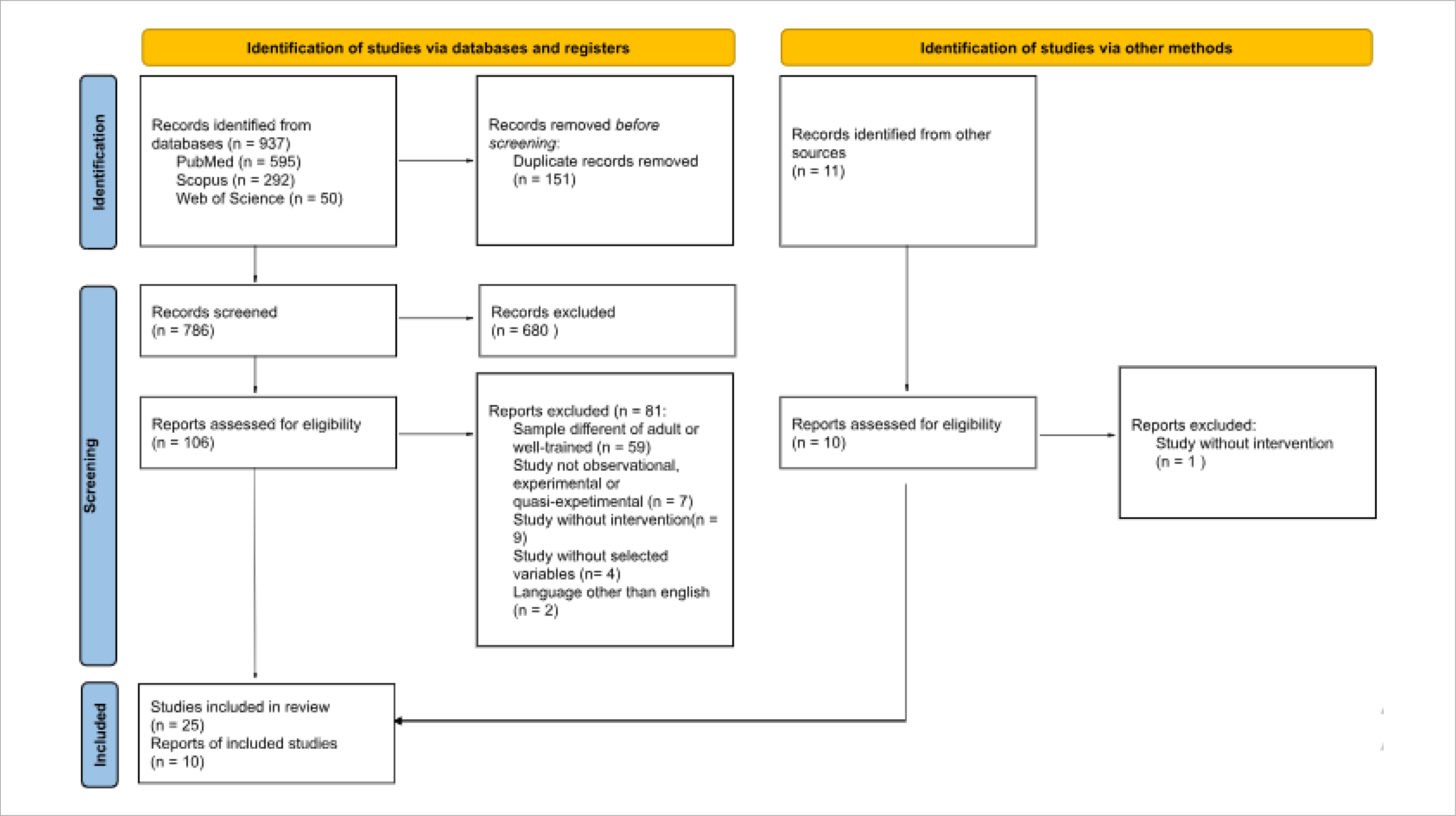
The included articles were classified into four categories according to the type of intervention applied. These categories were called running (17 articles), neuromuscular (9 articles), taper (7 articles) and others (2 articles).
Risk of bias
The risk of bias results showed that the included studies have, in most cases, a high risk for the types of bias "selection" and "performance", and a low risk for "attrition" and "report". It should be noted that the high risk of performance bias is probably due to the characteristics of the intervention: carrying out a certain type of physical training is an intervention that is difficult to be "blinded", especially for well-trained athletes and practitioners, who usually have good knowledge about physical training methods. The risk of bias results are presented in Table 1.
Table 1 Risk of bias of the studies included in the review, presented by category.
H: high risk; L: low risk; U: uncertain risk.
Effects of running protocols
Seventeen articles (Table 2) observed the results of 35 running protocols. Ten protocols applied High-Intensity Interval Training (HIIT), seven protocols involved both interval and continuous training, eight protocols proposed uphill HIIT, five protocols employed continuous running, two protocols used increased running training, two protocols involved cross-training interventions (combination of exercises from different modalities in a training session or increase the number of running sessions), and one protocol involved deep water running.
Table 2 Results of the running protocols category.
| Reference | Sample | Intervention | Measured variables/ effect |
|---|---|---|---|
| Berg et al., 1995 |
n= 7 gender: female Age: 19,4± 1,2 years VO2max (ml.kg-1.min-1): 53.4± 4.1 5km TT: 22.1± 1.3 min |
Method: continuous and interval (no control group) |
↑5km TT; ↔RE; ↑vVO2max; ↔VO2max |
| VO2max training: sets of 3 to 5 minutes runs at a heart rate within 10 beats of peak rate RE training: 30sec to 1min runs at a speed slightly faster than 5km race speed LT training: 10 to 25min at the speed associated with LT Velocity training: 100m to 400m sprints at speeds faster than 5km race pace Taper: 2 week before competition, volume reduction of 50% | |||
| Weekly frequency: 3x interval and 3x recovery or light. | |||
| Total duration of intervention: 1 year | |||
| Pizza et al., 1995 |
n= 11 gender: male Age: 34.8± 7.6 years VO2max (ml.kg-1.min-1): 65± 4.9 |
Method: continuous (crosstraining) | G1: ↔5km TT; ↔RE G2: ↔5km TT; ↓RE |
| G1: Normal training + 8 running sessions (69,9± 4,9% VO2max) | |||
| G2: Normal training + 8 ciclism sessions (crosstraining; 68,5±4,6% VO2max) | |||
| Total duration of intervention: 10 days | |||
| Bushman et al., 1997 |
n= 10 gender: male n= 1 gender: female Idade: 32.5± 5.4 years |
Method: deep water running |
↔5kmTT; ↔RE; ↔vLT; ↔VO2max |
| Intervention: 5 minutes warm-up and cool down in all sessions; 22,5 to 45 minutes of continuous or interval training. | |||
| Weekly frequency: 5 to 6x; 2 long interval sessions, 2 short interval sessions and 1 to 2 days of long duration sessions. | |||
| Total duration of intervention: 4 weeks | |||
| Flynn et al., 1998 |
n= 20 gender: male G1 Age: 33.6± 6.5 years VO2max (ml.kg-1.min-1): 63.3± 7.2 G2 Age: 32.6± 10.1 years VO2max (ml.kg-1.min-1): 65.2± 6.2 |
Method: Interval (crosstraining) | G1: ↑5km TT; ↔RE G2: ↑5km TT; ↔RE |
| G1: Normal training (6x/week) + 3 running sessions | |||
| G2: Normal training (6x/week) + 3 ciclism sessions | |||
| Session 01: 5x 5min 95%vVO2max, 5 min rest Session 02: 50-60min at 70%vVO2max Session 03: 2x 2,5min at 105%vVO2max (resy 1:1) + 6x 1,5min at 115%vVO2max (rest 1:1) | |||
| Weekly frequency: 2x interval and 1x recovery | |||
| Total duration of intervention: 6 weeks | |||
| Smith et al., 1999 |
n= 5 gender: male Age: 22.8± 4.5 years VO2max (ml.kg-1.min-1): 61.5± 2.9 |
Method: Interval (active recovery) |
↑vVO2max; ↑VO2max |
| Session: 6x 60-75%Tmax at 100%vVO2max Recovery: 30min at 60%vVO2max | |||
| Weekly frequency: 2x interval and 1x recovery | |||
| Total duration of intervention: 4 weeks | |||
| Smith et al., 2003 |
n= 27 gender: male Age: 25.2± 1.3 years VO2max (ml.kg-1.min-1): 61.4± 1.0 |
Method: Interval (passive recovery) | G1: ↔5kmTT; ↔RE; ↔VO2max; ↔vVO2max G2: ↔5kmTT; ↔RE; ↔VO2max; ↔vVO2max G3: ↔5kmTT; ↔RE; ↔VO2max; ↔vVO2max |
| G1: 6 sets; intensity of 100%vVO2max, duration of 60% Tmax (Rest 1:2). | |||
| G2: 6 sets; intensity of 100%vVO2max, duration 70% Tmax, (Rest 1:2). | |||
| G3: control instructed to maintain the routine, which consisted of low-intensity, long-duration running. | |||
| Additional continuous training (G1 and G2) Volume: free warm up and cool down, 30min main part Intensity: 60%vVO2max | |||
| Weekly frequency: 2x | |||
| Total duration of intervention: 4 weeks | |||
| Denadai et al., 2006 |
n= 17 gender: male Age: 27.4± 4.4 years G1: VO2max (ml.kg-1.min-1): 59.05± 6.0 5kmTT: 1001.0± 61.8 sec G2: VO2max (ml.kg-1.min-1): 59.98± 6.0 5kmTT: 994.7± 39.6 sec |
Method: Interval (active recovery) | G1: ↑5km TT; ↔RE; ↔vVO2max; ↔VO2max G2: ↑5km TT; ↑RE; ↑vVO2max; ↔VO2max |
| G1: Stimulus: 4 sets; intensity of 95% vVO2max, duration of 60% Tlim; Active recovery: intensity of 50%vVO2max, duration of 30% Tlim. (Rest 2:1) | |||
| G2: Stimulus: 5 sets; intensity of 100% vVO2max, duration of 60% Tlim; Active recovery: intensity of 50%vVO2max, duration of 60% Tlim. (Rest 1:1) | |||
| Weekly frequency: 2x | |||
| G1 e G2: 1 Additional vOBLA session (both groups) and 3 continuous running 60-70% vVO2max (both groups). | |||
| vOBLA session: 2x 20min; intensity of 60% vVO2max; 5 min interval Continuous running: 45-60min | |||
| Total duration of intervention: 4 weeks | |||
| Helgerud et al., 2007 |
n= 40 gender: male Age: 24.6± 3.8 years VO2max (ml.kg-1.min-1): G1: 55.8± 6.6 G2: 59.6± 7.6 G3: 64.4± 4.4 G4: 55.5± 7.4 |
Method: continuous and interval | G1: ↔VO2max; ↑RE; ↑vLT G2: ↔VO2max; ↑RE; ↑vLT G3: ↑VO2max; ↑RE; ↑vLT G4: ↑VO2max; ↑RE; ↑vLT |
| G1: continuous running at the intensity of 70% HRmax (137± 7 beats) lasting 45 min. | |||
| G2: continuous running at lactate threshold intensity (85% HRmax, 171 ±10 beats) lasting 25 min. Warm up: 10min; Cool down: 3 min (intensity of 70% HRmax) | |||
| G3: 47 reps of 15sec; intensity of 90–95% HRmax (180 to 190± 6 beats) with 15sec of active recovery at the intensity of 70% HRmax (140± 6 bpm). | |||
| G4: 4 intervals of 4min; intensity of 90–95% HRmax (180 a 190± 5 beats) with 3min of active recovery at the intensity of 70% HRmax (140± 6 bpm). Warm up: 10min; Cool down: 3 min (intensity of 70% HRmax) | |||
| Training bouts carried out on a treadmill, with 5.3% grade. | |||
| Total duration of intervention: 8 weeks | |||
| Philp et al., 2008 |
n= 14 male: n= 12 female: n= 2 Age: 25± 6 years G1: VO2max (ml.kg-1.min-1): 52,5± 9,4 G2 VO2max (ml.kg-1.min-1): 49,6 ±4,1 |
Method: continuous and interval | G1: ↑VO2max; ↑LT; ↑vVO2max G2: ↑VO2max; ↑LT; ↑vVO2max |
| G1: interval Stimulus: 7-11x 3min; intensity of ±0,5km/h vMLSS; | |||
| G2: continuous Stimulus: 21 min; intensity of vMLSS | |||
| Weekly frequency: 2x | |||
| Total duration of intervention: 8 | |||
| Enoksen et al., 2011 |
n= 19 gender: male Age: 19± 6.1 years VO2max (ml.kg-1.min-1): 70.4± 3.8 |
Method: continuous | G1: ↑RE; ↔vVO2max; ↔VO2max ↔vLT G2: ↑RE; ↑vVO2max; ↔VO2max ↑vLT |
| G1: Weekly volume (high): 70km Intensity (low): 65-82% HRmax | |||
| G2: Weekly volume (low): 50km Intensity (high): 82-92% HRmax | |||
| Weekly frequency: 6x Total duration of intervention: 10 weeks | |||
| Barnes et al., 2013a |
n= 22 gender: male Age: 21± 4 years 5kmTT: 16.5± 1.2 min |
Method: hills intervals (passive recovery) | G1: ↑5km TT; ↑RE; ↑vVO2max; ↑VO2max; ↑vLT G2: ↑5km TT; ↑RE; ↑vVO2max; ↑VO2max; ↑vLT G3: ↑5km TT; ↔RE; ↑vVO2max; ↑VO2max; ↑vLT G4: ↑5km TT; ↔RE; ↑vVO2max ↑VO2max; ↑vLT G5: ↑5km TT; ↔RE; ↑vVO2max; ↑VO2max; ↑vLT |
| G1: Stimulus: 12-24 sets of 8-12sec; 18% grade; intensity of 120%vVO2max (100% HRmax); Rest 1:6. | |||
| G2: Stimulus: 8-16 sets of 30-45sec; 15% grade; intensity of 110%vVO2max (100% HRmax); Rest 1:3. | |||
| G3: Stimulus: 5-9 sets of 2-2,5min; 10% grade; intensity of 100%vVO2max (98-100% HRmax); Rest 1:2. | |||
| G4: Stimulus: 4-7 sets of 4-5min; 7% grade; intensity of 90%vVO2max (93-97% HRmax); Rest 1:1,5. | |||
| G5: Stimulus: 2-3 sets of 10-25min; 4% grade; intensity of 80%vVO2max (88-92% HRmax); Rest 1:1. | |||
| Weekly frequency: 2x | |||
| Total duration of intervention: 6 weeks | |||
| Silva et al., 2014 |
n= 6 gender: male Age: 28,7± 9,5 years VO2max (ml.kg-1.min-1): 69,1± 3,9 5kmTT: between 14min20sec e 16min30sec |
Method: continuous e interval |
↔5km TT("uncertain") ↑vVO2max ("probable") ↔VO2max ("uncertain") |
| Continuous training: intensity of 65-70% vVO2max Weekly frequency (continuous): 4x to 5x/ week | |||
| Interval training 01: 10-15x; 200 to 400m; intensity of 108-112%vVO2max; 30 to 60sec rest; Interval training 02: 5-8x; 800m; intensity of 104-108%; 1min30sec rest; and Interval training 03: 3-5x; 1km to 2km; intensity of 98-102% vVO2max. Weekly frequency (interval): 1x ou 2x/ week | |||
| Complementary training: neuromuscular training 2x/week and pilates 1x/week | |||
| Total duration of intervention: 7 weeks | |||
| Ferley et al., 2013 |
n= 14 gender: male Age: 27.4± 3.8 years 5kmTT: below 21min n= 18 gender: female Age: 27.4± 3.8 years 5kmTT: below 24min VO2max (ml.kg-1.min-1): G1:63,3± 8,0 G2: 59,4± 8,9 GCon: 59,9± 8,6 |
Method: interval (active recovery) and continuous | G1: ↔VO2max; ↔vLT G2: ↔VO2max; ↔vLT GCon: ↔VO2max; ↔vLT |
| G1: hills interval Stimulus: 10-14 reps of 30sec; 10% grade; intensity of 100%vVO2max Active recovery: until reach 65% HRmax (Rest 1:4) Weekly frequency: 2x | |||
| G2: interval Stimulus: 4-6 reps; duration of 60%Tmax, 1% grade, intensity of 100%vVO2max Active recovery: until reach 65% HRmax (rest 1:1) Weekly frequency: 2x | |||
| Continuous training (G1 e G2): Volume: 45-60min Intensity: 75%vVO2max Grade: 1% Weekly frequency: 2x | |||
| Control: maintain normal routine (4,9±0,07 days/week; 270,4±81,6 min/week) | |||
| Total duration of intervention: 6 weeks | |||
| Ferley et al., 2016 |
n= 8 gender: male VO2max (ml.kg-1.min-1): 56.6± 6.8 n= 16, female VO2max (ml.kg-1.min-1): 47± 4.2 Age: G1: 26.9± 5.2 years G2: 28.1± 6.7 years |
Method: uphill interval (passive recovery) | G1: ↑RE; ↑vVO2max; ↑VO2max G2: ↑RE; ↑vVO2max; ↑VO2max |
| G1: Stimulus: 10-14 reps of 30sec; 10% grade; intensity of 100%vVO2max | |||
| G2: Stimulus: 4-6 reps; duration of 3min (60%Tmax); 10% grade; intensity of 68 %vVO2max | |||
| Continuous training (G1 e G2) Volume: 30min Intensity: 65%vVO2max Grade: 1% | |||
| Weekly frequency: 2x interval + 1x continuous | |||
| Total duration of intervention: 6 weeks | |||
| Skovgaard et al., 2018 |
n= 8 gender: male Age: 27.9± 4.6 years VO2max (ml.kg-1.min-1): 59.3± 3.2 |
Method: interval (active recovery) |
↑RE; ↑VO2max |
| G1: 10x SET and 10x moderate intensity aerobics | |||
| SET training: 10x 30sec of all-out sprint; 3min30sec rest (200m walking) Weekly frequency: 2x | |||
| Moderate intensity aerobics: 30-60min; intensity of 60-80% HRmax Weekly frequency: 2x | |||
| Total duration of intervention: 40 days | |||
| Silva et al., 2017 |
n= 16 gender: male G1 Age: 35± 6 years VO2max (ml.kg-1.min-1): 54,5± 8,1 GCon Age: 32± 9 years VO2max (ml.kg-1.min-1): 56,6± 7,3 |
Method: interval | G1: ↔5kmTT; ↑RE; ↔VO2max GCon: ↔5kmTT; ↔RE; ↔VO2max |
| G1: HIIT in addition to normal training. Stimulus: 5x 50%TLim; intensity of 100% vVO2max; rest at the intensity of 60%vVO2max (Rest 1:1) | |||
| Control: Maintain normal routine | |||
| Weekly frequency: 2x | |||
| Total duration of intervention: 4 weeks | |||
| Filipas et al., 2022 |
n= 60 gender: male Age: 38± 7 years VO2max (ml.kg-1.min-1): 67± 4 5kmTT: 993± 57 sec |
Method: continuous and interval | Polarized: ↑5kmTT Pyramidal: ↑5kmTT |
| Pyramidal: Training 01: 4x 40-70min Z1; Training 02: 1x 20min Z1 + 50-55min Z2; Training 03: 1x 20min Z1 + ~20-36min Z3; interval training; Z2 rest | |||
| Polarized: Training 01: 4x 40-70min Z1; Training 02: 2x 20min Z1 + ~20-36min Z3; interval training; Z2 rest | |||
| Pyramidal: Z1> Z2> Z3 Polarized: Z1> Z3> Z2 | |||
| Weekly frequency: 6x | |||
| Total duration of intervention: 2 interventions of 8 weeks each |
↑significative difference that represents "improvement" (decrease in 5km time trial, for example, is flagged as ↑);
↓significative difference that represents "worsening";
↔no significative difference;
5kmTT: 5km time trial; RE: running economy; HR: Heart Rate; HRmax: Maximal Heart Rate; LT: lactate threshold; NR: não related; SET: speed endurance training; Tmax: maximum time at the intensity of VO2max; Vmax: maximum velocity at the intensity of VO2max; vMLSS: velocity at maximal lactate steady state VO2max: maximal oxygen uptake; vOBLA: velocity at onset of blood lactate accumulation; vVO2max: velocity at the beginning of VO2max; Z1: zone 1, below ventilatory threshold; Z2: zone 2, between first and second ventilatory threshold; Z3: zone 3, above ventilatory threshold.
The analysis of the studies showed quite comprehensive results. Among the 21 protocols that evaluated the 5,000 m time trial, 16 mentioned a reduction in time (71.43%), and six (28.57%) showed no change in this measure. Of the 35 that applied running protocols, 23 evaluated running economy (RE): 13 (56.52%) protocols showed improvements in this aspect (VO2 reduction at a given intensity), while four (17.39%) got worse and six (26.09%) showed no changes. VO2max was evaluated in 31 protocols, showing significant improvement in 15 (48.39%) protocols but did not change in the other 16 (51.61%). The anaerobic threshold point was analysed in 21 protocols, increasing in 16 (71.43%) and not changing in eight (28.57%). Finally, the speed at VO2max (vVO2max) was determined in 15 protocols, not changing in four (26.67%) protocols and increasing in 11 (73.33%)
Among all protocols that improved the 5,000 m time trial or any of the predicted variables studied in this review, 33.33% used both interval and continuous training, 33.33% used uphill HIIT, 13.33 used HIIT, 6.66% applied cross training, and 6.66% applied increased running training. It was possible to observe that both continuous and HIIT training (including uphill training) are the most effective strategies to improve 5kmTT or physiological markers recognised as predictors of performance in this distance.
Effects of neuromuscular protocols
Nine articles (Table 3) totalling 12 neuromuscular intervention protocols were observed in this review. Four protocols were based on strength resistance training, four protocols dealt with complex training, two with plyometric training, one with hypertrophy training and, finally, a protocol with explosive training.
Table 3 Results of the neuromuscular category.
| Reference | Sample | Intervention | Measured variables/ effect |
|---|---|---|---|
| Paavolainen et al., 1999 |
n= 18 gender: male G1 n= 10 Age: 23± 3 years VO2max: 63.7± 2.7 Control n= 8 Age: 24± 5 years VO2max: 65.1± 4.1 |
G1: COMPLEX (EXPLOSIVE and PLYOMETRICS) | G1: ↑5kmTT; ↑RE; ↔VO2max Control: ↔5kmTT; ↔RE; ↑VO2max |
| Session duration: 15 to 90min; | |||
| Exercises: 5-10x 20-100m, alternative jumps, bilateral countermovement jump, drop and hurdle jump, with ou without additional weight; leg press, knee extension and knee flexion, with low weight and high or maximal movement velocity (30-200 contractions per session and 5-20 rep per sets). Weight: 0-40% 1RM | |||
| Continuous training: cross-country or road running; 30 to 120min; intensity below (84%) or above (16%) lactate threshold | |||
| G1: 33% of training replaced by complex training; Control: same running training; 3% of training replaced by complex training | |||
| Total duration of intervention: 9 weeks | |||
| Saunders et al., 2006 |
n= 15 gender: male G1: Age: 23.4± 3.2 years VO2max: 67.7± 6.2 Control: Age: 24.9± 3.2 years VO2max: 70.4± 6.2 |
G1: PLYOMETRICS | G1: ↑RE; ↔VO2max Control: ↔RE; ↔VO2max |
| Gym exercises: leg press 60%1RM, hamstring curls, continuous straight-leg jumps, squat jumps fot maximal height and fast feet drills. | |||
| Grass exercises: alternate-leg bounding (4-6x 10m), high skipping (4-5x 20-30m), single-leg hopping (4x20m), double-leg jumping over hurdles (5x5) and scissor jumps (5x8). | |||
| Weekly frequency: 3 sessions of 30 min per week. A familiarization session followed 4 weeks of 2 gym sessions and 1 grass session and then 4 weeks of 1 gym session and 2 grass sessions. | |||
| Control: Same running training. No neuromuscular training. | |||
| Total duration of intervention: 9 weeks | |||
| Støren et al., 2008 |
n= 9 gender: male n= 8 gender: female G1: Age: 28.6± 10.1 years 5kmTT:1122.4± 58.4 sec VO2max: 61.4± 5.1 Control Age: 29.7± 7.0 years 5kmTT: 1162.6± 99.6 sec VO2max: 56.5± 8.2 |
G1: STRENGTH Stimulus: 4x 4RM, exercise half squat, 3min rest. |
G1: ↑RE; ↔VO2max G2: ↔RE; ↔VO2max |
| Control: maintain normal routine | |||
| Weekly frequency: 3x | |||
| Total duration of intervention: 8 weeks | |||
| Hamilton et al., 2006 |
n= 20, gender: male 5km TT: < 20min G1: Age: 28± 8 years, 5kmTT: 18.8± 1.3 min VO2max: 66± 7 Control: Age: 31± 6 years, 5kmTT: 18.3± 1.2 min VO2max 66± 3 |
G1: PLYOMETRICS Exercises: 3 sets of maximal-effort single -leg jumps alternating with 3 sets of maximal-intensity treadmill running efforts; 20 explosive 1-leg step-ups off a 40cm box for each leg over a total duration of 2min; 5 sets of 30sec maximal-intensity running efforts on a treadmill set at a gradient of 5% ans a speed of 65% of the runner's peak running speed, with 30sec rest period between repetitions. Transition of 2min separated each 2 consecutive running and jump sets. Replacement of part of usual running training by 10 sessions of 30min of plyometrics |
G1: ↑5kmTT Control: ↔5kmTT |
| Control: maintain normal training | |||
| Weekly frequency: 1-3x | |||
| Total duration of intervention: 5-7 weeks | |||
| Guglielmo et al., 2009 |
n= 17 gender: male G1 n= 9 Age: 27.9± 8.2 years; VO2peak: 64.1± 10.48 G2 n= 8 Age: 31.0± 11.4 years; VO2peak: 59.6± 7.2 |
G1: EXPLOSIVE. Stimulus: 3-5 sets of 12 reps to failure; 3min rest period between sets. Concentric phase as fast as possible. |
G1: ↔RE; ↔vVO2max; ↔VO2max G2: ↑RE; ↔vVO2max; ↔VO2max |
| G2: STRENGTH. Stimulus: 3-5 sets 6 reps to failure; 3min rest period between sets | |||
| Exercises (G1 and G2): leg press 45°, parallel squat, leg extension, leg flexion and two calf raises exercises | |||
| Weekly frequency: 2x | |||
| Total duration of intervention: 4 weeks | |||
| Barnes et al., 2013b |
n= 42 G1: Strength n= 10 gender: male Age: 20.7± 1.2 years 5kmTT: 16.8± 0.9 min n= 10 gender: female Age: 20.5± 1.2 years; 5km TT: 20.1± 0.9 min G2: with complex training n= 13 gender: male Age: 19.6± 1.1 years 5kmTT: 16.7± 0.7 min n= 9 gender: female Age: 19.7± 1.1 years 5km TT: 20.2± 1.3 min |
G1: STRENGTH Stimulus: 2 to 4 sets of 6 to 20 reps Exercises: squat, calf raises, overhead press, glutes; lateral pull down; step-up, deadlift, incline bench press, side pass, chin-up, bulgarian squat. |
G1: ↔vVO2max; ↔VO2max G2: ↔vVO2max; ↔VO2max RE: G2 with significant higher improvements than G1. |
| G2: COMPLEX (PLYOMETRICS and STRENGTH) Stimulus: 1 to 4 sets of 6 to 15 reps Exercises: box jump, front jumps; countermovement jump, alternate-leg jumps, single-leg box jump, scissor jump, side pass. | |||
| Weekly frequency: 2x | |||
| Both groups maintained normal running training | |||
| Total duration of intervention: 7 a 10 weeks | |||
| Beattie et al., 2016 |
n= 20 gender: male VO2max: 61.3± 3.2 G1 n= 11 Age: 29.5± 10 years, GCon n= 9 Age: 27.4± 7.2 years |
G1: COMPLEX (STRENGTH, EXPLOSIVE and PLYOMETRICS) | G1: ↑RE; ↑vVO2max; ↔VO2max GCon: ↔RE; ↔vVO2max; ↔VO2max |
| Exercises Maximal strength - squat Explosive strength - jump squat Reactive strength - pogo jump; 35cm depth jump; countermovement jump Assistent exercises: romanian deadlift, split squat, single-leg squat; lunges; skater squat, single-leg romanian deadlift | |||
| Control: only running training | |||
| Weekley frequency: 2x (week 0 to week 20); 1x (week 20 to week 40) | |||
| Total duration of intervention: 40 weeks | |||
| Li et al., 2019 |
n= 28, gender: male VO2max: média de 65± 5 5km TT:média de 953± 10 sec G1: complex training n= 10 Age: 20.2± 1.03 years VO2max: 65.65± 5.06 ml/kg/min; 5KmTT: 953.70± 12.30 sec G2: Strength n= 9 Age: 21.22± 1.48 years VO2max: 65.54± 0.06; 5KmTT: 952.56± 10.10 sec Control n= 9 Age: 20.78± 1.20 sec VO2max: 66.14± 5.25; 5KmTT: 954.11± 6.75 sec |
G1: COMPLEX (STRENGTH and PLYOMETRICS) Stimulus: 3 sets of 3 complex-pair exercises; 5 to 6 reps Exercises: Squat + 40cm depth jump; bulgarian squat + single leg jump, romanian deadlift + double leg 50cm barrier jump; 80-85% of 1RM; 4min intra-complex rest. |
G1: ↑5kmTT; ↑RE; ↔VO2max G2: ↑5kmTT; ↑RE; ↔VO2max G3: ↔5kmTT; ↔RE; ↔VO2max |
| G2: STRENGTH Stimulus: 5 sets of 3 exercises, 5 to 6 reps. Exercícios: Squat, bulgarian squat, romanian deadlift; 80-85% of 1RM; 3min intra-complex rest. | |||
| G3: CONTROLE Estímulo: 5 sets of 3 execises, 15 to 20 reps. Exercícios: Squat, bulgarian squat, romanian deadlift; 40% 1RM. 1min rest . | |||
| Weekly frequency: 3x | |||
| Total duration of intervention: 8 weeks | |||
| Yamanaka et al., 2021 |
n= 8 gender: male Age: 20.3± 1.5 years VO2max: 70.4± 5.7 5kmTT: 15min10sec± 20.5 sec |
HYPERTROPHY |
↔RE; ↔VO2max |
| Training session: 3-4x 10 reps, with 1min rest. Exercises: V-abs with medicine ball; hip flexion e suspended leg raise. | |||
| Training sessions: Interval training: 1000 to 2000m Rhythm training: 8000 to 12000m Continuous training: 60 to 90min low intensity | |||
| Weekly frequency: 3x neuromuscular + 6x running | |||
| Total duration of intervention: 12 weeks |
↑significative difference that represents "improvement" (decrease in 5km time trial, for example, is flagged as ↑);
↔no significative difference;
5kmTT = 5km time trial; HR: Heart Rate; HRmax: Maximal Heart Rate; LT: lactate threshold; RE: running economy; RM: repetition maximal; VO2max: maximal oxygen consumption.
Of the 12 neuromuscular intervention protocols, eleven analysed running economy, with eight (72.73%) showing improvement and three maintaining this variable. Four protocols quantified the 5,000 m trial time, all (100%) indicating reduction. Among the 10 protocols that investigated VO2max, nine (90%) did not show significant changes, while only one protocol showed improvement. Finally, only three protocols studied the vVO2max, with improvement found in only one protocol (33.33%).
Among all protocols that improved the 5,000 m time trial or any of the predicted variables studied in this review, 50% applied complex training, 25% used plyometric as an intervention and 25% used strength resistance training. It was possible to observe that complex training, strength resistance training and plyometric training are effective strategies to improve 5kmTT or physiological markers recognised as predictors of performance in this distance.
Effects of taper protocols
Fourteen protocols (seven articles) (Table 4) dealt with training taper. Taper can occur in the days or weeks before the competition by decreasing the distance covered, training frequency and/or intensity. All articles selected in this review reduced the distance covered in a week, 21% decreased training frequency (days a week), and 14% decreased training intensity.
Table 4 Results of the taper category.
| Reference | Sample | Intervention | Measured variables/ effect |
|---|---|---|---|
| Houmard et al., 1990 |
n= 10 gender: male Age: 32.0± 2.6 years VO2max: 61.81± 1.08 |
Method: volume and frequency reduction | G1: ↔5kmTT; ↑RE; ↔VO2max |
| Volume reduction: 70% Frequency reduction: 17% | |||
| Training #1: 2-3km warm up at the intensity of 75%VO2max; 1-2x 200 to 800m at the intensity of 95%VO2max; 200-400m rest or recovery; maintain training frequency | |||
| Training #2: 5km race in week 2 and 3 | |||
| Weekly frequency: 5x | |||
| Total duration of intervention: 3 weeks | |||
| Wittig et al., 1992 |
n= 10 gender: male 5KmTT: 16.60± 0.82 min |
Method: volume, intensity and frequency reduction | G1: ↓5kmTT |
| Volume reduction: 66% Intensity reduction: running bellow the intensity of 70%VO2max Frequency reduction: 50% | |||
| Total duration of intervention: 4 weeks | |||
| McConell et al., 1993 |
n= 10 gender: male Age: 31.6± 1.4 years VO2max: 63.4± 1.3 |
Method: volume, intensity and frequency reduction | G1: ↓5kmTT; ↑RE; ↔VO2max |
| G1: Volume reduction: 65.5% Intensity reduction: to 68.2± 1.6% VO2max Frequency reduction: 50% | |||
| Total duration of intervention:4 weeks | |||
| Houmard et al., 1994 | n= 18gender: male n= 6 gender: female G1: running Age: 26.3± 11.4 years VO2peak: 55.4± 7.2 5kmTT: 17.5± 1.5 min G2: ciclism Age: 25.9± 8.8 years VO2peak: 57.6± 7.6 5km TT: 17.6± 2.6 min. GCon: Age: 30.3± 7.4 years VO2peak: 59.0± 7.9 5kmTT: 17.0± 2.3 min. |
Method: volume reduction | G1: ↑EC; ↔VO2max; ↑5kmTT G2: ↔RE; ↔VO2max; ↔5kmTT GCon: ↔RE; ↔VO2max; ↔5kmTT |
| G1: Reduction of 15% volume; intensity of 100% VO2max | |||
| G2: Reduction of 15% volume; done in cicloergometer, intensity of 100% VO2max | |||
| Total duration of intervention: 7 days | |||
| Zarkadas et al., 1995 |
n= 11 gender: male |
Taper I (10 days reduction) Group 1 (n= 6) volume reduction of 50%; exponential decay Group 2 (n= 3) volume reduction of 30% |
Taper 1 G1: ↑5kmTT G2: ↔5kmTT Taper 2 G1: ↑5kmTT G2: ↑5kmTT |
| race in the middle of season and training was resumed | |||
|
Taper II (13 days reduction) Group 1 (n= 7) with high volume Group 2 (n= 4) low volume | |||
| Total duration of intervention: 98 days divided in two periods of intervention (approximately 40 days each) | |||
| Banister et al., 1999 |
n= 11 Age: 26± 4 years |
Taper 1 Group 1 (n= 5) → volume gradual reduction of 22% during 2 weeks Group 2 (n= 6) → volume reduction of 31% (t = 5 days) during 2 weeks |
Taper 1 Gp1: ↔5kmTT Gp2: ↑5kmTT Taper 2 G1: ↑5kmTT G2: ↑5kmTT |
| Recovery training after a triathlon race. | |||
|
Taper 2 Grupo 1 (n= 5), slow exponential decay (t= 8 days) → volume reduction of 50% Grupo 2 (n= 6), constant reduction of fast exponential decay (t= 4 days) during 2 weeks → volume reduction of 65% Total duration of intervention: 94 days | |||
| Bellenger et al., 2019 |
n= 10 gender: male Age: 35,8± 10,0 years 5kmTT: 1165± 144 sec |
Method: volume and intensity reduction | ↑5kmTT |
| Light Training: 30min; intensity of 65-75% HRmax; Total duration of light training: 6 days | |||
| Heavy training: 5min warm up (at the intensity of < 69% HRmax) + 4x (4min at the intensity of 69-81% HRmax + 4min at the intensity of 82-87% HRmax + 4min at the intensity of 88-94% HRmax + 4min at the intensity of > 94% HRmax) + 5min cool down at the intensity of < 69%); 14 days | |||
| Total duration of heavy training: 14 days Taper: Continuous training: 25-30min running, at the intensity of 65-85% HRmax; Interval training: 01 day; 4x (3min at the intensity of 69-81% + 2min HRmax 88-94%); Total duration of taper: 10 days | |||
| Total duration of intervention: 5 weeks |
↑significative difference that represents "improvement" (decrease in 5km time trial, for example, is flagged as ↑);
↔no significative difference;
↓significative difference that represents "worsening";
5kmTT: 5km time trial; BT: base training; RE: running economy; HR: Heart Rate; HRmax: Maximal Heart Rate; LT: lactate threshold; RT: reduced training; VO2max: maximal oxigen consumption.
The taper interventions had a considerable diversity of results. Of the 14 protocols evaluated, four analysed the running economy, with three (75%) showing improvement (reduction) and one showing no significant changes. Eight (57.14%) protocols showed reductions in the time needed to complete the 5,000 m time trial, four showed no changes in this measure, and two showed an increase in the time needed to complete this test. VO2max increased in eight of the 10 protocols that investigated this variable (80%), while two protocols with no significant changes. Finally, the anaerobic threshold increased in all eight protocols that evaluated this variable vVO2max was not analysed in the taper protocols.
It was possible to observe that reducing the distance covered is an effective strategy to improve 5kmTT or physiological markers recognized as predictors of performance in this distance.
Effects of "others" protocols
It was possible to verify two types of protocols that in this study were classified as "others" in order to maintain the organisation of the study (Table 5). One of the protocols investigated the effect of immersion in high-temperature water after several exercise sessions (Zurawlew et al., 2016) and was observed as a result of an improvement in 5,000 m TT when exercising in high-temperature environments. The other protocol consisted of a training protocol in a hypoxic environment (Pedlar et al., 2008), which had no modification for 5,000 m TT.
Table 5 Results of the "others" category.
| Reference | Sample | Intervention | Measured variables/effect |
|---|---|---|---|
| Pedlar et al., 2008 |
n= 12 gender: male 5kmTT: 1275± 125sec G1: Age: 30.3± 6.8 years Control: Age: 28,5± 3,6 years |
Method: hypoxia training | G1: ↔5kmTT Control: ↔5kmTT |
| G1: Situation: Normobaric hypoxia Stimulus: 75min running; intensity below 2mmol | |||
| Control: Situation: normality Stimulus: 75min running; intensity below 2mmol | |||
| Total duration of intervention: 8 days | |||
| Zurawlew et al., 2016 | G1 n= 10 gender: male Age: 23± 3 years VO2max: 60.5± 6.8 Control n= 7 gender: male Age: 23± 3 years VO2max: 60.1± 8.9 |
Method: acclimation | G1: ↑5kmTT33°C; ↔5kmTT18°C Control: ↔5kmTT33°C; ↔5kmTT18°C |
| G1: Protocol: 40min running; intensity of 65% VO2max + 40 min in water bath at 40°C | |||
| Control: Protocol: 40min running; intensity of 65% VO2max + 40 min in water bath at 34°C | |||
| Weekly frequency: 6x | |||
| Total duration of intervention: 6 days |
↑significative difference that represents "improvement";
↔no significative difference;
5kmTT: 5km time trial; VO2max: maximal oxygen consumption; HWI: Hot Water Immersion.
DISCUSSION
The main objective of this study was to systematically review in the literature the physical training protocols applied to athletes and well-trained runners who have investigated the impacts on performance in 5,000 m races and/or on physiological markers in effort that are recognised as predictors of performance in this distance. Performance in the 5,000 m time trial showed the best improvement by the use of continuous running and interval training or uphill HIIT. Running economy, a recognised predictor of performance in 5,000 m races, showed significant changes through a neuromuscular intervention that involved complex training protocols.
Running
After analysing our results, it was possible to affirm that a training plan must include continuous and interval training. The continuous training protocols involved running at the intensity of 65-92%HRmax and 100%vMLSS (maximal lactate steady state) (Helgerud et al., 2007; Philp et al., 2008; Enoksen et al., 2011).
The improvements observed in running protocols based on HIIT were possibly linked to the fact that the anaerobic training presented in these HIIT sessions can influence aerobic capacity. That occurs due to the improvement of the body's capacity to remove hydrogen ions from the muscle, postponing fatigue. Additionally, HIIT improves the uptake, transport and use of oxygen in the body since high intensities, despite predominantly using anaerobic metabolism, also use aerobic metabolism and, thus, improve the individual's VO2max (Wen et al., 2019). Thus, it enables the individual to better perform aerobic activities due to the fact that the body generates physiological adaptations such as an improvement in the quality of mitochondria (MacInnis & Gibala, 2017). The importance of HIIT in VO2max gains is already well established in the literature, with more significant increases when compared to continuous training in moderate intensity (Neves et al., 2022). Among HIIT protocols, those that involved running at the intensity of 95-100%vVO2max and the duration of 60%Tlim presented improvements in 5,000 m TT (Denadai et al., 2006). Other protocols were able to improve the physiologic variables, using the intensity of 95-100%vVO2max or 90-95% da HRmax, using a duration of 50-75%Tlim (time to exhaustion at vVO2max) (Helgerud et al., 2007; Silva et al., 2017; Smith et al., 1999).
Bearing in mind the aspects presented about HIIT, the variation of this method on hills had interesting results in some of the studied protocols and can be of great value considering that running on hills can improve 5,000 m TT and vVO2max (Barnes et al., 2013a); and VO2max, LT and RE (Barnes et al., 2013a; Ferley et al., 2016).
Neuromuscular
The influence of neuromuscular protocols on performance predictors in the 5,000 m time trial was evident, mainly on running economy. This fact is probably due to the better synchronization of the recruited musculature, thus resulting in greater muscular strength (Cormie et al., 2011) and, therefore, the effort required to maintain the running activity would be less costly to the body. With this improvement, there is an improvement in the time of the 5,000 m time trial, considering that it will allow the athlete to perform the same level of effort, but at a higher speed.
Strength training was able to improve 5,000 m TT (Li et al., 2019) and RE (Guglielmo et al., 2009; Li et al., 2019; Støren, 2008). These protocols were performed in 4-6RM for leg exercises, through 4 to 8 weeks. Barnes et al. (2013b) used 6RM to 20RM and did not find significant improvement. Possibly this choice led to the use of a comparatively smaller amount of weight, which may have impaired strength development and contributed to the lack of results. This comparison allows us to infer that coaches should prioritize strength training, performing up to 6 maximum repetitions to improve running performance.
Plyometric training provided significant performance improvement in the 5,000 m TT (Hamilton et al., 2006) and RE (Saunders et al., 2006). Its benefits are probably not related to the improvement of cardiopulmonary variables, but to the development of muscle power and better use of stored elastic energy, as stated by Saunders et al. (2006).
The protocols that combine the amount of repetitions or weight that can be classified into more than one type of neuromuscular training are suitable for the complex training category. These protocols involved a combination of strength, plyometric and explosive exercises. Complex training provided improved performance in the 5,000 m TT (Li et al., 2019; Paavolainen et al., 1999), and an increase in VO2max (Paavolainen et al., 1999), in vVO2max (Beattie et al., 2016) and in RE (Paavolainen et al., 1999; Beattie et al., 2016). The complex training protocols studied in our review were different, but all of them used strength training in the session. Based on the results of these studies, we can infer that the use of strength training as an integral part of complex training is crucial.
Explosive training did not generate significant results in the evaluated variables (Guglielmo et al., 2009), such as hypertrophy training (Yamanaka et al., 2021).
Taper
The taper showed a wide variety of results due to the great diversity of applied protocols. In general, the taper that lasted from 1 to 2 weeks had a positive effect on the 5,000 m time trial, with a reduction of 15 to 65% during that time reduction period. This is related to adequate rest, providing the athlete with the best possible conditions to perform the test (Bompa & Haff, 2012). Longer training reductions may show a worsening of time in the 5,000 m test, possibly due to the athlete starting to reach levels of deconditioning.
Decreasing only the distance improved the 5,000 m performance (Banister et al., 1999; Houmard et al., 1994; Zarkadas et al., 1995). The decrease in intensity presented inconsistent results: worse performance for some protocols (McConell et al., 1993; Wittig et al., 1992) but better performance for the Bellenger et al. (2019) study.
It is not possible to conclude on the influence of frequency, given that, as a rule, this decrease was accompanied by a decrease in intensity as well. Analysis of the duration of the taper allows us to infer that this phase should last a maximum of 14 days. The articles that exceeded this period caused worsening (McConell et al., 1993; Wittig et al., 1992) or its maintenance (Houmard et al., 1999), which goes against the objective of this phase of training. We can also infer that the taper should be characterized by the reduction of the distance covered and that the intensity should not be changed.
Others
The intervention protocols in submersion in hot water after the running intervention demonstrated that for high temperatures, there was an adaptation of the organism to higher temperatures resulting in improvements in the time trial at 33°C, this may be related to the adaptation of the organism to higher temperatures allowing the individual to perform better in such situations, but when performing the test at milder temperatures (18°C) there were no significant changes. The intervention seeking to change the atmospheric pressure was ineffective for the performance in the 5,000 m time trial, this can be explained by the individual maintaining daily life at normal atmospheric pressures, making the adaptations that living in hypoxia would generate impossible.
Limitations and future prospects
The choice to use only English-language articles may have left some relevant articles out of the research. However, it is worth highlighting that the number of articles found that are not in English was not significant and would probably not alter the final results.
As for the 5,000 m race, future research should analyse the training protocols to be used by amateur and recreational runners, which were excluded from the scope of this work. Furthermore, this type of review should be done for other Olympic events, such as the 10,000m and the marathon.
CONCLUSION
The best approach to be adopted by coaches for 5,000 m events should be a combination of the various protocols presented. The running protocols with a combination of continuous and interval training or uphill HIIT showed the best changes in time trial performance in the 5,000 m. Continuous training should involve running at the intensity of 65-92%HRmax and 100%vMLSS and HIIT protocols should involve running at the intensity of 95-100%vVO2max or 90-95% da HRmax, using a duration of 50-75%Tlim.
The neuromuscular intervention, which involved complex training protocols, showed significant changes, mainly in the running economy. It should be performed in 4-6RM for leg exercises over 4 to 8 weeks.
Taper performed within up to two weeks with a reduction of 15 to 65% during that time reduction period is effective in presenting a better performance on the target test of this study.
Therefore, by combining the interventions presented, the coach can benefit his well-trained athletes and runners in different physiological aspects, enabling better performance in the 5,000 m races.

