




 Inglês (pdf)
 Artigo em XML
 Referências do artigo
 Tradução automática
 Enviar este artigo por email
 Citado por SciELO
  Similares em
SciELO
Similares em
SciELO 
 Permalink

INTRODUCTION
As a team sport, Futsal is characterised by its high intensity and unpredictability, with systematic alternations in the pace of play and the search for possession of the ball (Travassos, 2020). In futsal, the dynamics of the game are established within a complex frame of space-time relationships between the teams (Travassos, 2020). Accordingly, to further understand such relationships, coaches should explore the context of play to identify the interactions among players and teams (Almeida et al., 2019).
From an ecological dynamics perspective, coaches need to develop the ability to detect the informational constraints that allow new action opportunities (i.e., affordances), seeking to achieve momentary competitive goals (Araujo et al., 2009). As highlighted by Silva et al. (2013), players can communicate by sharing affordances between each other. Shared affordances result from the identification of possibilities for action for players in relation to the team’s behaviour and are aligned with the strategical guidelines previously defined by the coaches. Such a concept constantly recalls the relationship between knowledge about and knowledge of the game. While the knowledge about the game contributes to hypothetically specifying the coaches’ intentions and definition of priorities in the identification of possibilities for action, the knowledge of the game calls for constant perception of possibilities for action according to variations in the spatial-temporal relations between players and teams in the context of play (Silva et al., 2013; Turvey & Shaw, 1999). In this way, the coach’s knowledge of game dynamics can be extremely important, especially when detecting the game informational constraints that regulate players and team behaviour according to each game moment (Araujo et al., 2009). In this way, the coach’s ability to identify the critical information that underpins defensive game situations (knowledge of and knowledge about) can be extremely important when preparing a game or even when performing in competition, as it will allow him to adjust the information needed according to the game dynamics (i.e., competitive environment, offensive tactical behaviour of opponents, defensive tactical response of their own team). Thus, critical information relies on the clues picked up by coaches to interpret and decide how to adapt or play against different game scenarios.
Previous studies showed that expert coaches are more attuned to the critical information from the game compared to novices (Raab et al., 2019) while also expressing better knowledge (Araujo et al., 2009). That is, coaches tended to show different search strategies for visual information according to their level of expertise. Recently, it was found that the information that guides the visual search patterns of expert and novice coaches differs according to the game situations (attack, defence, set pieces). For example, while expert coaches, for defensive situations, tend to focus their attention on the attacker without the ball and space, novices focus their attention preferentially on the attacker with the ball (Rodrigues et al., 2024). In this sense, although visual search strategies have been investigated, the truth is that little is known about how coaches interpret the game and what their capacity is to identify and explain the most relevant variables that characterise game dynamics in each game moment. Thereby, particularly in futsal game, it is currently necessary to investigate the critical information gathered by expert coaches considering different defensive game situations. Such content can be helpful not only to deepen knowledge about the game but also to guide novice futsal coaches in developing knowledge of the game.
Thus, following an interpretative approach, this study aimed to understand, through the perspective of expert futsal coaches, the key information that shrouds the game dynamics of the defensive situations of the futsal game, namely: defence (i.e., defensive organisation), defensive set pieces (i.e., defensive corner kicks, defensive sideline kicks, defensive free kicks), and strategic defence (i.e., GR + 4x5 and GR + 3X4 + GR). For each game situation analysed, the aim was to explore the coaches’ perceptions, from a qualitative perspective, of the information used to compete and identify possible defensive actions to protect the goal.
METHODS
Participants
Ten male expert coaches (age: 48.30 ± 5.85 years) that accumulated at least ten years of experience (18.10 ± 4.12 years), hold Level III/IV of Futsal Portuguese coaching accreditation and were acting as coaches of national first division or national teams in the moment of the data collection accepted to participate in this study. The expert coaches had won at least one national or international title and were selected by convenience (Patton, 2002). The study was approved by the Ethics Committee of UTAD (UIDB/04045/2020) and adhered to the recommendations of the Declaration of Helsinki (Nicogossian et al., 2013). The selected coaches signed the free and informed consent form authorising the data collection and its use for research purposes, ensuring their anonymity.
Procedures
The video clips obtained involved official futsal matches of the AA national team (2018 European Championship in Slovenia and 2021 World Championship in Lithuania) and the U19 national team (2019 European Championship in Latvia). The technical footage and the video clips were obtained by request from the Portuguese Football Federation. They included three different defensive game situations, namely: defence (i.e. defensive organisation, 6 clips), defensive set pieces (defensive corner kicks, 6 clips, defensive side line kicks, 6 clips, defensive free kicks, 6 clips) and strategic defence (i.e., GK + 4x5, 5 clips and GK + 3X4 + GK, 5 clips). The video clips were selected by consensus between the first and last author, an expert futsal coach with more than ten years of professional experience in the premier futsal league. The video clips were representative of the defence sub-phases to isolate the coaches’ visual search strategy as accurately as possible. The total length of the video clips was approximately five minutes, and they were presented using a projector (LG CineBeam LED HD 1280 x 720), providing a superior view from a third-person perspective. The coaches had a front view of the screen (2.7 m x 3.6 m) and were positioned two and a half meters away (Roca et al., 2011). All the coaches were exposed to a familiarisation period in which they had the possibility to ask any questions about the procedures conducted.
Data collection and analysis
Qualitative data was collected through semi-structured interviews (Fontana & Frey, 2005; Magaldi & Berler, 2020). Based on the defensive game situations, a preliminary script was developed, and a pilot interview was conducted with a professional coach of the Portuguese Futsal League (1st division). Through this pilot procedure, it was possible to refine a few but relevant details in the question formulation for better understanding. Afterwards, each one of the futsal coaches was interviewed individually once. The interviews lasted between 41 and 93 minutes and were conducted personally.
A main question leads the interview to understand the coaches’ knowledge of the environment (e.g., assuming that you will play against this team, what are the key points that you need to understand about the defensive game of this team?). The first author used interview skills (prompts and probing) to encourage the coaches’ description and interpretation of the observed video clips and to explore the world interpretation of each coach (Kvale, 1996). The first author audio recorded and transcribed verbatim the ten interviews conducted. The transcripts were then imported to QSR NVivo 11 to encode text and group the information into specific categories and subcategories. In total, 6 categories and 26 subcategories emerged. Subsequently, to ensure that no possible subcategories had been identified previously, the transcripts were reviewed line by line. Afterwards, the qualitative data was analysed using content analysis (Bardin, 2009; Kimberly, 2016) framed upon an inductive approach.
Trustworthiness
Four different procedures were carried out in order to ensure the trustworthiness of the data, namely:
(i). the flexibility of the guide used in the semi-structured interview allowed an open approach that explored coaches’ thoughts, feelings, and convictions (Seidman, 2019);
(ii). the careful and impartial environment in which the interviews were conducted allowed each coach to feel free to express their genuine perceptions and insights (Magaldi & Berler, 2020);
(iii). after the first transcription, all the interviews were revised and double-checked by the first author (i.e., memo-checking; Galletta, 2013). Thus, coaches were invited to add, adjust, or delete information (Nowell et al., 2017), with the aim of clarifying their points of view and their perceptions that they wanted to share (i.e. member verification; (Denzin & Lincoln, 2011);
(iv). the second and last author acted as critical friends and questioned the interpretations made by the first author at each stage of the data analysis (Baskerville & Goldblatt, 2009).
RESULTS
Overall, in analysing the defensive game situations, the coaches emphasised adopting individual and collective defensive behaviours. Indeed, a huge part of the information highlighted was related to the performance of individual actions to maintain stability in defensive patterns of play, such as: defensive tracking, defensive exchanges, marking jumps (i.e., a movement that seeks to prevent defensive basculation or improving pressure on the ball carrier), positions and roles performed defensively according to the team’s defensive structure. For each defensive game situation, the key information considered by expert coaches is presented in Figure 1.
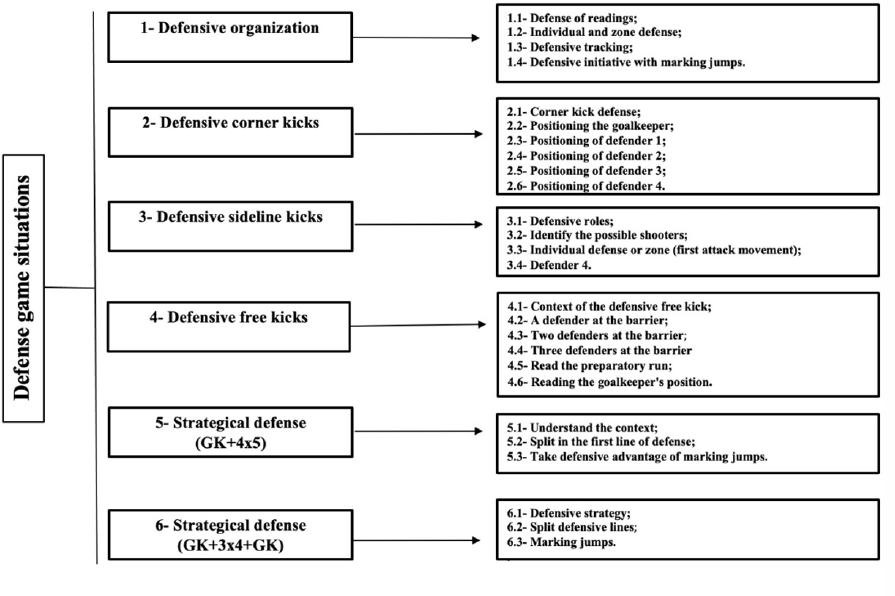
GK: goalkeeper.
Figure 1 Representation of the subcategories and codes obtained according to the different defensive game situations.
Defensive organisation
The defensive reading is crucial for defensive behaviour. It involves coaches’ perception of specific affordances according to variations in the contexts of play. Despite the defensive strategy applied, the pressure made on the ball carrier, or the lack of it, can be decisive in carrying out a defensive exchange or tracking (Coach 7).
From a defensive point of view, when an individual defence is performed, defensive tracking is needed. The main goal of defensive tracking was to follow the direct opponent, being able to see at the same time the ball and the attacker (i.e., pair) followed without losing the spatial advantage, as pointed out by Coach 1. The same coach also highlighted the availability of the first defensive line to do marking jumps and the need for the second line to be able to interpret the possibilities for action according to the behaviour of the first defensive line. However, it was also pointed out that to perform marking jumps, it is fundamental to keep a certain distance from the ball (Coach 8). Additionally, as reported by Coach 2, using purely individual defence or zone defence could become too predictable, as the opponent would be able to identify the spaces to exploit. The following excerpts and Figure 2 support these assumptions:
We do not perform a lot of zone defence, we do some defensive exchanges, but with one rule: the ball must be pressured. In this case, we saw a lot of situations where it did not happen and in these cases, you have to follow them up (i.e. the defender will have to accompany his direct opponent)
# 1 Coach 7
After the ball enters the pivot, not losing the pair and the ball (being able to simultaneously dominate your direct opponent and the player who has the ball without ever losing advantage in space and time) is one of the most important things, not losing that reference. […] The first defensive line takes the initiative to press the ball. Letting them have the defensive initiative, the marking jump. But the second line must be careful, it must protect itself by analysing. The first line decides whether to jump, and the second line reads.
# 1 Coach 1
We need to be careful about the criteria that players use to do a marking jump? The distance from the ball and the direction of displacement or the pass is fundamental. Follow the ball, depending on the distance and the existence of a back pass.
# 1 Coach 8
I would use a reading defence. A completely individual defence does not seem to be a very good solution because they have a well-established dynamic of play, they have the ability to change the direction of the game from one side to another, and play shorter and longer…an individual defence would cause unbalanced situations. A zone defence approach does not seem very intelligible either since they would also exploit the spaces between the lines with shorter entries, which often may cause space not in the middle of the defence but in the side corridors. So, a reading defence approach in which you can follow certain movements. I mean, when there is pressure, you can exchange and dominate the space.
# 1 Coach 2
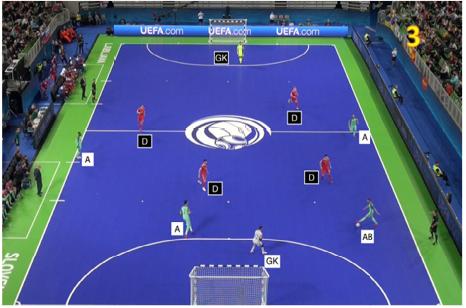
Defensive corner kicks
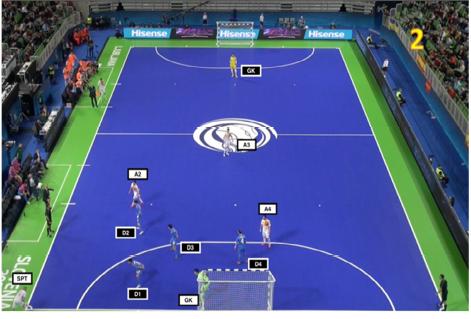
In the defensive corner kick, the identification of possible shooters, their location in space, the space occupied by the attackers and the knowledge about the different roles played by defenders are considered crucial by the expert coaches (coach 3). The coaches considered that individual information on the positioning of the attackers had implications for the positioning of the goalkeeper and was also crucial for creating and exploiting defensive opportunities to intercept the ball (Coach 8). The positioning of Defender 2 could vary depending on the attacker 2, where the body orientation and the possibility of Defender 2 constraining the passing line was critical information for Defender 2 (Coach 7). The coaches recognised the importance of defender 4 in preventing the opponent’s aerial shots (coach 1). In a zone defence, the positioning of defender 3 (inside vertex), along with defender 2 (positioned more towards the outside) and defender 1 (closes the space near the goal), is crucial to protecting the goal and recovering ball possession. The position of Defender 3 was of great importance to protect the space inside the goalkeeper area, particularly when there was an attacker inside free of marking (Coach 3 and Coach 5). The following excerpts and Figure 3 support these assumptions:
From the point of view of the players who are ready to shoot, what are their “strong feet”? Is he lefty, or is he right-footed? Defenders 1 and 4 are more positional. Defender 4 is usually positioned more in the six-meter zone (area), defender 1 further back (back line), behind the 5-meter mark, and leaving the back line to the goalkeeper.
If defender 2 changes the body orientation, he could mark attacker 2 perfectly. The defender in position 2 is very inside, he could put the supports a little more forward, so he could force the shot outside. The defender in position 2 could condition the passing line/grow a little more, and if the ball got to him, he’d have to rotate his support and close the goal.
# 1 Coach 3
The goalkeeper’s position varies because if there are people in the back line, he should be a little more towards the ball. If there’s no one there, his right foot is a little more open, so as to take away the passing line and increase his peripheral vision. If there’s an aerial pass to the second post, he’ll get there quicker, as he’ll be able to see more of the pitch when he turns.
# 2 Coach 8
What you want is that them grow forward or drop back, in terms of horizontality, here it was enough for the second defender to be one-step forward and the ball wouldn’t go in.
# 2 Coach 7
Defender 4, higher up coming out of the aerial, faced forward, which was correct. He had his supports turned and dominated the field of vision.
# 2 Coach 1
Defender 3 comes out for the ball because of the outside shot. Defender 3’s body orientation is wrong, he’s opening up the passing line. The defender 3 should have been closer to the attacker, closing the space inside, with the supports at the vertex. When player A saw an attacker was coming out in front of defender2, the attacker 3 conditions the passing line
# 2 Coach 3
Essentially, the actions of Defender 2 and Defender 3 were important. When they put the first support next to attacker 2 and the other outside, it started to individualise more with the one defender in position 3. Then, the behaviour between the second and third defenders was important to see if we did not open that window there.
# 1 Coach 5
Defensive sideline kicks
In the defensive sideline kicks, the expert coaches considered the importance of assigning the defensive roles to each player. According to each defensive role, defenders need to read the attacking movements and adjust their positions accordingly (coach 1). In addition, identifying the shooters and their dominant feet is key information for defensive behaviour (coach 4). Another aspect highlighted by the coaches referred to the first move of attackers, which could be decisive in adopting a specific defensive method (coach 4). The expert coaches mentioned the importance of the position and movement of Defender 4 to protect space in the back of the defence and to intercept aerial long balls (coach 1). The coaches also stressed the importance of avoiding getting “stuck” in the blocks (coaches 2 and 6). The following excerpts and Figure 4 support these assumptions:
The goalkeeper kept covering the goal, and defender 2 covered the area. Defender 2 conditioned the passing line to take away the outside pass line. In turn, the defensive player (fixed) must be further back to control more space. If the ball comes to the player at the back, the concern is to close the space inside, with defender 1 closing the pass to the second post and the goalkeeper closing the first post. Defender 4 would be responsible for the aerial shot.
# 3 Coach 1
Who are the potential shooters, and which foot is strong enough to finish? We have Player C “attacker”, who would be, for example, in this sideline kick, the most unlikely to shoot.
# 1 Coach 4
The first offensive movement will determine whether the defence is individual or zone. Because defender 1 is responsible for the ball, he rarely moves. The body orientation of the defender’s supports (the space occupied by the defensive supports, as well as their orientation, play an important role from a defensive point of view, limiting passing lines to the opponent) is facing the other way, which means you could play with the defender a little forward and control the direction of the supports.
There is a lot of distance between the place where the sideline kick is taken and the back line. I would use a zone defence, with a well-defined triangle so that the aerial ball cannot get into that space. I would keep the player with the ball fixed, readjust the support and the defender 4 to come out of the aerial on the opposite side.
# 2 Coach 4
When it’s more individual defence, there’s more movement from the attackers without the ball, using offensive blocks to create space and make defenders get stuck in the blocks.
# 2 Coach 2
This is individual defence. Direct block between attacker and defender 2. Defensive structure in a triangle. By following the attacker, the defender got out of the block. Here, we either zone or there must be more contact in individual defence.
# 1 Coach 6
Defensive free kicks
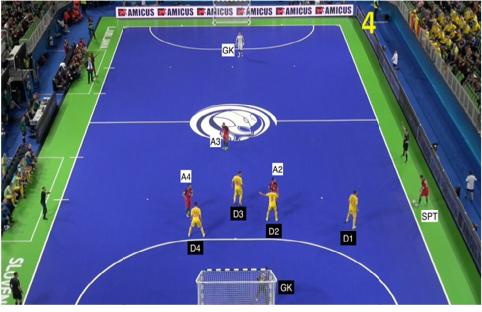
Regarding defensive free kicks, the context of the defensive free kick (i.e., the distance and angle between the ball and the goal), the definition of the number of players to place in the barrier, and its dynamics are fundamental information reported by coaches (e.g., coach 2). The distance and angle with the goal are crucial information to decide the number of players in the barrier: short distances and frontal position should indicate more players in the barrier, while high distances, even frontal or lateral to the goal, should indicate fewer players promoting more balance in numerical relationship between players outside of the barrier (Coach 3, and Coach 5). According to coaches, the adoption of strategies to confound the attacking team could be adopted (e.g., a player was introduced in the barrier as a false barrier and came out in the last moment or even remained in the barrier depending on the attacker’s preparatory run) (Coach 2). Additionally, the place where the goalkeeper was positioned in defensive free kicks could be important in the defensive strategy since placing him outside the goal could often be an invitation to the attacker to pass the ball and shoot in a privileged situation (Coach 4).
The following excerpts and Figure 5 support these assumptions:
Understand if it is lateral, frontal and the distance to the goal. The next decision is how many players are going to go to the barrier. Based on that, look at the position of the attackers and then decide how to behave.
# 3 Coach 2
The distance is so great that I would set up the barrier with only one player on the ball and the rest of the players using individual defence.
# 3 Coach 3
In the free kicks, more individual defence, with 1 defender at the barrier, and another at the post, as a false barrier. In other words, one at the barrier and the other cheating.
# 2 Coach 5
There are lots of situations where if you see the attacker going slowly for the ball, it is because he is going to pass. You do not necessarily have to put three in the barrier. If you open up the false barrier too much, you are already giving the indication that there is clearly one less defender in the barrier. In other words, you can take players out of the barrier or put them in, depending on the preparatory run the attacker demonstrates. If you let him get close to the ball and dismantle the false barrier, you will give him little time to shoot.
# 4 Coach 2
A central free-kick, very close to goal, he put three through the barrier to try close the goal. I would never put the goalkeeper out of the goal. It would have to be a player from the barrier who comes out. Because it’s easy for the player to take the ball out of the barrier and the goal is unprotected.
# 3 Coach 4
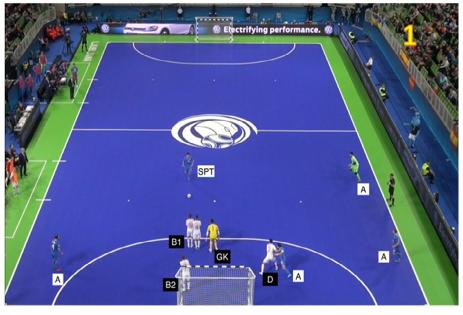
Strategical defence (GK + 4X5)
In GK + 4X5, the coaches mentioned the following contextual factors as the first issue to consider. The time remaining until the end of the game or the shooting characteristics of the opponents were mentioned as key information that need to be considered in preparing this specific situation (Coach 6). The coaches emphasised that sometimes the defensive strategy adopted to promote numerical equality between attacking and defending players consists of identifying a player that can mark two players simultaneously (Coach 3). Also, the identification of possibilities for using marking jumps was highlighted according to the players’ preferred feet and distance to the goal. For that, coordination between the first and second defensive lines is fundamental to maintaining the defensive unit and preventing defensive basculation (Coach 7).
Figure 6 and the excerpts below are examples of this specific game moment.
In defence, would you improve anything? That depends. How much time is left? What’s the score at the moment? Understand if the goalkeeper is a shooter (finishes well). Whether they are finishers or more passers. If they shoot, especially if it is right-footed, or if you take away space early, or if you take away the side of the right foot. If you want to take a risk, you must mark individually, and the goalkeeper must be on the diagonal. And he (the defender) cannot stop and give the goalkeeper time to think. You must provoke that equality, haven’t you? If you want to take a risk, if you are losing, you must equalise the space.
# 2 Coach 6
Here it was clear that player D (defender) wanted to take them both out (take out the passing line). When there is this division, the goalkeeper or the player who plays in the central area, must be extremely threatening. The way player D comes running for the ball, you can see that he is trying to split the 2 (attackers). If it is a 1x2 (defensive), how do I temporise so that these two players don’t progress? The advantage is due to the orientation of the supports. Player D realises it straight away. If you want to take the risk and defend such a big space, we are defending 30 meters. That is the point, if he wants to split it, it is that 1x2. Can it be decisive for the first line defender to be able to jump the marker? It helps a lot for the (fixed) defender to take the defensive initiative instead of the one in front so that we can keep the lines without moving.
# 4 Coach 3
We think the first defender is the most important. Because the other three defenders will adjust depending on what he does.
# 3 Coach 7
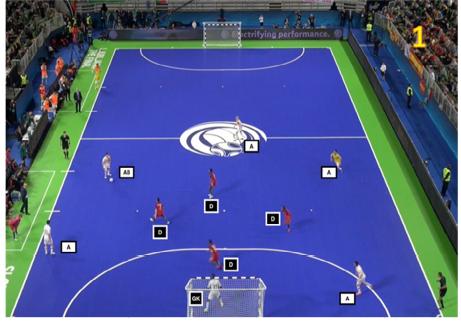
Strategical defence (GK + 3X4 + GK)
In a situation of numerical inferiority GK + 3x4 + GK, the expert coaches focused on defining a defensive strategy to obtain numerical equality (Coach 9). The coaches mentioned the importance of avoiding defensive rotation. Sometimes, they mentioned the importance of seeking the use of the goalkeeper to achieve this defensive balance (Coach 10). Another strategy identified by the expert coaches to defend numerical inferiority relies on one player dividing the attention between two attacking players (Coach 2). The following excerpts and Figure 7, support these assumptions:
What defensive strategy are we going to adopt (2:1 or 1:2), which may be related with the feet of the attacker and their initial positioning, as well as how we want to achieve numerical equality, whether it is through the goalkeeper or defensive rotation.
# 1 Coach 9
The goalkeeper’s defensive work of looking for equality through the bascule can be avoided by closing the back line.
# 1 Coach 10
When the opponent’s attack is organised in 2–2, you defend by putting 1 player forward and 2 back, or 2 back and one forward. When 1 player has to defend 2 attackers (1x2) in central midfield, you’re constantly creating situations of doubt: 1x2 or inferiority. If he can do fantastic, there’s absolutely no problem. The problem is when he draws out the defender.
# 5 Coach 2
Where do they make their marking jump? Which player is covered?
When they jump, they try to make sure it’s over a player where the passing line is reduced or one who will struggle to make a pass.
# 6 Coach 2
DISCUSSION
The main objective of this study was to characterise and interpret the critical information regarding the different defensive situations of the futsal game (i.e. defensive organisation, defensive set pieces, strategical defence) from the perspective of expert futsal coaches. Thus, we sought to explore the coaches’ perceptions of the information used to understand the team’s possibilities of action in different defensive game situations. Overall, coaches emphasised both individual and collective defensive behaviours. Much of the focus was on individual actions to maintain defensive stability, such as tracking, defensive exchanges, marking, and roles within the team’s defensive structure. Thus, the perception of affordances, centred on the perspective of a coach, is based on the movement of players and teams in the context of the game, i.e. the coach perceives the individual and shared affordances of players.
Based on their knowledge of the environment, the coach is responsible for building a game plan and preparing the team for competition. However, during the competition, it is the knowledge of the environment that is used to perceive the informational constraints and, consequently, the opportunities for action available. In fact, previous research has shown that coaches need to pick up the best information to understand the game dynamics according to the specificities of each game moment (Araujo et al., 2009; Silva et al., 2013; Wood et al., 2023).
The descriptions explaining the defensive method were linked to the offensive system and attack strategies, reinforcing that analysing a futsal team’s play cannot be done in isolation. (Travassos et al., 2014). Previous studies have shown that central offensive zones pose a high threat to scoring goals, giving attackers an advantage in the spatial relationship with defenders. (Sarmento et al., 2015). Thus, the distances between players are fundamental in ensuring defensive balance in relation to the attack (Vilar et al., 2013). In addition to situations of positional advantage, (Travassos et al., 2014) pointed out that situations of numerical advantage on the part of the attackers change tactical performance, particularly on the part of the defenders.
The analysis of defensive organisation revealed that coaches were concerned about the performance of defensive tracking. Thus, the defender must accompany the attacker defensively, trying to “resist” possible changes in direction and speed in his movement, in order to avoid disturbances in the patterns of spatial-temporal coordination between the defender and the attacker, as previously highlighted in the study of (Travassos et al., 2012). In addition to tracking, from a defensive point of view, marking jumps are identified to prevent defensive basculation or improve pressure on the ball carrier. In this sense, the coordination between the first and second defensive lines is paramount, which requires a continuous perception of the information from the environment that can open new action opportunities for defenders to take advantage of attackers. While defenders identify and interpret critical information about attackers, they also share affordances with their teammates (Silva et al., 2013). Another example might be when a defender pressures the ball properly, allowing his colleagues to make more defensive exchanges. In this sense, the concept of reading defence seems to be in line with the work carried out by (Ribeiro et al., 2019), where more than a game model and tactical principles, it is necessary for coaches/players to pick up information in a multiscale level of analysis and focused on self-organisation tendencies (local to global). From a practical point of view, a good example could be that defensive behaviour can vary in similar situations (self-organisation), making the opponent’s offensive behaviour more difficult and making the defence less predictable. When considering the strategic situations of defensive play, namely situations of GK + 4X5 and GK + 3X4 + GK, which constitute situations of numerical disadvantage for the defending team, the adoption of a zone defence is required (Travassos et al., 2012). In the cyclical context of the expert coaches’ search for critical information, two different situations emerge for the defenders to counter attacking numerical superiority, namely the use of marking jumps, to avoid defensive rotation or looking for 1v2 situations. Thus, the defending team continually explores the spatial-temporal relationships that underpin the structure of the game, with the express aim of disrupting the behaviour of the attacking team (Travassos et al., 2012). In this type of situation, where the defence is numerically inferior, the attack tends to show more variability in its movements. On the other hand, the defence, due to being outnumbered (GK + 4X5 and GK + 3X4 + GK), has to close off the paths to the goal by compacting and rotating, or even using marking jumps, maintaining great interpersonal coordination between the players (Travassos et al., 2014).
However, more than the contextual information from the game, coaches also mentioned as very important information to defend by the game result or even the time to the end of the match. These are factors that are usually neglected but are of extreme importance for the understanding of the strategy that should be followed to be successful (Méndez et al., 2019). The defensive method selected for the corner and sideline kicks, in general, seems to be pre-defined since there are specific roles assigned to each defender depending on the opponent’s offensive behaviour to shape emerging behaviours. Thus, in the moments before the corner or sideline kick, the coaches, through their knowledge of the game, try to identify the possibilities for action, identifying potential shooters and preferred feet for finishing. In this way, after the opponent’s first attacking move, coaches identify the collective dynamics of the attackers and spatio-temporal variables (Vilar et al., 2013), opting to use zone or individual defence. Coaches emphasised the importance of the relationship between defender 2 and attacker 2, which is often the first option for finishing. Thus, if the orientation of defender 2’s support is incorrect (i.e., opening space vertically instead of horizontally), it can generate possibilities for action that involve finishing zones closer to the goal, and, therefore more dangerous. Another aspect identified by the expert coaches was defender 4 since it is usually his specific responsibility to prevent attackers from exploiting the most dangerous space in a zone defence, which is precisely the space at the back of the defence. The space-time variables (Vilar et al., 2013) are extremely important in this regard, especially as this space is exploited by the attackers through aerial balls. Defender 4 must, therefore, direct his support forward to avoid blockages and place himself in space to avoid or make it difficult for opponents to finish.
Expert coaches have sought to obtain critical information on a defensive free kick through the locations of the goalkeeper, the barrier, and the attackers without the ball (Rodrigues et al., 2024). Thus, the defensive strategy selected will depend on spatial-temporal variables such as the place where the free kick occurs and its distance from the goal. More dangerous free kicks will require a greater number of players in the barrier. Based on the contextual information, the coaches understand that obtaining numerical equalities with the attack is possible, especially when the free kicks are more distant or even lateral. Another defensive strategy the expert coaches highlight is using “false barriers” (i.e., elements that come out of the barrier in the moments before the attacker scores the free kick), often because of his preparatory run. Thus, the ability to detect informational constraints during the run-up to the free kick can generate new affordances, enabling the defender to leave or not leave the barrier depending on spatial-temporal variables, namely greater or lesser speed (Araujo et al., 2009; Silva et al., 2013).
CONCLUSIONS
The defensive methods used, which seem to depend on the offensive system used by the opponent, reinforce the idea that to understand defensive behaviour, there is a need to know more about offensive behaviour. It should also be noted that the coaches’ attention was focused on the information that explains the interpersonal space-time relationship between the players from local to global analysis. Still, expert coaches balance their knowledge about and of the environment in preparing their team for competition. Thus, the ability to recognise and retrieve critical information both before through video analysis and in-loco during competition are vital to guide the team. Thus, the development of these skills must be paramount in coach education courses in futsal.
As practical implications, our study identifies the critical information, from a defensive point of view, that underpins the decisions of expert coaches. It could, therefore, be extremely important for futsal coaching courses to use and reflect on this information. Mainly for novice coaches who are just starting their careers to improve their knowledge of and about the game as well as to develop their ability to describe and interpret the game. In what future avenues regard, we highlight the conduction of the interviews in-loco (i.e., within real game contexts), clearly appealing to knowledge of the game.
The main limitation of this study relies on the specificity and the variability of the language used by coaches to refer to similar game situations (i.e., to present the same perspective using different expressions related to technique and tactics). Indeed, in a futsal context, coaches tend to use the individual expressions that are part of their game model so that they can conceptualise game situations broadly, as well as specific movements and patterns of play.

