




 Inglês (pdf)
 Artigo em XML
 Referências do artigo
 Tradução automática
 Enviar este artigo por email
 Citado por SciELO
  Similares em
SciELO
Similares em
SciELO 
 Permalink

INTRODUCTION
Football is an intermittent sport characterised by gameplay demands that include covering total distances of approximately 10 km, with an average of 1.3 km at high intensity, and involving around 1400 actions every 3 to 6 seconds (Bangsbo, 1994; Bangsbo et al., 2006; Hulton et al., 2022; Leão et al., 2022; Lockie et al., 2018; Stølen et al., 2005). During a match, professional athletes perform numerous high-intensity actions to overcome opponents and achieve a positive outcome (Aughey, 2011; Drust et al., 2007; Sweeting et al., 2017). These high-intensity actions are commonly referred to as “external workload,” which encompasses data such as distance covered, number of repetitions, load used, and training volume (Impellizzeri et al., 2019).
As a result, studies have utilised these markers to report the physical performance of football players during matches across various leagues worldwide. For instance, high-intensity actions throughout a match have been analysed among players of different competitive levels, such as the first and second divisions. Additionally, researchers have studied athletes’ ability to perform repeated high-intensity efforts during a game, as well as the characterisation of acceleration and sprint profiles among players from different leagues (Varley & Aughey, 2013; Bradley et al., 2010; Carling et al., 2012; Ingebrigtsen et al., 2015).
However, the literature has increasingly recognised that isolated analysis of activity profiles during games may lead to overly simplistic conclusions. Recent studies emphasise that performance reductions observed during the final stages or specific moments of a match may be driven by multiple variables beyond physical fatigue, including psychological factors, strategic pacing decisions by players, and contextual influences such as match importance or scoreline (Paul et al., 2015). This body of research highlights the complexity of performance in team sports, urging the integration of these considerations when analysing external workload in different competitive settings.
In football competitions, there are two main competitive formats: Double-Elimination, known as knockout tournaments, single-elimination, or cup, and Round-Robin, also referred to as league or points-based tournaments. In Double-Elimination, teams compete in knockout stages, facing each opponent twice (home and away). Elimination occurs if a team fails to advance, directly impacting their pursuit of the championship title. On the other hand, in Round-Robin, there are no knockout stages. Team standings are determined by a points system, with each team playing against every other team twice during the tournament. This format allows teams to pursue various objectives, such as winning the championship, qualifying for other tournaments, promotion to higher leagues, or avoiding relegation (Byl, 2014).
Therefore, based on previous studies examining how match context influences performance, it is hypothesised that the physical intensity and workload of players will differ between cup and league matches. Cup matches, given their high stakes and elimination format, are expected to demand higher levels of intensity and exertion compared to league matches, where teams have the opportunity to recover points over the course of the season. This study aims to empirically test this hypothesis and fill a gap in the literature by providing insights into how competition formats impact the intensity of players’ physical exertion. In this context, the objective of this study is to compare the activity profile (external load) of professional soccer players in a cup match and a league match.
METHODS
Sample
The sample consisted of 10 male professional soccer players (defenders, midfielders, and forwards), excluding goalkeepers, aged between 25.40 ± 3.24 years, who participated in two official matches in regional and national competitions organised by the Brazilian Football Confederation during the 2018 season. Inclusion criteria stipulated that players must have participated in both training sessions and matches and played at least 70 minutes on the field, thus constituting a convenience sample. Players who played less than 70 minutes or encountered technical issues with GPS equipment, such as equipment errors or signal loss during the game, were excluded. This study was approved by the Research Ethics Committee of the Federal University of Maranhão and received approval for conduct under protocol number: 3.429.057.
Procedures
The study was conducted in two distinct stages, carried out at different time periods but under identical conditions for both matches where the team in question played at home and won the matches. In the first stage, characterisation of the sample was performed seven days before the first match, including measurements of body mass, height, skinfold thickness, and aerobic capacity testing. The second stage occurred during a match in the Brazilian Serie B Championship, and another in the Copa do Nordeste. During this phase, each player was individually monitored in both matches using a GPS device consisting of an elastic belt with a micro-sensor capable of recording at 10 Hz, positioned around the athlete’s chest.
Instruments
Body composition
Body composition was assessed using measurements of body mass, height, and skinfold thickness. A scale with a stadiometer (Welmy® W200) was used to measure body mass with an accuracy of 0.5 kg while participants stood in an upright position, wearing light clothing and being barefoot. Height was measured with participants in an inspiratory breath-hold position using the stadiometer touching the vertex (highest point of the head) with feet together. Skinfold thickness measurements (subscapular, triceps, suprailiac, and abdominal) were taken using a calliper (Cescorf®) graduated to 0.1 mm, following the protocol proposed by Faulkner (1968) (apudCampos-Vazquez et al., 2017), and conducted by a properly trained professional to ensure reliability. The values obtained for each skinfold were used to calculate the sum of skinfolds (∑ skinfolds) and the percentage of body fat using the SIRI equation (1968). The calliper was calibrated by accredited professionals to ensure quality and reliability.
Aerobic capacity
Aerobic power was assessed using the Yoyo Intermittent Recovery Test (level 2) proposed by Bangsbo et al. (2008), a commonly used test for measuring aerobic power in intermittent sports athletes (Bangsbo et al., 2008; Fanchini et al., 2014). The test was conducted on a soccer field with players wearing soccer cleats. A measuring tape was used to mark the running (20 meters) and recovery (5 meters) spaces for the test. Cones and stakes were used to mark the distances. Players had to run back and forth over a 20-meter distance within the time allowed by an audible signal.
Prior to the test, players completed a 10-minute warm-up consisting of low-intensity running, direction changes, jumps, short bursts of high-speed running, and some stretching exercises before starting the test. Each run was separated by a 10-second interval during which the athlete walked or jogged back to the starting point and awaited the next audible signal indicating the next run. The interval time decreased gradually during the test, increasing the running intensity. Participants were allowed two consecutive failures before being removed from the test. For instance, if an individual failed to reach cone C before the audible signal but managed to return to cone B within the time frame, it would result in one failure. If this happened again on the next attempt, they would be disqualified. If they failed to reach cone C and did not return to cone B within the time frame in the same run, they would be immediately disqualified.
The maximal oxygen consumption (VO2max) calculation used the formula proposed by Bangsbo et al. (2008) (Equation 1):
Performance monitoring
We used a heart rate monitor and a Global Positioning System (GPS) with an integrated accelerometer, specifically the Polar brand (Polar Team Pro® model, capable of recording at 10Hz, MEMS motion sensor at 200Hz, digital compass with a range of up to 200 meters). The following variables were measured: minimum, maximum, and average heart rate; distance travelled; maximum and average speed; high-intensity distance; the number of sprints; decelerations; and accelerations.
Statistical analysis
The data are presented as mean ± standard deviation (SD). The Shapiro-Wilk test was used to assess normality. To compare between a cup match and a league match, paired Student’s t-tests were employed. All statistical analyses were conducted using GraphPad Prism 6.0 software. The significance level was set at 5% (p ≤ .05).
RESULTS
In Table 1, the anthropometric characterisation and aerobic power data of the players are described. The average age was 25.40 ± 3.24 years, with a mean body weight of 74.17 ± 4.60 kg and an average height of 179.10 ± 7.94 cm. The average body fat percentage was 10.48% ± 1.14, while the average muscle mass percentage was 47.17% ± 1,67. In the YoYo Intermittent Recovery Test Level 2 (IRL2), players achieved an average distance of 696.00 ± 155,72 meters, and the VO2max was 54.76 ± 12,24 mL.kg-1.min-1.
Table 1 Sample characterization.
| Characteristic | Mean ± DP |
|---|---|
| Age (years) | 25.40 ± 3.24 |
| Weight (kg) | 74.17 ± 4.60 |
| Height (cm) | 179.10 ± 7.94 |
| % BF | 10.48 ± 1.14 |
| % MM | 47.17 ± 1.67 |
| IRL2 (m) | 696.00 ± 155.72 |
| VO2max (mL.kg-1.min-1) | 54.76 ± 12.24 |
% BF: Body Fat Percentage; % MM: Muscle Mass Percentage; IRL2: YoYo Intermittent Recovery Test Level 2; VO2 max: Maximum Oxygen Consumption.
Figure 1 displays data on the physiological and performance variables of players in cup and league matches, including minimum heart rate (Figure 1A), maximum heart rate (Figure 1B), and average heart rate (Figure 1C). The results indicate that heart rate metrics were similar across both match types, suggesting a similar level of cardiovascular effort. Additionally, the figure presents the total distance covered (Figure 1D), maximum speed (Figure 1E), and average speed (Figure 1F). These variables also show no significant differences, implying that the players’ overall physical activity and intensity levels were consistent in both cup and league matches.
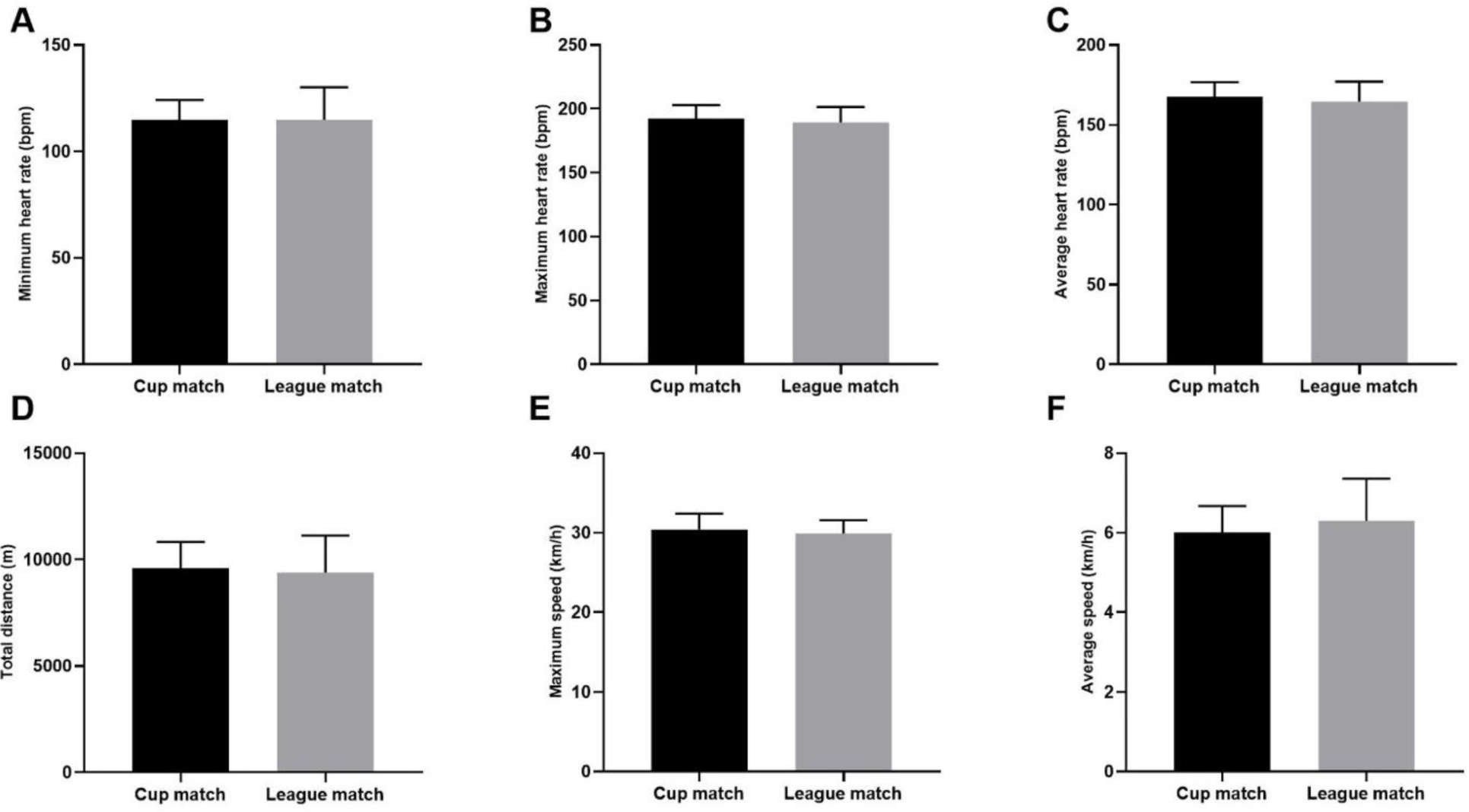
Figure 1 Comparison of physiological and performance variables in cup and league matches. (A) Minimum heart rate, (B) Maximum heart rate, (C) Average heart rate, (D) Total distance travelled, (E) Maximum speed, (F) Average speed. Data are presented as means ± SD for 10 players in each group.
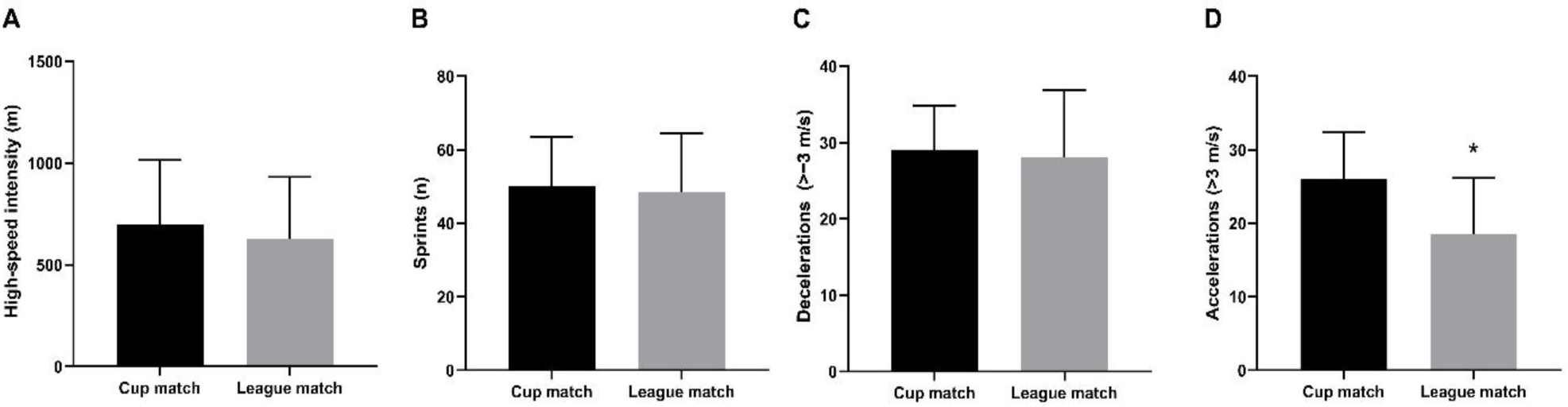
Figure 2 presents data on high-speed intensity distance (Figure 2A), number of sprints (Figure 2B), decelerations (Figure 2C), and accelerations (Figure 2D) of players during cup and league matches. The high-speed intensity distance, sprints, and decelerations show no significant differences between match types, indicating a similar demand for intense actions in both contexts. However, the number of accelerations in the league match was significantly lower (p < .03) than in the cup match, suggesting that cup matches may require more frequent bursts of speed, reflecting a potentially higher demand for quick, explosive movements.
DISCUSSION
In this study, the hypothesis proposed was that the activity profile of professional soccer players would differ between a cup match and a league match. The results indicate that, although most activity variables did not show significant differences between the types of competitions, the number of accelerations exhibited a statistically relevant variation, with league matches showing a reduction in accelerations compared to cup matches. This difference in accelerations suggests that the nature of the competition plays a key role in determining the intensity of explosive actions, particularly those that require high bursts of energy, such as accelerations.
A possible explanation for the lower number of accelerations in round-robin tournaments (league) could be related to energy management and injury risk. In round-robin tournaments, teams play many games, evenly distributed between home and away fixtures, with multiple objectives to achieve (Byl, 2014). For instance, a team recently promoted to a division may aim to secure enough points to avoid relegation and thus maintain its position in the higher division (García-Unanue et al., 2018). This demands a more conservative approach to maintain consistency and minimize physical fatigue among players. The need to preserve energy throughout a campaign may lead players to avoid intense and repeated efforts, such as rapid accelerations, which carry a high energy cost and increase the risk of injuries. In contrast, the knockout format of cup matches creates an all-or-nothing scenario where the stakes are much higher in each game. This urgency likely drives players to perform more explosive actions, like accelerations, as they attempt to seize opportunities and create immediate impact in a limited time frame.
In contrast, in cup competitions, each team has only two matches to advance to the next phase, one as a visitor and one as a host, with initial phases sometimes involving just one match (Byl, 2014). If a team fails to win and advance in these two matches, they are eliminated from the competition, while the winning team progresses to the next phase, also with two matches to continue advancing. In this type of competition, there is a singular main objective—to become the champion. However, another aspect of the dynamics of these tournaments can be considered a secondary goal: the financial aspect. In these competitions, teams receive prize money from the confederations for each phase surpassed, acting as an incentive for subsequent phases. This monetary reward can be considered an unplanned revenue, whereby passing through the stage, besides overcoming an opponent and getting closer to the title of champion, also receives a financial bonus.
Furthermore, the tactical differences between the two tournament formats can significantly influence the activity profile of players. In cup tournaments, teams often adopt more offensive and dynamic strategies, focused on overcoming opponents in decisive matches. This offensive approach likely leads to more frequent accelerations as players seek to quickly capitalize on opportunities and impose pressure on the opposing defence. This can lead to an increase in accelerations, which are crucial for creating and exploiting spaces, executing quick counterattacks, and maintaining constant pressure on the opposing defence. On the other hand, in round-robin tournaments, the emphasis lies in tactical consistency and minimizing errors over many games, resulting in a more moderate style of play that is less dependent on intense accelerations.
Another factor that sets these two tournament types apart is their duration. In Brazil, league format competitions typically span 7 to 8 months to conclude, whereas cup competitions can be completed in a shorter timeframe (Ribeiro & Urrutia, 2011). This is a crucial factor to consider, as not all teams are equipped to develop and maintain a competitive level throughout the entire year, whether due to insufficient investment in hiring top coaches and players or lacking adequate training and recovery facilities such as training fields, medical, physiology, nutrition departments, among others.
This study has several limitations. Firstly, the sample size may have been limited in terms of the number of games analyzed, teams or leagues included, which could compromise the generalization of results to all professional soccer players. Additionally, individual differences among players, such as playing position, physical conditioning level, age, and experience, may influence the activity profile and were not fully controlled for in the study. Furthermore, factors such as weather conditions, pitch conditions, opponents, and the importance of the game (e.g., decisive matches versus less critical ones) may impact player performance, aspects that were not comprehensively addressed in the research.
PRACTICAL APPLICATIONS
The results of this study have direct implications for the physical preparation of players, particularly in managing the intensity of efforts during different types of competitions. With the finding that league matches show a lower frequency of accelerations compared to cup matches, physical trainers and coaches can adjust training programs to reflect these differences. In league-format championships, a more conservative approach, focused on maintaining consistency and reducing injury risk, can be advantageous throughout the season. This may include prioritizing training that emphasizes endurance and load management, ensuring that players are physically prepared to handle the high number of matches with stable performance. In contrast, for cup competitions, where intensity and explosive efforts, such as accelerations, are more prevalent, training can focus on strategies that enhance short-term response capacity, with an emphasis on quick accelerations and effective muscle recovery. Thus, coaches can adjust game tactics and player rotation according to the type of competition, improving both performance and fatigue management over the course of a season.
CONCLUSION
In conclusion, the tournament format significantly impacts the number of accelerations among professional soccer players. This study found that a cup match exhibited an increase in accelerations compared to a league match, highlighting how the competition structure influences the intensity of explosive actions during games.

