




 Inglês (pdf)
 Artigo em XML
 Referências do artigo
 Tradução automática
 Enviar este artigo por email
 Citado por SciELO
  Similares em
SciELO
Similares em
SciELO 
 Permalink

INTRODUCTION
The Experiential Learning Theory (ELT) can be defined as a holistic paradigm that is based on the fact that learning is a function of experience, which is characterized by placing students at the center of their training process, using knowledge and skills to solve problems in their ‘real’ context (Kolb & Kolb, 2008). It allows for the comprehensive training of the individual, as it favors the acquisition of knowledge, personal, work, and educational skills (Kolb, 2015). ELT modifies the role of teachers, ceasing to be the protagonist of the sessions and becoming a facilitator who guides students in situations that generate learning (Kolb & Kolb, 2008).
Experiential Learning has been analysed from various perspectives, emerging different theoretical models (Epstein, 1994; Itin, 1999; Raelin, 1999), which agree on the value of experiences acquired through a “real” problem in which the student experiments, testing their own skills and knowledge, and generating learning through reflection. According to Itin (1999), a diamond-shaped model is proposed in which he relates the subject in its cognitive, social, physical, intellectual, and emotional dimensions. On the one hand, Raelin (1999) understands learning at three levels. The first level is attached to traditional teaching methodologies, where the student has a passive role. However, at the second and third levels, Experiential Learning takes place, in which the student becomes the protagonist of his own learning. On the other hand, Epstein (1994) focuses on emotional intelligence during the learning process, finding that through experience, the student is exposed to emotions that facilitate the acquisition of knowledge.
Dewey’s (1938) contributions are recognized. It mentions that Experiential Learning is represented in a four-phase cycle: 1) concrete experience, 2) reflection, 3) conceptualization and 4) application, related sequentially and essential for obtaining learning. However, to Kolb (1984) the Experiential Learning Cycle also includes four phases: 1) concrete experience, carrying out the action; 2) reflective observation, consists of reflecting on what happened, seeking to find the relationship between the action and its consequences; 3) abstract conceptualization, conclusions, theories or hypotheses of what happened are generated; and 4) active experimentation, in this stage the findings of the previous stage are tested. It is a cycle that repeats itself continuously and can be used to learn in any area of life (Kolb, 2015).
Other authors mention that Service Learning can be identified as a teaching methodology in which students mobilize their learning through service in the community (Maravé-Vivas et al., 2023; Yorio & Ye, 2012), but conceptually and methodically differentiated from the practices of the individual and the social service promoted by universities (Franco-Sola & Figueras, 2020). As such, significant reflection processes must be conducted in order to understand this process in a different manner (Cañadas & Calle-Molina, 2020; Páez Sánchez & Puig Rovi, 2015).
Reflective journal
Reflection can be defined as the process in which ‘our experiences are integrated into memories to create meaning’ (Kolb, 2015, p. 90). Reflection is a dynamic process in which skills are put into practice in day-to-day situations. Additionally, Páez Sánchez and Puig Rovi (2015) mentioned that having significant experience, which generates questions and motives, stimulates quality reflection. This is consistent with Shulman (1987), suggesting that in the educational context, reflection can be defined as ‘reviewing, reconstructing, recreating and critically analysing one’s own and that of others. Class performance and founding explanations on evidence’ (Shulman, 1987, p. 15).
It is essential to note that, given the educational system’s challenge of stimulating reflective thinking in students (Veliz-Rojas et al., 2021), the use of reflective journals is a comprehensive tool for teacher education training programs (Lindroth, 2014). However, different methods describe the reflection process. According to Varner and Peck (2003), there are four fundamental stages: articulation of the situation, analysis, explanation, and finally, the action. On the other hand, Williams and Wessel (2004) understand that reflection is a method articulated with the description of the event, analysis of what happened, confirmation of learning, and obtaining learning that conditions future behavior. Veliz-Rojas et al. (2021) noted that reflection is a pedagogical tool that fosters critical and reflective thinking. As such, it provides students with the opportunity to describe their experiences in detail, share their thoughts, express their feelings and opinions, and demonstrate the execution of intrinsic cognitive processes (Spalding & Wilson, 2002). Barry and O’Callaghan (2008) argue that reflection offers the advantage of allowing students to integrate theory and practice, thereby benefiting the acquisition of learning.
Lee (2008) noted that reflections are preferred by most students and that they promote reflective thinking. Reflective journals are useful in teacher education training, as they serve as a tool that stimulates cognitive processes, prompting students to question their performance, the actions that occurred, and possible solutions to problems that influence decision-making (Knapp, 2012; Lee, 2008). However, it is important to mention different disadvantages of reflective journals: 1) being too personal; 2) sharing ideas with others; 3) a lack of time to reflect and write down in their journal (Hubbs & Brand, 2005; Lee, 2008). These reasons could, to a certain extent, limit the possibility of students engaging and not properly reflecting. Another reason that can prevent students to use reflections is the preparation focus of training programs (e.g., health-related, medical-model, teacher-centered or top-down approaches), For instance, Mexico is traditionally know for using pedagogical and methodological approaches that are teacher-centered (Nuñez Enriquez & Oliver, 2021), since the students role is to follow the teachers leadership without questioning whether it is meeting the minimal learning competencies.
This has also been reproduced by higher education institutions, including physical education teacher education (PETE) programs, as these programs’ preparation focuses on health-related and/or traditional teaching methods. However, the use of reflective journals in combination with other approaches such as Service-Learning methodology within initial training of physical education, sport and recreation teachers has shown evidence of personal growth, development of values, pedagogical skills and understanding of concepts and theories (An, 2021; Cañadas, 2021; Chiva-Bartoll, Maravé-Vivas, et al., 2021; Chiva-Bartoll, Ruiz-Montero, et al., 2021; Maravé-Vivas et al., 2021; Ruiz-Montero et al., 2020).
Therefore, this study had two aims: 1) To analyze the didactical/teaching experience of physical education teacher education students using reflective journals; and 2) To correlate the Service-Learning methodology and the reflective process within the Experiential Learning cycle in a Mexican context.
METHOD
This study implemented a descriptive design with a qualitative approach (Maldonado Pinto, 2018). This design aims to understand the reality of the phenomenon being investigated. It also implements a hermeneutical study design because the reflective journals were analyzed by the Physical Education Teacher Education program at a university located in the North of Mexico. The Declaration of Helsinki (World Medical Association, 2015) served as a reference. To ensure participants’ anonymity, pseudonyms were used for the purposes of this study. The present study was presented and approved by the revision committee of the Autonomous University of Chihuahua.
Participants
An open invitation was made to undergraduate students from a Physical Education Teacher Education program. A total of ten senior students enrolled in an Adapted Physical Education class on the Spring 2023 semester. One University Professor who facilitated the APA class. From the total of undergraduate students that participated, seven were men and three were women, with an average age between 21 and 22 years old. Due to the nature of the study, it was an intentional sample (Hernández et al., 2010) considering the following inclusion criteria: a) Attendance at all service classes/sessions; b) Completion of the reflective journals in a timely manner; and c) acceptance of participation in the study through an informed consent letter.
Context
This project has been implemented in a Physical Education Teacher Education program at the Autonomous University of Chihuahua, located in northern Mexico. This program offers a bachelor’s degree in Physical Education Teacher Education, which can be completed in 4 years or 8 semesters. In six of these semesters, students enrolled have to take common core courses, although it is only up until their senior year or last two semesters where students have the option to choose a cluster of classes, which are known as complementary courses, but these are part of their degree curricula (Faculty of Physical Culture Sciences, 2024). This institution is also recognized for its competency-based approach across all programs, spanning majors and departments.
This educational context has already been the subject of study in other projects, which have identified opportunities for improvement in the pedagogical and didactic approaches employed by university professors (Zueck et al., 2023). This has led to the identification of the need for linkage strategies with different sectors of the population to design curricular plans, courses, and teaching strategies based on the development of skills, enabling students to solve current and future problems related to physical activity (González-Rivas et al., 2022). For example, a population with a sedentary tendency and obesity in infants and adolescents (Betancourt Ocampo et al., 2022; López-Alonzo et al., 2021; Pérez-Herrera & Cruz-López, 2019). Thus, teaching intervention programs that have been developed seek to strategically strengthen the educational quality of Physical Education Teacher Education training programs (González-Rivas et al., 2023); this project continues these efforts.
Procedure
At the beginning of the semester, the university professor designed the content of the Adapted Physical Education course, contemplating the use of the Service-Learning methodology. At the beginning of the semester, the format for developing the sessions was explained to the PETE students. This was relevant because students were not used to the Service-Learning methodology; thus, the criteria to be considered for the final delivery of the reflective journal were explained.
During the class session, the PETE students went together with the APA class professor to a specific institution to offer the physical activity service for individuals with disabilities (who presented motor and intellectual disabilities) and with some disorders such as autism and attention deficit disorder. It is worth noting that this institution has an established physical activity program, so the PETE students contributed primarily to the implementation of these classes. This pedagogical experience lasted up to 12 weeks, during which each student attended a total of 24 50-minute sessions and wrote a reflective journal.
To guide the reflection journals, these questions were considered: How did I feel during and after attending the service session? What have I learned today? At the end of the reflective journal, students were required to include a final reflection on their learning process. It is worth noting that students had the flexibility to include any information they deemed relevant. Once the semester concluded, the reflective journals of students who met the aforementioned criteria were selected.
Data analysis
The conceptual basis of grounded theory was used, specifically the systematic coding proposal of Strauss and Corbin (1998). The procedure was the following: 1) first was the data collection, which consisted of putting together the ten reflective journals in the same document (98 sheets in total). It is important to mention that initially twelve reflective journals were selected, however, this research only analyzed ten since theoretical saturation was reached (Glaser et al., 1968); 2) the open coding (Zunker & Ivankova, 2011) consisted of identifying the bases of what was the final interpretation, in the research the first codes were identified; 3) The axial coding stage, which is the grouping of the codes from the previous step to generate larger categories (Strauss & Corbin, 1998); At this stage the four categories emerged, identifying one as the principal one and which in turn is linked to the others; 4) Selective coding (Corbin & Strauss, 2008), which consisted of detailing the link between the central category and the others, to finally have a theoretical model; 5) The fifth and final step was the description of the theory. This process was carried out using the qualitative analysis software Atlas Ti version 7, which facilitated the coding and categorization of the information. It is essential to note that the analysis was a product of the researchers’ interpretation, rather than the software (Silva Junior & Leão, 2018).
Scientific rigour
In order to establish the scientific rigor of this study, the guidelines established by Shenton (2004) were taken into consideration. Three researchers who are members of the National System of Researchers (a distinction granted by the Mexican government to outstanding researchers) participated in this study. As part of their participation, one aspect was to compare the data, which contributes to the credibility of the research. The context in which the study was developed has been described, which strengthens reliability. Additionally, the limitations of this study are acknowledged, which enhances the confirmability of the research.
RESULTS AND DISCUSSION
The implementation of reflective journals contributed significantly to the teachers’ training process. Considering the first objective of this research, the following thematic organization is presented. The main category is the development of professional identity, which is based on three others: a) acquisition of learning; b) development of soft skills; and c) expression of emotions. The thematic organization is presented in Table 1.
Table 1. Development of professional identity.
| Professional identity | Learning acquisition | Reflective process | Critical thinking, reflective practice and self-criticism |
| Pedagogical and didactic training | Development of teaching skills and didactic adaptation | ||
| Conceptual domain | Appropriate terminology and praxis | ||
| Soft skills | Communication | Feedback | |
| Problem-solving and thinking | Creativity | ||
| Analytical skills | |||
| Leadership and teamwork | Motivation, patience, decision making, cooperative work, commitment and empathy | ||
| Ethical and moral values | Responsibility, effort, professional ethics | ||
| Self-management | Self-knowledge and self-motivation | ||
| Emotional expression | At the beginning | Fear, nervousness, uncertainty, stress, shame, frustration, despair | |
| At the end | Tranquility, confidence, pride, fun, sadness, and appreciation |
Development of professional identity: challenges and goals that await me in the future of my career
For most participants, completing the service was an enriching pedagogical experience, as they were able to experience real-life situations and problems from their academic training, which provided clarity regarding their future professional performance. In this sense, Sergio expressed it in the following way:
‘…I think this has been one of the best experiences I have had in my life. It left me with a clearer idea about the types of challenges and goals that await me in the future of my career…’
In addition to the above, one of the most cited codes was the satisfaction that the students experienced during their intervention. Based on their experience, participants like Perla expressed a sense of satisfaction with the learning acquired during the process. But also highlighting the opportunity to learn about the unpleasant realities of her profession. She highlighted the pleasure of being able to contribute to improving the quality of life of people with disabilities through physical activity.
‘…As we progressed, we became more relaxed, we had more confidence and we got closer to them, not like at the beginning when we were all together only between us… this experience makes it clear to me that perhaps our work will not always be something pretty, but It is very gratifying to be able to help them, share some time with them and cheer them up, even if just a little, that it is not bad to become fond of them, but you have to be aware...’
According to Virta et al. (2023), the professional identity of students in Physical Education is a fusion of personal and professional aspects. In this study, participants developed both. Olsen (2016) agrees on the close relationship between personal and professional identity, as they are two manifestations that cannot be separated. In this research, it was identified that students developed both professional skills and knowledge, as well as personal skills. These results are similar to those reported by Chiva-Bartoll, Maravé-Vivas, et al. (2021), where a student’s comment expressing his vision for his personal and professional future was identified in the category of personal growth.
The formation of the professional identity of Physical Education students is built gradually; however, the importance of the practices carried out during academic training is recognized for the teacher-in-training to shape their professional identity (Amorim & Ribeiro-Silva, 2022; Montes Ornelas, 2022; Shen et al., 2024). Along these lines, the development of specific knowledge and skills is a factor in the formation of professional identity (Virta et al., 2023); therefore, it is essential that students can generate learning in real-world contexts (Beijaard, 2019; Martín, 2021). In this sense, the Service-Learning methodology facilitated the student’s development of their professional identity. However, the reflective journal enabled the student to become aware of this, and in turn, gave the teacher confidence that the students were on the path of forming their identity.
Acquisition of learning: I consider that I execute it better
In the students’ journals, various elements that contribute to learning acquisition were identified. An example could be depicted through a reflective practice, which can be explained as a cognitive-affective process that is carried out during the development of the action (Shön, 1992). In Diego’s reflective journal, he expressed a critical incident that occurred during one session, which led him to reflect on his actions at that moment and as a consequence, he decided to apply a behavior modification technique that allowed the session to continue in a better way:
‘… The situation arose with two people from there. I learned that positive reinforcement is very important, giving them encouragement motivates them a lot, and that, for some people, if you pay a lot of attention to them, they do not do things quickly…’
Critical thinking can be defined as a mental process that allows making judgments that guide beliefs and enables decision-making (Huitt, 1998). This occurred during and after each intervention session. As happened with Esteban, who expressed that at a certain point, the didactic activities were not congruent with the needs and motor characteristics of the people with whom they worked, which led him to reflect on subsequent activities.
‘…As there were very few people with ID, I was able to observe as the exercises changed that some lacked motor skills, or that they had difficulty controlling their strength, since they threw the ball too hard, I think that is something we can improve for the next class, we must make adjustments…’
Starting from the fact that self-reflection is a ‘systematic and sustained, planned and self-critical inquiry, which is subject to public criticism and empirical verification’ (Stenhouse, 1984, p. 42). In the reflective journals, it was also found that there were participants who were self-reflective of their own performance, identifying areas of opportunity for improvement, but also recognizing their strengths and skills that they were developing. An example was reported by Sofía, who in the first sessions expressed difficulties in having control and attention of the group. However, in session eight of her reflective journal, she recognized improvement, taking over specific skills from her professional training, and providing better instructions and corrections for the exercises.
‘…Some things that I saw that I missed were letting go a little more and raising my tone of voice since they hardly heard me, It is something important, so that the students could pay attention to me… in general, I think that I executed better than in the past sessions because I was trying to explain to them more correctly how to position themselves to receive the ball...’
Analyzing the writing of the journals, it was found that the majority of students used the correct terminology, which implied a conceptual domain. It is relevant to mention that this mastery occurred gradually throughout the course. This was the case of Andrea, who in the writing corresponding to the fourth session correctly expressed two things: 1) the conceptual understanding of the topics addressed in theoretical sessions, in which critical thinking is clearly implicit; and 2) the use of appropriate terminology to refer to physical activity in people with disabilities.
‘…the first thing I did was look at the characteristics of people with disabilities, I saw Pedro who had problems with locomotion, so he used a walker, then I realized that he had spasticity in his lower limbs but that he is cognitively functional, I think his condition It’s cerebral palsy...’
The reflective journal allowed students to identify the acquisition of specific knowledge and skills of Physical Education participants. These results are in line with those reported in research carried out in various contexts (Chiva-Bartoll, Maravé-Vivas, et al., 2021; Chiva-Bartoll, Ruiz-Montero, et al., 2021; Maravé-Vivas et al., 2021). The congruence in these studies suggests that the application of Service-Learning placed students in a position to solve real problems in their profession, where they developed the necessary skills to perform adequately. However, we should not lose sight of the fact that it was through the reflective journal that they expressed their identification of the learning acquired.
Soft skills development
The analysis of the data showed that the students developed soft skills; However, in the literature research, different ways of classifying these skills were found. For purposes of interpretation and organization of the data, the classification proposed by Villiers (2010) was taken as a reference. In this way, five types of soft skills were identified, the first being communication, supported by the appropriate vocabulary expressed by students and the ability to give and receive feedback. The second problem is solving and thinking, which is linked to creativity when having to adapt activities unexpectedly and suddenly. As Andrés told it, that day the facilities were closed, and they had to solve it by managing another place to have the class.
‘… Today, we had to improvise a lot, since this day, the school where we always go was closed, and we couldn’t use the field. So, we had to improvise and look for another one...they asked me to see if there was a tennis court available for the kids, but they were all occupied, so together we came up with a solution: we went to a space that was near the entrance of the park…’
The third skill identified was leadership and teamwork, where decision-making, cooperative work, motivation, commitment, patience, and empathy were observed in the students’ reflective journals. Here are two points that draw attention: 1) that in all the reflective journals, the writings were in the first person, but in other paragraphs, the students expressed themselves in a group manner, implying feeling part of a group; and 2) support and feedback were given during the activities. The best example of this was cited by Francisco, where you can see how he wrote about him speaking for everyone; On the other hand, he expressed the support given to a colleague.
‘…In the first activities that we did, we noticed that the classmate got a little nervous and we helped him explain the activities better so that the students could understand better, which is why it was a success in that activity…’
These results are similar to those of Chiva-Bartoll, Ruiz-Montero, et al. (2021), who identified empathy as one of the experiences written in the reflective journals by the students. The fourth skill was the development of ethical and moral values, which were manifested in responsibility, effort, and professional ethics. In all the reflective journals, there were segments in which the participants expressed some of these skills. For Ramiro, responsibility is a priority during the sessions, as he is aware of his professional role.
‘… If something happens we have to be aware of what happened, because we are the ones in charge and we are responsible for them, if we don’t know what happened it could cause us problems…’
These results coincide with those of Bruce (2015), who reported that through reflective journals, students developed responsibility and ethics during their training. The consistency in these results allows us to assume that the students were aware of the need to develop these skills, identifying their relevance and importance in professional performance. The fifth and last skill was self-management, where students expressed self-motivation and self-knowledge, the latter being fundamental to being self-critical. Just as Joseph mentioned in his second session, he recognized the need to develop patience. This was an example; however, in the majority of the reflective journals, the students identified aspects that were evidently analyzed intrinsically.
‘… Today I saw something that I had already seen the last time: I must be patient. Many needs two or three explanations to perform the exercise, but others need you to explain to them several times, and also to be shown how to do it so that they can do it too...’
Emotional expression
This is the last category that supports the main category. The teachers in training experienced various emotions during the process; to organize them, they have been classified into two moments. The first was at the beginning of their intervention with people with disabilities, the most cited codes were fear and nervousness that generated uncertainty and stress, there was frustration, shame, and despair. According to the preservice teachers, this happened because it was the first time, they had the responsibility of working with people with disabilities, attributing it to a lack of experience specifically with this population. An example of this was what Sofia said:
‘… I felt nervous since I am not very used to being in charge of a situation with more people, in this case with people with disabilities. Afterwards I felt frustrated because I didn’t know how to react with each person...’
Our results are similar to those reported by Maravé-Vivas et al. (2021), who found that uncertainty was one of the emotions mentioned by students. According to Lara-Subiabre (2022), writing down the emotions experienced allows students to be aware of what happened. In this sense, it is prudent that students have a space to express their emotions through reflection (Lara-Subiabre, 2018); in this way, reflective journals serve as an instrument for students to express themselves. This suggests the importance of implementing pedagogical strategies that support the emotional well-being of teachers in training. On the other hand, reflective journals have been a valuable resource through which students can express their emotions freely, contributing to their professional development.
The second moment of analysis was at the end of the intervention, where confidence, pride, tranquility and fun were mentioned; This is because the students already had more experience. There were those who expressed the development of emotional bonds with people with disabilities, for which they mentioned on several occasions their appreciation for them; However, another feeling that some experienced was sadness at the conclusion of the intervention program. Such is the case of Ricardo, who expressed his feelings in the following quote:
‘...But also, I feel somewhat sad, because neither I nor any of my companions had the opportunity to properly say goodbye to them, and we probably will not see them again...’
In the present study, it was noted that the students initially exhibited negative emotions, but as the course progressed, they became more positive. This may have been due to the students’ developing confidence in themselves and their peers, as well as their pedagogical skills and knowledge about people with disabilities. This is consistent with the components of Subjective Well-being, where the relationship with others and satisfaction with how others perceive life (in the student’s perspective) influence well-being (Diener et al., 1999). This means that the use of reflective journals as a pedagogical tool also offers the possibility of understanding and regulating one’s emotional state, aligning with the findings of Mujica Johnson and Orellana Arduiz (2019).
In response to the second objective of this research, the use of the findings of reflective journals has been linked to Experiential Learning, taking as reference the cycle proposed by Kolb (1984). Below is the relationship found between said cycle and the previously mentioned categories:
The Service-Learning teaching methodology was used; in each service session, the students had the concrete experience of being able to work on the promotion of physical activity with individuals with disabilities, which generated a series of emotions in the students.
To stimulate reflection, students had to ask themselves the following question: What am I learning? How do I feel? Why did I feel like this? The answers to these questions led to what Kolb expresses as reflective observation; Therefore, the use of reflective journals becomes more relevant, since they specifically facilitate this stage of the cycle. As a product of reflection, the students identified the need to develop ideas, hypotheses and even conclusions about what happened in each session. This is the stage of abstract conceptualization and was also evidenced in the reflective journals. In the active experimentation stage, students developed soft skills. At this stage, in a new concrete experience, learning acquisition occurred. The constant repetition of this cycle led to the formation of a professional identity (Figure 1).
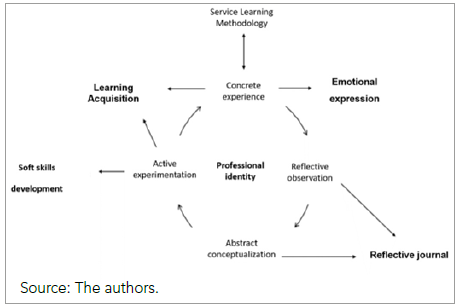
In reference to the relationship between the reflective journal and Experiential Learning (using the Service-Learning methodology), the students were able to apply and develop knowledge and skills in real contexts. Service Learning has been used in various studies that analyzed its impact on the initial training of Physical Education students (Cañadas, 2021). The congruence of these findings suggests that this methodology, applied correctly, contributes significantly to the training of teachers in areas related to physical activity, such as sports training and recreation, developing competencies that would be difficult to obtain using traditional methodologies.
Different pedagogical models that are based on Experiential Learning have been the subject of analysis in the training processes of Physical Education teachers; in all of them, results were found that point to the fact that the implementation of these models favored the development of competencies in students (García-López et al., 2022; González-Rivas et al., 2021). This suggests that Experiential Learning is an appropriate approach to train Physical Education Teacher Education students because it places them in ‘real’ life situations, which are accompanied by moments of reflection. Thus, we can say that this study demonstrates greater potential in showing that, although reflection presents different challenges, it remains a powerful and useful pedagogical tool that increases engagement and understanding among PETE students and future in-service teachers.
CONCLUSIONS
This research combined the Service-Learning methodology and the reflective journal as a pedagogical instrument. The first objective of this study was to analyze the pedagogical experience of Physical Education Teacher Education (PETE) students through reflective journals. It was found that the teaching methodology used contributed to generating experiences, knowledge, and skills that contribute to the professional training of teachers. However, it was through the reflective journals that students became aware of their academic evolution. Similarly, it was identified that this pedagogical intervention stimulated the integration of the students’ professional identity. The reflection prevented the service sessions from being limited to a “nice experience” and became an enriching and formative experience. This is consistent with Chiva-Bartoll, Maravé-Vivas, et al. (2021) and Chiva-Bartoll, Ruiz-Montero, et al. (2021), who mention that combining reflective journals with other methodologies, such as the Service-Learning methodology, can create a space for self-development in which personal and professional identities can merge and grow together within PETE and related training programs.
The second goal of this project was to correlate the service-learning methodology and the students’ reflective process with the Experiential Learning cycle proposed by Kolb. This study found that the reflective journal is an effective pedagogical tool for generating reflection in PETE students and aligns with various stages established in Kolb’s Experiential Learning cycle. For instance, it was evident that the PETE students transitioned from each of these phases, completing their concrete learning and moving it into action, as they demonstrated empathy and understanding towards others and their peers.
This study was not without limitations; it is recognized that only 10 reflective journals were analyzed and that they were selected intentionally, so no generalization could be made. On the other hand, the very nature of the study was based on analyzing the PETE students’ experience of a unique and unrepeatable reality, making it almost not feasible to replicate the research. Based on the findings that emerged and the limitations identified, the need to implement different research projects focusing on the various training processes of Physical Education teachers within the Mexican context is acknowledged. Along with this, it is also important to note that future areas of research can be centered on analyzing the use of reflective journals, but in combination with other teaching methodologies, such as problem-based learning, project-based learning, or cooperative learning. Another option would be to conduct more in-depth qualitative studies that include the view of faculty within a PETE program. Lastly, to conduct longitudinal studies where the training process is described thoroughly and broken down into a sequence of stages that can be woven together. In this way, to promote the combination of different quantitative and qualitative pedagogical methodologies and experiences that consider the characteristics of students, faculty, and the contextual and cultural aspects to encourage reflection and stimulate learning at various levels of physical education.

