




 Inglês (pdf)
 Artigo em XML
 Referências do artigo
 Tradução automática
 Enviar este artigo por email
 Citado por SciELO
  Similares em
SciELO
Similares em
SciELO 
 Permalink

INTRODUCTION
The current debate on sports inclusiveness is mostly focused on the participation of transgender individuals in sports competitions at every possible level, from amateur to professional (Buzuvis, 2011; Cunningham et al., 2021; Love, 2014; Reynolds & Hamidian Jahromi, 2021).
As reported by Oliveira et al. (2022), a transgender or trans person can be defined as an individual whose gender identity differs from their sex at birth. For the sake of simplicity, transgender individuals could be assigned to two different groups: a) a trans man (an individual with female sex at birth, but self-identifying as male); b) a trans woman (an individual with male sex at birth, but self-identifying as female). Oliveira et al. (2022) estimated that trans and gender-nonconforming people represent between 0.1 and 0.2% of the general population.
The inclusiveness concern in sport is consistent with the recommendations issued by the International Olympic Committee (IOC, 2023), aimed at asserting sport as a human right and as a space free of discrimination of any kind. To ensure the fulfilment of such goals, the IOC underlines that its overriding sporting objective is, and remains, the guarantee of fair competition.
As argued by Devine (2022), fairness in sports competition has been assured by binary, well-established biological and performance-related differentials between the two sexes. The same authors affirm that without single-sex categories, the fastest, highest and strongest females would disappear from most elite sports, as male athletes would outperform them. The inclusion of transgender males in female competition could, then, impair the CIO’s overriding objective of fair competition.
This issue is much more complex than it could appear from the single point of view of assuring equal rights in sports to everybody, irrespective of the biologically determined sex. If the perceived sex assumes the same level of importance as the outcome determined by the chromosome set, the rights which flow from it should not collide with those pertaining to biologically female feeling comfortable as female.
The complexity of the subject deserves a thorough examination encompassing different disciplines, from legal considerations (Buzuvis et al., 2021) to policy issues (Harper, 2022) and from biological standpoint (Hilton & Lundberg, 2021) to psychological concerns (Bal, 2011).
In addition, Oliveira et al. (2024) stressed the importance of self-representing drives in the overall quality of life of trans individuals. These authors found a moderate level of anxiety symptomatology but low levels of satisfaction with the perceived body image of 75 Portuguese transgender individuals tested. Emotional balance is obviously a major factor in athlete performance (Troisi Lopez et al., 2020).
The aim of this bibliographic study is to offer to the readers a wide range of articles spanning over the many different issues that transgenderism in sports raises. As of December 31 2024, 454 articles related to transgenders in sports were identified. In these articles, we carried out the following network analyses: a) countries and collaborations, b) authors and collaborations, c) journals, and d) high-frequency keywords. The most cited articles were also reported.
MATERIALS AND METHODS
Data source and PRISMA flowchart
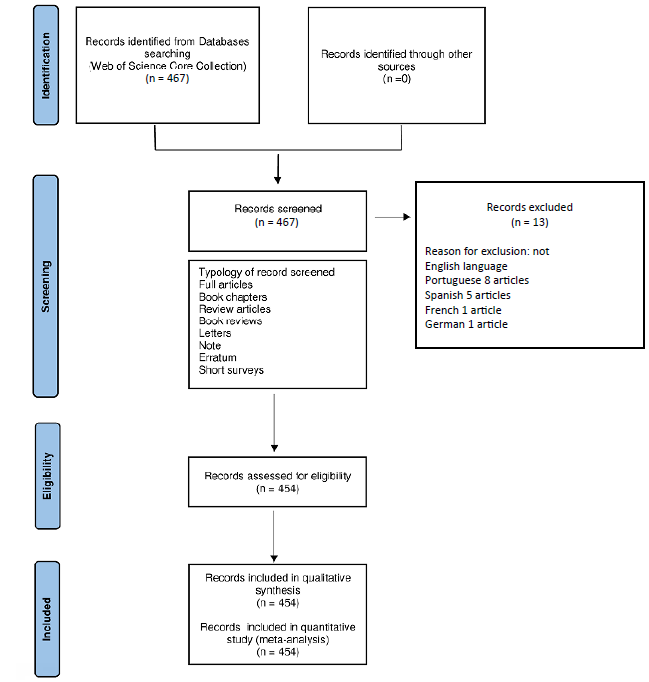
Scientific output data was extracted from the Web of Science Core Collection (WoSCC), one of the most widely used daily updated databases in academic and bibliometric studies, allowing the download of full citation records (AlRyalat et al., 2019). WoSCC can provide comprehensive information for bibliometric analysis, including the Science Citation Index-Expanded (SCI-E) and the Social Sciences Citation Index (SSCI). In this study, the WoSCC database was used to retrieve the related research on transgenders in spots for the period from 2006 to 2024. The language of the analysed papers is limited to English, with an overall number of 454 publications. We downloaded and exported the collected data (which include full records) in text format for further analysis. All data were exported on December 31st, 2024, to avoid deviations caused by the daily updates of this database.
The overall identification, screening, eligibility and inclusion criteria are shown in the following PRISMA flowchart (Figure 1).
Bibliometric network analysis
We performed the study of the global research and trends on transgender in sports through a bibliometric network analysis carried out according to Reuters (2008). We based our study on the visualised analysis of the Mapping Knowledge Domain (MDK) and on the implementation of a Social Network Analysis (SNA) (Zou et al., 2018). While MKD can be used to establish a reference information and research basis for the application and development of methods of a chosen domain, SNA is defined as the process of investigating social structures using networks and graph theory (Otte & Rousseau, 2002; Zou et al., 2018). SNA and maps based on network data allow the application of systems thinking in bibliometric science. The outputs of such analysis are network maps and statistics based on the relationships among countries, journals, organisations, authors, and keywords related to the investigated topic (Chen et al., 2016).
In this study, we used the VOSviewer software (version 1.6.20) to perform the bibliometric analysis. This software, using the VOS (Visualization Of Similarities) mapping technique, is especially useful for displaying large bibliometric maps in an easy-to-interpret way while allowing the creation and exploration of maps based on bibliometric network data. The output results are displayed in clusters to visualise the existing connections among the analysed bibliometric data. VOSviewer software is a useful tool for the elaboration of distance-based maps in which the distance between two items reflects the strength of the relation between the items. Unlike graph-based maps, in distance-based maps, a smaller distance generally indicates a stronger relation (Van Eck & Waltman, 2010).
Table 1 summarises the main technical terms used by the software. We implemented a co-authorship, co-occurrence, and citation analyses were conducted to create distance-based network maps showing (1) the co-authorship among researchers and collaborations of countries, (2) the co-occurrence of keywords, and (3) cited scientific journals.
Table 1. Terminology used by VOS viewer software.
| Term | Description |
|---|---|
| Items | Objects of interest (e.g., publications, researchers, keywords, authors). |
| Link | Connection or relation between two items (e.g., co-occurrence of keywords). |
| Link strength | Attribute of each link, expressed by a positive numerical value. In the case of co-authorship links, the higher the value, the higher the number of publications the two researchers have co-authored |
| Network | Set of items connected by their links. |
| Cluster | Sets of items included in a map. One item can belong only to one cluster. |
| Number of links | The number of links of an item with other items |
| Total link strength | The cumulative strength of the links of an item with other items. |
Source: Van Eck and Waltman (2023).
RESULTS AND DISCUSSION
Document types
As of December 31, 2024, 454 records related to transgenders in sports were identified and classified into 10 document types indexed in the Web of Science (Table 2). The article was the most frequently used document type, consisting of 81% of the total publications, followed by review articles (14%). Early access contributed (8%), editorial (3%), letter (1.7%), meeting abstract (1.54%), corrections (0.66%), proceedings (0.66%) and book chapters (0.44%), which showed lower numbers than articles and reviews. It is thus obvious that the articles and reviews with the largest proportion may greatly reflect the development trends and changes in this field.
Table 2. Document types of publications on transgenders in sports from 2000 to December 2023.
| Rank | Document Types | Numbers | Percentage (%) |
|---|---|---|---|
| 1 | Article | 368 | 81.06 |
| 2 | Book Chapters | 68 | 14.98 |
| 3 | Review Article | 37 | 8.15 |
| 4 | Book Review | 14 | 3.08 |
| 5 | Letter | 8 | 1.76 |
| 6 | Editorials | 7 | 1.54 |
| 8 | Note | 3 | 0.66 |
| 9 | Erratum | 3 | 0.66 |
| 10 | Short Survey | 2 | 0.44 |
Countries and collaborations network analysis
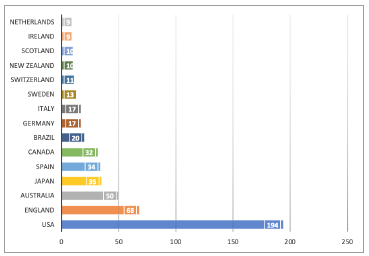
In 2006, only one paper was published on the topic of transgenders in sports published by researchers from the USA. Meanwhile, more or less 50 countries have carried out research on this topic by the end of 2024, which indicates the increasing amount of research possibilities and interest this topic possesses. Among all participating countries, 5 countries have published more than 30 papers until December 2024, as shown in Figure 2. The USA is leading in research on transgenders in sports with a total of 194 publications, followed by England (68), Australia (50) and Japan (35), respectively.
Academic cooperation between different countries or research institutions plays a guiding role in promoting the dissemination of knowledge and academic exchange among scholars (Chen et al., 2020). The academic cooperation relationship among the top 10 countries of publications from 2006 to 2024 is shown in Figure 3. The nodes in the figure represent different countries, the lines connecting the nodes indicate international cooperation between countries, and the thickness of the line represents the closeness of cooperation.
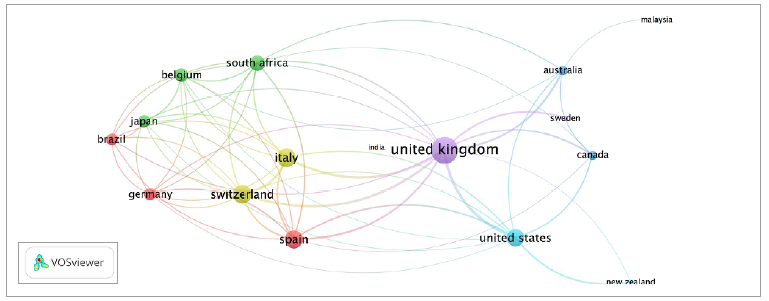
The USA and the UK are the most active countries in global cooperation on research of transgender studies, and both are located at the centre of the collaborative network. The USA and the UK both cooperated with 9 countries to publish in transgender research; Canada ranked Second as cooperating with 5 countries, followed by Australia, Spain, Germany and Brazil. The UK and the USA had the closest collaborations, and both countries collaborated very closely with Canada.
Authors and collaborations network analysis
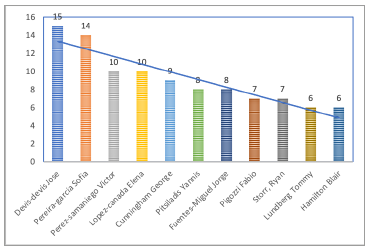
Almost 200 authors have contributed to the research of transgender in sports from 2006 to 2024. In Spain, researchers have produced more research in this field (Figure 4), as 5 out of 10 top productive authors are from Spain or associated with Spanish institutes, whereas 2 researchers are from the USA, 2 from Italy and 1 from Canada. Devis-devis Jose from the University of Valencia, Spain, leads with 15 publications, followed by other researchers from the University of Valencia, namely Pereira-Gracia Sofia, Perez Samaniego Victor, and Lopez Canada Elena have 14, 10 and 10 publications, respectively. Cunningham George from the University of Florida published 9. Pitsiladis Yannis from Hongkong Baptist University has 8 publications on this topic. Authors from the University of Valencia have the most publications in this field as per individual numbers, but Spain is overall far behind in terms of country publications.
Most cited articles and citation trend
Citation analysis is an important indicator to measure the quality of publications, and it represents both the interest raised by a research topic within academic circles and the attention the scientific community pays to the work of a researcher (He et al., 2019). The top 10 most cited papers from 2006 until date in the field of transgender studies are listed in Table 3, where the papers are classified according to the title, type, first author’s name, journal, total citations and year of publication.
Table 3. Top 10 most frequently cited publications from 2006 to 2024
| Rank | Title | First Author | Journal/ Conference | Year | Total Citations | Record type |
|---|---|---|---|---|---|---|
| 1 | DOING GENDER, DETERMINING GENDER: Transgender People, Gender Panics, and the Maintenance of the Sex/Gender/Sexuality System | Westbrook, Laurel | Gender & society | 2014 | 346 | Article |
| 2 | Circulating Testosterone as the Hormonal Basis of Sex Differences in Athletic Performance | Handelsman, David J | Endocrine reviews | 2018 | 316 | Article |
| 3 | Sport and Transgender People: A Systematic Review of the Literature Relating to Sport Participation and Competitive Sport Policies | Jones, Bethany Alice | Sports medicine | 2017 | 170 | Article |
| 4 | ‘More than boy, girl, male, female’: exploring young people’s views on gender diversity within and beyond school contexts | Bragg, Sara | Sex education-sexuality society and learning | 2018 | 112 | Article |
| 5 | Quality of life of treatment-seeking transgender adults: A systematic review and meta-analysis | Nobili, Anna | Reviews in endocrine & metabolic disorders | 2018 | 109 | Review article |
| 6 | Transgender Women in the Female Category of Sport: Perspectives on Testosterone Suppression and Performance Advantage | Hilton Emma, N | Sports Medicine | 2021 | 97 | Review Article |
| 7 | People have a knack of making you feel excluded if they catch on to your difference’: Transgender experiences of exclusion in sport. | Hargie, Owen D.W | International review for the sociology of sport | 2017 | 96 | Review Article |
| 8 | [Transgender] young men: gendered subjectivities and the physically active body | Caudwell, Jayne | Sport education and society | 2014 | 82 | Article |
| 9 | Testing sex and gender in sports; reinventing, reimagining and reconstructing histories | Heggie, Vanessa | Endeavour | 2010 | 78 | Article |
| 10 | Barriers and facilitators of physical activity and sport participation among young transgender adults who are medically transitioning. | Jones, Bethany Alice | International journal of transgenderism | 2017 | 72 | Article |
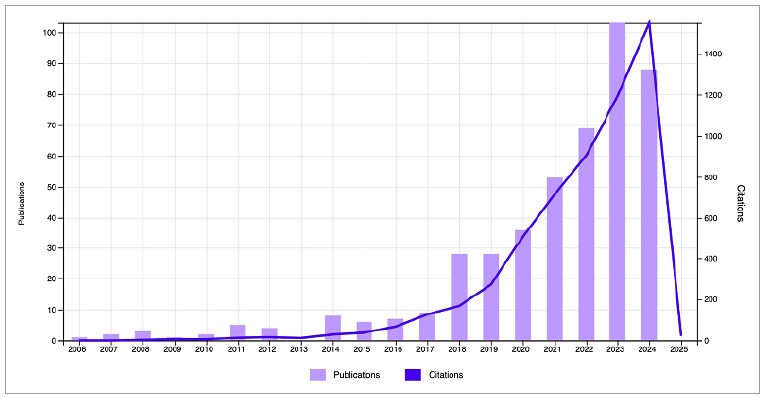
The Web of Science database search resulted in 454 publications on “Transgender in Sports” in the period from 2006 to December 31, 2024 (the date on which the analysis was performed). Both the cumulative citation index and the number of publications show an increasing trend in the investigated timeframe. Over the last 06 years, the number of publications has increased significantly. From the year 2006 to 2024, as can be seen in Figure 5, the number of publications dramatically increased and therefore, so do the citations. In 2015, only 6 papers were published on the topic, but in 2023, 103 papers were published worldwide covering this topic.
Journals network analysis
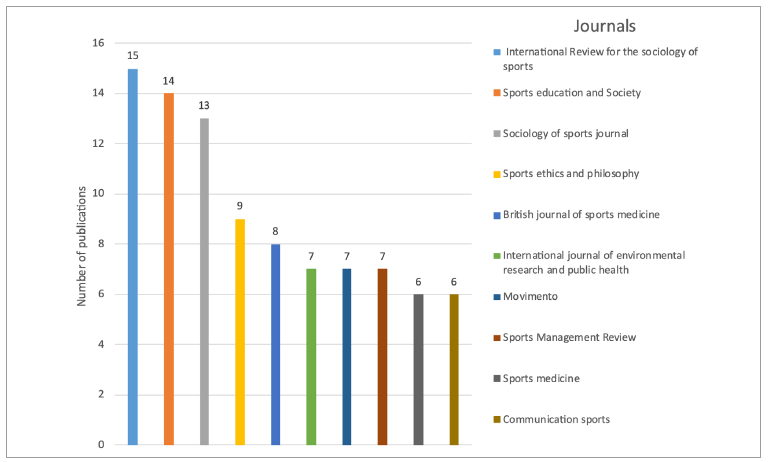
Figure 6 shows the top journals in terms of the number of publications on transgenders in sports. A total of 40 journals, with Impact Factor (IF) ranging from 1 to 5, published papers on this topic. International Review for the Sociology of Sport (IF = 1.7) is the most productive journal, with 15 published papers in this research area, accounting for 3.3% of total papers published on this topic, and Sports Education and Society (IF = 2.3) with 14 published articles. Sociology of Sports Journal published 13 papers, followed by Sports Ethics and Philosophy, which published 09 papers. These results confirm that the research on transgender studies, especially in sports, is growing each year.
High frequency keyword analysis
The research hotspots and overall trends in the field are accurately revealed by the analysis of the high-frequency keywords, their links, and total link strength (Qi et al., 2019). The analysis of the keywords related to transgenders in sports generated 884 results. Among them, only 43 met the threshold of at least five co-occurrences, which is 8.68% of the total count. Sixteen keywords appeared 10 times, and 88 keywords appeared 3 times, which is 4.15 and 15.16%, respectively. Transgender was used 113 times with a total link strength of 231, as shown in Table 4, followed by sports, which co-occur 51 times with a total link strength of 129.
Table 4. Top 10 authors keywords, frequencies and total link strength.
| Keyword | Frequency | Total Link Strength |
|---|---|---|
| Transgender | 113 | 231 |
| Sport | 51 | 129 |
| Gender | 48 | 122 |
| Inclusion | 33 | 73 |
| Policy | 14 | 49 |
| Gender Identity | 19 | 43 |
| LGBTQ | 14 | 34 |
| Physical Activity | 12 | 33 |
| Testosterone | 15 | 33 |
| Homobhobia | 11 | 32 |
The co-occurrence network map of keywords is shown in Figure 7, in which the bigger the size of the circle, the higher the co-occurrence of an item. Moreover, the shorter the distance between items, the stronger their relationship. Transgender is linked with 150 researched items, followed by sports, gender, inclusion, etc.

CONCLUSIONS
Our bibliometric analysis points out the complexity of the issue of transgenderism in sports, as it has been perceived by almost 200 authors from about 50 nations investigating this matter in 454 different papers. This is just a fraction of the even more complex issue of transgenderism in society (Jobe, 2013; Lombardi et al., 2002; Winter et al., 2016). According to WPATH (2012), transgender people experience a discordance between their personal sense of their own gender (their gender identity) and the sex assigned to them at birth (birth-assigned sex). Such a definition is highly problematic as it seems to give to an unidentified entity the role of sex assigner, implying that such an entity could also be wrong in assigning sex that does not correspond to the gender inner feeling of an individual. This entity should also be regarded as outdated because it does not consider the complexity of different gender identities emerging in the current society (Burnes & Chen, 2012), as it is strictly confined to a binary sex assignment. This is an epistemological concern that highlights the multifaceted nature of such an issue, outlining its extremely sensitive nature. The analysis of transgenderism in sports requires, then, a thorough scrutiny implying a number of different issues encompassing all the possible fields, the epistemological one included. The latter is, at the moment, excluded from the top 10 authors’ keywords that accompany the published articles. This mosaic of multiple domains of investigation seems to emerge from the increasing number of articles published on this topic, taking into account that in the year 2000, only 1 article dealing with transgender and sports appeared in the scientific literature. Our bibliometric analysis confirms that the scientific community’s interest in this topic is rapidly increasing all over the world, with a particular emphasis on the Anglo-American cultural context.

