




 Inglês (pdf)
 Artigo em XML
 Referências do artigo
 Tradução automática
 Enviar este artigo por email
 Citado por SciELO
  Similares em
SciELO
Similares em
SciELO 
 Permalink

In the turn of the 15th and 16th century, four clergymen hailing from Thorn (present-day: Toruń) in Prussia established ceremonial foundations in the parish church of the town. These individuals were the canons and parish priests Hieronymus Waldau (1495), Johann Smolle (1505), and Raphael Wayner (1520), as well as vicar and canon Caspar Welker (1505)2. The foundations established by the Thorn priests vividly exemplify the phenomenon of posthumous commemorative efforts in turn-of-the-century Prussia. Additionally, the clerical affiliation of these men holds significant importance. It was the responsibility of the clergy to commemorate the funders of the prebends they held through their prayers. Therefore, the four Thorn foundations portray a priest in two roles-both as the one commemorating and the one being commemorated. Examining them in a micro-historical way, as case studies, provides valuable insights into the religious and financial circumstances of the lesser clergy during this era, shedding light on their “professional” lives, but also social relations within groups of clergy. As Gustavs Strenga recently pointed out, memoria can be “a tool to study memorial practices and social history”3. Of course, in this broad context, the presented article is only a small contribution and introduction to the issue of remembering clerics4. However, the four presented foundations well illustrate the issues related to it.
At the time, Thorn was considered one of the prominent Prussian towns, alongside Danzig (present-day: Gdańsk), Königsberg (present-day: Kaliningrad), Elbing (present-day: Elbląg), and towns experiencing a decline in significance, namely Braunsberg (present-day: Braniewo) and Kulm (present-day: Chełmno). Its elevated status translated into prosperity and cultural development among the townspeople, influencing religious life, as evidenced by the establishment of religious foundations5. Thorn boasted two parishes during this period: St John’s in the Old Town and St James’s in the New Town, with an estimated total of about 11,000 parishioners6. The King of Poland held the right of patronage over the former parish, presenting a candidate for the parish priest alternately with the town council since 15057. The patronage of the latter parish was vested in the local Cistercian-Benedictine nuns, who acquired it from the territorial ruler (Teutonic Order) in the first half of the 14th century. During the discussed period, it is likely that the town council exercised this authority8. However, in adherence to the customs in areas of German settlement, the management of both churches rested in the hands of the town council, which appointed officials known as churchwardens (Latin: “vitrici”’ German: “kirchenvater”’) for this purpose9. Consequently, the parish church became a crucial element of communal identity, significantly impacting the religious climate of the town10.
Thorn’s sacral landscape included two filial churches: St Lawrence Church for St John’s Parish and St Catherine Church for St James’s parish. The town also housed the Franciscan and Dominican orders, along with the aforementioned nuns of mixed Cistercian and Benedictine obedience. In the suburbs, two hospitals were established: St. George Hospital in the north and the Hospital of the Holy Spirit in the south, the latter associated with a congregation of nuns who were residing there11. It is important to note that Thorn was not a cathedral town; the chapter of the Kulm diocese, to which Thorn belonged, was headquartered in Kulmsee (present-day: Chełmża), approximately 20 km to the north12. This dynamic influenced the social composition of the local clergy, with the lesser clergy predominantly represented13.
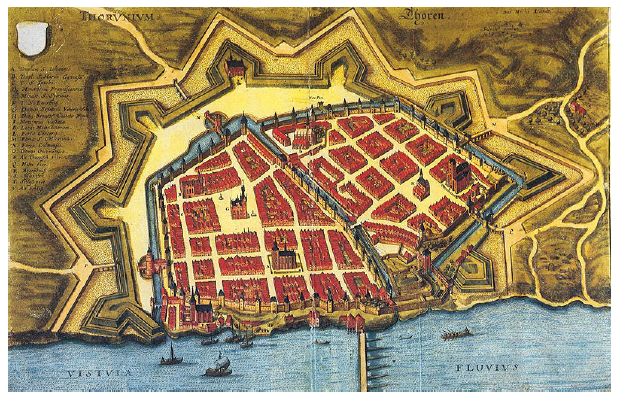
In the broader context of the Thorn clergy, the four founders were noteworthy figures, yet their profiles adhered to the typical clerical biography of the region15. Hieronymus Waldau, Johan Smolle and Raphael Wayner served successively at the parish of St John in the years 1466-1495, 1497-1512 and 1516-1524, respectively, within the office of Old Town parish priest16. Uncertainty surrounds the background and education of Waldau, while the latter two likely originated from local Thorn families, both possessing university education-Smolle from Leipzig and Wayner from Kraków. All three concurrently held the role of a parish priest and membership in cathedral chapters, with Waldau as a canon at Ermland (present-day: Warmia)17, and Smolle and Wayner in Kulmsee. Waldau stands out as the author of personal and historical notes, including references to his foundation activities18. Caspar Welker, the fourth priest, originated from Preußisch Stargard (present-day: Starogard Gdański) served as a vicar at St. John’s Church in Thorn from 1490 and, seven years later, became a canon in Kulmsee. This concise biographical overview underscores the parallels in the life trajectories of these four clergymen. As mentioned, these priests exemplify typical representatives of the town clergy during this period, often hailing from the town in which they ministered, although their families were not among the most prominent. The four Thorn priests advanced through similar ecclesiastical careers, culminating in their roles as canons in cathedral chapters.
What set the aforementioned priests apart from their fellow town clergy was undoubtedly their substantial material wealth. Andrzej Radzimiński, a researcher delving into the accounts of the parish priest of St John’s Church from the mid-15th century, estimated their expenses at a considerable sum of 200-300 marks annually19. The town’s parish priests derived income from various sources, including land emoluments and offerings, enabling them to amass significant revenue20. Additionally, it is important to note that all four priests held canonical prebends. Wayner, in particular, served as a notary public, which was a potential source of additional income. This financial stability provided the Thorn clergy with sufficient resources to embark on the costly foundation endeavours, undertaken in the later stages of their lives. Waldau’s presence in historical records concludes precisely with the 1495 foundation deed, Smolle disappears from records after 1513, eight years following the foundation, Welker is identified as having died in 1507, two years post-foundation, while Wayner passed away around 1527, approximately seven years after the foundation.
The four foundations under analysis in this article were established at St John’s Church, the largest and most significant church in the town. During the 15th and early 16th centuries, the church assumed its present form, reflecting the prosperity of the entire town at that time21. Through foundations, the wealthier townspeople and brotherhoods contributed to the construction of numerous side chapels during this period. According to the 1541 prebend list, the church housed 21 altars and chapels, with 30 prebends22. The foundations established by the four Thorn priests aligned with this prevailing trend. It is noteworthy that these clergymen sought commemoration primarily within their own parish church, a practice not uncommon among the lesser clergy in the region who often preferred the churches where they ministered23. Waldau designated his foundation at the main altar, Smolle at the altar of the Blessed Virgin Mary24, Welker at the altar of St Wolfgang25 while Wayner chose the altar of Sanctae Reginae26.
An analysis of the foundations of the Thorn clergymen reveals several levels, the first of which, pertinent to our discussion, is the extent of the obligations of prebend holders, particularly in the context of commemoration. Founders stipulated specific requirements in this regard. Waldau’s foundation postulated a minimum of three weekly masses. The first focused on the Holy Trinity, the second on the Assumption of the Blessed Virgin Mary, and the third (“szele messe”) served as a commemorative mass for the souls of all the deceased faithful, the founder, his parents, siblings, and relatives, combined with a collect. Additionally, during Lent, the priest was required to read the Passion of Christ at one of these three masses, and his responsibility included overseeing the founder’s other commemorative activities.
Similarly, the priest at Smolle’s altar was expected to conduct three masses: one for the dead, the second depending on the liturgical calendar (“de tempore vel de sanctis”), and the third, on Saturday, dedicated to the Blessed Virgin Mary. Notably, the parish priest, who founded the preacher prebend, imposed a specific commemorative obligation on its holder, instructing the preacher to mention the founder’s parents in every Sunday and holiday sermon- Nicolaus and Dorothea Smolle. Wayner’s will outlines the celebration of three masses: the Holy Trinity, All Saints, and one for the dead, coupled with a vigil for the deceased and alms for the poor. The founder specified the collects to be recited during these masses.
Welker’s foundation had even more detailed requirements, as it established two prebends for two priests, alternating daily mass. The order of celebration, as detailed in Table 1, included a Sunday morning mass (“prima missa”), probably to avoid conflicting with the parish mass. On Fridays, the mass was to be combined with the sequential reading of the Passion of Christ from the four gospels. Saturdays were reserved for a mass related to one of the seven Marian feasts, adapting to the current holiday in case of overlap. Clergy rotation occurred weekly, and they were obligated to hold a special commemoration (“memoriam specialem”) for the state of the universal Church and all living and deceased founders, patrons, and benefactors. Similar to Waldau’s foundation, priests were also responsible for the founder’s anniversary commemoration and that of Barbara Clementynne, probably related to the founder.
Table 1 Order of masses according to the foundation of Caspar Welker (1505)
| Sunday | Monday | Tuesday | Wednesday | Thursday | Friday | Saturday | |
| Priest 1 | Holy Trinity mass | Patron saints of the altar mass | Corpus Christi mass | Blessed Virgin Mary mass | |||
| Priest 2 | Mass for the dead | Mass for sins | Holy Cross mass |
The prevailing norm dictated that one priest should conduct three masses a week, aligning with similar foundations in the region27. This principle is integral to the obligation outlined in the synodal statutes for parish church priests, emphasizing the importance of celebrating three masses per week28. On the other hand, the liturgical arrangement of the examined foundations is distinctly linked to the Christian calendar. Notable examples include the Thursday Mass associated with the veneration of Corpus Christi, the Friday Mass dedicated to the Passion of Christ, and the Saturday Mass honouring the Blessed Virgin Mary29. A common thread among these foundations is the directive to pray not only for the founder and their relatives but also for all deceased Christians. Consequently, these rituals assumed the nature of commemorations and public prayer, a point underscored in Smolle’s foundation, explicitly established “pro communi omni salute”.
Other obligations, not directly tied to commemoration but crucial for the functioning of the prebends, as well as parish liturgy and pastoral care, were also integral to the duties of the priests. Smolle’s foundation, specifically intended for preachers, stands out in this regard. The foundation document expressed a deep-seated belief in the paramount importance of preaching the Word of God for the congregation’s salvation (“inter alia que ad salutem spectant populi Christiani parabulum verbi Dei quo anime pascuntur vereque vivunt per maxime esse necessarium”), citing the Gospel statement, “Man shall not live on bread alone, but on every word that comes from the mouth of God” (Matthew 4:4). The foundation of the Thorn parish priest can be viewed as a response to the pressing need for preachers during this period. Prebends of this kind were a common phenomenon in Central and Eastern Europe, and Prussia was probably no exception30.
Another responsibility of priests was active participation in the town’s public worship, as mandated by the statutes of the Prussian dioceses31. Both priests under Welker were expected to join the customary Sunday procession around the church, much like the other clergy of the parish church. Additionally, their duties encompassed aiding the parish priest during major holidays. This perspective was potentially shared by Smolle, who, in his own annotation to the document, indicated that his foundation was also established for the benefit of the parish priest (“comoditate plebani”). Clauses emphasizing the necessity of supporting the parish priest were a recurrent feature in foundation documents, likely responding to documented disputes over the authority of the lesser clergy, involving tensions between the parish priest, townspeople, and the vicars themselves32. Perhaps not without reason, Waldau specified that the vicar’s conduct towards the parish priest should be appropriate and that he should be prepared to assist in celebrating mass and other parish-related activities.
Among the obligations imposed on curates was the responsibility for the liturgical equipment belonging to their benefices. According to Waldau’s will, each time a vicar passed away, an inventory of the prebend had to be compiled in duplicate, with one copy provided to the priest. Wayner, on the other hand, mandated that, upon request from patrons, the vicar should provide an account of the altar equipment. Traces of such practices can be found in the surviving inventories of various Thorn altars, which sometimes bear references to clergymen33. In the case of St Lawrence Church, there is evidence of a dual census of this type, indicating the likely use of the two-copy method34.
Priests were not only responsible for maintaining the condition of the equipment but also for addressing the ongoing needs of the altars. Waldau’s curate, for instance, was tasked with personally managing the altar lighting and all other requirements for celebrating mass. However, only wine, water, and bread were allowed to be taken from the parish church’s resources. Similarly, priests employed at the Welker altar were instructed to ensure the appropriate number of candles. The funder specified that each clergyman should purchase two of each, ensuring a minimum of four candles on the altar. These candles were to be replaced three times a year: at Christmas, Easter, and the Assumption of the Blessed Virgin Mary35.
Prebend funders typically held specific expectations for the priests employed at their altars regarding their knowledge, character, and morality. These expectations aligned with the model of the virtuous priest prevalent in the Christian narrative, often juxtaposed with the negative portrayal of a wayward clergyman36. Waldau exemplified the desired demeanour of a clergyman, emphasizing the need for his vicar to be a man of “certainty” to faithfully fulfil his duty to the soul of the parish priest ("sicher ist zcu seynen leben unde des [...] pfarrers szele nicht vorgessen”). Smolle also outlined distinct requirements, insisting that his preacher possess excellent skills in preaching the Word of God, directly tied to the salvation of the faithful ("vir idoneus opere et sermone potens haberatur, qui populum catholicum verbo doceat et exemplo corrigatque et erudiat in hiis, que fidei sunt et salutis”). This naturally necessitated relevant education. Educational provisions were explicit in Welker’s and Wayner’s foundations. Under Welker, one of the priests could pursue studies, provided he arranged for a substitute who would receive appropriate financial compensation and wax for the specified candles. Similarly, Wayner’s vicar had the opportunity for a three-year study period, during which a senior chaplain would temporarily assume his duties. However, these were exceptions to the rule, which required the priests’ permanent residency at the prebend. The norm had to be observed by the vicars of the other foundations. The preacher of Smolle was even facing the forfeiture of his prebend if he abandoned his duties without just cause. Personal residency was an important aspect of how clergy functioned, as it discouraged the accumulation of prebends, especially among priests. In the case of the Prussian lesser clergy, having multiple benefices was a limited phenomenon37. This is also reflected in the foundations under discussion. Waldau’s curate was not allowed to hold other prebends, and Welker’s prebends were designated for priests without benefices in the parish church.
A possible consolidation of prebends was linked to the desire to augment income. In the context of the customary income for a vicar celebrating mass at a side altar-set at 10 marks in Prussia, rising to a dozen marks in larger towns38 -the foundations of the four Thorn priests were well-endowed. Like other prebends in the town, they relied on rental revenues39. Waldau secured a perpetual annuity of 25 marks from the town council for the substantial sum of 500 marks. The vicar was to receive this annual fee in two instalments, 12.5 marks each, on Ascension Day and Andermas (30 November). Smolle’s prebend also had a comparable capital, with the parish priest purchasing a redeemable annuity (”wedirkawff“, ”reemptionis“) of 30 marks for 500 marks in 1500, payable in two instalments on Pentecost and Martinmas (11 November)40. The revenue was redirected to support the preacher after a few years. Since the rent could be redeemed, the clergyman stipulated that in such a case patrons should take care of the new revenue. The initial capital was to remain with the town council “sub fideli custodia”. The interest rate on annuities in these two cases ranged from 5% (Waldau) to 6% (Smolle). In Thorn, the interest rate was 8.33%, but the interest rate on loans granted from orphans' assets was lower (5%)41. The capital contributed by clergy was treated similarly in these two cases.
The revenues of the curates from the other two foundations exhibited a more diversified structure, as we read in the foundation documents. The detailed description of rents owed to priests in Welker’s foundation provides insight into the extent of this diversification (refer to Tables 2 and 3). The former priest derived his income from 18 rents, totaling about 50 marks. Meanwhile, the latter priest enjoyed a substantial income from 25 rents, amounting to about 75 marks. Both prebends were thus generously endowed42. However, priests were obligated to allocate funds for two anniversary commemorations (detailed below), each amounting to six marks. Additionally, they were responsible for maintaining the technical condition of the houses from which they collected rents. Failure to fulfil this duty could result in the patrons revoking their rent for a period ranging from one to three years, depending on the extent of the necessary repairs. Furthermore, priests had specific financial obligations to the town council. The former priest, receiving rents from the village of Mocker (present-day: Mokre, district Toruń)43, was required to annually pay one mark and eight scots to the town hall. The latter priest, also associated with Mocker, had to remit three and a half marks to the councillors on November 11. This practice may reflect historical attempts to impose taxes on the clergy, occasionally taking the form of taxing rental income in Prussia44.
While most rents were designated as perpetual (“hereditatis”, “perpetuus”), some could be redeemed by debtors. The founder foresaw this possibility and stipulated that, in such cases, patrons were obligated to purchase a new rent. The encumbered properties primarily comprised plots of land and gardens in the suburbs, although houses within the walls were also included. Payment dates most frequently occurred at Easter and Michaelmas (29 September), with occasional appearances of Martinmas (11 November).
A crucial component of the compensation package was the provision of housing for the clergy. One priest was to be granted a rent-free house on Grossengasse (present-day: Szeroka St.)45 formerly owned by Barbara Clementynne, as we have seen, related to the founder. Another priest was allocated Anna Fawlschnicky’s house, located opposite the Franciscan monastery. This practice of providing housing for vicars was widespread in Prussian towns46.
Table 2 Rents of the first prebend in Welker’s foundation (1505)
| N. | Amount | Type of rent | Encumbered property | Payer | Payment date |
|---|---|---|---|---|---|
| 1. | 4 ‘small’ marks | redeemable | barn/granary and garden | Ulrich Zcyrvonka | Easter, Michaelmas (in equal parts) |
| 2. | 6 ‘small’ marks | 2 hereditary marks, 4 redeemable marks | house in the New Town of Thorn | Dorre Lorentz | Easter, Michaelmas (in equal parts) |
| 3. | 16 Prussian grosch | - | house and garden in the suburbs | Caleszke | Michaelmas |
| 4. | 4 marks | 3 hereditary marks, 1 redeemable mark | plot of land in Klein Mocker47 | Peter Franczel | - |
| 5. | 3 marks | perpetual | plot ‘in opporto vie Lapidee’ | Johannes Lehmfarer | - |
| 6. | 7 ‘small’ marks | 3 perpetual marks, 1 redeemable mark | house in the New Town of Thorn | Nicolaus Sznyder | Easter, Michaelmas (in equal parts) |
| 7. | 2 marks | hereditary | house and mansion in the suburbs behind St Lawrence Church | Johannes Lutifigalus | Easter, Michaelmas (in equal parts) |
| 8. | 1 mark | hereditary | house and garden in the suburbs | Procopius | Easter |
| 9. | 3 marks | hereditary | house and garden in the suburbs | Janyke Kraryetz | Michaelmas |
| 10. | 10 scots | hereditary | land plot in the village of Mocker | Martin Keselingk | - |
| 11. | 5 firdungs | perpetual | land plot in the village of Mocker | Johannes Grake | - |
| 12. | 5 firdungs | perpetual | land plot in the village of Mocker | Bernhard Mozanczer | - |
| 13. | 15 scots | hereditary | land plot in the village of Mocker | Michael Fideler | - |
| 14. | 0.5 marks | hereditary | land plot in the village of Mocker | Peter Niger | - |
| 15. | 8 marks | - | 4 lans in the village of Konradswalde (present-day: Kuczwały)48 | - | - |
| 16. | 9 marks | - | land and property in and outside the town (claims) | Johannes de Ponte (von der Brucke) and his son Johannes de Ponte | Easter, Michaelmas (in equal parts) |
| 17. | 8 marks | - | house in the Old Town of Thorn | Andreas Jode | Easter, Michaelmas (in equal parts) |
| 18. | - | - | house in the New Town of Thorn | Former owner - Peter Rothe (Roche) | - |
Table 3 Rents of the second prebend in Welker’s foundation (1505)
| N. | Amount | Type of rent | Encumbered property | Payer | Payment date |
|---|---|---|---|---|---|
| 1. | 2 marks 16 scots | - | vineyard by the mill in Trzeposz49 | Bartholomeus Gertner | Martinmas |
| 2. | 2 marks | redeemable | house in Old Town Thorn | priest Paul Lymberg | Easter, Michaelmas (in equal parts) |
| 3. | 4 marks | redeemable | house in the New Town of Thorn | Mathias Grawpener | Easter, Michaelmas (in equal parts) |
| 4. | 8 marks | 2 hereditary marks, 6 redeemable mark | house in the New Town of Thorn | Bernhard Schyndeler | Easter, Michaelmas (in equal parts) |
| 5. | 1 mark | perpetual | house in suburbs | Mathias Kale | Michaelmas |
| 6. | 2 marks | hereditary | granary and garden in the suburbs | Johannes Czeyne | Michaelmas |
| 7. | 2.5 marks | perpetual | property behind the payer’s manor (‘curia’) | Hengewegk | Martinmas |
| 8. | 16 scots | hereditary | house and garden in the suburbs | Johann Roszynsky | Martinmas |
| 9. | 1 mark 8 scots | - | garden in the suburbs | Nicolaus Wayner | - |
| 10. | 2 marks | hereditary | meadow | Woytke Fabri | - |
| 11. | 1 mark | - | house in the suburbs | Guse the fisherman | Michaelmas |
| 12. | 1 mark | - | estate (‘curia’) | formerly, Nicolaus the potter | - |
| 13. | 8 marks | - | four lans in the village of Konradswalde | - | - |
| 14. | 9 marks | - | land and property in and outside the town | Johannes de Ponte (von der Brucke) | Easter, Michaelmas (in equal parts) |
| 15. | 8 marks | - | house in Old Town Thorn | - | - |
| 16. | 2 marks | - | house in the New Town of Thorn | formerly Peter Roche | - |
| 17. | 2 marks | redeemable | house in the New Town of Thorn | Nicolaus Gobel | Easter, Michaelmas (in equal parts) |
| 18. | 1 mark | hereditary | house and garden in the suburbs | Bartosch, formerly Naye | - |
| 19. | 3 marks | hereditary | house and garden | Barbara Koszelerynne | Michaelmas |
| 20. | 2 marks | hereditary | a plot of land in the suburbs next to St Lawrence Hospital | Mathias Frisze | Easter, Michaelmas (in equal parts) |
| 21. | 3 marks | perpetual | property in the village of Mocker | Mathias Seyer | - |
| 22. | 3.5 marks | perpetual | property | Martin Maszer | - |
| 23. | 3.5 marks | perpetual | property | Labata | - |
| 24. | 1 mark | perpetual | Property | ‘Little’ Bartusch | - |
| 25. | 1 mark | perpetual | Property | Johannes Bogk | - |
The revenues of the Wayner prebend were also dispersed, although all rents were based on properties in the suburban village of Mocker (Table 4.) The priest was to collect revenue from as many as 28 properties for a total of about 46 marks. Wayner also stipulated a fee to the town in the amount of 1 mark and 10 shillings. This information was included in the parish priest’s personal annotation on the foundation document. The clergyman also stipulated not to dispose of rents belonging to the prebend.
Table 4 Rents from the village of Mocker in the Wayner’s foundation (1520)
| N. | Amount | Property | Payer |
|---|---|---|---|
| 1. | 1.5 marks | garden | Gregor Czegelky |
| 2. | 1.5 marks | garden | Andrzej Orlowskii |
| 3. | 3 marks | garden | Jan Maszgaii |
| 4. | 2.5 marks | garden | Andrzej Rusga |
| 5. | 5 firdungs | plot of land | Martin Hampusz |
| 6. | 1 mark | half a morgen | Stenczell Ruszga |
| 7. | 1 mark | half a morgen | Hans Torgen |
| 8. | 1 mark | plot of land | Paweł Matzni |
| 9. | 20 scots | plot of land | Paweł Matzni |
| 10. | 1 mark | half a morgen | Helena Santwochissyn |
| 11. | 2 marks | plot of land | Pawlick |
| 12. | 1 firdung | plot of land | Martin Hampusz |
| 13. | 2 marks | one morgen | Jan Smesni |
| 14. | 0.5 marks | plot of land | Paweł von Nijchten |
| 15. | 5 firdungs | plot of land | Mathes Sperlingk |
| 16. | 2 marks | plot of land | Valten Jaszkii |
| 17. | 4 marks | two morgens | Maciej Rathaii |
| 18. | 2 marks | one morgen | Clemens Jon |
| 19. | 0.5 marks | plot of land | Barbara Beutelin |
| 20. | 2 marks | plot of land | Steffanus Schubert |
| 21. | 7 firdungs | plot of land | Dominicus Ritter |
| 22. | 3 firdungs | plot of land | Nicolaus Frenczell |
| 23. | 3 marks | plot of land | Ursula Kalin |
| 24. | 5 firdungs | plot of land | Ursula Kalin |
| 25. | 3 marks | plot of land | Marek Krzyszian |
| 26. | 2.5 marks | one morgen | Andreas bei de Gassen |
| 27. | 2 marks | bulwark (‘pomerium’) | Jacob Bolcze |
| 28. | 3 firdungs | garden and meadow | Stanislaus Thorunsky |
The prebends established by the four clergymen from Thorn were notably well-endowed. However, the foundations of Welker and Wayner were marked by the dispersion of income among multiple contributors, placing the cleric within an extensive network of connections linking him and his debtors. This complexity could have posed challenges in collecting benefits, potentially leading to conflicts and financial issues for seemingly affluent priests.
The social context surrounding these foundations is a crucial aspect to consider. The founders held significant roles within the town’s community, being important members thereof. As clergymen, they were affiliated with the local priestly fraternity, a common phenomenon in the social landscape of late medieval Prussia50. As mentioned earlier, Waldau obligated his vicar to oversee various forms of commemoration, including an anniversary commemoration celebrated by the Thorn fraternity in St Giles day (1 September). In 1487, the parish priest donated 100 marks to the confratres for this purpose51. Three years later, the clergyman purchased one mark of annual rent for 12 marks, earmarked for the fraternity’s communal meal after the aforementioned anniversary52. In return, each brother was tasked with reciting Requiescat in pace for the benefactor’s soul. Welker also arranged for an anniversary commemoration from the Thorn fraternity. The first priest of his foundation was required to contribute six ‘small’ marks from his own funds to the confratres for this purpose. The second priest, in turn, financed the anniversary commemoration of the already mentioned Barbara Clementynne with the same amount. This commemoration was also celebrated by the priestly fraternity, and Welker’s connections to this confraternity are well-documented. He appeared as one of the elders of the association in 149553.
The social standing of priests holding funded prebends was significantly influenced by the right of patronage, wherein a candidate for a vacant benefice could be presented to the bishop. Waldau retained this right for the duration of his life. Upon his demise and that of the initial vicar he appointed, a new priest was to be jointly cared for by the then parish priest and the town councillors. The clergyman presented to the bishop had to undergo investiture from him and, within a month, transition from the role of a chaplain to that of a vicar. Smolle also opted to relinquish patronage to town councillors. According to the procedure he established, when the prebend became vacant, the parish priest was required to seek the authorities’ appointment of a new preacher and then accept their choice. Welker similarly designated the councillors as patrons, who were responsible for presenting both vicar candidates to the bishop. Wayner, on the other hand, designated his heirs and relatives as patrons. However, in the absence of such individuals, patronage was to be assumed by the council, in collaboration with the parish priest.
It is worth noting the influence of municipal government in shaping the staff of the parish church which is aligned with the intentions of the founders. This was undoubtedly driven by the growing significance of the town council as a powerful institution with enduring continuity over time. This ensured the duration of the prebend and, consequently, the posthumous commemoration of the funders. Patrons were entrusted not only with ensuring prebend revenues but also with inspecting the curate’s equipment. During the vacancy of Waldau’s prebend, the councillors, in conjunction with the parish priest, were tasked with compiling an inventory of liturgical equipment in duplicate to prevent loss. Patrons of Welker’s foundation were also obligated to inventory paraments. Both Welker’s and Smolle’s foundations explicitly stated that transferring patronage to the councillors aimed to safeguard the prebend’s income and equipment. This practice was widespread in Prussian towns, with councils serving as patrons for most altars in parish churches54. According to the 1541 census of Thorn’s prebends, out of 41 prebends, the council, as an institution, exercised or shared patronage for 19, while another 11 were under the responsibility of councillors, mayors, or their families55. Despite the emphasized role of the parish priest in the four foundations analysed, attributed to the clerical affiliation of the funders, the town authorities were the primary decision-makers concerning positions at the altars. This most probably had social consequences, evident in the local origins of the town’s clergy.
It is noteworthy to consider certain limitations in the selection of candidates for the foundations. Naturally, candidates were required to be properly ordained and adhere to the aforementioned priestly model. However, additional clauses were present in the foundations. Waldau specified that the curate should be the parish priest’s chaplain with the longest service, who had not yet held any prebend. If he succeeded in obtaining another benefice, the prebend was to pass to his younger colleague. This approach turned the parish priest’s foundation into a viable source of livelihood for priests waiting to secure a steady income from benefices, serving as a transitional phase for clergy. Waldau’s approach suggests that he responded to the challenges faced by the lesser clergy in achieving financial stability. A characteristic clause in the Welker and Wayner foundations was the priority given to members of the funders’ family in taking up prebends, contingent on their fitness (‘idoneitas’) for ministry. This clause, common in similar ventures56, was another factor influencing the social composition of the lesser clergy. In the case of priestly foundations, this overlapped with the documented role of the uncle-priest in guiding his nephew’s choice of a career in church57. Some clerics funded prebends with specific relatives in mind58. In this context, the foundation not only had a religious and commemorative purpose but also a familial one, providing support for young candidates for ordination at the threshold of their careers.
In the social context, the analysed foundations also relate, in part, to the town’s ethnic structure. Thorn at the time was inhabited by a German-speaking population, but there was also a growing Polish-speaking community in the town59. This is evident, for example, in the distinctly Polish names and nicknames of the residents of Mocker listed in Wayner’s foundation (see Table 4). This involved the activities of Polish chaplains, as noted by Waldau and Wayner. The parish priests acknowledged that their prebends could be covered by representatives of both nations (“her sey Deutcz ader Polnisch”, ”sive Alamano sive Polono”). Indirectly, Smolle’s foundation for preachers can also be placed in this context, as an essential element of effective pastoral ministry was the use of the language of the congregation, which was reflected in the functioning of many preachers described as Polish in Prussian towns, including Thorn60.
The four Thorn priests also took additional actions to ensure their salvation, sometimes directly related to the prebends analysed. Smolle and Welker supplemented their foundations with bestowals of liturgical equipment. Smolle donated to the altar a silver-gilded chalice bearing the founder’s personal data61, a missal, two silver altar cruets gilded on both sides, a silver pax, seven chasubles, and other lesser equipment. Welker, on the other hand, donated at least two silver altar cruets for each prebend, bearing his initials or symbol62. These priests were thus part of a practice often observed in foundation activities, including those of the clergy63.
The other two clerics, on the other hand, engaged in extensive and diverse foundation activities, extending beyond their own town. Waldau consolidated his efforts in a foundation in 149564. According to the priest’s will of 1483, he donated 50 marks to the town council for the construction works in the parish church65. This contribution entailed the chanting of the Ave verum Corpus Domini nostri Jhesu Christi antiphon at each high mass and the observance of an anniversary commemoration for the priest’s soul during Advent. Another noteworthy aspect concerning commemoration is the transfer of three marks of rent to the preacher of the parish church in 1486. In exchange, Waldau expected his name to be read from the parish’s book of the dead (“libellum mortuorum”, “toden buch”) and a prayer for his soul on every feast day66. As mentioned earlier, he also worked towards a commemoration by the priestly fraternity. Additionally, in 1488, he made similar efforts with the merchant fraternity67. Five years later, he secured an anniversary commemoration from the Ermland chapter, to which he belonged, held around the time of the commemoration of Mark the Evangelist (April 25)68. Although the parish priest is recorded in the anniversary commemoration book of this canonical corporation, he was eventually commemorated on 22 June69. This coincides with the presumed date of the clergyman’s death, as he last appears in the sources on 22 June 149570.
Various activities of similar nature were also undertaken by Wayner. After the Thorn foundation, in December 1520, the priest established a similar prebend at Kulmsee Cathedral71. In 1521, along with Gedula Esken, he received permission from the Holy See to organize a Thursday procession in Thorn72. The first such ceremony was successfully held later that year73. Around the turn of the 16th century, clergymen from Danzig (present-day: Gdańsk) and the priestly fraternity from Thorn were involved in similar activities in Rome74.
To complete the picture, it is essential to note the process of establishing the foundation itself. Such an undertaking primarily involved providing the prebends with a suitable material basis. This was reflected in the foundation documents, as descriptions of funding were more voluminous than other arrangements. The financial fundamentals have been discussed above. It should only be added that the funders could use the rents they themselves had previously enjoyed for this purpose. This practice was employed not only by Smolle, but also by Welker. According to the foundation document, Welker acquired the rents that comprised the income of the two prebends between 1490 and 1504. It primarily referred to specific records in the books that haven’t survived to the present day. However, at that time, Welker appeared in the town book as making such purchases75. Surely, the rents originally represented his own income, which he later decided to use for his foundation. This practice was not uncommon among Prussian clergy. Some priests endowed prebends with their own income and became the first curates of the altars they funded76.
Another avenue was to purchase rents with the foundation in mind, a process that came with potential difficulties in accumulating profits of sufficient value. Finding payers who were willing to pay obligations in small amounts could be easier, but this resulted in the aforementioned dispersion of income77. For the funder, this required more effort to find borrowers. For those with significant capital, a town council could be a favourable choice, as it ensured regular payments in an appropriate amount. Waldau and Smolle opted for this route, each investing as much as 500 marks. In contrast, Wayner purchased rents for the prebend from mayor Johann Liszeman78. As a side note, it should be mentioned that Wayner compiled a rent book for the funded prebend, though unfortunately, it has not survived to the present day. It is also worth adding, that according to research of Cezary Kardasz, the share of clergy and church institutions in annuity market in Thorn was small (from approx. 2% in the Old Town to approx. 11% in the New Town)79. In this context the four priests analysed (especially Welker) were quite active on this market.
The second stage involved providing the foundation with a legal basis, including the issuance of documents and their authentication. Notably, Waldau’s foundation was recorded in the town book under the date of 22 June 1495, likely due to the town council’s role as the rent payer and patron. Other foundations are preserved in document form, with Smolle’s document issued on 7 August 1505, by the Bishop of Kulm, Nicolaus Crapitz (Polish - Chrapicki). However, it should be noted that it carries a notation confirming the next bishop, Johann von Konopat (Polish - Konopacki), who assumed office in 150980. It is possible that the foundation did not commence its operations until then, indicating potential organizational difficulties or the establishment of the prebend only after the funder’s death. Of course, it can also be assumed that the purpose of the signature was merely for authentication. Smolle personally signed the document, stating, among other things, that an identical diploma was in the possession of the town council. In the case of Welker’s foundation, two documents have survived. The first is a notarial instrument issued on 14 February 1505, and the second is a bishop’s endorsement of this act dated 16 October 1506. Interestingly, both diplomas were drawn up by the same notary, who, in addition, was bishop Crapitz himself. The time span seems to indicate the duration of the foundation process. Wayner’s foundation is documented by a diploma issued by bishop Konopat on 19 June 1520.
Lastly, let us examine the issue of foundation sustainability, a crucial aspect from the founders’ perspective. Their actions clearly assumed the perpetuity of the benefices (“perpetuum ministerium”). The 1541 inventory of Thorn prebends shows those founded by the four priests at the turn of the century. The list also allows comparison of their organizational and material bases with the original assumptions. In the case of Waldau’s foundation, the operation of the prebend remained unchanged, with patrons being the councillors and the parish priest of the time, and the income being 25 marks a year81. The same was true for Smolle’s foundation, still designated for preachers with an income of 30 marks82. However, some changes are observed in the functioning of Welker’s prebends. The town council held patronage of both, but there were differences in revenue. Although the rents of the first prebend coincide, some changes can be seen. Greater differences are evident in the case of the second prebend, likely related to the aforementioned dispersion of income and changes in its sources. Let us now consider two examples. According to the foundation document, the priest of the first prebend was to receive seven ‘small’ marks from Nicolaus Sznyder, four of which the debtor could redeem. Probably this was the case, as in 1541, he was already obliged to pay only three marks. In the case of rent from the village of Konradswalde, which was later (in 1524) changed to Schonenfeld (present-day: Kijewo Królewskie)83 with the consent of the councillors of Thorn and bishop Konopat. Rent amounts also underwent some changes. The first priest was to receive about 60 marks a year, while the second was to receive about 50 marks84.
Wayner’s foundation was also in operation at the time, with burghers serving as patrons. This likely aligned with the founder’s intention to transfer the right of patronage to his heirs, possibly family members. While the number of rents was somewhat smaller, they yielded a similar amount of over 45 marks per year85. The permanence of the income of this prebend is attested by the 1583 inventory of rents of Reginae altar, where some payer names or nicknames coincide with the original foundation document, indicating a lasting commitment within the family86.
The stability of these foundations is indirectly evidenced by a 1596 inventory of church equipment. It lists the equipment of the altar of the Blessed Virgin Mary, overlapping with Smolle’s foundation87. The inventory also includes the equipment for the altar of St. Wolfgang with altar cruets bearing Welker’s initials and his symbol88. The Reginae altar and its equipment were also documented in the inventory89. To trace the future fate of these prebends, further research with modern materials is necessary.
The analysed foundations encapsulate the phenomenon of commemorating the dead in late medieval Prussian towns. They reflect the commemorative endeavours of town residents, along with their socio-cultural and financial context. A micro-historical examination of these manifestations of commemoration sheds light on the broader picture of this phenomenon. In the late 15th and early 16th centuries, Prussian burghers actively sought posthumous prayers for their souls. The scale of the phenomenon was certainly smaller than in Western Europe, but the relatively young and peripheral Christian society in Prussia seems align with the European model. However, comparative studies are needed to validate this hypothesis. To conclude, it is therefore necessary to call for cooperation among historians in this field from different parts of Europe90. Initial discussions reveal some surprising similarities in commemoration models - even in spatially and culturally distant regions of the continent.
The four Thorn priests embodied model clergymen of their time. They can be considered typical representatives of the bourgeois religious culture of the late medieval era, which is reflected in their foundations. In their pursuit of posthumous commemoration, these clerics were no different from their secular neighbours. Through foundation procedures, members of the clergy not only became the subjects responsible for commemoration, but also objects of commemoration.
As the executors of commemorative services, they were responsible for the remembrance of the deceased. As the ones being commemorated, they became the objects of remembrance. This first aspect distinguished them from laymen and emphasized their role as “memory professionals”. The demand for commemorative services even shaped the social expectations placed on lesser clergy. In the second aspect, the clergymen, in their role as the ones being commemorated, functioned similarly to the laity. They were among the members of the brotherhoods who were subject to commemoration, they belonged to the funder’s family or were funders themselves. The former aspect was an expression of their theoretical social distinctiveness, while the latter - of their practical affiliation with the bourgeoisie. This duality reflects the social position of the clergy in the towns of the late Middle Ages. They were defined by their socio-cultural role, but fundamentally remained part of the bourgeoisie.
Translated by Tomasz Leszczuk
Bibliographical references
Sources
Manuscript sources
Pelpin, Diocesan Archive in Pelplin, Diplomata et epistolae, Varia, n. 14, 17
Toruń, State Archive in Toruń, Kat. I, n. 626/1/2, 626/1/3, 834a, 991, 2633, 2641, 2679, 2855a, 2928, 2934, 2981, 2985/5
Toruń, State Archive in Toruń, Kościół św. Jana, ref. 1, 8
Printed sources
"Die Aufzeichnungen des Thorner Pfarrers Hieronymus Waldau". Ed. Otto Günther. Zeitschrift des Westpreussischen Geschichtsvereins 49 (1907).
“Die ermländischen Anniversarienbücher”. Ed. Carl Peter Woelky. In WOELKY, Carl Peter; SAAGE, Johann Martin (eds.) - Scriptores Rerum Warmiensium, vol. 1. Braunsberg: Verlag von Eduard Peter, 1866.
Księga długów miasta Torunia z okresu wojny trzynastoletniej. Ed. K. Ciesielska, I. Janosz-Biskupowa, Fontes TNT, 55. Toruń: Towarzystwo Naukowe w Toruniu, 1969.
Księga ławnicza Starego Miasta Torunia (1479-1515). Ed. Krzysztof Kopiński, Krzysztof Mikulski and Janusz Tandecki, Fontes TNT 113. Toruń: Towarzystwo Naukowe w Toruniu, 2018.
Repertorium Poenitentiariae Germanicum. Ed. Ludwig Schmugge et al., vol. 7. Tübingen: Max Niemeyer Verlag, 2008.
Repertorium Poenitentiariae Germanicum. Ed. Ludwig Schmugge et al., vol. 8. Berlin/Boston: De Gruyter, 2012.
Repertorium Poenitentiariae Germanicum. Ed. Ludwig Schmugge et al., vol. 10. Berlin/Boston: De Gruyter, 2016.
Średniowieczne rachunki kościołów toruńskich. Ed. Alicja Sumowska; Marcin Sumowski; Piotr Oliński, Fontes TNT, 121. Toruń: Towarzystwo Naukowe w Toruniu, 2023 [forthcoming].
Urkundenbuch des Bisthums Culm, vol. 2. Ed. Carl Peter Woelky, Neues preussisches Urkundenbuch: Westpreussischer Teil, 2. Danzig: Commissionsverlag von Theodor Bertling, 1887.
“Wykaz prebend kościelnych Torunia z 1541 roku”. Ed. Karol Górski and Maciej Gołembiowski, Zapiski Historyczne 42.4 (1977).

