



 Inglês (pdf)
 Artigo em XML
 Referências do artigo
 Tradução automática
 Enviar este artigo por email
 Citado por SciELO
  Similares em
SciELO
Similares em
SciELO 
 Permalink

Introduction1
The libri divisionum of the College of Cardinals have been used as a source for a diverse range of studies over the years, mostly with the aim of establishing successions of bishops and abbots2. The exception came in 1967, when Anthony Antonovics published in the Papers of the British School at Rome an article dedicated to the volume Obligationes et Solutiones 803, which corresponds to the liber divisionum between the pontificates of Pius II and Paul II. In this article, the author set out to answer essentially two questions: what were the incomes of the College of Cardinals and of each individual cardinal at the end of the 15th century4. More recently, Pierre-Bénigne Dufouleur used this and three other fifteenth-century libri divisionum, spanning from 1418 to 1470, to determine the number of cardinals present in consistory5. Both studies represent innovative approaches to these records, exploring their potential as sources for studying the cardinal’s institutions.
The register Obligationes et Solutiones 616, a liber divisionum that covers part of the pontificate of John XXIII and Martin V, is not cited by the two aforementioned studies. Its limited use by historians can be mapped in the Bibliografia dell'Archivio Vaticano7, which shows the occasional use of this register to find references to specific dioceses or countries8. Notable among the others is Emil Göller's study on the apostolic chamber during the Schism of 13789 and, above all, Paul Maria Baumgarten's book, which uses this volume to understand the workings of the Chamber of the College of Cardinals, transcribing several excerpts in an appendix10.
In this article we intend to explore this liber divisionum by following the trail of Cardinal João de Azambuja. Methodologically, this means that his participation or non-participation in the various moments - consistories and general divisions - guided our reading and analysis of the source. However, this does not mean that we limited ourselves to calculating his income or monitoring his attendance at consistories. We drew on the particular information to make comparisons with the general picture, to understand the workings of the cardinal's institutions - chamber and college - and to follow the troubled path of John XXIII's curia. In addition, we have tried to demonstrate, through this case study, how this type of record has significant potential for studying individual cardinals and the cardinalate in general in the 15th century.
João Afonso de Azambuja, the Cardinal of Lisbon (1411-1415)
João Afonso de Azambuja was born in the second half of the 14th century. He was the son of Afonso Esteves de Azambuja, a nobleman who served at the courts of the Portuguese kings Pedro I (1357-1367) and Fernando I (1367-1383)11. In 1383, with the death of the latter and the emergence of a dispute over his succession by Beatriz, his only daughter and wife of Juan I of Castile, Afonso de Azambuja and his son supported the cause of João, Master of the Military Religious Order of Avis and bastard son of Pedro I. João de Azambuja, a bachelor in canon law, had been a desembargador12 in the chancellery of the Master of Avis since 1384, signing more than three hundred documents during his first years of activity. He witnessed the success of his candidate at the cortes of Coimbra of 1385, and his name appears on the document that acclaims João I King of Portugal. In addition to his duties in the royal chancellery, which he held until 1395, he also became a member of the royal council13.
Royal service took João de Azambuja to the Papal Court, where he was sent in 1388 to obtain from Urban VI the dispensations of illegitimacy and clerical status for the former Master of Avis. João I was trying to free himself from the blemishes that could jeopardise his ascension to the throne and his marriage to Philippa of Lancaster, daughter of John of Gaunt and sister of the future Henry IV of England14. João de Azambuja was still at the curia in 1389, where he encountered obstacles to the success of his mission. Despite returning to Portugal without the desired papal dispensations, João de Azambuja was made bishop of Silves during his stay in Rome in March of that year. He returned to the Roman Curia in 1390, managing to obtain from Boniface IX, in addition to the aforementioned dispensations, a series of other graces and papal privileges15. Still at the curia in February 1391, Azambuja was transferred to the diocese of Porto16.
On his return to Portugal, João de Azambuja became less and less active in the royal chancellery17, dedicating himself to the government of his diocese, during a period marked by the negotiations that would lead to the transfer of the lordship of the city of Porto from the bishop to the king at the beginning of the 15th century18. He was appointed bishop of Coimbra in July 1398, a dignity with which he joined the Portuguese delegation responsible for negotiating a truce in the conflict with the kingdom of Castile19, which had been raging more or less continuously since the succession crisis of 138320. Azambuja remained involved in the peace process and was part of an embassy to the court of King Enrique III of Castile in 1402, the year he was transferred to the archdiocese of Lisbon. Having already accumulated considerable experience in the field of Portuguese-Castilian relations, he kept on the forefront of negotiations with Juan II, the successor to the Castilian throne, between 1407 and 1408, always with the aim of renewing the truce between the two warring kingdoms21.
At the beginning of 1409, the archbishop of Lisbon was appointed by the king to preside over the Portuguese embassy sent to the Council of Pisa. Leaving the kingdom after the 20th of April of that year, the date of his will, he joined the conciliar assembly at the end of June22. The Portuguese delegation, despite their late arrival at the council, declared their support for Pope Alexander V and later for Pope John XXIII. After the council, João de Azambuja remained in the papal curia, before undertaking a possible pilgrimage to the Holy Land at the beginning of 141023. He returned to Portugal in the early months of 1411, where he received the news of his creation as cardinal, with the title of cardinal presbyter of S. Petri ad Vincula, at the consistory on the 6th of June of that year24.
Libri divisionum servitiorum Collegii Cardinalium
The libri divisionum (books of divisions) have been preserved in the “Obligationes et Solutiones” holding, which contains 91 financial volumes produced between 1295 and 1555 by the Apostolic Chamber and the Chamber of the College of Cardinals25. Of these, only the five libri divisionum shown in the table below are preserved for the 15th century26. As can be seen, from the pontificate of Martin V onwards, there are several books that we don't know about or that haven't reached us, with the pontificate of Eugenius IV being the only one that is completely covered27.
| Archival reference | Dates of production | Pontificates covered |
| Cam. Ap., Oblig. et Sol. 61 | 1413/06/08 - 1420/11/01 | John XXIII - Martin V |
| Cam. Ap., Oblig. et Sol. 65 | 1428/03/15 - 1437/06/18 | Martin V - Eugenius IV |
| Cam. Ap., Oblig. et Sol. 69 | 1437/06/21 - 1443/09/16 | Eugenius IV |
| Cam. Ap., Oblig. et Sol. 63A | 1443/10/24 - 1447/02/21 | Eugenius IV |
| Cam. Ap., Oblig. et Sol. 80 | 1460/03/03 - 1470/01/01 | Pius II - Paul II |
The libri divisionum are essentially made up of two types of records: the individual payments for common and minor services made by ecclesiastics who were granted consistorial benefices, and the general divisions where the shares corresponding to each of the members of the Sacred College are recorded. Each individual payment record is usually made up of the following elements: the date when the payment was made, on whose behalf and which ecclesiastical benefice was concerned, the name of the person who made the payment (whether the beneficiary himself or a proxy), the amount that was paid (since it could be paid in full or in parts), the place and date of the consistory in which the benefice was conferred, the number of cardinals who were present (or officially present, as we will see), a list (in one or more columns) with the names of the cardinals who were present, the percentage that belongs to the clerics of the College of Cardinals (1% of the amount paid), the amount that remains to be distributed to the cardinals (99%) and, finally, the amount that each of the cardinals listed above should receive28.
The divisio generalis (general division) took place following a variable number of individual payments and with an equally variable chronological interval. On these occasions, the sum resulting from all these payments was distributed to the cardinals and clerics from the College of Cardinals. The presence of the cardinals at this time was not obligatory, and the amount could be withdrawn on the spot, by the cardinal himself or by a proxy, or recorded in the cardinal's ratio to be withdrawn later29. The structure that the records of the general divisions took varied slightly from book to book and even from record to record, with certain elements being omitted or not in the different records (such as the differentiation between living and dead cardinals, the destination of the sums allocated to dead cardinals, the amounts that went to the clerics of the College of Cardinals, etc.). Despite this, the usual structure of a general distribution had the following elements: the date and place where the division was made, the individual payments from which the money to be distributed originated, a list with the names of the cardinals entitled to a portion, an indication of the amount granted to each cardinal, the sum of the amount granted to the set (or different sets) of cardinals, the sum allocated to the clerics of the College of Cardinals, the total of the initial amount and the total of the divided amount30.
Common and minor services
Services were a tax paid to the Apostolic Chamber and the Chamber of the College of Cardinals by patriarchs, archbishops, bishops and abbots when they were appointed by the pope in consistory. The services were divided into servitia communia (common services) and servitia minuta (minor services). Common services represented the largest portion of the tax and were divided between the two chambers. Minor services represented a smaller amount and were divided between the servants of the two chambers31.
The origin of the services can be traced to the gifts that the popes received when, as metropolitans, they confirmed the provisions of the prelates of central Italy. On that occasion, offerings were also made to other clerics of the Papal Curia who took part in the provision ceremonies. These gifts were the origin of the common and minor services. Its transformation from a voluntary offering to a compulsory tax has its origins between the end of the 12th century and the first half of the 13th century32. They were definitively structured between the pontificates of Alexander IV (1254-1261) and Gregory X (1271-1276) 33. Despite this, the services underwent constant adjustments throughout the 14th century34.
Only the benefices provided by the pope in consistory paid the common and minor services. However, between the 13th and 15th centuries, the number of benefices covered by the papal collation kept increasing. Clement IV (1265-1268) decreed that whenever a benefice became vacant in the Curia due to the death of its holder, the pope would be entrusted with its provision. Boniface VIII (1294-1303) went on to include all benefices that became vacant within two days' travelling time of the Curia. Clement V (1305-1314) added all the benefices vacated by the death of cardinals, apostolic nuncios and papal chaplains or officials. John XXII (1316-1334) extended the reservation to all benefices vacant due to papal deposition, deprivation, promotion or transfer, cancellation of elections or resignation at the hands of the pope. With Urban V (1362-1370), the reserve came to include all patriarchal, archiepiscopal and episcopal churches with annual incomes of more than 200 florins and all male monasteries with incomes of more than 100 florins, regardless of the circumstances in which they became vacant. This pope also reserved the benefices left vacant by all papal officials, including collectors and sub-collectors. Eugenius IV (1431-1447) raised the threshold for papal collation monasteries to 200 florins, but it was lowered again to 100 at the end of the 15th century35.
The amount charged for the common service corresponded to one third of the total income of the benefice in question. First the value of the income of each benefice was initially estimated by a local enquiry, then successive promises to pay for the services were recorded in a separate register and these began to determine the amount paid by the future occupants of the benefice. At the end of the 14th century, the amount corresponding to the common service of each benefice was recorded in the Liber taxarum. When the benefice provided could not be found either in the previous obligation registers or in the Liber taxarum, a commission was appointed to determine the value of the benefice, which was usually the responsibility of either local prelates or collectors. The amount to be paid could be updated if the income from the benefice fell, usually due to extraordinary circumstances, such as a prolonged war36.
The minor services represented a set of five services and their amount depended on the number of cardinals present in consistory at the time the benefices were provided. A service corresponded to the share that each cardinal received from the common service, with some variations between the end of the 14th century and the beginning of the 15th century. From Paul II onwards, in 1470, each service of the minor service no longer depended on the number of cardinals actually present in consistory but was fixed at 1/14th of the common service paid to the Chamber of the College of Cardinals. Each service, of the five that made up the minor service, was distributed among different officers of the two chambers, the chancery and other members of the Papal Curia37.
Those who received the provision of a consistorial benefice had to pledge to pay the fees due for common and minor services, receiving the bull of provision only after paying the amount due for said services38. Payment could be made by the beneficiaries themselves, through proxies appointed for the purpose or through bankers. In the case of bankers, they could advance the payment for the services to the two chambers and they received the benefice's bull of provision, which they handed over to the beneficiary when he had paid off his debt39. Prelates who failed to fulfil this promise ran the risk of being excommunicated. They were also obliged to pay any debts left by their predecessors in the benefice40.
The Chamber of the College of Cardinals
The development, structure and functioning of the Chamber of the College of Cardinals were studied in depth by Johann Peter Kirsh (1895)41, Baumgarten (1898)42 and Göller (1910)43, and their studies remain relevant despite their advanced age. Nevertheless, and given the lack of recent studies on the subject, the origins of the Chamber of the College of Cardinals remain unclear. Georg Schneider refers to the existence of a separate deposit for the cardinals' funds and a college chamber since the pontificate of Alexander III44. However, we only know for sure that it existed from the 13th century onwards, when the first clear documentary references appear45. At least as early as 1250 there was a common box for the College of Cardinals, where the funds allocated to it by the pope were deposited, and from 1272 onwards there is mention of the first chamberlain of the sacred college46.
The structure of the chamber of the College of Cardinals became more complex from its beginnings and throughout the 14th century, as its income increased. At least from 1332 onwards, it is possible to describe its hierarchical structure. It was led by the college chamberlain, chosen from among the cardinals, assisted by the two clerics of the college, who were his main sub-officials, an unspecified number of servants and scribes, who were responsible for the documentary production of the college’s chamber47. This structure went through the 14th and 15th centuries practically unchanged and is the one we find in the register Oblig. et Sol. 61.
One of the main functions of this structure was to distribute the revenues of the College of Cardinals among its members. At least since the 13th century, the various popes had endowed the college, for example, with part of the censuses paid by the Christian kingdoms to the papacy and with part of the common services, which came to represent an additional way of financing the Sacred College48. On the 18th of July 1289, Pope Nicholas IV published the bull Caelestis altitudo49, in which he allocated half of the church's secular income to the cardinals, essentially half of the aforementioned censuses and income from the provinces of central Italy. However, nowhere in this bull are the services mentioned. As Göller said, there is no known document that establishes the equal distribution of common services between the pope and the cardinals. This may have started before the bull of Nicholas IV, influencing it, or it may have started afterwards, influenced by it50. Throughout the 15th century, including during the pontificate of John XXIII, which is of interest to us here, the sharing in half of the common service between the pope and the cardinals remained unchanged.
Liber divisionum “Obligationes et Solutiones 61”
The volume Oblig. et Sol. 6151 records the general divisions of the Chamber of the College of Cardinals from June 1413 onwards. Cardinal João de Azambuja died on 23rd of January 1415. During this period of about 20 months, Cardinal Ulisbonensis took part in a total of 10 general divisions. However, his name continues to appear in the records for a further 24 general divisions. Although the last five of these divisions are found in the Oblig. et Sol. 65 register52, they have been considered in the totals presented below. After the division in July 1433 during the pontificate of Eugenius IV, Cardinal Azambuja is not mentioned again53.
Living cardinals’ shares
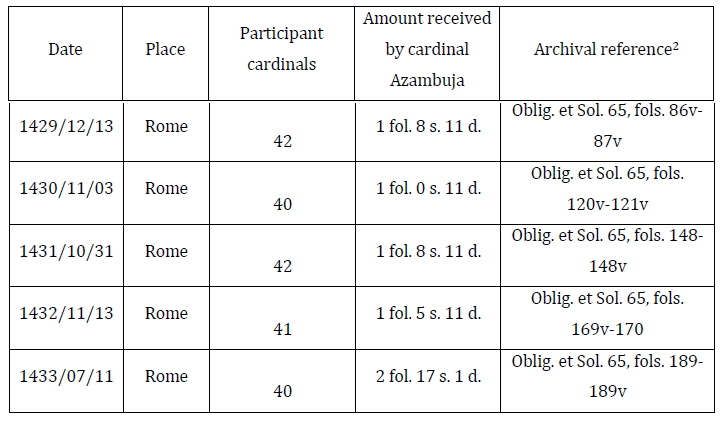
The information gathered allows us to calculate not only the amount accrued by Cardinal Azambuja for his participation in the consistory over the course of about a year and a half, but also the amount owed to him for obligations that were not settled during his lifetime. Thus, between the 18th of June 1413 and the 11th of July 1433, Azambuja was awarded a total of 1253 florins, 6 solidi and 8 denarii. Of these, the cardinal only received 673 florins, 33 solidi and 1 denarius, that is, the amount allocated to him until the general distribution of 24 December 1414, the last one he participated in before his death. The remaining 579 florins, 23 solidi and 7 denarii were awarded to him posthumously. In the following table are the amounts attributed to all the cardinals who took part in the 10 general divisions recorded in the Oblig. et Sol. 61 during the Portuguese cardinal's lifetime54.
| Cardinals | Totals from 1413/06/18 to 1414/12/24 |
|---|---|
| Angelo d’Anna Sommariva (Laudensis) | 722 fol. 10 s. 4 d. |
| Rainaldo Brancaccio (Brancatiis) | 722 fol. 10 s. 4 d. |
| Giordano Orsini (de Ursinis) | 676 fol. 27 s. 2 d. |
| Antoine de Challant (Challanco) | 676 fol. 27 s. 2 d. |
| Pietro Stefaneschi (S. Angeli/Romanus) | 676 fol. 27 s. 2 d. |
| Francesco Zabarella (Florentinus/de Padua) | 673 fol. 48 s. 11 d. |
| Antonio Panciera (Aquilegensis) | 673 fol. 48 s. 11 d. |
| Francesco Lando (Venetiarum) | 673 fol. 48 s. 11 d. |
| Tommaso Brancaccio (Tricaricensis) | 673 fol. 48 s. 11 d. |
| João de Azambuja (Ulixbonensis) | 673 fol. 33 s. 1 d. |
| Jean de Brogny (Ostiensis) | 645 fol. 10 s. 4 d. |
| Lucido Conti (de Comitibus) | 633 fol. 48 s. 11 d. |
| Oddo Colonna (de Columna) | 623 fol. 9 s. 5 d. |
| Guillaume Fillastre (S. Marci) | 571 fol. 38 s. 11 d. |
| Pedro Fernández de Frías (de Yspania) | 488 fol. 30 s. 7 d. |
| Landolfo Maramaldo (Barensis) | 482 fol. 21 s. 4 d. |
| Ludovico Fieschi (de Flisco) | 466 fol. 22 s. 8 d. |
| Amédée de Saluces (Salutiarum/de Salutiis) | 454 fol. 15 s. 10 d. |
| Pierre Gérard (Aniciensis) | 395 fol. 27 s. 2 d. |
| Alamanno Adimari (Pisanus) | 376 fol. 36 s. 9 d. |
| Pierre d’Ailly (Cameracensis) | 309 fol. 37 s. 10 d. |
| Francesco Uguccione (Burdegalensis) | 272 fol. 15 s. 4 d. |
| Giacomo Isolani (S. Eustachii novus) | 272 fol. 15 s. 4 d. |
| Branda da Castiglione (Placentinus) | 249 fol. 8 s. 8 d. |
| Antonio Caetani (Aquiliensis Senior) | 249 fol. 7 s. 8 d. |
| Simon de Cramaud (Remensis) | 171 fol. 34 s. 6 d. |
| Corrado Carracciolo (Militensis) | 41 fol. 21 s. 7 d. |
| Antonio Calvi (Tudertinus) | 41 fol. 21 s. 7 d. |
| Giovanni Migliorati (Ravennatensis) | 31 fol. 27 s. 1 d. |
| Guy de Malsec/Malesset (Penestrinus) | 31 fol. 26 s. 7 d. |
| Niccolò Brancaccio (Albanensis) | 26 fol. 16 s. 7 d. |
| Pierre de Thury (de Tureyo) | 26 fol. 16 s. 7 d. |
| Pierre Blau/Blavi (Sancti Angeli Gallicus) | 26 fol. 16 s. 7 d. |
| Enrico Minutolo (Neapolitanus) | 15 fol. 10 s. 6 d. |
The total received by the 34 different cardinals taking part in these 10 general distributions is 13024 florins, 8 solidi and 7 denarii, with the average amount received by each cardinal being 394 florins. The median value per cardinal stands at 454 florins, while quartile 1 is 106 florins and quartile 3 is 673 florins. The amount received by João de Azambuja is thus among the 25% highest and significantly above average.
What was the significance of the 673 florins received by João de Azambuja over a year and a half? The church of Lisbon had an estimated annual income of 6000 florins55, so since the beginning of the 14th century, elected ecclesiastics had to pay a common service of 2000 florins56. This was the amount that João de Azambuja undertook to pay to the Apostolic Chamber in 1402 when he was transferred to the archbishopric of Lisbon57, whose administration he would maintain until his death. The division of the common service thus seems to be far from being Azambuja's main source of income, and certainly that of his colleagues at the College of Cardinals, although it should represent a significant supplement to the cardinal's treasury.
Regarding the cardinals as a whole, in quartile 3 we find four cardinals created by the Roman obedience, controlling the 1st, 2nd, 3rd and 5th positions of the table. A cardinal created by Avignon’s obedience, Antoine de Challant, is in the 4th position, while the remaining five cardinals were created by John XXIII in 141158. Between quartile 3 and 1, where we find intermediate incomes, the obediences are quite heterogeneous, with cardinals created by the two obediences mentioned and by the Pisan pope. Finally, in quartile 1 we have exclusively cardinals created by the popes of Rome and Avignon. The main justification for the positioning of the last eight cardinals is the fact that, with the exception of Pierre de Thury, they all died between 1409 and 141259. The differences between the other cardinals are essentially due to their greater or lesser attendance at the consistory, with specific reasons for each individual. In the case of João de Azambuja, for example, we will see that he was not in the curia when he was created cardinal, which led him to be absent for several consistories.
Dead cardinals’ shares
Ecclesiastics who were provided with consistorial benefices and who promised to pay their obligatio sometimes took several years to do so60. This meant that some of the cardinals who had been present at the consistory of their provision had already died by the time the payment was made, as we have just seen. Who received the sums allocated to the dead cardinals? It seems that over the centuries the situation evolved significantly. Antonovics says that he can find no indication in the register of 1460-1470 that the popes received the sums owed by the dead cardinals: “there is no trace in the register of the pope having a share”61.
In the register Oblig. et Sol. 61 we find some elements of response. For example, in the general distribution of the 31st of August 1413, the Apostolic Chamber receives the sum of 14 florins, 41 solidi and 6 denarii. which was to be attributed to Cardinals Niccolò Brancaccio, Francesco Uguccione and Enrico Minutolo, who were dead62. On 11th of April 1414, Nicholas, bishop of Luca, paid the common and minor services due for his promotion during the pontificate of Boniface IX. Of the 15 cardinals who were present at the consistory, only three were alive. The register indicates that the Apostolic Chamber received the portions belonging to 11 of these cardinals, with the portion belonging to Cardinal Enrico Minutolo (Neapolitanensis) being allocated to his heirs63.
There is no reference to this issue in the statutes of the Chamberlain of the Sacred College of 143764 and 146665. It wasn't until 1498, in the reform of the statutes proposed by Cardinal Bernardino Carvajal and approved by Pope Alexander VI, that the portions of the dead cardinals were given a destination:
“Item quod de rata contingente cardinales mortuos detur ordo, quod bene intelligatur et heredibus suis integraliter restituatur; et si non fuerint heredes in Curia, illis absentibus fideliter destinetur; quibus non existentibus pro beneficio animarum suarum in elemosynas vel missas dicendas infra sex menses distribuatur: et de hac rata mortuorum in qualibet divisione fiat certitudo per clericos collegii domino camerario et similis fiat certitudo de quindenniis solutionum abbatum triannalium, ut facilius omnia intelligantur”66.
This determination seems to apply the same rules to the portions attributed by the distribution of services to deceased cardinals as were applied to their other goods acquired per ecclesiam. Like the latter, we assume that a licentia testandi granted by the pope was required so that these assets, normally inalienable, could be bequeathed to the cardinal's heirs67. So, although we do not know the statutes of the chamberlain of the college in force during the pontificate of John XXIII and this issue is not explained in the statutes of 1437 or 1466, it seems that the heirs of deceased cardinals could receive the portions posthumously attributed to their relatives, as we saw happen with the cardinal of Naples.
Also, according to these statutes, if there were no heirs, these sums were to contribute to the salvation of the cardinal's soul, being distributed in the form of alms or used to pay for masses for the soul of the deceased. This determination is also in line with canon law, namely the decree of Alexander III which allows ecclesiastics to bequeath part of their ecclesiastical goods to the poor or for pious causes68.
In the book of divisions Oblig. et Sol. 61 there is often no separation between cardinals who are alive or dead. As a rule, the living cardinals are listed in hierarchical order and the dead are at the bottom of the list. At other times and very rarely, the dead cardinals are clearly identified69. The destination of their portions is also almost always omitted, the case of the cardinal of Naples being one of the exceptions. When it is mentioned, these sums are destined for the Apostolic Chamber70, as probably happened with the 579 florins awarded posthumously to Cardinal Azambuja.
Frequency of general divisions
According to the statutes of the chamberlain of the sacred college of 1437, the general divisions were to take place every two months, which could be brought forward or delayed at the request of the cardinals71. This provision was again affirmed in the statutes published during the pontificate of Paul II in 146672. Regarding the frequency of the 29 general divisions recorded in the Oblig. Et Sol. 61, between the first distribution on the 18th of June 1413 and the last on the 1st of November 1420, there is no regular rhythm. Even if we don't consider the exceptional situation that occurred between the general division of 31st October 1415 and 14th May 1418, a total of 925 days perhaps justified by the context of the Council of Constance and the election of Martin V, the irregularity remains significant. For example, only 24 days pass between the general distribution of October 7 and that of October 31, 1413, while, in contrast, 120 days pass between the latter and that of the 7th of April 1414.
In fact, this irregularity is in line with the rules throughout the 15th century. If we exclude the aforementioned exceptional interval of 925 days, the average time between distributions is 65.5 days, with a median of 58 days, i.e. around two months between general distributions, brought forward or postponed according to the will of the college, as provided for in the statutes of 1437 and confirmed by those of 1466. There is a pattern in the distributions for the month of December, which always occur on the 24th, Christmas Eve73.
Presence of the cardinal of Lisbon at consistories
The libri divisionum of the College of Cardinals do not just give us information about the income earned by the cardinals. Dufouleur used four volumes of these books, corresponding, with some gaps, to the period between 1418 and 1470, to establish the number of cardinals present in consistory throughout the 15th century74. As each individual payment record provides us with the place and date of the consistory in which the benefice was provided, as well as how many and which cardinals were present75, it is therefore possible to establish calendars, and attendance lists for the consistories.
Only those cardinals who were present in the consistory at the time of the corresponding beneficial provisions took part in the distribution of the common services. But not all of them, because in order to participate in the divisions, a cardinal had to have gone through the aperitio oris ceremony, at which point they had a voice in the consistory and took part in the common service distributions76. Cardinals who arrived late to the consistory could also be deprived of taking part in the distribution of services77. Furthermore, in exceptional cases, cardinals who were not present in the curia could receive their portions as if they were in the consistory. To do this, they needed a specific license, usually justified by health reasons78, such as the one obtained by João de Azambuja on the 6th of September 141479. There was also the possibility, at least from the pontificate of Sixtus IV80 onwards, for cardinals absent on legations to continue to receive their share of the distribution of services, but this had to be discussed and approved in consistory81.
In Annex 6 we have gathered information on the consistories attended by the Cardinal of Lisbon, allowing us to follow his participation in these meetings and his movements within the Papal Curia82. A complete survey of the register would allow us to draw up a list of all the consistories, or at least those in which consistorial benefices were provided, during the pontificate of John XXIII. Such an analysis extended to the five known books of divisions for the 15th century could be even more fruitful, resulting in a significant series of dates and places of consistory meetings from the late 14th century to the pontificate of Paul II.
The analysis carried out by Dufouleur, using the libri divisionum to find out how many cardinals were present in consistories from the pontificate of Martin V onwards, is undoubtedly innovative compared to the limited studies that have been carried out using these records so far. It allows us to have a long-term perspective, supplemented by the ceremonialists' diaries for the late 15th and early 16th centuries, on the evolution of the number of cardinals assiduously participating in consistories and involved in the government of the Church83. However, the fact that there were licenses for absences from the curia and that, against the statutes of 1466, there were exceptional cases in which cardinal legates de latere could continue to participate in divisions, the attendance lists established are always approximate or, at least, not absolutely exact. On the other hand, the list of dates and places of consistory meetings, apart from any gaps and lapses in the register, can be reconstructed with great precision. So far, this has not been done.
According to the data in Annex 6, between 1411 and 1415, in the consistories attended by Cardinal Azambuja, there was an average of 20 (19.6 or 19.7 if we consider the lower or higher uncertain values) cardinals present. Dufouleur, for the period between 1418 and 1446, indicates an average of 14 cardinals (13.8) and for the years between 1458 and 1469 an average of 19 (19.4) cardinals84. The figures we present for these years of John XXIII's papacy would have to be calculated for all consistories, not just those attended by the Portuguese cardinal. However, these figures already represent a significant number of meetings (a total of 100), and the overall average for this pontificate shouldn't be too different. We are thus faced with a “stabilité assez remarquable”, in Dufouleur’s words, in terms of the number of cardinals present in consistories between 1411 and 1469, assuming that the notable drop during the pontificates of Martin V and Eugenius IV is due to the exceptional conditions of the Council of Basel85.
Regarding the case of Cardinal Azambuja, if we assume the licence he received to be absent from the curia for health reasons was the only one, then we can take for granted his attendance at consistories before the 6th of September 141486. The table in Annex 6 shows a period of absence of several months between 31st of August 1411 and 11th of March 1412. Sousa Costa suspects that João de Azambuja returned to Portugal soon after his creation as cardinal, based on a not very explicit document from the chancellery of King João I87, which would justify this absence. A bull dated 10th of September 1411 authorised the cardinal, as administrator of the archdiocese of Lisbon, to conduct visitations to his church through vicars-general, giving him one less reason to go to Portugal88. However, since we don't have enough news about João de Azambuja's activity between September 1411 and February 1412, we cannot come up with a solution for his absence from the consistory during these months or confirm the hypothesis that he went to Portugal, only that he was absent from the Curia.
The same Sousa Costa states that between the years 1410 and 1413 he has not identified any traces showing the presence of João de Azambuja in the archdiocese of Lisbon, but only documents issued in the name of the archbishop by his vicars-general89. Azambuja's return to Portugal would have taken place in the early months of 1414, according to a document that would have been granted in Lisbon on 13th of February by the cardinal, as administrator of the archdiocese. Cardinal Azambuja would have returned to the Curia in April or May of that year, where he appears again in the pontifical documentation90. However, the list of consistorial presences that we have established in Annex 6 shows that the cardinal was present at the consistory meetings in December of that year, in Lodi, and then in Mantua, Ferrara and Bologna during the month of February, making it unlikely that he travelled to Lisbon during these months.
The cited document is a judgement on the case that was being heard by the tribunal of the archbishop of Lisbon between the prior and the raçoeiros of the church of Santo Estevão de Alfama and the alcaide pequeno of the city. It was drawn up on 13th of February 1414, by the notary João Martins, in the cloisters of the cathedral91. The transcription presented by Sousa Costa begins with the phrase: “Dom Joham, per merçee de Deus e da santa egreia de Roma cardinal de Lixboa”92. However, an analysis of the document in question reveals an earlier sentence, more blurred than the rest of the text, which reads: “In nomine domine. Cristove Anes bacharel em degregos vigario gerall per o muyto honrado padre senhor”93. In the same document, the penultimate line reads: “...per mandado do dicto Christove Anes vigairo este publico estromento de sentença scripvi...”. This new reading shows, without a shadow of a doubt, that the document was produced in the name of the cardinal's vicar and not the cardinal himself94.
After this clarification, there does not seem to be any documents that solidly prove the presence of João de Azambuja in Portugal after he reached the cardinalate, which is reinforced by his regular presence in the consistory. If his stay in Rome is confirmed, Azambuja would join the group of other Portuguese cardinals from the 15th century who, after residing in the papal curia, did not return to Portugal, that is, Antão Martins de Chaves, Jaime de Portugal and Jorge da Costa.
Conclusion
Through the only surviving book of divisions for the pontificate of John XXIII (1411-1415), part of the archives generated by the distribution of common and minor services among the cardinals, we were able to clarify some aspects of the functioning of the Chamber of the College of Cardinals. Among these, we highlight the fate of the portions allocated to dead cardinals and the functioning of the Curia's leaves of absence. The different types of records and their evolution throughout the volume were also analyzed. Following the presence of Cardinal João de Azambuja in this book of divisions, it was possible to reconstitute not only his consistory income between June 1413 and December 1414 and, posthumously, between January 1415 and November 1420, but also to monitor his presence in the consistory for over four years, from his arrival at the Papal Curia and until his death. In the end, we demonstrate how this type of sources can be used to reconstruct a calendar of consistories from the 15th century and how it is possible to analyze the consistorial attendance of each cardinal, allowing us to clarify aspects about their lives but also about the government of the church by the Pope and the College of Cardinals.
Bibliographical references
Sources
Manuscript sources
Lisbon, Torre do Tombo, Colegiada de Santo Estêvão de Alfama de Lisboa, Mç. 8, n. 148.
Vatican City, Archivio Apostolico Vaticano, Camera Apostolica, Obligationes et Solutiones 61.
Vatican City, Archivio Apostolico Vaticano, Camera Apostolica, Obligationes et Solutiones 65.
Vatican City, Archivio Apostolico Vaticano, Armadio XXXI, 52.
Printed Sources
BAUMGARTEN, Paul Maria - Untersuchungen und Urkunden über die Camera Collegii Cardinalium für die Zeit von 1295 bis 1437. Leipzig: Giesecke & Devrient, 1898.
Corpus Iuris Canonici. Vol. 2. Eds. Aemilius Ludwig Richter and Emil Friedberg. Leipzig: Officina Bernhardi Tauchnitz, 1881.
GÖLLER, Emil - Die Einnahmen der Apostolischen Kammer unter Johann XXII. Paderborn: Druck und Verlag von Ferdinand Schöningh, 1910.
Monumenta Portugaliae Vaticana. Vol. III-1. Ed. António Domingues de Sousa Costa. Braga: Editorial Franciscana, 1982.
Taxae pro communibus servitiis. Ex libris obligationum ab anno 1295 usque ad annum 1455 confectis. Ed. Hermann Hoberg. Città del Vaticano: Biblioteca Apostolica Vaticana, 1944.