




 Inglês (pdf)
 Artigo em XML
 Referências do artigo
 Tradução automática
 Enviar este artigo por email
 Citado por SciELO
  Similares em
SciELO
Similares em
SciELO 
 Permalink

It is difficult to overstate the importance of monasticism to the development not only of the Church in England but even of the English nation. The Celtic Christianity brought to northern England before the end of the fourth century by St Ninian and St Germanus was deeply monastic, influenced particularly by the example of St Martin of Tours (MacCulloch, 2009, pp. 313-314). The Roman mission to re-evangelise England launched in 597 by Pope Gregory the Great, himself a monk, was the work of Benedictine monks (MacCulloch, 2009, pp. 334-338).
In the midst of the confusions and breakdowns in order in the early Middle Ages, Benedictine monks provided essential continuity with the Classical world and its legacy. They preserved the manuscripts and other sources of ancient knowledge; they recovered Roman building techniques and became skilled engineers and craftsmen; they were the educators of a society only partly literate; their network of monasteries provided a series of safe havens for pilgrims and others who travelled; in an age when social services did not exist, they provided the medical know-how and cared for the most vulnerable in society. The influence of Benedictine monasticism permeated European society at every level (Clark, 2011).
Monasticism became part and parcel of the life and mission of the English church, and the cathedral priory, a cathedral that was also a monastery and an institution practically unknown elsewhere in the Church worldwide, became a characteristic feature of English Church life. Fully half of England’s twenty mediaeval cathedrals were also priories, among them Canterbury, Winchester, and Durham (Knowles, 1950, pp. 129-134). Norwich Cathedral was the last of these, founded in 1096 (Atherton et al., 1996). Even secular cathedrals in England looked to model their buildings and their lives on the monastic model. The secular clergy at the cathedrals of Exeter, Wells, York, and London (St Paul’s) followed the Enlarged Rule of St Chrodegang, based on the Rule of St Benedict (Orme, 2017, pp. 26, 28). In contrast to cathedrals on the continent, generally set in the heart of urban life, English cathedrals were typically set in enclosures known as closes that either were or imitated monasteries, complete with cloisters (everywhere other than Lichfield and York) that had no real function in secular contexts (Orme, 2017, pp. 64, 77-78).
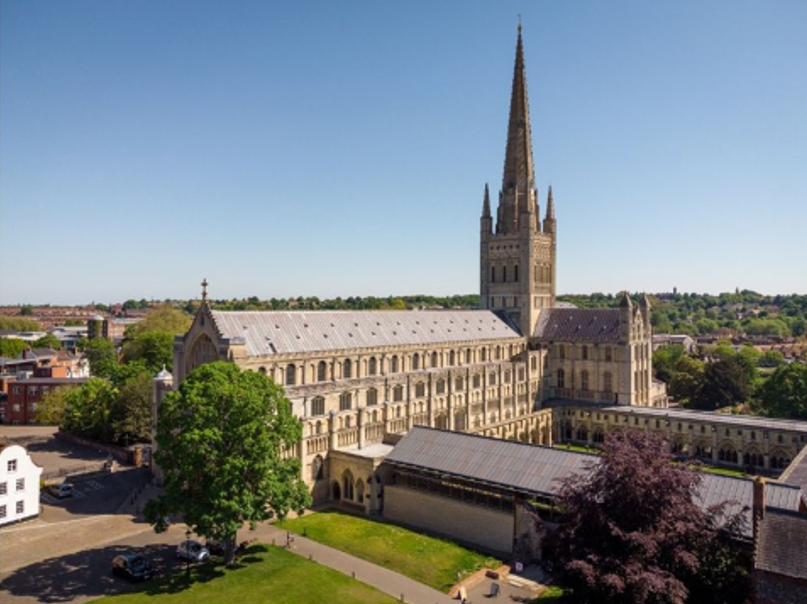
If we recognise how deeply the medieval English cathedrals were infused with a monastic spirit, we should not be surprised if some of that spirit should remain characteristic of the Church of England, even after the Reformation and the forcible dissolution of the monasteries. The Roman Catholic Benedictine scholar Dom Robert Hale observes,
The essentials of the Benedictine spirit were rendered immediately accessible to the entire Church through the key and characteristic work of the Anglican Reform, the Book of Common Prayer. It is extremely important to note this decisive fact about the Anglican Reform: at its centre and guaranteeing its spirit, stands not a towering reformer (a Luther, a Calvin), not a theological doctrine or a moral code - but a book of liturgical prayer. In this fundamental aspect alone the Anglican reform has a clearly Benedictine spirit (Hale, 1982, p. 90).
It was part of the particular genius of Archbishop Thomas Cranmer (who was no friend to monasteries, regarding monks as ‘but belly-gods’ (MacCulloch, 1996, p. 33)) to take the seven daily offices of prayer and to compress them into two, Matins and Evensong. His ideal was that these two offices should be the people’s prayer, that the lay people in their parish churches would take the place of the monks in the daily offering of prayer to God, so that the whole Church of England might become a kind of generalised monastic community (Thornton, 1963, pp. 57, 81; Mudge, 1978, p. 507). Even if this ideal was never fully realised, it is undoubtedly true that adherence to the offices has been central to Anglican identity and that choral evensong is the service most typically associated with Anglican worship around the world.
It is also important to recognise that the English tradition of choral music would not have survived if English cathedrals had not retained virtually all of their medieval infrastructure intact - bishops, deans and chapters, minor canons, choristers, organists, vergers. Once again, this peculiarity separates English cathedrals from their counterparts elsewhere around the world, whether Reformed or Catholic. Diarmaid MacCulloch has pointed out that while in many ways the English religious reform was congruent with its continental neighbours, cathedrals were a subversive element such that a Catholic identity (embodied in cathedral life) and a Protestant identity (embodied in parish life) became ‘paradoxical but indestructible strands of a double helix’ (MacCulloch, 2016, p. 161). He goes on to argue that cathedrals ‘fostered an attitude to the sacred which strayed far from the normal Protestant emphasis on communal praise by the people and the Word of God interpreted by the minister from the pulpit. English cathedrals preserved a sense that regular prayer and the contemplation of the divine through beauty constituted an equally valid road to divinity’ (MacCulloch, 2016, pp. 146-147). It is a spirit we can unhesitatingly associate with the cathedrals’ Benedictine foundations. In the case of Norwich, the continuity between the monastic community and the new secular foundation was complete. When the Cathedral priory was surrendered to the Crown in 1538, the same men who one day had been the prior and monks of the cathedral priory overnight became the dean and canons of a secular foundation (Atherton et al., 1996, pp. 507-510).
If cathedrals did retain the governing structures essential to their historic continuity, that is not to say they did not lose much of the fabric associated with their medieval predecessors. At Norwich many monastic buildings and even chapels attached to the Cathedral were either adapted for other uses, or dismantled, or became ruinous through neglect. The Lady Chapel, the Bell Tower, the Hostry, the Refectory, the Dormitory, the Chapter House, and the Infirmary were all lost, to name only the most significant. (See Lyon, 2022).
The Laudian movement in the seventeenth century marked the first attempt to recover something of the richness of the fabric and worship typical of the medieval cathedrals (Parry, 2006). After the rupture and destruction of the Civil War in the mid-seventeenth century and into the beginning of the 19th century, cathedrals on the whole were content as far as they were able to maintain the decent dignity of Laudian worship (Fincham and Tyacke, 2007, p. 315). There were cathedrals where vestments and even incense were used; in most, the daily choral worship morning and evening was retained.
In the nineteenth century, through the efforts of the Oxford Movement, the Ecclesiological Movement and the growing sophistication of antiquarianism, cathedrals became more conscious of their medieval heritage and began a further quest to recover ancient standards of worship, public accessibility, and service. Norwich was fortunate in having one of the great reforming deans of the era, Edward Meyrick Goulburn, who became dean in 1866. He had the first heating system installed, increased the number of services and events, kept the church open for visitors and for prayer, restored chapels to liturgical use, and lobbied Parliament to prevent the Lynn and Fakenham Railway from building its line through the Close. Much of this he paid for out of his own pocket (Atherton et al., 1996, pp. 618-626. See also Henderson, 1996).
It was right at the beginning of his tenure that Goulburn made explicit what was the ultimate inspiration for the reforms he instituted. It was an era like our own, when there were many both inside and outside the Church who, in a pushing and progressive age, thought that the quaint traditions and quiet tenor of cathedral life looked, frankly, like a waste of money, money which could be put to better use promoting a pushing and progressive religion.
In response, Goulburn enunciated the first principles of cathedrals, for which he looked directly to Benedictine precedent. He wrote,
A full half of our Chapters, it must be remembered, are the lineal successors of and represent conventual establishments, so far as the principles of such establishments can find place in the Reformed Church. … They were in their day the shelters of a devout and contemplative piety, the seminaries of youth, and the places where learning, profane as well as sacred, scared away by the barbarism of the age, found a congenial refuge and numerous devotees. Our Cathedrals may well perform similar functions in an age when knowledge, more widely diffused over the surface of society, is far less concentrated in the few (Goulburn, 1870, pp. xxxv-xxxvi).
Goulburn enumerated the monastic qualities which he saw as still necessary for the life of the modern Church: To maintain the daily worship of God in solemn form; To support scholarship and learning in the life of the Church; ‘To keep alive the spark, so likely in an age of progress to die out, of contemplative devotion’ (Goulburn, 1870, p. xxvi); To be schools of church music; To provide extensive libraries for clergy and other students of theology; and to be places for retreat and seclusion for those who would avail themselves of the daily worship. All these qualities are fruits of the Benedictine inheritance of the English cathedrals; they are the same qualities that inspire people today to take retreats in monasteries and convents.
Such aspirations have continued to motivate succeeding deans and chapters at Norwich. In more recent days, from the mid-1990s, Chapter began to prepare seriously to fill in some of the gaps in the monastic infrastructure. In its mission statement, Chapter had focussed on its dedication to three dimensions of its Benedictine inheritance: Worship, Hospitality, and Learning. Since worship was still adequately represented by the activities in the Cathedral itself, Chapter agreed to invest in new structures that would speak to the Cathedral’s commitment to Learning and Hospitality (Atherton et al., 1996, pp. 755-758).
The layout of the medieval Cathedral reveals how important understanding Benedictine principles is to understanding how the place is intended to work. Most monasteries adhered to a standard design in which the chief structures - the church, chapter house, refectory, and guest hall or hostry - were linked by the cloister. After the Reformation destruction of all these elements other than the church, the cloister became effectively redundant as a working space.
The architect Sir Michael Hopkins takes up the account:
In 1995 the Dean and Chapter commissioned me as architect to look into how facilities for visitors to the Cathedral might be improved. The Upper Close and the old infirmary were to be investigated as possible sites. The underlying intention of the brief was to bring into focus the Benedictine traditions of hospitality and education alongside that of worship, clearly already provided by the Cathedral.
Hopkins Architects explored rebuilding the Hostry and Refectory on their original sites immediately outside the west and south cloister walls. Using these sites would enable the Cloister to fulfil its original role of providing a sheltered way linking the various aspects of Cathedral life. Architecturally, we wanted to reflect the form, volumes, and materials of the original buildings without designing imaginary replicas; making it evident in the construction that we were building at the turn of the 21st century using contemporary engineering techniques and allowing the earlier work to read through distinctly and clearly (Twenty-five Treasures, 2015, pp. 47-48).
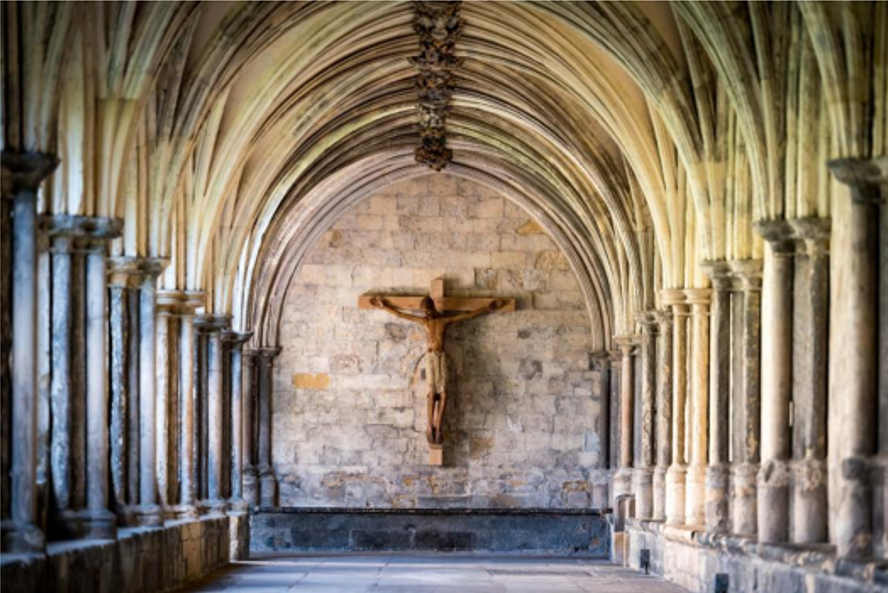
Here in brief is a plan that is Benedictine not only in the sense of rebuilding monastic buildings and restoring the functionality of the original layout but also in its recognition of the importance of innovative architecture and engineering to complement its historic context. Here is a recognition that if the spirit and the proportions and the materials are right, contemporary and historic architecture can complement and enhance one another.
The project overall included also a significant educational element in the creation of a new Library reading room to provide a space for study and shelving to accommodate the acquisition of the significant collection of the former Lincoln Theological College. This was built adjacent to the Refectory on the upper level of the south range of the Cloister where domestic buildings had been created after the destruction of the monastic Dormitory. The provision of an extensive library for study and teaching was a fulfilment of Goulburn’s vision for a monastically-inspired cathedral.
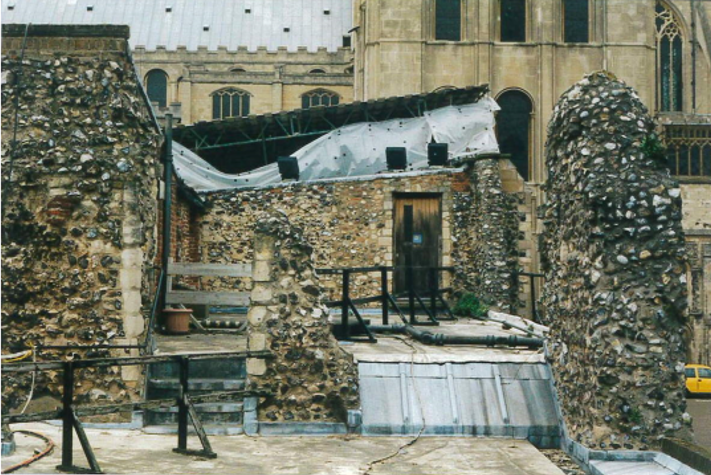
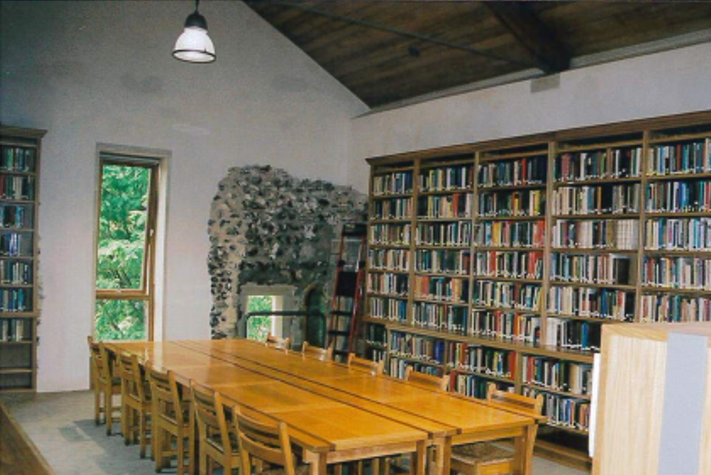
The Dean & Chapter of Norwich Cathedral
Figure 4 Cloister roof space transformed into Library Reading Room (B)
The Refectory, on the south side of the Cloister, was conceived as a shared meeting and eating place for the Cathedral staff and community as well as for local residents, visitors and pilgrims. English Heritage as the national body with responsibility for historic listed buildings was cautious about giving permission to build directly onto the remaining twelfth-century fabric of the monastic refectory. Hopkins observed,
To avoid an extra load on the cloister wall, the restaurant floor and the roof are supported on a freestanding beautifully engineered and detailed timber frame, spaced away from the old walls, clearly demonstrating what is new and allowing the full volume of the original Refectory to be seen and understood (Twenty-five Treasures (2015) pp. 47-48).
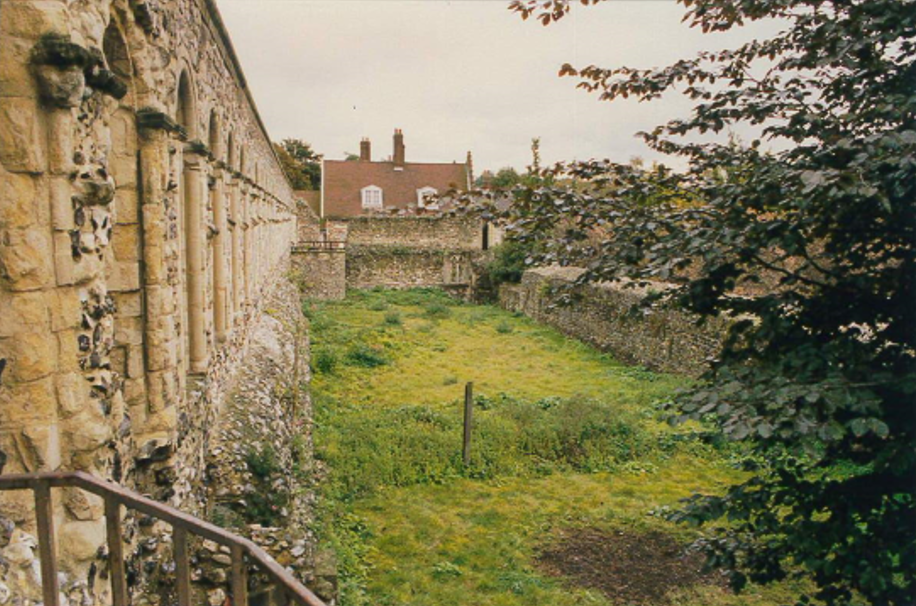
The Dean & Chapter of Norwich Cathedral
Figure 5 Site of monastic Refectory and contemporary Refectory (A)
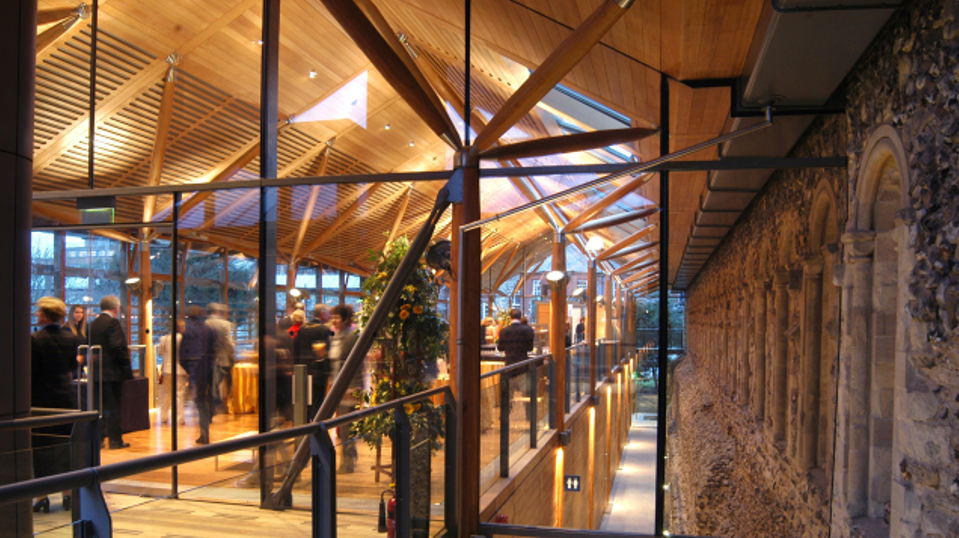
The Dean & Chapter of Norwich Cathedral
Figure 6 Site of monastic Refectory and contemporary Refectory (B)
Once the Refectory and Library Reading Room were completed in 2004, the Dean and Chapter turned its attention to rebuilding the Hostry or monastic guest hall on the western side of the Cloister. Rather than providing accommodation for guests, the building was reconceived as a place to welcome visitors and pilgrims to the Cathedral and to provide information about its ministry and history as well as to provide educational spaces: a Song School or rehearsal room for the Cathedral Choir, a classroom for visiting school pupils, and a lecture hall. Hopkins’ handling of the Refectory proved so effective that when it came to the building of the Hostry, English Heritage gave permission for the new fabric to be built directly on the mediaeval foundations, fully integrating the old with the new. The entrance to the building was shaped around the remains of the thirteenth-century Hostry arch. The buildings were dedicated in the presence of Queen Elizabeth II in 2010.
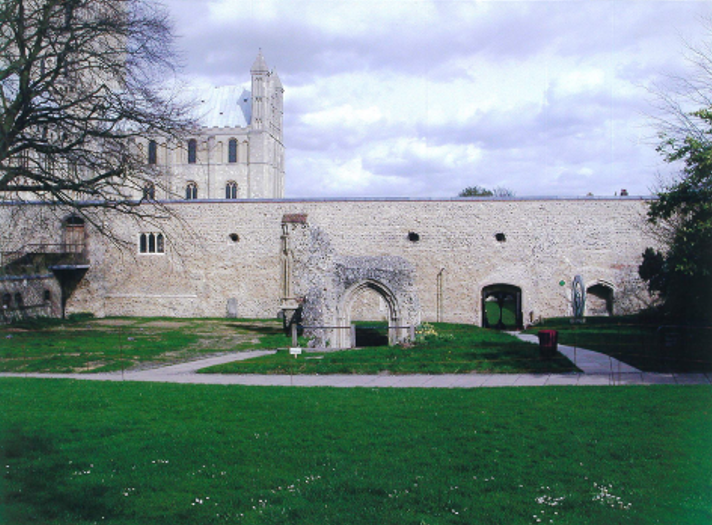
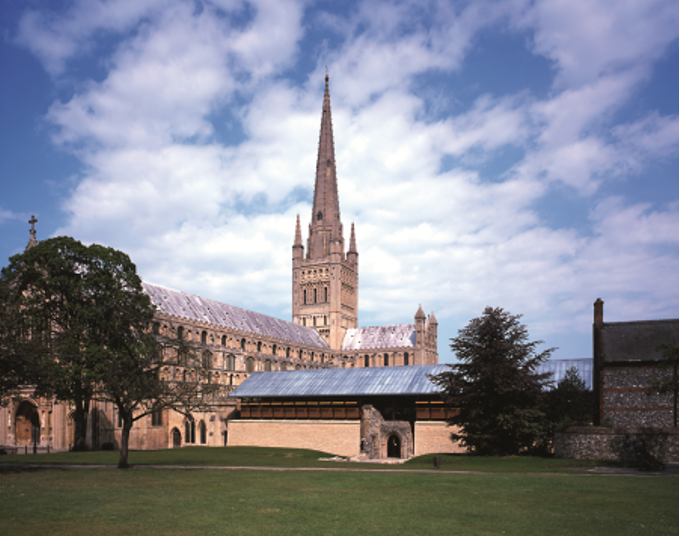
As Norwich Cathedral has continued to engage with its Benedictine heritage, the Dean and Chapter have come to recognise that monastic buildings and even monastic worship do not make for a complete Benedictine identity. The life in community and in the world must also be attentive to Benedict’s voice in the Rule, particularly in a world marked by a brutal market-driven economic order. The Rule of St Benedict has been shaping the lives of communities for more than 1400 years and is still going strong. Its spirituality retains a capacity to inspire deep commitment from monastics and lay people alike; more to the point here, it is no stranger to economic survival. Indeed it attracts considerable interest from those who write and teach about business life as a viable alternative to contemporary business culture (Dollard et al., 2002).
For Benedict all activity in the monastery, whether prayer, leisure, or work, is holy. The very tools of the workshop, Benedict says, are as sacred as the vessels of the altar (Benedict, 1952, ch. 31). He describes the disciplines of the spiritual life as tools for good works and the monastery as a spiritual workshop (Benedict, 1952, ch. 4). Ora et labora: prayer is work, and work is prayer. For Benedict, there is no divide between prayer and business; they are both essential parts of a life that should bring us closer to God.
Benedictine monasteries have always had to live by the labour of their hands and minds, to survive in a commercial environment without depending on commercial values. In a 2010 article, Birgit Kleymann and Hedley Malloch studied the culture of a highly profitable anonymous Trappist brewery which flourishes in an intensely competitive market while abiding by the Rule of St Benedict. The monastic Cellarer who oversees the brewery understands his role not as leadership but as service to the community and to the employees, whose work he facilitates. Good governance requires time for reflection before making decisions and discerning ‘what is a source of life for the longer-term’. ‘Subsidiarity is key in the good running of a hierarchy. One must trust the workers’ (Kleymann & Malloch, 2010, p. 214). Rather than seeing workers through a capitalist lens as a human means of increasing shareholder value, in a monastery the human fulfilment of each monk and each lay worker is the highest priority. An organisation informed by Benedictine values should be ‘good’ as a place to work and ‘good’ in what it produces, staffed by a workforce valued as whole persons.
Even since the Reformation, a Benedictine rhythm and Benedictine values have nourished the life of English cathedrals. These are organic entities, communities with deep roots in the past and with a mission to reach out to and welcome the wider community today for the sake of a shared future. It is as communities, not as commercial entities, that they should flourish, shaped by the Christian faith and worship that are the very reason for their existence. How can cathedrals exist with integrity unless the Gospel they proclaim also defines the way they live and work? As Kleymann and Malloch point out, the Benedictine way, while appearing strange, even bizarre, in comparison with corporate culture, has ‘met in full key tests of strategic sustainability and durability over a period of time unmatched by any other type of organisation’ (Kleymann & Malloch, 2010, p. 219).
Benedictine monastics at their profession make vows of stability, obedience, and conversion of life. A cathedral or any other institution that lives faithfully by the values of commitment to place, of valuing and investing in its personnel, and of responding to the vicissitudes of life for the sake of its Gospel mission and ministry, will have the strength, flexibility, and durability to survive and flourish however challenging or hostile the environment in which it lives. The Dean and Chapter of Norwich Cathedral continue to believe that Benedictine principles best serve its mission and ministry to the world as it is today.

