




 Inglês (pdf)
 Artigo em XML
 Referências do artigo
 Tradução automática
 Enviar este artigo por email
 Citado por SciELO
  Similares em
SciELO
Similares em
SciELO 
 Permalink

Introduction
The issue of citizen participation in city-making is nowadays widely accepted and encouraged by design practices and urban planning laws and agreements all over the world. At the local development scale, citizen participation is considered vital, as it relies on the mobilisation of local resources for the physical, economic, and social regeneration of degraded urban areas (Adams, 1994; Capello, 2011). To this end, local actors should be able to manage data commons (Calleja-López, 2018), lead self-organised collaborative arrangements and build decision-making capacity on aspects of urban planning and city-making.
The extensive utilisation of digital technologies, notably Information and Communication Technologies (ICT) in recent decades, has expanded the hacking culture (Ampatzidou et al., 2015) and enabled the expansion of citizen participation in the co-production of cities. The term co-production is used here to refer to the citizen's active participation in designing and delivering public services and in polycentric negotiation processes of governance (Ostrom, 1996; Linders, 2012; Iaione, 2016; Mitlin & Bartlett, 2018).
In this context, civic hacking and the co-production of civic tech (McCann, 2015; Schrock, 2018) arise in pursuing to change democratic institutions and social action, stimulating the openness of legal and administrative structures of public institutions, making them more responsive. Altering characteristics, processes, means and actors in city-making, demands for new social innovation frameworks, such as the penta-helix model (Calzada, 2020), that puts together government, industry, academia, civil society plus social entrepreneurs and activists, capable of facilitating the collective intelligence agency of data commons.
The association of ICTs to urban issues and the operationalisation of urban services has exposed the technopolitical intricacies of different approaches to city-making. On the one hand, smart cities, whose hegemonic practices relate to closed control systems, favour top-down and prescriptive decision flows with no power distribution (Kitchin et al., 2015; Mendes, 2020b). The Gujarat International Financial Tech-City - GIFT1, the first Indian smart city, built from scratch, is an outstanding example, of a strong neoliberal orientation.
Conversely, bottom-up participatory and activist practices, with bidirectional information flows that give visibility to demands and enable the organisation and engagement of collectivities in concrete actions, bolstered by discourses on commons, people-centred smart cities and shareable, open, coordinated, or hackable cities (Ampatzidou et al., 2015; Calzada et al., 2023; Labaeye, 2019; Mendes, 2020a; Sennett, 2021). Two examples that have already been extensively studied are the digital platforms for political participation Consul2 and Decidim3, created in Spain and already spread to dozens of other cities around the world (Barandiaran et al., 2017; Smith & Martín, 2021).
However, the viability of a hackable city is contingent upon the presence of a hackable government, or an open, platform government (O’Reilly, 2010), which is defined as a government that facilitates collective action through the use of open systems. In addition, other institutions, such as universities, should contribute providing resources for collective intelligence production and sustained relationships.
To build an open and hackable city, new methodologies and infrastructures must, among other things, guarantee conditions for the inclusion of social diversity in processes of civic hacking, sustainability of the generated projects and communities of practice, and the technological sovereignty of these communities in the face of the hegemony of big techs. The concept of "infrastructure" in the participatory design field aims to connect actors, means and processes that occur before, during and after what is traditionally understood as designing activities (Björgvinsson et al., 2010), thereby contributing to the overcoming of the aforementioned challenges. At the local development scale, the necessary use of resources for the common and alternative construction of systems of values (Capello, 2011; E. Innes & Booher, 2000) may be benefited by the infrastructures oriented to hackable cities, supporting citizens as agents of social change (Ampatzidou et al., 2015), where the ignitor actor play a pivotal role.
Globally, governments have focused their efforts to the digital transition, encompassing regulation on digital rights and on the digitalisation of urban planning and governance. Transnational initiatives like the General Data Protection Regulation (European Union Agency for Fundamental Rights, 2019), the Charter of Human Rights and Principles for the Internet (Internet Rights and Principle Coalition, 2014) and the People-Centered Smart Cities Report (UN-Habitat, 2021) exemplify a commitment to fostering (human) smart and sustainable cities and put pressure over municipalities.
In Portugal, various smart city programmes and projects have been promoted with public investment, the collaboration of various universities and the attention of the business community. Several digital platforms have been provided by municipalities, including Lisbon, facilitating access to open data and tools for public participation, although they are still underused by organisations working on local development (Farias, 2021). Since 2016, Lisbon has hosted the Web Summit, the largest event in the internet industry, which has contributed to the dissemination of technological innovation from major technology companies and a multitude of start-ups, with municipal subsidies. The city boasts a vibrant tech community, and the mayor elected in 2022 made the creation of a Unicorn Factory a key commitment. Nevertheless, these initiatives still don't seem to have had a significant impact on the formation of a critical mass on the penetration of ICT in urban activities and participatory processes in the country. The ‘tech’ narrative of entrepreneurship prevails over the collective intelligence that could emerge from a ‘hacker’ narrative.
Furthermore, Lisbon has also a strong local initiative, bolstered in recent years by its local development strategy. Created in 2011 and called Priority Intervention Neighbourhoods and Zones (BIP/ZIP), it has been funding small projects carried out by the local initiative in territories defined as “priority”, with the support of public offices and collaborative networks (Departamento Municipal de Habitação e Desenvolvimento Local, 2017). The challenge of the political use of technologies is pressing in such a context, as political decision-makers, council technicians and local initiative organisations recognise the need to widen the capacity of collaboration and monitoring in a ‘more open city’ of Lisbon (Farias, 2021).
Aiming to contribute to this necessary debate, this paper asks: How to include local initiative organisations in co-production processes of civic tech? It is hypothesised that civic hacking may contribute to initiating an infrastructuring process to facilitate co-operation and co-production. Drawing on Lisbon’s local development context, a civic hackathon was carried out as a method of digital tools co-production serving also as an experiment basis for designing an information infrastructure to enhance collaboration. The experiment provoked several inquiries, including the significance of a consistent ignitor actor prior to, during, and following the action; the alignment of interests and agendas among the various actors involved; and the function of academia in fostering the local initiative.
Beyond being the first study of the digital dimension of the BIP/ZIP Strategy, this study discusses opportunities and challenges in using digital technologies in participatory dynamics on the local development scale. Providing insights on inclusion, technological sovereignty and sustainability, it contributes to a wider debate about practices of technology-enabled collaborative city-making (De Waal & De Lange, 2019).
Theoretical review
Participation is a fundamental characteristic of digital culture in contemporary society, due to current network communication and interaction possibilities (Stalder, 2018). In social and civil interactions that are increasingly more mediated by technological devices, emerge new actors (connecting individuals and communities of practice) and new participation means (digital interfaces).
The creative utilisation of digital technologies under the hacking culture values-self-learning, open systems, utilising and sharing resources (Himanem, 2001)-has influenced the logic of participation in architecture and urbanism from the 1950s to this day. Cybernetics, computation, and later, the internet, have enabled the development of design practices and software that allows participation and collaboration through information democratisation (Friedman, 1975; Ampatzidou et al., 2015; Schliwa, 2018).
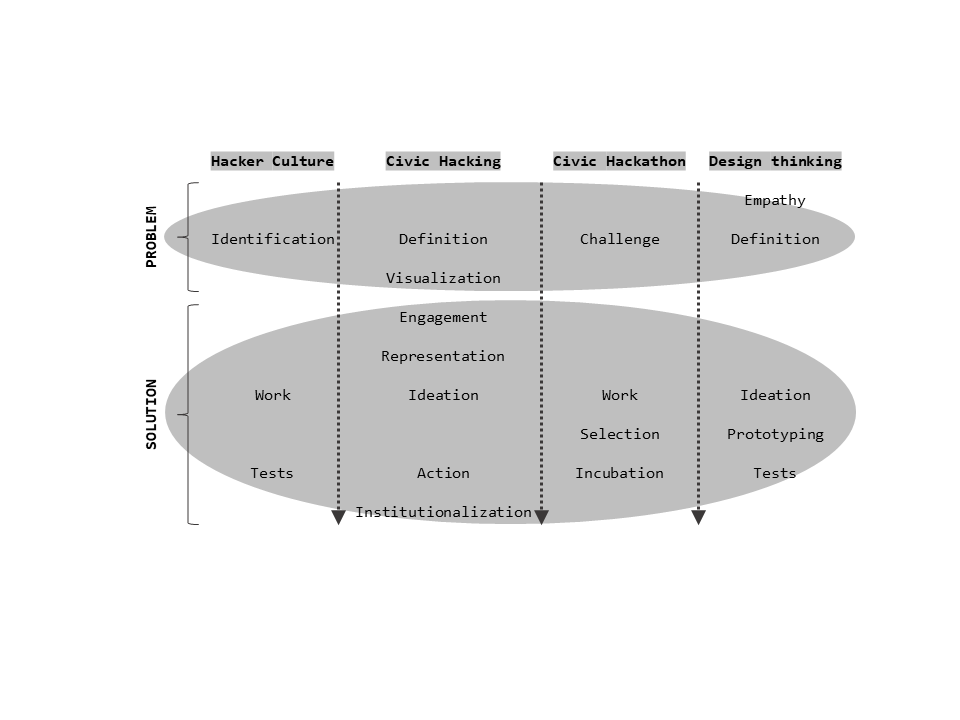
Collaboration, in this context, occurs around communities of practice, that is, collectives that together, and through practice, acquire, develop, and preserve knowledge, skills, and social and material resources in a certain area (Stalder, 2018). The hacker collaboration is guided toward problem-solving and constant experimentation through three stages: (1) identifying the problem; (2) working for a solution through various resources; and (3) testing the developed solution (Himanem, 2001).
The popularisation of the internet and Web 2.0, from the 2000s until nowadays, has allowed civic hacking practices. Civic hacking is characterised by activist appropriation of digital technologies and its application to urban causes and civic action (De Waal & De Lange, 2019; Del Signore & Riether, 2018; Townsend, 2014). These practices tend to produce and share data on the city, interfering with institutionalised processes, creating interfaces among different actors, enabling the collaboration between governments and citizens, testing ideas before implementing large-sized projects, and emerging new forms of urban commons, potentially co-produced and co-governed. Civic hacking can constitute new forms of sustainable governance of cities, through the development of situated software products, also called civic tech, dedicated to urban issues (De Waal & De Lange, 2019; Del Signore & Riether, 2018; Lodato & DiSalvo, 2016; Schrock, 2018; Townsend, 2014).
The hackable city and people-centred smart city approaches, bolstered by civic hacking behaviour, advocate for the right to the digital city and its digital and data commons (Ampatzidou et al., 2015; Calzada et al., 2023). Digital rights, as defended by them, protect what is the fundamental hacking culture: access, use, create, and disseminate content (Pangrazio & Sefton-Green, 2021).
The demand for open data goes back to the origins of civic hacking, together with Web 2.0 and e-governance innovations, which have been taking place since the 1990s (Tauberer, 2014). Civic hackathons arise in this context, characterised by a kind of programming marathon in short-term immersive events with civic purposes, launched in 2008 with the Apps for Democracy, promoted by the Washington/DC government, along with the launch of its open data platform, the Open Data DC4 (Johnson & Robinson, 2014), a foundational example of innovation from an open government.
Lodato and DiSalvo (2016) note that the hackathons are opportunities for collaborative prototyping of the issues that will guide public policies or services. Therefore, the problem that will be established as a challenge must be treatable and oriented towards goals that arouse the work and action interests of the target audiences. Johnson and Robinson (2014) point out that, to be addressed, the challenge must be well-designed and combined with access to the necessary data and the software produced must be constantly evaluated. Both the ignition work and the follow-up are of great importance, which put great pressure on the cohesion of the participants.
Understood as urban innovation tools, civic hackathons represent opportunities for the relationship between hackers and local initiatives, educating the former on real civic issues and developing the latter's expertise on ICTs, which is crucial to face the complexity of current urban problems (Tauberer, 2014; Townsend, 2014). In addition, they allow for the overcoming of tokenism in participation (Arnstein, 1969) when they involve participants in the production of interfaces that will engage with the problems (Lodato & DiSalvo, 2016). For this to happen, their demands need to come from citizens and societal needs, rather than from the pure technological ambitions of the developers.
The collaborative process on civic hacking initiatives goes through seven stages: (1) problem definition; (2) problem visualisation (3) engagement; (4) public representation; (5) ideation; (6) action; and (7) institutionalisation (Ampatzidou et al., 2015). In civic hackathons, these stages are compressed into: (1) presenting challenges; (2) collaborating to present solutions; and (3) electing winning projects (Kitsios & Kamariotou, 2019; Komssi et al., 2015). Tests and adjustments that follow the use of the solutions depend on subsequent arrangements, including the implementation of training programmes, the services created, or the promotion of networking between developers and potential investors.
In these processes, design thinking is the approach used to mediate actors. Schliwa (2018) highlights the role of design thinking in conducting these events through a myriad of professional-led toolkits and dynamics, contributing to the emergence of a new type of urban citizenship. The design thinking approach, which is computational in nature, is directed toward creative problem solving and occurs in five stages: (1) empathy, (2) problem definition, (3) ideation, (4) prototyping, and (5) testing (Schliwa, 2018). Figure 1 illustrates the stages of hacker collaboration, highlighted between the problem and the solution.
However, several studies point to the limitations of civic hackathons and hacking practices. The inclusion of diverse knowledge and perspectives is one of great importance, as digital culture, to this point, has increased urban inequality, adding digital inequality to preexisting ones (Falk Olesen & Halskov, 2020; Kitsios & Kamariotou, 2019; Mendes, 2020b; Townsend, 2014). If, on the one hand, digital tools enable more people to take part in design, planning, and decision-making processes, on the other hand, it is expected that the diverse actors will not take part as equals, such as hackers vs. info-excluded people, open data experts vs. users that have not yet used e-govern services, technological entrepreneurs vs. community leaderships, to name but a few.
Another inclusion-related issue refers to the type of “interested” participation they host. Here, engaging in community issues, despite being voluntary, is not necessarily altruistic. Although their members act guided by collective goals - information democratization, technological and social development - they are motivated by personal gains - acquiring expertise, resources, and recognition (Himanem, 2001). Collective goals they seek may not reflect the public interest, resulting in antidemocratic processes that favour privileged groups to the detriment of others without technological or relational skills (Ampatzidou et al., 2015). Furthermore, the prevalence of techies and smart city narratives above others can result in a lack of civic character, to the detriment of an intelligent pretension (Wolff et al., 2020). The challenge of aligning the diverse interests of the various actors is a significant issue.
Citizen sovereignty is another key issue related to the ambiguity of the role of Web 2.0 in these processes. On the one hand, it allows more people to create and share content on the Internet (O’Reilly, 2007). Many authors recommend their use, due to the lack of technology and data literacy (Kitsios and Kamariotou, 2019), as a way of facilitating processes of civic tech co-creation (Hou & Lampe, 2017; McCann, 2015), once they are familiar to participants and easy to use. However, on the other hand, this usually happens in proprietary platforms, such as digital social networks and applications of big techs such as Google and Microsoft, among others, which end up storing the generated data and often profiting from it (Morozov, 2019). This situation prevents the achievement of technological sovereignty (Mendes, 2020a) by communities of practice since they are unable to overcome their dependence on these platforms in the face of proprietary technology companies.
Although the promotion of open data platforms allows for some data literacy and can lead to territorial applications (Johnson & Robinson, 2014; Lodato & DiSalvo, 2016; Townsend, 2014), the ephemeral characteristic of these initiatives raises another problem for civic hacking, which concerns the sustainability of the developed actions, civic techs, and communities of practice (Falk Olesen & Halskov, 2020). Many authors stress the necessity of studies and methodological validation to evaluate the processes and results of these practices from a more critical perspective (Falk et al., 2021; Falk Olesen & Halskov, 2020; Perng, 2019). In order to surmount this challenge, universities may be able to assume a role in facilitating critical thinking.
Some studies recommend best practices for civic hackathons and hacking practices. The use of low-tech, offline processes and the increment and compatibility of existing adequate platforms that are thus familiar to the target audience are recommended as a way of enabling inclusion and sustainability (Hou & Lampe, 2017). The hybridisation between physical and virtual spaces (Allegretti et al., 2016), the utilisation of common physical spaces and the establishment of partnerships among communities of practice, organisations, technology companies, and the government may enable mutual learning and contextualise socio-technical production (McCann, 2015). To achieve citizen’s technological sovereignty, it is essential not only to produce more inclusive technology but also to adequate existing ones, and regulate property technologies, besides guaranteeing the production of data and knowledge with the people (Labaeye, 2019; Mendes, 2020a).
To support the collaborative ecosystem of a hackable city, design should be appropriated as a civic hacking infrastructure (Le Dantec & DiSalvo, 2013; Wilson & Chakraborty, 2019). This way, it could provide the use of actors and means that will build communities of practice, encourage the use of the civic tech made available, allow for the expansion and adaptation of the systems created, manage conflicts, and support possible institutionalisation processes (Campolargo et al., 2014; Rizzo et al., 2015).
The concept of “information infrastructure”, brought by participatory design research, is essential for the production and use of civic tech (Karasti, 2014; Wilson & Chakraborty, 2019). An information infrastructure is a system with socio-technical resources (actors, means, relationships) for a “future design”, that is, a design that enables the participation of individuals who were absent at the beginning of the process and the discovery of new issues, allowing for the appropriation and adaptation of an initial given scope, thus facilitating the formation and sustainability of communities of practice (Le Dantec and Di Salvo, 2013). Unlike a framework, in which issues are established in advance and created by established ideas, an infrastructure allows for the creation of issues based on the action of involved actors.
Due to its ‘ongoing’ relational nature and its long-term development, the term was updated as ‘infrastructuring’ (Karasti, 2014). Its application focuses on social innovation, political aspects of participatory design, the acquisition of skills, and the emergence of a new socio-technical relationship (Björgvinsson et al., 2010; Le Dantec and Di Salvo, 2013), which are some important goals of the hacking processes intended in the local development context. The question, however, is which actor is best placed to maintain this infrastructure.
Local development policies rely on self-organisation and decision-making by local actors and their capacity to build collaboration networks, challenging the administrative structures of the territories (Capello, 2011; Falanga, 2014). In this sense, infrastructuring collaboration on local development, laying down on civic hacking processes, could reveal opportunities and weaknesses in engaging local actors with digital tools, while could be opportune to support lasting interactions of mutual learning and co-production of hackable cities.
The BIP/ZIP context in Lisbon
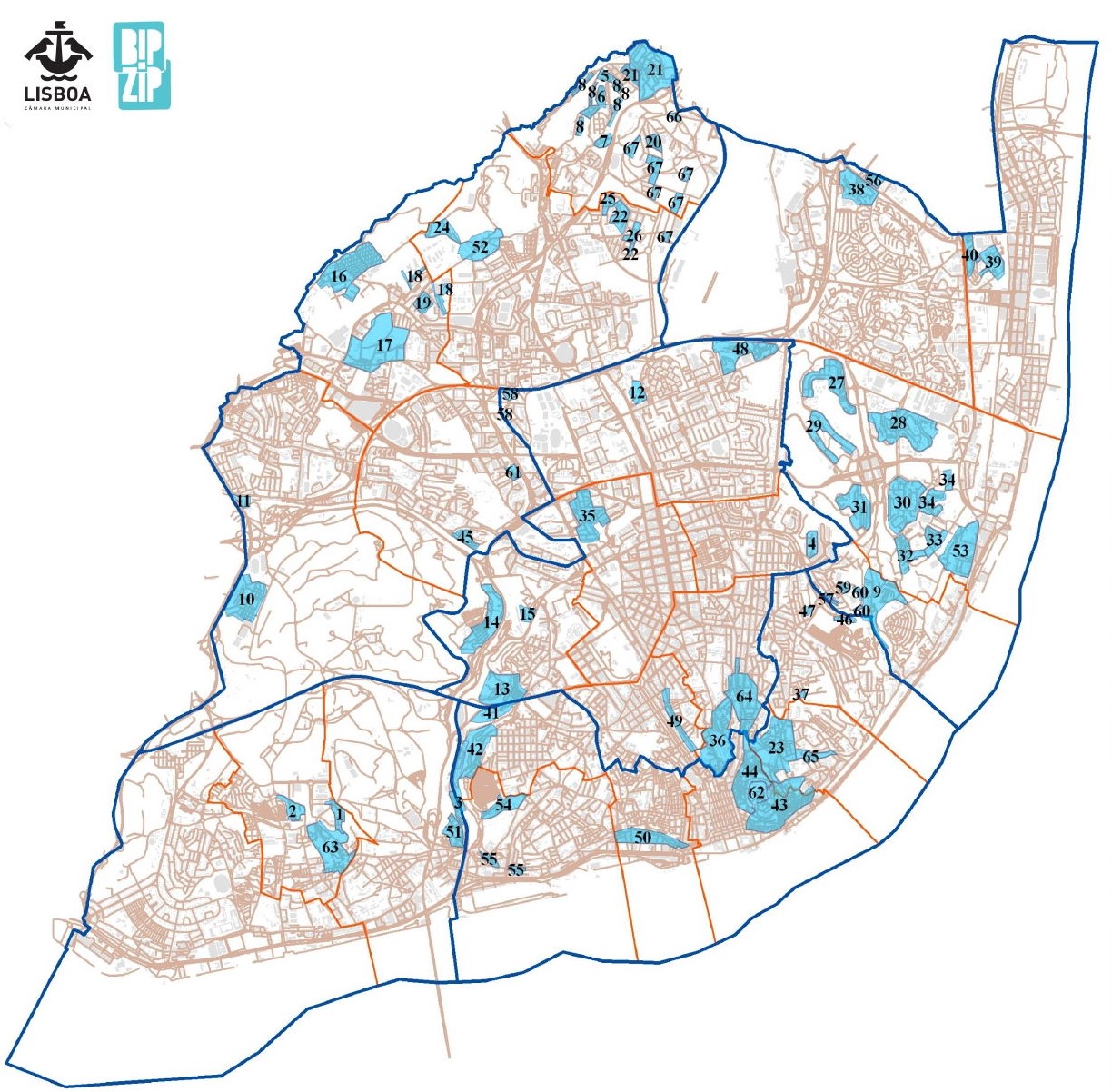
The BIP/ZIP local development strategy was created during the elaboration of the Lisbon Local Housing Programme, based on the need to identify the vulnerable areas (of priority intervention) in the city, which initially resulted in the BIP/ZIP Chart (Figure 2). During the participatory process to define the Chart, the local initiative showed the need for a project funding programme to revert the precarious conditions found, thus leading to the Lisbon BIP/ZIP Programme - Local Partnerships (Câmara Municipal de Lisboa, 2010). In 2021, another line of funding5 was created for continuity projects.
https://bipzip.cm-lisboa.pt/
Figure 2 The BIP/ZIP Chart: Lisbon’s map, with the priority intervention territories highlighted in blue, denoting clusters of poverty territories. The numbers refer to their names
To mediate conflicts between municipal services and the local initiatives, the municipality created GABIP - Local Support Offices. The municipality also encourages the creation of collaborative networks, among which we highlight the Community-Based Local Development Network in Lisbon (DLBC Lx Network), which brings together hundreds of local initiative organisations to strengthen their partnerships (Departamento Municipal de Habitação e Desenvolvimento Local, 2017).
BIP/ZIP was considered a good practice by the International Observatory of Participatory Democracy, in 2013, and by the Urbact III European Territorial Cooperation Programme, in 2017, and, between 2018 and 2021, it led the network programme Urbact Com.Unity.Lab6, with the challenge of transferring its knowledge and experience to other European cities and the commitment to strengthening its collaborative networks. In Portugal, it was an inspiration for a national-wide programme in support of local initiatives during the COVID-19 pandemic, called Programa Bairros Saudáveis7 (Healthy Neighbourhoods Programme), which has since been discontinued.
Since 2011, BIP/ZIP yearly funds projects proposed and conducted by the local initiative, organised in partnership consortia, promoting actions from training and employment to the rehabilitation of public spaces (Câmara Municipal de Lisboa, 2024). Between 2011 and 2024, 549 projects were approved. A previous study demonstrated the relevant use and production of digital tools in BIP/ZIP projects, such as the use of ICTs in participatory processes, collaborative mapping, platforms for product and service exchange, collaborative networks, and crowdfunding campaigns, among others, supporting the local initiative organisation and communication (Farias& Paio, 2020).
As demonstrated in Figure 3, the BIP/ZIP strategy is performed by varied actors (PPL, 2011), compounding a penta-helix structure (Calzada, 2020). From the government, it comprises (1) political actors, in charge of designing the strategy and defining the budget; (2) municipal technicians, responsible for operationalising the strategy; and (3) external consultants, hired by the municipality to evaluate the programme. From the academia, it has the (4) scholars, working on some projects, in the jury and consultant services. From civil society are the (5) communities, as the projects’ beneficiaries, also the (6) jury for project evaluation; and the (7) international partners of the transference networks. Social entrepreneurs and activists are organised into (8) local initiatives, understood as groups of citizens, formally or informally organised under varied types of organisations, which propose and conduct the projects financed by the Local Partnerships Programme. With a weaker representation, the industry has participated in some projects in partnership with local initiative organisations. The arrangements between local initiative organisations and the communities in which they act are seen, in this study, as communities of practice.
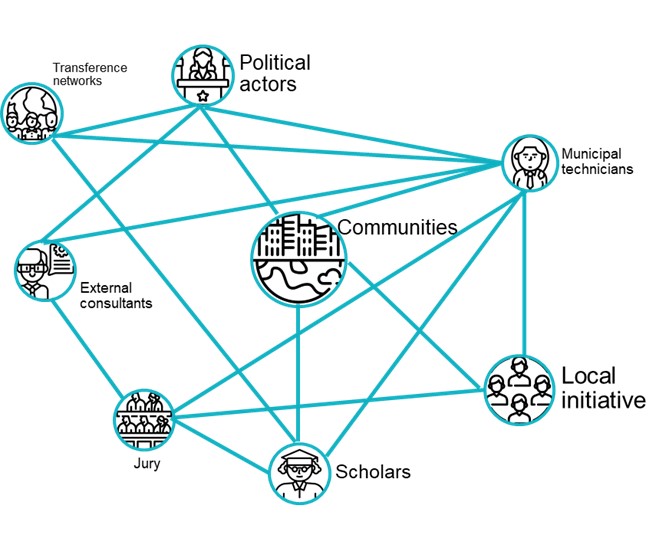
The interactions among all those actors rely on several physical and digital means. A website operates the application process and publicises applications submitted by all projects in all editions, being a repository for data and documents of the programme. A social media page, created during the first years of the programme, is managed by the municipality aiming to promote projects and collaborative arrangements. Some digital tools created as part of the projects funded by the programme allow for interaction between local initiatives and communities, in addition to the various digital platforms provided by the municipality and other institutions that publish open data and tools for citizen participation.
In terms of physical means, there are many opportunities to meet, such as the 'training' sessions organised by the municipality at the annual launch of the programme, with presentations of the data obtained through the monitoring of the projects. The GABIP meetings, where everyday problems in the neighbourhoods are discussed. In addition to the meetings of the organisations belonging to the DLBC Lx network, which serve as a space for discussing the type of support the network can offer them, there are also meetings organised by the organisations themselves to develop their projects.
Even though the Local Partnerships Programme was a demand of the communities in a participatory process, there is no current formal feedback process to ensure that the programme is updated based on bottom-up contributions and critique. The municipality shares its monitoring with the local initiative occasionally, and this monitoring is conducted with no clear participation of the organisations and communities involved. The open data interfaces and participatory tools provided by the municipality were not yet fully appropriated by the local initiative, and the interfaces produced by it are unable to ensure their sustainability and integration with the processes of the BIP/ZIP Strategy.
In this sense, the co-production of interfaces could cover the plurality of voices and perspectives, contributing to a shared monitoring of the effects of the projects on territories. It could also contribute to the construction of systems of values and commitments shared by the local initiative and municipal government, aligning their local development actions.
Materials and Methods
As a way to encourage the co-production of digital tools in Lisbon's local development context, we designed a methodology comprised of a civic hackathon (Johnson & Robinson, 2014; Kitsios & Kamariotou, 2019; Komssi et al., 2015; Lodato & DiSalvo, 2016), aiming to draw an information system of infrastructuring collaboration (Björgvinsson et al., 2010; Le Dantec & DiSalvo, 2013). A civic hackathon is suitable to set a challenge and encourage the participation of communities of practice, unlocking a continuous process of civic hacking that comprises testing, evaluation, and enhancement of the tools created, consequently allowing their co-governance. Then, infrastructuring the local development interactions could facilitate the formation of long-term collaborative relationships, while simultaneously functioning as a dynamic work and innovation space, encompassing a range of collaborative governance models for the city.
Called hackaBIP, a civic hackathon was prepared by the authors with the support of the Lisbon City Council and other partners, including industry, code schools, innovation agencies, creative collectives, and designers, between February and November 2021. The scholars were defined as igniting actors, represented by the Iscte - Instituto Universitário de Lisboa, a university that has worked on many BIP/ZIP projects.
The target audience was the local initiative, the tech community, academia and citizens in general. A partnership with the DLBC Lx Network would facilitate the participation of the local initiative organisations. Participation of the tech community was facilitated by a partnership with the Municipal Directorate for Economy and Innovation, and its community of entrepreneurs, Made of Lisboa. The event was also promoted on social networks, partners' communication channels and websites, as well as through banners placed in strategic locations in the priority areas.
The hackathon programme included: (a) a brainstorming session with local initiative actors for defining the challenge; (b) a period for registering ideas and participants, when online events were also held with the introduction of topics relevant to the development of the projects, to contribute to the framing of ideas, elucidating development possibilities and providing moments of interaction between the local initiative and the tech community; (c) the marathon itself over four days when the groups were led through daily activities with the help of project mentors and specialised mentors in specific subjects; (d) voting the best projects through a popular vote and a technical jury that awarded the three most voted projects; and (e) the follow-up of the winning teams in accessing the prizes and in tentative developments with the municipality.
The challenge launched was “How is our neighbourhood? Using digital tools and open data to develop our neighbourhood.” Based on that question, projects in four categories were encouraged: (1) data gathering, mapping, and monitoring; (2) collaboration among citizens, organizations, and the local government; (3) documentation, archiving, and sharing of experiences; and (4) spaces for citizen discussion and deliberation. Conducted during the physical isolation imposed by the COVID-19 pandemic, the civic hackathon, was carried out online, by using a ready-to-use platform8, independent from the municipal council platforms, during a four-day marathon.
The communication strategy encouraged the formation of heterogeneous teams containing at least one member of the tech community and one from the local initiative, thus covering the skills required to develop digital tools based on concrete community issues (Kitsios & Kamariotou, 2019; Lodato & DiSalvo, 2016; Townsend, 2014). It was recommended that the teams have between 3 and 5 people, who could know each other beforehand or get to know each other on the platform provided for the action or at one of the online events.
Communication between teams and mentors was facilitated through the hackathon platform and a collective online workspace. A series of activities was carried out to support the projects, focusing on: the problem X solution definition, the use of open data, and the prototype level of the projects. Beyond the evaluation of the tangible results, reflections on hackaBIP were possible by observing and surveying the teams, mentors and judging panel.
The hackaBIP infrastructure was developed during the preparation, realisation and evaluation of the online civic hackathon. Using this real scenario as a practice model, it encompasses the civic hacking process as a methodology, including the hackathon phase, and organises interaction stages in the BIP/ZIP Local Partnership Programme, and its actors and currently available means. Infrastructuring the BIP/ZIP is intended to support the co-production of civic tech in Lisbon’s local development.
Civic hacking on Lisbon’s local development
The proposed methodology allowed for two types of outcomes: those of the online civic hackathon itself, and the information infrastructure created during it. The civic hackathon lasted nine months and involved numerous partners. Sixty-one registrations were received, of which only 13 per cent identified themselves as coming from the local initiative and 17 per cent as Lisbon residents. Five teams of fourteen people took part in the marathon, building five different civic techs. Of the five teams, three were formed by people who already knew each other or had worked together (75 per cent of registrants said they had participated in other hackathons). The other two teams were formed through interactions on the hackaBIP platform and at pre-hackathon events. Communication and collaboration took place through existing online social networks and applications.
The apps proposed by the teams in response to the challenge were: (1) a platform for the collaborative development of proposals for the city; (2) a platform for sharing and community deliberation aimed at creating data on public spaces; (3) a local social network for sharing information in real time; (4) a platform for submitting ideas and ratings of public spaces; and (5) an app to promote green mobility aimed at benefiting local commerce. Table 1 provides more details, including their categories and the composition of the teams. With the aim of improving communication between local actors, organising collective action and influencing local urban legislation, they explored data that could be used to create useful indicators for monitoring local development, which had not yet been explored by the municipality.
Tabela 1 Projects and teams that took part in hackaBIP
| CIVIC TECH |
Get Together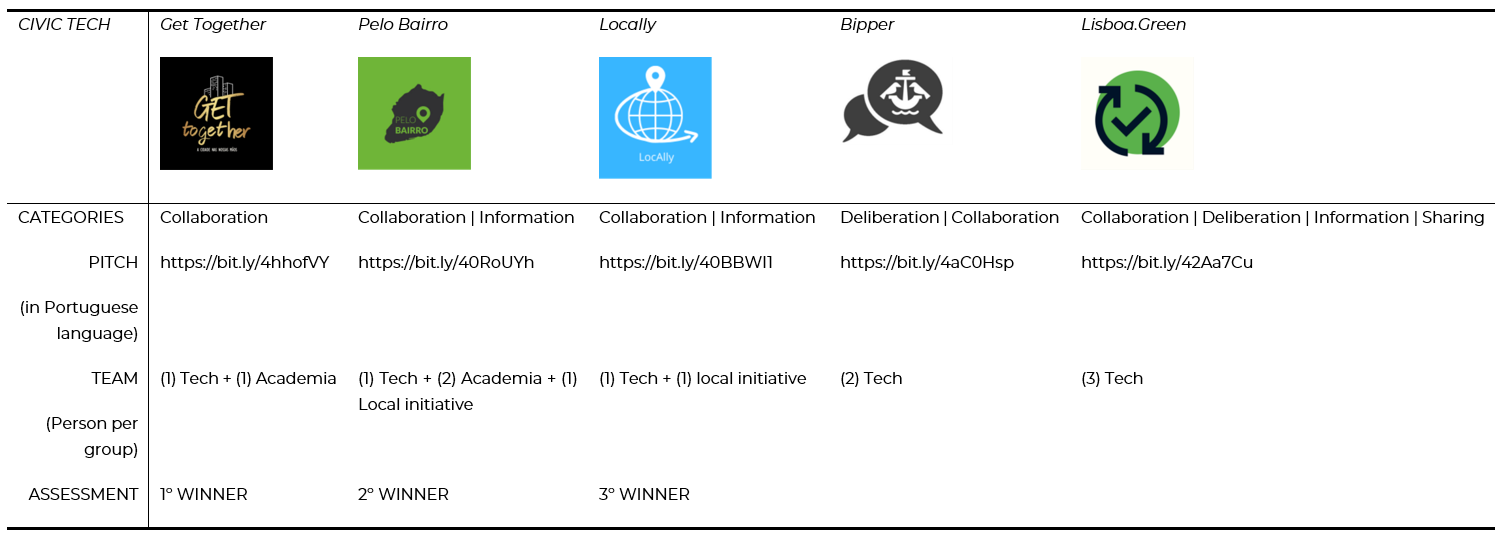
|
Pelo Bairro
|
Locally
|
Bipper
|
Lisboa.Green / |
| CATEGORIES | Collaboration | Collaboration | Information | Collaboration | Information | Deliberation | Collaboration | Collaboration | Deliberation | Information | Sharing |
| PITCH (in Portuguese language) | https://bit.ly/4hhofVY | https://bit.ly/40RoUYh | https://bit.ly/40BBWI1 | https://bit.ly/4aC0Hsp | https://bit.ly/42Aa7Cu |
| TEAM (Person per group) | (1) Tech + (1) Academia | (1) Tech + (2) Academia + (1) Local initiative | (1) Tech + (1) local initiative | (2) Tech | (3) Tech |
| ASSESSMENT | 1º WINNER | 2º WINNER | 3º WINNER |
Source: the author.
From the preparation phase, it was difficult to involve local organisations because of a certain mistrust of local power and a competitive attitude among them, as some have already created digital tools in the past. Involving academia itself, established as an ignitor, was not easy either. It was expected that there would be greater participation from students and researchers, and efforts were made to achieve this. But the action took place at the end of a particularly atypical academic year due to the pandemic. Above all, we had to deal with the hegemonic orientation of universities towards quantitative targets, large community funding and a preference for links with large companies and large government projects.
As far as the municipal technicians were concerned, it was a challenge for them to coordinate the time between several simultaneous events, such as the extensive programme to celebrate the 10th anniversary of the Local Partnerships Programme, the closing of the URBACT Com.Unity.Lab project and the 10th Lisbon Entrepreneurship Week. In addition, coordination with the hackathon was concentrated in the Economic and Innovation Directorate, with less involvement from the Local Intervention Unit.
The context of the civic hackathon constituted the enabling environment for the design of the hackaBIP infrastructure. It aims to overcome the detachment between the interfaces produced by prevailing technocratic structures and the reality of the territories and communities, enabling the constitution of an interface focused on visualising and solving problems through the engagement, training, and collaboration of diverse actors.
The hackaBIP infrastructure, as it emerged from the experienced hackathon, is shown in detail in Figure 4. Columns at the left and right contain repertoires of actors and means, which must be contextual, so, this model brings the BIP/ZIP strategy dynamics. At the center are the tasks that connect actors and means, and guide a hacking process aiming at sustainability, sovereignty, and inclusion. Tasks are organised according to the stages extracted from the study of the hacking process as a methodology. On top, the university appears as igniting actor. Its stages - ignition, infrastructure, hackathon, experimentation, and appropriation - are defined as follows:
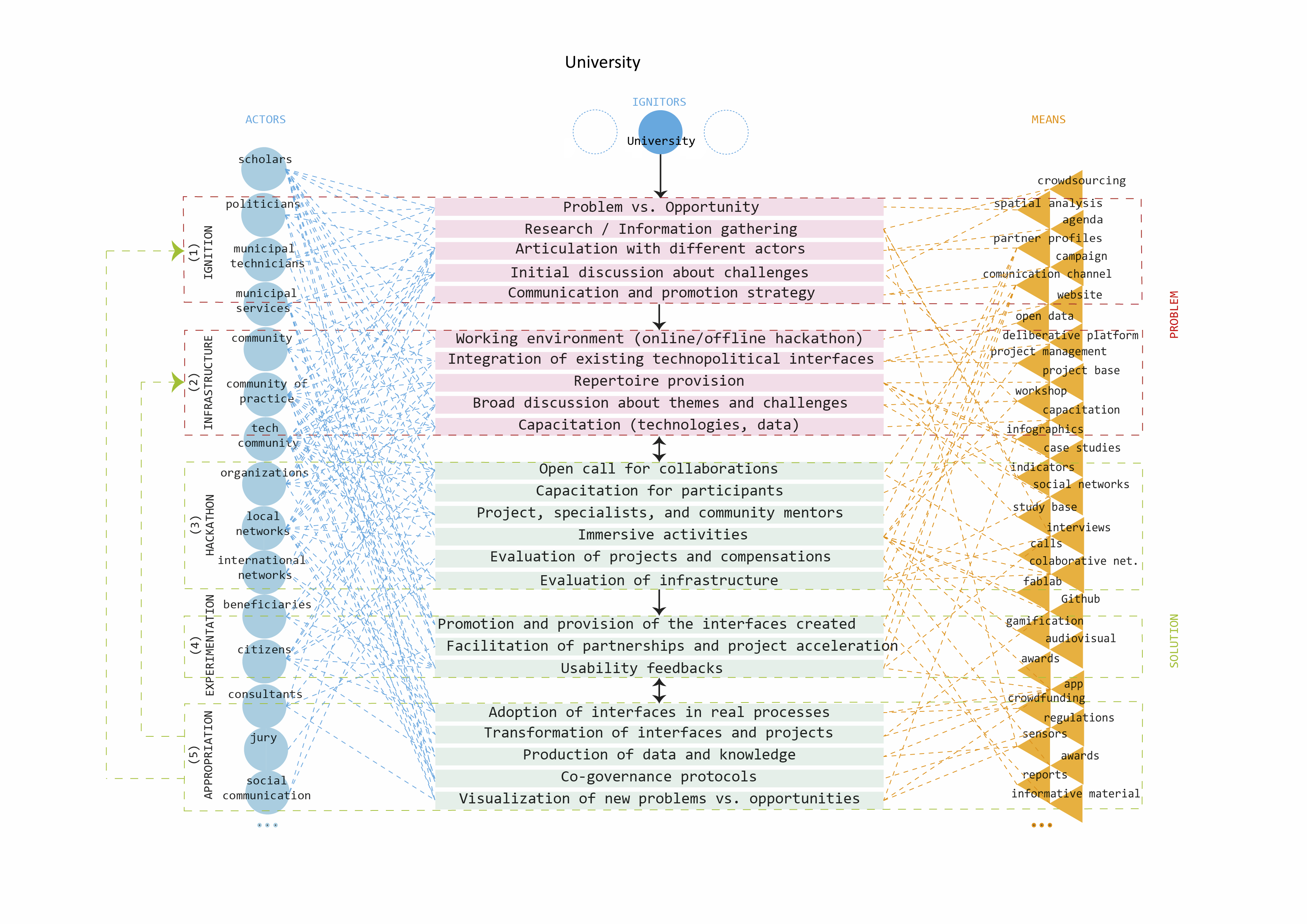
[Ignition] - The role of the igniting actor must be to foster the creation of a first actor network to begin the process, and, afterwards, engage communities of practice in calls for collaboration, encourage the use of the tools created, and mediate the interests of the many actors involved in the process toward a possible institutionalisation.
[Infrastructure] - An initial infrastructure with tools for the visualization of the problem, engagement of actors and their representation, supported by a repertoire of actors and means, adjusted to the local context. Ideally, it must be an open source and independent infrastructure, thus ensuring the technological sovereignty of its users. Integrating existing technopolitical interfaces must be encouraged, strengthening a digital culture familiar with data. The defined process will adjust this infrastructure to the tools and data initially available.
[Civic Hackathon] - Call for collaboration in projects focused on the identified problems by using the available infrastructure to articulate working groups among themselves and with a broader audience. A way of facilitating this relationship with citizens and organisations may be to carry out part of the discussion on problems vs. solutions in a hybrid environment previous to the development of the project so that they could respond to real needs raised in discussions. It is fundamental to evaluate the hackathon process, and the infrastructure used to adjust them to local context and learning. We suggest conducting the hackathon in a flexible format and time that is accessible to a large audience, in association with minicourses on the problems’ frameworks and the groups’ production capacity. The evaluation of the projects may suggest a combination of similar ideas and projects. The infrastructure will serve to promote projects once they reach an operational stage.
[Experimentation] - A period for: a) using, testing, and adapting the co-produced interfaces; b) their cross-referencing with ensuing processes in the territories; c) documenting the experiences to feed back the initial infrastructure with new data on the territories, communities, and the lessons learned with the use of new tools.
[Appropriation] - Derived from the use of the infrastructure described at point 2, integrated with civic tech produced at the civic hackathon, depending on the engagement of communities of practice in conflict management and the possible expansion and adaptation processes, institutionalisation opportunities may arise, such as civil society organisations or governmental initiatives. Consequently, the infrastructure must engage new actors and reconfigure the initial problem in continuous calls for collaboration and experimentation.
hackaBIP infrastructure can be applied to any territory, just by first adapting the repertoires of actors and means and the best local choice for igniting actor(s) that, in articulation, will be able to adjust tasks, challenges and the infrastructure itself.
After carrying out the hackaBIP hackathon, it can be proposed for the BIP/ZIP context that: a civic hackathon should take place before the preparation of projects to apply for the annual funding by the Local Partnerships Programme since it is easier, at this moment, to mobilise organisations and there is time to fund some of the proposed interfaces and projects; the period for experimenting the created interfaces should happen in parallel to the elaboration and evaluation of BIP/ZIP projects when the access to data and collaboration among partners is essential; the jury for the evaluation of projects submitted to the hackathon should include representatives of the local initiative, as well and the mentoring team; the usability and sustainability of created interfaces should be discussed in meetings of the GABIP, DLBC Lx Network, and other local and international networks, as fit for the use, scale, and actors engaged.
Challenges in infrastructuring local development
As is often the case with hackathon initiatives (Hou & Lampe, 2017; Townsend, 2014), hackaBIP involved a wide network of players that was demobilised soon after it took place, leaving no major impact other than the direct one on the participants. For this reason, an infrastructure that connects actors, tools and tasks and gives them autonomy can overcome the ephemerality trap and the sustainability problem of hacking processes (Le Dantec & DiSalvo, 2013). Moreover, this environment of autonomy and self-learning could favour the development of an auto-evaluation capacity and the gradual construction of technological sovereignty. Nevertheless, there are many challenges for a hacking environment on local development, which we begin by discussing their effect on the actors, followed by the means.
Starting with the actors, the role of academia as an ignitor is significant. Nevertheless, it is challenging to ascertain the extent of the initiative's influence on subsequent academic actions, largely due to the complexity of aligning the initiative with other projects, as well as with existing networks and partnerships. Greater participation by a plurality of scholars would have made it possible to better gauge the contributions of the relationship with public authorities and society. Despite its professed non-profit and neutral orientation, academia seems to have remained more entrepreneurial and focused on business rather than social innovation through smaller projects. However, initiatives such as hackaBIP facilitate a rapprochement between academic organisations and communities, enhance capacities for active citizenship, and facilitate exchanges between technical and non-technical knowledge. It is time to claim a hackable university, i.e., transdisciplinary academic environments and infrastructures that are open to dialogue with collective action and hackable government.
Playing the role of igniting actor articulated to other partners involved in the process of co-production, it is crucial to demonstrate the value of the initiative, clarifying the necessary investments and possible gains, sewing the various interests, in addition to their availability to maintain these networks. The ignition work is essential; however, it is only the beginning of a path that other actors must be able to take on with autonomy, which justifies the need for infrastructuring it.
Local government, represented here by Lisbon municipality, played a significant role in promoting and boosting the initiative. Still, catering for an action as robust and intensive as a hackathon was somewhat difficult. The challenging coordination of agendas that local governments require to be receptive to the demands that are presented to them must be supported by a medium- to long-term perspective (O’Reilly, 2010). The generated resources need to be understood as instruments for improving local governance and citizen participation in local development, in addition to the opportunity to generate economic and business value.
Although all hackaBIP's communication encouraged the establishment of bridges between local initiatives and the tech community, the former wasn't as willing and open to this. With the latter prevailing over the other public, their perspectives naturally stood out in the developed proposals, exposing the danger of an imbalance of power in co-production processes as discussed by Ampatzidou et al. (2015). Using the term ‘community tech’ instead of ‘hacker community’ in the communication strategy, on the one hand, removed the generally negative connotation associated with the figure of the ‘hacker’, in a context where the concept of civic hacking is not yet widely used; on the other, it contaminated the initiative with the discourses of innovation and entrepreneurship, typical of the governmentality already adopted by the local government. Even if the civic tech generated by hackaBIP can indeed be characterised as 'civic', since it aims to solve real problems, the lack of participation of the local initiative has contributed to its ineffectiveness.
The marked absence of local initiative among the hackaBIP teams also highlights the fact that even the actors of community intervention and local activism must realise immediate gains in exchange for their commitment and working time, as their work is commonly project oriented. Also noteworthy is the competitiveness that exists between organisations, which leads them to see the initiatives of their peers as competitors, added to a certain distrust of collaboration with local government. The Lisbon local initiative's integration into this hackathon could have been more effectively leveraged by aligning the interaction devices more closely with their objectives, technical expertise, political interests, and engagement willingness.
More strategic efforts should be made by scholars committed to digital inclusion, and by local governments pretentiously engaged with digital innovation, as well as a claiming behaviour from local initiatives and citizens in general must arise, to reach conditions for inclusivity.
As for the means, the used tools were all ‘ready to use’, familiar to users and easy to handle, which allowed for interaction and the smooth development of the work (Hou & Lampe, 2017). However, requiring logging in to proprietary systems does not achieve technological sovereignty (Mendes, 2020b). It is necessary for stronger and more literate communities of practice committed to their independence of proprietary systems through the creation of common systems, as experienced in cases such as the Decidim community.
A hybrid environment (digital and physical), permanently used and appropriated by the various actors, could contribute to that. It could offer more opportunities to cultivate data skills, thereby reducing the digital inequality experienced by actors who are not yet literate in digital tools, and better reflecting their social, economic and cultural diversity, as pointed out by Allegretti et al. (2016).
Hybridisation is a promising possibility of inclusion, which is especially important for key moments - definition of challenges, problems vs. solutions, experimentation, and evaluation. If the involvement in these moments is guaranteed, there may be a power distribution with those who are usually absent. Given the emphasis on partnership networks on local development (Capello, 2011), not only must the access to technologies and tools be widened, but the capacity to articulate technologies and information with actions by the local initiative, organisations, and governments must also advance. This highlights the challenge of co-governance of the hackaBIP infrastructure.
The civic tech generated at the hackathon showed different data that could be used to form useful indicators for monitoring local development. If done with greater participation from the local initiative or even with more feedback from the local government, they could generate indicators that converge with the monitoring needs from the perspective of these actors. However, it is known that the civic tech generated remained inactive due to insufficient follow-up with the participating teams after the hackathon. This reinforces the role of the igniter actors in managing the network of actors for the appropriation and experimentation phases of the infrastructure, guaranteeing the sustainability of the created civic tech, the community of practice and the infrastructure itself.
Tasks for building a hackable city
The implementation of the online civic hackathon hackaBIP has shown that it is possible to facilitate more cross-sectional monitoring of local development in Lisbon. However, it has also shown many challenges in ensuring the creation and use of digital tools by the local initiative towards a hackable city. Also, the hackaBIP infrastructure has contributed to the debate on how the co-production of civic tech is capable of mobilising sustained participation in local development, guided by civic hacking practices.
However, it is imperative to have a leadership with the political and technical capacity to guide an infrastructuring process. In this sense, the hackaBIP experience introduces the concept of "hackable universities," stressing there is still a considerable way to go, starting with the establishment of effective and sustained communication channels to facilitate the formation of collaborative networks.
We propose that research centres with a stronger focus on technology-based research engage in a comprehensive reflection on their role in collective and social action. This should include the organisation and dissemination of scientific information that is relevant to these processes, the organisation and capacitation of communities of practice, the mapping of practices and critical reflections for sharing with the academic community and beyond, as well as the expansion of internal deliberation spaces to establish ethical guidelines and commitment to emerging societal issues, such as the application of digital technologies in participatory processes. Hackable universities should establish partnerships with local initiatives to pull up concrete actions from local governments. It is necessary to bake a critical mass able to claim digital rights and technological sovereignty.
With regard to the role of government, we propose a more integrated approach between the departments responsible for geo-referenced information, urban information, innovation platforms, participatory processes and local intervention. This integration would enable a more comprehensive and effective monitoring of services and policies for local development, as well as enhanced citizen engagement.
To contribute to local development, these hacking processes must be able to mobilise local physical and relational resources. Then, it is necessary to establish common agendas among local initiative organisations, local government and hackable universities. The relevance of the process and the means to the actors involved is what can guarantee its sustainability over time and stimulate the establishment of partnership protocols for the shared management of the digital interfaces that will mediate local development.
Finally, it is imperative to demystify digital technologies and foster the skills of the local initiative actors in navigating digital tools. This should be done not by introducing novel products developed by major technology companies, but rather from the standpoint of aligning existing capabilities and necessities in the co-production of their own technologies. Perhaps local initiative, rather than designing the tools, should play a more important role at decision-making moments, such as defining the challenges, defining the problems vs. solutions, and the informed evaluation of the projects.

