




 Inglês (pdf)
 Artigo em XML
 Referências do artigo
 Tradução automática
 Enviar este artigo por email
 Citado por SciELO
  Similares em
SciELO
Similares em
SciELO 
 Permalink

Introduction
The public debate on the financial sustainability of the welfare state points to the critical observation that world democracies are in crisis (European Commission & Merkel, 2019). As for the legitimacy of the welfare state, there are signs of a potential shift from governance rooted in experience, multilateralism, and consensual policymaking to governance characterised by majoritarianism, unilateralism, nationalism, populism, and polarisation (Abts et al., 2021; European Commission & Merkel, 2019).
Until the end of the 20th century, the main discussion centred on the redistributive format and the privatisation of social protection. The current social, political, and economic crises related to the COVID-19 pandemic and the war in Ukraine have exacerbated inequalities and heightened the vulnerability of the middle class and the working poor, thereby contributing to the growth of new concepts such as social chauvinism (Abts et al., 2021).
The political expressions of welfare deservingness, especially in Southern European countries (Ferrera, 1996), require scientific investment to better address new paradigms of social intervention amid current economic, political, and social challenges. The concept of welfare deservingness facilitates an understanding of the nature and depth of solidarity across various societal groups and thus contributes to a critical analysis not only of the principles and norms that people perceive as essential for ensuring a fair distribution of opportunities but also of how to apply formal solidarity (Appelbaum, 2001; van Oorschot, 2000).
The welfare deservingness model argues that individuals tend to support social solidarity measures favouring those individuals who, according to their perceptions, are more deserving, often to the detriment of other categories. They may also assume positions of indignation or rejection toward the less deserving (Larsen, 2008; van Oorschot, 2000). These attitudes encourage beliefs and social classifications that aim to identify various groups; such differentiation determines the level of social support each distinct group deserves to receive (Kallio & Kouvo, 2015).
Welfare deservingness has been studied mainly with respect to the relationship between the state and its citizens. Street-level bureaucrats’ perceptions of welfare deservingness can impact how services are provided, whom they prioritise, how they react to specific groups in different situations, and which political programmes they promote (Kallio & Kouvo, 2015). Street-level bureaucrats are characterised as frontline professionals (e.g., social workers) who, accumulated with their workloads, must deal with challenges such as overwork, conflicting roles, and limited resources.
Citizens experience government policy guidelines through these professionals, whose actions often reflect policies imposed in critical areas (Lipsky, 2010). Overall, the literature shows that street-level bureaucracy plays a crucial role in shaping how policies are implemented and how they affect their target groups across various domains. This influence is particularly evident in the delivery of activation policies at the frontline, which may adopt either supportive and facilitative approaches or, alternatively, more disciplinary and punitive measures (Nothdurfter & Hermans, 2018).
However, there is still limited knowledge about how these perceptions operate in Southern European welfare systems, where sociopolitical specificities and historical trajectories influence both public opinion and professional practice.
In this context, where public opinions and street-level bureaucrats’ perceptions of welfare deservingness play a pivotal role in determining who is considered deserving of social support, a broader investigation into the relationship between these concepts seems fundamental. Through this review, we aimed to conduct a comprehensive mapping of existing literature and examine studies that explore the influence of public opinion and street-level bureaucrats’ perceptions of welfare deservingness, particularly in Southern European welfare state models.
1. Materials and methods
1.1. Search strategy
The review aimed to systematically identify and map: (1) existing empirical studies examining the relationship between public opinion and perceptions of welfare deservingness; (2) research analysing how street-level bureaucrats’ perceptions influence the implementation and delivery of social policies; (3) the dimensions and criteria of welfare deservingness most frequently reported in the literature; and (4) the scope and characteristics of scientific production addressing welfare deservingness in Southern European welfare state models.
This study presents a scoping review conducted in accordance with the Preferred Reporting Items for Systematic Reviews and Meta-Analyses (PRISMA) protocol standards for methodological design (Moher et al., 2009; Page et al., 2022), with the main goal of mapping the available theoretical and empirical evidence on welfare deservingness. Adopting this approach facilitated a structured identification of the historical evolution, conceptual frameworks and knowledge gaps concerning welfare deservingness theory, as well as potential areas for further study (Peters et al., 2024).
Due to the limited number of articles addressing this topic, the search applied a broad temporal range, including all publications from 2000 to May 2023, in order to capture the evolution of the concept from the moment it gained scientific relevance in the early 2000s. Althought the review period started in 2000, the majority of articles identified were published long after that year, reflecting a gradual increase in research on welfare deservingness.
The literature search was conducted in three online databases - Web of Science, Scopus, and EBSCO - between January and May 2023. Additionally, the bibliographic reference lists of the selected studies and monographs were analysed to expand the research scope. Studies were included if they addressed perceptions of welfare deservingness by public opinion or street-level bureaucrats. Studies that focused exclusively on economic indicators or welfare expenditure, without reference to perceptions or deservingness criteria, were excluded (see Table 1).
Table 1 Search string and descriptors used in the different databases analysed
| Data bases | Keywords search string | Search criteria | Filter by specific area |
|---|---|---|---|
| Web of Science | “Welfare Deservingness” AND “Welfare” OR “Welfare Deservingness” AND “Street-level bureaucrats” OR “Welfare Deservingness” AND “Portugal” | All fields | Public administration, political science, social issues, social work and sociology |
| EBSCO (Academic Search Complete) | Subject terms | No filter by area | |
| Scopus | Article title, abstract, keywords | Social sciences |
Source: Authors’ systematisation.
1.2. Eligibility criteria
The research strategy considered studies published in Portuguese, Spanish, French, and English; however, most of the articles were written in English.
The research data used to identify articles for eligibility were independently extracted by two reviewers, according to the steps and review questions outlined in Table 2.
Data from the selected articles were thoroughly analysed through the systematisation of the most relevant information, namely, author, place, population/sample, study objectives, main results, and contributions to the field.
In recent years, qualitative studies have become increasingly relevant in this area, particularly for deepening the understanding of welfare deservingness theory and its dimensions (Heuer & Zimmermann, 2020; Laenen et al., 2019). However, this review included only quantitative studies to ensure comparability of results and standardisation of sampling and measurement approaches.
Table 2 Steps for identifying articles for eligibility
| Step 1 | Step 2 | Step 3 |
|---|---|---|
| Reading the titles of the studies found and excluding those that did not fit any of the inclusion criteria. | Reading the abstracts of the studies selected in Step 1 and excluding those that did not meet the inclusion criteria. | Full reading of all remaining studies from the previous stages and the selection of those that met the inclusion criteria. |
| Questions: - What is the relationship between the public perception of welfare deservingness and the implementation of social protection policies within the current welfare state? - What is the influence of street-level bureaucrats’ perceptions of welfare deservingness on the implementation of public policies? Inclusion criteria: - Population: public opinion and street-level bureaucrats; - Concept: studies on welfare deservingness; - Context: Europe. | Data extraction: - Authors; - Year of publication; - Country of origin; - Type of study; - Study objectives; - Population/sample; - Concepts relevant to the research question. |
Source: Authors’ systematisation.
1.3. Data extraction and synthesis
The research data were synthesised using tables and figures, intended to facilitate observation and analysis during the presentation of the results and discussion. The data are presented in a narrative format with the support of a flowchart (Moher et al., 2009; Page et al., 2022), aligning with PRISMA’s scoping review methodology and reflecting consensus between the two reviewers. Any disagreements were resolved by consulting a third reviewer.
This scoping review was prospectively registered in the International Platform of Registered Systematic Review and Meta-analysis Protocols (INPLASY) under the registration number INPLASY202320010 (Caetano et al., 2023).
2. Results
The search in the three databases initially identified 575 papers. After applying area selection criteria, 82 papers were excluded, resulting in 493 papers. An additional 206 duplicates were removed, leaving 287 articles. Following title and abstract screening, 265 articles were excluded. Finally, 22 articles were assessed in full text (Caetano et al., 2023). After detailed reading, 16 articles were excluded, resulting in a final sample of six articles considered central due to their significance in advancing the theory of welfare deservingness and the CARIN - Control Atitude, Reciprocity, Identity and Need model (Figure 1; see further criteria in section 3.2). Although most studies were conducted in Northern Europe, they were included due to their foundational contribution to the conceptualisation of welfare deservingness, which has subsequently informed research in Southern European contexts.
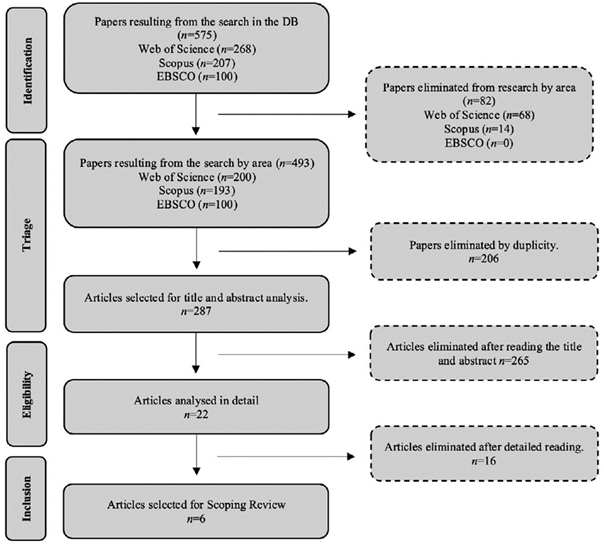
The six articles analysed (see Table 3) span a 20-year publication period. This limited number is due to: (1) the scarcity of studies on the topic; (2) the frequent citation of these studies in recent literature; and (3) their recognised relevance to the empirical development of welfare deservingness theory. The articles exhibit diverse characteristics, including heterogeneous samples, varying objectives, and different methodological approaches.
During the inclusion process, it was evident that research related to welfare deservingness and its dimensions remains closely linked to the pioneering work of Wim van Oorschot (2000, 2006), whose contributions remain central in the field. Subsequent studies have expanded and operationalised these criteria, applying them in a variety of sociopolitical contexts. Most studies were conducted in Northern Europe, which reflects growing interest in the selectivity of social policies in historically universalist systems. Nonetheless, this review aimed to synthesise contributions relevant to understanding welfare deservingness in Southern Europe contexts, particularly in Portugal.
Table 3 Systematisation of articles that constitute the corpus of the scoping review
| Author/ Year | Title | Methodology | Study Aims | Main Results |
| Wim van Oorschot 2000 | Who should get what, and why? On deservingness criteria and the conditionality of solidarity among the public | Quantitative study Sample: n=1,500 respondents (over 16 years old) Research study in the Netherlands; data from 1995. | Measure people’s opinion, perception and attitudes towards the welfare state in general and the social security system in particular. | The author concluded that the most important criteria were control, identity and reciprocity. The investigation revealed some clear deservingness criteria and differences in conditionality, which can be linked to three different sets of explanatory variables, namely, socioeconomic and demographic characteristics, opinions and perceptions about the welfare state, and basic values and attitudes. |
| Wim van Oorschot 2006 | Making the difference in social Europe: deservingness perceptions among citizens of European welfare states | Quantitative study Sample: n=28,894 Research study in 23 European countries: France, UK, Germany, Austria, Italy, Spain, Portugal, Greece, Netherlands, Belgium, Denmark, Sweden, Finland, Ireland, Estonia, Latvia, Lithuania, Poland, Czech Republic, Slovakia, Hungary, Bulgaria, Slovenia; data from 1999 and 2000. | Contribute to the empirical understanding of the cultural and popular context of the rationing of social support measures, examine the European public’s perceptions of deservingness of the most vulnerable groups, as well as variations in conditionality among Europeans. | The author concluded that deservingness opinions and attitudes are deeply rooted in popular culture. The author found a common pattern in European countries in which informal solidarity is highest towards elderly individuals, people with illness or disability, the unemployed and, finally, immigrants. |
| Christian Albrekt Larsen 2008 | The institutional logic of welfare attitudes: How welfare regimes influence public support | Quantitative study Sample: n=25,679 Research study in the USA, Canada, UK, Ireland, Sweden, Norway, Denmark, Finland, Netherlands, Germany, France, Belgium, Austria, Spain, Portugal and Italy; data from 1990. | Understand the connection between the welfare state regimes, public attitudes and social policies (applicability of the 5 CARIN criteria of welfare deservingness to the different regimes). | The author developed a macro and micro link, which combine the literature on deservingness criteria and the theory of welfare state regimes. The author considered that there is a relationship between welfare state regimes and the social perceptions of those who are the poorest and the most unemployed. He also concluded that there is a strong connection between the perception of control and identity and support in social policies. |
| Johanna Kallio & Antti Kouvo 2015 | Street-level bureaucrats’ and the general public’s deservingness perceptions of social assistance recipients in Finland | Quantitative study Sample: n=2,124 street-level bureaucrats (social workers, deacons and Kela staff) and n=1,883 citizens Research study in Finland; 2011 data. | To understand if the social perception of deservingness of the beneficiaries of social support varies between different groups of street-level bureaucrats and the community in general. | The conclusions raised questions about the usefulness of the concept of street-level bureaucrats (different perceptions according to the professional’s training). The authors reinforced the importance of developing research with beneficiaries of social policies. |
| Bart Meuleman, Femke Roosma & Koen Abts 2019 | Welfare deservingness opinions from heuristic to measurable concept: The CARIN deservingness principles scale | Quantitative study Validation of the CARIN scale Sample: n=1,400 Research study in Belgium; 2014 data. | It proposes to operationalise the merit criteria, through the CARIN scale, which aims to (1) test the model’s dimensionality, validity and reliability, and (2) verify the extent to which the five criteria predict policy preferences. | The authors confirmed that the five deservingness principles are distinct dimensions that are differently rooted in structural social characteristics and have divergent consequences for political preferences. |
| Xavier Guijarro Rubinat 2020 | The centrality of deservingness criteria in explaining attitudes towards social policy conditionality | Quantitative study Sample: n=1,900 Research study in Catalonia, Spain; 2010 data. | Theoretically justify the deservingness criteria and demonstrate their impact on the configuration of attitudes towards the welfare state; highlights the current relevance of studying attitudes towards social policy conditionality in the context of the shift towards labour activation and social investment policies. | The analysis demonstrated the explanatory power of deservingness criteria and how they interfere with self-interest and ideology. The findings are especially relevant to political communication. |
Source: Authors’ systematisation.
3. Discussion
3.1. Welfare deservingness perceptions and public support for social policies
In the current social and political climate of welfare states, it is crucial to understand how perceptions of social deservingness can influence political decisions. Van Oorschot (2006) argued that social protection extends far beyond the initial systems designed for the poor, as it now encompasses, in terms of “coverage and generosity”, a wide range of groups in need (van Oorschot, 2006, p. 23).
For some groups, social protection, from van Oorschot’s (2000, 2006) perspective, is more accessible, generous, durable, and/or less subject to reciprocal obligations compared to other groups. Several examples illustrate this disparity. Jan-Ocko Heuer and Katharina Zimmermann (2020), Tijs Laenen et al. (2019), and van Oorschot (2000, 2006) reported that older adults and individuals with disabilities generally receive more benefits and experience less stigma compared to unemployed individuals. According to van Oorschot (2006), widows receive greater social protection than divorced women, contract workers benefit from more comprehensive schemes compared to temporary or self-employed workers, and older adults and single parents typically face weaker job search obligations associated with benefit receipt.
Differential treatment in access to social protection measures may reflect several considerations by political legislators. Van Oorschot (2006) identified three main reasons for this differential treatment: (a) economic, less protection for less productive groups; (b) political, groups with stronger lobbies receive better protection; and (c) cultural, better protection is granted to “our kind of people” or “well-behaved” individuals (van Oorschot, 2006, p. 24). These factors became central when legislators consider the economic, political, and cultural contexts with respect to allocating or distributing social protection schemes.
From the perspective of the welfare state redistribution, people tend to support social protection schemes targeting groups they consider the most deserving. Based on the examples above, the answer to a key aspect of welfare deservingness theory - “Who should get what and why?” - may not lie in the universalism of social protection but rather in society’s moral and symbolic perceptions of specific groups or individuals as deserving (Appelbaum, 2001; van Oorschot, 2000, 2006).
Public opinion can shape and constrain political agendas, either legitimising or undermining support for social policies. Van Oorschot (2006) provided evidence from multiple European countries showing distinctions in public support for different groups in need. He found a common pattern across 23 European countries: informal solidarity is strongest for older adults, followed by individuals with illnesses and disabilities, with lower levels of solidarity for the unemployed, and the least solidarity directed towards immigrants.
Although much of this evidence comes from studies conducted in Northern and Central Europe, this scoping review demonstrates that similar dynamics of moral categorisation and selective solidarity can be identified and analysed in Southern European contexts. This is particularly relevant given the distinctive characteristics of Southern welfare regimes, which combine elements of familialism, fragmented benefits, and historical legacies of social assistance (Ferrera, 1996).
The collected data indicate that globalisation, contemporary social and political crises, and the erosion of social protection systems reinforce the risk of selective social policies. These policies often focus on strengthening state-level confidence rather than guaranteeing social rights. Welfare deservingness theory is therefore valuable for understanding popular support, or the lack thereof, for social protection schemes. The theory asserts that individuals’ direct solidarity toward groups they perceive as deserving, while excluding others (Larsen, 2008; van Oorschot, 2000, 2006).
This scoping review contributes to consolidating existing knowledge on how these perceptions shape support for social policies across different European welfare regimes, while identifying significant gaps in the literature on Southern Europe. The evidence summarised here highlights that perceptions of welfare deservingness are key predictors of support for specific social policies, a finding particularly relevant for analysing the legitimacy and sustainability of welfare states in countries such as Portugal, Spain, Italy and Greece (Caetano et al., 2023).
3.2. Welfare deservingness criteria: the most and/or least valued in public opinion
The results of this study confirm that the five principles identified by van Oorschot (2000) are not fixed or inherent attributes, but rather cultural, historical, political, and social constructions. As such, they can be shaped by political agendas, partisan ideologies and broader societal values. In addition to being social perceptions, these criteria also possess a structural dimension, as they are embedded in the specific temporal and contextual settings in which they are applied. Their dynamic and context-dependent nature must not be undervalued in scientific research.
Deservingness principles are rooted in the logic of redistributive justice - equality, equity, and need (Meuleman et al., 2019). According to Bart Meuleman et al. (2019), the equality principle states that everyone deserves the same, while the equity and need principles justify unequal support directed at specific groups (e.g., contributors and those who are in genuine need).
Deservingness theory builds on the foundational principles of distributive justice by introducing two additional dimensions: (1) rather than proposing normative theories of justice, it examines how the general public invokes these principles to differentiate between groups deemed deserving and undeserving; (2) it analyses the arguments used to challenge equality as a universal criterion and to redirect social solidarity toward specific target groups (Meuleman et al., 2019).
In contrast to John Rawls (2001) and Nancy Fraser (1998), deservingness theory does not aim to define the normative criteria or dimensions that constitute social justice. Instead, it focuses on how redistributive policies are implemented in practice, emphasising that tensions between citizens, street-level bureaucrats, and the state often arise from the stigmatisation of socially differentiated groups.
A central question addressed by van Oorschot (2000, 2006), Rawls (2001), and Fraser (1998) concerns the nature of a just redistributive system. For Rawls (2001), an ideal normative conception of justice requires the internalisation of inequality through principles of equity and positive differentiation, prioritising the most disadvantaged groups. For Fraser (1998), justice is only achievable when accompanied by the active participation of the most vulnerable in decision-making processes.
Although deservingness theory is grounded in public perceptions of how social policies are applied, it also reveals the persistent tension between what is considered just in theory (Rawls, 2001) and what is perceived as just in practice (deservingness). This disjunction between normative and perceived justice is also present in Fraser’s work. Indeed, the empirical dimension of deservingness theory captures cultural patterns of discrimination and the failure to recognise the singular identities of specific groups - issues that Fraser (1998) identifies as fundamental to the development of a more just and participatory political system.
The origins and logic underlying the deservingness criteria CARIN - Control, Attitude, Reciprocity, Identity, and Need (Meuleman et al., 2019; van Oorschot, 2000, 2006; van Oorschot & Roosma, 2017) are explained from the perspective of the authors as follows.
The first criterion refers to one’s Control over need, that is, the degree to which those most in need are seen as personally responsible for their particular life situation. The more control a person has over their situation, the less deserving they are considered to be. In the literature, this concept helps explaining why, for example, in times of higher unemployment, people tend to support those who are unemployed to a greater extent.
The second criterion, Attitude, refers to the docility or gratitude of those in need; thus, individuals who appear more compliant and appreciative are deemed more deserving. The public tends to prefer beneficiaries who are perceived as conforming to normative standards.
Reciprocity evaluates whether a group contributes - or is likely to contribute - to society. Groups perceived as reciprocal are seen as more deserving. Reciprocity is related to the concept of “equity”, where the act of giving affords a person the right to receive.
Identity is associated with the proximity or similarity to the in-group. Those within the in-group are often seen as more deserving than those belonging to the out-group. Proximity can take the form of kinship relationships, place of residence, or group identification. This criterion explains the low legitimacy attributed to social support for immigrants (van Oorschot, 2006).
Finally, the fifth criterion, Need, refers to whether people are more willing to provide help if the intensity of the need is greater. It is understood that the degree of need has an impact on the level of support that individuals are willing to offer: the greater the need, the greater the perceived deservingness.
Deservingness criteria mediate the relationship between sociostructural characteristics and concrete political preferences. They represent refined logics of social justice that challenge equality by arguing that certain groups deserve more support than others. Meuleman et al. (2019) emphasised that deservingness criteria are not inherent characteristics of target groups or social protection systems but rather abstract moral principles to which individuals adhere to varying degrees.
When evaluating different target groups, immigrants are often scored low on Identity and Reciprocity criteria. They are frequently accused of relying on welfare systems without contributing sufficiently. The unemployed, while sometimes viewed as responsible for their situation, generally score higher on Identity and Reciprocity than immigrants, especially in contributory welfare regimes. By contrast, sick and disabled individuals are seen as more deserving due to less ambiguity regarding their Control over need. Elderly individuals are often perceived as the most deserving group. They cannot be blamed for their age, are closely connected to the in-group (particularly through kinship), have presumably contributed to society during their lives, and are typically viewed as docile and grateful. However, deservingness remains a relative concept, with most target groups falling along a spectrum between the most deserving and the most undeserving.
In conclusion, the articles included in this scoping review demonstrate methodological coherence. When analysing popular support for social policies directed at specific groups through the categorisation of the deservingness criteria, the selected studies have reinforced that these five dimensions play a critical role in mediating between sociostructural characteristics and political preferences (Meuleman et al., 2019). This synthesis highlights the need for further research on how these perceptions operate in Southern European welfare contexts, where cultural and historical specificities may shape deservingness criteria differently.
3.3. Street-Level bureaucrats’ perceptions of welfare deservingness
Since the publication of Michael Lipsky’s seminal work in 1980, perspectives on working conditions within organisations have evolved considerably. According to Lipsky (2010), street-level bureaucrats typically operate in environments where resources - such as time or information - are not enough to address every individual adequately. As a result, the routines they develop to manage these constraints and the decisions they make “effectively become the public policies they carry out” (Lipsky, 2010, p. xiii). In this context, discretionary decision-making remains an intrinsic element of policy implementation (Evans & Harris, 2004), with frontline workers describing discretion as an inherent aspect of their roles, even in environments governed by strict rules.
While discretion has been the focus of numerous empirical studies on policy implementation, less attention has been devoted to the mechanisms underlying discretionary decision-making, particularly among frontline workers (Senghass, 2021). Decision-making on behalf of clients involves not only the provision of services - such as family counselling or determining eligibility for benefits - but also moral judgements about their deservingness, the causes of their circumstances, and the appropriate outcomes. Therefore, street-level bureaucrats often base their decisions on attributes that align with social deservingness categories (Jilke & Tummers, 2018).
The perceptions which street-level bureaucrats hold of the most disadvantaged groups can influence how social protection resources are allocated, which clients are prioritised, how clients are treated in different situations and which social policy programs are promoted (Kallio & Kouvo, 2015). In this sense, client attitudes and perceived deservingness play a significant role in shaping the implementation process.
Due to their discretionary powers, street-level bureaucrats’ perceptions can also impact equitable access to social protection services and benefits. Large variations in attitudes within a group of professionals may threaten the consistency of service provision or benefits distribution (Kallio & Kouvo, 2015).
Regarding individual characteristics, Johanna Kallio and Antti Kouvo (2015) found that, among the groups studied, social workers exhibited the most positive perceptions of deservingness. Among the general public, individuals who are or were beneficiaries of social support tended to display higher levels of positive perceptions. The study emphasised the importance of individual characteristics - such as age, education, and political identification - in shaping these perceptions.
Differences in welfare deservingness perceptions are also linked to individual socioeconomic characteristics and political ideology, as previously demonstrated in studies of the general public (Kallio & Kouvo, 2015; van Oorschot, 2006). However, it is less frequently acknowledged that street-level bureaucrats’ perceptions are similarly influenced by deservingness criteria. Consequently, the perceptions of those involved in the implementation process can serve as a critical predictor of the political support directed toward certain policies. This is especially relevant in Southern European welfare systems, where fragmented benefits and stronger discretionary practices may amplify the influence of professional attitudes.
3.4. European studies on welfare deservingness: Southern European studies
The results of the scoping review indicate that the investigations used quantitative methodologies with a large participant samples, ensuring robust internal consistency. In studies conducted within a single European country, sample sizes ranged from 1,400 to 28,890 respondents (Kallio & Kouvo, 2015; Meuleman et al., 2019; Rubinat, 2020; van Oorschot, 2000). In comparative studies across European countries, sample sizes ranged from 25,679 to 28,894 respondents (Larsen, 2008; van Oorschot, 2006).
The analysis of the selected articles highlights a shared cultural foundation of deservingness in European countries (van Oorschot, 2006). Social categories often follow a typical pattern in which older adults are perceived as the most deserving and immigrants as the least deserving. This pattern tends to be more pronounced in countries with higher unemployment rates, lower levels of trust in institutions and weaker welfare infrastructures. Van Oorschot (2006) found that in 17 of the 23 European countries examined, solidarity shown to the unemployed and to immigrants was significantly lower. In the remaining six countries (Denmark, Austria, Ireland, Italy, Greece, and Slovenia), solidarity towards elderly individuals, the sick, and people with disabilities was equally high.
In highly developed welfare states such as Denmark, Sweden and the Netherlands, solidarity perceptions tend to polarise into two groups: higher for the elderly, sick and disabled, and lower for the unemployed and immigrants. By contrast, in most Western and Southern European countries, these differences are less pronounced. In Central and Eastern Europe, the gap between immigrants and other groups is relatively large, while the distances between the elderly, sick and unemployed are smaller.
Van Oorschot (2006) emphasised that differences in conditionality are influenced by sociodemographic and attitudinal characteristics, as well as by specific national contexts. Christian Larsen (2008) observed that attitudes towards policies targeting the poor and unemployed reflect a welfare regime pattern: (1) low support in liberal regimes; (2) moderate support in conservative regimes; and (3) high support in social democratic regimes. Larsen (2008) argued that the institutional structures of welfare regimes significantly influence public perceptions of the poor and unemployed. Political preferences are therefore not entirely exogenous, as posited by rational choice theory, but are strongly influenced by institutional frameworks.
Overall, Larsen (2008) systematised the effects of deservingness dimensions on a social policy. In welfare states with selective measures, debates about Need and deservingness remain open. In contrast, in universalist welfare states, discussions about Need, Control, Identity, and Reciprocity are largely suppressed, and the attitudes of beneficiaries toward social protection services become less relevant. Three characteristics of welfare regimes influence welfare deservingness and public support: (1) the extent of universalism in welfare policies; (2) economic disparities between “the base” and “the majority”; and (3) the extent of employment opportunities.
However, in Southern European countries, research on welfare deservingness remains limited. Laura Brito (2019), in the ETHOS report, noted the absence of a consistent narrative on welfare deservingness theory in Portugal. This gap makes it difficult to assess the challenges arising from reduced social protection, particularly during economic crisis, when welfare states are often underdeveloped and heavily reliant on informal welfare societies.
Xavier Rubinat (2020) conducted a study in Southern Europe and found that active labour market policies and the social investment paradigm promote debates on the increasing conditionality of social policies. Based on public opinion surveys in Catalonia (Spain) and literature reviews, Rubinat (2020) concluded that the theoretical distinction between deservingness dimensions and social policy conditionality provides a strong foundation for empirical analysis. This study also confirmed the mediating role of welfare deservingness perceptions between sociostructural characteristics and political preferences. While this framework has been widely validated in other European countries, Rubinat’s work underscores its relevance in the context of Mediterranean welfare regimes, where unique sociopolitical factors shape perceptions of deservingness.
Overall, the findings of this scoping review reinforce that, despite some empirical contributions, the analysis of welfare deservingness in Southern Europe remains fragmented and underdeveloped, underscoring the need for further systematic research.
Conclusions
The NORFACE report (2017) brought attention to the need for equity and social justice in public policy implementation, highlighting social protection as a cornerstone for the sustainability of the welfare state. In the context of ongoing social and economic crises, the redistribution of social policies has gained renewed importance.
Over the past two decades, studies on welfare deservingness have increased gradually, particularly since van Oorschot’s (2000) seminal work, which emphasised the importance of understanding, in terms of social support, “who receives what and why”. This study systematised the deservingness criteria and paved the way for subsequent investigations. Recent literature has expanded the CARIN model, adopting new approaches with a broader sociopolitical scope.
Welfare deservingness criteria are not intrinsic characteristics of target groups or social systems but rather abstract moral principles to which individuals adhere to varying degrees (Meuleman et al., 2019). Our findings confirm that perceptions of deservingness are critical for explaining levels of public support for social policies and understanding the evolution of modern welfare states (Kallio & Kouvo, 2015; Larsen 2008). These perceptions reflect the status of specific population groups within society and the level of social cohesion between marginalised groups and the general population (Kallio & Kouvo, 2015). Whether someone is seen as deserving of social support varies significantly across social groups (van Oorschot, 2000), and there are marked differences in deservingness between various welfare state regimes (Larsen, 2008).
The scoping review presented consolidates the theoretical development of welfare deservingness research and examines its central principles. This research underscores the association between welfare deservingness perceptions and public support for social policies, demonstrating that certain groups are consistently perceived with different levels of legitimacy (van Oorschot, 2000, 2006). Moreover, these criteria mirror broader ethical debates about justice and solidarity, as they are closely related to principles of equality, equity and need, while also reflecting moral hierarchies that can legitimise selective or conditional approaches to social protection. In this sense, deservingness perceptions can be understood both as tools for recognising different needs and mechanisms that risk reinforcing exclusions, depending on how they are applied.
This review also demonstrates that deservingness criteria measure stereotypes about targeted groups (Kallio & Kouvo, 2015, Larsen, 2008). Recent research has focused on the operationalisation and validation of the CARIN model (Meuleman et al., 2019), while emerging studies, such as Rubinat (2020), have explored welfare deservingness in Southern European countries. However, significant gaps remain.
This literature review identifies a critical lack of studies on welfare deservingness in Portugal (Santos et al., 2021). Consequently, there is limited knowledge about how deservingness dimensions influence public opinion and social workers’ perceptions. This lack of insight extends to how these perceptions shape the conception and implementation of social policies, potentially affecting the legitimacy and sustainability of the Portuguese welfare state. Addressing this gap is particularly relevant in contexts where social protection is both a distributive and symbolic arena in which ideas of justice and solidarity are constantly negotiated. Future research should focus on welfare deservingness in Southern European countries, considering the unique characteristics of their welfare regimes and how institutional structures influence public support for social policies.
Finally, this systematic review acknowledges the following limitations: studies in the publication or editing processes may not have been included, and studies published in other languages or lower-impact journals may not have been identified in the databases used. Furthermore, the scope of the literature analysed is relatively narrow, as the time between the selected articles is significant, which may result in a fragmented understanding of the evolution of welfare deservingness theory. Additionally, there is a noticeable scarcity of studies addressing welfare deservingness in South European countries, particularly in Portugal, where research on this subject remains limited. This gap in the literature makes it difficult to fully understand how deservingness dimensions operate in these contexts and how they influence public opinion, professional practices, and the implementation of social policies. These limitations highlight the need for further research focusing on Southern European welfare regimes as a way to provide a more nuanced and comprehensive understanding of welfare deservingness in diverse sociopolitical contexts.

