




 Inglês (pdf)
 Artigo em XML
 Referências do artigo
 Tradução automática
 Enviar este artigo por email
 Citado por SciELO
  Similares em
SciELO
Similares em
SciELO 
 Permalink

Introduction
A company is fundamentally connected to society and has to take responsibility for its actions, acknowledging its reliance on societal and environmental resources-a concept increasingly emphasised through the growing prominence of corporate social responsibility (CSR) in both business and academia in recent years (Buzzao & Rizzi, 2024). Through CSR, enterprises could gain innovations, a competitive edge, and opportunities by engaging in ethical, socially responsible, and commercial practices. This approach aids them in producing high-quality products and services while meeting their stakeholder obligations and adhering to legal requirements and standards (DeNisi et al., 2014; Özcan & Elçi, 2020).
CSR has several aspects; however, economic, ethical, environmental, and philanthropic duties are the most popular facets of CSR (Buzzao & Rizzi, 2024; Hassan & Soliman, 2021; Vávrová, 2022). Many companies invest significantly in social responsibility initiatives, considering them a strategic approach to enhance overall performance and increase brand equity. Hence, the acts of CSR are contemplated as a crucial part that helped to shape the strategies, objectives, and behaviours of corporations, also gaining attention from policymakers, researchers, agencies of the government, and numerous academicians (Mahmood & Bashir, 2020; Vukić et al., 2018).
On the other hand, a strong company reputation is regarded as a valuable strategic asset, helping to attract more experienced and qualified personnel (Gandasari et al., 2024). A corporation's reputation is crucial in making the brand profitable and successful in almost every business and industry (Azham et al., 2020). Managers and organisations are eager to develop distinctive identities and understand stakeholders' various meanings. They work to improve the image and reputation of the company in this highly competitive global environment (Azham et al., 2020; Hemsley-Brown et al., 2016). In addition, employer branding, a long-term strategy for influencing the perceptions of current and potential employees and other stakeholders, has already proven its worth across various industries (Plaikner et al., 2023). However, employer branding does not have a long history compared to product branding. Conceptual work and marketing models began to be applied in the early 1990s (Budhiraja & Yadav, 2020; Gandasari et al., 2024). From employees’ perspectives, the employer-associated brand entails the organisational culture, strategic competence, and talent pool that help build their reputation (Budhiraja & Yadav, 2020; Ewing et al., 2002). The employer branding strategy is used to retain and acquire qualified and talented individuals, establishing the organisation as an "employer of choice" (Rai & Nandy, 2021; Tanwar & Prasad, 2016). The growing value of corporate reputation includes market share, sales growth, profit margin, and brand awareness, collectively known as brand performance (Saurage-Altenloh, 2017).
Previous studies have shown a positive linkage between CSR and a firm’s performance (Lin et al., 2009; Saurage-Altenloh, 2017). Companies perform their CSR obligations to enhance their corporate image or reputation, which has a positive impact on the brand/firm’s performance (Torres et al., 2012; Wang et al., 2015). CSR helps to attract highly qualified employees from the labour market who prefer to work for companies with high reputation. This is considered a high-level factor that positively influences the attitude of the employees, considering the employer brand as well (Bahri-Ammari et al., 2022; Kanwal & Van Hoye, 2024).
The context of the current research focuses on banks, as central economic actors with a profound impact on society, which engage in various activities, including social responsibility and charity, as well as combating monetary fraud, thereby influencing both public welfare and the broader economy (Kanwal & Van Hoye, 2024; Malik et al., 2015). The concept of CSR is being publicised by multinational corporations in Pakistan, including Unilever and Nestle, as well as banks such as MCB and HBL, which are assisting in grooming the talent of individuals and contributing to education and health issues. Some corporations are struggling and donating for the safety of the environment. Moreover, a few banks are now integrating CSR into their objectives, mission statements, and strategies (Chang & Chuang, 2021; Pérez & del Bosque, 2015). The HBL Foundation is making efforts to advance and improve the quality of life for residents of Pakistan, according to the MCB and HBL Sustainability Report in 2011 (Szegedi et al., 2020).
In light of the preceding discussion, this research examines the impact of CSR on brand reputation, employer branding, and performance within Pakistan’s banking sector. More specifically, it seeks to address the research gap concerning the effects of CSR from employees’ perspectives, particularly in banking, and responds to prior studies’ recommendations for further investigation in this area. In this respect, most prior studies have primarily examined customer perceptions related to CSR activities (e.g., Gupta et al., 2021; Lacey & Kennett-Hensel, 2010; Lee et al., 2020), with relatively few focusing on employee perceptions (e.g., Carlini et al., 2019; Özcan & Elçi, 2020; Szegedi et al., 2023). According to Aldousari et al. (2017), future research could focus on medium to large-scale companies to further explore the elements of employer branding. Özcan and Elçi (2020) suggested that future studies on CSR should be conducted in other countries to generalise the results. Furthermore, there is a significant demand for an integrative analysis of the various connections between CSR issues, stakeholders’ responses to CSR, and the influence of these connections on reputation and brand performance, which lies at the heart of the corporate brand phenomenon. Specifically, such an analysis will enhance the current understanding of corporate branding processes through CSR (Kucharska, 2020; Maon et al., 2021).
Consequently, this study aims to (a) examine how employees’ perceptions of CSR affect corporate brand reputation, employer branding, and brand performance; (b) investigate the structural associations between corporate brand reputation, employer branding, and brand performance; and (c) test the intervening role of corporate brand reputation in the connection between CSR (as a predictor variable) and employer branding and brand performance (as outcome variables).
The current endeavour contributes substantially to the literature on CSR in the banking industry by developing and examining an integrative conceptual framework concerning its extensive consequences from employees’ perspectives. In addition, it offers valuable practical implications for managers and concerned stakeholders, aiding them in gaining a clearer understanding of how CSR initiatives can influence organisational outcomes. By highlighting both the direct and indirect impacts of CSR on brand reputation, employer branding, and brand performance, the present work enables decision-makers to strategically utilise CSR as a means to drive sustainable growth, strengthen stakeholder (e.g., employees) relationships, and gain a competitive edge in the increasingly socially-conscious banking industry.
2.Literature review
The stakeholder theory (Parmar et al., 2010) emphasises the accountability of both organisations and stakeholders. Executing accountability to stakeholders involves information disclosure (Martínez et al., 2016). Developing the stakeholder's perspective implies modifying the standard bilateral relationship between relevant groups and the firm, such as employees, owners, and shareholders (Bridoux & Stoelhorst, 2014; Elshaer et al., 2023). As a result, this study is connected to stakeholder theory through employees’ perceptions regarding the influence of CSR practices on employer branding and brand performance, while corporate brand reputation acts as a mediator.
2.1CSR and Brand Reputation
CSR can be defined as the method by which companies incorporate social, environmental, and economic considerations into their values, culture, decision-making, strategy, and operations in a transparent and responsible way. This approach helps firms develop better practices, generate wealth, and benefit society (Oduro et al., 2024). CSR is a concept that signifies a company's commitment to fostering sustainable economic development and enhancing its positive impact on society (Vávrová, 2022). According to AbdelAzim et al. (2022), CSR encompasses both internal and external initiatives. The internal aspect of CSR focuses on practices that directly impact the physical and mental well-being of employees. Incorporating CSR into business operations is a gradual process where management, employees, and other company stakeholders must embrace the concept and recognise the long-term benefits of CSR (Metzker et al., 2021).
Corporate brand reputation is focused on "the act of performing well to do even better" and helps build a positive reputation for companies among different groups of stakeholders (Falck & Heblich, 2007; Kowalczyk & Kucharska, 2020; Kucharska, 2020). Stakeholders (e.g., employees) behaviour is positively impacted by CSR, which is a significant antecedent of corporate reputation (Maden et al., 2012; Özcan & Elçi, 2020). One of the key outcomes of CSR practices is reputation. By engaging in CSR activities, companies gain a positive reputation among different stakeholder groups (Hassan & Soliman, 2021). The CSR theory and practice are considered contemporary ideas essential for brand reputation growth (Falck & Heblich, 2007; Kowalczyk & Kucharska, 2020). The face of CSR is changing, and it is now being used more frequently by organisations as a strategic tool for HR and marketing, which ultimately enhances corporate reputation (Le, 2023). If companies do not engage in CSR activities, they might jeopardise their reputation and negatively impact their long and short-term performance (Price & Sun, 2017). When employees are linked to CSR, it results in corporate brand reputation. The perceived reputation is higher when the employer brand is stronger (Kowalczyk & Kucharska, 2020; Story & Neves, 2015). Therefore, corporate reputation is expected to become stronger when impacted by CSR (Kucharska, 2020; Verčič & Ćorić, 2018). Based on this discussion, the first hypothesis is:
H1: Employee-focused CSR practices and corporate brand reputation are positively associated.
2.2 CSR and Employer Branding
Employer brand can be described as the social and organisational innovations aimed at fostering long-term and personalised relationships with employees, making the company a desirable employer and a brand associated with core values (Bahri-Ammari et al., 2022). In addition, employer branding refers to the process by which employers offer functional and economic benefits to distinguish their enterprise from others (Backhaus & Tikoo, 2004; Tumasjan et al., 2020). Employer branding can establish a distinct position for a company compared to its competitors and attract potential employees (Plaikner et al., 2023). An employer brand enhances the workplace experience for employees and positively influences their attitudes towards job-seeking (Bahri-Ammari et al., 2022). This approach produces a high-quality job experience that encourages the development of secure relationships between employers and employees, resulting in a feeling of closeness to the company (Martin et al., 2011). On the other hand, employer branding is well-known and increasing in value worldwide (Biswas & Suar, 2016; Knox & Freeman, 2006). Each company is responsible for consciously building and shaping its employer branding to improve its competitiveness in the market. Carlini et al. (2019) indicated that companies increasingly incorporate CSR into their employer branding to enhance appeal, engage current and prospective employees, and maintain consistency in employee brand behaviours. Additionally, previous studies (e.g., Kowalczyk & Kucharska, 2020; Özcan & Elçi, 2020) have shown that CSR is crucial in developing employer branding. Therefore, the second hypothesis is formulated:
H2: Employee-focused CSR practices and employer branding are positively associated.
2.3 CSR and Brand Performance
CSR works similarly to advertising in boosting demand for goods and services, reducing price sensitivity among consumers, improving financial and non-financial brand performance, and enabling businesses to develop intangible assets such as goodwill (Ansong, 2017; Mohamed et al., 2018). Stakeholder theory supports the view that CSR practices should simultaneously manage strong relationships with multiple stakeholders (Ansong, 2017). This benefits the performance of individual companies, communities, economies, and countries, especially for global brands (Kowalczyk & Kucharska, 2020). Over the last three decades, research has empirically verified the relationship between CSR and financial performance, achieving positive results (Van Beurden & Gössling, 2008). Aupperle et al. (1985) investigated the connection between CSR and profitability. Several prior studies (see, for example, Kao et al., 2018; Lai et al., 2010; Wang et al., 2015) depicted that more socially responsible firms can develop an efficient managerial system, supporting firms to improve their performance. Based on the discussion mentioned above, the following hypothesis has been proposed:
H3: Employee-focused CSR practices and brand performance are positively associated.
2.4 Brand Reputation, Employer Branding, and Performance
Based on CSR practices, companies can attain a competitive advantage in attracting employees (Lee et al., 2016) and oppose short-term gains that are not the company’s purpose (Lee, 2012). Hence, companies that are CSR-oriented use a profit-seeking approach for the long term, which is usually done by developing a corporate brand reputation.
The connection between brand reputation, employer branding, and brand performance has been investigated by previous studies (for example, Stanaland et al., 2011; Verčič & Ćorić, 2018), which showed a positive relationship among them. Other researchers (e.g., Özcan & Elçi, 2020; Verčič & Ćorić, 2018) have confirmed that there is no doubt that employer brand is an outcome of brand reputation. Another study emphasised that, through CSR activities, businesses can boost the effectiveness of their corporate brands in terms of both financial and non-financial values (Verčič & Ćorić, 2018). Further studies found that corporate reputation significantly impacted brand performance (Kowalczyk & Kucharska, 2020; Lai et al., 2010; López-Pérez et al., 2018). Thus, the following hypotheses have been developed:
H4: There is a positive association between corporate brand reputation and employer branding.
H5: There is a positive association between corporate brand reputation and brand performance.
2.5 The Mediating Role of Brand Reputation
The current paper further unveils the mediating role of brand reputation between CSR and its outcomes, namely employer branding and performance. In this vein, prior studies have explored the connections between such variables. For example, a company’s CSR practices help to construct an effective reputation for brands (Ramesh et al., 2019), which leads to the development of stronger employer branding (Mahmood & Bashir, 2020). Past research (Cowan & Guzman, 2020; Pratihari & Uzma, 2018) has acknowledged the beneficial association between CSR practices, corporate branding, and mediating corporate brand reputation. In addition, the study by Kim et al. (2015) identified that CSR practices indirectly influence brand performance (Kowalczyk & Kucharska, 2020). Furthermore, corporate reputation mediates the association between brand performance and CSR (Lai et al., 2010). As a result, it could be argued that these factors are closely associated with significant relationships in the business’s success (Kucharska, 2020). Based on the above discussion, it might be claimed that CSR could influence employer branding and performance by mediating brand reputation. Such a discussion leads to the formulation of the following hypotheses:
H6: Corporate brand reputation mediates the link between CSR and employer branding.
H7: Corporate brand reputation mediates the relationship between CSR and brand performance.
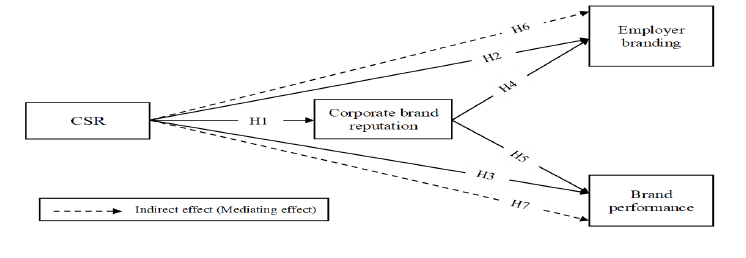
Building on the previous discussion, the proposed research model has been developed using insights from earlier studies (Kowalczyk & Kucharska, 2020; Özcan & Elçi, 2020; Verčič & Ćorić, 2018), as shown in Figure 1.
3.Methodology
3.1 Measurement Scale
The research model includes four reflective variables, as presented in Figure 1. Such variables have been measured using validated multiple-item scales adapted from prior studies (see Appendix 1). CSR has been measured through a four-item scale adapted from Kowalczyk and Kucharska (2020). Four items taken from Verčič and Ćorić (2018) were used to measure corporate brand reputation. Employer branding was measured by four indicators adapted from Özcan and Elçi (2020). A four-item scale from Kowalczyk and Kucharska (2020) has been used to assess performance.
3.2 Sampling and Data Gathering
The population of this study comprises employees from Karachi’s four major banks in Pakistan: three private banks (HBL, MCB, and UBL) and one public bank (NBP). These banks were selected based on their overall CSR score, disclosed from 2008 through 2020, and indicate the employer brand ranking and the best place to work in Pakistan (Szegedi et al., 2020). This research employed purposive sampling, a non-probability technique, within a quantitative methodology. Consequently, the primary data were gathered through a self-administered questionnaire from employees working at the selected banks. The first section of the questionnaire covered demographic questions such as age, gender, experience, and designation. The constructs-associated items are covered in the second section. These items were scored using a seven-point Likert scale, with 1 indicating strong disagreement and 7 indicating strong agreement. Workers with at least one year of employment were asked to provide the data between March 2021 and May 2021 because they were familiar with the bank and its CSR policies. Out of 430 questionnaires distributed, 254 responses were gathered and deemed genuine for further analysis. Regarding demographics, 61% of the respondents were female, and 39% were male. The respondents’ average years of experience ranged from less than three years to more than five years for 39%, 33%, and 28%, respectively. Age-wise, 36% were under 25, 35% were between 25 and 45, and 29% were between 46 and 60. Of them, 11% were senior managers, 37% were managers, and 52% were employees.
4.Results
The PLS-SEM method, which depends on SmartPLS software, is employed in the current study to analyse the collected data. The PLS-SEM technique consists of two steps: an assessment of the measurement model and an assessment of the structural model (Hair et al., 2020). PLS-SEM is a suitable tool for assessing complex structural frameworks with several variables that have direct and indirect linkages to one another (Manley et al., 2021). It is an analytical technique widely used in various contexts and disciplines (Gam et al., 2023; Ismail et al., 2022; Khalifa et al., 2023; Mekawy et al., 2022), including the finance and economics area (Alkathiri & Soliman, 2022; Heriyati et al., 2024).
4.1 Assessment of the Measurement Model
Table 1 shows the assessment of the outer (measurement) model. Firstly, the constructs and items are internally consistent, as indicated by the factor loading values of the items being greater than 0.7. Additionally, construct reliability is supported because the composite reliability (CR) and Cronbach's alpha (α) values for all variables are above 0.7 (Hair et al., 2020). Moreover, the AVE (average variance extracted) values are higher than 0.5, confirming convergent validity.
Table 1 The measurement model
| Construct | Item | Loading | CR | α | AVE | VIF |
| CSR | CSR-1 | 0.892 | 0.934 | 0.905 | 0.779 | 3.287 |
| CSR-2 | 0.937 | |||||
| CSR-3 | 0.836 | |||||
| CSR-4 | 0.864 | |||||
| CBR | CBR-1 | 0.892 | 0.898 | 0.848 | 0.690 | 2.557 |
| CBR-2 | 0.796 | |||||
| CBR-3 | 0.892 | |||||
| CBR-4 | 0.731 | |||||
| EB | EB-1 | 0.830 | 0.942 | 0.905 | 0.803 | 2.087 |
| EB-2 | 0.950 | |||||
| EB-3 | 0.934 | |||||
| EB-4 | 0.866 | |||||
| BP | BP-1 | 0.874 | 0.947 | 0.925 | 0.816 | 2.614 |
| BP-2 | 0.918 | |||||
| BP-3 | 0.930 | |||||
| BP-4 | 0.891 | |||||
| Note: CSR= Corporate social responsibility; CBR= Corporate brand reputation; EB= Employer brand; BP= Brand performance; CR= Composite reliability; AVE= Average variance extracted; α= Cronbach’s Alpha | ||||||
Source: own elaboration.
Additionally, two methods were used in the current study to evaluate discriminant validity. The first method is the Fornell and Larcker (1981) criterion, which states that a construct must have greater variance within its item than another. Discriminant validity is supported by the diagonal cell (in bold) of Table 2, which displays the square root of AVE for each variable and is larger than its association with other elements. The second method is the Heterotrait-Monotrait (HTMT) ratio (Henseler et al., 2015). The discriminant validity is established if the HTMT value is less than 0.90. Table 2 validates all latent constructs, confirming their sufficient discriminant validity. Furthermore, the absence of common method bias/variance and multicollinearity-related concerns in our work is supported by the VIF values being less than 5 (Table 1) (Kock & Lynn, 2012).
4.2 Assessment of the Structural Model
Numerous metrics were used to assess the inner (structural) model and test the research hypotheses, including the path coefficient, t value, and p value. According to the results shown in Table 3, CSR positively and significantly affected CBR (β=0.716, t=11.796, P=0.000). Consequently, H1 is approved. The results also showed that CSR positively and significantly impacted EB (=0.498, t= 2.776, P=0.003) and BP (=0.612, t= 5.240, P= 0.034). H2 and H3 are hence both supported. The results showed a significant relationship between CBR and EB, which support H4 (=0.510, t=3.819, P=0.000). The findings also supported H5, which states that CBR and BP are significantly and positively correlated (β=0.191, t= 1.825, P=0.034).
Furthermore, this study follows the guidelines of Preacher and Hayes (2008), using the bootstrapping approach and bias-corrected (BC) 95% confidence intervals to explore the mediating impact of CBR. The results of PLS-SEM show that CBR has a significant mediating effect in the association between CSR and EB (β=0.357, t=3.233, P=0.001) as well as in the association between CSR and BP (β =0.137, t=1.669, P=0.048). Therefore, H6 and H7 are accepted.
Table 3 Hypotheses testing
| Hypotheses | Path coefficient (β) | T-Statistics | P-value | Decision |
| Direct effect | ||||
| H1: CSR(CBR | 0.716 | 11.769 | 0.000 | Accepted |
| H2: CSR(EB | 0.498 | 2.776 | 0.003 | Accepted |
| H3: CSR(BP | 0.612 | 5.240 | 0.034 | Accepted |
| H4: CBR(EB | 0.510 | 3.819 | 0.000 | Accepted |
| H5: CBR(BP | 0.191 | 1.825 | 0.034 | Accepted |
| Indirect effect (mediation) | ||||
| H6: CSR(CBR(EB | 0.357 | 3.233 | 0.001 | Accepted |
| H7: CSR(CBR(BP | 0.137 | 1.669 | 0.048 | Accepted |
Source: own elaboration.
5.Discussion
The study’s findings revealed a strong and positive relationship between employee perceptions of CSR and brand reputation. This implies that when a bank deploys high levels of CSR, its reputation could be improved significantly. This improvement is attributed to the positive employee perception and increased trust that result from their ethical and community-focused initiatives. This result is in line with earlier research (Hassan & Soliman, 2021; Kowalczyk & Kucharska, 2020; Özcan & Elçi, 2020), which indicated that reputation is regarded as a key result of CSR practices within different domains. The second hypothesis is supported by the finding that CSR and employer branding have a significant and positive association. This finding implies that high employee perceptions of CSR could significantly enhance employer branding in the banking sector. This result is consistent with past studies such as Verčič and Ćorić (2018) and Kowalczyk and Kucharska (2020), which demonstrated how CSR could improve employer branding. Additionally, the results indicated that CSR has a significant and positive link with brand performance, supporting the third hypothesis. This indicates that positive employee perceptions of CSR can enhance brand performance in the banking sector. In other words, employees who perceive their bank as socially responsible tend to be more engaged and motivated, resulting in an overall better performance. This outcome is in line with prior studies (e.g., Kao et al., 2018; Lai et al., 2010; Wang et al., 2015), which showed that CSR is one of the major factors influencing organisations’ performance.
Furthermore, the empirical findings revealed that brand reputation positively and significantly influences employer branding. This finding suggests that higher brand reputation results in greater employer branding in the banking sector and is consistent with previous studies (Özcan & Elçi, 2020; Verčič & Ćorić, 2018) that have shown a positive correlation between brand reputation and employer branding. Similarly, the study’s results found that brand reputation positively and significantly influences brand performance. This implies that enhancing a brand’s reputation can improve overall performance, such as higher market share, sales growth, and overall success. This result is consistent with prior studies (López-Pérez et al., 2018; Stanaland et al., 2011; Verčič & Ćorić, 2018) showing a positive impact of corporate reputation on brand performance.
The empirical findings also showed that brand reputation plays a significant intervening role in the relationship between CSR (as a predictive construct) and employer branding and performance (as outcome constructs). Such results prove that brand reputation is a crucial link between the banking sector's CSR, employer branding, and brand performance. In other words, a strong brand reputation mediates the positive effects of CSR on how a brand is perceived as an employer and its overall performance. This also supports the results provided by past research (e.g., Cowan & Guzman, 2020; Pratihari & Uzma, 2018).
5.1 Theoretical Implications
From a theoretical perspective, the results of the current work present various implications for theory. The results contribute to the body of knowledge concerning the essential consequences of CSR in the finance and economics fields, particularly in the banking sector. In addition, this research article represents a notable contribution by being among the few efforts exploring the impact of CSR on brand reputation, employer branding, and performance, specifically focusing on the banking sector in developing nations such as Pakistan. As a result, this research contributes to a thorough understanding of employees’ perceptions of CSR practices in the banking industry. In this vein, it is evident that most empirical past studies are limited to consumers’ perceptions of CSR practices. By exploring these connections within this context, the paper addresses a significant gap in the literature, offering new insights into how CSR initiatives influence these critical business dimensions in developing nations.
Additionally, the findings enhance existing research by illustrating how brand reputation substantially affects employer branding and performance in the banking sector. By elucidating the interactions among such variables, the paper highlights the critical role of brand reputation in boosting employer branding and achieving superior performance. In other words, the findings demonstrate that a strong reputation fortifies employer branding and fosters better organisational performance, bridging the knowledge gap in this regard.
Furthermore, assessing the mediating role of corporate brand reputation in the structural relationships between CSR, employer branding, and brand performance does offer a crucial theoretical implication. This is particularly valuable given the scarcity of prior research unveiling these connections in depth, especially in the service industry, including the banking sector. By testing such a role, the present study fills a critical gap in the literature and enhances scholars’ understanding of the dynamic interplay among these variables, providing a more nuanced perspective on how CSR initiatives can impact employer branding and performance outcomes through the lens of corporate reputation.
5.2 Practical Implications
Practically, the current paper produces crucial managerial implications for managers in the banking sector. Firstly, it introduces a new paradigm of research and practical guidelines regarding CSR practices by investigating the perspectives of internal stakeholders (i.e., employees) and explaining the key outcomes of their perception towards CSR in their banks. The empirical results demonstrate that CSR is crucial for building banks’ brands, strengthening their performance, and improving their reputation. In other words, bank managers are urged to support employees' perceptions regarding CSR activities. This might be accomplished by educating staff members about CSR procedures at banks, including them in decision-making processes, and allowing them to express their opinions and provide feedback efficiently. In addition, the paper’s findings represent solid evidence for policymakers and practitioners in the banking industry, outlining the key challenges and opportunities faced by enterprises in developing economies (i.e., Pakistan) regarding CSR and its broader outcomes.
Moreover, managers or senior management must comprehend how important other stakeholders’ satisfaction is to the company’s success and how important it is to keep this in mind when strategically planning CSR. The extent and specifics of a company's CSR practices must be communicated to its employees consistently and understandably; it has been mentioned that people prefer to work for socially responsible businesses because they believe these organisations give their employees more opportunities for personal development (Du et al., 2010; El Akremi et al., 2018; Lei et al., 2021). Another managerial implication drawn from the research findings is that future employer branding, brand reputation, and sustainable brand performance are in the hands of CSR practices. Therefore, it can be inferred that if businesses try to engage in CSR, their brands will be recognised more for it. This may also benefit their reputation and increase the performance and value of their employer branding (Kucharska, 2020; Verčič & Ćorić, 2018). Furthermore, the research results hold valuable guidance and insights for businesses seeking to effectively harness their reputation and brand to gain competitive advantages and operational excellence, thereby advancing practical applications.
6. Conclusions
Drawing on stakeholder theory (Parmar et al., 2010), this study investigated the effect of CSR on brand reputation, employer branding, and performance while considering the mediating role of brand reputation in the banking sector in Pakistan. PLS-SEM was used to analyse primary data collected from employees working at four banks in Pakistan. The empirical results supported the research hypotheses and offered theoretical and managerial implications.
However, some limitations related to the current research should be considered in subsequent studies. First, this article gathered data from staff at four banks in Pakistan through a questionnaire, which may restrict the applicability of the findings. To enhance generalisability, it is recommended that the research model be tested using samples from multiple nations. A cross-country empirical study is recommended for future research. The second limitation is related to the research model and its associated variables. As previously discussed, the research framework involves an independent variable (CSR), a mediator variable (brand reputation), and two dependent variables (employer branding and brand performance). Thus, future studies should incorporate additional variables such as intellectual capital or servant leadership (Elzek et al., 2024). The study model could also be expanded by including other factors, considering customer-related perspectives, such as brand loyalty and attachment (Gam et al., 2023), corporate image and e-WoM (Soliman, 2021). Expanding the current research framework could provide a broad understanding of the predictability of brand performance and employer branding in the banking sector from different perspectives. The next limitation relates to sampling techniques. In this respect, this paper employed a non-probability sampling method (i.e., purposive sampling). Consequently, it is advised that future studies use probability sampling techniques. Using mixed-method techniques and other advanced methodologies to improve current research methods is a noteworthy avenue for future study (Mekawy et al., 2022). Another limitation concerns the sample. This paper mainly focused on the perceptions of workers at banks. Future research should evaluate how other stakeholders, such as bank customers, perceive CSR and its outcomes in their banks. With valuable results and insights, CSR and its effects on the banking industry could be addressed in-depth. A multi-group analysis is recommended for further work.

