




 Inglês (pdf)
 Artigo em XML
 Referências do artigo
 Tradução automática
 Enviar este artigo por email
 Citado por SciELO
  Similares em
SciELO
Similares em
SciELO 
 Permalink

1. Introduction
The silence can have devastating consequences, as history demonstrates. One example occurred on January 28, 1986, with the explosion of NASA's Challenger space shuttle, 73 seconds after launch, resulting in the death of all seven crew members. Before the STS-51-L mission, engineers at Morton Thiokol had already identified risks in the sealing rings, particularly in low temperatures. However, NASA's organizational culture discouraged dissent, leading the contractor to succumb to pressure to avoid delaying the schedule. The fear of retaliation prevented concerns from being properly communicated, resulting in tragedy (Mahler, 2009).
This demonstrates that, although silence may seem beneficial in avoiding hierarchical tensions, it can prevent the sharing of crucial information, leading to catastrophic consequences. In organizational settings, employees often identify problems and have suggestions to improve processes (Wilkinson, Barry & Morrison, 2020). However, low psychological safety may cause their voices to remain unheard, contributing to organizational stupidity (Hao et al., 2021).
Thus, this study seeks to address the following questions: How does psychological safety shape different types of employee silence (defensive, diffident, relational, ineffectual, and deviant)? In what ways does psychological safety mediate the relationship between sociodemographic variables (sex, education, and seniority) and employee silence? What are the practical implications of psychological safety-or its absence-for organizational management, particularly in fostering a more open work environment?
This study innovates by not treating employee silence as a unidimensional construct, allowing for a more in-depth analysis by specifying different types of silence. The research also explores the concept of deviant silence, expanding the understanding of this phenomenon. Furthermore, the literature on employee silence has placed little emphasis on practical solutions for managers. In this regard, this study provides comprehensive strategies to help mitigate the negative effects of silence.
While the literature often relies on student samples, this research uses a sample of employees from an aviation company. In this highly regulated context, perceptions of psychological safety emerge from a shared organizational dynamic in which silence can put lives at risk.
2. Employee Silence
Employee silence refers to intentionally withholding information, suggestions, or concerns that could contribute to decision-making (Al-Dhuhouri, Mohd-Shamsudin & Bani-Melhem, 2024). This phenomenon has been widely studied in the organizational behavior literature, as it is directly related to organizational performance, innovation, and employee well-being (Maqbool, Černe, & Bortoluzzi, 2019). The literature on employee silence highlights that this behavior can be influenced by individual, interpersonal, and organizational factors (Mohammad, Nazir & Mufti, 2023).
At the individual level, personality traits and previous experiences of retaliation can determine an employee’s willingness to remain silent (Crant, Kim & Wang, 2011; Maynes & Podsakoff, 2014). The interpersonal level emphasizes the relationship between employees and authority figures, suggesting that perceptions of justice can reduce silence (Milliken et al., 2003; Vakola & Bouradas, 2005). Studies indicate that leaders who value employee input can significantly reduce defensive and relational silence, as employees feel more comfortable sharing their perceptions without fear of retaliation or deterioration of interpersonal relationships (Tangirala & Ramanujam, 2012). On the other hand, authoritarian leadership styles tend to reinforce a culture of silence, preventing the flow of information (Vries et al., 2012). At the macro level, organizational structures can reinforce implicit norms about what can or cannot be said (Morrison & Milliken, 2000). Highly hierarchical companies often foster employee silence by creating formal and informal barriers to upward communication (Kwon & Farndale, 2020). Moreover, the absence of formal feedback channels can reinforce the perception that voicing concerns will have no significant impact, promoting a cycle of silence (Hou et al., 2024). The literature also suggests that cultures with high power distance, where hierarchical inequality is more accepted, tend to exhibit higher levels of employee silence (Gustiawan et al., 2023). In these contexts, employees often perceive that expressing concerns could be seen as a challenge to authority. Additionally, the emphasis on group harmony in collectivist cultures may discourage disruptive behaviors (Panaccio et al., 2015).
Despite the dichotomy between employee silence and employee voice, some authors argue that these phenomena are not two extremes of the same continuum but rather distinct processes mediated by different psychological mechanisms (Morrison, 2023). While employee voice is associated with the Behavioral Activation System (BAS), which stimulates the expression of ideas, silence is often driven by the Behavioral Inhibition System (BIS), which regulates self-protection in threatening environments (Sherf et al., 2021). Thus, employee silence is not merely an absence of communication but a strategic choice employees make to navigate the organizational context.
Although silence may, in some cases, serve as a self-preservation mechanism, its consequences are predominantly negative. Studies indicate that employees who frequently withhold concerns are perceived as less committed to their work (Maqbool et al., 2019). Furthermore, companies that fail to promote a psychologically safe environment struggle to detect problems, making them more vulnerable to crises (Mohammad, Nazir & Mufti, 2023).
Given the relevance of employee silence in organizational dynamics, it is crucial to further investigate the factors that can mitigate it, among which psychological safety appears to play a central role. However, few studies have validated the relationship between these two constructs in a multidimensional framework. When employees perceive that they can communicate without fear of retaliation, a significant reduction in silence is expected, fostering innovation.
2.1 Defensive Silence
Defensive silence (DS) is a proactive behavior in which employees withhold ideas, information, and opinions to avoid reprimands from supervisors (Newman, Donohue & Eva, 2017; Van Dyne, Ang & Botero, 2003; Yao et al., 2022). An example is an employee who witnesses a mistake but chooses not to report it to avoid causing problems for themselves.
The literature suggests that defensive silence is associated with the use of avoidance coping strategies (Kish-Gephart et al., 2009). The transactional stress model (Lazarus & Folkman, 1984) explains that when faced with a threatening situation (primary appraisal), individuals assess their options (secondary appraisal) and may adopt avoidance responses, such as silence, to reduce risks (Inman & Yeh, 2007).
Empirical studies reinforce this relationship. Brinsfield (2012) demonstrated that fear of retaliation is a key determinant of defensive silence. Whiteside and Barclay (2013) found that organizational justice positively influences this type of silence.
Another contributing factor is ostracism. This phenomenon acts as a psychological stressor, leading employees to avoid interactions that could make them vulnerable, thereby increasing the incidence of defensive silence (Jahanzeb et al., 2018). Furthermore, emotional exhaustion can mediate this relationship, as emotionally drained employees have fewer psychological resources to cope with adversity, making them more likely to adopt avoidance strategies, including silence (Shaukat & Khurshid, 2022).
Defensive silence restricts organisational communication and weakens interpersonal trust (Jahanzeb et al., 2018). Psychological safety appears to play a crucial mitigating role in this process.
H1: Psychological safety has a significant negative effect on defensive silence.
2.2 Diffident Silence
Diffident silence (DifS) manifests as a passive, timid behavior in which employees hesitate to express their opinions. This hesitation, in turn, can make them more susceptible to mistreatment by superiors (Krishna, Soumyaja & Sowmya, 2023). An example occurs when an employee has a suggestion to improve process efficiency but decides not to share it for fear of their idea being ridiculed.
The literature suggests that diffident silence is closely related to personality traits, particularly neuroticism, which involves a greater tendency toward insecurity (Clercq, Jahanzeb & Fatima, 2021). Brinsfield (2012) also notes that this type of silence resembles the spiral of silence phenomenon, in which individuals hesitate to express dissenting opinions for fear of social rejection.
Beyond individual traits, organizational cultures that emphasize strict hierarchies, discourage idea-sharing, and have low psychological safety tend to increase the incidence of this type of silence (Brinsfield, 2012; Chou & Chang, 2020). For instance, in cultures characterized by high power distance, there is an expectation of obedience to authority, discouraging employees from speaking up and reinforcing diffident silence (Gustiawan et al., 2023). Workplace bullying can also intensify this behavior (Krishna, Soumyaja & Sowmya, 2023).
Environments where employees feel safe to express ideas promote more open communication and reduce this type of silence (Brinsfield, 2012; Krishna, Sou-dmyaja & Sowmya, 2023).
H2: Psychological safety has a significant negative effect on diffident silence.
2.3 Relational Silence
Relational silence (RS) refers to the intentional withholding of ideas, information, and opinions to preserve interpersonal relationships (Wu & Li, 2023). For example, a team member may identify a colleague’s mistake that could compromise project quality. However, instead of pointing out the error during a meeting, they choose to speak to the colleague privately or, in some cases, decide not to mention it at all to avoid tensions. This dynamic reflects the dilemma between interpersonal loyalty and organizational transparency (Rai & Koodamara, 2025).
Studies indicate that relational silence can be driven by social support. Kızrak and Yeloğlu (2023) concluded that an organization's commitment to learning positively influences employees' prosocial silence, with perceived organizational support partially mediating this relationship. On the other hand, Jamil et al. (2023) found that psychological safety influences relational and deviant silence in the context of organizational ostracism.
Leadership also plays a key role in the manifestation of relational silence. When employees perceive their managers as approachable, the need to protect relationships through silence decreases, as there is greater confidence that disagreements will be handled respectfully (Wu & Li, 2023).
Moreover, relational silence can have significant implications for innovation. Employees who avoid expressing opinions to prevent discomfort may limit collective creativity (Lee et al., 2022; Maqbool et al., 2019). Morrison and Milliken (2000) highlight that excessive silence can lead to a stagnant organizational culture, where growth opportunities are lost.
Therefore, when employees feel they can voice concerns without compromising their interpersonal relationships, the need for silence tends to decrease (Lee & Dahinten, 2021).
H3: Psychological safety has a significant negative effect on relational silence.
2.4 Ineffectual Silence
Ineffectual silence (IS) refers to the withholding of information, opinions, and ideas by an employee due to feelings of resignation, low self-esteem, limited decision-making ability, lack of confidence in the value of their contributions, and a tendency toward inaction (Dedahanov et al., 2021). This form of silence is characterized by passivity rather than active participation (Yao et al., 2022).
For example, an employee may have suggestions for improving customer service but chooses not to share them, believing that management disregards frontline employees' suggestions due to past dismissals.
Anwar, Kee, and Ahmed (2020) indicated that, in response to cyberbullying, employees tend to remain silent to conserve resources. Ahmadian, Astrabeh, and Ejrami (2023) investigated the mediating role of organizational silence, including defensive, relational, and ineffectual silence, in the effect of organizational trust on organizational commitment. However, the results did not confirm the mediating role of ineffectual silence in this relationship.
Dedahanov et al. (2021) concluded that abusive supervision is positively related to ineffectual silence, as employees believe that their opinions will not be considered. Bari, Ghaffar, and Ahmad (2020) found that knowledge-hiding behaviors are associated with ineffectual silence, as employees use them as a strategy to safeguard their jobs.
These studies emphasize that ineffectual silence is often a response to an organizational culture that devalues employee voice. Therefore, low psychological safety can lead to an increase in ineffectual silence.
H4 Psychological safety has a significant negative effect on ineffectual silence.
2.5 Deviant Silence
Deviant silence (DeS) is a form of deviant workplace behavior (e.g., sabotage, improper disclosure of information, procrastination, lying, and theft). Employees exhibiting this behavior deliberately aim to mislead their superiors and colleagues (Khan et al., 2022). For example, an employee may be aware of a security flaw in the company’s IT systems but chooses not to report it, hoping it will create difficulties for management with whom they have a conflict.
Knoll & Van Dick (2013) measured four forms of organizational silence, concluding that deviant silence can be a response to unfair supervision and is particularly common in organizations with high levels of interpersonal conflict.
Sharu and Manikandan (2019) argue that deviant silence can have serious consequences for organizations, including failures in error detection, a decline in service quality, and increased employee turnover. They suggest that this type of silence often reflects inadequate organizational policies.
Thus, deviant silence can be used as a form of retaliation, especially in contexts with low psychological safety (Brinsfield, 2012;
Imam & Kim, 2022; Kızrak & Yeloğlu, 2023).
H5: Psychological safety has a significant negative effect on deviant silence.
3. Psychological Safety at the Individual Level
Psychological safety (PS) can be analyzed at three levels: individual, group, and organizational (Edmondson & Lei, 2014). At the individual level, it refers to an employee's confidence in expressing ideas, concerns, or admitting mistakes without fear of reprimands. This level is crucial for psychological well-being (Dehkharghani et al., 2022). However, when employees perceive potential risks to their professional image, interpersonal relationships, or position within the company, they may choose to remain silent as a self-preservation strategy (Hao et al., 2021; Ju et al., 2019).
The absence of psychological safety can stem from a culture of fear (Liang, Farh & Farh, 2012). Edmondson (1999), through surveys with employees across various industries, demonstrated that when employees perceive psychological safety, they are more likely to speak up without fear of retaliation. Similar findings were reported by Kolbe et al. (2020). Likewise, Liang, Farh, and Farh (2012) concluded that the absence of psychological safety leads to silence, negatively impacting organizational performance.
Studies indicate that psychological safety enables employees to face workplace challenges with confidence. Wang et al. (2020), for instance, examined 300 Turkish hospitality industry workers and found that error tolerance enhanced psychological safety, which, in turn, helped employees perceive mistakes as learning opportunities rather than threats to their image. Other studies have shown that psychological safety can reduce organizational inequalities, fostering a more equitable environment (Hora et al., 2021).
The growing body of literature on psychological safety also highlights the critical role of leadership in this process. Supervisors who demonstrate openness to dialogue, transparency, and emotional support contribute to a safer environment, where employees feel encouraged to take interpersonal risks without fear of negative repercussions (Frazier & Tupper, 2018). In a study of nearly 600 employees at a Chinese telecommunications company, Liu et al. (2015) found that psychological safety mediated the relationship between authentic leadership and employee voice.
Beyond leadership, organizational culture also determines the promotion or inhibition of psychological safety. Companies that foster diversity tend to exhibit higher levels of psychological safety, leading to a more collaborative organizational climate (Singh et al., 2013). Similarly, a study conducted by Yoon & Solomon (2017) in South Korean companies revealed that a psychologically safe environment can help stabilize organizations under pressure.
However, despite extensive evidence on the benefits of psychological safety, the literature still tends to focus primarily on the team level, following the pioneering studies of Edmondson (1999). Therefore, this research focuses on the relationships between employees and their supervisors (individual level).
4. Psychological Safety and Sociodemographic Variables
4.1 Psychological Safety and Sex
Cultural expectations shape how men and women behave in the workplace. Studies indicate that women may face additional pressure to maintain harmony in interpersonal relationships, being encouraged to adopt a conciliatory communication style (Hatipoglu & Inelmen, 2018; Köse & Köse, 2019; Neculaesei, 2015). This factor may contribute to women being more prone to avoiding expressions of disagreement, limiting their participation in organizational decision-making (Eagly & Wood, 1999).
On the other hand, men, in accordance with traditional masculinity norms, may be more encouraged to adopt confrontational positions (Eagly & Wood, 1999; Köse & Köse, 2019). This difference in communication styles may impact how men and women exert influence in the workplace, affecting their propensity to express themselves.
H6.1: Sex has a significant negative effect on psychological safety.
4.2 Psychological Safety and Education
The educational level of an employee is directly associated with the development of critical skills, self-confidence, and communication abilities, influencing their predisposition to express themselves in the workplace, even in adverse contexts (Hatipoglu & Inelmen, 2018).
H6.2: Education has a significant negative effect on psychological safety.
4.3 Psychological Safety and Seniority
More senior employees may have experienced situations where their opinions were disregarded, leading to a more passive behavior in which they prefer not to speak up to avoid frustration (Jesevičiūtė-Ufartienė, Brusokaitė & Widelska, 2020). On the other hand, these employees may also avoid conflicts that could jeopardize their position or relationships within the team (Hatipoglu & Inelmen, 2018). This behavior may result in the adoption of strategic silence.
H6.3: Seniority has a significant negative effect on psychological safety.
5 Psychological Safety as a Mediator Between Sociodemographic Variables and Silence
The relationship between sociodemographic variables (sex, education, and seniority), psychological safety, and different types of silence has received little attention in the literature. Some studies suggest that sociodemographic variables do not significantly affect the adoption of silence (Jesevičiūtė-Ufartienė, Brusokaitė & Widelska, 2020; Köse & Köse, 2019), while others indicate that they may play an important role depending on the level of psychological safety in the work environment (Hatipoglu & Inelmen, 2018). In contexts of high psychological safety, employees tend to feel more encouraged to express their opinions without fear of retaliation (Edmondson & Lei, 2014). However, when psychological safety is low, sociodemographic characteristics may impact different forms of silence, reflecting social norms, previous professional experiences, and perceptions of the risks associated with open communication (Gustiawan et al., 2023).
5.1 Defensive Silence and Sociodemographic Variables
Studies suggest that women may be more prone to defensive silence due to gender norms that discourage confrontation (Eagly & Wood, 1999; Hatipoglu & Inelmen, 2018). In situations of low psychological safety, these norms may be reinforced, leading women to avoid expressing opinions for fear of negative repercussions.
H7.1: Psychological safety negatively mediates between sex and defensive silence.
Education may reduce defensive silence, considering that higher levels of academic training tend to develop critical thinking, making individuals more confident in expressing their ideas (Hatipoglu & Inelmen, 2018). However, when psychological safety is low, even highly educated employees may resort to defensive silence to avoid negative consequences.
H7.2: Psychological safety negatively mediates between education and defensive silence.
Seniority may increase defensive silence, as more experienced employees may have faced reprimands or organizational resistance over time, making them more cautious (Jesevičiūtė-Ufartienė, Brusokaitė & Widelska, 2020). If psychological safety is low, employees with longer tenure may have learned that expressing concerns rarely results in positive changes, reinforcing their tendency toward defensive silence.
H7.3: Psychological safety negatively mediates between seniority and defensive silence.
5.2 Diffident Silence and Sociodemographic Variables
Women may exhibit greater hesitation in communication, especially in organizational contexts where they are expected to be more conciliatory (Hatipoglu & Inelmen, 2018; Köse & Köse, 2019; Neculaesei, 2015). This insecurity may be exacerbated when psychological safety is low, leading them to avoid speaking up to prevent being perceived as disruptive.
H8.1: Psychological safety negatively mediates between sex and diffident silence.
Education may reduce diffident silence, as higher educational levels are associated with the development of interpersonal skills and greater self-confidence in expressing opinions (Hatipoglu & Inelmen, 2018). However, if psychological safety is low, even employees with higher education may hesitate before speaking out, fearing that their ideas will be devalued.
H8.2: Psychological safety negatively mediates between education and diffident silence.
Seniority may be associated with increased diffident silence, as employees with longer tenure may have experienced rejection of their contributions (Jesevičiūtė-Ufartienė, Brusokaitė & Widelska, 2020). When psychological safety is low, the accumulation of negative experiences may reinforce this hesitation.
H8.3: Psychological safety negatively mediates between seniority and diffident silence.
5.3 Relational Silence and Sociodemographic Variables
Women, due to cultural norms that encourage them to maintain social harmony, may be more prone to relational silence (Hatipoglu & Inelmen, 2018; Neculaesei, 2015). When psychological safety is low, this tendency may be amplified, leading women to avoid discussions to prevent harming interpersonal relationships.
H9.1: Psychological safety negatively mediates between sex and relational silence.
Education may decrease relational silence, as employees with higher academic qualifications may have greater awareness of organizational dynamics, developing communication skills that allow them to express concerns strategically without compromising professional relationships (Hatipoglu & Inelmen, 2018). However, if psychological safety is high, employees may feel even more comfortable expressing their opinions.
H9.2: Psychological safety negatively mediates between education and relational silence.
Seniority may be associated with relational silence, as more experienced employees tend to value the stability of their workplace relationships, avoiding the exposure of sensitive issues that may generate tensions (Jesevičiūtė-Ufartienė, Brusokaitė & Widelska, 2020). In environments with low psychological safety, this behavior may be reinforced.
H9.3: Psychological safety negatively mediates between seniority and relational silence.
5.4 Ineffectual Silence and Sociodemographic Variables
Women, due to social norms that often associate their communication with a supportive role, may be more prone to ineffectual silence, especially in environments where they feel their voices are not valued (Eagly & Wood, 1999; Köse & Köse, 2019). In situations of low psychological safety, this tendency may be exacerbated, leading women to believe that expressing their opinions will have no impact.
H10.1: Psychological safety negatively mediates between sex and ineffectual silence.
Education may reduce ineffectual silence, as employees with higher educational levels tend to be more confident in their skills (Hatipoglu & Inelmen, 2018). However, if psychological safety is low, even highly qualified employees may perceive that their opinions are not taken seriously, leading them to adopt ineffectual silence as a mechanism to protect themselves from frustration.
H10.2: Psychological safety negatively mediates between education and ineffectual silence.
Seniority may increase ineffectual silence, as more experienced employees may have gone through situations where their suggestions were ignored, reinforcing the idea that their voice has little impact (Jesevičiūtė-Ufartienė, Brusokaitė & Widelska, 2020). In environments with low psychological safety, these employees may refrain from expressing opinions, believing that their contributions will be disregarded.
H10.3: Psychological safety negatively mediates between seniority and ineffectual silence.
5.5 Deviant Silence and Sociodemographic Variables
Women may be less prone to deviant silence due to socialization that emphasizes maintaining harmonious workplace relationships (Eagly & Wood, 1999; Köse & Köse, 2019). However, if psychological safety is low and the environment is perceived as unjust, this gender difference may be reduced, leading women to adopt deviant silence as a form of passive resistance.
H11.1: Psychological safety negatively mediates between sex and deviant silence.
Education may reduce deviant silence, as employees with higher educational levels may have greater skills to resolve conflicts proactively (Hatipoglu & Inelmen, 2018). However, if psychological safety is low, even highly qualified employees may resort to deviant silence as an indirect retaliation strategy.
H11.2: Psychological safety negatively mediates between education and deviant silence.
Seniority may be positively associated with deviant silence, as more experienced employees, feeling that they no longer have influence within the organization, may adopt passive resistance strategies to express frustration (Jesevičiūtė-Ufartienė, Brusokaitė & Widelska, 2020). In environments with low psychological safety, these employees may withhold information as a form of protest.
H11.3: Psychological safety negatively mediates between seniority and deviant silence.
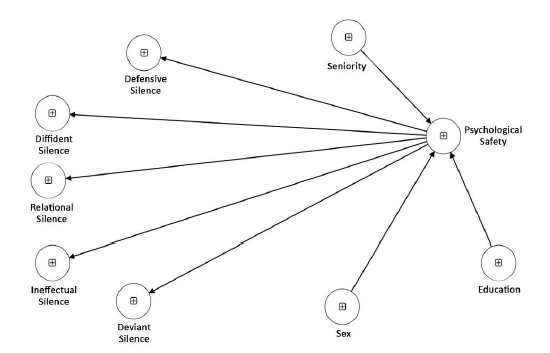
Figure 1 presents the structural model under study, illustrating the possible links between psychological safety, different types of silence, and sociodemographic variables (sex, education, and seniority). The solid lines indicate the direct effects of psychological safety on defensive, diffident, relational, ineffectual, and deviant silence. Additionally, the model allows for an assessment of whether sex, education, and seniority have direct effects on psychological safety. The ‘+’ signs within the circles denote that these variables are latent, meaning they are inferred from multiple indicators.
6. Materials and Methods
This study uses a quantitative approach. The instrument is structured with the dependent variable being employee silence and the independent variables being psychological safety and sociodemographic factors (sex, education, and seniority). For the measurement of defensive, diffident, relational, ineffectual, and deviant silences of the employee, the Brinsfield scale (2012) was used (7-point Likert scale). For the measurement of psychological safety at the individual level, the Edmondson scale (1999) was adapted (7-point Likert scale).
The sampling process was non-probabilistic. Data collection was conducted through an online survey, sent via email through the internal channels of a Portuguese aviation company and made available to all non-management employees. Participants were informed that the study was conducted by researchers external to the company. The results would be used exclusively for scientific purposes. Participation was voluntary and anonymous, allowing employees to respond freely without fear of retaliation or influence from their superiors.
Although this approach does not allow for the statistical generalization of results to the entire company population or the aviation sector, the sample includes a significant proportion of employees (486 out of a total of 1329), representing different levels of seniority, education, and interaction with management. To mitigate common method variance, respondent anonymity was ensured, reducing social pressure. Additionally, the order of questions was designed to minimize biased responses. Harman’s single- factor test was also conducted, where an unrotated exploratory factor analysis revealed that the first factor explained less than 50% of the total variance, indicating that common method bias does not compromise the study’s results (Podsakoff et al., 2003).
The Cronbach’s Alpha coefficient for both scales is 0.917 (above 0.8), confirming the internal consistency validity of the employee silence and psychological safety scales. Moreover, all subscales of employee silence exhibit Cronbach’s Alpha values ranging from 0.871 to 0.937, indicating good internal consistency for these subscales.
All participants were Portuguese. The majority (55.5%) of the respondents were male. 41.9% were between 35 and 44 years old, 36.4% between 25 and 34 years old, 11% between 45 and 54 years old, 5.5% aged between 18 and 24 years, and 5.2% aged between 55 and 64 years. 46.7% had a high school education, 29.2% had a bachelor’s degree, 10.1% had basic education, 7.2% had a postgraduate degree, and 6.8% had a master’s degree. Some respondents had been working in the same organization for more than 10 years (40%), followed by 6 to 10 years (28.6%), 3 to 5 years (20.4%), and 2 years or less (11%). 42.3% of the respondents reported being under the same supervisor for more than 5 years, 31.5% between 3 and 5 years, and 26.2% for less than 3 years. Regarding frequency of contact, 71.7% of employees interacted daily with their direct manager, 15.4% several times per week, and 12.9% less regularly (once a week or less). 62.8% of the participants had a permanent contract, while 37.2% had a fixed-term contract.
The decision to restrict the sample to a specific company in the aviation sector was made for several reasons. By focusing on a single organization, the study could better control the contextual variables that might influence employees’ perceptions of psychological safety and silence behavior. Different industries have distinct organizational cultures, management structures, and social norms, which could complicate the analysis of results. Considering Sürücü and Maslakci (2020), a controlled context allows for a more accurate analysis of the relationships between the studied variables.
The aviation sector was also chosen due to the unique characteristics of the work environment, which include high regulation, a focus on safety, and a dynamic and sometimes stressful work pace. These factors can significantly influence levels of psychological safety and silence tendencies. Focusing on a single organization also facilitates the implementation of interventions based on the study’s results.
7. Results and Discussion
The analysis of results was conducted using the Partial Least Squares Structural Equation Modeling approach, implemented in the PLS-SEM 4.0 software, focusing on evaluating the dimensions of the study on types of silence. The procedure included assessing the measurement framework and analyzing the structural relationships, following the guidelines of Hair et al. (2019).
7.1 Measurement Model Evaluation
The quality of the measurement model was verified through reliability criteria. The reflective loadings showed values above 0.5, demonstrating a good fit. Table 1 presents the reliability indicators of the model (Cronbach’s alpha, composite reliability, and average variance extracted [AVE]), as well as its convergent and discriminant validity.
The Cronbach’s alpha coefficients exceeded the 0.60 cutoff point established by Hair et al. (2006). Composite reliability ranged between 0,91 and 0,97, which is considered satisfactory according to Hair et al. (2019). Convergent validity, assessed through AVE, met the minimum criterion of 0.50 proposed by Henseler et al. (2015), as all values surpassed this threshold.
Table 1 Reliability and discriminant validity.
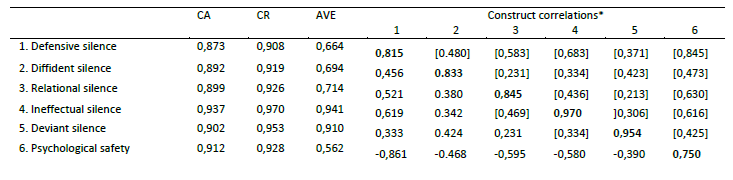
*Fornell-Larcker Criterion and Heterotrait-Monotrait Ratio (HTMT): The bolded values represent the square root of AVE; HTMT ratios are indicated in parentheses. The Fornell-Larcker criterion values are shown below the diagonal.
Discriminant validity was analyzed using the Fornell-Larcker criterion and the Heterotrait-Monotrait Ratio (HTMT), as proposed by Henseler et al. (2015), ensuring the distinction between constructs.
The Fornell-Larcker criterion (Fornell & Larcker, 1981) involves comparing the square root of AVE with correlations, where it is expected that, in most cases, the square root of AVE should be higher than the highest correlation of the respective construct.
The HTMT assesses correlations between items within and across constructs (Henseler et al., 2015), and values above 0.90 are considered problematic. In Table 1, all HTMT values are below this threshold, indicating no issues with discriminant validity.
7.2 Evaluation of Structural Model: Results and Discussion
The PLS-SEM technique was used in the study analysis. The path coefficients showed statistical significance for p <0.05 (Hajli, 2014). The model fit was evaluated using the Standardized Root Mean Square Residual (SRMR), which resulted in 0.058, a value below the
0.08 threshold, indicating a good fit (Hair et al., 2019). Additionally, the Variance Inflation Factors (VIF) were below 4.0, suggesting no multicollinearity issues (Henseler et al., 2015). Out of the twenty hypotheses tested, nine were confirmed (Table 2).
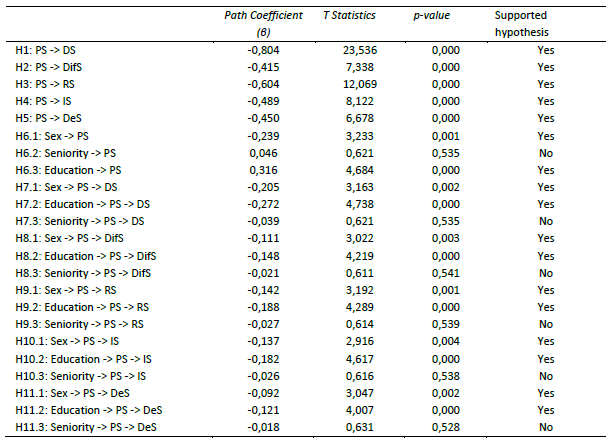
The results deepen the understanding of the influencers of silence, considering psychological safety and sociodemographic variables in employee-supervisor relationships. Sub-hypothesis 1 is supported, with psychological safety having a statistically significant negative effect on defensive silence (β= -0.804; p = 0.000). As observed, employees tend to fear retaliation when psychological safety is low, leading them to adopt defensive silence as a protective mechanism. Companies can implement various strategies to reduce defensive silence to foster a safer work environment. First, strengthening a culture of open communication, including regular active listening meetings, helps employees feel safe expressing opinions, concerns, and suggestions. Implementing anonymous reporting channels can be an alternative for those hesitant to speak up. Additionally, empathetic leadership and non-violent communication training can help managers better handle employee concerns while fostering respect for employee contributions. Another measure is the implementation of organizational policies that ensure employees are protected from retaliation. Companies should establish guidelines to prevent punitive actions against those who voice concerns. Promoting a sense of belonging can also reduce defensive silence. Companies can invest in inclusion programs to achieve this, reinforcing recognition of employee suggestions. Finally, it is crucial for companies to regularly assess psychological safety levels. Internal surveys, organizational climate assessments, and employee engagement analyses can help identify areas for improvement. Moreover, leaders should monitor management practices that may discourage open communication.
There is support for sub-hypothesis 2, reinforcing the negative impact of psychological safety on diffident silence (β= -0.415; p = 0.000). One approach to minimizing diffident silence is the implementation of mentoring programs, where interactions with mentors can create a safe space for timid employees to express their concerns without fear of ridicule. Additionally, structured brainstorming sessions can normalize participation from all team members: ensuring that each participant has an opportunity to contribute reduces the fear that only dominant voices will be heard. Furthermore, diffident silence is often linked to the fear of making mistakes. To reverse this perception, companies should reinforce a growth mindset, in which mistakes are seen as learning opportunities rather than punishable failures. This can be achieved through training, public recognition of innovative attempts (even if unsuccessful), and leaders communicating the importance of experimentation. Companies can also establish peer support networks, where employees feel encouraged to share concerns in smaller groups before bringing them to larger forums. Fear of public speaking can be mitigated when employees have the chance to validate their ideas in a mutually supportive environment.
Psychological safety has a statistically significant negative effect on relational silence (β = -0.604; p = 0.000), supporting sub- hypothesis 3. Companies should promote communication mediated by conflict management specialists to reduce relational silence. These professionals can create dialogue spaces where employees feel comfortable expressing concerns without negatively impacting their interpersonal relationships. Furthermore, companies should provide assertive communication training, ensuring employees know how to respectfully express their opinions. This can reduce the tendency to avoid difficult conversations out of fear of harming interpersonal ties. Another strategy is the use of anonymous team evaluations, where employees can express concerns about processes, group dynamics, or work relationships without exposing themselves directly. Managers should also emphasize that differences in opinion do not threaten interpersonal relationships but instead provide an opportunity for organizational growth. This can be achieved through regular team discussions that address challenges collaboratively.
This study suggests a significant negative impact of psychological safety on ineffectual silence (β= -0.489; p = 0.000), supporting sub-hypothesis 4. To mitigate ineffectual silence, companies can implement reward programs for organizational process improvements (e.g., financial bonuses, profit-sharing, gift cards, shopping vouchers, employee recognition in meetings, internal newsletters, or social media, promotions, funded training programs, extra days off, event tickets, and service subscriptions). When employees perceive that their suggestions lead to changes, the feeling of uselessness decreases, encouraging active participation. Additionally, creating multidisciplinary working groups for organizational problem-solving can help reduce ineffectual silence, allowing employees to participate in decision-making. These groups should include members from different departments and hierarchical levels, ensuring a diversity of perspectives. Another strategy is enhancing transparency. Ineffectual silence often arises from the perception that organizations make decisions without consulting employees. To reverse this, companies can introduce feedback meetings on strategic decisions, demonstrating how employee suggestions were incorporated or, if not, providing justifications for their exclusion. Moreover, excessively centralized organizational structures may cause employees to feel that their opinions carry no weight. Therefore, companies can encourage participative leadership, where managers demonstrate openness to dialogue. Companies should also implement training on respectful communication and reporting channels that allow employees to report abusive behaviors without fear of retaliation. Additionally, psychological safety has a significant negative effect on deviant silence (β=-0.450; p=0.000), supporting sub-hypothesis 5. This type of silence can be particularly harmful, as it creates an environment of distrust. To reduce deviant silence, companies should implement a zero-tolerance policy against workplace harassment, favoritism, and exclusion. Organizations must clearly communicate that any uncivil behavior will be investigated, ensuring that employees have safe channels to report misconduct. Another strategy is to ensure that all employees, regardless of position, are treated ethically. Transparency in performance evaluations, promotions, and conflict resolution processes can reduce perceptions of injustice, one of the main triggers of deviant silence. Companies can invest in collaborative interdepartmental projects, where employees from different areas work together toward common goals, reducing internal resentment. Additionally, deviant silence often arises from experiences of marginalization within the team. Leaders should be attentive to employees who show signs of disengagement, preventing these feelings from developing into intentional withdrawal. Companies can adopt reconciliation meetings facilitated by conflict management professionals, providing a safe space for tensions to be resolved constructively. Emotional intelligence training can equip employees with better coping strategies for frustration, preventing deviant silence.
Hypothesis H6.1 (Sex → PS) was confirmed (β = -0.239; p = 0.001), showing that women perceive lower psychological safety. Leaders should implement practices that promote women’s voice in organizational discussions. This can be done through training where leaders learn to reduce gender biases. Additionally, diversity committees can be created to ensure that all employees, especially women, have the opportunity to express their opinions without fear of retaliation. On the other hand, hypothesis H6.2 (Seniority
→ PS) was rejected, suggesting that seniority does not directly affect psychological safety (β = 0.046; p = 0.535). Leaders should, therefore, ensure that psychological safety is promoted at all hierarchical levels, especially in organizations with strong hierarchies. One solution could be the implementation of reverse mentoring programs, where employees with less time at the company can share their perceptions with more experienced colleagues. This creates an exchange of experiences and strengthens trust. Hypothesis H6.3 (Education → PS) was confirmed (β = 0.316; p < 0.001), indicating that education has a positive impact on psychological safety. One solution would be implementing training programs focused on effective communication skills and conflict resolution, ensuring employees feel confident in sharing ideas. This could include leadership courses for leaders, helping them to create a safer environment.
The results of hypothesis H7.1 (Sex → PS → DS) indicated that women, when perceiving low psychological safety, tend to adopt defensive silence (β = -0.205; p = 0.002). Leaders can create work environments where mistakes are seen as learning opportunities rather than personal failures. For example, implementing a "positive error" policy may be effective, where mistakes are openly discussed in meetings, and collaborative solutions are encouraged instead of punishments. This approach helps reduce the fear of retaliation, allowing women and other employees to feel more comfortable expressing concerns. Hypothesis H7.2 (Education → PS → DS) was also confirmed (β = -0.272; p < 0.001), suggesting that employees with higher educational levels are less likely to engage in defensive silence when they perceive a safe environment. One solution would be the creation of a two-way communication channel where employees can suggest improvements for organizational processes. Leadership should formalise this channel, ensuring that all employees, regardless of their educational background, feel motivated to contribute. Hypothesis H8.1 (β = 0.111; p = 0.003) is accepted, suggesting that psychological safety mediates the relationship between sex and diffident silence (DifS). Hypothesis H8.2 (β = -0.148; p < 0.001) was also confirmed, indicating that education significantly influences the relationship between psychological safety and diffident silence. Leaders should promote communication skills programs and open meetings where all members can contribute without fearing retaliation.
Women, when perceiving low psychological safety, tend to adopt relational silence (RS) less frequently, according to hypothesis H9.1 (Sex → PS → RS) (β = -0.142; p = 0.001). Leaders can reduce this type of silence by promoting a culture of respect. One solution would be to implement "non-violent communication training" that helps employees express concerns constructively, without harming their relationships. Additionally, leaders should set an example in treating concerns respectfully, reinforcing that everyone has the right to be heard without negatively affecting their work relationships. Hypothesis H9.2 was also confirmed (β = -0.188; p < 0.001), indicating that education reduces relational silence (RS) through psychological safety. One solution would be to implement conflict mediation sessions that help employees articulate their concerns constructively, without causing ruptures in relationships.
The results also suggest that women and employees with lower educational levels may be more prone to ineffective (IS) and deviant (DeS) silences, especially in the presence of low psychological safety (H10.1 β = 0.137; p = -0.004; H11.1 β = 0.092; p = -0.002). Leaders can combat these forms of silence by creating a culture of close follow-up, where all employees, regardless of their educational level, are encouraged to participate in decision-making. This can be done through programs that value good communication practices, rewarding those who contribute to the collaborative environment. Hypothesis H10.2 (Education → PS → IS) was also confirmed (β = -0.182; p = 0.000), as well as hypothesis H11.2 (Education → PS → DeS) (β = -0.121; p = 0.000). Therefore, professional development programs, such as assertiveness workshops, can be implemented to help employees feel more confident in expressing their concerns.
8. Conclusions and Implications
8.1 Theoretical Implications
This study advances knowledge on psychological safety by analyzing it at the individual level, in contrast to most previous research that focuses on its influence within teams. This research confirms that psychological safety reduces the adoption of silence (defensive, diffident, relational, ineffective, and deviant), although its impact varies depending on the type of silence. Additionally, by integrating sociodemographic variables-sex, education, and seniority-the study contributes to a deeper understanding of the factors that shape employees' decisions to remain silent.
Education plays a critical role in organizational communication, as employees with lower educational levels may feel less confident in expressing their opinions, making them more prone to defensive, ineffective, and deviant silence. However, the impact of education can be mitigated by an organizational culture that values a diversity of voices.
Seniority is associated with diffident silence, as employees with more experience may have accumulated negative experiences that reinforce doubts about the relevance of their contributions. However, creating safe communication spaces can restore these employees' confidence to express themselves. Sex demonstrated significant effects on the types of silence, with women tending to adopt defensive, diffident, relational, and deviant silence when perceiving low psychological safety.
Another theoretical advancement is the empirical demonstration of psychological safety as a mediator between individual characteristics and silence, indicating that the impact of education and seniority can be mitigated in organizational contexts where employees feel protected when expressing their concerns. Furthermore, the results suggest that general approaches to promoting open communication may be ineffective, and that personalized strategies, considering individual characteristics, are necessary to reduce silence.
8.2 Practical Implications
The results offer implications for organizational management, highlighting the importance of strengthening psychological safety to reduce various forms of silence. Companies should create an environment where employees feel safe to communicate without fear of retaliation. To achieve this, promoting active listening meetings, anonymous communication channels, and training focused on empathetic leadership is essential.
To reduce defensive silence, it is crucial to reinforce organizational transparency, train leaders to handle criticism constructively, and encourage the participation of all employees in organizational decisions. To minimize diffident silence, it is recommended to implement mentoring programs, structured brainstorming sessions, and the development of a growth-oriented organizational culture, where mistakes are viewed as part of the learning process rather than punishable failures.
Relational silence can be mitigated through conflict mediation, assertive communication training, and anonymous team evaluations, creating an environment where differences are treated as opportunities for growth.
Ineffective silence can be addressed with recognition programs for improvement suggestions, the creation of multidisciplinary workgroups, and increased transparency in decision-making processes. Deviant silence can be reduced by implementing zero- tolerance policies against harassment, fair management processes, and closer interdepartmental collaboration.
Additionally, strategies should consider sociodemographic variables, as sex, education, and seniority influence the tendency toward silence. Women tend to adopt more defensive, diffident, relational, and deviant forms of silence, especially in contexts of low psychological safety. To address this, companies should create practices that promote women's voices in organizational discussions, such as training leaders to reduce gender biases.
For more experienced employees, it is essential to implement recognition programs for experience, adapt internal communication to their needs, and offer training that keeps them updated. The creation of dialogue spaces, combined with internal mobility opportunities, can also help reduce professional insecurity, improving engagement among long-term employees.
8.3 Limitations and Future Research Directions
This study is based on a sample from a single company in the Portuguese aviation sector, which may restrict the generalization of the results to other organizations and industries. Future studies could broaden the scope of the research by including different organizational contexts for a more comprehensive analysis.
Additionally, although the sample represents a significant fraction of the target population, the sampling process was non- probabilistic, requiring a cautious interpretation of its representativeness.
Another point is that the study does not explicitly control for contextual variables-such as corporate culture, leadership style, or organizational climate-which may influence both psychological safety and different forms of employee silence. Thus, future research could benefit from including these variables to provide a deeper understanding of the interactions between the organizational environment and employee behavior.
Moreover, the study analyzed data collected at a single point in time. This approach makes it difficult to identify evolving patterns. It is recommended that future research adopts longitudinal methodologies, especially considering the impact of organizational interventions that promote an open communication culture.
Another factor is the use of self-administered questionnaires, which may not capture the full complexity of employees’ experiences. To mitigate this limitation, future studies could combine mixed-method approaches-incorporating interviews, focus groups, and observational analysis-to deepen the understanding of the underlying factors related to silence.
Nonverbal communication in organizational interactions remains underexplored. Future research could examine how expressions, gestures, and postures affect employees’ decisions to remain silent.
Furthermore, different cultures have distinct norms regarding the expression of opinions, which may significantly influence employees’ willingness to speak openly. Future investigations could explore how cultural variables mediate/moderate the relationship between psychological safety and silence, particularly in multinational contexts.
On the other hand, while this study analyzed the interaction between psychological safety and sociodemographic variables, it did not exhaustively explore the complexity of these relationships. Future research could delve deeper into the impact of the intersectionality of sex and education level on the propensity for silence. Additionally, there is a need to investigate how employee status (newcomer vs. veteran, temporary vs. permanent employee) influences the decision to remain silent, even when explicitly encouraged to speak up.
Moreover, limited access to organizational information may affect employees' ability to assess the risks and benefits of speaking up. Future studies could explore how the density and centrality of employees’ social ties influence their silence behavior, considering the role of interpersonal trust.
Future research could focus on developing more refined measurement instruments to assess different forms of silence, enabling managers to implement more effective strategies to minimize its harmful effects.

