




 Inglês (pdf)
 Artigo em XML
 Referências do artigo
 Tradução automática
 Enviar este artigo por email
 Citado por SciELO
  Similares em
SciELO
Similares em
SciELO 
 Permalink

1. Introduction
Many reasons justify the increase in hotel reservations on the Internet: the intangibility of services, characteristics of this sector; customer's expectation to find more affordable prices on the Internet, due to lower distribution costs (Toh et al., 2011); facility to compare prices (Sahay, 2007); direct interactions with the seller (Toh et al., 2011).
Increased competitiveness has led hoteliers to seek to understand the factors that condition their customers' choice of services, and to seek to innovate and improve management performance (Smaliukiene et al., 2015). Changes in hospitality are associated with innovations, especially in electronic commerce (Shaw et al., 2011). Some researchers have evaluated tourism-related websites, and among the analyzed elements are website design (interactivity, navigation, and functionality) (Guillet & Law 2010), website content (readability, integrity, added value) (Benckendorff & Black, 2000), in addition to information/content attributes, interactive features, and visual-design appeal were the most used in previous studies (Bilro et al., 2018).
Some studies have addressed the influence of website quality on customer satisfaction and the reflection on purchase intentions (Wang et al., 2009; Wang et al., 2015), the perceived flow as a mediator between customer satisfaction and purchase intentions purchase on hotel websites (Ali, 2016). Research by Abdulah et al. (2016) proposes that the customer's perception of the interactivity of the hotel's website influences the perceived value and intention to revisit the hotel's website in the future.
According to Li et al. (2019), the average of previous reviews and the number of reviews positively influence the customer's evaluation. Thus, creating value for the customer becomes one of the main objectives of hotels (González-Mansilla et al., 2019). However, research on communication between hotels and customers through online reviews still needs to be deepened (Li et al., 2019).
Many studies investigated the influence of website quality on customer satisfaction and the role of online reviews for trust and booking. However, the form of communication in these channels, how customers interact on booking sites, and the importance of site quality, interactivity, and interaction, with the perceived value for customers as a mediator between satisfaction and loyalty, still needs to be tested empirically.
The relationships between perceived value and satisfaction, satisfaction and loyalty, and perceived value and loyalty have already been extensively studied in the tourism and hospitality literature (Brodie et al., 2009; Hutchinson et al., 2009; Paulose & Shakeel, 2022), however in regard of reservations done directly through the hotel website, the theme still requires some improvement, especially testing satisfaction as a mediator between the perceived value and loyalty.
The hospitality industry is highly competitive, facing constant challenges related to employee retention, service quality, and distribution strategies. Among these challenges, the growing dependence of hotels on Online Travel Agencies (OTAs) stands out, as these platforms play a crucial role in intermediating transactions between consumers and hotels. While OTAs provide increased visibility and access to a broader market, they also impose high commission fees, which can directly impact the profitability of hotel businesses.
Given the growing digitalization of hotel bookings, understanding the factors that impact customer perception and behavior has become essential for the sector’s competitiveness. While website quality and online reviews have been widely explored, gaps remain regarding how interaction and usability influence perceived value and customer loyalty. This study investigates the impact of hotel website design and functionality and the need for interaction on consumers' perceived value and loyalty. Additionally, it tests the role of satisfaction as a mediator in these relationships, providing insights to enhance the digital experience and customer retention in the hospitality industry.
2. Literature Review
2.1 Hotel Website Appearance
Just like in a physical shop, the look and feel of a website affect how customers perceive it (Park et al., 2007). When customers use an online platform, they receive stimuli like colors, design, layout, and interactive content, which influence their opinion on the quality of the website (Loureiro, 2015). The quality of a hotel's website service depends on its ease of use (Van & Thai, 2022). The quality perceived in a website leads to a positive attitude and improves the willingness to participate in online experiences (Jiménez- Barreto & Campo-Martínez, 2018).
A website's attractiveness results from a combination of features such as colors, font size and type, clear and readable text, animation, and sound effects. But if these components are not good enough the opposite effect can occur, and customers may not want to return (Park et al., 2007).
Several areas have investigated the website quality dimensions, including design and visual appeal. The SITEQUAL scale was developed to measure online service quality service through ease of use, aesthetic design, processing speed, and security (Yoo & Donthu, 2001). Chen & Yen (2004) studied the relationship between interactivity and website design quality. Wolfinbarger & Gilly (2003) analyzed the online shopping experience through the dimensions of website design, fulfillment, reliability, privacy/security, and customer service.
In tourism, Kaynama & Black (2000) investigated service quality in e-commerce scenarios and identified dimensions like content, accessibility, navigation, design and presentation, responsiveness and feedback, basic information, personalization, and customization. Sigala & Sakellaridis (2004) investigated the cultural dimensions of website users and their expectations regarding tourism websites, including the visual appeal dimension, and in a case study with regional tourism authorities in Australia, Benckendorff and Black (2000) analyzed site design elements like interactivity, navigation, and functionality, as well as content elements like readability, completeness, and added value.
Hotels with high-quality websites have a competitive advantage in marketing because they provide a more reliable customer experience (Van & Thai, 2022). However, a study by Park et al. (2007) on OTAs found no significant influence of visual appeal. Nonetheless, the authors considered visual appeal a hygienic factor, and a bad appearance can affect the customer's willingness to buy.
Just as the quality of the website of a tourist destination is considered a significant stimulus in intentions and attitudes (Jiménez- Barreto & Campo-Martínez, 2018). Tourists show great interest in design, ease of use, and the quality of information on the websites, and based on these factors, users are more willing to participate in online co-creation experiences (Jiménez-Barreto & Campo-Martínez, 2018).
The website of a tourist destination plays an important role in shaping tourists' intentions and attitudes (Jiménez-Barreto & Campo- Martínez, 2018). Tourists are particularly interested in website design, user-friendliness, and the quality of information provided. These factors can influence users' willingness to participate in online co-creation experiences. Therefore:
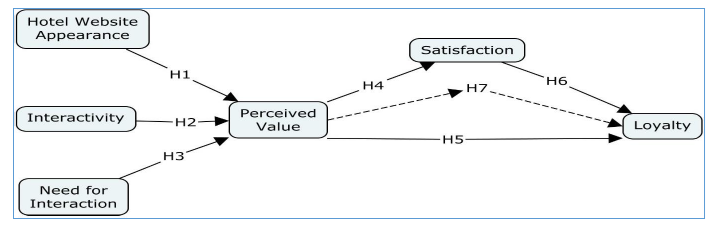
H1 - The appearance of the website positively influences the value perceived by the customer.
2.2 interactivity
There is no universal definition of interactivity (Yim, 2023), a widely used definition describes interactivity as the extent to which users can participate in modifying the form and content of a mediated environment in real time (Steuer, 1992). Interactivity is one of the advantages provided by the internet (Abdullah et al., 2016) and has been established as a fundamental characteristic of the online environment (Song & Zinkhan, 2008).
Interactivity is the user's perception of engaging in bidirectional communication with a mediated persona (Labrecque, 2014). The most common components of interactivity are bidirectional communication, synchronicity, and controllability (Mollen & Wilson, 2010). Furthermore, evidence suggests that brands with high interactivity cultivate more personal relationships with customers (Sawhney et al., 2005). There is evidence that interactivity positively impacts perceptions of website effectiveness (Song & Zinkhan, 2008; Liao et al., 2019).
Abdullah et al. (2016) propose perceived customer value as a mediating variable to examine the indirect relationship between a hotel's website interactivity and the intention to revisit the site. They suggest that the customer's perception of website interactivity influences both perceived value and intentions to revisit the website in the future. Other studies involving mobile devices, online platforms, and social media have established a direct positive relationship between interactivity and customer loyalty (Kim et al., 2015; Sallaku & Vigolo, 2022; Ting et al., 2021; Yang & Lee, 2017).
H2 - Interactivity improves the value perceived by the customer.
2.3 Need for interaction
Despite the advantages and facilities, the online booking process in hotels has inserted some distance between hotels and their consumer, a circumstance that sometimes makes it difficult to understand customers' needs and preferences, due to the impossibility of interpreting body language or even their voice. In the past, face-to-face customer-employee interaction was part of the service process (Lee et al., 2022). However, the perception of value can still be improved by personalization, interaction, and dialogue with customers and new technologies (Iannitto, 2020). Company-consumer interactions lead to value co-creation and promotion of interactions, thus consumers who are willing to interact with the team are more likely to be influenced (Morosan & Defranco, 2019).
Human contact and online interaction are part of the need for interaction dimensions (Morosan & Defranco, 2019). As human interaction is part of the experience, it's normal for customers to value it - and even try to extend it - during service encounters (Ko, 2017). The lack of direct interaction with hotel staff during the booking process makes it difficult to perceive what generates value for the customer, in the service encounter, thus we can say that self-service can make it difficult to meet more complex customer needs (Lee et al., 2022).
The advantages and cost-effectiveness of using technology for the service provider are quite intuitive (Lee et al., 2022). Everything suggests that the desire for privacy and autonomy motivates customers to use self-service (Ko, 2017). However, the question remains whether self-service can also improve the quality of the experience, considering that humanized attention makes it possible to personalize services for the customer (Ko, 2017).
The need for interaction in service encounters generates value for the guest during the experience, and this can make hotel managers hesitate to adopt self-service (Ko, 2017). The motivations for customers to prefer self-service over a service team are related to the speed of transactions and congestion avoidance (Meuter et al., 2003), and the preference for the assistance of a team comes from the intrinsic desire for interaction (Ko, 2017).
The process of value creation by the customer emerges with her/his use, and accumulates dynamically over time, through physical, mental, and possessive actions (Gronroos & Voima, 2012). To determine value, it must be perceived and experienced in an exclusive, experimental, and contextual way by the customer (Gronroos & Voima, 2012). The customer has a strategic role for companies, as the customer will be the value creator, and the company's role is just to deliver potential value resources to the customer (Gronroos & Voima, 2012). Thus, the following hypothesis can be stated:
H3 - The need for interaction positively influences the value perceived by the customer.
2.4 Satisfaction, an intersection between perceived value and loyalty
Perceived value is a functional, emotional, social, and monetary construct (Sweeney & Soutar, 2001). When cost-benefit is analyzed, the perceived value of hotel reservation services is considered a key element in ensuring customer satisfaction (Chang et al., 2019). Initially, the perceived value corresponds to the benefits attributed to the product due to its quality, compared to the sacrifice corresponding to the price paid (Monroe, 1990). Zeithaml (1988) defined customer-perceived value as the consumer's overall assessment of the usefulness of a product based on the perception of what was received and what was given.
Satisfaction and loyalty can be considered results of perceived value (Brodie et al., 2009; Hutchinson et al., 2009). Perceived value is an immediate antecedent of customer satisfaction and repurchase intention, directly or indirectly affecting WOM (word of mouth) through customer satisfaction and repurchase intentions (Oh, 1999).
The greater the company's ability to involve the guest in the role of co-creator, the greater the reflection on the perceived value and value of the brand in the context of hospitality (González-Mansilla et al., 2019). Considering the context of e-commerce, functional and hedonic quality improve perceived value, but the influence of functional quality is greater (Berbegal-Mirabent et al., 2016).
Satisfying customers' curiosity and learning needs during service interaction, motivates hotel customers to engage online at various levels (from effortless ratings to blogging and interactions with other customers), for brand-related activities. This demonstrates the central role of behavior and social value in promoting hotel guest satisfaction (Christina et al., 2019).
The company should identify factors that can influence the customer's positive perception of the co-creation process (González- Mansilla et al., 2019). The focus on the hotel booking experience and on the way customer creates value from interaction on smartphone platforms has demonstrated that satisfied customers are more prone to share their knowledge, attract new customers, and produce electronic word of mouth (E-WOM) through an app mobile (Wu et al., 2018).
Experience is an external factor that can influence perceived value, attitude, and memorization (Meng & Cui, 2020). The integration of the co-creation experience can allow the prediction of the total variation in decisions and expand the concept of intention formation (Campos et al., 2018). A high evaluation of the experience could raise the perceived value, influencing memorability (Campos et al., 2018). However, co-creation alone does not create a memorable experience, confirming the idea of Campos et al. (2018), that co-creation behavior should include active participation, and interaction and the company needs, to involve the guest as a co-creator, to reflect on the perceived value (González-Mansilla et al., 2019).
Customer satisfaction is directly related to perceived value and brand equity (González-Mansilla et al., 2019). Brand equity is built from perceived quality and loyalty, so brand recognition and associations are only relevant to new customers. In this way, co- creation can be used as a tool to promote loyalty and solidify the value perceived by existing customers (González-Mansilla et al., 2019). It was also found that the higher the level of perceived value, the greater the effect on loyalty (Berbegal-Mirabent et al., 2016).
Previous studies have examined the connection between satisfaction and loyalty. When customers are more satisfied, they tend to increase purchase frequency, participate more, and spread positive word-of-mouth (Goh & Okumus, 2020). One study found that satisfaction positively affects both loyalty and behavioral intention (Rather et al. 2019), which was considered an attitudinal concept of loyalty (Cronin et al., 2000). Additionally, satisfied guests are more likely to remain loyal and contribute more to the customer's lifetime value (CLV) (Tseng et al., 2009).
The relationship between satisfaction and loyalty is already established in literature (Chitty et al., 2007; Kim et al., 2008). The study by Paulose and Shakeel (2022) on the mediating effect of satisfaction found that perceived value has a stronger impact on building loyalty, through satisfaction, than directly. The above considerations allow us to raise the following research hypotheses:
H4 - The value perceived in the experience improves satisfaction; H5 - The value perceived in the experience improves loyalty
H6 - Satisfaction boosts consumer loyalty; and
H7 - Satisfaction mediates the relationship between perceived value and loyalty, during online reservations experiences. Figure 1 summarizes the theoretical model to be tested.
3. Methods
This research analyzes the influence of website appearance, interactivity, and need for interaction, on customer perceived value and loyalty, taking satisfaction as a mediator in online reservations on hotel websites. The research was carried out through a survey and used a quantitative approach. The hypothetical-deductive method was used, initially identifying a problem, raising hypotheses about the problem, and deducing it from the observed consequences. The hypotheses were tested for falsification or possible corroboration with other studies (Gil, 2008).
Data were gathered in a Survey-type questionnaire, with a 5-point Likert scale, where (1) is equivalent to strongly agree and (5) completely disagree. The questionnaire was created in Google Forms. The questionnaire variables were adapted from studies of Bilro, Loureiro, and Ali (2018) - Website Appearance; Jiménez-Barreto and Campo-Martínez (2018) - Interactivity; Morosan and Defranco (2019) - Need of interaction; Berbegal-Mirabent, Mas-Machuca and Marimon (2016) - Perceived value and loyalty; and Kamboj and Gupta (2020) - Satisfaction.
3.1 Data collection
The target population for this study was tourists who had booked through hotel websites in the last three years. These were the screening criteria for identifying the right respondents for the survey. The survey was done by Amazon Mechanical Turk (MTurk), an internet marketplace of survey takers, where tasks are allocated to a population of unidentified workers for completion in exchange for compensation. The use of web-based research using Amazon's Mechanical Turk (MTurk) has become a common source for research data (Goodman & Paolacci, 2017), with a high-quality data reputation and relatively inexpensive samples (Thomas & Clifford, 2017).
Due to the covid 19 pandemic, the number of trips drastically decreased in 2020, which was why respondents were asked to consider trips made in the last three years. The questionnaire was active from 17 to 25 November 2020, with a US$0.60 per answer compensation. The questionnaire contained two cut-off questions, to confirm respondents’ adequacy to the research objectives, and attention questions were also inserted in the middle of the questionnaire.
3.2 Demographic information of sample
After removing outliers, 400 questionnaires were received, resulting in a final sample of 376 valid responses. In the sample collected, 70.2 percent of respondents were from the United States, 23.4 percent were from India and 6.4 percent were from other countries. The sample was 61.4 percent male, 38 percent female, and 0.5 percent of other genders.
The majority (38.8%) of respondents were between 26 to 33 years old, 19.7% were between 34 and 41, 18.4% between 18 and 25,
12.5% between 42 and 49, 7.7% between 50 and 57, and 2.9% between 58 and 70 years old. In terms of education, 70.5% of respondents completed college or university, while 25% had a post-degree or master's degree. Only 3% were in middle school, 2.7% in high school, and 1.6% had a PhD.
3.3 Analysis of the relationships between theoretical models
The Confirmatory Factor Analysis and the Structural Model were performed with WarpPLS (Kock, 2018), a software that implements classical (composite-based) as well as factor-based PLS, but with greater statistical power than conventional PLS (Kock, 2019). Like other PLS-based algorithms, the WarpPLS can also converge to a result with non-normal data or in small samples, as in this case. According to Latan (2018), despite being widely used in other areas, PLS-based algorithms in hospitality and tourism are still in the exploratory stage.
The application of this technique in scientific research makes it possible to answer various questions that may or may not be interrelated, in a simple, robust, and comprehensive way. Modeling the phenomenon using SEM allows several different equations to be estimated simultaneously (Hair Jr. et al., 2009).
4. Results
The indicators for each of the six factors and the influence of the three dimensions of website appearance (website appearance, interactivity, and need for interaction) on the endogenous factors, are shown in Figure 2. As can be seen in the figure, all the direct relationships in the model performed as expected. Results point out that the appearance (H1) and the interactivity (H2) of the website, as well as respondents' need for interaction (H3), significantly favor the perceived value; and the latter has a considerable effect on satisfaction (H4) and loyalty (H5).
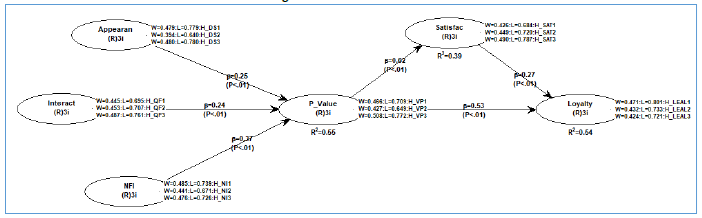
Figure 2 Model Estimation. Note1: Appearn = Appearance; Interact = Interactivity; NFI = Need for Interaction; P_Value = Perceived Value; Satisfac = Satisfaction. Note2: W = Indicator weights; L = Indicator loadings. Source: Developed by the authors (2021).
The result confirms that respondents' satisfaction with the online booking experience directly drives loyalty (0.274), confirming hypothesis H6. As the influence of perceived value on loyalty remains significant, even when an indirect relationship through satisfaction is estimated, it is possible to conclude that satisfaction partially mediates the influence of that construct on loyalty, thus confirming H7. Table 1 shows the direct and indirect effects of the structural model (the inner model).
Table 1: Direct (path coefficients and effect sizes) and Indirect Effects
| Direct effects | |||||
| Exogenous Variables | Appearance | Interaction | Need For Interaction | Perceived Value | Satisfaction |
| Perceived Value | 0.225/0.143 | 0.263/0.173 | 0.363/0.241 | -- | -- |
| Satisfaction | -- | -- | -- | 0.624/0.390 | -- |
| Loyalty | -- | -- | -- | 0.528/0.373 | 0.274/0.170 |
| Sums of indirect effects | |||||
| Exogenous Variables | Appearance | Interaction | Need for Interaction | Perceived Value | Satisfaction |
| Satisfaction | 0.140 (<0.001) | 0.164 (<0.001) | 0.226 (<0.001) | -- | -- |
| Loyalty | 0.157 (<0.001) | 0.184 (<0.001) | 0.253 (<0.001) | 0.171 (<0.001) | -- |
Note: Path Coefficients/Effect Sizes.
The model's predictive validity was assessed by the Blindfolding technique, which showed Stone-Geisser Q² values for Loyalty, Satisfaction, and Perceived Value greater than zero (Hair et al., 2014). In Table 2 we can see the Q2 values, among other indices relating to the latent variables in the model.
Table 2: Latent variable coefficients
| Coefficients | Appearance | Interaction | Need For Interaction | Perceived Value | Satisfaction | Loyalty |
| R-squared coefficients | - | - | - | 0.554 | 0.390 | 0.543 |
| Adjusted R-squared coefficients | - | - | - | 0.551 | 0.388 | 0.541 |
| Composite reliability coefficients | 0.778 | 0.765 | 0.755 | 0.754 | 0.775 | 0.796 |
| Cronbach's Alpha coefficients | 0.573 | 0.539 | 0.514 | 0.511 | 0.564 | 0.616 |
| Average Variances Extracted | 0.541 | 0.521 | 0.507 | 0.507 | 0.535 | 0.566 |
| Full collinearity VIFs | 2.238 | 2.330 | 2.087 | 2.621 | 2.006 | 2.527 |
| Q-squared coefficients | - | - | - | 0.555 | 0.391 | 0.543 |
Cronbach's alpha is the most widely used measure of reliability. The generally accepted lower limit for Cronbach's alpha is 0.70, but this can be reduced to 0.60 in exploratory surveys. However, it is necessary to note that “Cronbach's alpha is positively related to the number of items in the scale, and due to this reason researchers should make more stringent demands for scales with many items” (Hair et al., 2005, p. 126). Therefore, if the opposite occurs - as in this case - the small number of items is expected to produce lower Cronbach's alphas. According to these authors, both Cronbach's Alpha and Composite Reliability are measures used to assess the internal consistency of a scale. Still, Composite Reliability is generally considered more robust, especially when the items have varying factor loadings, as it considers the different weights of each item in the construct. At the same time, Cronbach's Alpha assumes that all items contribute equally to the construct. As we can see in Table 2, except for Loyalty, all the factors failed to pass the 0.6 limit on their Crombach's alphas. However, as the factors were composed of only three variables, considering that Cronbach's alpha is sensitive to the number of items and that the composite reliability (more robust than Cronbach's alpha) showed adequate values, this small deficiency was tolerated.
Convergent validity shows whether a test that is designed to assess a particular construct correlates with other tests that assess the same construct. In this case, the convergent validity was attested by the Average Variances Extracted greater than 0.5 in all six factors (Fornell & Larcker, 1981). The coefficients of determination (R²) show that the model explains 55% of the value perceived by respondents within the experience, 39% of their satisfaction, and 54% of guests intention to be loyal to the brand evaluated. The coefficient of determination is a number between 0 and 1 that measures how well a statistical model predicts an outcome (Hair Jr. et al, 2009). The Discriminant validity was evaluated by the Fornell & Larcker (1981) criterion, according to which factors are assumed to be different from each other when the square root of the factor’s Average Variance Extracted (AVE) exceeds the correlations with the other constructs in the same model. As we can see from Table 3, all the factors attended the discrimination premise.
Table 3: Correlations among latent variables with square roots of AVE
| Appearance | Interaction | Need For Interaction | Perceived Value | Satisfaction | Loyalty | |
| Appearance | 0.736 | - | - | - | - | - |
| Interaction | 0.657 | 0.722 | - | - | - | - |
| Need For Interaction | 0.568 | 0.598 | 0.712 | - | - | - |
| Perceived Value | 0.630 | 0.629 | 0.656 | 0.712 | - | - |
| Satisfaction | 0.569 | 0.616 | 0.553 | 0.613 | 0.732 | - |
| Loyalty | 0.646 | 0.624 | 0.620 | 0.700 | 0.608 | 0.753 |
Note: Square roots of Average Variances Extracted (AVEs) are shown in bold on the main diagonal.
5. Discussion
This work results confirmed that a hotel's website's appearance and interactivity, as well as customers’ need for interaction, positively influence the perceived value, and the last push satisfaction and loyalty, which corroborates the pieces of evidence found by Loureiro (2015), that stimuli (colors, design, layout, interactive contents, and interactive functionalities) contribute to consumers’ judgment regarding the quality of the website.
The hypothesis that the appearance of the website positively influences the perceived value during online hotel reservations was confirmed. In this work, the appearance of the website contributes 25% of its load to the customer's perceived value, confirming that high perceived quality may represent a greater willingness to participate in online co-creation experiences (Jiménez-Barreto & Campo-Martínez (2018). The study by Morosan and De Franco (2019) validated that value co-creation behavior results from the role of technology in company-consumer interactions in hotels. An attractive and organized website is crucial for the success of the hotel (Wong & Law, 2005), as it serves as a source of information for the customer (Emir et. al. 2016), and can generate satisfaction and loyalty (Tan, 2015), and can persuade the customer through these information sources (Bhattacherjee & Sanford, 2006). In addition, it contributes to the customer engagement (Bilro et al., 2018).
The hypothesis that interactivity improves the value perceived by the customer was also confirmed. When accessing the hotel's website, the customer is attracted first by its appearance, and then by the possibility of interacting with other customers, either through reviews posted directly on the hotel's website, or through opinions and discussions posted on social networks. The study result confirmed the findings of Abdulah et al. (2016), who found that the customer's perception of the interactivity of the hotel website influences the perceived value and the intention to revisit the hotel website in the future. The comments generated by customers on a well-structured website enable co-creation and interactivity between guests, and customers involved with the website can lead friends and relatives to use the platform again and recommend it to other people (Bilro et al., 2018).
The hypothesis that the need for interaction influences positively the value perceived by the customer was also confirmed. As Bilro et al. (2018) verified the relevance of interactions between the customer and the brand, this study also points to the need for interaction as an important antecedent to the creation of value for the customer. Hotels need to involve the guest in the co- creation process, once it improves perceived value, and consequently the satisfaction (González-Mansilla et al., 2019). Considering the increase in technology and the growing robotization of the hotel sector, third parties' content helps humanize service, even in online contact. The possibility of interacting with a human being, even at a distance, may give customers the required confidence to make a reservation based on the other person's experience.
The fourth, fifth, and sixth hypotheses, which dealt with perceived value as an antecedent of satisfaction and loyalty, directly or indirectly, were all confirmed. Therefore, the results of this study are in line with previous studies, which have pointed to satisfaction and loyalty as a result of perceived value (Brodie et al., 2009; Hutchinson et al., 2009), and that the latter is an immediate antecedent of customer satisfaction and purchase and repurchase intention (Oh, 1999). The results of this study are also in line with those of Paulose and Shakeel (2022), who confirm satisfaction as an important mediator between perceived value and loyalty.
6. Theoretical Implications
This research advances the literature on online hotel reservations by integrating key variables of the user experience on hotel websites and their relationship with perceived value creation, satisfaction, and loyalty. Unlike previous studies that addressed these dimensions in isolation (Ali, 2016; Wang et al., 2015), this study proposes a holistic theoretical model in which website appearance, interactivity, and the need for interaction are incorporated as critical determinants of perceived value, which, in turn, influences customer satisfaction and loyalty.
Firstly, this study reinforces the value co-creation theory (Ramaswamy & Ozcan, 2018) by demonstrating that hotel website interactivity enhances the customer experience and facilitates their active participation in shaping perceived value. Interactivity has been considered a relevant factor in consumer engagement with digital platforms (Bilro et al., 2018), and our study confirms that online interaction can partially replace physical interaction in guests' perception of value, a relevant finding for digital hospitality.
Secondly, this research expands the understanding of the relationship between satisfaction and loyalty by empirically testing satisfaction as a mediator between perceived value and loyalty, as suggested by Paulose and Shakeel (2022). While previous studies have established this relationship in the context of retail and services in general (Brodie et al., 2009; Hutchinson et al., 2009), our approach specifies the role of this relationship in the digital hotel reservation environment, where direct interaction with hotel staff is reduced. The developed model confirms that perceived value and satisfaction are fundamental to generating loyalty even in a digital self-service environment.
Additionally, this study contributes to the literature on digital marketing and hospitality by examining how the need for interaction affects perceived value. While the increasing adoption of self-service technologies is often seen as a path to operational efficiency (Lee et al., 2022), our findings suggest that a fully automated approach may be counterproductive for certain customer segments, reinforcing the need for a balance between digitalization and personalized service (Ko, 2017). This finding challenges the assumption that unrestricted automation invariably improves customer experience and adds a new layer to the discussion on personalization in digital services.
Finally, this study also provides a methodological contribution by employing Structural Equation Modeling (SEM) based on the WarpPLS algorithm. While SEM has been widely used in marketing and consumer behavior research, its application in hospitality is still exploratory (Latan, 2018). The approach used allowed for simultaneously testing complex relationships among the model constructs, providing a robust analysis of the factors influencing guest satisfaction and loyalty in digital environments.
Thus, this work not only reinforces findings from existing literature but also proposes new perspectives on the role of interactivity, website design, and the need for interaction in creating value and loyalty in the hospitality sector. Future studies can expand this model by considering moderating variables, such as generational or cultural differences, which may influence customers' perceptions of interactivity and perceived value.
6.1 Managerial Implications
This study contributes to a deeper understanding of the factors that drive customers to book directly through hotel websites rather than third-party booking platforms. Specifically, it examines the role of website aesthetics, interactivity, and the need for interaction in influencing consumer behavior.
However, merely investing in website appearance is insufficient to enhance its effectiveness without complementary marketing strategies. As highlighted by Morosan and De Franco (2019), promotional factors significantly influence management and marketing strategies, serving as antecedents to system usage-an approach that contrasts with previous studies focusing solely on system design perceptions, which provided limited insights into how hotels can mitigate design shortcomings.
This study also suggests the need for hoteliers to invest more in website appearance to make it more attractive and convert new customers. When potencial guests browse an OTA for accommodations, they often visit the hotel's website to gather more information and view photos. This moment presents a critical opportunity for direct booking conversion. A well-structured website, where customers can access reviews from other guests, find links to the property's social media, and interact directly with staff to clarify doubts and preferences, can facilitate engagement and increase direct sales. While automation and chatbot-driven interactions enhance efficiency and convenience, the option for human interaction-where customers can express their needs and concerns, and find solutions to potential issues-adds value to their interaction.
Hoteliers must recognize that customers vary in age, socioeconomic background, and needs. By understanding these differences, It becomes easier to meet and exceed guest expectations. Leveraging data analytics and personalization strategies can significantly improve user engagement. By tracking visitor behavior and preferences, hotels can tailor promotional efforts, offering customized recommendations and targeted incentives that enhance perceived value and increase conversion rates. Even in an online setting, customer-employee interaction creates opportunities for personalization and value co-creation. Beyond the reservation process, hotels should also enhance post-booking communication through personalized confirmation emails, tailored service recommendations, and proactive customer engagement. By offering customized service interactions, hotels can enhance perceived value, leading to greater guest satisfaction and loyalty. By maintaining meaningful interactions with guests before their arrival, hotels can reinforce perceived value and cultivate long-term loyalty.
Furthermore, hoteliers must prioritize mobile optimization, ensuring that their websites provide seamless navigation and fast- loading pages to prevent potential customers from abandoning the site in favor of third-party booking platforms. Additionally, website speed and overall user experience play a pivotal role in the decision-making process. A slow or poorly structured website may deter users, underscoring the need for investment in performance optimization and intuitive design.
Transparency in pricing and the provision of exclusive benefits, such as lower rates compared to OTAs, complimentary services, or flexible cancellation policies, can further incentivize direct bookings and strengthen customer trust.
6.2 Limitations and Future Studies
Given that different hotel websites provide distinct user experiences, this study is limited in that it examines the overall customer experience rather than focusing on a specific platform. Consequently, a case study on a particular website could yield different results. Future research could also explore the purchasing process through online travel agencies (OTAs), which serve as major booking channels and accommodation partners, where there is no direct interaction with hotel employees and no exchange of instant messages.
This study analyzed customer perceptions of hotel bookings made through the hotel's official website. However, reservations made via email, telephone, social media, or WhatsApp could also be investigated. In the context of direct bookings-such as those confirmed through hotel websites-the interaction between customers and employees appears to be even more pronounced.
For future research, a deeper exploration of online interactions within the hotel industry is recommended, with a focus on understanding the entire service cycle and how value is co-created and perceived by customers, ultimately contributing to satisfaction and loyalty. Furthermore, to establish causal relationships, future studies could conduct experimental research with control tests to assess customer perceptions of hotel websites.
Credit author statement
Author 1: Conceptualization, Methodology, Investigation, writing, data analysis, results, implications & english review - Original Draft. Author 2: Supervision. Author 3: Data analysis & English review. Author 4: Data analysis, writing & editing. Author 5: Supervision & data analysis.

