




 Inglês (pdf)
 Artigo em XML
 Referências do artigo
 Tradução automática
 Enviar este artigo por email
 Citado por SciELO
  Similares em
SciELO
Similares em
SciELO 
 Permalink

1. Introduction
Launched in November 2022, ChatGPT (Generative Pre-trained Transformer) has rapidly gained a substantial user base, a testament to the expanding era of artificial intelligence (AI) being leveraged for the benefit of users. ChatGPT reached 1 million users within just five days of its launch. During the first months of 2025, ChatGPT has been the most widely used AI application, boasting over 800 million weekly active users and averaging more than 1 billion queries per day (Badalyan, 2025).
Specifically designed to understand and generate human-like text from natural language input, ChatGPT excels in various tasks including language translation, text completion, and question answering. Its prowess is rooted in extensive training on large datasets, enabling it to discern patterns and relationships in language without explicit supervision (Zamfiroiu et al., 2023)
More generally, AI technologies enable consumers in the tourism domain to receive more intelligent and personalised services, which involve itinerary creation, lodging preferences, and tourist attractions, as well as the essential information they need to enhance their travel experience (Iskender, 2023). The applications are particularly interesting given that ChatGPT can improve communication, language support, and smooth interaction for travellers and businesses. ChatGPT has deployment value in various stages of the travel journey, including those before, during, and after travel. It does so by providing information and offering an uninterrupted experience to users throughout all stages of the trip (Gursoy et al., 2023). This AI tool can perform a wide variety of tasks, including sustainable tourism planning, selecting destinations and planning itineraries, estimating travel costs, booking flights and hotels, and exploring travel experiences and cultures (Buitrago-Esquinas et al., 2024; Demir & Demir, 2023). These tasks can be completed directly on the ChatGPT site or through various AI travel planning tools that utilise ChatGPT (Sharma, 2023).
ChatGPT has played a big role in travel by influencing the way we plan trips. During the pre-trip stage, ChatGPT can assist in learning the preferences of each user and produce user-tailored travel content to support planning a rewarding travel experience (Dwivedi et al., 2023). Users can initiate conversations with ChatGPT about destination suggestions, accommodation options, transportation choices, and recommended activities. Essentially, ChatGPT serves as a valuable source of travel inspiration, providing insightful recommendations for trip planning.
Although ChatGPT tools are becoming increasingly popular, a significant number of Internet users still haven't used them for planning their trips. This highlights the need to go deeper into what drives people to adopt ChatGPT for travel planning. It is essential to understand what motivates travellers to use ChatGPT for their travel planning, enabling them to make the most of this platform in online marketing strategies.
While there has been a notable increase in academic interest in the role of AI in tourism, most of the existing research has focused on specific applications such as recommendation systems (Gretzel & Fesenmaier, 2006; Palahan & Arunthari, 2024), virtual assistants (Ivanov & Webster, 2017; Shakar et al., 2024) and chatbots used by travel agencies or platforms (Mariani & Pérez-Vega, 2022), among others. These studies typically address various aspects of tourism, such as recommending destinations or activities tailored to the user's preferences. Although these applications have impacted the tourism sector, they are often limited because they tend to rely on pre-established answers or limited data sets. On the other hand, generative AI, especially models like ChatGPT, can create engaging, contextual, and highly personalised conversations by accessing a much broader understanding of language, context, and user behaviour. Previous studies haven't fully explored the potential of generative AI technologies, such as ChatGPT, to offer dynamic and personalised interactions, which could change how people plan their travels.
There is a significant gap in research regarding the understanding of how everyday users interact with large language models (LLMs) like ChatGPT, particularly in the context of travel planning. This gap presents an opportunity to connect information systems (IS) theory with the new consumer behaviour trends emerging around generative AI technologies. To our knowledge, no prior study has thoroughly examined how system-level factors (such as information quality, system quality, and privacy protection) and individual-level aspects (including intrinsic/extrinsic motivation, trust, satisfaction, and self-esteem) interact to shape users' intentions to use ChatGPT for travel planning. This study aims to fill that gap by proposing and empirically testing a research model that combines elements of the IS success theory with psychological and motivational factors, providing a well-rounded perspective on what drives the adoption of ChatGPT in the travel sector.
Young people are typically the first to adopt new trends, while many others only catch on after those shifts have already occurred (Church, 2016). University students can be seen as digital natives, having grown up surrounded by various network technologies, apps, and mobile devices from a young age (Huedo-Martínez et al., 2018). This research focuses on university students, who often lead the way in adopting new technologies thanks to their extensive exposure, digital skills, and eagerness to try new things. It provides insight into a group that is expected to influence future trends in digital tourism behaviour.
This paper aims to identify and analyse factors influencing university students’ intention to use ChatGPT for travel planning. The remainder of the article is organised as follows. In the second section, the theoretical background is presented, including details about the research model and the hypotheses proposed. The third section addresses methodological issues, and results are provided in the fourth section. The final sections encompass the study's implications and concluding remarks.
This study contributes to our scientific understanding by expanding the IS success model into the new territory of generative AI in tourism, incorporating psychological and behavioural elements that haven't been widely examined in this area yet. By doing so, it fills a gap in the existing literature and provides a theoretical foundation for a better understanding of the factors that drive the adoption of LLM-based tools, such as ChatGPT, in trip planning. From a practical perspective, the findings offer valuable insights for the developers of AI travel tools and tourism service providers.
2. Theoretical background and hypotheses
The research model is based on DeLone and McLean’s IS success model and literature related to factors influencing privacy protection services, trust, visit duration, self-esteem, opportunity cost, user satisfaction, and intrinsic and extrinsic benefits. According to DeLone and McLean (2003), this IS success model evaluates “systems quality” to measure technical success, “information quality” to measure semantic success, and “use”, “user satisfaction”, “individual impacts”, and “organisational impacts” to measure effective success.
2.1 AI for the tourism sector
Tourism has always been quick to adopt new technologies, and nowadays, a significant amount of travel information is found and booked online. The industry's ability to adapt is evident in its effective integration of online platforms, making travel planning easier and changing the way people discover and organise their trips (Sandoval, 2001).
Over the past few years, social media has transformed the way we plan our trips. People are using it to get information and recommendations from others. However, these platforms not only influence our travel decisions but also allow us to personalise and share our travel experiences (Fardous et al., 2017; Milano et al., 2011). Previous studies have explored these trends, highlighting the role of social media in trip planning. It makes it easier for travellers to find information, increases consumer influence and helps them to make smarter decisions (Ayeh et al., 2013; Hernández-Méndez et al., 2015; Leung et al., 2013).
Over last year there has been a rapid development of AI. Today, AI has become one of the most disruptive and transformative technologies, powering a new generation of tools and systems that drive innovation across products, services, and capabilities. Generative AI models have moved beyond just analysing existing data; they can now create new content (Korzynski et al., 2023). The tourism sector has become a key area where AI technologies have found practical applications. Tools like ChatGPT, for example, are now being implemented to improve travel experiences, offering significant benefits to travellers (Dwivedi et al., 2023). In this sense, travellers can take advantage of AI's capabilities to find information that supports their decisions and makes organising their itineraries much more efficient (Wong et al., 2023).
ChatGPT, for example, can analyse public discourse and traveller reviews to identify preferences and needs. Based on these insights, it can then provide travellers with detailed recommendations for potential destinations, covering everything from itineraries and dining options to accommodation and transport (Carvalho & Ivanov, 2024; Sudirjo et al., 2023). This capability has positioned ChatGPT to play a growing role how travellers search for information and make decisions (Mich & Garigliano, 2023). However, despite the increasing research on ChatGPT and other generative AI tools in the tourism field, few studies have explored the specific factors that influence their use in travel planning.
This indicates that the user believes the technology can perform a specific task accurately while acknowledging the potential for unfavourable outcomes. In this scenario, certain users might readily accept the assertions, data, or claims presented by a computer as valid solely due to their computerised origin. On the other hand, other users may require some form of justification (empirical evidence or reasoning) before they believe that the computer's presentations or assertions are genuinely valid and true (Hoffman et al., 2023). User satisfaction is characterised as the user's perception of a particular computer application or IS that fulfils their information needs (Doll & Torkzadeh, 1988). User satisfaction can be extended to any web-based service that provides the means for users to interact over the Internet (Dong et al., 2014). Kotler (1994) defined satisfaction as an individual's sensation of pleasure or disappointment, stemming from comparing a product's perceived performance or outcome against their expectations.
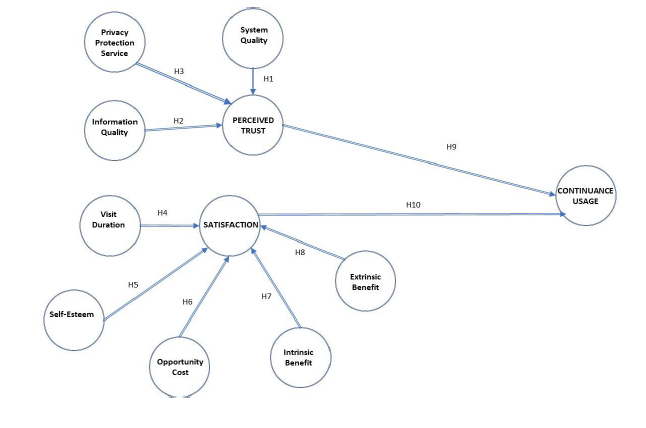
This study integrates trust and satisfaction into a single conceptual model, following Fam et al. (2004), who suggested that trust, combined with customer satisfaction, is a dynamic process that evolves over time, enhancing satisfaction beyond the economic benefits. It can also be expected that trust and satisfaction act as mediators between the antecedents and the use of ChatGPT in this context. Therefore, the research model includes information quality, system quality and privacy protection as antecedents of perceived trust, and visit duration, self-esteem, opportunity cost, intrinsic and extrinsic benefits as antecedents of satisfaction. Figure 1 presents the research conceptual framework.
2.1 Definition of constructs and hypotheses
2.2.1 System Quality, Information Quality and Privacy Protection, and their effect on Perceived Trust
System quality refers to the perceived excellence of a system's overall performance (Delone & McLean, 2004). This concept encompasses the effectiveness and efficiency of systems in processing information (Nelson et al., 2005), and it is often regarded as one of the primary predictors of trust (McKnight et al., 2017). Previous research has identified the link between system quality and the level of trust users place in it (Gao & Waechter, 2017; Gefen et al., 2006; Zhou, 2012). Since ChatGPT lacks a physical format, users' first impressions are influenced by its speed, ease of navigation, and visual appeal (Silic & Ruf, 2018).
Information quality, on the other hand, refers to the value of content being received (Jiang et al., 2021). Many studies have highlighted the significance of information quality, encompassing factors such as relevance, currency, clarity, consistency, and accuracy (Elliott & Speck, 2005). These qualities generally are relevant when users decide which sources to trust (Komiak, 2010). Some researchers even argue that information quality not only influences trust but may also enhance users’ perception of the system's integrity. Consequently, information quality has an influence on perceived trust (Wang et al., 2009). Hernández-Méndez et al. (2015) show how tourists are more influenced by the comments of friends and family when planning trips than by those of other Internet users. This led to the conclusion that the higher the perceived quality of information for a consumer, the greater the level of trust.
Perceived privacy refers to individuals' perceptions of their ability to control and regulate the sharing, use, and reuse of their personal data in online settings. When personal information is used without their awareness, the resulting lack of control is known as a privacy risk (Kang et al., 2014). Individuals with privacy concerns hesitate to provide their information or utilise new technologies, fearing potential leaks, misuse, or tracking due to privacy violations. The utilisation of ChatGPT to plan trips is a relatively recent development, potentially heightening privacy concerns among citizens. The strength of privacy directly correlates with citizens' trust in using online services. Consequently, addressing privacy concerns is imperative to foster trust among citizens in AI services (Maqableh et al., 2021; Shin, 2010).
These three constructs can influence the perceived trust of the ChatGPT user. Based on these definitions, the following hypotheses are proposed:
H1: The consumers' perception of the quality of the ChatGPT system has a positive effect on their perceived trust in planning trips using ChatGPT.
H2: The consumers’ perception of the quality of ChatGPT information has a positive effect on perceived trust to plan trips using ChatGPT.
H3: The consumers’ perception of ChatGPT protection of privacy has a positive effect on perceived trust to plan trips using ChatGPT.
2.2.2 Visit duration, Self-esteem, Opportunity cost, Intrinsic Benefit, Extrinsic Benefit, and their effect on Satisfaction
Danaher et al. (2006) have defined visit duration as the period during which a user remains actively engaged with a system. This metric has become a standard industry measure, routinely reported by audience-measurement agencies. One way customer engagement with new technologies shows up is through the duration of their visits (Kabadayi & Price, 2014). Investigating user retention is crucial for understanding ChatGPT's ability to retain visitors (Zott et al., 2000). If tourists spend more time using ChatGPT to plan their trips, it could lead to a better return on their investment in the trip, thereby resulting in greater satisfaction. Therefore, stickiness could serve as an indicator of user interest, involving cognitive involvement and engagement, which could be a precursor to satisfaction (Lien et al., 2017). Thorbjornsen and Supphellen (2004) identified two distinct types of browsing behaviour on a website: how often users visit and how long they stay during each time.
Self-esteem is the experience of being competent to cope with new challenges (Branden, 1994). It reveals how a person assesses their self-esteem (Del Mar Ferradás et al., 2016) and can also drive proactive behaviour (Wu et al., 2019). It encompasses a motivational process focused on the growth and development of the ego, involving positive aspirations and efforts of the ego (Clary et al., 1998). Jackson et al. (2010) highlight the relationships between IT use and self-esteem. Someone with high self-esteem is likely to feel comfortable dealing with technical tools (Korzynski et al., 2021), and this could be another motivational factor influencing satisfaction when using ChatGPT to plan trips, as it is a very new and powerful tool in development. Therefore, we can argue that the higher the self-esteem of users, the greater the corresponding level of satisfaction when using ChatGPT.
According to McConnell and Brue (2005), opportunity cost is defined as the value of the best alternative that must be given up when a decision is made. For example, customers can conveniently organise their travel plans with ChatGPT. The system can store and manage various plans and itineraries, allowing travellers to access them whenever needed. This would reduce unnecessary waiting times and opportunity costs, allowing travellers to enjoy other leisure activities while ChatGPT manages the logistical aspects of their trip. Users can focus on enjoying their free time and discovering new experiences without worrying as much about the trip's details. Reducing opportunity costs increases convenience, enhances the experience, and improves overall travel satisfaction, allowing travellers to fully enjoy every moment of their adventure. Therefore, it can be suggested that the lower the opportunity cost, the higher the level of satisfaction when using ChatGPT.
Intrinsic benefits refer to to the advantages associated with engaging in an activity due to its inherent interest or enjoyment (Ryan & Deci, 2000). In this context, Sun et al. (2014) discuss the perceived enjoyment and sense of self-worth. According to Hui et al., (2006) three important types of intrinsic benefits are (i) pleasure refers to acquiring a positive and enjoyable experience, gaining satisfaction from the activity, (ii) novelty exploring unfamiliar territories to fulfil informational needs and (iii) altruism entails assisting others selflessly, empathising with their needs and concerns. In this sense, users may find pleasure in interacting with ChatGPT, enjoying the experience of receiving helpful information to plan trips. ChatGPT, with its natural language processing capabilities, can also provide a novel experience by offering diverse and informative responses, exploring different topics and responding to user queries. Additionally, ChatGPT fosters a sense of altruism and support by providing valuable and pertinent information, assisting users without any self-serving intentions. Hence, it can be asserted that the more pronounced the intrinsic benefits experienced by users, the higher the resulting level of satisfaction while utilising ChatGPT.
Extrinsic benefits primarily relate to the financial rewards offered by seekers to compensate solvers for the time and effort they invest in completing online tasks (Sun et al., 2014). It refers to the advantage gained from the result of engaging in the task, yet it is separate from the task itself (Atchariyachanvanich et al., 2007). It offers consumers ways to achieve additional objectives. These benefits can incentivise consumer actions as individuals aspire to enhance their possessions, which can subsequently be utilised in future situations (Hui et al., 2006). Extrinsic benefits, such as time and cost savings, can also affect satisfaction. Social adjustment is another extrinsic benefit (Hui et al., 2006), referring to the human need to establish social identities by assimilating into desired social groups (Baumeister & Leary, 1995). In this context, the greater the extrinsic benefits experienced by users, the higher the associated level of satisfaction when utilising ChatGPT.
All these constructs can influence user satisfaction. Therefore, it is hypothesised that: H4: Visit duration on ChatGPT has a positive effect on Satisfaction
H5: Self-esteem obtained by using ChatGPT has a positive effect on Satisfaction H6: Opportunity cost by using ChatGPT has a positive effect on Satisfaction
H7: Intrinsic Benefit by using ChatGPT has a positive effect on Satisfaction H8: Extrinsic Benefit by using ChatGPT has a positive effect on Satisfaction
2.2.3 Perceived Trust, Satisfaction, and their effect on Continued Usage
Bhattacherjee (2001) defined IS continuance intention as an individual's intention to persist in using an IS. Yan et al. (2021) stated that continuance intentions have been explored across various digital technology contexts like mobile apps, e-learning platforms, online banking, e-commerce sites, sharing economy platforms, social networking, and online services. Understanding why people keep using a tool over time is a key issue for analysing user behaviour and engagement in ChatGPT and other digital platforms. Through this analysis, we can gain clearer insight into why users interact with the tool and thus better adapt its functions to meet their expectations and needs.
Satisfaction also plays a key role in understanding users' intention to continue using digital technologies (Bhattacherjee, 2001; Melone, 1990), making it one of the strongest drivers of continued interaction (Mouakket, 2018). For example, Bai et al. (2008) found that prioritising user satisfaction is necessary to achieve continuous use of online tools.
Beyond satisfaction, trust is another key factor in understanding users' intention to continue using a system (Chong, 2013). As Wang and Lin (2017) observed, higher levels of trust often lead to a stronger commitment to using a digital service over time. By building this trust, developers of generative AI systems could increase their usage rate (Menon & Shilpa, 2023), especially since a positive correlation has been found between trust in technology and willingness to use tools like ChatGPT (Choudhury & Shamszare, 2023).
In this regard:
H9: Perceived Trust has a positive effect on Continuance Usage H10: Satisfaction has a positive effect on Continuance Usage
3. Methodology
3.1 Measurements
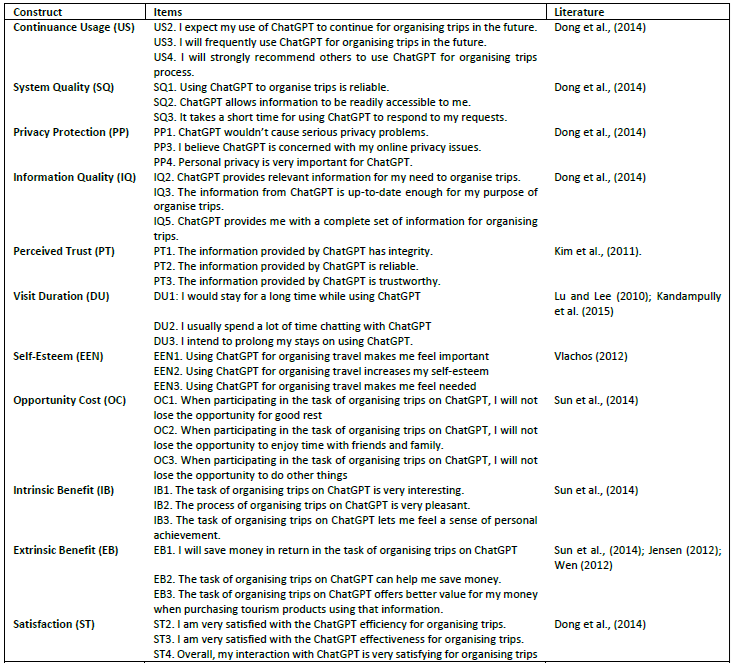
Table 1 shows the items for this study and the supporting literature for each construct. A total of 33 items were obtained. Survey participants provided ratings for each item on a seven-point Likert scale, from 1 (“strongly disagree”) to 7 (“strongly agree”). This widely accepted method is frequently used to assess variables that cannot be directly measured or observed (Churchill & Iacobucci, 2002).
The survey was originally developed in English and then was adapted for Spanish-speaking users familiar with using ChatGPT for trip planning. Researchers and a native English translator independently translated the English questionnaire into Spanish. Following a comprehensive comparison of the independently translated versions, a final questionnaire was agreed upon. To ensure consistency, the final Spanish version was then translated back into English by another native English speaker (Venkatesh et al., 2012).
To ensure that the items were linguistically and culturally accurate for Spanish-speaking respondents, the concepts used were verified to be easily understandable, thereby ensuring clarity to the target group. For this purpose, a preliminary test was conducted with 30 Spanish university students who had experience using ChatGPT for travel planning. The goal of this pilot study was to evaluate the clarity and comprehensibility of the items. The participants offered some minor comments, and small adjustments were made to improve their understanding.
3.2 Sample and data collection
The survey was conducted from September 1, 2023, to October 31, 2023. Undergraduate students from various programmes at the Faculty of Business Sciences of a Spanish public university participated. A total of 262 participants completed the survey, all of whom were full-time students under the age of 25 with previous experience using ChatGPT to plan their trips. Among the respondents, 53% were men and 47% were women.
4. Analysis of the measurement model and results
This study employs the Partial Least Squares (PLS) method to develop a model that represents the relationship between the eleven proposed constructs, each measured by specific items. This method primarily focuses on examining the dependent constructs and the interrelationships between latent variables (Hair et al., 2011). The Smart PLS 4.0 software was used to analyse the research model and test the hypotheses.
4.1 Assessment of the Measurement Model
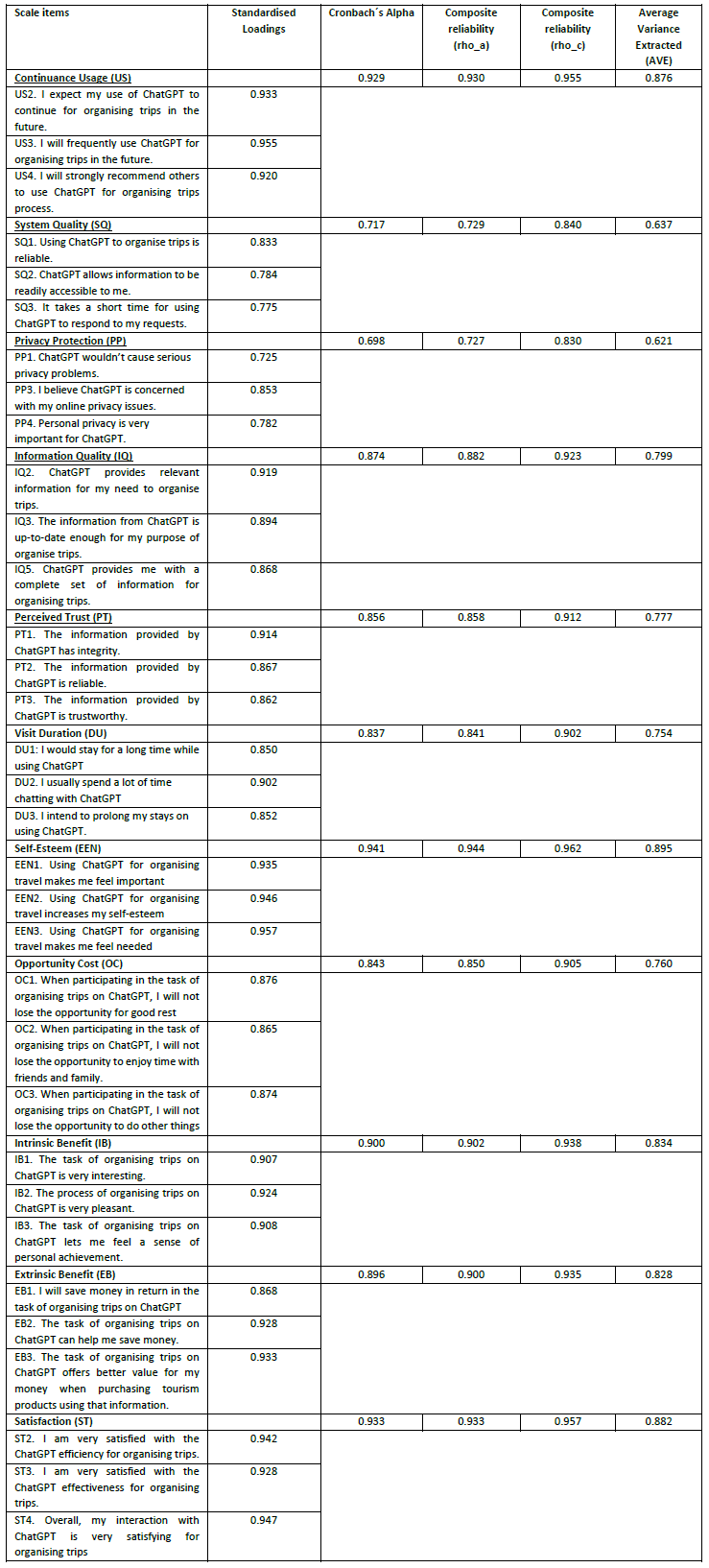
The initial phase involves establishing the individual reliability of each item and evaluating the convergent and discriminant validity of the constructs. The individual reliability of each indicator is assessed by examining the external loading, with the criterion that it should be equal to or greater than 0.707. Table 2 displays the loadings for each significant item.
To evaluate construct reliability (internal consistency), the Cronbach's alpha coefficient is utilised, and all levels are above 0.7, except for the Privacy Protection Service (PP). Both the composite reliability (rho_a and rho_c) exceed the minimum acceptable threshold of 0.7 (Gefen et al., 2000; Nunnally, 1978).
Convergent validity of the constructs is assessed using the average extracted variance (AVE). According to Fornell and Larcker (1981), the acceptable level should be more than 0.5. In all 11 constructs, it surpasses the desired value.
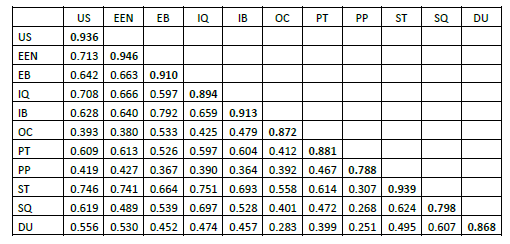
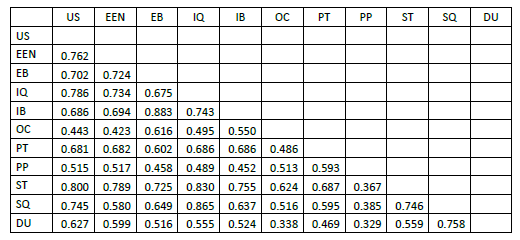
To evaluate discriminant validity among constructs, Fornell and Larcker (1981) compare the square root of the AVE (Average Variance Extracted) with the correlations between constructs. The diagonal elements should be significantly higher than the off- diagonal elements in the respective rows and columns of the correlation matrix (Table 3).
Another method for assessing discriminant validity is through the cross-loadings matrix. Items measuring the same construct should have a significantly higher factor loading on the same construct than on other constructs (Table 4).

Finally, the Heterotrait-monotrait (HTMT) ratio of correlations measures the average of the Heterotrait-heteromethod correlations (Henseler et al., 2015). All HTMT values are below the threshold of 0.85 (Table 5). The three criteria used allow us to infer that the measurement model possesses discriminant validity, confirming that the constructs are distinct and represent phenomena not captured by other constructs in the model.
4.2 Structural model assessment
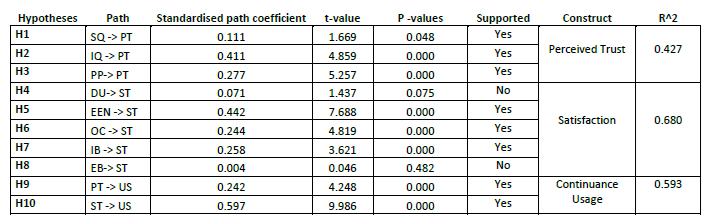
After conducting the validation test, PLS analysis was employed to evaluate the effectiveness of the proposed model in explaining and predicting outcomes, determining the magnitude of path coefficients, and assessing the significance of the hypothesised relationships. In the PLS algorithm, the primary criterion for assessing the structural model is the explained variance (R-squared, R²). Chin (1998) outlines R2 values of 0.19, 0.33, or 0.67 for endogenous latent constructs, representing weak, moderate, or substantial explanatory power, respectively. As illustrated in Table 6, the model accounted for 42.7% of the variance in perceived trust, 68% in satisfaction, and 59.3% in continuance usage of ChatGPT for travel planning. Thus, the R2 values indicate a satisfactory level of explanatory power for the variables under consideration.
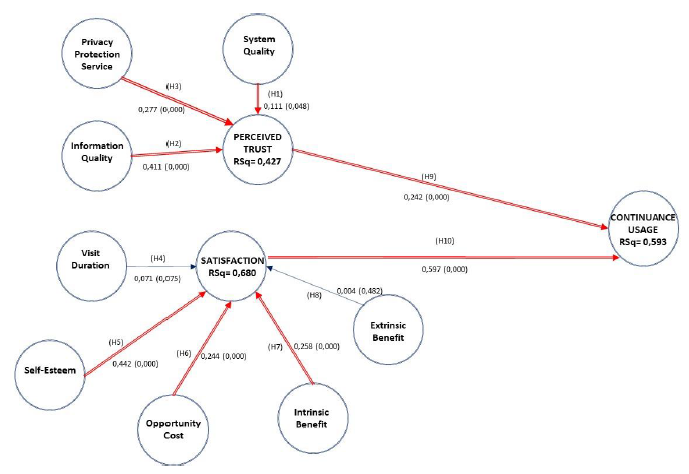
To assess whether path coefficients significantly differ from zero, t-values were computed using bootstrapping. The non-parametric bootstrapping technique was employed with 5000 iterations and a one-tailed approach. Analysis of the data revealed that eight out of the ten hypothesised relationships in the inner path model exhibit statistically significant findings (see Table 6 and Figure 2).
Hypotheses 1, 2, and 3, which posit direct positive relationships between System Quality (β=0.111, p-value<0.05), Information Quality (β=0.411, p-value<0.05), and Privacy Protection (β=0.277, p-value<0.05) with Perceived Trust, have been confirmed. Notably, Information Quality shows the strongest association with Perceived Trust.
The results also indicate that Self-esteem (β = 0.442, p-value < 0.05), Opportunity Costs (β = 0.244, p-value < 0.05), and Intrinsic Benefits (β = 0.258, p-value < 0.05) positively influence Satisfaction, with Self-esteem showing the strongest association. However, the findings did not support the significant effects of Visit Duration and Extrinsic Benefits on Satisfaction.
The study also controlled for the influence of Perceived Trust (β = 0.242, p-value < 0.05) and Satisfaction (β = 0.597, p-value < 0.05) on the intention to continue using ChatGPT for trip planning. Both relationships were deemed significant, with Satisfaction showing a stronger effect. Thus, the conventional beliefs regarding the positive impacts of Perceived Trust and Satisfaction, as suggested in the IS adoption literature, are verified within the context of our study.
5. Discussion
One of the challenges in the tourism sector is to maximise the potential of AI by integrating these new tools with existing ones to streamline operations. Utilising AI technologies to enhance efficiency and inform decision-making is a key area for development, given the benefits they offer to the tourism sector (Carvalho & Ivanov, 2024; Orden-Mejía & Huertas, 2022).
The use of GPT technologies is transforming the way tourist trips are planned (Çolak, 2023), highlighting their contribution to creating personalised travel experiences, providing detailed information, making suggestions, offering travel recommendations, and conducting virtual tours. Additionally, it facilitates trip planning and considers factors such as weather, events, and routes. GPT technologies also inspire travellers to explore new destinations, provide real-time updates, analyse feedback to make better travel decisions, enhance travel experiences with informative content, promote sharing on social media, and support responsible tourism practices.
ChatGPT has quickly emerged as a valuable tool for organising travel plans, helping users to create itineraries and manage their time and resources more effectively. Thanks to advanced machine learning techniques, it stays updated with relevant information and can serve as a personal assistant for a wide range of tasks (Ruiz-Lacaci et al., 2024; Wong et al., 2023). As AI technologies continue to evolve, technologies like ChatGPT are making it possible to significantly improve the quality of travel experiences (Henriques & Nobre, 2024; Taecharungroj, 2023).
This work expands existing studies in the field of IS by exploring how ChatGPT fits into travel planning. Our findings highlight the significant effect of perceived trust and satisfaction in predicting university students' intentions to continue using ChatGPT for this purpose. These insights align with existing literature, with consistently shows that satisfaction is a key predictor of continued use. Previous research has established that user satisfaction with a system is positively correlated with their intention to continue using it (Bhattacherjee, 2001; Melone, 1990; Mouakket, 2018). This emphasises how important customer satisfaction is to achieve continued use intention in the context of ChatGPT. This supports the conclusions of previous research on digital technologies, which also found a strong link between perceived trust and continue usage (Chong, 2013; Wang & Lin, 2016; Menon & Shilpa, 2023; Choudhury & Shamszare, 2023).
Our results suggest that when users trust ChatGPT's capabilities, they are more likely to use it for tasks related to travel planning. These findings highlight how satisfaction and trust influence university students' continued interaction with the tool. Furthermore, our study identifies several factors that influence perceived trust and satisfaction. It highlights the influence of elements such as System Quality, Information Quality, and Privacy Protection Services on how university students perceive the trustworthiness of ChatGPT for planning their trips. When using ChatGPT to organise trips, System Quality is defined by aspects such as system reliability, accessibility to information, and response speed. Together, these factors form the basis of perceived trust. This aligns with existing literature, which has long shown the importance of technical performance in users' first impressions of a system's quality (Delone & McLean, 2004; Silic & Ruf, 2018). Our research supports this view, indicating that when ChatGPT works quickly and smoothly, users are more likely to trust it for planning their trips.
In this context, information quality is a key element in building user trust. For university students, their trust in ChatGPT depends on its ability to provide relevant and up-to-date content that aligns with their travel planning needs. This finding supports earlier studies that identifies information quality is a relevant factor in building trust in online services (Elliott & Speck, 2005).
Another important issue is privacy. Users need to feel that the system protects their personal data, as this is essential for building perceived trust. Previous research suggests that users are more engaged with digital platforms when they believe their privacy is respected (Polyportis & Pahos, 2024; Wang et al., 2009). Our study reinforces this idea: university students are more likely to trust and continue using ChatGPT if they feel that their personal data is secure. Therefore, enhancing privacy protection in ChatGPT is crucial not only for establishing trust but also for fostering long-term use of the platform. In this way, our work highlights the effects of system quality, information quality, and privacy protection in digital technologies, such as ChatGPT.
The results also indicate that intrinsic benefits, self-esteem, and lower opportunity costs significantly influence the satisfaction of university students when they use ChatGPT for travel planning. These findings align with existing research, which highlight how motivational and emotional factors contribute to user satisfaction in digital environments (Hui et al., 2006; Sun et al., 2014; Wu et al., 2019; Korzynski et al., 2021; McConnell & Brue, 2005).
The university students in our study felt valued and important when using ChatGPT to organise their trips. This increases their self- esteem and, in turn, their satisfaction with the platform. Self-esteem is already recognised in the literature as an important factor in IS adoption, especially in how people engage with new technologies like ChatGPT in the hospitality sector (Leong et al., 2025). In general, self-esteem is seen as a positive attribute that encourages participation, reinforcing its significance in both tourism and IS research (Orth & Robins, 2022).
ChatGPT helps users save time on travel planning and reduces opportunity costs, which is another important factor contributing to user satisfaction. Opportunity costs refer to the value of alternatives that are sacrificed when individuals or organisations invest resources, such as time, money, or effort (Wollborn et al., 2023). In both consumer and IS contexts, opportunity costs influence user behaviour, as people often weigh the benefits of a digital service against other options. This evaluation can sometimes lead to dissatisfaction, especially when the perceived value of the alternative is high (Haghpour et al., 2022). Theoretical models suggest that considerations of opportunity costs go beyond simple economic evaluations and are also influenced by personal traits, situational factors, and cognitive processes.
ChatGPT also offers intrinsic benefits for organising trips. For example, many users simply enjoy the process, and this can increase their overall satisfaction. In the tourism sector, these intrinsic benefits add non-monetary value that can become significant even when economic rewards are not a primary concern (Strickland-Munro & Moore, 2013). In digital environments, elements such as immersion, active participation, and enjoyment have been linked to higher satisfaction levels (Hwang et al., 2018). These findings highlight the importance of recognising and promoting these intrinsic benefits to drive the effective adoption of IS, rather than just focusing on external rewards.
Visit Duration refers to the amount of time users spend interacting with ChatGPT to trip planning, while Extrinsic Benefits are more about cost savings or getting better value for money when booking travel services based on the information provided by ChatGPT. In our work, neither of these factors had a significant effect on students’ satisfaction. This outcome differs from previous research (Danaher et al., 2006; Lien et al., 2017), which often assumes that the more time users spend with a service like ChatGPT, the stronger their satisfaction should be. Our findings suggest that for university students, longer interactions do not necessarily lead to greater satisfaction. This could mean that for university students, efficiency matters more to them than the duration of the experience itself.
In the same line, while previous research highlights the importance of extrinsic benefits in shaping satisfaction (Atchariyachanvanich et al., 2007; Hui et al., 2006), our findings suggest that university students may not find these financial advantages as appealing when using ChatGPT. It is possible that this generation is more motivated by convenience, autonomy, and experiences than by economic incentives. These results highlight the need for further research into how various contextual and demographic factors affect the relationship between different types of benefits and user satisfaction with digital tools like ChatGPT.
Perceived trust in ChatGPT is directly related to its ability to provide relevant and up-to-date information, respond accurately and consistently, and protect user privacy. On the other hand, satisfaction seems to be driven by how efficiently the system works and how well it adapts to users’ needs. Both perceived trust and satisfaction are key elements for the continued use of ChatGPT in travel planning. As the system continues to improve in reliability and its use becomes more gratifying, users will be more likely to keep using it to plan their trips.
6. Conclusions
From a theoretical perspective, this study offers a new insight into the DeLone and McLean model by applying it to the use of ChatGPT for travel planning. By analysing the factors that drive satisfaction and trust, our research helps explain what motivates university students to keep using ChatGPT for travel planning. The results underscore the importance of both satisfaction and trust in the long-term adoption of AI tools like ChatGPT.
Our findings underscore the importance of system quality, information quality, and privacy protection in shaping students' trust. They also indicate that students' trust depends on the system's reliability, ease of access to information, and whether the responses they receive are timely and relevant. For businesses in the tourism sector, these findings highlight the importance of developing AI tools that prioritise reliability and high-quality information to drive user retention.
The study also highlights the role that privacy protection services play in fostering trust. In a world where data privacy is a major concern, our results indicate that users are more likely to interact with and continue using ChatGPT if they feel their personal information is handled securely. This sends a clear message to AI developers and tourism platforms to prioritise robust data protection measures and communicate these efforts effectively to users. By strengthening these privacy guarantees, developers can reduce user concerns, which is essential for sustained engagement, especially in areas like travel planning where sensitive data is often shared.
From a practical perspective, university students really appreciate the personal empowerment and efficiency that ChatGPT brings to their trip planning. Developers and marketers should focus on making these systems not just a source of useful travel information, but also tools that engage users in ways that boost their sense of accomplishment and enjoyment. It is crucial to design user interfaces that are interactive and capable of delivering personalised, enriching experiences to meet the psychological needs of users. However, this study challenges the notion that satisfaction is always positively correlated with the duration of the visit and extrinsic benefits, such as cost savings. The results show that university students value efficiency and convenience over time spent interacting with the system or receiving economic incentives, despite previous studies emphasising the relevance of participation and economic advantages.
These results may indicate a shift in consumer behaviour, particularly among younger generations. They seem to prioritise convenience, speed, and autonomy over purely economic gains. These findings suggest that, instead of focusing solely on extrinsic incentives like cost reduction, AI developers and tourism companies should place emphasis on system efficiency and the overall user experience. This study also highlights the importance of adapting digital tools like ChatGPT to better meet the specific needs of users. When ChatGPT can make travel planning more effective and provide tailored recommendations and real-time updates, it increases customer satisfaction. This underlines the need for AI developers and travel agencies to create AI systems that can anticipate and adjust to the interests of specific users. Greater customer satisfaction and engagement are likely to result from AI technology that can provide personalised, real-time experiences.
While this study contributes to AI research, it also has its limitations. Because ChatGPT is a relatively new AI tool, there is still limited prior research available to compare our findings with. The use of ChatGPT for trip planning has its own constraints, such as the lack of real-time information updates and the inability to provide personalised recommendations based on a user's tastes or personality. Moreover, how a user phrases a query can impact the quality of the response, sometimes leading to incorrect responses (Johnson, 2022; Ray, 2023).
Furthermore, ChatGPT faces a limitation because it cannot fully recreate the immersive nature of direct communication between tourists and guides or local residents. Its capabilities are also confined by the limitations of existing database, making it unable to consistently provide thorough and up-to-date information (Sudirjo et al., 2023). One important limitation of this study is the use of a university student sample, which may affect the generalizability of the findings. While students are often considered as early adopters of new technologies, extending these conclusions to the general population can be problematic, especially when variables related to attitudes are involved. Results may differ between university students and the broader public, potentially limiting the applicability of the conclusions to other demographic groups (Hanel & Vione, 2016)
The future research directions for ChatGPT could address various aspects to enhance and expand its capabilities. Some potential areas of research include contextual improvement, such as enhancing memory of users interactions for the long term and generate coherent responses in future conversations, integration of specialised knowledge in different areas, exploration of approaches to address ethical issues and avoid biases in responses, expanding ChatGPT's capacity to include multimodal content by combining images and text, adaptation for low-resource languages. Future research could also extend this work by exploring a more diverse population than university students alone. Incorporating participants from different age ranges, educational backgrounds, and professional contexts would help determine whether the identified relationships hold true across broader segments of the population. This would improve the external validity of the findings.

