


SciELO - Scientific Electronic Library Online

 
vol.36 número2Hemorragia Massiva de Varizes Periestomais - Como Atuar?Carcinoma Mucoepidermóide da Mama: Um Caso Clínico índice de autoresíndice de assuntosPesquisa de artigos
Home Pagelista alfabética de periódicos  

Serviços Personalizados

Journal

Artigo

Indicadores

Links relacionados

  • Não possue artigos similaresSimilares em SciELO

Compartilhar


Acta Radiológica Portuguesa

versão impressa ISSN 2183-1351versão On-line ISSN 2976-0763

Acta Radiol Port vol.36 no.2 Lisboa ago. 2024  Epub 31-Ago-2024

https://doi.org/10.25748/arp.35314 

Solução Casos ARP

ARP Case Report: Primary Adrenal Lymphoma

Caso Clínico ARP: Linfoma Primário das Glândulas Supra-Renais

1Serviço de Radiologia, Hospital CUF Tejo, Lisboa, Portugal


Abstract

Primary adrenal lymphoma is a rare and aggressive entity affecting mostly older males and that should be considered in the differential diagnosis of bilateral, hypovascular and hypermetabolic bulky adrenal masses.

Keywords: Lymphoma; Diffuse large B-cell lymphoma; Adrenal glands.

Resumo

O linfoma primário das glândulas supra-renais é uma entidade rara e agressiva que afeta maioritariamente homens mais velhos e que deve ser considerado no diagnóstico diferencial de massas supra-renais volumosas, bilaterais, hipovasculares e hipermetabólicas.

Palavras-chave: Linfoma; Linfoma difuso de grandes células B; Glândulas supra-renais.

Case Presentation

A 73-year-old man with no relevant past medical history and with complaints of asthenia, fever and weight loss over the past few months was referred for abdominal computer tomography after an incidental adrenal mass was detected on abdominal ultrasound. The CT scan (figure 1) revealed bilateral large solid adrenal masses with well-defined margins, homogeneous density and discrete contrast enhancement. Several enlarged paraaortic lymph nodes were also noted. Posterior laboratory studies revealed anemia and elevated LDH and β2-microglobulin. An ultrasound-guided biopsy of the left adrenal mass was performed revealing diffuse large B-cell lymphoma.
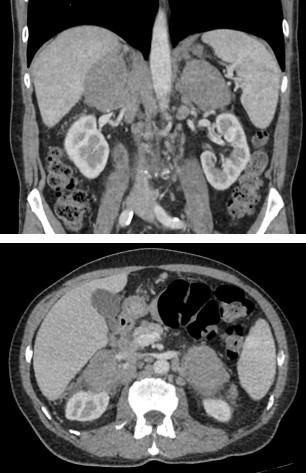
Figure 1: Coronal and axial slices, soft-tissue window, 1.25 mm thickness, contrast-enhanced CT. 

Discussion

Adrenal incidentalomas have been increasingly detected due to improvements in CT resolution, with some studies estimating a prevalence between 1.4% and 7.3%.1,2,3 Some features are suggestive of malignancy namely a diameter greater than 4 cm, irregular margins, inhomogeneous density, tumor calcification and high unenhanced CT attenuation values (>10 HU).4 Among the rarer causes of malignant adrenal lesions is lymphoma, which may be secondary or primary. Secondary adrenal lymphoma is more common (seen in approximately 5% of non-Hodgkin lymphomas5) and occurs when lymphoma spreads from another primary site to the adrenal glands, often presenting with asymmetrical adrenal involvement and associated disseminated disease.

Primary adrenal lymphoma (PAL), on the other hand, is a rare diagnosis with fewer than 200 cases reported in the literature.6 Its definition is not well established, but most authors have defined it as a histologically proven lymphoma in a patient with no prior history of lymphoma elsewhere and, if there is involvement of lymph nodes and/or other organs, then the adrenal lesions are unequivocally dominant.6 Its pathophysiology is poorly understood considering the lack of lymphatics in the adrenal parenchyma,7 with some authors suggesting ectopic hematopoietic tissue6 and others proposing an association with preexisting adrenalitis.8,9 Its most common histological subtype is the diffuse large B-cell lymphoma (78%).10 Demographically, it predominantly affects older men, with a male-to-female ratio of 1.8:1 and a median age of around 60 years old.6,7,8,9,10,11 The clinical presentation is variable, but B-symptoms, pain and fatigue seem to be present in the majority of patients as well as laboratory changes such as elevated LDH and decreased HDL.6,7,8,9,10,11 Treatment usually involves aggressive chemotherapy although the prognosis is poor.6

Its radiological appearance6,12,13 is non-specific and variable, appearing on CT as bilateral (about 70% of cases) solid, large and well-defined adrenal masses that may be hypovascular or have mild to moderate enhancement and that are not associated with calcifications. Similarly to our case, there may be involvement of other structures such as adjacent lymph nodes, emphasizing that for the diagnosis of PAL, the adrenal lesions must be the most prominent ones. On PET-CT these are metabolically active presenting avid glucose uptake.

On MRI, PAL tends to be iso/hypointense in T1 and hyperintense in T2 weighted images and have a variably heterogeneous enhancement pattern.6,12,13 Additionally, given their high cellularity, these also present restricted water diffusion with high signal on DWI. While the usual characteristics of PAL are sufficiently worrisome to warrant further testing, other possible diagnoses must be considered,10 especially in the context of bilaterally occurring adrenal masses such as pheochromocytoma, congenital adrenal hyperplasia, tuberculosis and metastatic disease.

In conclusion, PAL is a rare and aggressive entity affecting mostly older males and that should be considered in the differential diagnosis of bilateral, hypovascular and hypermetabolic bulky adrenal masses.

References

1. Reimondo G, Castellano E, Grosso M, Priotto R, Puglisi S, Pia A, et al. Adrenal incidentalomas are tied to increased risk of diabetes: findings from a prospective study. J Clin Endocrinol Metab. 2020;105:dgz284. [ Links ]

2. Jing Y, Hu J, Luo R, Mao Y, Luo Z, Zhang M, et al. Prevalence and characteristics of adrenal tumors in an unselected screening population : a cross-sectional study. Ann Intern Med. 2022;175:1383-91. [ Links ]

3. Bovio S, Cataldi A, Reimondo G, Sperone P, Novello S, Berruti A, et al. Prevalence of adrenal incidentaloma in a contemporary computerized tomography series. J Endocrinol Invest. 2006;29:298-302. [ Links ]

4. Holalkere N, Kulkarni N. Adrenal Masses. In: Sahani DV. editor. Abdominal imaging. 2nd ed. Philadelphia:Elsevier; 2017. p 885-894. [ Links ]

5. Paling MR, Williamson BR. Adrenal involvement in non-Hodgkin lymphoma. AJR Am J Roentgenol. 1983 Aug;141:303-5. [ Links ]

6. Rashidi A, Fisher SI. Primary adrenal lymphoma: a systematic review. Ann Hematol. 2013 Dec;92:1583-93. [ Links ]

7. Merklin RJ. Suprarenal gland lymphatic drainage. Am J Anat. 1966;119:359-74. [ Links ]

8. Reddy SVB, Prabhudesai S, Gnanasekaran B. Origin of primary adrenal lymphoma and predisposing factors for primary adrenal insufficiency in primary adrenal lymphoma. Indian J Endocrinol Metab. 2011;15:350-1. [ Links ]

9. Ellis RD, Read D. Bilateral adrenal non-Hodgkin’s lymphoma with adrenal insufficiency. Postgrad Med J. 2000;76:508-9. [ Links ]

10. Ozimek A, Diebold J, Linke R, Heyn J, Hallfeldt KKJ, Mussack T. Bilateral primary adrenal non-Hodgkin’s lymphoma - a case report and review of the literature. Eur J Med Res. 2008;13:221-8. [ Links ]

11. Wang Y, Ren Y, Ma L, Li J, Zhu Y, Zhao L, et al. Clinical features of 50 patients with primary adrenal lymphoma. Front Endocrinol (Lausanne). 2020;11:595. [ Links ]

12. Karaosmanoglu AD, Onder O, Leblebici CB, Sokmensuer C, Akata D, Ozmen MN, et al. Cross-sectional imaging features of unusual adrenal lesions: a radiopathological correlation. Abdom Radiol (NY). 2021;46:3974-94. [ Links ]

13. Zhou L, Peng W, Wang C, Liu X, Shen Y, Zhou K. Primary adrenal lymphoma: radiological; pathological, clinical correlation. Eur J Radiol. 2012;81:401-5. [ Links ]

Ethical Disclosures

Financing Support: This work has not received any contribution, grant or scholarship.

5Licence: Creative Commons - Attribution Non-Commercial Use - (CC-BY-NC)

Received: March 30, 2024; Accepted: April 01, 2024

Address Nuno Lupi Manso, Serviço de Radiologia, Hospital CUF Tejo, Av. 24 de Julho 171ª, 1350-352 Lisboa, e-mail: nuno.manso@cuf.pt

Conflicts of interest: The authors have no conflicts of interest to declare.

Confidentiality of data: The authors declare that they have followed the protocols of their work center on the publication of data from patients.

Protection of human and animal subjects: The authors declare that the procedures followed were in accordance with the regulations of the relevant clinical research ethics committee and with those of the Code of Ethics of the World Medical Association (Declaration of Helsinki).

Creative Commons License This is an open-access article distributed under the terms of the Creative Commons Attribution License