


SciELO - Scientific Electronic Library Online

 
vol.38 número2Arteriopatia Cerebral Autossómica Dominante com Infartos Subcorticais e Leucoencefalopatia índice de autoresíndice de assuntosPesquisa de artigos
Home Pagelista alfabética de periódicos  

Serviços Personalizados

Journal

Artigo

Indicadores

Links relacionados

  • Não possue artigos similaresSimilares em SciELO

Compartilhar


Acta Radiológica Portuguesa

versão impressa ISSN 2183-1351versão On-line ISSN 2976-0763

Acta Radiol Port vol.38 no.2 Lisboa maio 2026  Epub 31-Ago-2026

https://doi.org/10.25748/arp.39792 

Imagens de Interesse

Benign Notochordal Tumor: An Embryological Whisper

Tumor Benigno da Notocorda: Um Sussurro Embriológico

1Serviço de Radiologia, Unidade Local de Saúde de Lisboa Ocidental, Lisboa, Portugal

2Serviço de Radiologia, Hospital de Portimão, Unidade Local de Saúde do Algarve, Portimão, Portugal


Abstract

We present the case of a 31-year-old woman with a history of thoracolumbar scoliosis surgically corrected. In the context of lower back pain refractory to conservative treatment, imaging studies were performed, including MRI and CT of the lumbosacral spine and sacroiliac joints. An incidental finding revealed a nodule on the posterior aspect of the S1 vertebral body, with imaging characteristics suggestive of a Benign Notochordal Tumor. No other significant alterations were detected.

Benign notochordal cell tumors are rare lesions derived from Notochordal remnants, often discovered incidentally during imaging. These tumors are most frequently located in the clivus and sacrum, where they exhibit characteristic imaging findings, including mild sclerosis, preservation of trabecular bone, and the absence of aggressive features such as cortical destruction or soft tissue involvement. While Benign notochordal cell tumors are benign and typically indolent, their differentiation from chordomas, which are malignant and aggressive, is essential to prevent overtreatment and ensure proper management.

Keywords: Benign notochordal tumor; Axial skeleton lesions; Notochord remnants.

Resumo

Apresentamos o caso de uma mulher de 31 anos com antecedentes de escoliose toracolombar corrigida cirurgicamente. No contexto de lombalgia refractária ao tratamento conservador, foi realizado um estudo imagiológico com ressonância magnética e tomografia computorizada da coluna lombo-sagrada e articulações sacroilíacas. Como achado incidental, identificou-se um nódulo na vertente posterior do corpo vertebral de S1, com características imagiológicas sugestivas de tumor benigno da notocorda. Não foram detectadas outras alterações significativas.

Os Tumores Benignos da Notocorda são lesões raras derivadas de remanescentes da Notocorda, frequentemente descobertas incidentalmente durante estudos de imagem. Estes tumores localizam-se mais frequentemente no clivus e no sacro, onde apresentam características imagiológicas típicas, incluindo esclerose leve, preservação do padrão trabecular ósseo e ausência de características agressivas, como destruição cortical ou envolvimento dos tecidos moles. Embora os Tumores Benignos da Notocorda sejam benignos e, normalmente, indolentes, a sua diferenciação dos cordomas, que são malignos e agressivos, é essencial para evitar tratamentos excessivos e garantir uma correcta orientação.

Palavras-chave: Tumor benigno da notocorda; Lesões do esqueleto axial; Remanescentes da notocorda.

Case Description

We report the case of a 31-year-old female patient with a history of thoracolumbar scoliosis surgically corrected via thoracolumbar arthrodesis. Over the preceding six months, she experienced occasional low back pain refractory to conservative management with physiotherapy, prompting imaging evaluation of the lumbosacral spine and sacroiliac joints.

MRI (Fig.1) revealed an incidental nodule on the posterior aspect of the S1 vertebral body. The lesion was well-defined, regular, and measured 30 mm, with heterogeneous T2 hyperintensity and T1 hypointensity. No evidence of intralesional fat, surrounding edema, diffusion restriction, or post-contrast enhancement were observed.
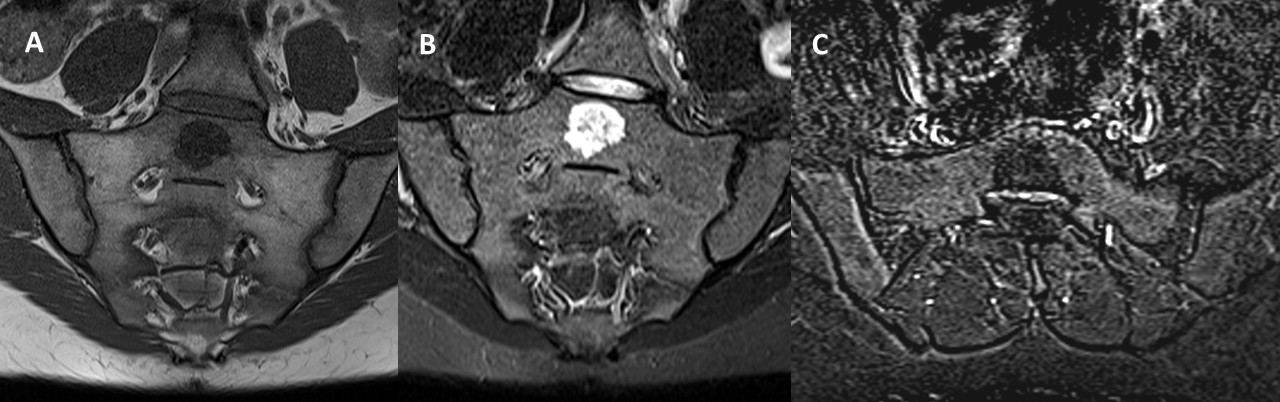
Figure 1: Coronal oblique T1-weighted (A), STIR (B) and axial oblique T1 fat saturated post-contrast subtraction (C) MRI images demonstrate a lesion in the midline of the S1 vertebral body with heterogeneous T2 hyperintensity and T1 hypointensity. No evidence of post-contrast enhancement or surrounding edema was observed. 

Subsequent CT of the lumbosacral spine (Fig.2) demonstrated a mild osteosclerotic lesion with poorly defined margins with preservation of the trabecular bone pattern. No radiological signs of aggressiveness, such as bone destruction or soft tissue involvement were observed.
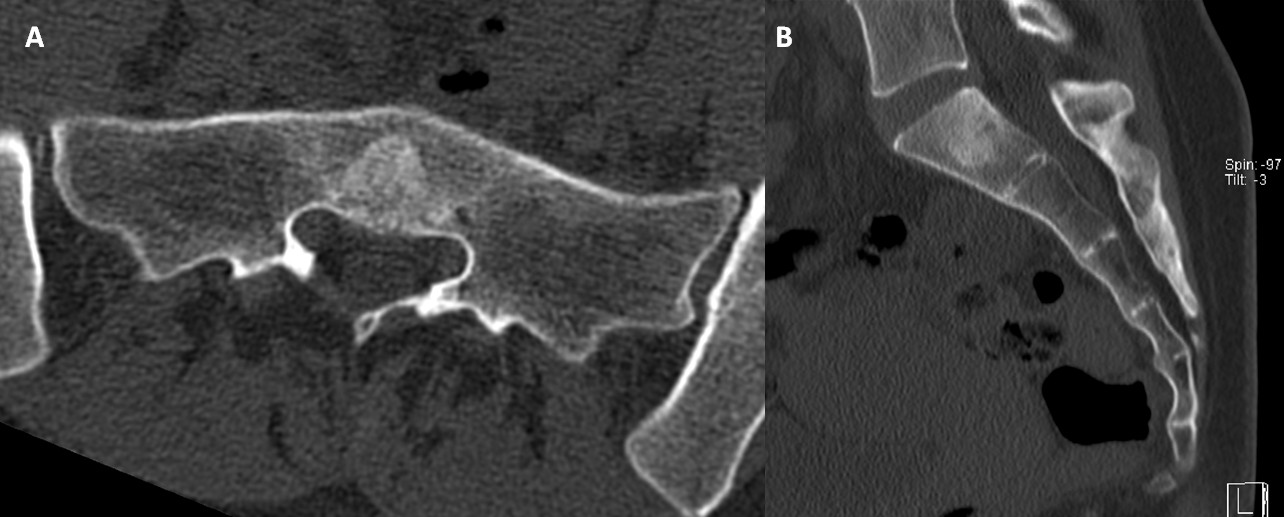
Figure 2: Axial (A) and Sagittal (B) CT images of the lumbosacral spine show a mild osteosclerotic lesion in the midline of the S1 vertebral body, with poorly defined margins and preservation of the trabecular bone pattern. No evidence of bone destruction or soft tissue involvement is observed. 

The sacroiliac joints appeared normal on both MRI and CT, with no additional findings of inflammatory or degenerative changes or complications related to the surgical instrumentation observed.

Given the imaging characteristics, the lesion was categorized as Bone-RADS 3 (indeterminate lesion, requiring imaging follow-up). A decision was made to opt for imaging surveillance rather than an anatomopathological study, considering the absence of aggressive features and the need to assess its stability over time.

Discussion

Benign notochordal cell tumors (BNCTs) are rare lesions derived from remnants of the notochord and are typically discovered incidentally. Although their precise prevalence is unclear, autopsy studies suggest they may occur in up to 20% of the population, highlighting their relatively common presence as incidental findings in asymptomatic individuals.1,2

They are distinct from chordomas, with which they share embryological origins, but differ in clinical behavior and prognosis3,4 BNCTs are most commonly found in the clivus and sacrum, presenting as small, well-defined intraosseous lesions.3 Radiographically, they exhibit mild sclerosis without cortical destruction or soft tissue extension.1,4 MRI findings include low T1 and high T2 signal intensities, with little or no enhancement post-contrast.2,4. In contrast, chordomas are aggressive, osteolytic, and often associated with significant soft tissue masses.(Table 1)3,4
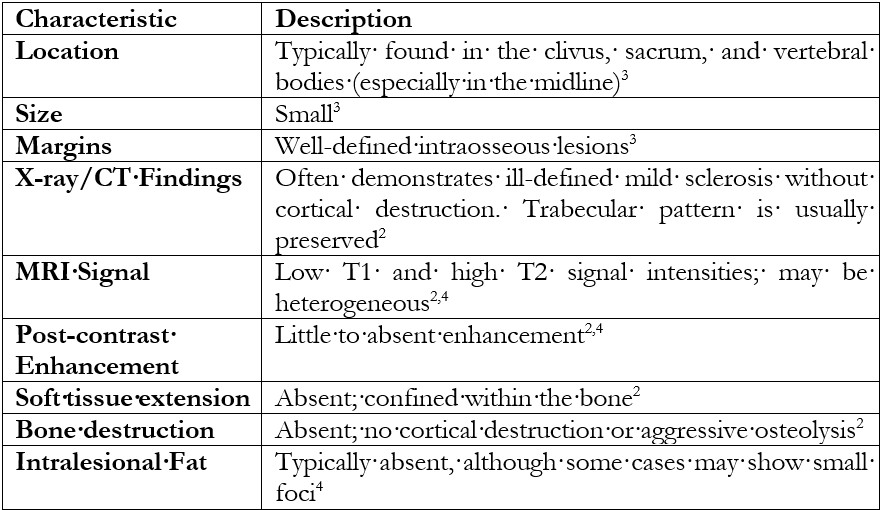
Table 1: Characteristics of Benign Notochordal Cell Tumors 

BNCTs are considered benign lesions that do not require surgical resection.4 However, sporadic cases associated with chordoma have been reported in the literature, and it remains controversial whether these are concomitant lesions or if BNCT may occasionally act as a precursor to chordoma.3,4 That being said, most sources recommend imaging follow-up to confirm their radiological stability and rule out malignant progression, although they do not specify the optimal follow-up interval.3,4,5

References

1. Kreshak JL, Joyce MJ, McCarthy EF, et al. Difficulty distinguishing benign notochordal cell tumor from chordoma further suggests a link between them. Cancer Imaging. 2014;14:4. Doi: 10.1186/1470-7330-14-4. [ Links ]

2. Nishiguchi T, Mochizuki K, Ohsawa M, Inoue T, Kageyama K, Suzuki A, et al. Differentiating benign notochordal cell tumors from chordomas: radiographic features on MRI, CT, and tomography. Am J Roentgenol. 2011;196:644-50. doi:10.2214/ajr.10.4460. [ Links ]

3. Carter JM, Wenger DE, Rose PS, Inwards CY. Atypical notochordal cell tumors. Am J Surg Pathol. 2017;41:39-48. [ Links ]

4. Pasalic D, et al. Benign notochordal cell tumor of the sacrum with atypical imaging features: the value of CT-guided biopsy for diagnosis. Open Neuroimaging J. 2013;7:36-40. doi: 10.2174/1874440001307010036. [ Links ]

5. Yamaguchi T, Suzuki S, Ishiiwa H, Shimizu K, Ueda Y. Benign notochordal cell tumors: a comparative histological study of benign notochordal cell tumors, classic chordomas, and notochordal vestiges of fetal intervertebral discs. Am J Surg Pathol . 2004;28:756-61. Doi: 10.1097/01.pas.0000126058.186. [ Links ]

Ethical Disclosures

Financing Support: This work has not received any contribution, grant or scholarship.

Received: January 04, 2025; Accepted: February 05, 2025

Address Diana da Vinha, Serviço de Radiologia, Unidade Local de Saúde de Lisboa Ocidental, Rua Quirino da Fonseca, 3, 1495-768 Cruz Quebrada-Dafundo, Portugal, e-mail: dianavinha@hotmail.com

Conflicts of interest: The authors have no conflicts of interest to declare.

Confidentiality of data: The authors declare that they have followed the protocols of their work center on the publication of data from patients.

Protection of human and animal subjects: The authors declare that the procedures followed were in accordance with the regulations of the relevant clinical research ethics committee and with those of the Code of Ethics of the World Medical Association (Declaration of Helsinki).

Creative Commons License This is an open-access article distributed under the terms of the Creative Commons Attribution License