




 texto em
  Inglês (pdf)
 Artigo em XML
 Referências do artigo
 Tradução automática
 Enviar este artigo por email
 Citado por SciELO
  Similares em
SciELO
Similares em
SciELO 
 Permalink

1. Introduction
Artificial intelligence (AI) is a central issue nowadays, and it is of global interest to understand how these technological tools impact the present day and will affect our collective future and our professional and personal lives in various domains (Avin, 2024). From a historical perspective, AI has been defined in different ways by different authors. Still, two perspectives should be highlighted: the human-centered approach associated with human behavior and the rationalist approach associated with the mathematical and engineering side of technology (Russell & Norving, 1962/2010). Four capabilities are deemed essential for a machine to be able to reproduce AI: natural language processing, knowledge representation, automated reasoning, and machine learning (Russell & Norving, 1962/2010).
As technology has improved, AI has become embedded in society, and this has led to a necessity not only to look at AI from a technological perspective but also to understand the social and political implications of this tool (Avin, 2024; Lindgren, 2023). This is particularly relevant as - given that this technology reflects real data and human behavior - it tends to reflect social inequalities and reproduce discriminatory outcomes (Lindgren, 2023).
The launch of ChatGPT at the end of 2022 was a milestone in the incorporation of AI into not only people’s daily lives but also in the production of journalistic content (Chin, 2024). This tool presents many opportunities, but there are also concerns about accountability, inclusion, automation, social cohesion, bias, and more (Stahl & Eke, 2024). The incorporation of AI into journalistic processes is seen as convenient, but there are clear concerns about its incorporation in terms of creative processes and protecting jobs (Jaakkola, 2024). Undeniably, AI is changing and challenging journalistic processes (Eldridge et al., 2024).
The purpose of this study is to review the most recent published literature about AI and news, survey existing studies, understand the sub-themes being investigated, and propose future research. This work is a systematic review of the literature and follows a rigorous methodology using the PRISMA method to guide the inclusion and exclusion criteria in filtering the bibliography to be included in the analysis.
This literature review is structured as follows: the first methodological section presents the process of defining the keywords in the code and describes how to determine the literature to be included in the systematic review that gave rise to the 43 articles and chapters under analysis. This is followed by a section summarizing the contributions of this systematic review, highlighting the sub-themes present in the studies, authors, year of publication, scientific journals, methods used, and keywords. The central section of this work is the discussion, where the various studies under analysis are debated through a narrative analysis of the contributions. This work also includes a section that presents the limitations of this study and suggestions for future work. This study culminates in the conclusion that epitomizes the work presented.
2. Methodology
2.1. Exploratory Phase and Keywords
The purpose of this study is to assess what literature has been published in recent years about AI and news. Considering that the aim is to understand the ramifications of this theme to identify opportunities, problems, and prospects for future research, the code was constructed widely. The keywords used were: “news” and “artificial intelligence”/“AI”, giving rise to the code: “news” AND “AI” OR “artificial intelligence”.
The keywords and code were tested on the Scopus platform, and once they had been defined, the various search fields (all fields in the abstract, title, and keywords) were also tested to identify the one that best met the research objective. The title field was selected; that is, the articles should have the search keywords explicit in the title so that they can be considered, helping to ensure that the texts are, in fact, focused on the desired topic.
Two scientific databases were selected to conduct the research: Scopus and Web of Science. These were chosen since they are the platforms where the most reputable scientific journals are indexed.
2.2. Systematic Literatures Review Process
After defining the keywords, codes, and platforms where the literature gathering would be conducted, the systematic literature review process began. The study is governed by the PRISMA method, which is used to filter the bibliography present in this review (Moher et al., 2009).
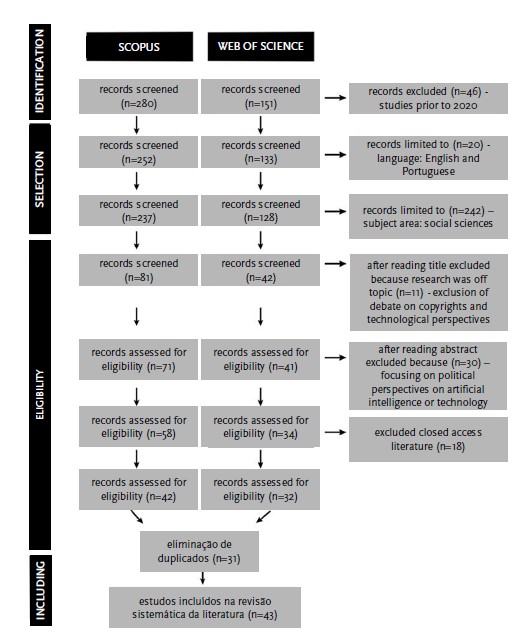
As can be seen in Figure 1, the initial search using the defined code produced 280 results in Scopus and 151 in Web of Science. Once the selection phase began, the year of publication, language, and scientific area were considered. Articles published before 2020 were excluded, as the aim was to analyze recent literature (as of September 2024) that reflects the current technological landscape (n = 252 Scopus; n = 133 Web of Science). The results were also restricted to works published in English or Portuguese (n = 237 Scopus; n = 128 Web of Science) and in the field of social sciences (n = 81 Scopus; n = 42 Web of Science). The eligibility phase involved three stages: reading the titles, reading the abstracts, and excluding closed-access items. In the first phase, after reading the titles, papers were excluded if their titles focused on topics related to AI and copyright or if their approaches were too focused on technology (n = 71 Scopus; n = 41 Web of Science). Next, the abstracts of all the articles still under consideration were analyzed, and studies that addressed political perspectives on AI in a broad sense were excluded, that is, not aimed at the creation, dissemination, and consumption of news or focused on regulation and public policies on technological advances in a broad sense (n = 58 Scopus; n = 34 Web of Science). Among the platforms, 18 publications that were in closed access were excluded. After eliminating duplicates between platforms, 43 publications were included in this systematic literature review.
3. Summary of Contributions
This section lists and summarizes the main characteristics of the studies included in this analysis (Table 1). The use of various methods in the studies reviewed is evident, from more quantitative approaches with techniques such as questionnaires to qualitative approaches, including interviews, content analysis, and observation, among others. The literature is mainly published in scientific journals but also in book chapters and conference proceedings.
Table 1 Summary of contributions
| Paper title | Authors | Year | Journal, proceeding, etc. | Keywords | Method | Sub-theme |
|---|---|---|---|---|---|---|
| “The News Ecosystem in the Age of AI: Evidence from the UAE” | Ahmad et al. | 2023 | Journal of Broadcasting & Electronic Media | - | In-depth qualitative semistructured interviews | Journalists’ adoption of artificial intelligence (AI) |
| “Stop Fake News: AI, Algorithms and Mitigation Actions in India” | Biju & Gayathri | 2023 | The Law, State, and Telecommunications Review | Fake news, algorithms, legal responses, social media, artificial intelligence | Survey of mitigation efforts in select countries | AI, social media and disinformation |
| “The Gendered Lens of AI: Examining News Imagery Across Digital Spaces” | Chen et al. | 2024 | Journal of Computer-Mediated Communication | Artificial intelligence, media logic, gender, visual framing, digital space | Python crawler and manual coding methods | Images generated by AI |
| “Impact of Artificial Intelligence News Source Credibility Identification System on Effectiveness of Media Literacy Education” | Chiang et al. | 2022 | Sustainability | Artificial intelligence, media literacy education, news source credibility, identification, learning effectiveness, learning attitude | Highly efficient message discrimination method | AI and news |
| “AI Journalists and Reduction of Perceived Hostile Media Bias: Replication and Extension Considering News Organization Cues” | Cloudy et al. | 2022 | Technology, Mind, and Behavior | Artificial intelligence, hostile media bias, machine heuristic, defensive processing, value-relevant involvement | Selfreplication/ extension - researchers | News produced by AI |
| “A Perfect Storm: Social Media News, Psychological Biases, and AI” | Datta et al. | 2021 | Digital Threats: Research and Practice | AI, xAI, DLP (data loss prevention), bias, information bias, anchoring, fake news | Information bias anchoring model | AI as a factchecking tool |
| “Artificial Intelligence in News Media: Current Perceptions and Future Outlook” | De Lima Santos & Ceron | 2022 | Journalism and Media | Journalism, artificial intelligence, computer science, machine learning, computer vision, NLP (natural language processing) | Case studies | AI and news dissemination |
| “From Data Journalism to Artificial Intelligence: Challenges Faced by La Nación in Implementing Computer Vision in News Reporting*” | De Lima Santos & Salaverría | 2021 | Palabra Clave | Computer vision, artificial intelligence, machine learning, data journalism, La Nación, technology, journalism, computer science, advanced technology | Newsroom observation | News produced by AI |
| “Imagination, Algorithms and News: Developing AI Literacy for Journalism” | Deuze & Beckett | 2022 | Digital Journalism | - | - | AI literacy |
| “Disintermediation and Disinformation as a Political Strategy: Use of AI to Analyse Fake News as Trump’s Rhetorical Resource on Twitter” | Diez-Gracia et al. | 2023 | Profesional de La Información | Disinformation, disintermediation, fake news, political communication, political strategy, political personalization, artificial intelligence, AI, social networks, discourse analysis, sentiment analysis, Twitter, Donald Trump, deep learning, machine learning, natural language processing | Content analysis | AI as a factchecking tool |
| “Personalization, Echo Chambers, News Literacy, and Algorithmic Literacy: A Qualitative Study of AI-Powered News App Users” | Du | 2023 | Journal of Broadcasting & Electronic Media | - | Qualitative study - computerassisted personal interview | Personalized news |
| “The Theory of Planned Behavior Regarding Artificial Intelligence in Recommendations and Selection of YouTube News Content” | Habes et al. | 2023 | International Conference on Multimedia Computing, Networking and Applications | YouTube, artificial intelligence, Jordan, theory of planned behavior, structural equation modeling | Close-ended structured questionnaires | AI and news dissemination |
| “Consumer Trust in AI - Human News Collaborative Continuum: Preferences and Influencing Factors by News Production Phases” | Heim & ChanOlmsted | 2023 | Journalism and Media | Media research, news trust, Artificial Intelligence, news production, AI trust, usage intention, structural equation modeling | Survey | News produced by AI |
| “Can AI Become Walter Cronkite? Testing the Machine Heuristic, the Hostile Media Effect, and Political News Written by Artificial Intelligence” | Hong et al. | 2024 | Digital Journalism | Artificial intelligence, automated journalism, political communication, journalism studies, credibility, hostile media, communication technology | Experiment with a 3 × 2 factorial design survey | News produced by AI |
| “Understanding the Continuance Intention for Artificial Intelligence News Anchor: Based on the Expectation Confirmation Theory” | Huang & Yu | 2023 | Systems | Meta-human, AI news anchor, continuance intention, expectation confirmation model | Online survey | AI-generated reporters |
| “HearHere: Mitigating Echo Chambers in News Consumption through an AI-based Web System” | Jeon et al. | 2024 | Proceedings of the ACM on Human-Computer Interaction | Echo chamber, political stances, balanced news consumption, information diversity, user experiment | User study | AI to mitigate echo chambers |
| “Scrutinizing Algorithms: Assessing Journalistic Role Performance in Chinese News Media‘s Coverage of Artificial Intelligence” | Ji et al. | 2024 | Journalism Practice | Chinese journalism, role performance, algorithmic imaginaries, artificial intelligence, investigative journalism, critical reporting, journalistic roles, Wechat | Textual analysis | AI and news |
| “Fake News, Technology and Ethics: Can AI and Blockchains Restore Integrity?” | Lacity | 2022 | Journal of Information Technology Teaching Cases | Blockchains, artificial intelligence and neuroscience, fake news, social media, human biases, ICTs and society | Teaching case | AI as a factchecking tool |
| “Unraveling Generative AI in BBC News: Application, Impact, Literacy and Governance” | Lao & You | 2024 | Transforming Government, People, Process, and Policy | Generative AI, AI literacy, AI governance, BBC newspaper | Case study | AI and news |
| “Something That They Never Said: Multimodal Disinformation and Source Vividness in Understanding the Power of AI-Enabled Deepfake News” | J. Lee & Shin | 2021 | Media Psychology | - | Online study | AI, deepfakes and news |
| “Predicting AI News Credibility: Communicative or Social Capital or Both?” | S. Lee et al. | 2020 | Communication Studies | AI news, news credibility, media use, public discussion, social trust, South Korea | Online survey | News produced by AI |
| “Anchoring Voices: The News Anchor’s Voice in China From Television to AI” | Levy- Landesberg & Xuenan Cao | 2024 | Media, Culture & Society | anchor, artificial intelligence (AI), China, datafication, journalism, news, sound, synthetic media, television, voice | Literature review | AI-generated reporters |
| “News Audiences in the Age of Artificial Intelligence: Perceptions and Behaviors of Optimizers, Mainstreamers, and Skeptics” | Lim et al. | 2023 | Journal of Broadcasting & Electronic Media | - | Survey | AI and news dissemination |
| “When Citizens Support AI Policies: The Moderating Roles of AI Efficacy on AI News, Discussion, and Literacy” | Liu et al. | 2024 | Journal of Information Technology & Politics | Artificial intelligence, AI policy, AI regulation, AI efficacy, AI literacy, civic participation, communication mediation model, OSROR | Online survey | AI and news |
| “Breaking News at Machine Speed: The Rise of AI in Real-Time Journalism” | Mahajan et al. | 2024 | Library Progress International | Artificial intelligence, journalism, ethical, risks, creditability | - | AI and news |
| “A Legal Cure for News Choice Overload: Regulating Algorithms and AI With ‘Light Patterns’ to Foster Autonomy and Democracy” | Molitorisz | 2024 | Policy & Internet | AI, algorithms, autonomy, caveat venditor, democracy, digital platforms, news choice overload, regulation | Literature review | AI and news |
| “Robots in the News and Newsrooms: Unpacking Meta- Journalistic Discourse on the Use of Artificial Intelligence in Journalism” | Moran & Shaikh | 2022 | Digital Journalism | Journalism, artificial intelligence, meta-journalistic discourse, normative ideals | Thematic analysis | AI and news |
| “Algorithmic Bias or Algorithmic Reconstruction - A Comparative Analysis Between AI News and Human News” | Nah et al. | 2024 | International Journal of Communication | Artificial intelligence, news framing, news bias, algorithmic bias, automated journalism, gender bias, race/ethnicity bias | Mixed-method content analysis | News produced by AI |
| “Audience Perceptions of AI-Driven News Presenters: A Case of ‘Alice’ in Zimbabwe” | Ndlovu | 2024 | Media, Culture & Society | African newsrooms, AI newsreaders, artificial intelligence, automated journalism, journalism practice, Zimbabwe | Qualitative study - digital ethnography and in-depth interviews | AI-generated reporters |
| “How News Media Frame Data Risks in Their Coverage of Big Data and AI” | Nguyen, 2023 | 2023 | Internet Policy Review | Big data, artificial intelligence, data literacy, news media, critical data studies | Mixed methods design | AI and news |
| “What They’re Not Telling You About ChatGPT’: Exploring the Discourse of AI in UK News Media Headlines” | Roe & Perkins | 2023 | Humanities and Social Sciences Communications | - | Content analysis | AI and news |
| “Jornalismo, Inteligência Artificial e Desinformação: Avaliação Preliminar do Potencial de Utilização de Ferramentas de Geração de Linguagem Natural, a Partir do Modelo GPT, Para Difusão de Notícias Falsas” | Saad & Carneiro dos Santos | 2023 | Estudios Sobre el Mensaje Periodístico | Journalism, misinformation, artificial intelligence, conversational robots | Exploratory interview for functionality assessment | News produced by AI |
| “Framing Discourses in Turkish News Coverage Regarding Artificial Intelligence Technologies Prospects and Challenges” | Sarisakaloğlu | 2021 | Türkiye İletişim Araştırmaları Dergisi | Journalism, news coverage, artificial intelligence, framing, framing analysis | Framing analysis | AI and news |
| “Algorithmic News Versus NonAlgorithmic News: Towards a Principlebased Artificial Intelligence (AI) Theoretical Framework of News Media” | Scheffauer et al. | 2024 | Profesional de La Información | AI, artificial intelligence, algorithmic news, nonalgorithmic news, AI theoretical framework of news media, journalism principles, ethical principles | Comparative analysis - literature analysis | AI and news |
| “In Platforms We Trust? Unlocking the Black Box of News Algorithms through Interpretable AI” | Shin et al. | 2022 | Journal of Broadcasting & Electronic Media | - | Ethnographic methods and off-line experiments | AI and news dissemination |
| “Uneasy Bedfellows: AI in the News, Platform Companies and the Issue of Journalistic Autonomy” | Simon | 2022 | Digital Journalism | AI, news, journalism, platform companies, autonomy, public arena, gatekeeping | - | AI and news |
| “Escape Me If You Can: How AI Reshapes News Organisations’ Dependency on Platform” | Simon | 2023 | Digital Journalism | AI, artificial intelligence, autonomy, isomorphism, journalism, LLM (large language models), news, platforms | Interviews | AI and news |
| “Technology in Society Adoption of AI-driven Personalization in Digital News Platforms: An Integrative Model of Technology Acceptance and Perceived Contingency” | Soo & Zhang | 2022 | Technology in Society | Artificial intelligence, news personalization, technology acceptance model, perceived contingency, engagement | Online survey | AI and news dissemination |
| “Generative Visual AI in News Organizations: Challenges, Opportunities, Perceptions, and Policies” | Thomson et al. | 2024 | Digital Journalism | AI-generated images, AI in newsrooms, generative visual AI, Midjourney, journalistic innovation, text-to-image | Interviews | Images generated by AI |
| “Caring in an Algorithmic World: Ethical Perspectives for Designers and Developers in Building AI Algorithms to Fight Fake News” | Wellner & Mykhailov | 2023 | Science and Engineering Ethics | Ethics of care, fake news, algorithmic design, philosophy of technology, stakeholders, human involvement | Literature review | AI as a factchecking tool |
| “Does Polarizing News Become Less Polarizing When Written by an AI?” | Wischnewski & Krämer | 2024 | Journal of Media Psychology | Polarizing news, automated journalism, credibility perceptions, self-confirmation bias, trustworthy automation | Online survey | News produced by AI |
| “Removing AI’s Sentiment Manipulation of Personalized News Delivery” | Wu et al. | 2022 | Humanities and Social Sciences Communications | - | Sentimentdebiasing method | AI and news dissemination |
| “What Do You Think of AI? Research on the Influence of AI News Anchor Image on Watching Intention” | Xue et al. | 2022 | Behavioral Sciences | AI anchors, news anchors, watch intention, perceived attractiveness, inherent cognition | Two-step experimental method | AI-generated reporters |
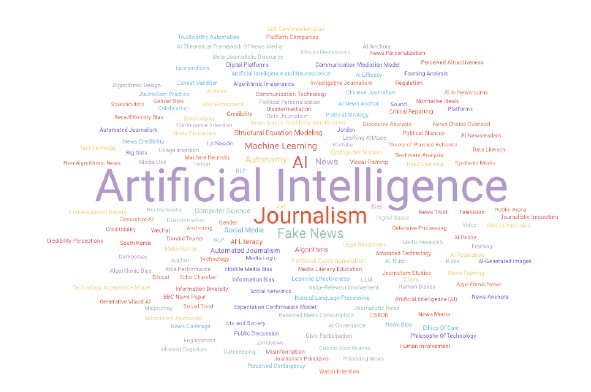
The survey made it possible to gather the different keywords used in the publications. This collection led to the following word cloud (Figure 2), making it clear that the most recurrent concepts and terms among the publications are: “artificial intelligence” (or “AI”), “journalism,” and “fake news”. In total, 169 different terms were identified in the keywords, which allows us to assess the expansion of this research topic.
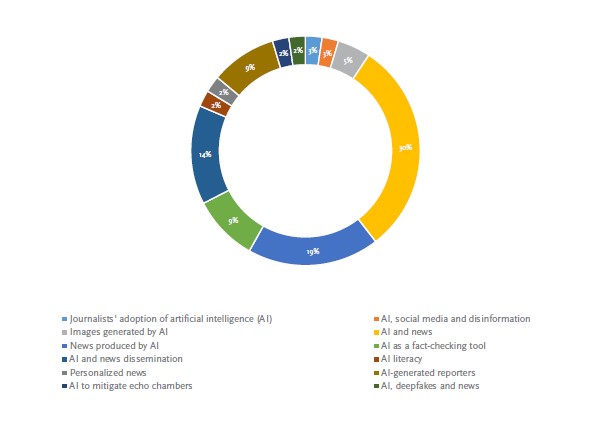
In the 43 studies analyzed, 12 sub-themes were identified (Figure 3). The most frequently addressed in the literature analyzed were AI and news (13), a classification that includes literature that addresses this concept more broadly or explores the relationship between these two components; news produced by AI (eight), AI and news dissemination (six); AI as a fact-checking tool (four) and AI-generated reporters (four). It is possible to identify a wide variety of areas incorporated into the main theme of AI and news.
The publications under analysis were studied to understand where the literature converged and conflicted. The analysis was conducted considering the themes and categories found within the published literature. An analysis of the literature was constructed, which allowed for the creation of a narrative review of the literature that originated in the following discussion chapter.
4. Discussion
AI technologies have been incorporated into various aspects of daily life, and this phenomenon is the subject of debate in multiple spheres, including journalism (Lao & You, 2024). The rise of new technologies has forced newsrooms and news agencies to adapt to new tools and methods (de Lima Santos & Salaverría, 2021). The launch of ChatGPT at the end of 2022 was a milestone in the incorporation of AI in the production of journalistic content. This incorporation can be present in the planning, research, content creation, dissemination, consumption, and monetization phases (Deuze & Beckett, 2022).
The transversal role that AI can play in the news process is evident, establishing itself as an omnipresent force and transforming the very essence of news production (Thomson et al., 2024). All this, as well as generating new opportunities, raises major concerns. The privacy of users’ personal information and the consequences of the impact of personalization is an issue on the agenda (Shin et al., 2022). Similarly, the vulnerability of AI tools to making mistakes generating manipulated, biased, or skewed content is a serious dilemma that can contribute to the proliferation of disinformation and reinforce existing inequalities, values, and beliefs (Deuze & Beckett, 2022; Lim et al., 2023). Consequently, compromising the credibility of news is a risk for individuals’ information processes and for the vitality of democracy (S. Lee et al., 2020; Shin et al., 2022).
Online news consumption - through news apps or social media - is increasingly becoming a widespread news consumption practice, and personalized consumption tailored to each individual is possible through the use of algorithms (Du, 2023; Lim et al., 2023). The rapid pace at which news content is created and disseminated generates an abundance of choices that can be paralyzing for consumers (Molitorisz, 2024). This is also an opportunity for news agencies to “adjust” their strategies to their readers through machine learning models (de Lima Santos & Ceron, 2022).
Despite the obvious advantages that personalization strategies offer users - the recommendation of content that matches individuals’ preferences - it is necessary not to overlook the damage of personalizing content, which can have global effects. AI tools learn from their users and are liable to replicate these personal preferences, recommending potentially biased content or using sentimental recommendations through content that arouses strong negative feelings (Wu et al., 2022). It should be considered that the purpose of algorithms in recommendation processes is to maximize user interaction with content (Du, 2023). In this way, algorithms and AI play an important role in the dissemination of journalistic content on platforms (Habes et al., 2023), promoting user interaction with content by recommending publications using machine learning (de Lima Santos & Ceron, 2022). These technologies raise concerns for users regarding their privacy (Shin et al., 2022). One possible way around this problem is to increase transparency in the use of AI by platforms and give users more control and autonomy over their process of personalizing content recommendations (Soo & Zhang, 2022).
Research exploring news articles generated by AI is noteworthy. Nah et al. (2024) point out that news written by AI differs from news written by reporters in linguistic terms and in its thematic focus. In other words, the study found that the use and choice of words or terms are quite different between AI and journalists, and the approach to the topic also differs, with news written by AI being more focused on the subject and relatively less biased and more positive. Meanwhile, the study by Cloudy et al. (2022) lists both benefits and challenges, addressing the issue of biased journalism and what the role of AI can be to mitigate this problem and promote impartiality in reporting.
In fact, AI is already part of news agencies, even if only slightly in some cases. The use of AI systems for mechanical tasks or the storage and management of databases is part of the day-to-day operations of agencies (Saad & Carneiro dos Santos, 2023). AI can also help to reduce costs and human resources by assisting in the processing of large amounts of information or creating codes (de Lima Santos & Salaverría, 2021). It’s clear that AI is both a resource and a concern: in terms of creativity, AI can either help the process of inspiration or limit creativity; in terms of work, there is concern that AI could lead to the elimination of jobs as well as the creation of new ones (Lao & You, 2024). It is noticeable that, despite the start of the introduction of AI in news agencies, there are mixed feelings about its adoption.
News agencies and journalists recognize that AI and algorithms can bring benefits to the quality of journalism (Ahmad et al., 2023). However, tensions may be found between these two actors. According to Moran and Shaikh (2022), there seems to be a tendency for the industry to focus on the uses of AI in journalism, while journalists continue to be more concerned about the use of these technologies. Journalists are concerned that AI will jeopardize their work and the quality of journalism, just as they fear that readers will not be able to distinguish AI-generated content from content written by journalists (Moran & Shaikh, 2022), with journalists calling for the regulation of AI (Ji et al., 2024).
AI will continue to have a major impact on the journalism industry in the way news is researched, produced, and distributed (Mahajan et al., 2024). However, the literature also points out that the use of AI by agencies can lead to dependencies and the loss of authority to the large technological platforms that provide AI tools (Simon, 2022, 2023).
The literature review identified a new phenomenon associated with news and AI that should be considered in this discussion: AI-generated news reporters. These new AIgenerated anchors can present a realistic human figure or resort to approaches that are more distant from the appearance of humans, such as animated figures or cartoons (Xue et al., 2022). But what makes viewers choose television news presented by AI-generated avatars over human journalists? According to research by Huang and Yu (2023), what makes viewers select this type of newscast in the long term is the degree of trust and the quality of the information (capacity and perception of intelligence) that viewers place in the content and, consequently,, associate with the figure broadcasting it.
Two distinct phenomena can be found in the approach to this technology and the type of figures generated. The work of Levy-Landesberg and Xuenan Cao (2024) explores users’ perceptions of AI avatars modeled after real anchors. In this case, where the AI anchors are modeled/copied from real people, the AI figures benefit from the human capital of the journalists from whom they were modeled because they are reputable and recognized figures. The avatars benefit from that same reputation, also generating greater proximity to the audience (Levy-Landesberg & Xuenan Cao, 2024). This is in line with the study by Huang and Yu (2023), who point out that not only trust but also emotional connections are important in establishing a relationship between viewers and the avatar pivots. On the contrary, Xue et al. (2022) present evidence in their study that non-human figures with anthropomorphic voices are more attractive to audiences. AI-generated anchors evoke conflicting views among audiences, and there is no consensus among viewers about their adoption. While technological innovation can be appealing to some, concerns arise about this type of approach, such as the lack of human emotions or the threat to the jobs of traditional journalists (Ndlovu, 2024).
Technological developments make it very easy to create AI-generated images. This practice is becoming increasingly common, and online platforms that allow ordinary users to create images generated by AI have become widespread. This generalized access raises ethical issues that concern professionals: the growing difficulty in detecting whether images are AI-generated or not, as well as concerns that the use of this type of image in journalism will lead to the promotion of disinformation (Thomson et al., 2024). These concerns are evident in the research of Chen et al. (2024). The representation of gender in AI-generated images becomes an example of the potential ethical problems and reproductions of stereotypes for which these technologies can be responsible. Chen et al. (2024) showed a low representation of women in the images generated by AI. Women tend to be represented according to gender stereotypes in secondary or passive positions, while men tend to be presented in more dominant positions, which highlights the reproduction of gender roles by AI.
Another widespread concern is deepfakes. Deepfakes are audiovisual content manipulated using AI, alterations to videos that, for example, allow content to be manipulated to make it appear that someone said something they didn’t actually say, did a certain action, or took a certain stance that didn’t actually happen (Lacity, 2022). In this way, AI becomes a major force in shaping people’s perceptions of information (Lao & You, 2024). Images and videos have a greater impact on the user than text, which is worrying because this content generates a greater connection with the user, and this also applies to false and disinformation content. That is, this type of content uses visual components, which leads users to interact more quickly with the content and spread it (J. Lee & Shin, 2021).
It is clear that the accelerated evolution of AI poses several risks for access to information, underlying the potential use of AI as a manipulative technology with censurable objectives. However, despite the eminent dangers of these technologies, there can also be advantages to using AI in a preventative dimension.
The responsibility for mitigating fake news or biased content must also be placed on social media platforms, as legislation alone is insufficient (Biju & Gayathri, 2023). Currently, the burden tends to fall on users, who have the task of managing the content they consume on social media and checking its veracity (Datta et al., 2021). AI can be a tool that lessens the burden on the user and helps platforms manage disinformation content by supporting AI solutions to evaluate and categorize large amounts of posts, a job that would be impossible for a person to do (Lacity, 2022). The study of Wellner and Mykhailov (2023) also suggests four good practices to stop fake news through AI tools: (a) detect suspicious sources and limit their distribution; (b) involve various agents in the fight against fake news; (c) allow users to report fake news; (d) keep users updated on the treatment of suspicious news. In addition to detecting fake news, AI tools can also help mitigate echo chambers on social media by promoting more balanced news consumption, leading to a reduction in political polarization (Jeon et al., 2024). In addition to supporting social media users, this type of tool can also be useful for researchers focused on social media phenomena, as the use of AI can help collect, process, and analyze a large agglomeration of data (Diez-Gracia et al., 2023).
However, how is AI perceived by the media and consumers? According to research by Sarisakaloğlu (2021), there is a perception that AI can improve people’s lives, even though potential risks are also pointed out. This is relevant because the discourse that the media promotes about AI has an impact on public opinion and consumer perception of AI (Roe & Perkins, 2023). Likewise, citizens who are more familiar with AI and who consume more news about AI are more willing to reflect on it and support policies aimed at regularizing AI (Liu et al., 2024).
Regarding consumer perceptions of news written by AI, research by Wischnewski and Krämer (2024) demonstrates that the news being written by AI does not make consumers consider it less credible, yet the study by S. Lee et al. (2020) points out that those who consume more news online and on social media are more willing to consider news generated by AI to be credible. In contrast, the study by Hong et al. (2024) highlights that citizens consider news written by human journalists to be more plausible than that written by AI (at least when it comes to political content) and perceive journalists more positively than AI, although they tend to consider AI to be more impartial than journalists. Yet Heim and Chan-Olmsted (2023) conclude that the participants in their study prefer a low level of AI integration in the various stages of the journalistic process, but AI integration can help increase the degree of trust in the news if journalists maintain control of the processes. It is necessary to consider what concerns are raised even by the most favorable consumers or those who prefer news written by AI. Concerns are expressed about their privacy or losing relevant information (Du, 2023). Also, when news is generated by AI, it stands out that it generates less emotional involvement from consumers (Wischnewski & Krämer, 2024).
Considering the panorama presented, it is worth highlighting the importance of media literacy, and more specifically, AI literacy, in mitigating the harmful effects of these technologies. AI literacy includes having knowledge about AI, knowing how to recognize it, being aware of its impact, and knowing how to interact, create, and implement it (Deuze & Beckett, 2022). People who can deal effectively with AI are better able to cope with new developments and updates in technology (Liu et al., 2024). This reinforces the importance of literacy in understanding and interacting with technologies and also in providing knowledge and strategies to interpret messages and their veracity (Chiang et al., 2022). However, managing knowledge about algorithms is an arduous task. The very complexity of algorithms makes it difficult to legislate them, but it is necessary to regulate and implement policies for them in order to guarantee greater transparency of the technologies (Scheffauer et al., 2024). Increasing regulations on AI tools and technologies also make it possible to regulate the ethical standards that the technology must follow (Saad & Carneiro dos Santos, 2023). Consequently, AI technologies should serve the interests of citizens rather than shaping and conditioning individuals, especially in relation to information consumption (Molitorisz, 2024).
5. Limitations
This systematic literature review has the following limitations. First, for this study to be achievable, only two databases were used for analysis. Although two reputable platforms were chosen, we are aware that more work relevant to the topic may be indexed in other scientific databases. The language barrier is evident in this study. As only articles written in English and Portuguese were analyzed, it is understandable that other relevant works may have been overlooked due to linguistic impediments. It should also be noted that the literature analyzed has an international component; that is, all phenomena may not be as strong in all contexts or cultures; for example, the literature on AI-generated pivots is largely of Asian origin.
6. Directions for Future Research
The work presented, and the discussion offered by this study make it possible to propose future research that can be implemented both in an international context and in the Portuguese setting. The algorithmic personalization of social media is something relevant to be analyzed in the context of the distribution of journalistic content. Considering that young people today mainly consume their news online through social media, it is relevant to understand how algorithmic personalization dictates their information diet and compromises their construction of the world around them and their political preferences. Regarding the spread of extremism, we present two proposals: does AI promote extremist content to people who already have far-right or far-left political tendencies? And if so, what implications do these recommendations have for individuals’ political attitudes? Also, with the possibility of creating AI-generated images, how are these images used to reinforce hate speech online, and what effect do these images have on social media discussions? Another interesting topic to investigate would be to understand what leads individuals to share deepfakes when they are aware that it is content manipulated by AI. Finally, it is crucial to carry out an international survey of the regulations that are being applied to AI technologies, assess how these policies affect citizens’ relationship with the technologies, and understand whether these policies impact the quality of democracy.
7. Conclusion
This systematic literature review presents a survey of literature published since 2020 about news and AI to understand how AI technologies are incorporated into journalistic processes and in the production, dissemination, and consumption of news. This work, which includes the analysis of 43 publications extracted from Scopus and Web of Science, allowed us to understand which main sub-themes are being explored on the subject. A total of 12 sub-themes were identified, ranging from studies that aim to understand the relationship between AI and News to AI-generated news, algorithmic recommendation, AI-generated images, deepfakes, AI-generated news anchors, AI as a fact-checking tool, among others.
The analysis made it possible to conduct a narrative discussion of the literature under review, thus highlighting the concepts investigated, problematic issues, and contrasting visions and studies. The integration of AI into journalism represents both an unprecedented opportunity and a substantial risk to the future of news production, distribution, and consumption. While scholars such as Deuze and Beckett (2022) recognize the potential of AI across all phases of journalism (from research to monetization), others express caution about the consequences of implementing these technologies. For instance, concerns about privacy and algorithmic personalization are central in the literature, with Shin et al. (2022) and Du (2023) warning that the tailoring of content may reinforce biases and erode pluralism. Moreover, although studies such as Nah et al. (2024) suggest AI-generated news can be more objective and less emotionally charged, there remains a perceptible trust gap between consumers and AI-produced journalism, particularly in politically sensitive contexts (Hong et al., 2024).
Debates also arise regarding the credibility and emotional engagement of AIgenerated content. While some consumers perceive AI-generated news as credible (Wischnewski & Krämer, 2024), others continue to view human journalism as more trustworthy and empathetic (S. Lee et al., 2020). Furthermore, the emergence of AIgenerated news anchors and visuals introduces new ethical dilemmas, such as deepfakes and gender stereotyping in AI imagery (Chen et al., 2024), raising concerns about misinformation and audience manipulation (Lacity, 2022). Despite these risks, AI also offers mechanisms to counter disinformation, such as automating the detection of fake news and mitigating echo chambers (Jeon et al., 2024; Wellner & Mykhailov, 2023).
What becomes evident is the dual nature of AI in journalism: as both a tool of innovation and a source of disruption. Bridging this divide requires robust regulatory frameworks (Scheffauer et al., 2024), enhanced AI literacy (Deuze & Beckett, 2022; Liu et al., 2024), and a commitment to transparency. Ultimately, AI technologies must be guided by democratic principles to ensure that they inform rather than manipulate. As Molitorisz (2024) notes, AI should serve the interests of citizens, not shape them unknowingly. Journalism’s future, therefore, depends not only on technological progress but also on the ethical and critical frameworks we establish to regulate its use.
In conclusion, this work provides a general approach to this topic, raises concerns, and puts forward proposals for future research. The relationship between AI and the news is a subject that should be worked on thoroughly since, as the study illustrates, the potential social and political consequences of this technology can be very damaging. As such, a commitment to scientific research can make a major contribution to helping policymakers make informed decisions about regulating these technologies.

